
Carl Jung did not simply study the mind.
He widened the meaning of the mind.
For Jung, the psyche was not just a private chamber of memories, wounds, instincts, and repressed desires.
It was a symbolic landscape.
A myth-making system.
A living depth.
A place where dreams, religions, archetypes, visions, synchronicities, fantasies, and cultural symbols all pointed toward something larger than personal psychology.
This is why Jung remains so difficult to place.
Psychiatrist.
Mystic-adjacent thinker.
Founder of analytical psychology.
Student and rival of Freud.
Scholar of myth, alchemy, religion, dreams, symbols, and the unconscious.
One of the few modern thinkers who could move from clinical observation to mandalas, from personality types to flying saucers, from word-association tests to the possibility that the psyche and matter may not be as separate as modern culture assumes.
To some, Jung is one of the great explorers of the inner world.
To others, he is too speculative, too symbolic, too difficult to test.
Both reactions make sense.
Jung’s work survives because it does not sit comfortably inside one category.
He did not only ask what we think.
He asked what thinks through us.
What dreams through us.
What symbols return across cultures.
What patterns emerge when the conscious mind stops pretending it is the whole story.
That is the Jung problem.
The modern world wants the mind to be private, measurable, and contained.
Jung kept finding doors.

Overview
Carl Gustav Jung was a Swiss psychiatrist and psychologist best known as the founder of analytical psychology.
His work introduced or developed several ideas that still shape psychology, spirituality, literature, religion, film, personality theory, myth studies, and the modern conversation around consciousness.
The collective unconscious.
Archetypes.
The Shadow.
The Persona.
The Anima and Animus.
The Self.
Individuation.
Synchronicity.
Psychological types.
Complexes.
Active imagination.
Jung began inside the early twentieth-century psychiatric world, but his work moved far beyond conventional clinical categories.
He studied dreams.
Myths.
Alchemy.
Religion.
Gnosticism.
Eastern thought.
Fairy tales.
Visions.
Symbols.
UFOs.
He treated these not as meaningless fantasies, but as symbolic expressions of the psyche.
That is what made him influential.
And dangerous.
Jung’s central claim was not simply that people have unconscious thoughts.
Freud had already made the unconscious culturally explosive.
Jung’s deeper move was to suggest that the unconscious is not only personal.
It may contain shared symbolic patterns that shape human imagination across time.
The psyche, in Jung’s view, is not merely a storage room.
It is an image-making reality.
A symbolic intelligence.
A hidden architecture beneath culture.

Origins and Background
Carl Jung was born in 1875 in Kesswil, Switzerland.
His father was a Swiss Reformed pastor. His family background placed him close to religion, doctrine, spiritual conflict, and the question of belief from the beginning.
This matters.
Jung did not approach religion only as a system of ideas.
He approached it as a psychological force.
A symbolic language.
A structure through which the psyche expresses meaning, fear, transformation, and wholeness.
As a young man, Jung studied medicine and became a psychiatrist. He worked at the Burghölzli psychiatric hospital in Zurich under Eugen Bleuler, one of the major figures in European psychiatry.
There, Jung became known for his work with word-association tests.
Patients were given stimulus words and asked to respond. Delays, slips, emotional reactions, and unusual associations revealed hidden clusters of meaning.
Jung called these emotionally charged clusters complexes.
That early work is important because it shows Jung was not only a mythic or mystical thinker.
He began with clinical observation.
The strange movements of the unconscious were not abstract to him.
They appeared in speech.
Reaction time.
Dreams.
Symptoms.
Images.
Emotional disturbance.
He later came into close contact with Sigmund Freud, whose psychoanalysis had already placed the unconscious at the center of modern psychology.
At first, Jung was seen by Freud as a successor, even as a kind of crown prince of psychoanalysis.
But the relationship broke apart.
Their disagreement was not only personal.
It was metaphysical.
Freud placed sexuality, repression, and personal history near the center of psychic life.
Jung thought that was too narrow.
He believed the psyche contained religious, symbolic, mythic, and transpersonal dimensions that could not be reduced to sexual conflict or personal biography alone.
That split created Jung’s independent path.
Analytical psychology.

What It’s Known For
Jung is known for several major contributions.
The collective unconscious
The collective unconscious is one of Jung’s most famous and most controversial ideas.
The personal unconscious contains memories, experiences, repressions, forgotten material, and emotional complexes specific to the individual.
The collective unconscious points deeper.
It refers to patterns, images, symbolic structures, and psychic tendencies that seem to recur across cultures and history.
Mother.
Hero.
Trickster.
Wise old man.
Shadow.
Divine child.
Underworld journey.
World tree.
Mandala.
Flood.
Dragon.
Death and rebirth.
Jung did not argue that every culture copied these symbols from one another.
He argued that the human psyche may generate recurring symbolic forms because human beings share deep psychological structures.
This is the core.
The collective unconscious does not mean everyone secretly knows the same stories.
It means the human psyche may have inherited forms of imagination.
Patterns of meaning.
Archetypal potentials.
This made mythology psychologically alive again.
Myth was not merely false history.
It was psychic truth in symbolic form.
Archetypes
Archetypes are the organizing patterns of the collective unconscious.
They are not fixed images.
They are not simple characters.
They are not memes.
An archetype is more like a deep pattern that can express itself through many images.
The Mother may appear as nurturing, devouring, protective, terrifying, earthly, divine, or cosmic.
The Hero may appear as warrior, seeker, redeemer, explorer, survivor, rebel, or fool.
The Shadow may appear as monster, enemy, stranger, demon, criminal, rival, or hidden double.
The Self may appear as mandala, divine child, wise figure, sacred center, stone, city, garden, or symbol of wholeness.
The images change.
The pattern persists.
That is Jung’s power.
He gave modern culture a way to understand why certain stories keep returning.
Why ancient myths still feel psychologically true.
Why dreams can feel mythic.
Why films, religions, fantasies, and personal crises often arrange themselves around familiar symbolic structures.
The Shadow
The Shadow may be Jung’s most culturally durable idea.
It refers to the parts of the self that are rejected, denied, disowned, feared, or pushed out of conscious identity.
The Shadow is not simply evil.
It is whatever the conscious personality refuses to recognize.
Aggression.
Desire.
Weakness.
Creativity.
Jealousy.
Power.
Fear.
Instinct.
Shame.
Unlived life.
A person who believes they are purely rational may carry a Shadow full of emotion.
A person who believes they are purely good may carry a Shadow full of cruelty.
A culture that imagines itself enlightened may project its Shadow onto outsiders, enemies, criminals, heretics, or monsters.
That is why Jung matters far beyond therapy.
The Shadow is personal.
But it is also collective.
Societies have shadows.
Movements have shadows.
Religions have shadows.
Technologies have shadows.
Civilizations have shadows.
The things we refuse to see do not disappear.
They return disguised.
Individuation
Individuation is Jung’s term for the process of becoming psychologically whole.
Not perfect.
Whole.
It is not self-improvement in the modern productivity sense.
It is not ego optimization.
It is the long, often painful integration of conscious and unconscious life.
The person meets the Shadow.
Recognizes the Persona as a mask.
Encounters inner contraries.
Moves through symbolic conflict.
Finds a deeper center beyond the ego.
This deeper center is what Jung called the Self.
The Self is not the same as the ego.
The ego says “I.”
The Self is the larger pattern of the psyche.
The totality.
The organizing center.
The hidden wholeness.
In Jungian language, the goal is not to destroy the ego.
It is to put the ego in right relation to the deeper psyche.
That idea still matters because modern culture often confuses identity with wholeness.
Jung would say the identity we perform is only one layer.
The deeper question is what remains unconscious beneath it.
Synchronicity
Synchronicity is Jung’s term for meaningful coincidence.
Not coincidence in the casual sense.
Not simply “something weird happened.”
Synchronicity refers to events that are not causally connected in any obvious way, but are linked by meaning for the person experiencing them.
A dream image appears in waking life.
A symbol repeats at a decisive psychological moment.
An outer event mirrors an inner state.
The psyche and the world seem briefly to rhyme.
This idea is often misused.
Online culture can turn synchronicity into confirmation bias, magical thinking, or a way to make every coincidence feel cosmic.
But Jung’s stronger version is more careful.
He was not saying every coincidence is a message.
He was asking whether meaning may sometimes appear in patterns that cannot be explained by ordinary causality alone.
This became especially interesting through his dialogue with physicist Wolfgang Pauli.
Together, Jung and Pauli explored whether psyche and matter may be connected by deeper ordering principles.
That question remains unresolved.
But it is one of the reasons Jung still matters to people interested in consciousness, physics, symbolism, and the structure of reality.

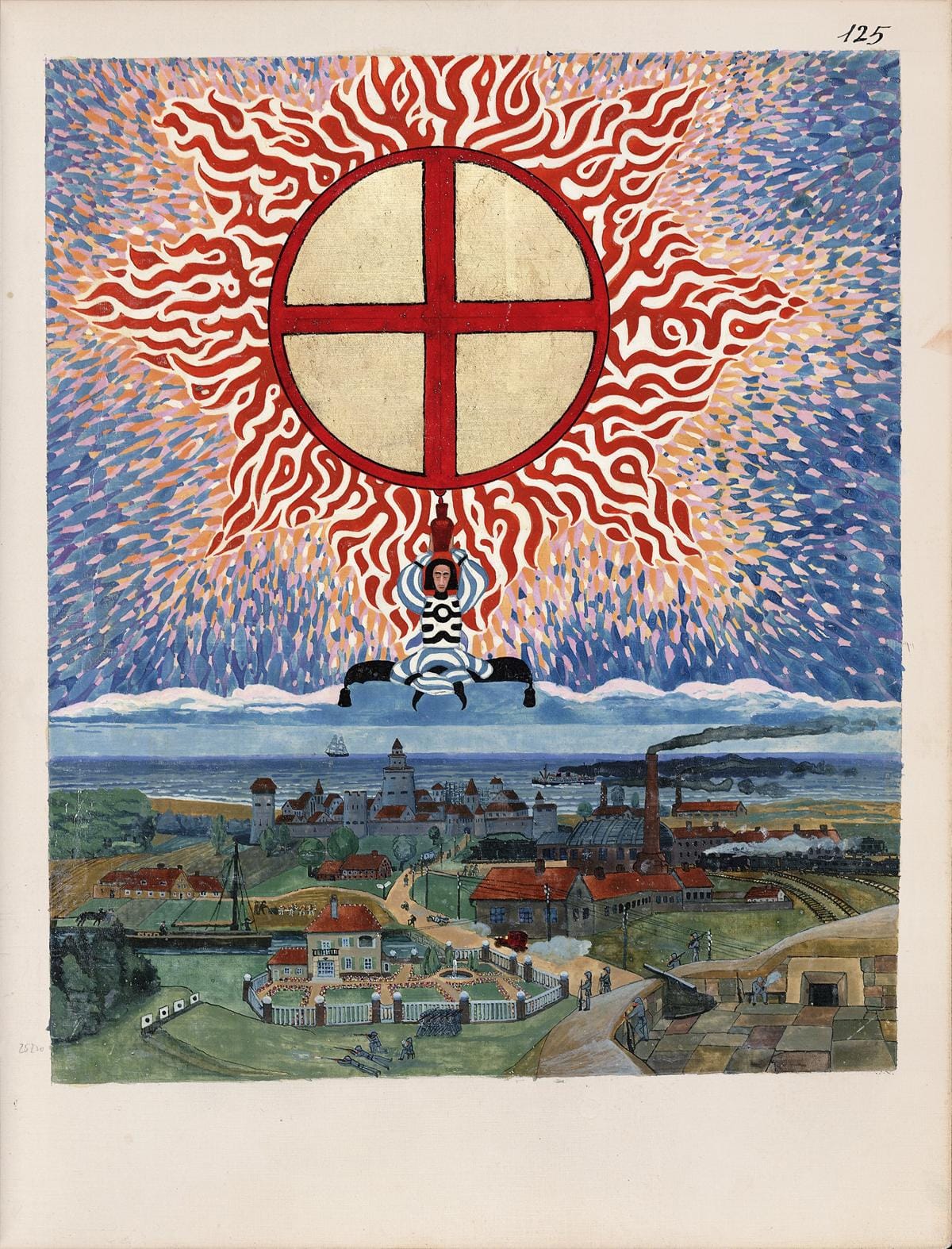
The Red Book
Jung’s Red Book, also known as Liber Novus, is one of the strangest documents in modern psychology.
After his break with Freud, Jung entered a period of intense self-exploration. He recorded dreams, visions, fantasies, dialogues, and symbolic images.
He did not treat these as random imagination.
He treated them as encounters with the unconscious.
Over many years, he shaped this material into an illuminated manuscript, filled with calligraphy and elaborate images.
For decades, the book remained private.
When it was finally published in 2009, readers could see how central Jung’s inner work had been to the development of his later ideas.
The Red Book changed the public picture of Jung.
It revealed that his system did not come only from theory.
It came from direct confrontation with the image-making depths of the psyche.
That is why it still feels dangerous.
It blurs the line between science, art, dream, revelation, pathology, and symbolic initiation.
The Core Idea or Signal
The core signal of Carl Jung is this:
The unconscious is not empty darkness. It is a symbolic reality beneath the surface of the self.
That is the central shift.
The modern person often assumes consciousness is the command center.
The rational ego explains, chooses, names, controls, and interprets.
Jung challenges that.
For Jung, the ego is not the whole mind.
It is a small island inside a much larger sea.
Dreams are not meaningless static.
Myths are not dead stories.
Symbols are not decorative.
Religious images are not merely outdated beliefs.
Synchronicities are not automatically proof, but they may reveal the psyche’s hunger for meaning.
The Shadow is not somewhere else.
The unknown is not only outside the human being.
It is inside the human being.
And sometimes the inner unknown may shape what we see outside.
This is why Jung belongs in The Galactic Mind archive.
He changes the location of mystery.
The unknown is not only in the sky, ancient ruins, classified files, or distant stars.
It is also in the symbolic depths of the mind interpreting all of them.
Perspectives and Interpretations
Jung can be interpreted through several lenses.
The clinical psychologist view
In the clinical view, Jung is one of the great founders of depth psychology.
He developed analytical psychology as a system for understanding the unconscious, dreams, complexes, symbolic development, and the process of individuation.
His early work at Burghölzli placed him inside serious psychiatric research.
His word-association experiments helped reveal that emotional complexes could influence behavior outside conscious awareness.
From this perspective, Jung matters because he expanded therapy beyond symptom reduction.
He saw psychological life as a process of meaning, integration, and transformation.
A neurosis was not only a malfunction.
It could also be a signal.
A symptom might point toward what the conscious personality had refused to face.
The myth and symbol view
In the mythological view, Jung is one of the major modern interpreters of symbolic life.
He treated myths, dreams, religions, alchemical texts, and fairy tales as expressions of deep psychic patterns.
This made him deeply influential in literature, film, comparative religion, art, and storytelling.
The Jungian lens asks:
What archetype is moving here?
What shadow is being projected?
What unconscious pattern is trying to enter consciousness?
What symbol of wholeness appears at the center of chaos?
This is why Jung still haunts modern culture.
Superhero stories.
Fantasy epics.
Dream sequences.
Villain arcs.
Hero journeys.
Spiritual awakenings.
Alien encounters.
AI fears.
Apocalypse narratives.
Many of these can be read through Jungian patterns, whether the creator intended it or not.
The spiritual view
Spiritually, Jung offers a bridge between modern psychology and religious experience.
He did not reduce religion to nonsense.
He saw religious symbols as psychologically real.
Not always historically literal.
Not always doctrinally true.
But real as expressions of psychic depth.
This makes Jung valuable for people who cannot return to traditional religion, but cannot accept a purely flattened materialism either.
He gives language for the sacred without requiring literal belief.
The divine becomes psychologically active.
The soul becomes a field of symbols.
Transformation becomes inner initiation.
But this is also where caution is needed.
Jung is not a replacement religion.
And Jungian language can become vague if it is used to make every symbol mean everything.
The strongest Jung is disciplined.
Symbolic, but not sloppy.
Open to mystery, but not careless.
The consciousness and reality view
For The Galactic Mind, this may be Jung’s most important layer.
Jung did not only study private psychology.
He questioned the boundary between psyche and world.
Synchronicity opened the possibility that meaning might appear in the relationship between inner and outer events.
His work with Wolfgang Pauli pushed this further.
Pauli came from physics. Jung came from psychology.
Together, they explored whether mind and matter might be two expressions of a deeper order.
This is not a settled theory.
But it is a profound question.
What if the psyche is not sealed inside the skull?
What if symbols are not merely subjective decoration?
What if reality and mind are entangled through meaning in ways that modern causality cannot easily describe?
Jung did not prove this.
But he made the question intellectually alive.
The UFO and modern myth view
Jung’s work on flying saucers is especially relevant to The Galactic Mind.
In Flying Saucers: A Modern Myth of Things Seen in the Skies, Jung examined UFOs not primarily as engineering problems, but as psychic and cultural symbols.
He noticed that saucers often appeared as circular forms.
Mandala-like forms.
Symbols of wholeness.
He argued that in a period of technological anxiety, spiritual disorientation, nuclear fear, and collective uncertainty, the psyche might project images of order and salvation into the sky.
This does not mean Jung simply dismissed UFOs as fake.
His position was more careful, and often misunderstood.
He was interested in the psychological reality of the phenomenon regardless of its physical status.
Even if something physical were being seen, the human meaning around it would still matter.
That insight remains important.
The UAP question is never only about objects.
It is also about symbols.
Fear.
Hope.
Projection.
Salvation.
Threat.
Messiah technology.
Non-human mirrors.
The sky becomes a screen for the psyche.
Jung understood that before most of the modern conversation existed.

The critic’s view
Critics of Jung argue that many of his ideas are difficult to test.
The collective unconscious can be too broad.
Archetypes can become interpretive catchalls.
Synchronicity can slide into magical thinking.
Dream interpretation can become subjective.
His use of myth, religion, gender, and cultural comparison can feel dated or problematic through modern eyes.
His remarks and actions during the 1930s, especially concerning Jews and Nazi-era psychology, remain a serious part of his contested legacy.
A grounded Dossier cannot ignore this.
Jung was not an untouchable sage.
He was a brilliant and flawed figure whose work must be read with discernment.
His concepts can illuminate.
They can also be overused, misapplied, romanticized, or turned into vague spiritual vocabulary.
The task is not to worship Jung.
It is to understand the signal and the shadow.
Strengths and Limitations
Jung’s greatest strength was that he took symbolic life seriously.
He did not treat dreams as meaningless noise.
He did not treat religion as mere error.
He did not treat myth as primitive fiction.
He did not treat fantasy as automatically worthless.
He saw that human beings live through images.
That is still true.
A civilization is not only made of laws, markets, technologies, and institutions.
It is made of symbols.
Stories.
Fears.
Archetypes.
God-images.
Monsters.
Heroes.
Apocalypses.
Shadows.
Hidden patterns.
Jung gave modern culture a language for those depths.
His second strength was integration.
He tried to connect the rational and irrational, science and myth, clinic and symbol, personal trauma and collective pattern, ancient religion and modern crisis.
That is why he remains so useful for The Galactic Mind.
His work does not stay inside one box.
The limitations are equally real.
Jung’s ideas can become too elastic.
If every image is archetypal, the word can lose precision.
If every coincidence is synchronicity, discernment collapses.
If every dream is treated as profound, analysis becomes projection.
If every myth is read through one universal pattern, cultural differences can be flattened.
Jung’s gendered concepts, especially Anima and Animus, need careful handling today.
His writings also contain historically problematic statements about race, culture, and Jews, and his role during the 1930s remains debated and ethically serious.
A useful ledger looks like this:
What is documented:
Carl Jung was a Swiss psychiatrist and psychologist who founded analytical psychology and developed influential concepts including complexes, archetypes, the collective unconscious, psychological types, individuation, the Shadow, and synchronicity.
What is claimed:
Jung argued that the unconscious contains both personal material and deeper collective patterns expressed through myth, dream, religion, symbol, fantasy, and culture.
What is interpreted:
Supporters see Jung as one of the most important explorers of the psyche, symbolic life, and the bridge between psychology and spirituality. Critics see his work as speculative, difficult to test, culturally dated, and vulnerable to overinterpretation.
What remains unresolved:
Whether archetypes and the collective unconscious describe inherited psychic structures, recurring cultural patterns, symbolic habits, evolutionary tendencies, or a metaphorical framework that remains powerful even if not literally proven.
What is speculative:
Claims that Jung proved synchronicity as a physical principle, proved a universal unconscious in a scientific sense, solved mythology, or provided a final map of the psyche.
Jung did not solve the mind.
He made the mind bigger.
Broader Implications
Jung matters now because modern culture is drowning in symbols while pretending it is purely rational.
We live in myths.
But we often do not recognize them as myths.
Technology has myths.
AI has myths.
UAP disclosure has myths.
Politics has myths.
Markets have myths.
Fame has myths.
Apocalypse has myths.
The self has myths.
The future has myths.
Jung’s work helps us ask:
What archetype is being activated?
What Shadow is being projected?
What fear is being disguised as certainty?
What salvation image is being placed onto technology?
What unconscious religious pattern is hiding inside secular language?
This is deeply relevant now.
AI is not only a technical development. It is also an archetypal event.
The machine that speaks.
The artificial mind.
The created intelligence.
The golem.
The oracle.
The double.
The god we build.
UAP are not only aerospace questions. They are also symbolic events.
Visitors from above.
Judgment from the sky.
Messengers.
Watchers.
Angels translated into technology.
Threats and saviors wearing the same mask.
Ancient mysteries are not only archaeological puzzles. They are also memory structures.
Lost golden ages.
Forgotten ancestors.
Buried knowledge.
Civilization amnesia.
The longing for origins.
Jung does not make all of these claims true.
He makes their symbolic power visible.
That is the broader implication.
Humanity does not simply encounter the unknown.
Humanity dreams into the unknown.
And sometimes the dream becomes part of the event.
The Reality Signal
What this subject represents
Carl Jung represents the return of depth to the modern mind.
He represents the refusal to reduce human beings to rational surfaces.
He represents the idea that symbols are not decorations, dreams are not trash, myths are not dead, and the unconscious is not a psychological basement.
He also represents the danger of depth.
Because when a thinker opens symbolic doors, people can mistake interpretation for proof.
Jung’s value is not that he gives us certainty.
It is that he reveals how much of human reality is shaped below the line of conscious explanation.
What reality frame it challenges
Jung challenges the frame that reality is only what the conscious ego can measure, explain, and control.
He challenges the frame that mythology is false because it is symbolic.
He challenges the frame that religion disappears when belief weakens.
He challenges the frame that modern people are free from ancient patterns.
Most of all, he challenges the idea that the self is transparent to itself.
For Jung, the conscious mind is not master of the house.
It is one room in a much older structure.
Why it matters now
Jung matters now because the world has become psychologically symbolic at planetary scale.
Millions of people interpret reality through images, screens, myths, narratives, conspiracy structures, spiritual frameworks, technological promises, and apocalypse expectations.
The collective unconscious, whether taken literally or metaphorically, feels newly relevant because culture now behaves like a shared dream moving at the speed of the feed.
Symbols spread instantly.
Archetypes mutate.
Shadows project globally.
Myths become movements.
Images become identities.
Jung gives us one of the best languages for noticing what is happening beneath the surface.
Not because every Jungian interpretation is true.
Because ignoring symbolic life leaves us blind.
What remains unresolved
The unresolved ledger is where Jung’s signal remains alive.
What is established:
Jung founded analytical psychology and became one of the most influential figures in the modern study of the unconscious, dreams, symbols, personality, religion, and myth.
What is claimed:
He claimed that the psyche contains deeper collective structures expressed through archetypes, that individuation is the movement toward psychic wholeness, and that meaningful coincidences may point toward a relationship between psyche and world not reducible to ordinary causality.
What remains unresolved:
Whether Jung’s deepest ideas should be understood as literal psychological structures, symbolic metaphors, clinical tools, cultural maps, spiritual insights, or speculative metaphysics.
Why it still matters:
Because the modern world may be more symbol-driven than ever, and Jung remains one of the few thinkers who gave us a serious vocabulary for the invisible images shaping human behavior.

The Galactic Mind Perspective
Carl Jung belongs in The Galactic Mind archive because he understood something modern culture still struggles to admit:
Reality is not only made of facts.
It is also made of meanings.
This does not mean facts do not matter.
They do.
It means facts enter human life through interpretation.
Through symbols.
Through fear.
Through dreams.
Through narratives.
Through inherited patterns we barely understand.
A person does not simply see the world.
A civilization does not simply see the world.
It sees through a psyche.
That is Jung’s enduring relevance.
He forces us to ask what hidden image is shaping the question before we even begin answering it.
When we ask about UAP, are we asking about craft, or are we also asking about salvation, threat, and non-human mirrors?
When we ask about AI, are we asking about software, or are we also awakening the archetype of the artificial being, the created mind, the double, the oracle?
When we ask about ancient mysteries, are we asking about lost civilizations, or are we also searching for a lost part of ourselves?
When we ask about consciousness, are we studying the brain, or are we confronting the strange fact that the thing doing the studying is itself partly unknown?
Jung does not answer these questions cleanly.
That is why he matters.
He tells us the unconscious is not gone just because we built machines.
The mythic is not gone just because we use scientific language.
The sacred is not gone just because we abandoned the church.
The Shadow is not gone just because we claim virtue.
For The Galactic Mind, Jung is not a final authority.
He is a warning.
A guide.
A doorway.
A reminder that the unknown is not only beyond humanity.
It is also beneath humanity.
And maybe the greatest mysteries survive because they meet us from both directions at once.
Open Thread
Carl Jung leaves us with one of the most uncomfortable questions in modern thought.
What if the world we think we are interpreting is also interpreting us?
What if symbols are not passive?
What if dreams are not meaningless?
What if the things we dismiss as fantasy are sometimes messages from the deeper architecture of the psyche?
What if civilization itself has a Shadow?
What if the unknown outside us becomes most powerful when it finds the unknown inside us?
That is the Jungian door.
Not a doctrine.
Not a religion.
Not proof of every mystical claim.
A door into depth.
And once that door opens, the modern self becomes harder to believe in.
The ego is not the whole story.
The rational mind is not the whole map.
The symbols keep returning.
The dreams keep speaking.
The Shadow keeps following.
And beneath the surface of every age, the old patterns wait for new masks.
What do you think? Drop your thoughts in the comments ...
Sources / Receipts
- Britannica: Carl Jung biography
- International Association for Analytical Psychology: Carl Gustav Jung biography
- C. G. Jung, Psychological Types
- C. G. Jung, The Archetypes and the Collective Unconscious
- C. G. Jung, Man and His Symbols
- C. G. Jung, Memories, Dreams, Reflections
- C. G. Jung, The Red Book: Liber Novus
- C. G. Jung, Synchronicity: An Acausal Connecting Principle
- C. G. Jung, Flying Saucers: A Modern Myth of Things Seen in the Skies
- C. G. Jung and Wolfgang Pauli, writings and correspondence on psyche, matter, and synchronicity
- Philemon Foundation and W. W. Norton materials on The Red Book


Discussion