
1950s “vanishing lights” tied to nukes and UFO reports. Artifact or anomaly?
Quick Take: Two new peer-reviewed papers reanalyze 1950s Palomar sky plates and report statistical links between brief “transient” lights, above-ground nuclear tests, and spikes in historical UFO reports. Critics say the signals can still be plate flaws or other mundane effects. Current read: medium curiosity value, weak extraordinary claim until independent plate forensics land. Live Science
A 70-year-old mystery just resurfaced in mainstream science coverage.
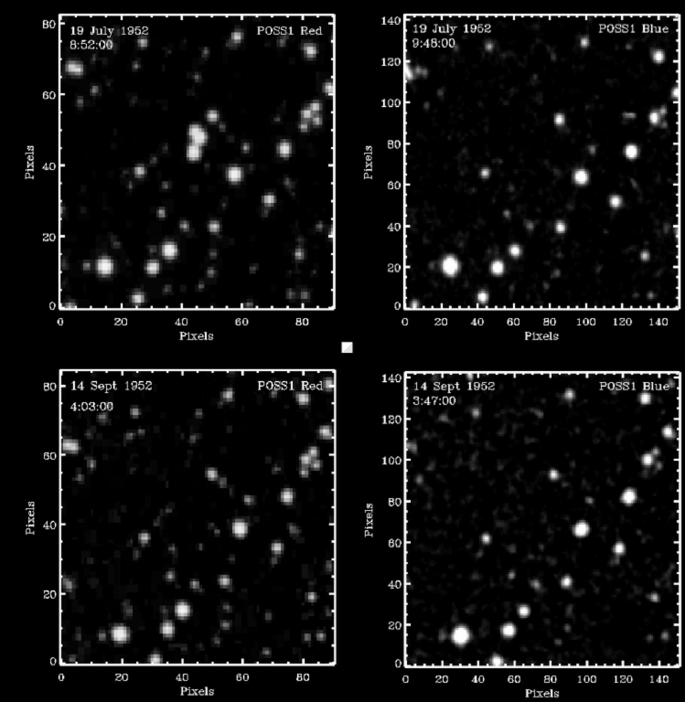
Researchers combed through thousands of vintage Palomar Observatory images and found star-like flashes that appear on one plate, then vanish.
They now argue those “transients” cluster around dates of Cold War nuclear tests and rise with same-day UFO report counts, a pattern reviving the idea of pre-Sputnik artificial objects in orbit. Others urge caution.
“Intriguing statistics from rough data is not the same thing as a clean detection.”
What is being claimed
Authors report that brief, point-like transients in 1949–1957 sky plates are more likely within a day of above-ground nuclear tests, and that nights with more UFO reports also show more transients. A companion analysis says some events appear in aligned groups and are rarer inside Earth’s umbral shadow, hinting at sunlight glints from reflective objects in high orbit.
- 45% higher chance of transients within ±1 day of a nuclear test.
- About 8.5% more transients per additional UFO report on a given date.
- Aligned, point-like sources and an umbra effect are argued to be hard to explain with simple artifacts. go.redirectingat.com
What we actually know so far
- The stats paper is peer-reviewed in Scientific Reports (Oct 20, 2025). It quantifies the nuclear-test and UFO-report associations using the POSS-I dataset. go.redirectingat.com
- A companion paper in Publications of the Astronomical Society of the Pacific analyzes alignments and the umbra drop-off, proposing reflective objects as one hypothesis. Bibliographic records and preprint versions exist even where full text is gated. ADS+1
- Coverage this week highlights both the claims and the skepticism: multiple astronomers say defects, dust, scratches, or digitization artifacts on old plates can mimic “aligned points,” and better, plate-level forensics are needed. Live Science
- Prior related work documents a “bright triple transient” that vanished within an hour, showing why the topic persists. OUP Academic
Red flags and green flags
Red flags
- Heavy reliance on digitized copies of mid-century plates rather than direct microscope inspection of originals. Known to create spurious aligned specks. Live Science
- Provenance noise in historical UFO databases can bias correlations. Several experts caution the data quality is uneven. Live Science
- Methodological debates and replication attempts note that alternative null models may erase the reported significance. Metabunk
Green flags
- Peer-reviewed statistical treatment rather than a single anecdote; clear, testable claims. go.redirectingat.com
- Specific physical predictions (e.g., umbra deficit if sunlight glints are involved) that can be re-tested on other plate archives. ADS
- A growing paper trail linking multiple historical transient cases worth re-examining. OUP Academic
How this looks right now: medium curiosity, weak extraordinary signal.
The stats are interesting and the umbra prediction is at least falsifiable, which is better than vibes. But the foundational question remains whether we are measuring real sky events or plate and digitization quirks. Until independent teams examine original plates under a microscope, or reproduce the same patterns in other pre-Sputnik archives with tight controls, this sits in the “keep watching, don’t overclaim” bucket. Live Science
Closing
What would move the needle: forensic checks of the original Palomar plates, replication on other observatory archives, and a pre-registered analysis plan that survives alternate nulls. Stay curious, stay skeptical, and let the next receipts lead.
The receipts
- News recap this week: balanced overview of the new papers and expert pushback. Live Science
- Scientific Reports (Oct 20, 2025): nuclear-test and UFO-report associations in POSS-I data. go.redirectingat.com
- PASP companion (Oct 17, 2025): alignments and umbra effect suggesting reflective objects hypothesis. ADS
- Preprint/working versions and institutional summaries: useful for figures and methods while access is gated. dela.jdc.se+1
- Context paper: a documented “triple transient” that vanished within 50 minutes. OUP Academic
- Method critiques/replication discussion: alternative nulls and artifact risks. Metabunk


