
Central Question
Most of us already carry a translator in our pocket. A sentence spoken in one language can be transcribed, converted, and played back in another within seconds. The process feels almost ordinary now, as if translation were mainly a matter of matching one set of symbols to another.
That impression works because human languages sit on top of a deeply shared world. However different our words may be, we recognize bodies, objects, danger, affection, hunger, distance, memory, and time through broadly similar forms of life. Translation is difficult, but the participants are still human minds attempting to describe a reality they inhabit together.
A genuinely non-human mind removes that reassurance.
A sperm whale lives inside an acoustic world shaped by pressure, darkness, depth, kinship, and movement through three-dimensional ocean space. A dolphin’s social signals emerge from a body and sensory system unlike ours. A hypothetical extraterrestrial intelligence might not share our biology, our timescale, our distinction between individual and collective, or even the sensory categories through which we divide reality.
If such an intelligence communicated, would we recognize the communication as language? If we found structure, would we know what it meant? And if the gap exceeded the limits of unaided human perception, could artificial intelligence become the first system capable of building a bridge across it?
That possibility is no longer pure science fiction. Machine learning is already being used to identify structure in whale vocalizations, analyze dolphin sounds, collect behavioral context, and filter immense volumes of radio-telescope data. These systems can detect relationships that human observers might miss.
But detecting a pattern is not the same as understanding a mind.
The central question is therefore more demanding than whether AI can decode an unfamiliar signal. It is whether a human-built machine can help us recognize meaning when the other side does not share the human world that gives meaning its shape.
The Translation Machines We Already Trust
Modern translation systems create the sense that language has become computationally manageable. Give a model enough examples of human speech and text, and it can learn statistical relationships between phrases, contexts, and likely continuations. The result can be extraordinarily useful even when it remains imperfect.
This success encourages a tempting analogy. If machine learning can translate between English and Japanese, perhaps a sufficiently advanced system could translate between humans and whales—or between humanity and a signal from another civilization.
Yet human translation begins with advantages that disappear almost completely in non-human communication. Parallel texts exist. Bilingual speakers can correct errors. Words can be connected to familiar objects and actions. Speakers can explain what they intended, reject a mistranslation, or offer another example. Culture complicates meaning, but the translator is not starting from zero.
With another species, there may be no dictionary, no bilingual teacher, and no agreement about the units being exchanged. Researchers must first determine whether a sound is a message, a name, an emotional display, a navigational cue, a social ritual, an involuntary expression, or several of these at once. Even the term “language” can quietly import human expectations into a system that evolved under different pressures.
The scientific work now taking place in the ocean makes both the promise and the difficulty visible. Project CETI is combining machine learning, linguistics, biology, robotics, acoustic recording, and behavioral observation to study sperm whales. Its aim is not simply to collect clicks, but to connect vocal patterns with the circumstances in which they occur.
In 2024, a Project CETI research team analyzed 8,719 sperm-whale codas—short sequences of clicks exchanged during social activity. The researchers identified a richer combinatorial structure than earlier classifications had captured, involving rhythm, tempo, rubato, and ornamentation. Some features changed with conversational context, suggesting that the whales’ communication system has more expressive capacity than previously understood.
This was a real advance. It was not a translation.
The study revealed something closer to an unfamiliar phonetic architecture: recurring components and ways those components can vary or combine. The communicative function of most of those patterns remains unresolved. Structure opened the door to meaning, but did not walk through it.
That distinction matters because AI systems are particularly good at making the first discovery feel like the second. A model can generate an organized interpretation from organized data. The interpretation may sound coherent long before anyone has shown that it corresponds to what another being actually intended.

Before Translation Comes Recognition
Communication with a non-human mind is not one problem. It is a ladder of problems, and each rung requires a different kind of evidence.
The first rung is detection. Researchers must distinguish a potentially meaningful signal from environmental noise, biological activity, coincidence, or—in radio SETI—human interference.
The second is structure. Repetition, timing, turn-taking, modulation, sequence, and context may reveal that signals are organized rather than random. Machine learning is increasingly useful here because it can compare more examples and dimensions than a person could hold in mind at once.
The third is grounding. A pattern must be connected to something beyond itself: an individual, an action, a location, a social relationship, an environmental change, or a response from another participant. Without that connection, the system may have syntax-like organization while its meaning remains opaque.
The fourth is reciprocity. A proposed interpretation should make testable predictions. If researchers play a signal or produce a response, does the other intelligence react in the expected way? Can the result be repeated, blinded, challenged, and distinguished from projection?
The final rung would be dialogue: not merely eliciting a behavior, but sustaining an exchange in which both sides can introduce information, detect misunderstanding, and revise what follows.
Current AI is strongest near the lower rungs. It can classify sounds, identify clusters, detect anomalies, compare sequences, and propose relationships. It can help researchers decide where to look and which distinctions may matter. It is less reliable at grounding those distinctions in another being’s lived world, especially when no reference translation exists.
Recent projects make this progression tangible. In 2025, Google introduced DolphinGemma with the Wild Dolphin Project and researchers at Georgia Tech. Trained on decades of acoustic and observational data from wild Atlantic spotted dolphins, the approximately 400-million-parameter audio model was designed to identify vocal patterns and predict likely subsequent sounds. It can also generate dolphin-like sound sequences for carefully controlled research.
That is technically significant, but DolphinGemma is not a dolphin-to-English translator. Predicting what sound may follow another sound can reveal organization without establishing what either sound means. The difference resembles learning the rhythm and probable next move of a conversation heard through a wall without knowing what the speakers are discussing.
Project CETI’s expanding robotic infrastructure addresses another piece of the puzzle: context. A 2026 study described an autonomous underwater glider capable of detecting sperm-whale clicks, separating multiple sources, estimating their direction, and changing course in response to acoustic events. Long-term whale following had not yet been demonstrated in that study, but the system points toward richer datasets connecting vocalizations with movement and behavior over time.
That context may prove more important than raw sound. Meaning rarely exists in the signal alone. It develops through bodies, environments, relationships, consequences, and response.
The Crack Between Pattern and Meaning
The most important limitation in AI-mediated translation is easy to state and difficult to solve:
A machine can discover structure without knowing what that structure is about.
This problem is not unique to animal communication. Philosophers and cognitive scientists have long asked how symbols acquire meaning rather than merely referring to other symbols. A computer may manipulate formal relationships flawlessly while the connection between those relationships and lived reality remains supplied by human interpreters.
With human language, the gap can be hidden by the enormous amount of grounded material surrounding the model. Text, photographs, video, corrections, ratings, and human interaction all supply indirect connections to the world. Even then, language models can produce statements that are fluent, plausible, and false.
Non-human communication removes many of those safeguards. There is no verified whale translation against which to score an output. A model could generate a sentence such as “the pod is preparing to dive” because that interpretation fits a behavioral pattern researchers have observed. It might be correct, partly correct, or an elegant fiction imposed on a signal serving a very different function.
The difficulty becomes sharper when human categories do not fit. We tend to search for nouns, calls, greetings, names, warnings, and sentences because those are familiar units in our own communication. Another species may organize information around relationships, bodily states, spatial gradients, social synchronization, or sensory distinctions for which human language has no direct equivalent.
AI does not automatically escape that bias. Its objectives, training labels, architectures, and evaluation methods are created by people. If researchers ask a model to find “words,” it may divide the data according to assumptions embedded in the request. If they reward human-readable outputs, the system may compress something genuinely unfamiliar into a form that feels meaningful to us while losing what made it different.
This is the crack in the optimistic frame. AI may help us move beyond the limits of human intuition, but it remains entangled with human choices.
Its value may lie not in acting as a neutral translator, but in making competing interpretations testable. Instead of declaring what a signal means, a strong system would propose models, predict contexts and responses, quantify uncertainty, and expose where its interpretation fails.
The first trustworthy translator may need to behave less like an oracle and more like a skeptical research partner.
Where Machines May Help Us Listen
None of these limits make the project futile. They clarify where AI’s contribution could be most powerful.
First, AI can expand the bandwidth of observation. Animal communication research generates more acoustic, visual, location, and behavioral data than human teams can manually compare. Machine learning can search across long timescales, detect subtle variations, and identify relationships between vocalizations and events that would otherwise remain scattered across thousands of hours of recording.
Second, multimodal systems can bring context closer to the signal. A click sequence becomes more informative when paired with the identity of the whale producing it, the individuals nearby, depth, direction of travel, recent behavior, and what happens next. The goal is not to replace field observation with computation. It is to let computation connect observations at a scale field researchers alone cannot manage.
Third, AI can support controlled interaction. In a 2023 study, researchers documented approximately twenty minutes of responsive turn-taking with a humpback whale known as Twain after playing a recorded contact call. The whale’s timing changed across phases of engagement, agitation, and disengagement. The authors treated the result as preliminary and emphasized the need for dynamic, adaptive playback designs, not as proof that a human, whale language had been decoded.
That restraint is instructive. An AI system could adjust playback timing, select among previously recorded signals, and help researchers test whether particular patterns reliably produce particular responses. With proper ethical controls, it could turn passive pattern recognition into a more rigorous form of hypothesis testing.
Fourth, machines may help compare communicative systems without assuming they are identical. Information theory can measure repetition, predictability, and combinatorial complexity across signals produced by whales, birds, primates, and other species. Those comparisons do not translate meaning, but they can help identify which systems contain deeper layers of organization and which experimental methods are most appropriate.
Finally, AI can function as a cognitive prosthetic. Human senses evolved to notice what helped human ancestors survive. We hear only a narrow range of frequencies, attend to limited timescales, and instinctively privilege signals that resemble our own. Instruments already extend those limits. AI may extend the interpretive layer, drawing attention to structures our native perception does not naturally foreground.
This is the strongest compatible perspective: machine intelligence as assisted noticing.
It does not require the machine to possess superior wisdom or consciousness. It requires only that the system detect relationships across dimensions humans struggle to integrate, while remaining accountable to evidence collected in the world.
The Risk of a Convincing Misunderstanding
The same qualities that make AI useful also make it dangerous in this role.
A model is rewarded for producing an output, not for sharing the uncertainty a scientist ought to feel. Unless uncertainty is built into the system and communicated clearly, the machine can transform a weak correlation into a confident interpretation. A speculative translation may then travel through headlines and social media stripped of every caution attached to the original research.
The first risk is anthropomorphism. Humans readily project intention, personality, and narrative onto ambiguous behavior. AI can intensify that tendency by supplying polished language. A whale call presented as a sentence in quotation marks will feel more direct than the underlying evidence warrants, even when the sentence is only one probabilistic interpretation among many.
The second risk is false grounding. A vocalization may correlate with a dive without meaning “dive.” It could coordinate spacing, identify a participant, express arousal, or perform several functions depending on context. Treating correlation as vocabulary would create a dictionary of behaviors that may not match the communicative system itself.
The third risk is mediation. If AI becomes the bridge between two forms of intelligence, neither side encounters the other without a filter. The model decides which features matter, which ambiguities are preserved, and how unfamiliar distinctions are compressed into human terms. Translation is never perfectly neutral between human cultures; across species or civilizations, the distortions could be much larger.
The fourth risk is power. Who controls the translator? Which institution determines when an interpretation is reliable enough to publish or act upon? If a system appeared to identify distress, preference, social identity, or requests from another species, the output could affect conservation policy, commercial activity, legal debates, and humanity’s moral obligations. A translation tool would quickly become a political instrument.
There are ethical risks on the other side as well. Playing synthetic or selected signals into an animal community may disrupt behavior, create stress, or introduce patterns whose effects researchers do not understand. Communication is not simply data extraction. An attempt to speak is an intervention in another living system.
Skepticism therefore serves an essential function. Critics are right to insist that organized signals are not automatically language, that prediction is not comprehension, and that a plausible translation is not a verified translation. The standard should rise with the stakes of the claim.
Yet skepticism can also become too narrow if it assumes that only human-like language counts as meaningful communication. Research methods built around isolated signals and immediate behavioral reactions may overlook meaning distributed across social context, timing, relationship, or environment. A framework designed to prevent anthropomorphism can still impose a human model by deciding in advance what evidence is allowed to count.
The honest position sits between premature translation and premature dismissal. We should expect years of partial mappings, failed models, behavioral tests, and revised categories before anything resembling open conversation becomes credible.
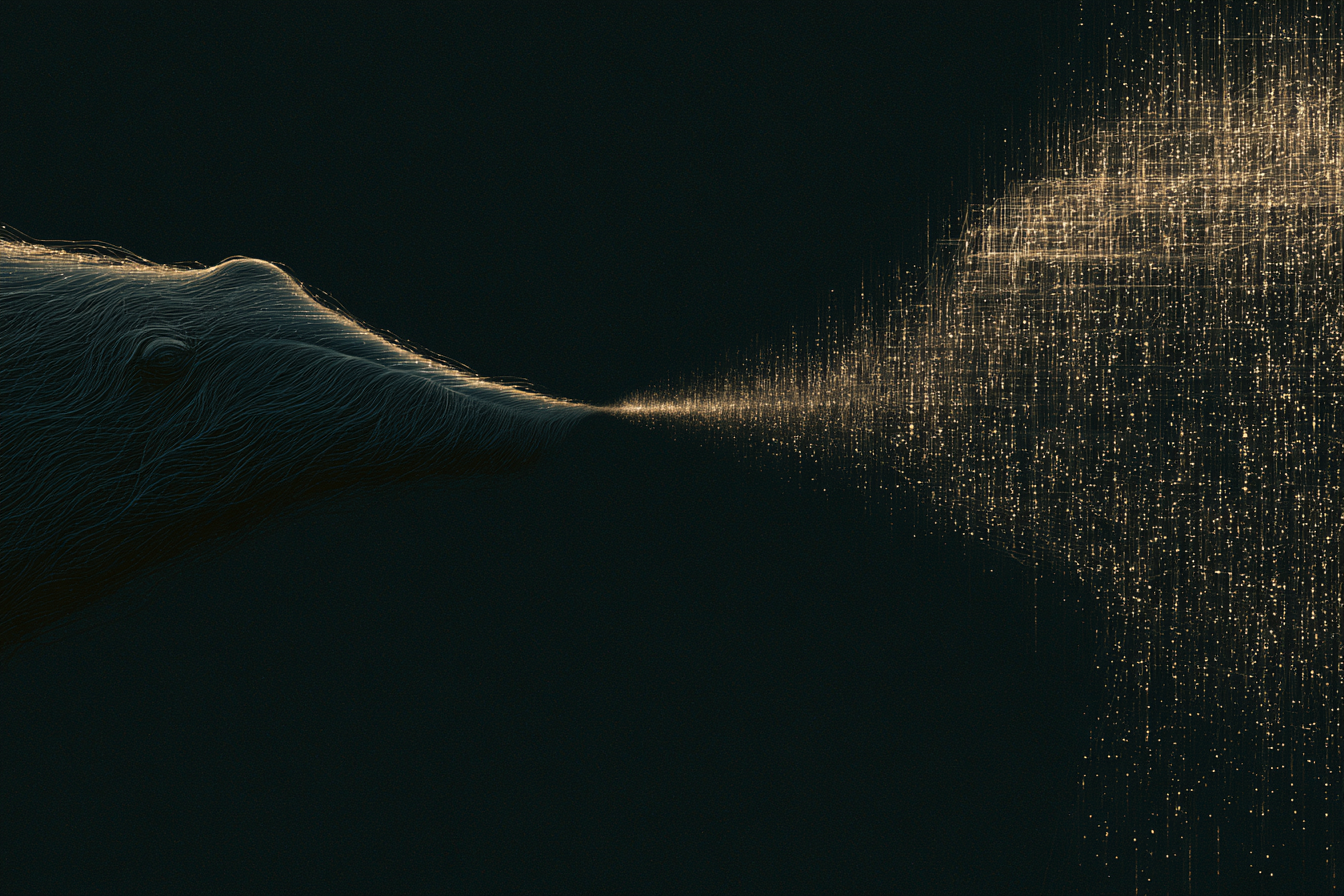
From Ocean Voices to Cosmic Signals
The path from whale communication to extraterrestrial intelligence is an analogy, not evidence that the two problems are the same. A whale is a known biological organism with an evolutionary history on Earth. Researchers can observe its body, environment, social relationships, and responses. An extraterrestrial signal may arrive without any of those forms of context.
That difference makes cosmic translation harder but the terrestrial work still matters. It teaches researchers not to assume that intelligence will package meaning in human-like ways. It develops methods for detecting organization, measuring complexity, testing responsiveness, and separating a signal from the expectations brought to it.
Machine learning is already part of SETI signal analysis. A 2023 deep-learning search examined more than 480 hours of observations from 820 nearby stars and reduced the candidate set dramatically by filtering likely radio-frequency interference. The system identified eight signals of interest that earlier analyses had not flagged, but later observations did not detect signals with similar characteristics.
That result captures the discipline the larger question requires. AI successfully changed what researchers could notice. It did not establish what the signals were.
If humanity ever receives a credible technosignature, detection may be only the beginning. A signal could use unfamiliar mathematics, compression, timing, or physical media. It might be a beacon rather than a conversation, an archive rather than a greeting, or the output of a machine whose creators no longer exist. Even when something is clearly artificial, intention may remain inaccessible.
Interstellar distance introduces another problem: feedback. A whale can respond within seconds. A civilization dozens or hundreds of light-years away cannot correct our first interpretation on a human conversational timescale. AI-generated models of the message might shape public belief, diplomacy, religion, markets, or military policy long before any reply could verify them.
The first translator for an extraterrestrial intelligence would therefore carry an extraordinary burden. It would need to separate detection from interpretation, interpretation from speculation, and speculation from decisions made under uncertainty.
The machine would not only mediate a message. It could mediate humanity’s understanding of its place in the universe.
The Frame Shift: Contact May Be a Problem of Perception
The default frame imagines non-human intelligence as something that must announce itself clearly enough for humans to recognize. Animals communicate, but not quite in the ways we call language. The universe may contain intelligence, but until an unmistakable message arrives, the sky remains silent.
That frame places humanity at the center of the test. Other minds become real to the degree that they enter our categories successfully.
The crack appears when we consider how narrow those categories are. Human perception samples only a fraction of the physical world. Human attention favors particular timescales, patterns, and social cues. Human language divides experience according to a body and history specific to one species on one planet.
Silence may sometimes describe the receiver more accurately than the world.
The wider lens is not that every unexplained sound contains a hidden message, or that the universe is secretly speaking to us. That would replace one form of certainty with another. The wider lens is that communication and intelligence may be present in forms that do not volunteer themselves to human intuition.
AI changes the question because it can widen the range of patterns we are capable of investigating. It may detect structures across frequencies, timescales, modalities, and datasets that no individual human could perceive as a whole. In that role, AI is less a universal translator than an instrument for expanding humanity’s perceptual bandwidth.
The distinction matters. A translator promises meaning. An instrument reveals phenomena that still require interpretation.
Seen this way, the first stage of contact may not be an exchange of sentences. It may be the disciplined recognition that a pattern belongs to another center of experience. Translation would come later, if it comes at all.
The return to ordinary reality is subtle. The ocean remains the ocean. A whale’s click remains a pressure wave moving through dark water. The night sky remains filled largely with signals produced by natural processes and human technology.
But the listener has changed.
What sounded like noise becomes a question with structure. What looked like silence becomes a limit we can investigate. The unknown does not become evidence, but it no longer has to resemble us before it becomes worthy of attention.

The Galactic Mind Perspective: The Translator Should Not Become the Oracle
The most coherent interpretation is not that AI will suddenly deliver fluent conversations with whales or aliens. It is that AI may help build progressively better models between forms of intelligence—models that remain provisional, testable, and tied to observable context.
That is a less dramatic future than the universal translators of science fiction. It may also be the path that produces real understanding.
A credible system would not output a single authoritative sentence and ask humanity to believe it. It would show alternative interpretations, identify the evidence supporting each one, predict what should happen next, and revise itself when those predictions fail. Field researchers, linguists, cognitive scientists, ethicists, and communities affected by the work would remain part of the interpretive process.
The strongest signal of progress may not be an English phrase attributed to another species. It may be a model that reliably predicts who will respond, under which conditions, and how the interaction changes when one feature of a signal is altered. Meaning would emerge through accumulated relationships between signal, context, behavior, and response.
This perspective also places a limit on the romance of machine neutrality. AI is not a visitor from outside human culture. It carries our data, objectives, assumptions, and blind spots. Its contribution is not freedom from perspective, but the ability to compare perspectives and patterns at a scale unavailable to unaided cognition.
That is why this question matters now. The tools are arriving before society has agreed on what would count as success. Pattern-generating systems are becoming persuasive faster than our methods for validating meaning. Without careful standards, the appearance of translation could arrive years before translation itself.
The Galactic Mind position is therefore open but disciplined: use AI to widen the search, deepen the context, and pressure-test interpretations. Do not allow the intermediary to become an oracle merely because its language sounds certain.
Wonder deserves better than a fabricated voice.
If contact with another form of intelligence becomes possible, respect begins with admitting how easily we could misunderstand it.
Learning to Hear What Was Already Here
Humanity often imagines first contact as an arrival. Something crosses the distance, enters the frame, and finally makes itself known.
The research unfolding in the ocean suggests another possibility. Contact may begin as a change in attention. A familiar environment reveals a form of organization we had not learned to notice. A signal becomes a pattern; a pattern becomes a testable relationship; a relationship begins to suggest the outline of another point of view.
AI may be essential to that process, but not because machines are automatically wiser than people. They can help us listen across more data, more dimensions, and more forms of difference than human cognition can easily integrate. The meaning will still have to be earned through context, interaction, humility, and correction.
If that work succeeds, the first translated non-human message may matter less for what it says than for what its existence proves: that another interior world was present beside us, structured and responsive, while humanity heard only sound.
And if the bridge eventually reaches beyond Earth, we may discover that the most important preparation for cosmic contact was not building a louder transmitter.
It was learning not to confuse unfamiliarity with silence.
What do you think? Drop your thoughts in the comments ...
More in Deep Think
What Alien Disclosure Could Reveal About the Minds We Are Building
If humanity creates minds before encountering them elsewhere, our assumptions about intelligence may shape how we interpret both.
Is Intelligence a Cosmic Inevitability?
Does intelligence emerge wherever conditions allow complexity—or is the human mind an improbable exception?
What If First Contact Was a Mirror, Not a Rescue?
First contact may matter less for what another civilization gives us than for the comparison it forces humanity to make.
Sources / Receipts
- Project CETI — Official Research Overview — Describes the project’s use of machine learning, robotics, behavioral data, linguistics, and controlled playback to study sperm-whale communication.
- Sharma et al., “Contextual and Combinatorial Structure in Sperm Whale Vocalisations” — Nature Communications, 2024 — Peer-reviewed analysis of 8,719 sperm-whale codas identifying rhythm, tempo, rubato, ornamentation, and contextual variation. The study establishes richer structure, not translated meanings.
- Diamant et al., “Backseat Driver Architecture to Passively Follow Sperm Whales by Their Voices with an Autonomous Underwater Glider” — Scientific Reports, 2026 — Describes real-time acoustic detection, source separation, direction estimation, and adaptive glider control; long-term whale following remained future work in the reported study.
- Google, “DolphinGemma: How Google AI Is Helping Decode Dolphin Communication,” 2025 — Official technical overview of the approximately 400-million-parameter audio model trained on Wild Dolphin Project data. It identifies and predicts vocal patterns; it is not a verified dolphin-to-human translator.
- McCowan et al., “Interactive Bioacoustic Playback as a Tool for Detecting and Exploring Nonhuman Intelligence” — PeerJ, 2023 — Reports a preliminary twenty-minute responsive playback interaction with the humpback whale Twain.
- Ma et al., “A Deep-Learning Search for Technosignatures from 820 Nearby Stars” — Nature Astronomy, 2023 — Demonstrates machine learning’s value for filtering radio interference and identifying signals for follow-up; its eight signals of interest were not redetected.
- Cartmill, “Overcoming Bias in the Comparison of Human Language and Animal Communication” — PNAS, 2023 — Examines methodological biases in identifying and comparing meaning across human and animal communication systems.
- Harnad, “The Symbol Grounding Problem” — Physica D, 1990 — Establishes the longstanding problem of connecting formal symbols to meaning grounded beyond other symbols.
- “Ethical Implications of AI-Mediated Interspecies Communication” — AI and Ethics, 2025 — Reviews risks involving translation accuracy, misinterpretation, animal welfare, power, and the gap between signal decoding and genuine understanding.


Discussion