
Central Question
Before an unknown thing becomes a story, it must first become a shape.
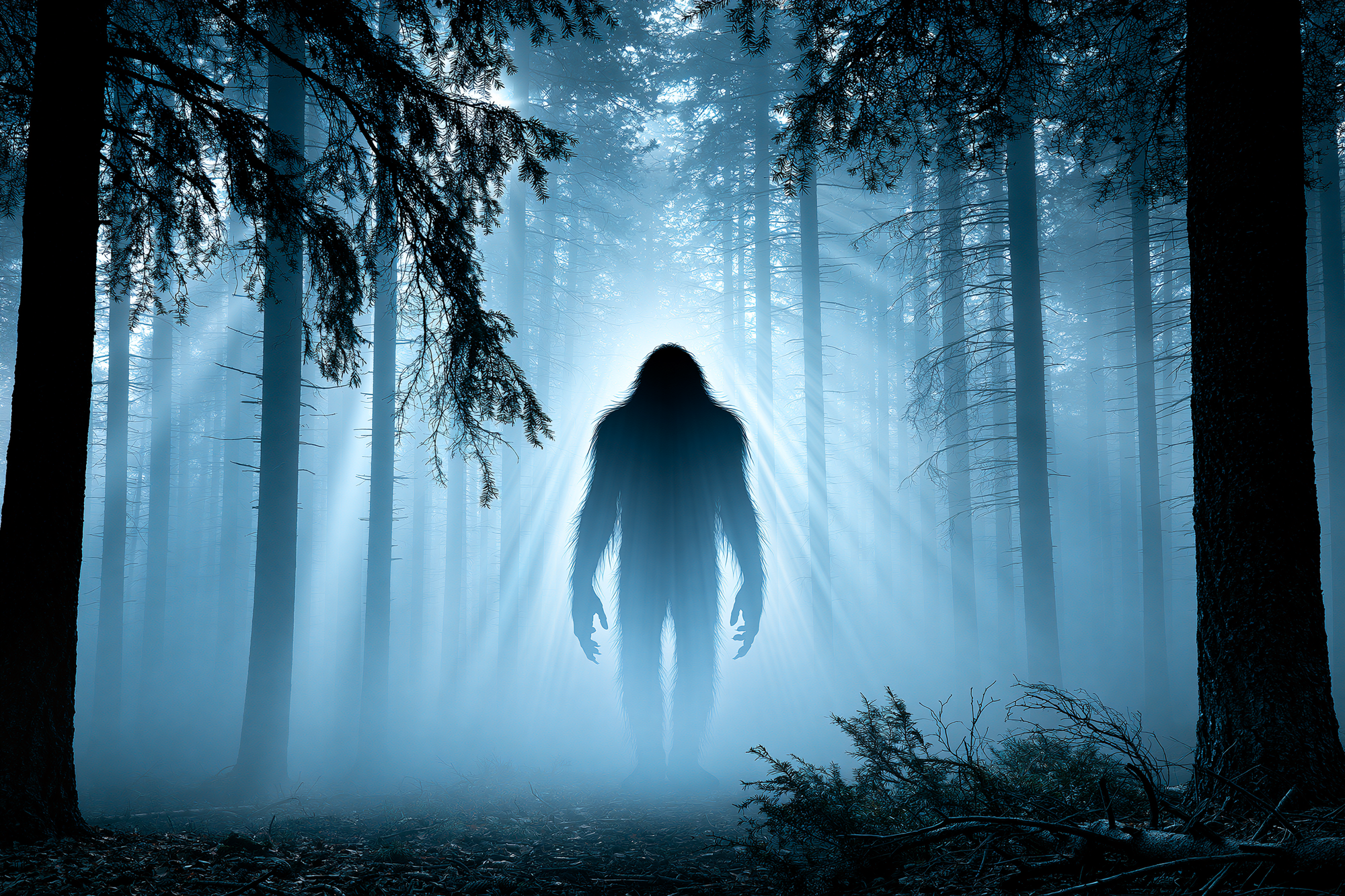
A movement at the edge of the forest.
A figure crossing a road.
Two lights where eyes should be.
Something standing upright that should be moving on four legs.
For a fraction of a second, the witness does not know what they are seeing.
There is only interruption.
A break in the familiar world.
Then the mind begins searching for a name.
Bigfoot.
Mothman.
Dogman.
A ghost.
An alien.
A demon.
The name arrives because the human mind does not encounter reality without interpretation. We compare the unfamiliar against everything we have previously seen, heard, feared, imagined, and inherited.
Folklore gives the unknown a recognizable face.
That much is understandable.
But what if the relationship does not move in only one direction?
What if folklore shapes how we interpret the unknown—but the unknown can also learn how to wear our folklore?
Not metaphorically.
Not merely as a story changing through repetition.
What if some unexplained phenomenon, assuming one exists beyond the witness, appears through forms already embedded in the culture encountering it?
What if the monster is not always a species?
What if the form is part of the communication?
And what if the strangest beings in our stories are not simply inventions or undiscovered animals but masks produced at the boundary between human consciousness and something we do not yet know how to perceive?
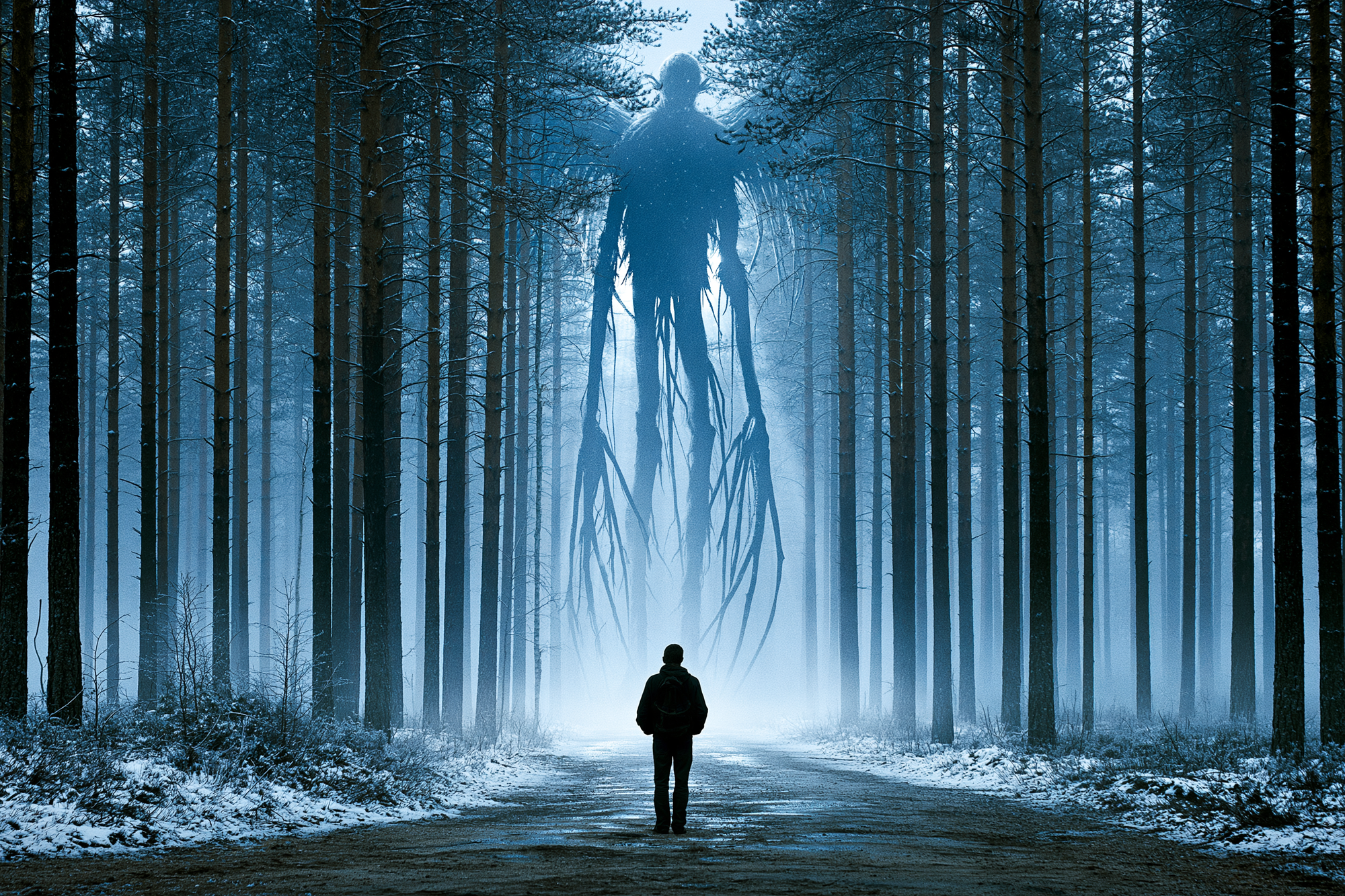
The Faces Waiting in the Dark
Folklore is usually treated as something that comes after an event.
Someone sees something strange.
They tell another person.
The story spreads.
Details change.
A name is created.
A legend forms.
Under this familiar model, the encounter produces the folklore.
The direction appears simple:
Event.
Witness.
Story.
Myth.
But the witness never arrives empty-handed.
Long before entering the forest, they have already seen the silhouettes.
They know what a grey alien looks like.
They know Bigfoot’s walk.
They recognize the red eyes associated with Mothman.
They have seen pale crawlers, black-eyed children, winged humanoids, shadow people, werewolves, demons, fairies, and faceless figures in films, documentaries, illustrations, podcasts, games, and social media posts.
The story may exist before the experience.
The image may be waiting before the witness sees anything.
That does not mean every witness is lying.
It means perception is not a camera.
The brain does not passively record a complete external world and then examine the footage. It continuously interprets incomplete sensory information by comparing it against prior knowledge and expectation.
Under predictive and Bayesian models of perception, the brain combines incoming sensory evidence with existing expectations to infer what is most likely present. This is not a defect. It is part of how ordinary perception works. (Knill and Pouget, The Bayesian Brain)
You see a coat hanging in a dark room and briefly perceive a person.
You mistake a branch for a snake.
You hear your name inside an indistinct crowd.
You recognize a face in the arrangement of a house, a tree, or the surface of the Moon.
The brain does not wait patiently for perfect evidence.
It completes the scene.
Most of the time, this predictive system is extraordinarily useful. But when visibility is poor, fear is high, the event is brief, and the object is unfamiliar, the mind has more empty space to fill.
Culture helps fill it.
Folklore may therefore do more than shape the story told afterward.
It may help determine what the witness experiences in the moment.
Why the Mask Matters
It is easy to reduce this question to a debate between believers and skeptics.
One side says the witness saw a creature.
The other says the witness imagined it.
But that division may be too simple.
An experience can contain several layers at once:
Something occurred.
The witness perceived something.
The brain interpreted incomplete information.
Memory reconstructed the event.
Culture supplied language and imagery.
The community gave the experience a category.
None of these layers automatically proves or disproves that something external was present.
A real animal can be misperceived.
An ordinary stimulus can produce an extraordinary experience.
A sincere witness can be mistaken.
An unusual event can be partially remembered and culturally reshaped.
And if an unknown phenomenon genuinely exists, it would still have to pass through the same human machinery of perception, memory, language, and belief.
That is why this question matters.
The report is not simply a window onto an external creature.
It is the record of a relationship between an event and the person trying to understand it.
The creature described may be part observation.
Part interpretation.
Part memory.
Part culture.
And perhaps, if we allow the question to remain open, part something else.
The goal is not to flatten every cultural tradition into the same universal monster. Fairies, spirits, sacred beings, cryptids, and entities from living Indigenous traditions are not interchangeable simply because outsiders notice surface similarities.
Each belongs to its own history, language, geography, and worldview.
Similarity is not identity.
But the recurrence of humanlike visitors, wilderness beings, tricksters, luminous figures, night travelers, and threshold creatures still raises an important question:
Why does the unknown so often arrive through culturally recognizable forms?
When the Story Changes the Creature
The Chupacabra offers a revealing example.
Early reports associated with the 1995 Puerto Rican legend described something largely bipedal, reptilian, alienlike, and sometimes covered with spines.
Later reports from Mexico and the American Southwest increasingly applied the same name to hairless, four-legged canids. Many photographed or recovered “Chupacabras” were identified as coyotes, dogs, or similar animals suffering from mange.
The name survived.
The body changed.
Investigator Benjamin Radford has argued that media, eyewitness interpretation, animal predation, and even imagery from the 1995 film Species influenced the formation of the modern legend. That conclusion remains his interpretation, but the broader transformation is difficult to miss: one cultural category absorbed creatures that looked almost nothing alike. (Tracking the Chupacabra)
This does not prove that an external phenomenon adapted itself.
It demonstrates something more grounded.
Folklore is capable of reorganizing ambiguous evidence.
Once a culture possesses the category “Chupacabra,” unfamiliar livestock deaths and unusual animals can be pulled toward it.
The legend becomes a container.
Different events enter.
A single story emerges.
Something similar may happen throughout cryptid culture.
A large shape in the forest becomes Bigfoot.
An unidentified canine becomes Dogman.
A strange light becomes a UFO.
A dark humanlike form becomes a shadow person.
The category does not necessarily invent the original stimulus. But it can influence which details receive attention, which are forgotten, and which are added as the story is retold.
Psychologist Frederic Bartlett’s early work on reconstructive memory showed that people often transform unfamiliar material into forms that better fit their existing cultural expectations. Later research has continued to show that memory is not a fixed recording. It is reconstructed each time it is recalled.
The strange is gradually made familiar.
But there is another possibility.
Sometimes the familiar is made strange.
A known animal becomes an impossible predator.
A human silhouette becomes something not entirely human.
A light becomes a craft.
A dream becomes a visitation.
A local story becomes an encounter template.
The witness may not first encounter “Bigfoot” and name it afterward.
They may encounter a rupture in the forest and Bigfoot becomes the nearest cultural container available.
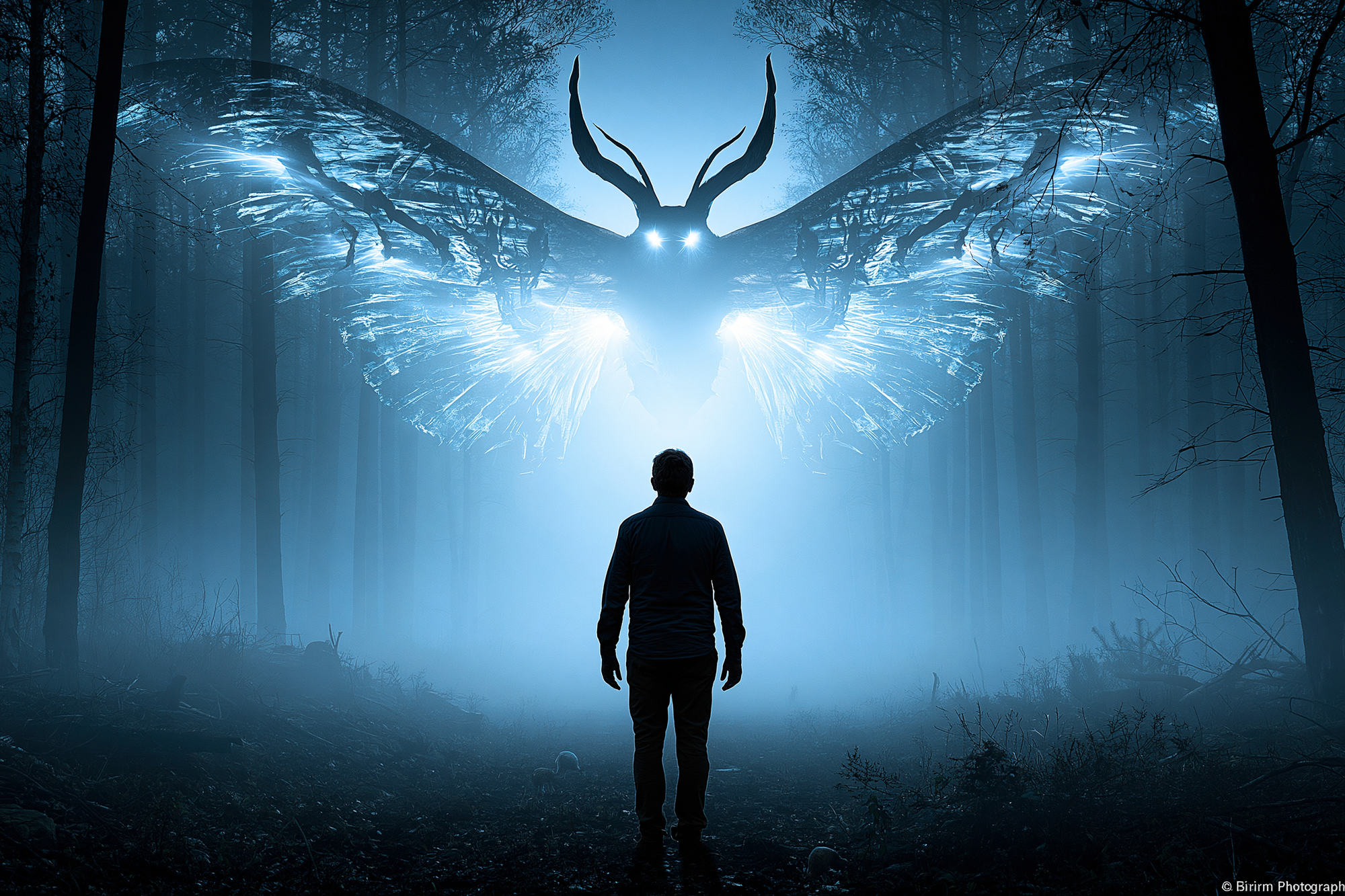
Four Ways the Unknown Acquires a Face
There are several ways to interpret this relationship without pretending they all lead to the same conclusion.
The psychological model
The most grounded explanation begins inside the human mind.
Perception is constructive.
Memory is reconstructive.
Expectation influences attention.
Fear intensifies pattern detection.
Ambiguous stimuli are interpreted through familiar categories.
Under this model, the unknown does not actually learn anything.
Human beings place familiar masks over unfamiliar events.
This can happen without deception and without mental illness. A witness may honestly describe what they remember while remaining wrong about what produced the experience.
Experiments involving conditioned hallucinations have shown that learned expectations can sometimes cause people to report perceiving a stimulus when it is absent, particularly when prior expectations outweigh uncertain sensory evidence. This does not explain every unusual encounter, but it illustrates how strongly expectation can participate in perception. (Powers et al., Science, 2017)
The more ambiguous the signal, the more influence the prior story may have.
In darkness, the folklore speaks louder.
The cultural feedback model
A story does not remain inside an individual mind.
It spreads.
One report gives future witnesses a template.
Future reports strengthen the template.
Artists standardize the appearance.
Documentaries dramatize the behavior.
Online communities collect patterns.
Algorithms repeat the most emotionally powerful versions.
Eventually, people know how the creature is supposed to look, where it is supposed to appear, and what sensations supposedly accompany its presence.
The legend shapes attention.
Attention produces reports.
Reports strengthen the legend.
Folklorists have used the concept of ostension to describe how stories can be enacted in the real world rather than merely told. People visit supposedly haunted locations, perform rituals connected to legends, imitate stories, or interpret ambiguous events through narratives they already know.
The boundary between narrative and behavior becomes porous.
The story does not become a biological creature.
But it begins producing real experiences, actions, journeys, fears, communities, and sometimes physical consequences.
In that sense, folklore can become real without the monster becoming zoological.
The archetypal model
Carl Jung approached flying saucers partly as a psychological and symbolic phenomenon.
His primary question was not simply whether UFOs were physically real. He asked why that particular image had become culturally powerful during a period of technological progress, existential fear, and global instability.
For Jung, the circular form of the saucer could carry psychic meaning independent of whether any particular object came from another world. The phenomenon could be physical, psychological, or some unresolved combination; its symbolic force still deserved attention. (Princeton University Press)
An archetypal interpretation would suggest that certain forms recur because the human psyche repeatedly produces them.
The threatening animal.
The wild man.
The visitor from above.
The luminous guide.
The trickster.
The double.
The thing that is almost human but not quite.
These forms may return because they organize ancient fears and desires.
The wilderness being represents what civilization excludes.
The winged omen gives approaching catastrophe a body.
The alien represents intelligence separated from humanity.
The shapeshifter reflects the instability of identity.
Under this model, folklore is not reporting an external species.
It is revealing the symbolic architecture of the human mind.
The monster is psychologically real because it carries something humanity has not fully integrated.
The adaptive phenomenon model
Then comes the most speculative possibility.
What if some unknown phenomenon is responsive?
Jacques Vallée famously compared modern UFO and entity reports with older accounts involving fairies, aerial beings, religious apparitions, and other folkloric visitors. He did not treat these parallels as proof that every tradition described the same literal entity. He questioned whether the modern extraterrestrial interpretation was large enough to contain the full strangeness of reported encounters.
Perhaps, he suggested, the phenomenon interacts with human belief, symbolism, and culture in ways that a simple spacecraft hypothesis cannot explain. His ideas remain controversial and speculative, but they widened the question beyond visitors traveling here in metal machines. (Wired profile of Vallée and his work)
If some form of intelligence were involved, cultural adaptation could serve several purposes.
It could make the encounter comprehensible.
It could disguise the phenomenon inside existing belief.
It could generate fear, transformation, confusion, or attention.
It could communicate symbolically rather than literally.
Or it could preserve ambiguity.
An intelligence seeking complete concealment would simply remain unseen.
But an intelligence seeking influence without open revelation might do something stranger.
It might appear in ways that are unforgettable to the individual but unbelievable to the culture.
The most effective disguise may not be to look ordinary.
It may be to look exactly like something no institution will take seriously.
A monster.
A fairy.
A demon.
An alien.
A figure already waiting inside folklore.
The Most Grounded Answer May Be Enough
The adaptive phenomenon model is powerful because it seems capable of explaining almost anything.
That is also its greatest weakness.
If the unknown can appear as any creature, symbol, light, dream, or religious figure, then nearly every unusual experience can be folded into the hypothesis.
A theory that explains every possible form risks predicting nothing.
There is currently no reliable evidence showing that an external intelligence deliberately selects folkloric disguises.
The human explanation may be enough.
Animals are misidentified.
Witnesses influence one another.
Memory changes.
Stories spread.
Hoaxes occur.
Media imagery becomes confused with personal experience.
Reports that fit established categories receive attention, while experiences that do not fit a known pattern are forgotten or never shared.
The repeated forms may also reflect shared human biology rather than a shared external phenomenon.
Humans are naturally alert to eyes, faces, predators, bodies, movement in darkness, and anything resembling a person while violating the expected proportions of one.
A tall humanoid in the forest activates several ancient alarms at once.
Human.
But not human.
Animal.
But standing.
Familiar.
But wrong.
We may repeatedly create similar monsters because we carry similar nervous systems.
The unknown does not need to wear our folklore.
Our folklore may be what the human mind wears when facing the unknown.
That possibility should not be treated as disappointing.
If culture can influence what people perceive, remember, and experience, that is itself profound.
It means myths are not dead stories preserved from the past.
They are active structures operating inside present-day consciousness.
They influence where people look.
What they fear.
What they recognize.
What they report.
And what reality feels like when the familiar world breaks.
The Signal Beneath the Mask
If we wanted to examine these encounters seriously, the goal would not be to remove culture from the witness.
That is impossible.
The better goal would be to identify which elements belong to the cultural mask and which, if any, remain stable underneath it.
What did the witness perceive before assigning a name?
Which details appeared in the earliest account?
Which emerged after speaking with other people?
Had the witness encountered similar imagery beforehand?
Do witnesses with little exposure report the same core features?
Which details remain consistent across time?
Which change immediately after films, documentaries, or viral posts?
Does the creature’s body change while its behavior remains stable?
Do different cultures describe different forms performing similar roles?
These questions would not automatically establish an external phenomenon.
They would create cleaner data.
If the reports are entirely cultural, we might expect imagery to track exposure, media, and local expectation.
If an external animal is involved, biological characteristics should remain relatively stable even as stories accumulate around it.
If the experience is psychologically generated, patterns may correspond more strongly with human perception, altered states, trauma, sleep phenomena, and expectation than with ecology.
And if something responsive exists, we might eventually find a stranger pattern:
A stable intelligence hiding beneath unstable forms.
The mask would change.
The interaction would remain.
That possibility is not established.
But it gives the inquiry a more disciplined question than simply asking whether every reported creature is real.
What stays the same when the folklore changes?
A Global Folklore Engine
For most of human history, folklore traveled slowly.
Stories belonged to landscapes.
A mountain.
A river.
A village.
A stretch of forest.
A dangerous road.
A particular community carried the memory, and the form changed as it crossed generations.
The internet has transformed that process.
A local creature can become globally recognizable within days.
A single image can standardize the appearance of an entity before most people have ever heard its story.
Podcasts connect unrelated accounts.
Online communities arrange scattered experiences into categories.
Algorithms reward the most frightening, visually distinct, and emotionally charged versions.
Generative artificial intelligence can now create convincing images of beings that have never existed, embedding new forms into the imagination at enormous speed.
We may be entering an age of synthetic folklore.
The old sequence was:
Encounter.
Story.
Image.
Legend.
The new sequence can begin with the image.
An invented figure appears online.
Stories gather around it.
People dream about it.
They search for it.
Some begin reporting encounters.
The folklore no longer requires an original event.
It can generate the conditions through which future events are interpreted.
This does not mean every modern report is manufactured.
It means the cultural environment surrounding the witness is becoming denser.
We now carry a global archive of monsters in our pockets.
The forest has not changed.
But the number of faces waiting inside our minds has multiplied.
And if an external phenomenon were somehow responsive to human expectation, it would now be encountering something unprecedented:
A planetary culture continuously producing and distributing new masks.
What If Folklore Is an Interface?
Imagine trying to show a person something their senses were never designed to perceive.
Not simply an unfamiliar animal.
Something operating through dimensions, forms of consciousness, or structures of reality outside ordinary human experience.
The person might not perceive the thing as it actually is.
They might receive a translation.
A computer folder icon is not a literal folder.
A cloud icon is not the cloud.
A cursor is not the machinery moving beneath the screen.
The symbol makes an invisible process usable.
What if folklore sometimes functions in a similar way?
A winged humanoid may not represent literal anatomy.
A luminous visitor may not possess a human-shaped body.
A trickster may not be a biological species.
The perceived form could be the nearest symbolic interface available to the witness.
Under a psychological interpretation, the brain performs the translation.
It converts ambiguity into a culturally recognizable image.
Under a participatory interpretation, the experience forms somewhere between the witness and the stimulus.
Neither side produces the encounter alone.
Under the adaptive intelligence hypothesis, the phenomenon itself participates in choosing the symbol.
The mask may not be camouflage.
It may be compatibility.
Something genuinely unfamiliar might be unable to enter human awareness without becoming partly familiar.
It would need eyes even if it did not see.
A body even if it did not possess one.
A voice even if it did not speak.
A story even if it did not come from anywhere stories can describe.
Folklore would then be more than a collection of old beliefs.
It would be the translation layer between human consciousness and whatever exists beyond its normal categories.
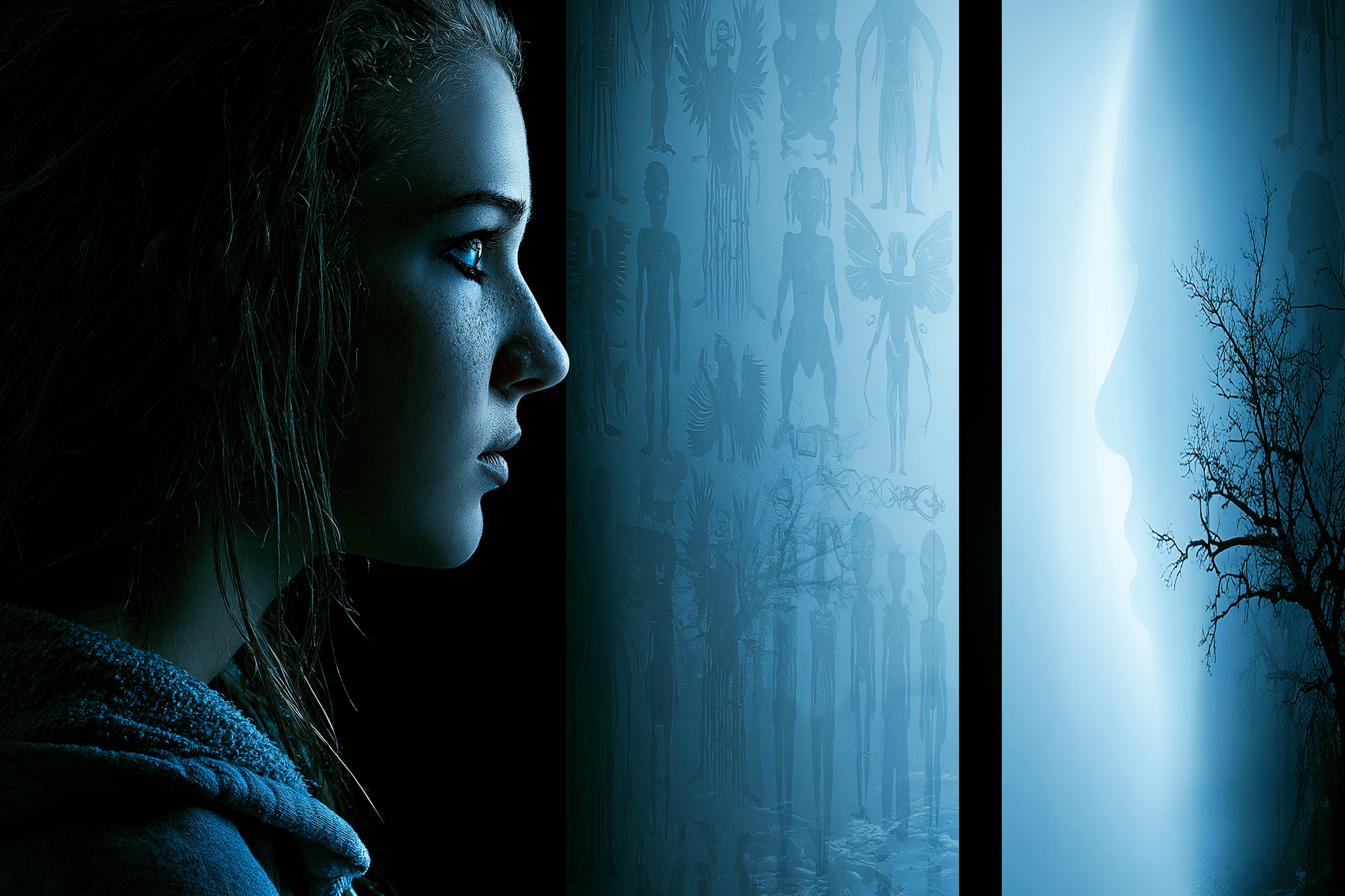
The Frame Shift: Folklore May Be Part of the Encounter
The familiar assumption is that an encounter happens first.
Folklore comes afterward.
Someone sees the creature.
Then humanity creates the story.
But the crack appears when we recognize that the story may already be present inside the witness.
The mind does not meet the unknown without expectations.
Memory does not preserve the experience without alteration.
Culture does not merely receive the report.
It helps shape what can be seen, named, remembered, and shared.
The wider lens is this:
Folklore may not simply document encounters with the unknown.
It may participate in producing their form.
That participation does not tell us whether the source is psychological, cultural, physical, or something more difficult to separate.
But it changes the question.
We no longer ask only:
Did someone really see a monster?
We also ask:
Why did the unknown take this particular shape?
Why here?
Why now?
Why this creature?
Why this witness?
Why did earlier generations see fairies, spirits, demons, angels, and wild men where modern witnesses might see aliens, cryptids, interdimensional beings, or simulated anomalies?
Perhaps the beings changed.
Perhaps the stories changed.
Perhaps human interpretation changed while the underlying stimulus remained the same.
Or perhaps there was never a stable thing beneath the masks.
The return to ordinary reality is quieter.
The next time we hear an impossible story, we do not have to choose immediately between belief and ridicule.
We can study the shape of the story itself.
The mask becomes part of the evidence.
Not proof of the creature.
Evidence of the relationship.
Because the form an encounter takes may tell us as much about the mind, culture, and historical moment surrounding it as it does about whatever stood in the darkness.
The mystery is no longer confined to the forest.
Part of it is carried into the forest by us.
And if something is waiting there, perhaps it is looking back through a face we already taught ourselves to recognize.
Open Reflection
Maybe the unknown never learned to wear our folklore.
Maybe we dressed it ourselves.
A shadow became a figure.
A figure became a creature.
A creature became a story.
And the story returned to shape the next shadow.
That cycle alone could explain generations of sincere encounters without requiring an undiscovered species or an adaptive intelligence.
But perhaps the boundary is less clean.
Perhaps consciousness is not a passive observer of reality.
Perhaps some experiences emerge through an interaction between external stimulus and internal symbol.
Perhaps the unknown does not arrive with a fixed face.
Perhaps it becomes recognizable only when it enters the stories already living within us.
That does not make every legend true.
It makes the relationship between truth and perception more complicated.
Somewhere, a person stands at the edge of a dark road.
Something moves beyond the trees.
For one brief moment, before the mind finds a category, the experience has no name.
Then the archive opens.
Wild man.
Werewolf.
Alien.
Spirit.
Omen.
The unknown acquires a face.
The unresolved question is who chose it.
If something truly other wanted to cross into human awareness, would we perceive it as it is?
Or would it reach for one of the masks we had already left waiting in the dark?
What do you think? Drop your thoughts in the comments ...
Sources / Receipts
- David C. Knill and Alexandre Pouget, “The Bayesian Brain: The Role of Uncertainty in Neural Coding and Computation,” Trends in Neurosciences, 2004.
Useful for grounding the role of prior expectations and sensory uncertainty in perception. - Albert R. Powers III et al., “Pavlovian Conditioning-Induced Hallucinations Result from Overweighting of Perceptual Priors,” Science, 2017.
Useful for grounding how learned expectations can influence perception under uncertain conditions. - Frederic C. Bartlett, Remembering: A Study in Experimental and Social Psychology, 1932.
Foundational work on reconstructive memory, schemas, and the tendency to reshape unfamiliar material into culturally familiar forms. - Linda Dégh and Andrew Vázsonyi, “Does the Word ‘Dog’ Bite? Ostensive Action: A Means of Legend Telling,” Journal of Folklore Research, 1983.
Useful for grounding the concept that folklore can be enacted through behavior rather than merely transmitted as narrative. - C. G. Jung, Flying Saucers: A Modern Myth of Things Seen in the Sky.
Useful for examining the symbolic and psychological significance of anomalous phenomena without deciding their physical reality in advance. - Jacques Vallée, Passport to Magonia: From Folklore to Flying Saucers, 1969.
Useful for the speculative comparison between modern entity encounters and older folkloric traditions. - Gideon Lewis-Kraus, “Jacques Vallée Still Doesn’t Know What UFOs Are,” Wired, 2021.
A useful overview of Vallée’s attempt to study anomalous reports through both physical evidence and cultural context. - Benjamin Radford, Tracking the Chupacabra: The Vampire Beast in Fact, Fiction, and Folklore, University of New Mexico Press, 2011.
Useful for grounding the Chupacabra’s changing physical description and the roles of media, misidentification, and folklore.


Discussion