
A hidden animal would have to evade our searches. An intermittent phenomenon would have to evade continuity itself.
Bigfoot is usually imagined as a body somewhere in the forest—moving beneath the trees, sleeping beyond a ridge, or retreating into terrain where people rarely follow. Even when the creature is described as unusually intelligent, the basic assumption remains the same: when no one sees it, it is still somewhere.
The interdimensional idea breaks that assumption.
In its most familiar form, the theory suggests that Bigfoot does not merely hide. It leaves. A figure steps behind a tree and never emerges. Tracks end without a clear route. Some accounts also include strange lights, sudden silence, disorientation, or the feeling that something entered the scene rather than approached through it.
“Interdimensional” appears to solve the mystery with one word: the body does not remain here, its population exists elsewhere, and no continuous trail is necessary.
But a word is not yet a mechanism.
If Bigfoot leaves footprints, it exerts force against the ground. If it can be seen, light interacts with it. Odor and vocalization require exchanges with the air. Such a being is interacting with the physical world through several channels at once.
So the real question is not simply whether Bigfoot could come from another dimension.
It is what kind of phenomenon could become physical enough to be encountered, remain elusive enough to resist biological confirmation, and then cease interacting without leaving the continuous trail expected of an animal.
That breaks the mystery into four problems: the body witnesses describe, the population it would require, the discontinuity surrounding some encounters, and the role of perception in giving an uncertain presence a recognizable form. Only then can we ask whether Bigfoot crosses a boundary—or whether the boundary itself briefly takes the shape of Bigfoot.
The Creature the Forest Has Not Given Back
The modern Bigfoot phenomenon is not one untouched tradition. It layers distinct Indigenous traditions, settler “wild man” stories, newspaper coverage, alleged footprints, disputed films, testimony, hoaxes, and popular culture.
The name Sasquatch is an Anglicization of Sasq’ets, from the Halq’eméylem language of First Nations peoples in southwestern British Columbia. Individual Indigenous communities have their own beings and meanings; they should not be flattened into one modern cryptid. Bigfoot gained broad public recognition after reports of immense tracks along logging roads in 1958. The Oregon Encyclopedia traces this mixture of history, sightings, pranks, and regional meaning.
What has not emerged from that history is an authenticated biological specimen.
No accepted body, recent fossil, tissue sample, or genome has established an unknown North American primate. In 2014, researchers genetically analyzed 30 hair samples attributed to Bigfoot, Yeti, and other alleged anomalous primates. They did not identify an unknown primate; apart from two disputed Himalayan bear results, the sequences belonged to known mammals. The study did not test every claim, but it reinforced a basic standard: physical evidence must survive physical testing. It is available through Proceedings of the Royal Society B.
Modern wildlife detection raises the burden further. Environmental DNA, or eDNA, can recover cells shed into water and soil even when an animal is never seen. In one British Columbia landscape study, stream-water eDNA detected 35 mammal taxa—25 percent more than a simultaneous camera-trap survey, though detectability varied. North American forests have not been comprehensively tested for Bigfoot, but a continuously present breeding population should generate an ecology of connected traces. The Scientific Reports study shows how sensitive that search can become.
The factual floor is therefore uneven but clear. Bigfoot is culturally real, persistent in testimony, and biologically unverified.
Physics offers no established escape hatch. A dimension is a coordinate needed to describe position or motion—not automatically a parallel wilderness. Some theories propose additional spatial dimensions, and CERN searches for possible signatures such as heavier particle states or missing energy in collisions. None supplies a demonstrated pathway for an organism to leave ordinary space and return intact. CERN’s overview shows the distance between the mathematical idea and the popular portal image.
Quantum mechanics does not rescue the idea either. Interaction with the environment produces decoherence, suppressing observable quantum interference as classical behavior emerges. A warm organism continuously exchanges photons, heat, air, and force with its surroundings; it is not an isolated particle. Wojciech Zurek’s foundational review explains why this works against casual claims of macroscopic phasing. It can be read in Reviews of Modern Physics.
That is where established knowledge ends.
What follows is not a claim that Bigfoot exists or travels between dimensions. It is an exploration of what becomes possible if some small residue of the phenomenon is real, physical-seeming, and not continuously present as an ordinary animal.
A Body Cannot Simply Switch Off
Before building an interdimensional model, one problem has to be faced directly: invisibility and non-interaction are not the same thing.
An animal could become difficult to see while remaining fully physical. Camouflage can reduce the light that distinguishes a body from its background. Silence can conceal movement. Intelligence can help an organism avoid roads, people, and cameras. None of that allows the animal to pass through a tree or disappear from an enclosed space.
To do that, the body would have to alter how it interacts with matter.
The difficulty is that the same electromagnetic forces that prevent an animal from moving through a wall also allow it to stand on the ground, breathe air, retain chemical bonds, and remain a body. If those interactions were simply turned off, the creature would not become a ghost that could still choose where to walk. Its biology would lose the very relationships holding it together and connecting it to the environment.
A viable crossing mechanism would therefore need selectivity. It would have to preserve the internal chemistry of the organism while changing its external coupling to light, air, soil, and surrounding matter. It would need to determine which interactions remain active, how momentum is conserved during entry and exit, and where the organism’s energy and mass are represented while it is absent from our accessible space.
That requirement gives the interdimensional idea structure. It also divides it into several very different possibilities.
The Cross-Section in the Trees
The cleanest geometric model begins with a familiar thought experiment. Imagine a two-dimensional world drawn on paper. If a three-dimensional sphere passed through it, the inhabitants would see a point appear, expand into a circle, contract, and vanish. The sphere would seem to disappear without traveling across their world.
Raised by one dimension, a body extending in a spatial direction inaccessible to us might appear only as its three-dimensional intersection with our world. Its disappearance would not require invisibility. The intersection would simply end.
This could also produce incomplete physical traces. If only part of the entity intersected the ground, it might leave pressure, disturbed soil, or impressions that did not follow an ordinary path.
But the model creates a new problem: why would the intersection look like a stable, anatomically coherent primate?
A sphere crossing a plane changes size continuously. A complex higher-dimensional organism should likewise produce shifting anatomy unless its orientation were tightly controlled. A recognizable figure with a persistent head, torso, arms, and legs would be surprising as an accidental cross-section.
It would make more sense as a stabilized interface.
Under that model, the Bigfoot form is not the complete organism. It is a shape the larger system maintains inside our space, like a cursor controlled from beyond the screen. The visible creature becomes an instrument extended into our environment—moving the hypothesis from an unknown ape toward an intelligence capable of controlling geometry.
It also produces expectations. Matter appearing, exerting force, and leaving should exchange momentum or energy with the environment. Instruments might register pressure, heat, or electromagnetic disturbance even if a camera missed the body. The exact signature requires a real theory, but entry into the physical world should have a physical cost.
If nothing crosses any instrument under controlled conditions, the geometric model loses force.
A Habitat Beside Our Own
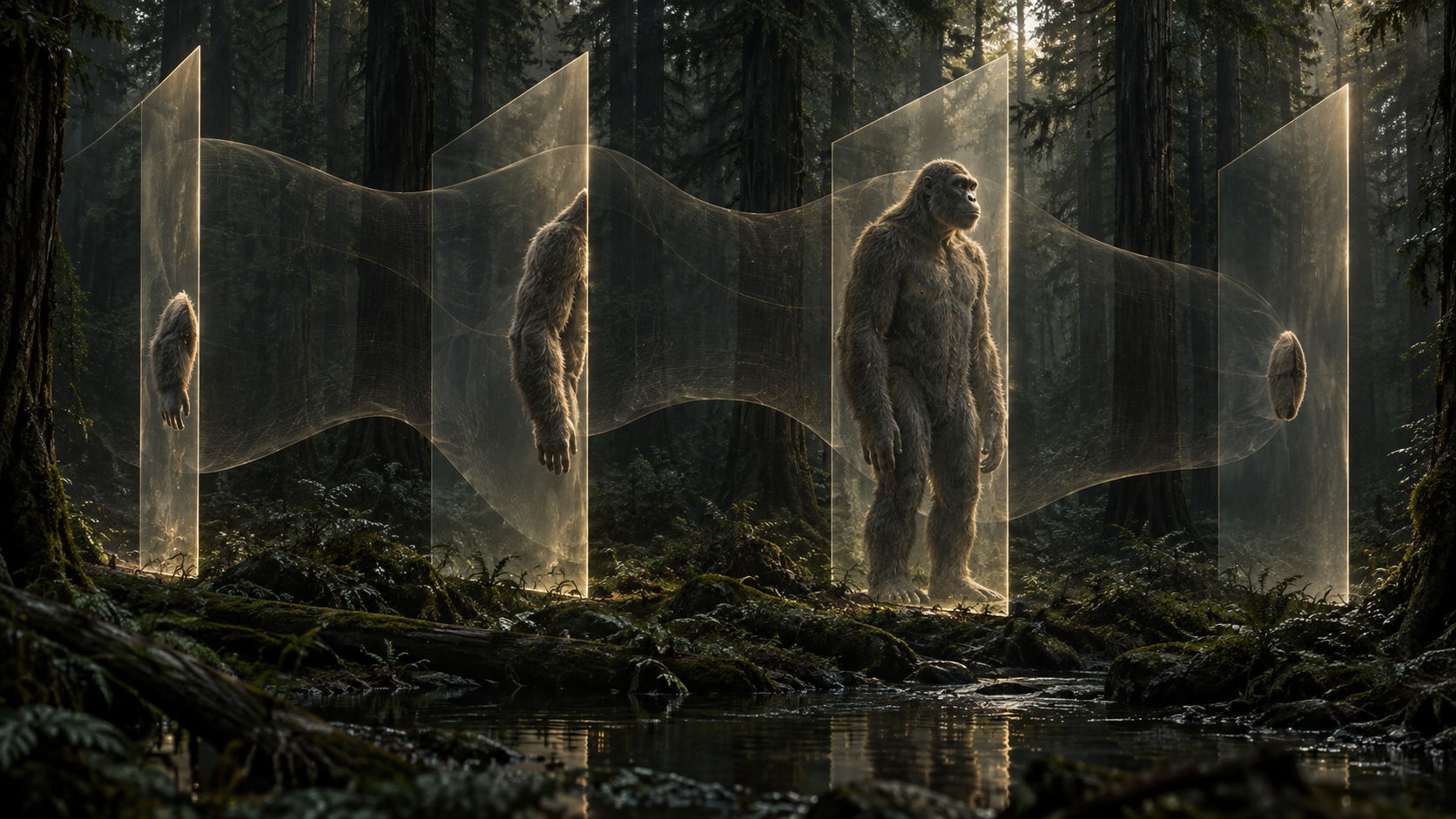
A second model does not treat Bigfoot as the cross-section of a larger body. It treats the creature as a complete organism living in a neighboring environment.
Imagine two pages pressed together. A creature confined to one page could travel forever without reaching the other, despite their closeness. Crossing would require a direction unavailable within its own surface.
Some speculative physical models imagine our observable universe as a lower-dimensional “brane” embedded in a larger space. This is not evidence for parallel forests, but it gives the idea a precise form: Bigfoot could occupy a region nearby in a higher-dimensional geometry yet inaccessible through our three familiar directions.
The beings would not need to reproduce unnoticed in the Pacific Northwest. Their habitat, food web, remains, and genetic continuity would exist elsewhere. Only visitors would enter our environment.
Yet a living body crossing between environments would face requirements stranger than distance.
Its chemistry must remain stable while it tolerates our gravity, pressure, temperature, microbes, and gases. The more different the other environment is, the less plausible it becomes that its visitor would resemble a terrestrial primate already suited to Earth.
The habitats might share similar conditions; the species might have evolved around boundary zones; or the crossing could be technological, with the visible body acting as a suit, engineered organism, or proxy.
Each answer changes Bigfoot’s identity. A migrating boundary species belongs to an ecology that occasionally leaks into ours. A technological visitor is closer to non-human intelligence than an undiscovered animal. Hair, bulk, and bipedal movement could be adaptation, protection, or an interface suited to wooded terrain.
If crossings depend on local conditions, encounters should cluster around repeatable transition zones. Geology, weather, electromagnetic conditions, season, or time might matter. The forest would not just conceal the being; it would help make the crossing possible.
And if those conditions never repeat, the neighboring-habitat model becomes indistinguishable from a story invented after each encounter.
The Animal That Never Left
There is another possibility that preserves a continuous creature while explaining why witnesses sometimes experience discontinuity: the animal remains here, but human detection fails.
Nature contains concealment more sophisticated than color matching. Cuttlefish, octopuses, and squid rapidly reorganize skin patterns to blend with backgrounds or disrupt their outlines. Their biology differs radically from mammalian fur, but it shows that evolution can build an active surface under nervous control. A review appears in Philosophical Transactions of the Royal Society B.
A forest animal would not need perfect invisibility. Breaking its outline, freezing when watched, using visual clutter, and anticipating human attention could make a large body vanish surprisingly fast. Concealment could be behavioral as much as biological.
Perception would complete the effect.
The brain infers objects from incomplete sensory information and prior expectations. Research shows that expectation can bias visual processing when a stimulus is uncertain. That does not make witnesses dishonest or every sighting imaginary. It means a brief encounter in dim, obstructed terrain is not a calibrated recording. A useful overview appears in Nature Reviews Neuroscience.
A figure disappearing behind a tree may exploit a break in attention while the witness experiences that lost continuity as something more dramatic. Apparently impossible movement could combine animal speed, poor depth cues, fear, and reconstructed memory.
But camouflage has limits.
A warm mammal remains visible to thermal sensors. A heavy animal disturbs soil. A breeding population sheds DNA, consumes food, produces waste, and dies. Suppressing every channel creates biological costs: reducing heat risks overheating, containing odor means containing molecules, and silent movement becomes harder with mass.
The camouflage model can explain why an individual sighting ends abruptly. It cannot, by itself, explain why a continent-scale population would leave no verified biological chain.
Visible-light ambiguity should eventually yield to thermal imagery, repeatable tracks, unknown primate DNA, or consistent anatomy. If those traces appeared, “interdimensional” would become unnecessary. If not, concealment alone would remain incomplete.
When the Encounter Becomes the Organism
The deepest model begins by questioning the assumption that Bigfoot must be a continuous object at all.
Some real things are events or relationships rather than self-contained objects. A whirlpool keeps its form while its water changes. A flame persists through a reaction. A rainbow emerges from a relationship among light, droplets, and an observer; it is physically real without existing independently like a stone.
What if a Bigfoot encounter belongs closer to that category?
Under this model, no complete creature travels into the forest. An external system couples with a place and produces a temporary local body. Whether the source is an intelligence, natural process, or neighboring ecology, the visible figure is only a short-lived interface.
The nearest technological analogy is an avatar. A face on a screen can respond in real time, but the person has not traveled into the glass. The local device turns information into light and sound; when the connection ends, the controlling intelligence remains elsewhere.
A temporary Bigfoot body would require a radical version of that process. A signal or field would organize light, sound, pressure, perhaps limited matter, into a coherent presence. Human perception would resolve it into a recognizable near-human form. The result could be external without being fully material, perceptual without being imaginary, and physical enough to affect the ground.
Strong coupling might produce a clear body, odor, and tracks; weaker coupling might produce only movement or a silhouette. Physical completion would vary because the body is an interaction in progress, not a finished organism.
It also offers two very different answers to why the figure resembles Bigfoot.
First, the human mind may supply part of the form. It stabilizes an unfamiliar signal using images available in memory and culture: the wild human, upright animal, watcher between the trees. The encounter provides the disturbance; the witness provides some of the mask. Does the Unknown Learn to Wear Our Folklore? explores this possibility more deeply.
The second answer is stranger: the source selects the form because it understands the observer.
An advanced intelligence need not present its native body. It could use a form suited to the environment and psychologically legible to us. A large, human-adjacent forest being communicates intelligence, power, kinship, distance, and wildness before language begins. Bigfoot would be neither disguise nor anatomy. It would be a translation.
An intelligence able to instantiate a temporary organ inside another environment need not transport its native body. It could see, exert limited force, and withdraw without leaving a resident population.
The creature would be to the larger system what a fingertip is to a person: the small portion that crosses a boundary and makes contact.
But variable “coupling” could explain a clear sighting, blurry photograph, footprint, failed camera, or no evidence at all. A theory compatible with every outcome predicts nothing.
To become meaningful, the model must produce structured mismatches. Witnesses might agree on overall form while differing systematically in detail. Visible-light, thermal, acoustic, and depth sensors might capture different portions of the event. Traces might cluster around the encounter without ecological continuation, while particular locations or conditions recur. The phenomenon would behave less like an animal and more like a signal appearing when a circuit closes.
Without patterns like these, “interface” is only a more elaborate word for mystery.
Four Models, Four Different Searches
These possibilities should not be blended into one shapeless paranormal explanation. Each places Bigfoot somewhere different between encounters, and each demands different evidence.
| Model | Where Bigfoot is between encounters | What the model predicts | What would weaken it |
|---|---|---|---|
| Hidden or camouflaged animal | Continuously present in Earth’s ecosystem | Unknown primate DNA, waste, feeding signs, stable anatomy, continuous movement across sensors | Continued failure to establish a connected biological trace |
| Higher-dimensional cross-section | Mostly outside the three-dimensional region we perceive | Abrupt but physical intersections, changing or partial geometry, localized transition effects | Stable ordinary anatomy with no measurable crossing signature |
| Neighboring-habitat traveler | A complete organism in an adjacent environment | Repeatable crossing zones, full physicality during visits, correlations with local conditions | No recurring geography, conditions, or transition effects |
| Temporary interface | Not a continuous local body; the figure is produced during interaction | Structured sensor disagreement, observer-linked variation, localized traces without ecological continuity | A model that can reinterpret every failed prediction as weaker manifestation |
The models also collide.
A camouflaged animal should have one stable genome. A perceptual interface may not. A complete traveler should register as an ordinary physical body while present. A partial intersection may produce anatomy that changes with the crossing. A culturally mediated form predicts meaningful variation between communities. A fixed biological species predicts anatomical consistency regardless of what a witness expected to see.
The word interdimensional hides these differences. It makes several incompatible mechanisms sound like one theory.
There may not be one phenomenon behind every report. Hoaxes, bears, shadows, expectation, folklore, and sincere misidentification can coexist in the same archive without being parts of one hidden reality. If any residual anomaly remains after those are separated, its value would come from recurring structure—not from the sheer number of stories collected under the Bigfoot name.
The task is not to find a theory large enough to absorb every account. It is to find whether any subset of accounts behaves as though the same underlying process occurred more than once.
Studying the Circuit Instead of Hunting the Creature
If Bigfoot were an intermittent event, the traditional search would be aimed at the wrong target.
Expeditions usually seek an animal. They follow tracks, place cameras, collect hair, listen for calls, and hope to move from encounter to specimen. Those methods are appropriate for the hidden-population model. They are poorly designed for an event produced by a rare alignment of place, environment, witness, and external source.
An event model would require an ecology of conditions.
Researchers would need synchronized visible-light and thermal cameras, acoustic and infrasound recorders, depth mapping, local weather data, magnetometers, radiation sensors, and repeated eDNA sampling. Witnesses would record impressions separately before comparing stories. Sampling procedures and predicted signatures would be established in advance, so an unexplained result could not be invented after the fact. Ordinary wildlife, equipment errors, and human activity would need controls.
Most importantly, the instruments would need to remain active before, during, and after an encounter. The question would no longer be only, “Did a creature cross this frame?” It would become, “What changed across the entire local system when the encounter began?”
That shift matters even if the interdimensional premise is wrong. It would turn a collection of dramatic narratives into competing models capable of failure. It would help distinguish a biological animal from a perceptual event, a physical intrusion from a cultural pattern, and an external anomaly from a story that becomes stranger in retelling.
If the temporary-interface model were correct, the witness could not be treated merely as unreliable contamination. The witness would be one component of the apparatus. Physiology, attention, expectation, emotional state, and cultural imagery might influence how the event resolves into experience. That would not lower the standard of evidence. It would expand the number of variables that must be measured.
This is where the Bigfoot question opens into something much larger.
Science often assumes that an unusual signal points back to a persistent source object: find the track, then find the foot; find the light, then find the craft; find the voice, then find the speaker. Usually that assumption works because objects endure when no one is looking at them.
But reality also contains events, fields, patterns, and relationships. If some forms of intelligence could act through temporary bodies, then searching only for permanent organisms would miss the category entirely. A civilization might reach into another environment without sending its native biology. A distributed intelligence might grow local interfaces the way a fungus produces temporary fruiting bodies. A neighboring reality might become visible only through the forms our environment can support and our minds can recognize.
Bigfoot would then be neither an ape nor a ghost.
It would be a terminal.
The Price of a Larger Reality
The temporary-body model can absorb many of the contradictions that make Bigfoot compelling. That is precisely why it must be handled carefully.
No experiment has demonstrated a macroscopic organism crossing an extra dimension, moving between neighboring realities, or being remotely instantiated through a forest and a witness. Known extra-dimensional theories do not predict Sasquatch. Quantum decoherence works against casual claims of biological phasing. No verified transition signature has been tied to a Bigfoot encounter. The radical models in this article therefore begin far beyond the current evidence.
They also require more assumptions than ordinary explanations. Misidentified animals, manufactured tracks, unreliable memory, expectation, folklore, and deliberate deception are all known to occur. A new category is earned only if carefully documented evidence remains after those processes have been tested.
Most of all, absence cannot become positive evidence for discontinuity. The lack of a body does not show that a body traveled elsewhere. A trail ending does not establish a portal. A camera failure does not demonstrate selective invisibility. Otherwise every missing piece becomes proof of the mechanism invented to explain why it is missing.
A serious interdimensional model must risk being wrong.
Unknown primate DNA recovered independently across multiple locations would pull the mystery back toward biology. A continuous thermal track where visible imagery failed would favor concealment. Repeatable environmental disturbances precisely synchronized with abrupt appearances would make a crossing model more interesting. Consistent disagreement among witnesses and instruments—if it followed a pattern established in advance—could support an interface model. Controlled observations that resolve into bears, people, artifacts, and equipment errors would steadily reduce the need for any extraordinary layer.
At present, the extraordinary layer remains a possibility constructed beyond the evidence, not a conclusion drawn from it.
But constructing it carefully reveals why the original question may be too small.
The Shape a Boundary Takes
Bigfoot may be exactly what the present evidence most comfortably allows: a powerful cultural figure surrounded by hoaxes, misidentifications, sincere testimony, inherited stories, and unresolved claims.
Yet if some residue survives—if even a narrow class of encounters proves to involve physical effects without biological continuity—then asking where the creature hides may never lead us to it.
We would need to ask what persists when the body does not.
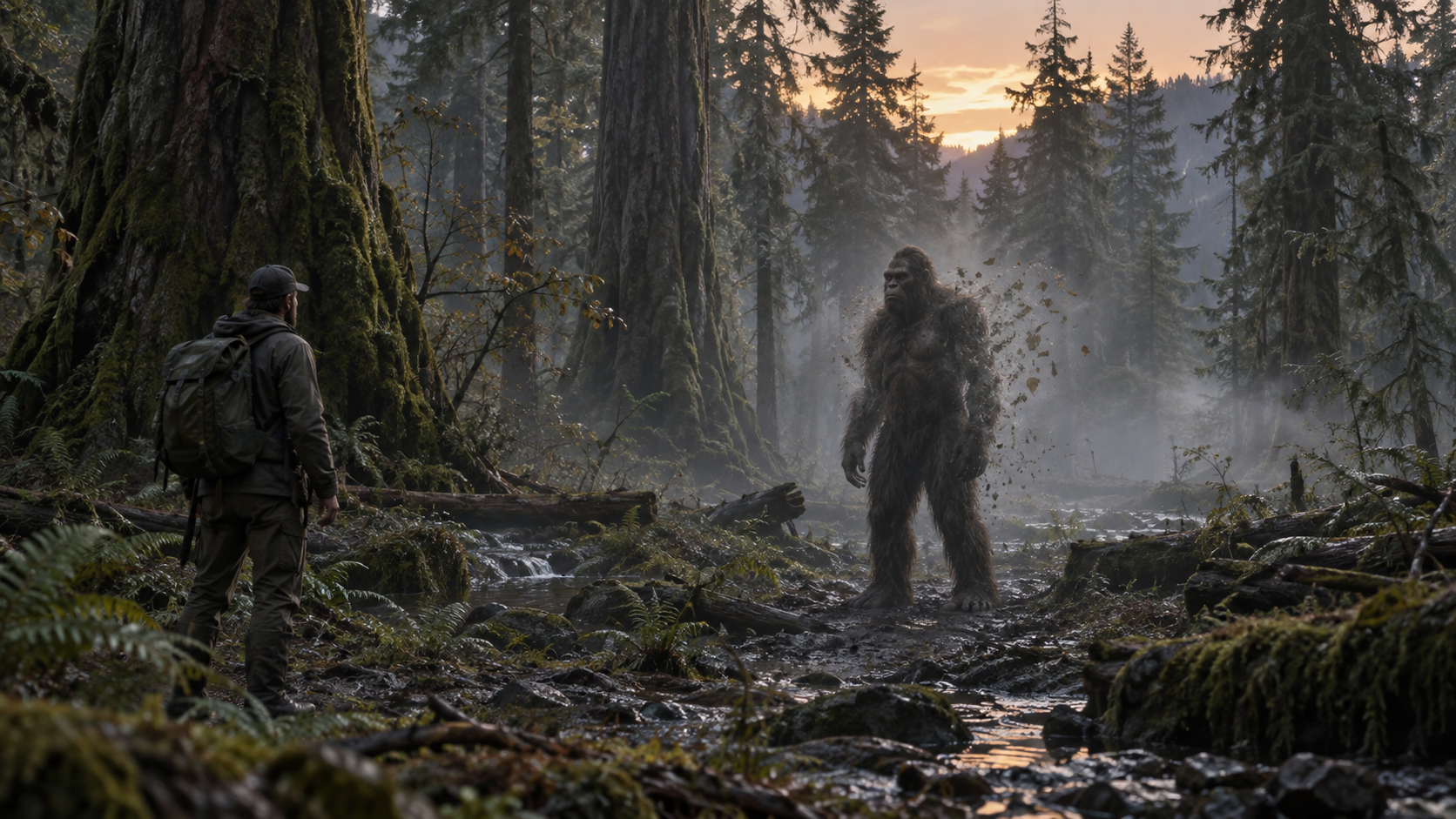
Is it a complete organism in an adjacent habitat? A higher-dimensional structure intersecting ours? An intelligence projecting a local instrument? An external disturbance that human perception resolves into the ancient form of the wild other?
In every version, the deepest shift is the same. Bigfoot stops being a permanent animal with an impossible talent and becomes a temporary relationship between worlds, environments, or modes of perception.
The forest may not be hiding a creature.
Under rare conditions, it may be completing a circuit.
And the silhouette between the trees may not be a traveler from another world, but the shape a boundary takes when, for a few seconds, it becomes visible.
More in SPEC
Does the Unknown Learn to Wear Our Folklore?
What if folklore does more than shape how we describe the unknown—and supplies the forms through which an anomalous presence becomes perceptible?
What If First Contact Happens Inside the Mind?
An exploration of contact that arrives through consciousness rather than public spectacle, complicating the boundary between external intelligence and interior experience.
When Does an Anomaly Become Evidence?
A framework for separating evidence that something unusual occurred from evidence for the particular explanation placed around it.
Sources / Receipts
- Oregon Encyclopedia — “Bigfoot (Sasquatch) legend”
Supports the cultural and linguistic history of Sasquatch and Bigfoot in the Pacific Northwest, including the Halq’eméylem origin of Sasq’ets, the 1958 popularization of Bigfoot, the mixture of testimony and pranks, and the distinct significance of related beings within Indigenous traditions. - Smithsonian Sidedoor — “Seriously Seeking Sasquatch”
Provides historical context through anthropologist Grover Krantz and the long effort to establish Bigfoot biologically, while emphasizing that no conclusive physical proof had emerged. - Sykes et al., “Genetic analysis of hair samples attributed to yeti, bigfoot and other anomalous primates,” Proceedings of the Royal Society B (2014)
Supports the discussion of the first systematic genetic survey of 30 alleged anomalous-primate hair samples. The analysis did not identify an unknown primate and demonstrates how biological claims can be subjected to direct molecular testing. - Lyet et al., “eDNA sampled from stream networks correlates with camera trap detection rates of terrestrial mammals,” Scientific Reports (2021)
Supports the explanation that terrestrial mammals leave recoverable genetic material in landscapes and waterways. The study also shows both the power and the species-dependent limits of eDNA detection. - CERN — “Extra dimensions, gravitons, and tiny black holes”
Supports the distinction between extra dimensions in physics and popular ideas of parallel realms or portals. It summarizes the kinds of particle and missing-energy signatures physicists actually seek. - Zurek, “Decoherence, einselection, and the quantum origins of the classical,” Reviews of Modern Physics (2003)
Supports the discussion of environmental decoherence and why quantum behavior does not provide a demonstrated mechanism for a warm macroscopic organism to phase in and out of ordinary matter. - Hanlon et al., “Cephalopod dynamic camouflage: bridging the continuum between background matching and disruptive coloration,” Philosophical Transactions of the Royal Society B (2009)
Supports the biological foundation for rapid, neurally controlled camouflage and disruptive patterning while also illustrating how specialized and lineage-dependent such a system is. - Summerfield and de Lange, “Expectation in perceptual decision making: neural and computational mechanisms,” Nature Reviews Neuroscience (2014)
Supports the explanation that expectation influences visual processing and perceptual decisions, particularly when sensory information is uncertain.


Discussion