
If an encounter happened before writing, it could survive only by becoming something human beings knew how to carry—and that transformation may matter more than what the first witnesses saw.
If something not human stood before a community ten thousand years ago, the encounter itself would disappear almost immediately.
The witnesses would die. Their language would divide or vanish. Settlements would be abandoned, coastlines would move, objects would decay, and the social world that gave the event meaning would be replaced many times over.
What might survive is not the encounter, but a pattern reproduced by people.
This possibility is often reduced to a crude question: were ancient gods actually aliens? That framing fails in two directions. It treats mythology as a collection of primitive eyewitness reports, and it assumes a modern reader can reverse thousands of years of symbolism simply by replacing chariot with spacecraft or heaven with another planet.
A more difficult question begins with the medium itself.
What parts of an impossible encounter could pass through story, ritual, genealogy, landscape, taboo, song, and repeated performance? Would a tradition preserve what the visitors looked like, what they did, how people responded, or only the consequences that followed? And after centuries of reinterpretation, what could distinguish a memory of contact from a story produced entirely by human minds?
Before mythology could preserve contact, contact would have to become mythology.
That transformation is the real speculative problem.
Stories Do Not Preserve Everything Equally
Oral tradition is not simply an uncontrolled game of Telephone. Communities can regulate who tells a story, where it may be told, which words or movements belong to it, and how younger members learn it. Meter, imagery, repetition, ritual, place, and social authority can all stabilize transmission.
There are documented cases in which oral histories plausibly retain the core of real events. Indigenous traditions from the Pacific Northwest describe destructive shaking and flooding associated with the Cascadia subduction zone. Researchers comparing some of those accounts with genealogy found date ranges consistent with the great earthquake of January 1700—an event independently established through Japanese tsunami records, drowned trees, coastal geology, and other evidence. The stories did not supply a modern seismological report, but they appear to have carried the disaster across generations. (Ludwin et al., 2005; USGS, 2005)
The possible reach can be longer, though the certainty becomes lower. Patrick Nunn and Nicholas Reid argue that several Aboriginal Australian traditions describe coastal landscapes inundated by postglacial sea-level rise more than 7,000 years ago. The stories themselves cannot be directly dated to those floods, so continuity remains an inference rather than a demonstrated chain. Still, the study raises a serious possibility: some place-based narratives may preserve an event kernel across very long spans, even as names, explanations, and social settings change.
Stories can also preserve their own ancestry. A phylogenetic analysis of Indo-European folktales—using methods related to those used for reconstructing biological and linguistic descent—suggested that some tale families may predate their earliest written forms by thousands of years. That does not make their events historical. It shows that narrative structures can travel deep into the past.
What survives is selected rather than neutral. In one modern transmission experiment using constructed creation stories, propositions containing social, survival-related, negative-emotional, and biologically counterintuitive information were recalled more often than neutral material. Separate experiments suggest that narratives containing a small number of counterintuitive but comprehensible elements can show a delayed recall advantage. These are short-term laboratory findings, not evidence that any motif remains accurate for millennia. (Berl et al., 2021; Norenzayan et al., 2006)
This is also why survival is not accuracy. Conversation reshapes memory, and social networks can make communities converge on shared versions while suppressing other details. Agreement may be the result of repeated exchange rather than independent confirmation. (Hirst and Echterhoff, 2012; Coman et al., 2016)
The evidentiary boundary is therefore clear. Stories can preserve transformed traces of real events, sometimes across remarkable spans of time. They can also spread, converge, and become compelling without describing a literal event. There is currently no scientifically accepted evidence that any myth, ritual, or artifact records ancient non-human contact. Separately, NASA’s 2023 UAP study reported no conclusive peer-reviewed evidence suggesting an extraterrestrial origin for UAP; it did not assess myths or ancient-contact claims.
What follows does not claim that mythology records contact. It asks what would have to survive, how it might survive, and what evidence could make that interpretation stronger than the many human processes already known to create and transmit myth.
An Encounter Would Have to Become Human
The first transformation would occur before anyone told a story.
Perception does not deliver an event with its explanation attached. People understand unfamiliar things by relating them to familiar categories. A source of light may be remembered as a property of the being carrying it. An instrument may become a staff, garment, weapon, or living companion. A procedure may be understood as healing, initiation, punishment, or exchange. A point of origin outside the known world may become the sky, the underworld, the ancestral realm, or the domain of gods.
This would not mean that ancient witnesses were unintelligent. A modern observer confronting a genuinely unprecedented intelligence would also reach for the nearest available language: drone, avatar, organism, machine, projection, hallucination, weapon. Every description would already contain interpretation.
A prehistoric encounter would then undergo a second transformation as private experience became public memory. The community would decide—often without consciously choosing—which details mattered enough to repeat. A visitor’s anatomy might fade while the prohibition it imposed remained. The mechanism of a device might be lost while the place where it operated became sacred. A conversation might disappear while a change in leadership, migration, or ritual obligation survived.
The resulting myth would not be a technical report covered in metaphor. It would be a cultural object built from what the event did to human lives.
That suggests four ways contact memory might endure, each requiring a different kind of carrier and leaving a different kind of trace.
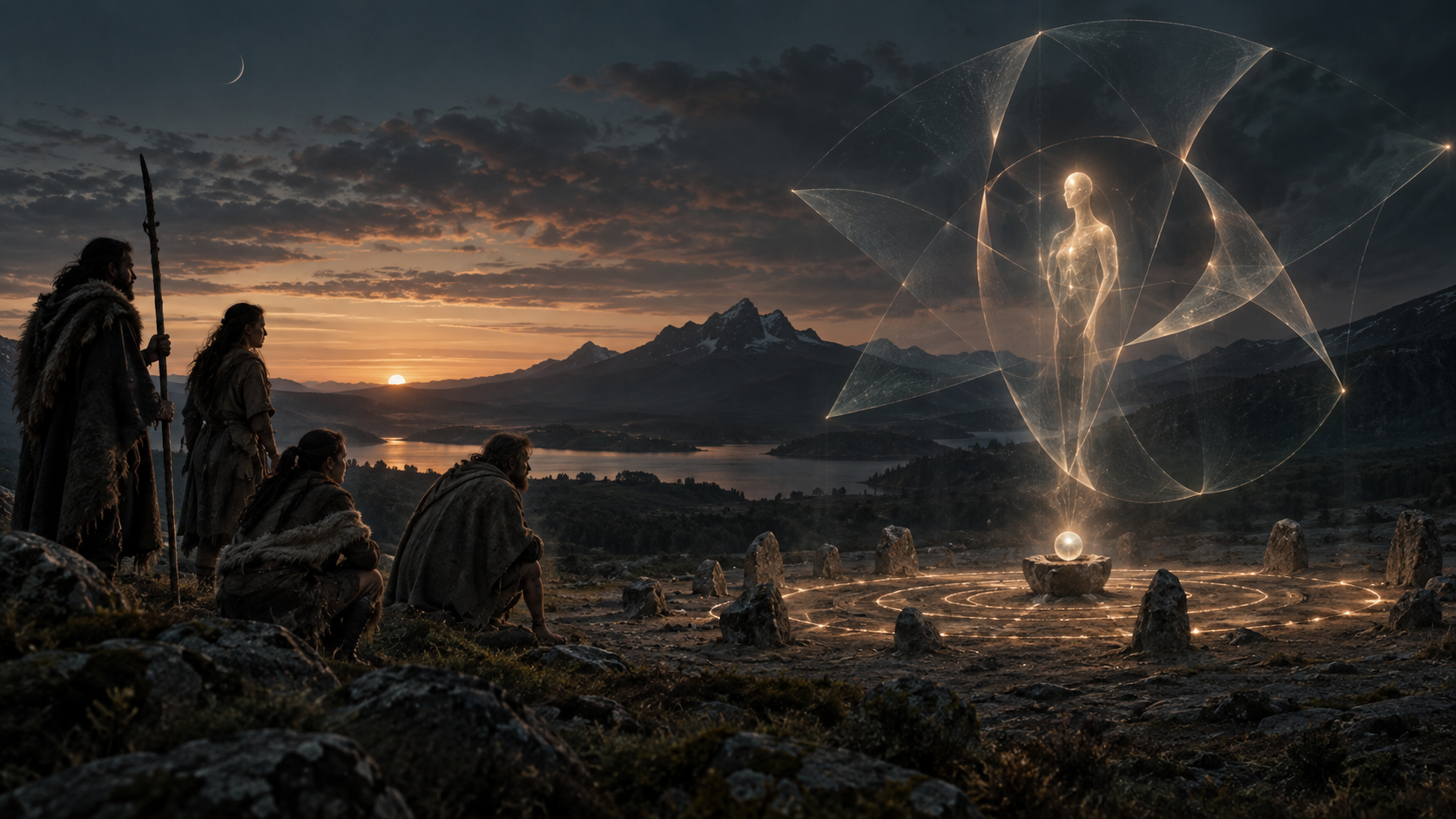
The Event Fossil
The simplest model is accidental preservation.
A rare encounter creates intense social pressure: fear, wonder, injury, new knowledge, a changed boundary, or a struggle over authority. The sensory details decay, but the relationship between the parts remains. Something arrived. Someone crossed a boundary. An exchange occurred. A prohibition followed. The presence departed or promised to return.
The myth becomes an event fossil. A fossil does not preserve a living animal in full. It preserves enough structure to reveal that a particular kind of body once occupied the space. In the same way, a tradition might lose the visitors’ appearance and origin while retaining the encounter’s causal shape.
This model explains why the most durable element might be consequence rather than description. If an encounter created a dangerous zone, the story that kept people away would outlive an accurate account of the danger. If it changed who could rule or who controlled certain knowledge, later generations might remember a divine gift, a covenant, a theft, or a punishment. The tradition would survive because it continued doing social work.
A contact interpretation would need more than a recognizable pattern. Descent, forbidden knowledge, sky beings, luminous objects, floods, and world-changing gifts are widespread because human societies repeatedly confront power, disaster, hierarchy, weather, altered states, and the unknown. Those motifs carry little evidentiary weight by themselves.
An event fossil should instead form a traceable lineage. Its oldest recoverable versions should contain a stable and unusually specific structure before modern contact imagery entered the tradition. Its geographic spread should make sense in relation to known migration, language, and exchange. Ideally, archaeology or environmental evidence would independently date a matching event at the same place and period, even if the tradition helped researchers decide where to look.
Even then, the model would show that something happened—not automatically what happened.
The Procedure That Outlived Its Meaning
Stories describe, but rituals perform.
That difference creates a second route. The surviving trace of contact might not be an image of the visitors at all. It might be a sequence once associated with interacting safely or successfully with them.
A community could preserve a time of year, an orientation, a pattern of movement, a sound, a geometry, a restricted location, or an ordered response. The explanation would change as generations lost the original context, but the procedure could remain because it was sacred, socially important, or dangerous to alter.
Human cultures already transmit useful procedures without preserving a complete causal theory. On Indonesia’s Simeulue Island, the smong tradition taught that strong shaking followed by a retreating sea meant people should run uphill. Passed down after a 1907 tsunami, that oral rule contributed to rapid evacuation during the 2004 Indian Ocean tsunami. It preserved a relationship between signs and action, not a technical model of subduction. (McAdoo et al., 2006)
The speculative extension is a contact protocol whose syntax survives after its semantics die. A ritual might once have aligned an observer with a phenomenon, marked a safe distance from an object, answered a recurring signal, or reproduced part of an exchange.
Laboratory results are mixed and limited in scope. In a study of 3- to 6-year-olds, convention-oriented framing and agreement among multiple demonstrators increased imitative fidelity. In a preregistered adult experiment, high proportions of ritualized gestures impaired recall of individual gestures and overall sequence success, while low proportions showed only weak evidence of benefit. Millennial continuity would require custodianship, repetition, correction, a durable location or celestial anchor, and strong penalties against uncontrolled change. (Herrmann et al., 2013; Kapitány et al., 2018)
This model would make a risky prediction. The order of actions should remain more stable than the stories explaining them, and the procedure should correspond to something outside the tradition. Under safe, controlled, and preregistered conditions, it might identify a location, produce a measurement, or reveal a physical function that ordinary ritual history did not predict.
Obscurity would not be enough. A ritual does not become alien technology merely because modern observers do not understand it.
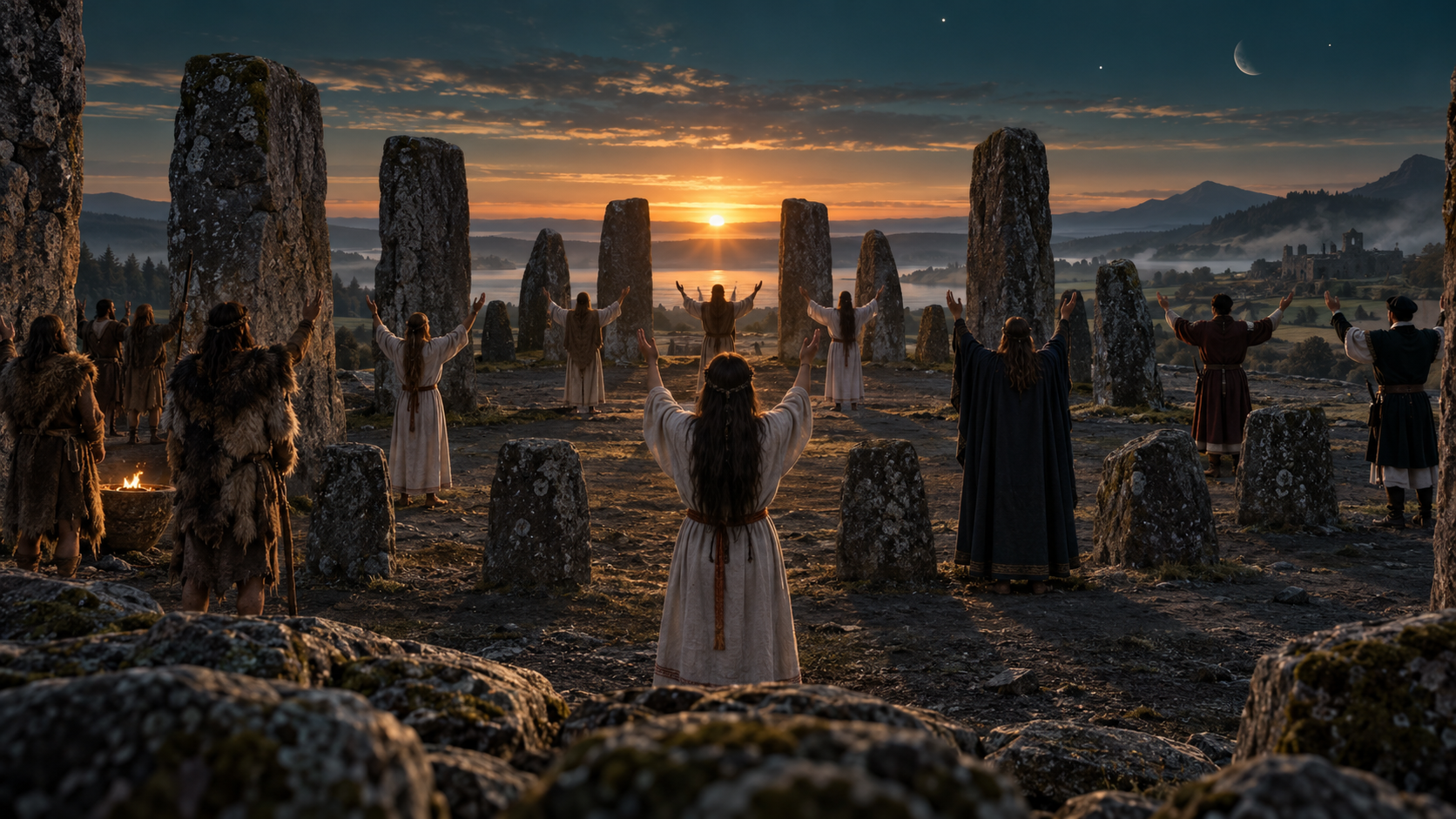
A Memory in Many Pieces
A third model gives up the search for one complete tradition.
Imagine that an encounter affected a population that later divided. One branch preserved the setting. Another retained an ordered sequence. A third remembered a warning. A fourth converted an astronomical reference into a seasonal ceremony. Each version changed, but the losses were different.
Together, the traditions could function loosely like redundancy in a noisy communication system. Repetition does not stop information from degrading, but overlapping copies can allow some lost structure to be reconstructed. Mythology would not literally be a digital error-correcting code. The analogy is useful only because it shows why several incomplete versions can sometimes constrain a common source more strongly than one detailed version can.
The ordinary explanations are formidable. Stories travel through migration, marriage, conquest, trade, translation, and religious conversion. Research on Eurasian folktales shows that distributions can reflect both population movement and diffusion across cultural boundaries. Separate traditions are therefore not automatically separate witnesses.
A distributed contact memory would require genuinely rare, linked details. “A being came from the sky” is too general. A sequence of arbitrary relationships—specific timing, geometry, material, action, consequence, and location—would be more useful, particularly if the pieces appeared in records collected before modern cross-contamination.
The variants would also need to constrain one another. If every new story permits another interpretation, the model gains flexibility rather than evidence. A strong reconstruction should narrow the possibilities and make a prospective prediction: an unexamined tradition should contain a missing element, a particular site should hold a defined material trace, or an astronomical target should possess a specified feature.
Only after multiple preregistered predictions succeeded, survived correction for multiple comparisons, and were independently reproduced would resemblance begin to look like recovery rather than post hoc matching.
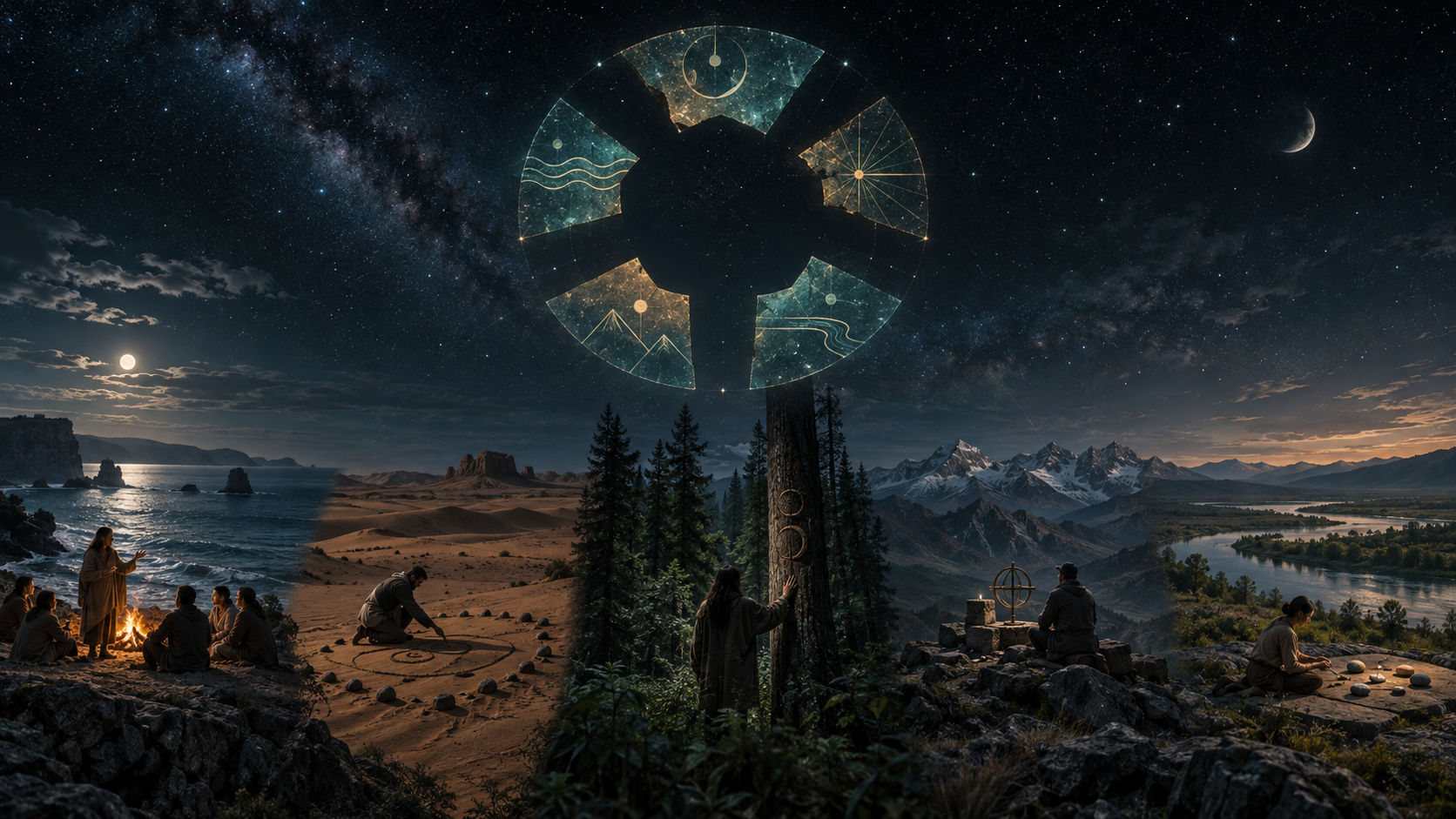
The Message Designed to Change
The fourth model replaces accidental survival with engineering.
An intelligence expecting its witnesses to die would face the same problem humans face when designing messages for unknown recipients. The Voyager Golden Record uses images, sounds, diagrams, and physical constants in an attempt to make part of Earth intelligible beyond human language. Nuclear-waste planners have confronted a shorter but equally difficult version of the problem: how can a warning remain recognizable for thousands of years after institutions, symbols, and languages change? Thomas Sebeok’s 1984 report on communication across ten millennia recommended a relay system built on periodic re-encoding, a mixture of iconic, indexical, and symbolic signs, and heavy redundancy; it did not assume one fixed sign would retain its meaning for ten millennia.
A non-human intelligence might reach the same conclusion. Metal corrodes. Monuments are reused. Archives require readers. A story, however, recruits every generation to copy it.
The engineered message would need two layers. Its surface would have to remain valuable inside changing human cultures: a warning, origin story, moral conflict, sacred duty, memorable being, or recurring ceremony. Beneath that adaptable surface, a more constrained structure would persist across several channels—narrative order, number, orientation, rhythm, landscape, celestial timing, or repeated relationships among symbols.
The goal would not be to prevent change. It would be to survive through change.
Such a message might remain incomplete until later observers acquired a missing measurement or analytical tool. A star pattern might disclose a more precise location only after better astronomical data; a repeated sequence might reveal a formal relation once suitable analytic methods existed; a ceremonial arrangement might gain a testable physical interpretation only after relevant instruments became available. The original witnesses would carry a form they could use, while the intended information waited for a civilization able to recognize a second layer.
This is a coherent design, but it demands extraordinary capabilities from the sender. It must understand human cognition, predict which cultural forms remain transmissible, distribute redundancy without making the message obvious too early, and supply an authentication key that later interpreters cannot manufacture from flexible symbolism.
Without that key, any sufficiently rich mythology can be made to resemble a code.
The Myth That Builds Its Future Reader
The deepest possibility begins when the message contains more than information.
A civilization communicating across ten thousand years might not try to preserve a sentence. It might try to cultivate the kind of recipient capable of completing the communication.
Under this model, mythology is not a damaged archive but a deliberately self-renewing pattern: its surface changes in retelling while successive versions keep rebuilding the same deep relationships. Visitor and host. Gift and obligation. Knowledge and danger. Separation and return. The surface adapts to new religions, political orders, artistic forms, and technologies, while the tradition keeps rebuilding a conceptual space in which non-human contact can eventually become thinkable.
The distortion would not be a flaw in the system. It would be part of the developmental process.
Ancient witnesses might receive only the first half of the exchange. Their descendants preserve it because the story helps organize life, not because they know it contains a future message. Over centuries, the tradition encourages observation of the sky, protection of a location, repetition of a sequence, or reflection on the moral limits of knowledge. Eventually, a planetary civilization develops comparative archives, archaeology, precise dating, computation, and instruments capable of discovering the pattern’s external anchor.
At that point the story becomes legible in a new way—not because modern people are smarter than their ancestors, but because the receiver is finally complete.
The intended recipient may never have been the community that first encountered the source. It may have been the later civilization that community would help produce.
This changes the meaning of contact. It is no longer a meeting between beings at one place and time. It is a process distributed across generations, with human culture serving simultaneously as carrier, transformer, and decoder. In this model, the sender would not need to remain present. It would exert influence indirectly through a pattern that continued shaping the receiving civilization after every witness was gone.
The oldest contact event on Earth would still be happening.
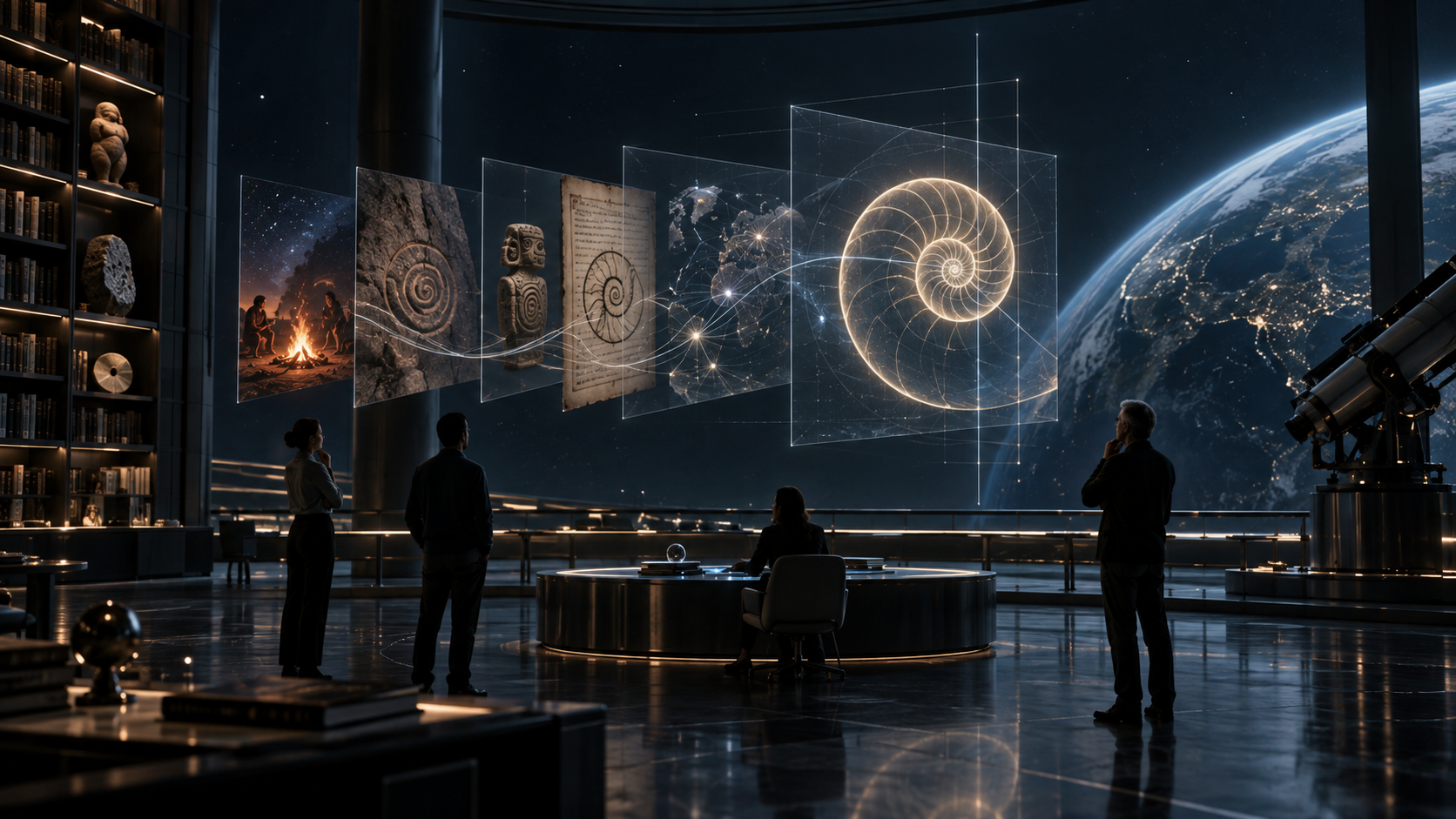
Where the Pattern Would Break
The more powerful this possibility becomes, the more sharply it must be constrained.
Evidence would need to climb several levels. Resemblance is weakest: broad motifs such as luminous beings, floods, ascent, forbidden knowledge, and voices from the sky are expected to recur. Genealogy is stronger: securely dated records and phylogenetic models can support—but not prove—an older lineage and possible transmission path. Specificity matters more: a rare linked bundle is documented in early sources across branches. External correspondence matters only when independent evidence matches a specific reconstruction under criteria fixed before comparison. Authentication is strongest: a preregistered decoding rule repeatedly yields novel, independently verifiable information or risky predictions that independent teams reproduce, with alternative decodings and false-positive rates explicitly tested.
No known ancient-contact claim currently completes that climb.
Each model also has its own point of failure. The event fossil weakens when its supposedly ancient technical features appear only in late translations. The ritual model weakens when the sequence changes freely or produces no external result. The distributed-memory model fails when apparently independent traditions can be connected through ordinary exchange. The engineered-message model collapses into numerology when interpreters may choose symbols, translations, numbers, and correspondences after seeing the answer they want.
A real investigation would begin with securely documented versions, not modern summaries. It would map trade, migration, conquest, missionary influence, collecting practices, and online contamination. Motif coding and decoding rules would be registered before testing. Mismatches would remain visible. Claims would have to generate information rather than merely reorganize familiar material.
There is also an ethical boundary. Living traditions are not abandoned datasets waiting for outsiders to extract alien technology from them. Descendant communities hold language, context, custodial responsibilities, and interpretive authority that an archive or laboratory may lack. Research would require collaboration rather than appropriation.
Nor would verified contact subtract human achievement from the past. Temples, calendars, cities, navigation, mathematics, art, and social institutions remain human accomplishments unless evidence shows otherwise. An encounter could have entered a tradition without building the civilization that preserved it.
The standard must remain demanding because mythology is powerful enough to reward almost any pattern imposed upon it. A model that can decode every story has not found a hidden archive. It has built a mirror.
The Story Waiting for Its Second Event
Suppose one tradition eventually did something ordinary myth should not be able to do.
A reconstruction fixed before excavation predicts a specific object in a specific place. The object supplies an independent key. Variants once treated as contradictions resolve into complementary parts of one constrained message. The result survives replication and contains information unavailable to the cultures that carried it.
The discovery would not show that ancient people mistook machines for gods. It would reveal something more consequential: culture itself can become a medium of communication between intelligences separated by deep time.
The oldest contact artifact would not sit intact beneath a temple. It would be distributed across languages, rituals, landscapes, images, and generations—altered by every mind that helped keep it alive.
The first event would be encounter.
The second would be recognition.
And the story may have spent ten thousand years building the civilization capable of answering it.
More in SPEC
What If First Contact Happens Inside the Mind?
Explores the parallel problem of separating an externally sourced message from the human mental systems that receive and interpret it.
What If First Contact Is an Archive?
Examines contact as preserved information from a civilization that may no longer be present—the future-facing counterpart to mythology as a deep-time archive.
What If Humanity Was a Million-Year Project?
Develops another ancient-intervention pathway in which the surviving trace is found in biological history rather than inherited narrative.
Sources / Receipts
- Ruth S. Ludwin et al. — “Dating the 1700 Cascadia Earthquake: Great Coastal Earthquakes in Native Stories”
Compares Pacific Northwest Indigenous accounts and genealogical estimates with the independently established 1700 Cascadia earthquake. It supports the careful use of oral histories as evidence for event memory without treating every narrative detail as literal. - Patrick D. Nunn and Nicholas J. Reid — “Aboriginal Memories of Inundation of the Australian Coast Dating from More than 7000 Years Ago”
Argues that several place-specific traditions are consistent with landscapes flooded by postglacial sea-level rise. The proposed ages are inferred from reconstructed geography; the stories themselves are not directly dated. - Sara Graça da Silva and Jamshid J. Tehrani — “Comparative Phylogenetic Analyses Uncover the Ancient Roots of Indo-European Folktales”
Uses linguistic phylogenies to estimate the inheritance histories of folktale families. The method can support narrative antiquity, but it does not establish that the events within a tale occurred. - Richard E. W. Berl et al. — “Prestige and Content Biases Together Shape the Cultural Transmission of Narratives”
In a modern experiment using constructed creation stories, these researchers found higher recall for social, survival-related, negative-emotional, and biologically counterintuitive propositions. The result concerns short-term recall under controlled conditions, not millennial fidelity. - William Hirst and Gerald Echterhoff — “Remembering in Conversations: The Social Sharing and Reshaping of Memories”
Reviews how conversation can reinforce, alter, suppress, and align memory. It helps explain why a shared narrative can converge without functioning as independent corroboration. - Rohan Kapitány et al. — “Examining Memory for Ritualized Gesture in Complex Causal Sequences”
A preregistered experiment found clear evidence that high proportions of ritualized gesture impaired recall and only weak evidence that low proportions improved overall success. It cautions against treating ritual as a uniformly high-fidelity storage system. - Eugenio Bortolini et al. — “Inferring Patterns of Folktale Diffusion Using Genomic Data”
Examines how folktales spread through population movement and diffusion across linguistic boundaries. It grounds the need to test ordinary transmission before treating similar traditions as independent witnesses. - Thomas A. Sebeok — Communication Measures to Bridge Ten Millennia
Explores long-duration warning through periodic re-encoding, multiple sign types, redundancy, and institutional continuity. It is an analogy to the communication problem, not evidence that myth can carry an engineered message. - NASA — Voyager Golden Record Overview
Describes a deliberate attempt to communicate aspects of Earth through images, sounds, diagrams, and physical reference points to an unknown recipient. - NASA — Unidentified Anomalous Phenomena Independent Study Team Report
Reports no conclusive peer-reviewed evidence of an extraterrestrial origin for UAP as of 2023. It concerns modern UAP evidence and does not evaluate ancient myths.


Discussion