
The Moon has always felt like more than a rock.
It hangs above human history like a witness. Older than empires. Older than scripture. Older than every map, border, and language we now treat as permanent. Civilizations have used it to measure time, encode myth, track ritual, and imagine the unknown. But for all its familiarity, the Moon remains strangely unopened.
We have touched it, photographed it, orbited it, sampled it.
But we have not truly exhausted it.
And now, as the Moon returns to the center of geopolitical ambition, a deeper question quietly re-emerges: what if the next great lunar discovery is not just water, minerals, or engineering access, but evidence that the Moon has preserved something older than our current story of history?
Not necessarily a city.
Not necessarily a craft.
Not necessarily a revelation dramatic enough to fit a movie.
Something subtler than that.
An artifact.
A vault.
A remnant.
A sign that the Moon may be less like a frontier and more like an archive.
Central Question
Could the Moon be hiding alien relics, ancient human artifacts, or some other preserved trace of intelligence that would radically alter how humanity understands its past and its place in the cosmos?
Nature of the Inquiry
This is not simply a question about extraterrestrials.
It is a question about preservation, memory, and where intelligence leaves its traces.
The Moon matters in this conversation because it is not Earth. It has no weather in the human sense, no flowing water, no biosphere, no tectonic recycling comparable to our own. That makes it, at least in principle, a place where material could endure differently than it does here. The lunar environment is harsh, but it is also stable in ways that Earth is not. NASA’s Lunar Reconnaissance Orbiter has mapped the Moon in high detail, including permanently shadowed regions and polar areas where water ice appears to persist, while lunar pits and possible lava-tube skylights have become serious scientific targets because they may preserve material and provide shelter from surface extremes.
That means the Moon is not only a destination for future bases.
It is also a different kind of storage medium.
And once you see it that way, the deeper question begins to widen.
If intelligence existed elsewhere and ever moved through this region of space, could the Moon have preserved evidence better than Earth?
If some forgotten human or prehuman technological phase ever existed, however unlikely, would the Moon be a better place to look for its traces than Earth’s constantly recycled surface?
And if no such artifacts exist, what does our urge to ask this question reveal about the human need for hidden continuity beneath official history?
That is why this belongs in Deep Think.
Because the real subject is not only relics.
It is the relationship between cosmic archaeology and civilizational self-understanding.
Why This Question Matters
The modern return to the Moon is not imaginary. NASA’s Artemis program now targets a first lunar landing in 2028, while China’s Chang’e program has already completed major robotic missions including sample-return missions, and Chang’e-6 brought back the first samples from the lunar far side in 2024. Water ice, polar access, scientific opportunity, and long-term infrastructure are central reasons the Moon has become strategically important again.
Officially, this renewed interest is about science, capability, and future exploration.
And that is true.
But whenever a place shifts from symbolic to strategic, imagination follows close behind. The Moon is no longer just a poetic object or a Cold War memory. It is becoming active territory again. A place of plans, routes, claims, logistics, extraction, shelter, and long-term presence.
That alone changes the psychological atmosphere.
Because the moment a place becomes newly explorable, it also becomes newly suspect.
People begin asking what was missed there before.
What older missions overlooked.
What future instruments might reveal.
What the next layer of resolution will uncover.
And that tension between official science and speculative possibility is where this question draws its energy.
Not because every speculation is credible.
But because the Moon occupies a rare zone where myth, archaeology, state power, and cosmic wonder all overlap at once.
Compatible Perspectives
There are several ways this question can be approached without forcing it into either blind belief or dismissive cynicism.
The Moon as a Natural Archive
The most grounded version begins with material reality.
Earth is difficult on the past. It erodes, subducts, floods, burns, grows over, and recycles. The Moon does not preserve everything, but it preserves differently. Its lack of atmosphere, weather, and active geology means that some surface traces and subsurface structures can endure for very long times, especially in sheltered environments. That is part of why lunar pits, possible lava tubes, and permanently shadowed regions are scientifically compelling. NASA has highlighted lunar pits as possible skylights into lava tubes, and these features are often discussed as prime targets for future exploration and possible sheltering.
In that sense, the Moon does not need to hide alien ruins to become archaeologically interesting.
It only needs to be better at keeping secrets than Earth.
The Moon as a Technological Waystation
A second perspective is more speculative but still structurally plausible.
If an advanced civilization ever operated within this solar system, the Moon would make sense as a place of interest. It is gravitationally accessible relative to deeper planetary surfaces, rich in scientific value, and offers long sightlines, stable terrain, and regions that may support long-term infrastructure. Human planners already view the lunar south pole as strategically important because of illumination conditions and access to water ice.
That does not suggest evidence exists.
It suggests the Moon is the kind of place intelligence would likely use.
Which is a different and more serious thought.
The Moon as a Mirror for Forgotten History
Then there is the ancient-human-artifact angle.
Taken literally, claims of lost lunar civilizations or ancient human moon bases are not supported by accepted archaeological or scientific evidence. But the persistence of this idea tells us something psychologically important. Humans repeatedly intuit that history is thinner than reality. That something has been forgotten. That the official timeline, even when broadly correct, may still be incomplete in spirit.
The Moon becomes a canvas for this instinct because it feels like an untouched extension of origins. A nearby elsewhere. A place where the missing chapter might be waiting if only we dug in the right crater.
This is not evidence.
It is mythic pressure.
But mythic pressure is often where serious questions first begin.
The Archaeology of Another Intelligence
Archaeology is usually imagined as an Earthbound discipline.
Ruins. Pottery. Bones. Settlement layers. Inscriptions. Fragments of intention made material.
But at a deeper level, archaeology is the study of time made visible.
And that frame can be widened.
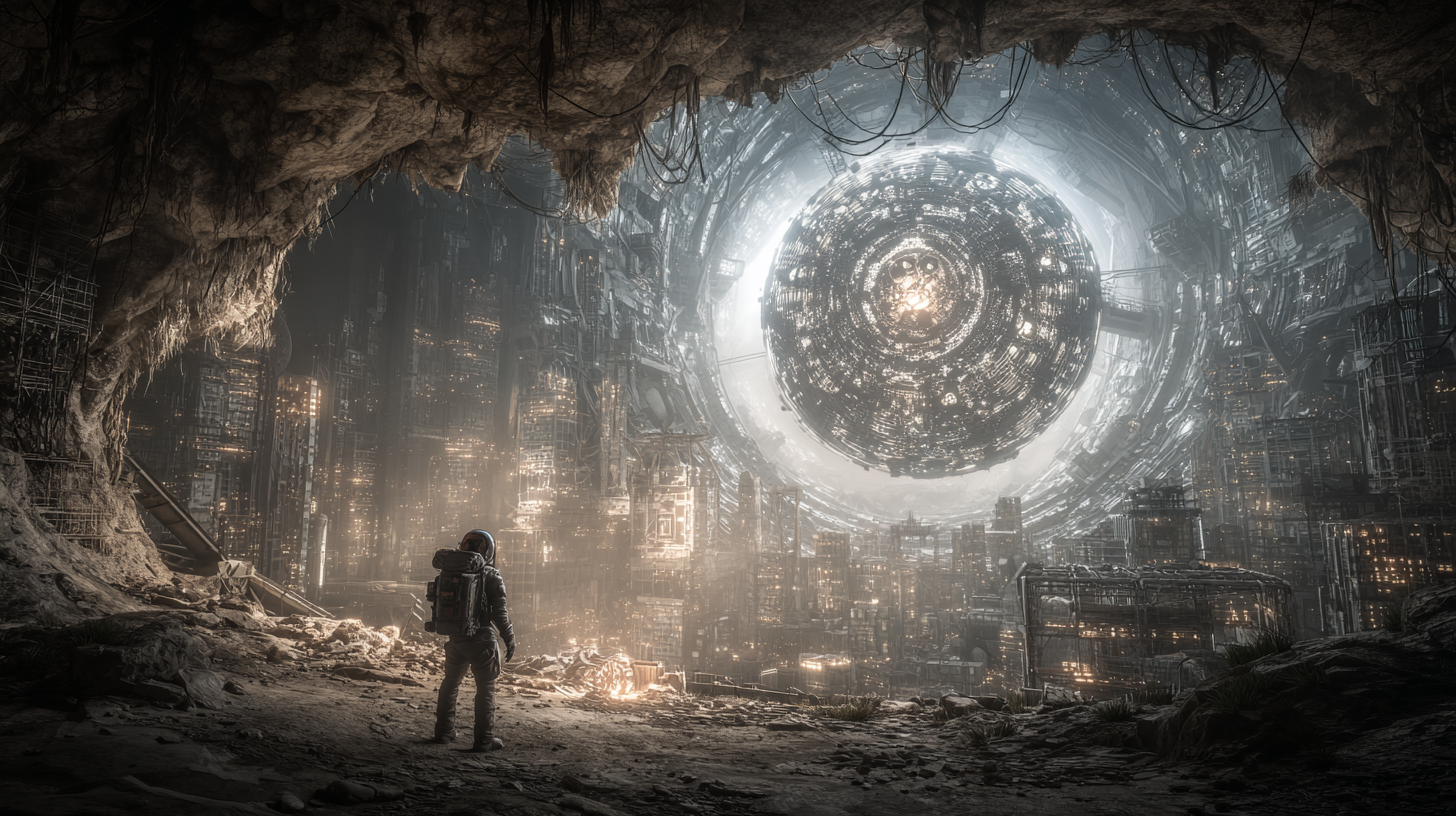
If intelligence leaves traces, and if those traces persist, then in principle there can be an archaeology of non-human intelligence. Not mythology. Not disclosure culture. Actual trace-hunting. Pattern recognition. Context analysis. Material interpretation. The same basic logic used to understand vanished human worlds, extended into a larger cosmic arena.
The Moon is one of the few places close enough for this idea to feel tangible.
Not proven.
Not even likely in any settled sense.
But tangible.
Because it sits in the strange middle ground between myth and field site.
Too near to remain fully abstract.
Too unexplored to feel closed.
And that creates a powerful thought:
What if first contact is not a meeting, but an excavation?
What if humanity’s first undeniable confrontation with another intelligence does not come through a message in the sky, but through an object in the dust?
A structure that should not be there.
A material ratio not produced by geology.
A patterned cavity.
A worked surface.
A preserved machine fragment.
An archive deposited not for us specifically, but simply because the Moon was stable enough to keep it.
That possibility is exactly why the lunar question lingers even when evidence does not yet justify belief.
Because it transforms contact from event into residue.
Contrasting Views
This is where discipline matters.
Because the Moon has long attracted projection.
The Skeptical View
The skeptical position is straightforward and important: there is no accepted scientific evidence that alien relics, ancient human lunar artifacts, or crashed extraterrestrial craft have been found on the Moon. Most anomaly narratives collapse under scrutiny, image artifacts, low-resolution interpretation, selective framing, or a desire to fill uncertainty with intention.
That caution is healthy.
Without it, every shadow becomes a monument.
The Strategic-Realist View
A more grounded alternative to the “cover-up” angle is simply that the Moon is strategically valuable on its own terms. NASA and other major space actors are focused on access, science, long-term infrastructure, and future human operations. Water ice, polar illumination, communications, terrain, sheltering options, and logistics are enough to explain intense interest without invoking hidden relics.
This view does not kill the mystery.
It just refuses to smuggle meaning into ordinary strategic behavior.
The Deep-Time View
Then there is a more interesting middle ground.
It says: no current evidence justifies specific extraordinary claims, but the Moon is still exactly the kind of place where future discoveries could surprise us. Not necessarily with alien monuments or lost human vaults, but with preserved geological, technological, or historical traces that shift what questions become reasonable to ask.
This view keeps humility without collapsing wonder.
And that may be the most honest stance available.
What If the Moon Is Not a Frontier, But a Memory Device?
This is where the inquiry deepens.
Humanity tends to imagine exploration as expansion.
We go outward to gain territory, knowledge, resources, prestige, and eventually perhaps survival space.
But what if some places in space are not most significant as frontiers?
What if they matter because they preserve memory?
The Moon may be the closest thing in our neighborhood to a material witness. Not conscious. Not active. But durable. A body that has watched Earth’s story unfold from near enough to be implicated and far enough to remain comparatively untouched.
That changes the emotional logic of lunar exploration.
You are no longer just going there to build.
You are also going there to read.
To drill into shadow.
To inspect what survived.
To search not just for utility, but for residue.
And once the Moon becomes legible as a possible memory device, the relic question stops sounding purely fringe.
It becomes philosophical.
Because every civilization eventually has to ask whether reality stores more of its past than current institutions can remember.
Broader Context
The deeper reason this question matters is not the thrill of hidden artifacts.
It is what discovery would do to the human story.
If the Moon held evidence of alien intelligence, then Earth would no longer feel like the unquestioned center of meaning. Human civilization would become one expression within a broader field of intelligence, and cosmic archaeology would replace cosmic loneliness as the defining frame.
If the Moon somehow held evidence of an unknown technological phase tied to humanity or a human precursor, the effect would be different but equally destabilizing. History itself would become less linear. Progress would look less secure. The story of civilization would shift from ascent to recurrence, with all the moral consequences that implies.
And if the Moon holds none of these things?
Even then the question remains revealing.
Because it shows that modern humanity increasingly suspects the universe is layered. That the visible story may not be the whole story. That archives may exist outside institutions. That truth may sometimes wait in places too quiet, too remote, or too durable to fit our normal pathways of knowledge.
That instinct is not proof.
But it is not trivial either.
It may be part of what drives science forward in the first place: the refusal to believe that current visibility equals total reality.
What If…?
What if the most important discovery on the Moon is not a base, a fuel source, or a territorial foothold?
What if it is evidence that intelligence leaves behind more than messages?
What if the universe stores traces not in the places where life is loudest, but in the places where time is gentlest?
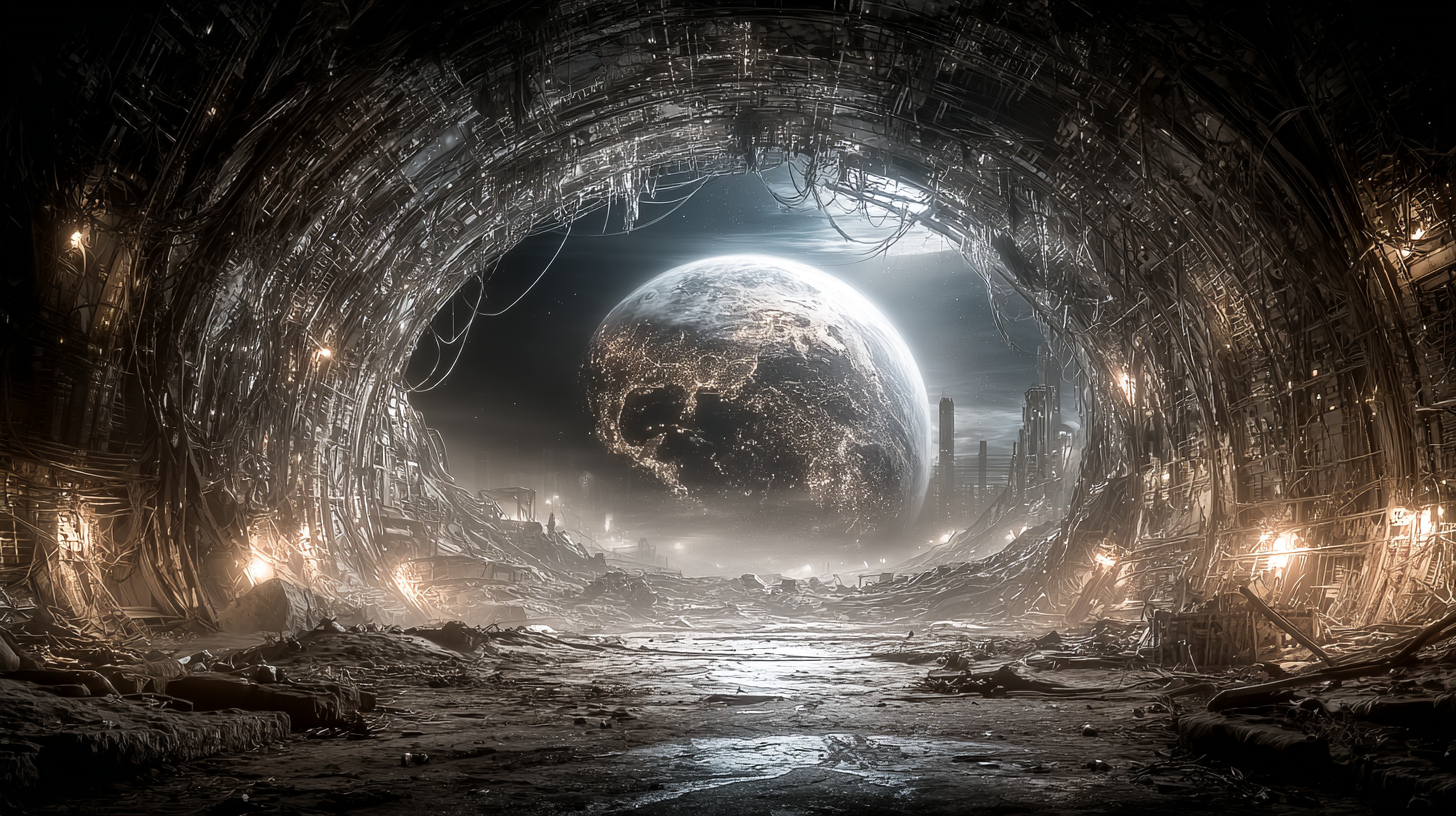
What if the Moon, so familiar in symbol and so unfamiliar in detail, turns out to be one of the first true libraries humanity ever learns to read beyond Earth?
And what if the relic question, whether or not it is ever confirmed literally, is really asking something even deeper:
How much of reality’s memory still lies outside our current story of the world?
Open Reflection
The Moon invites projection because it sits at a perfect distance.
Close enough to touch.
Far enough to mythologize.
Ancient enough to feel prior to us.
Silent enough to make us wonder what silence can hold.
Maybe there are no alien relics in its dust.
Maybe there are no ancient human artifacts waiting beneath a crater floor.
Maybe the next decades of lunar exploration will reveal only geology, water, engineering constraints, and the ordinary magnificence of another world becoming knowable in detail.
That would still matter.
But the question persists because the Moon has become, for humanity, more than an object of exploration. It has become a test of whether the cosmos contains preserved traces that could reorganize our sense of origin, time, and intelligence.
In that sense, the real mystery is not just whether something is hidden there.
It is whether we are entering an era in which celestial bodies stop being scenery and start becoming archives.
What do you think? Drop your thoughts in the comments
Receipts / Sources
- The original Galactic Mind post frames the Moon as a site of possible hidden relics, artifacts, and deeper civilizational implications.
- NASA says Artemis remains part of its Moon-to-Mars architecture, and as of 2026 NASA had updated plans toward later lunar-surface missions, with Artemis IV tied to a south-pole surface stay and NASA’s broader Artemis page still targeting an early 2028 lunar landing.
- NASA says water ice appears in permanently shadowed regions near the Moon’s poles, and LRO has played a major role in mapping polar conditions and high-resolution lunar terrain.
- NASA has identified lunar pits and possible lava-tube skylights as real features of scientific interest and possible targets for future exploration and sheltering.
- China’s lunar program has already completed sample-return missions, and Chang’e-6 returned the first samples from the Moon’s far side in 2024.


Discussion