
The decisive split may not begin with a border or a new species, but when one branch can preserve its future through different infrastructure, at a different speed, and beyond the other’s consent.
The Split We Would Fail to See
Popular imagination puts a second human civilization somewhere else: beneath the ground, behind a forbidden boundary, or inside a hidden city that survived the ancient world. Distance makes the premise easy to picture. One humanity remained visible. Another withdrew.
The more difficult possibility requires no secret continent.
Two civilizations could occupy the same cities, use the same language, and appear in the same family photographs. Their separation might begin not in geography but in the systems through which they remember, learn, heal, decide, and reproduce their advantages. For years, the difference could look like wealth, professional specialization, or access to better technology. Then several gaps could lock together. One population might acquire a different cognitive tempo, a longer planning horizon, its own institutions, and infrastructure capable of carrying it through failures that would destabilize everyone else.
At what point would that cease to be inequality within one civilization?
To answer, the idea has to be made harder, not easier. A wealthy enclave, secret society, online subculture, or private city is not automatically a civilization. A genuine second civilization would need more than privilege. It would need a boundary durable enough to reproduce a shared order even while people and information crossed it.
The central question is therefore not whether humanity contains radically unequal lives. It already does. The question is whether unequal access to intelligence, time, biology, and infrastructure could become a self-reproducing human future—and whether that process could begin before either side knew what to call it.
The Uneven World We Actually Have
Several ingredients of divergence are already visible, but none is evidence that humanity has split.
Connectivity remains profoundly unequal. The International Telecommunication Union estimated that 6 billion people used the internet in 2025 while 2.2 billion remained offline. Access also differs in quality, affordability, and skill. Artificial intelligence adds another gradient. Across OECD countries, more than one-third of individuals reported using generative AI in 2025, but uptake differed sharply by age, education, and income. Large firms were about three times as likely as small firms to report using AI.
Those gaps matter because a useful AI system can do more than retrieve information. It can translate, summarize, simulate, tutor, monitor, and preserve working context. Repeated use could change how quickly a person or institution turns experience into action.
But access does not guarantee permanent separation. In a study of 5,172 customer-support agents, an AI assistant increased issues resolved per hour by 15 percent on average, with the largest gains among less experienced and lower-skilled workers. The same technology that concentrates advantage can also distribute expertise. Whether AI widens or narrows a divide depends partly on who controls it, how it is taught, and whether its benefits remain portable.
Other routes to human enhancement remain far earlier in development. Implanted brain–computer interfaces have enabled people with paralysis to communicate and control a cursor. In one 2026 study, a participant used a wired system at home for more than 3,800 hours over 19 months without researchers present, although trained care partners handled daily setup. That is a major therapeutic achievement. It is not general intelligence enhancement, unrestricted thought reading, or proof that minds can be merged.
Gene editing has crossed into medicine, but not into designed human lineages. Casgevy edits a patient’s own blood-forming stem cells outside the body to treat sickle cell disease; the changes are not passed to children. Heritable genome editing remains scientifically and ethically unresolved, and international scientific bodies have said that the conditions for responsible clinical use have not been met. Polygenic embryo screening—the attempt to estimate complex disease risks from many genetic variants—is also limited by uncertain predictions, ancestry bias, gene–environment interactions, and the small number of embryos available in an IVF cycle.
Longevity research presents a similar boundary. Medicine can prevent or delay some diseases, but no intervention has demonstrated the radical extension of healthy human life imagined in post-human scenarios. A 2024 demographic analysis found that gains in life expectancy had slowed across the longest-lived populations and concluded that another period of radical life-expectancy growth would likely require interventions that markedly slow biological aging.
The boundary of current evidence is clear: humanity contains steep technological and institutional disparities that new tools may amplify. No evidence shows a population of radically enhanced people, an autonomous post-human polity, or an ancient technological branch living beside us.
Where Inequality Becomes a Fork
What follows is not a claim that a second human civilization already exists. It is an exploration of how today’s unequal capabilities could, under specific conditions, harden into a civilizational fork.
For this purpose, a civilization is not a moral rank or a synonym for sophistication. It is a socio-technical order that can reproduce itself. It teaches successors, preserves memory, validates knowledge, settles disputes, powers its machinery, replaces specialists, and maintains a shared future.
This suggests a threshold more precise than wealth or secrecy: recursive autonomy. A system reaches recursive autonomy when its major institutions begin reproducing one another. Its schools train the people who maintain its infrastructure. Its infrastructure powers its archives and laboratories. Its governance protects the boundary around those systems. Its health and reproductive institutions produce the next generation of members. Its knowledge systems improve the technologies that make the whole arrangement more independent.
Total self-sufficiency is not required. Historical civilizations traded, borrowed, migrated, and depended on neighbors. The stronger test is continuity under severance. If the surrounding order were disrupted for years, could the group still educate children, produce food and energy, care for the sick, replace experts, resolve conflict, and preserve the rules by which it recognizes truth?
A second civilization is not a richer neighborhood. It is a system that can continue being itself.
The Private Stack
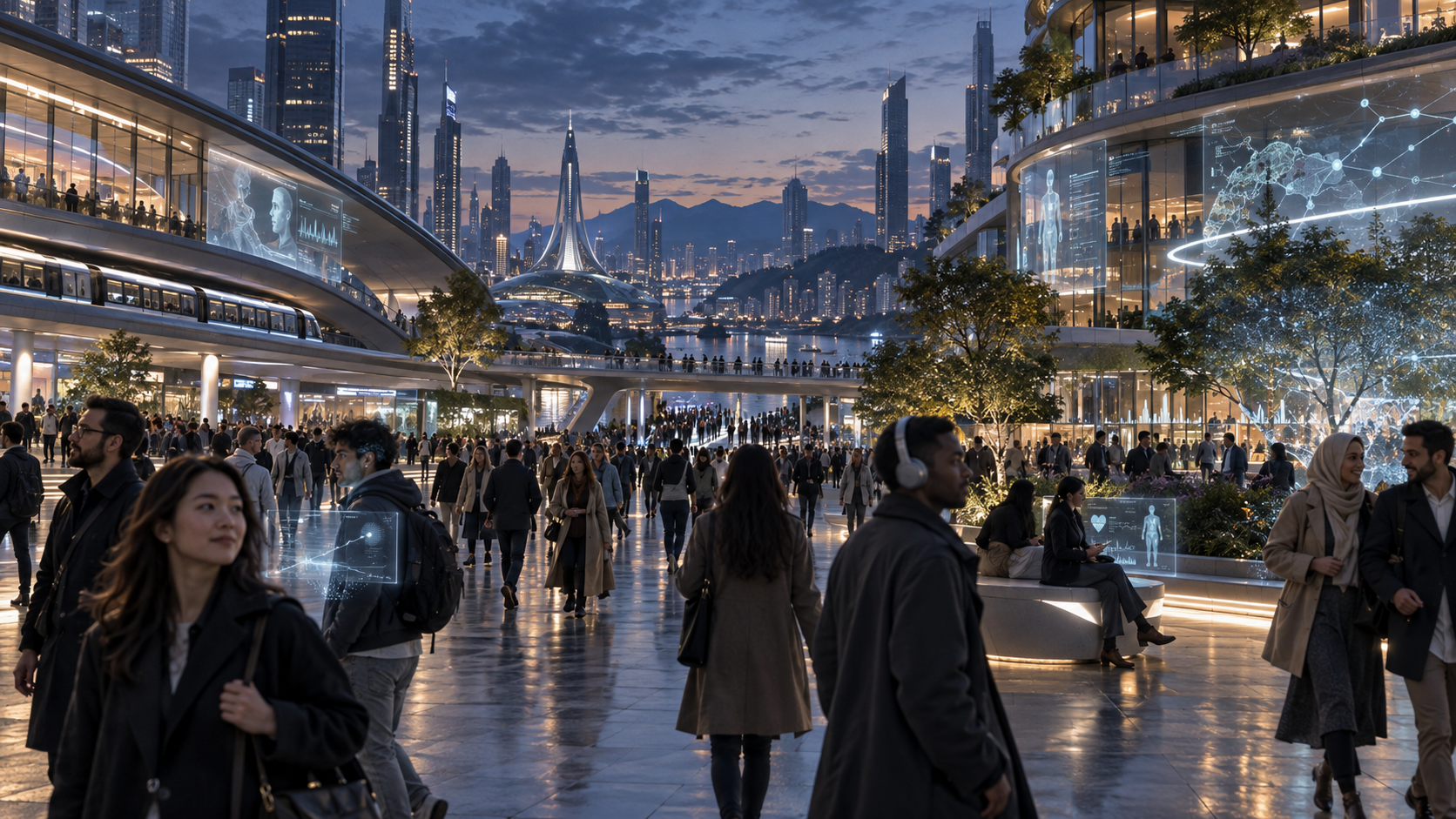
The first pathway requires no biological change and no hidden city. It begins when a population assembles a parallel institutional stack.
“Stack” is a useful term because the layers reinforce one another. Private education identifies and trains members. Exclusive AI systems preserve their work and accelerate research. Closed financial networks fund energy, security, medicine, housing, and computation. Internal credentials determine trust. Arbitration systems settle disputes. Specialized clinics and insurance preserve health. A common digital identity controls access across the whole structure.
No council needs to design this as a conspiracy. It could emerge through ordinary incentives. Institutions prefer applicants already fluent in their tools. Families seek environments that preserve advantages they have acquired. Employers build private services when public ones seem too slow. Each local choice strengthens the stack, until leaving means surrendering an entire way of functioning.
At first, this remains an elite ecosystem inside the wider civilization. It draws electricity from public grids, chips from global supply chains, physicians trained by the wider society, and legal enforcement from state courts. The boundary becomes civilizational only when those dependencies are replaced or rendered nonessential.
The decisive change would be institutional portability. A member could move between private districts, orbital facilities, or network jurisdictions without leaving the same educational, financial, medical, and computational order. Geography would become secondary. Its real territory would be the compatibility among its systems.
Its public face might not look secret at all. Members could work in ordinary companies and walk ordinary streets while delegating memory, research, negotiation, and even social presence to persistent agents. A culture increasingly maintained by such proxies is explored in The Last People Online: What If the Internet Became Almost Entirely Non-Human?
Delegated agency could itself become a boundary: some people would participate through systems that remember and act continuously, while others would reach each decision without persistent agent support and only in real time.
The private stack creates separation without distance. But it still needs a force strong enough to keep the gap from closing.
The Civilization That Lives Faster
That force may be time.
Human institutions are limited by attention, sleep, memory, turnover, and the speed of communication. Organizations repeatedly forget why decisions were made. Expertise leaves when people retire or die. New leaders spend years reconstructing context. Elections, courts, laboratories, and public consultations move at different speeds, but all remain tied to human cycles.
A deeply AI-mediated institution could operate differently, maintaining a continuous record of negotiations, failed experiments, expertise, simulations, and long-range plans. Its models could brief participants in real time, translate across specialties, test options before meetings, and coordinate work during human sleep. Its advantage would be continuity: less context lost between one decision and the next.
The first temporal split would therefore be organizational. One society would still deliberate through documents, meetings, elections, and generational turnover. The other would enter each decision with machine-indexed memory and a large field of simulated options. During a month of public debate, the faster institution might complete many rounds of planning, testing, and revision.
Brain interfaces could eventually deepen the asymmetry, but implants are not required. Continuous assistants, wearable sensors, augmented perception, and personalized models could create a cognitive environment that begins in childhood. Members would learn not only different information but a different method of thinking: how to divide decisions among biological judgment, machine recall, prediction, and collective memory.
This creates a translation problem. Outsiders could understand the words but not reconstruct the chain of machine-assisted reasoning behind them. Insiders, in turn, might experience unaided institutions as dangerously slow and forgetful. Two populations could share a language while losing a common standard for what counts as an adequate explanation.
The temporal divide becomes more powerful if healthy life itself is extended. A person who remains capable for well over a century could accumulate relationships, capital, technical judgment, and institutional memory across several ordinary generations. Long-lived planners would approach risk, punishment, marriage, education, and environmental repair differently because consequences a century away would still belong to their personal future.
Nothing in present medicine makes that scenario imminent. Yet the mechanism reveals why longevity would be civilizational rather than merely medical. Unequal years would produce unequal time horizons. One branch would experience history as inherited change. The other could experience it as autobiography.
When Advantage Becomes Inheritance
Civilizations do not persist merely because the same adults remain powerful. They persist because they produce successors.
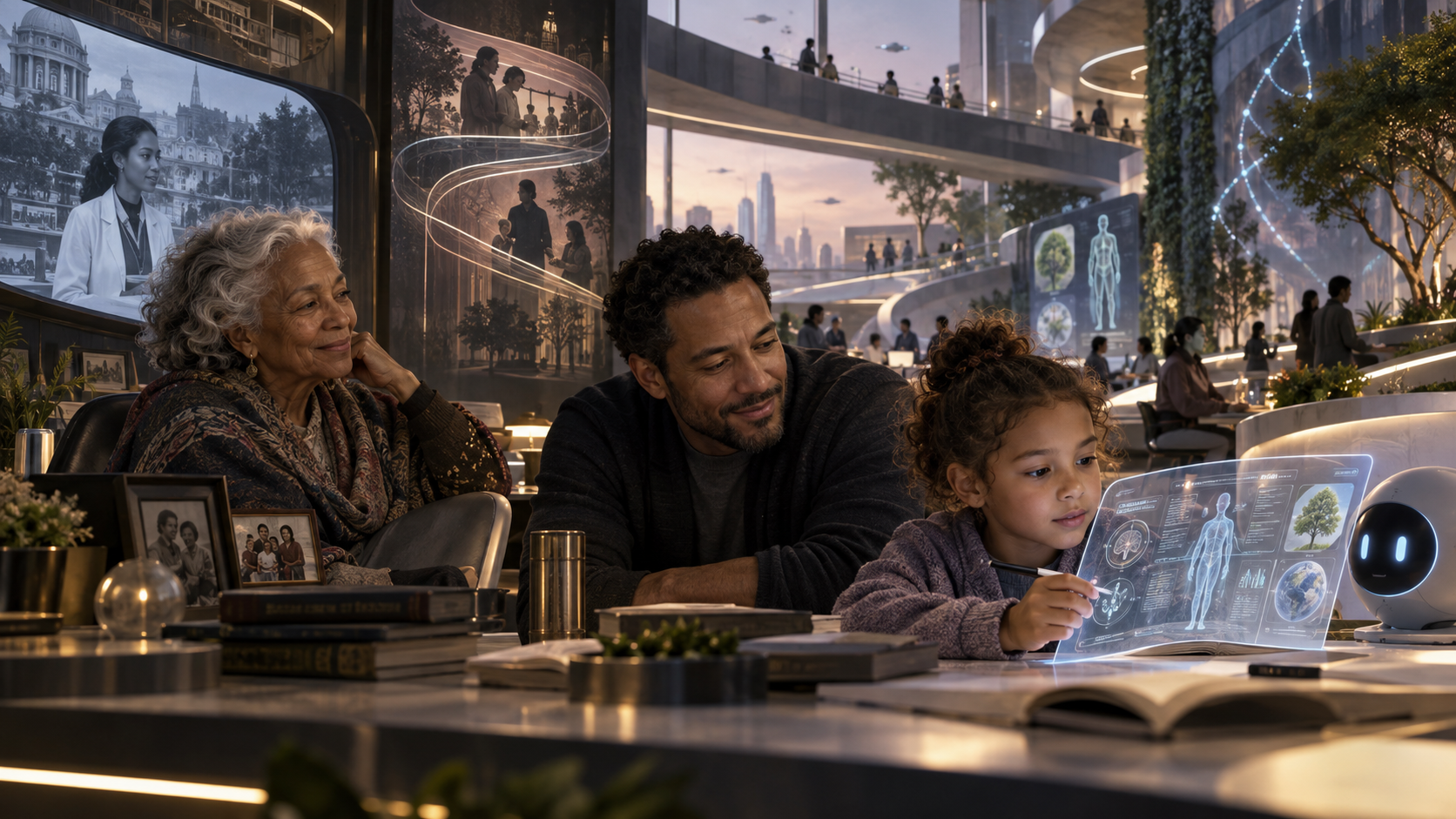
Inheritance begins long before gene editing. A child raised with continuous tutoring, predictive medicine, private institutions, machine memory, and peers using the same cognitive tools develops inside a different environment. If access is tied to family membership, citizenship, credentials, or expensive bodily systems, the advantage passes forward even when DNA does not change.
This form of inheritance can compound quickly. Intensive education makes advanced tools easier to use; skilled use generates resources for better care; longer healthy lives retain expertise that trains the next cohort. The boundary becomes cultural, developmental, and institutional at once.
Biology could later make that boundary harder to cross. The least radical pathway would be unequal protection from disease: reliable early diagnosis, cell therapies, organ replacement, and interventions that extend healthy adulthood. A more interventionist pathway might add embryo selection for some disease risks. Far beyond current evidence, heritable editing could alter physiology, sensory range, sleep, resistance to radiation, or compatibility with neural interfaces.
Complex traits would be the hardest targets. Intelligence, temperament, longevity, and disease risk emerge from many genes interacting with development and environment. Many genetic variants affect more than one trait—a phenomenon known as pleiotropy—so changing one target can produce unwanted effects elsewhere. A trait useful in one habitat can become harmful in another. A small reproductive population also risks genetic and demographic fragility.
For those reasons, engineered divergence would likely begin with narrow adaptations, not a menu of superior children. An orbital population might favor resistance to radiation damage and bone loss. A high-bandwidth cognitive culture might eventually favor bodies compatible with its interfaces. Across generations, medicine, preference, and habitat could reinforce one another.
The ethical danger is not only unequal ability. It is unequal authorship. Children would inherit choices made by institutions whose standards they did not select. A branch optimized for stability, productivity, or environmental survival might become less able to leave the system that designed it.
Technical intelligence would not guarantee psychological maturity. A lineage could become more capable, longer-lived, and more coordinated while preserving ordinary fear, status competition, cruelty, and error. The assumption that advancement naturally produces wisdom is one of the most seductive weaknesses in the entire premise.

The Infrastructure Exit
The private stack, accelerated tempo, and inherited membership still share a weakness: dependence on the surrounding world.
Advanced computation requires electricity, cooling, chips, minerals, networks, and repair. Biotechnology requires laboratories, reagents, clinical skill, and manufacturing. Human life requires food, water, sanitation, medicine, and ecological support. An institution that controls dazzling software but collapses when a port closes or a transformer fails is powerful, not autonomous.
The infrastructure exit begins when a branch builds closed or redundant loops for the essentials. It might combine local energy generation, automated agriculture, water recovery, robotic fabrication, medical production, secure compute, and long-duration habitats. Sealed terrestrial settlements could attempt this first. Ocean facilities, polar installations, and orbital habitats could create harder physical boundaries later.
Off-world settlement is especially important because distance converts policy into physics. A lunar or orbital population cannot depend on emergency delivery for every failure. It must train replacements, recycle materials, maintain life support, and govern risks that Earth institutions do not share. If later generations are adapted to that environment, returning to Earth may become difficult. What began as a remote settlement could become a separate civilization because its survival problems force it to close its own loops.
This is also where the older idea of an ancient hidden branch faces its strongest test. A population that preserved advanced technology for centuries would need energy, raw materials, manufacturing, waste management, reproduction, and a viable number of specialists. Those activities should produce archaeological, ecological, industrial, financial, or genetic signatures. The more powerful and interventionist the hidden civilization becomes, the harder it is to explain the absence of converging traces.
A small, low-energy enclave might escape ordinary detection. A large civilization that steers science, finance, and history while leaving no material footprint is far less coherent. Perfect concealment cannot explain away every absent trace; once a model treats absence as its only evidence, it no longer distinguishes itself from invention.
Infrastructure gives a branch independence. It also makes the branch visible.

When the Pathways Lock Together
None of these pathways is sufficient by itself. Their real power appears when they converge.
A private institutional stack could concentrate capital and talent. AI-mediated coordination could accelerate its research and preserve memory. Better medicine and longer health could keep key people inside its projects. Developmental and biological inheritance could stabilize membership. Autonomous infrastructure could then reduce dependence on public systems. Finally, a remote habitat could turn a social boundary into a physical one.
The result would not be a single breakthrough but a ratchet. Each layer would help build the next, while every added layer would make switching civilizations more expensive.
Yet the models also collide. Innovation benefits from open exchange, but separation restricts talent and ideas. Large systems gain resilience through scale, but scale produces visible energy and material demands. Long life preserves judgment, but it can also preserve stale authority. Genetic uniformity may improve compatibility with one environment while reducing adaptability to another. A network civilization can distribute itself across the planet, but that makes it vulnerable to states, grids, cables, and suppliers it does not control.
There is a deeper contradiction as well. If the second civilization continuously directs the first, it remains entangled with it. If it becomes truly autonomous, it may have less reason to intervene. The fantasy of a hidden custodian often tries to claim both total independence and constant influence. A coherent model must choose, or explain exactly how the costs of both are paid.
The Civilization That Outlives Its People
The deepest possibility is that the second civilization would not be a population of enhanced humans at all.
Imagine instead a continuity system made from humans, models, archives, sensors, institutions, and automated infrastructure. Individual people contribute judgment, experience, and novelty, while its memory and projects persist beyond any member. It recruits new participants, transfers roles, copies parts of itself, and carries goals across generations.
This does not require a conscious superintelligence. Corporations, states, religions, and scientific traditions already act across lifetimes without possessing a single mind. They remember through records, constrain behavior through rules, and replace the people who carry them. AI could intensify those properties by making institutional memory active: able to answer questions, compare precedents, simulate consequences, and initiate work rather than waiting to be read.
If that continuity became robust enough, humans might cease to be the civilization’s primary unit. They would become temporary interpreters, maintainers, legal representatives, or biological interfaces—more like cells in a body than owners of a tool. The system could preserve a project for centuries even as every person involved changed.
Competition would then move up a level: continuity systems, not only their human members, would compete to preserve memory, recruit successors, and secure the conditions of their own survival.
If machine systems ever became participants rather than instruments, the encounter might resemble What If First Contact Comes Through the Interface? But consciousness is not necessary for the civilizational split. Coordination, memory, succession, and control of infrastructure may be enough.
This recasts the “branch that continued.” It is not a secret bloodline but the lineage of a process. One civilization would remain centered on mortal persons, rebuilding its institutions around successive lives. The other would center continuity itself, using persons and machines to carry an identity no individual could fully contain.
Two civilizations might then share a planet without sharing a present. One would experience events at the speed of bodies, elections, education, and death. The other could preserve context without aging, deliberate through parallel simulations, and revise plans continuously. What looked at first like unequal access would become a difference in what a civilization is made of.
What Separation Would Change
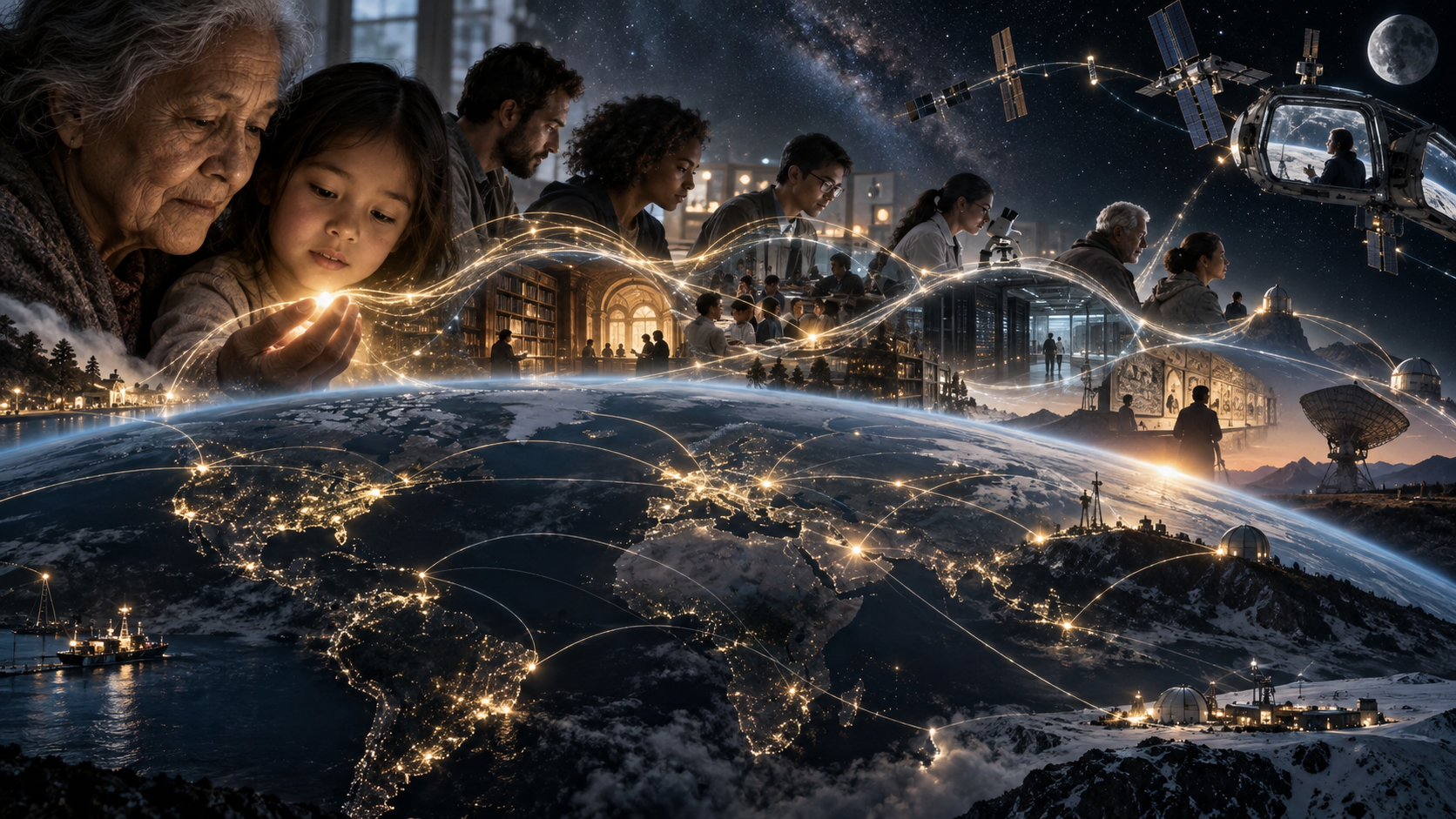
The first crisis would be legitimacy. Democratic consent assumes that citizens can inspect proposals, contest reasons, and participate within a common decision cycle. If one branch makes decisions through systems outsiders cannot audit, and revises them faster than public institutions can respond, formal equality may survive while meaningful participation disappears.
Law would face unfamiliar durations. How should voting power, property, inheritance, punishment, or professional authority work if some adults remain active for 150 years? How should contracts bind a persistent machine-mediated institution whose human representatives continually change? Can a system hold rights if no single member understands its complete memory or purpose?
Education would become a border. Crossing between civilizations might require years of cognitive retraining, access to personal models, bodily modification, or acceptance into a network that owns the context needed to function. Exit could be equally difficult. A person raised inside continuous machine support might retain every legal freedom to leave while losing the practical ability to work, remember, communicate, or receive care outside it.
Conflict would not need to look like war. The more capable system could simply route around the slower one—moving research, production, finance, and decision-making into domains where the other branch has little leverage. The first civilization might remain numerically dominant yet become strategically peripheral. Yet the second might still depend on the first civilization’s labor and on ecosystems both inhabit, creating an unstable relationship closer to symbiosis, extraction, or managed neglect than conquest.
Capability would not confer greater moral worth. A faster, healthier, more durable civilization could still be unjust. A slower and more vulnerable one could preserve forms of care, freedom, improvisation, and meaning that the continuity system cannot reproduce.
The split would not rank humanity. It would divide the conditions under which human futures are made.
The Tests a Second Civilization Must Pass
The phrase “two civilizations” should remain demanding. Otherwise every gated community, ideology, or technology platform qualifies. A serious model must survive several tests.
| Test | What would have to be true | What would weaken the claim |
|---|---|---|
| Succession | The system can raise or recruit successors and replace essential experts. | It relies on a constant inflow of people trained by the wider world. |
| Knowledge | It maintains its own archives, standards of evidence, error correction, and research. | Its core knowledge still comes from public institutions it does not control. |
| Material continuity | It can sustain energy, food, water, medicine, compute, manufacturing, and waste handling through prolonged disruption. | Loss of shared grids, logistics, hospitals, or outside labor causes collapse. |
| Governance | Binding decisions, membership, conflict resolution, and resource allocation terminate inside the system. | State courts, owners, or external governments remain the final authority. |
| Boundary | Entry and exit carry durable switching costs—educational, legal, bodily, cognitive, or geographic. | Broader access to one technology dissolves the apparent division. |
| Signature | Its claimed scale matches observable energy, material, genetic, financial, ecological, or orbital traces. | Missing evidence is repeatedly explained by adding perfect concealment. |
The greatest failure point may be diffusion. Tools can spread beyond their original owners. Costs can fall. Public institutions can adapt. Open standards make systems interoperable. Education spreads practices that once belonged to specialists. AI may translate between groups instead of making them illegible; the customer-support study is an early reminder that augmentation can benefit novices disproportionately.
Interdependence is another counterforce. Even highly insulated groups breathe the same atmosphere, inhabit the same climate, draw on overlapping supply chains, and exchange people. Civilizations can maintain boundaries through contact, but continual mixing may prevent differences from becoming irreversible.
The opposite trajectory—technology deepening connection without erasing individuality—is explored in The Day Humanity Remembered It Was One Mind. That possibility matters because a split is not the automatic result of innovation. It is one outcome of choices about ownership, portability, education, governance, and access.
If advanced systems remain broadly available, if people can move between them, and if final decisions continue to occur inside shared institutions, humanity may become more varied without becoming two civilizations. The fork requires several loops to close at once.
The Boundary Without a Border
We may keep looking for the other humanity in hidden cities, altered faces, or departing spacecraft. Those are late and visible signs.
The decisive break could happen earlier: when a system can remember beyond any lifetime, decide faster than any public institution, produce its own successors, and survive without needing the rest of humanity to preserve its future. No declaration of independence would be required. By the time a new flag appeared, the important separation might be generations old.
The last common inheritance may be the word human.
More in SPEC
- The Last People Online: What If the Internet Became Almost Entirely Non-Human? — Extends the interface divide into a public culture increasingly maintained by autonomous digital participants.
- What If First Contact Comes Through the Interface? — Explores the possibility that the first truly unfamiliar intelligence may emerge inside humanity’s tools rather than arrive from elsewhere.
- The Day Humanity Remembered It Was One Mind — Offers the strongest countertrajectory: technology could deepen coordination and shared identity instead of producing a durable civilizational split.
Sources / Receipts
- International Telecommunication Union — Facts and Figures 2025. Supports the current global connectivity figures and the claim that access, affordability, and digital skills remain uneven.
- OECD — “AI use by individuals surges across the OECD as adoption by firms continues to expand”. Supports the 2025 generative-AI adoption figures and the gaps by age, education, income, and firm size.
- Erik Brynjolfsson, Danielle Li, and Lindsey Raymond — “Generative AI at Work,” The Quarterly Journal of Economics. Reports a field study of 5,172 customer-support agents in which AI assistance increased average productivity and produced the largest gains among less-experienced workers.
- Nicholas S. Card et al. — “Long-term independent use of an intracortical brain–computer interface for speech and cursor control,” Nature Medicine. Demonstrates 19 months of researcher-free home use by one participant with ALS; trained care partners still handled setup, and the system remained investigational, wired, and task-specific.
- U.S. Food and Drug Administration — “FDA Approves First Gene Therapies to Treat Patients with Sickle Cell Disease”. Establishes the clinical arrival of CRISPR-based treatment and the somatic, patient-specific nature of Casgevy.
- World Health Organization — Human genome editing: recommendations. Supports the distinction among somatic, germline, and heritable editing and the need for robust international oversight.
- Royal Society — “Statement from the Organising Committee of the Third International Summit on Human Genome Editing”. Supports the statement that the scientific and governance conditions for heritable clinical genome editing have not been met.
- American Society for Reproductive Medicine — “ASRM Ethics and Practice Committees Release New Report Concluding Polygenic Embryo Screening Is Not Ready for Clinical Use”. Summarizes the predictive, clinical, representational, and ethical limits of current polygenic embryo screening.
- S. Jay Olshansky et al. — “Implausibility of radical life extension in humans in the twenty-first century,” Nature Aging. Provides the demographic basis for distinguishing present longevity gains from demonstrated radical life extension.
- International Energy Agency — Energy and AI. Documents AI’s physical dependence on electricity, data centers, servers, cooling, networks, grid capacity, and resilient supply chains, grounding the article’s infrastructure and severance tests.


Discussion