
Case Overview: The Event
There is a document in the United States government archive that appears, at first glance, to contain almost everything the internet says it contains.
It discusses hypnosis, meditation, binaural beats, brain-wave synchronization, remote viewing, out-of-body experience, travel beyond time and space, a universal hologram, an infinite consciousness called the Absolute, and the possibility of encountering nonphysical intelligences. Its final pages even outline how an intelligence organization might try to turn these ideas into an experimental program.
The document is real.
That is where the easy part ends.
Online, it is often called a CIA manual, a suppressed consciousness technology, or proof that the government discovered astral projection. Some versions go further: the Gateway Process supposedly confirms manifestation, reveals that reality is a hologram, or provides an official method for escaping the body.
The record supports a more specific—and more interesting—story.
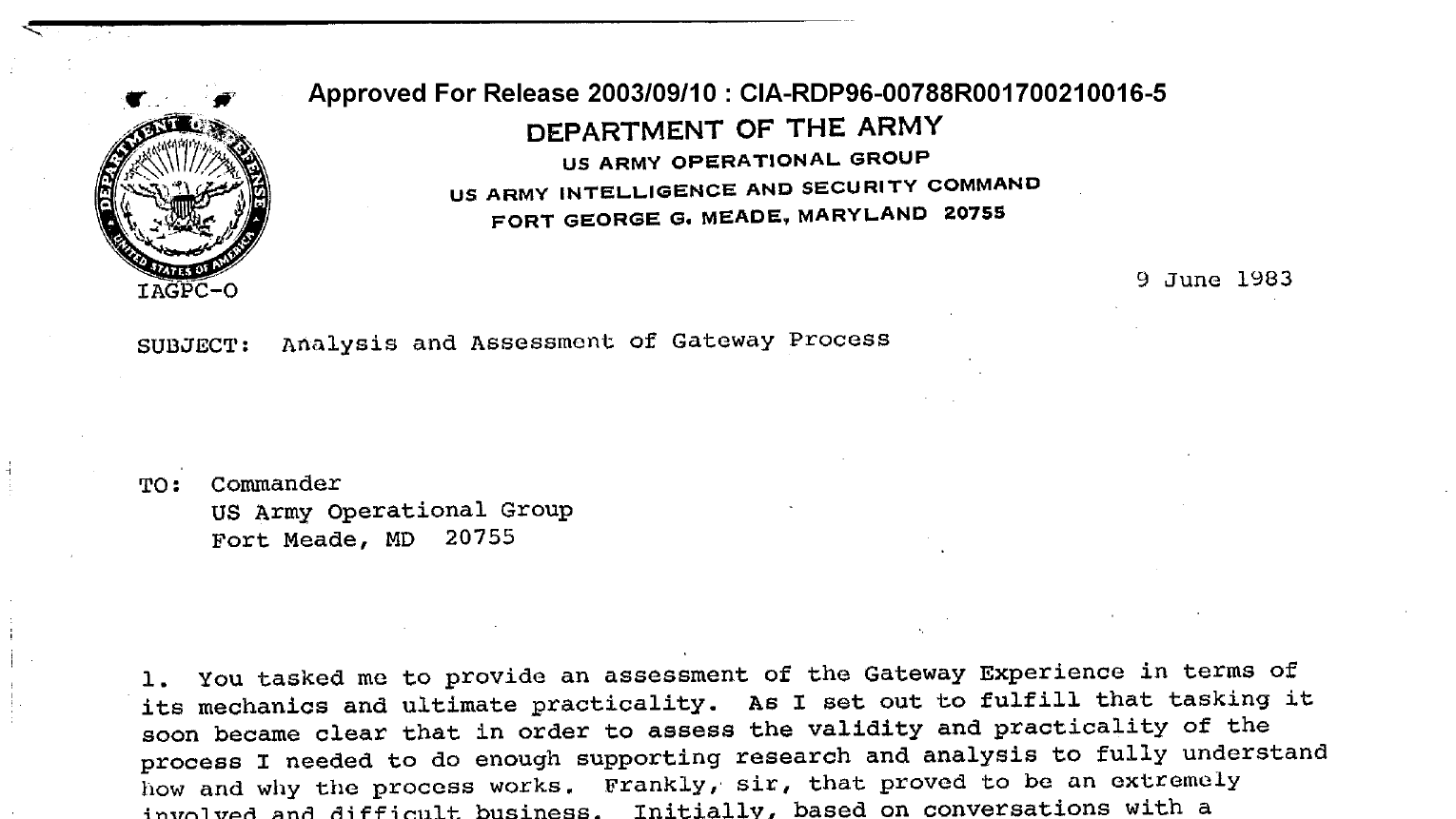
On June 9, 1983, Lieutenant Colonel Wayne M. McDonnell of the U.S. Army Intelligence and Security Command sent a memorandum to the commander of the U.S. Army Operational Group at Fort Meade, Maryland. Its title was Analysis and Assessment of Gateway Process. McDonnell said he had been tasked to assess the mechanics and practical value of the Gateway Experience, a consciousness-training program developed by Robert Monroe and taught by the Monroe Institute in Virginia. He also indicated that he had taken the training himself, alongside a physician with whom he discussed its possible mechanisms.
McDonnell’s paper was not a report of a controlled government experiment. It was not a peer-reviewed CIA study. It was not a finding by the scientific community that consciousness can leave the body. It was an Army intelligence officer’s attempt to assemble a theoretical explanation for a private institute’s altered-state training system and to consider whether that system might have practical value.
The distinction matters because the memo’s institutional provenance is strong while its evidentiary foundation is uneven. The U.S. Government Publishing Office catalog identifies the government author as the Department of the Army and dates the publication to 1983. The scan later became publicly famous through the CIA’s declassified STARGATE collection, where records from the CIA, Defense Intelligence Agency, and Army were gathered together. Its location in that collection confirms that the government retained and released the document. It does not transform every proposition inside it into an official conclusion.
The real case is therefore not whether the Gateway report exists. It does.
The case is how one authentic memorandum became evidence for claims it did not actually demonstrate.

What Actually Happened
The reconstruction begins with the document itself.
McDonnell wrote from the U.S. Army Operational Group under U.S. Army Intelligence and Security Command, or INSCOM. His audience was another Army commander. The stated purpose was to assess the Gateway Experience in terms of its mechanics and practical potential, and to produce a guide for INSCOM personnel who might take the training or work with its materials. The memorandum is signed by McDonnell as a military intelligence lieutenant colonel and commander of “Det O.”
This is frequently blurred in retellings. The CIA did not author the report. Robert Monroe did not write it. The Monroe Institute did not issue it as a scientific paper. McDonnell wrote it after attending Gateway training and consulting Monroe materials, a fellow trainee, books, magazine articles, and a small group of theoretical influences.
The broader setting helps explain why an Army intelligence unit was interested. During the Cold War, American intelligence organizations explored remote viewing and other forms of what they called psychoenergetics. Army activity at Fort Meade would soon be formalized in the INSCOM CENTER LANE project. A 1984 Army document preserved in the CIA Reading Room describes CENTER LANE as an INSCOM program using remote viewing for intelligence collection. Gateway was not simply another name for CENTER LANE or STARGATE, but it entered an institutional environment already willing to investigate whether altered states could support unusual information-gathering methods.
The training McDonnell assessed came from Robert A. Monroe, a broadcasting executive whose accounts of spontaneous out-of-body experiences led him into private experimentation with sound and consciousness. Monroe published Journeys Out of the Body in 1971 and developed a training system around what became known as Hemi-Sync, short for hemispheric synchronization. The Monroe Institute continues to offer Gateway Voyage and describes it as an experiential consciousness program using binaural-beat audio guidance. That continuity establishes the relationship between the program and the institute; it does not independently verify the institute’s more extraordinary claims.
As the report describes it, Gateway was a layered practice rather than a pair of magic headphones. Participants listened to different tones delivered separately to the two ears, combined with pink or white noise, verbal guidance, progressive relaxation, humming, affirmation, and repeated visualization. The goal was to place the body near sleep while keeping the mind alert, then move through named “Focus” states.
Focus 10 was described as “mind awake, body asleep.” Focus 12 involved expanded awareness and a set of visualization exercises for problem-solving, “patterning” desired outcomes, regulating the body, and attempting remote viewing. Focus 15 was associated with access to the past. Focus 21 was framed as movement beyond ordinary time-space toward the future. One exercise addressed out-of-body movement through imagined actions such as rolling, lifting, or sliding away from the physical body.
Even the memo places limits around those claims. It says Gateway was not created solely to produce out-of-body experiences and did not guarantee that most trainees would have one. It reports an estimate that fewer than five percent of participants reached Focus 15 during the roughly week-long training, but it provides no participant records or measurement criteria behind that figure. It also relays an unnamed Monroe trainer’s account of experiments in which people allegedly traveled out of body across the country to read ten computer-generated digits. No one reportedly read all ten correctly. Instead of treating the failures as disconfirmation, the memorandum speculates that information from the past, thought forms, or holographic reversal may have distorted the results.
That passage captures the central methodological problem. The document repeatedly moves from an experience, to an interpretation of the experience, to a physical theory designed to protect that interpretation. Alternative explanations are mentioned less often than auxiliary mechanisms that allow the extraordinary claim to survive.
The final section makes the status of the report especially clear. McDonnell does not present completed trials showing successful controlled out-of-body travel. He proposes a phased program: use Hemi-Sync, add REM-related audio and hypnosis, practice leaving the body, approach Focus 15 and 21, employ three simultaneous viewers to correct distortion, prepare for possible nonphysical intelligences, and construct protective holographic patterns around sensitive locations. The closing sentence says that if these experiments were carried out, practical value might be found.
The experiment is written in the future tense.
The proof never appears in the preceding pages.
Key Claims and Evidence
The Gateway report is best read as an evidence ladder. Its lower rungs are real and testable. Its upper rungs become increasingly theoretical. Online mythology often treats the whole ladder as though every rung has equal support.
The binaural beat is real
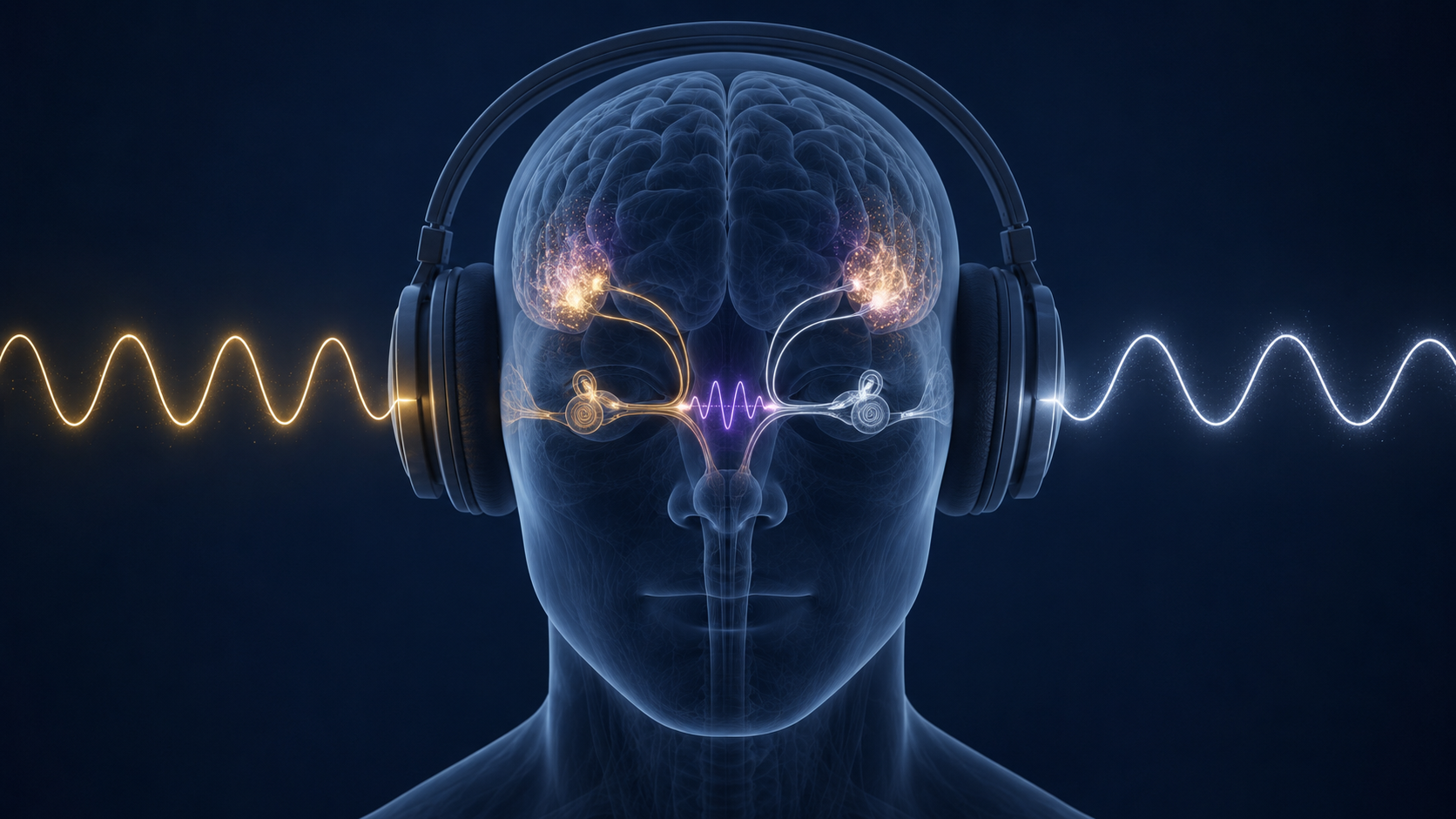
When two tones with slightly different frequencies are presented separately to the ears, a listener can perceive a rhythmic beat corresponding to the difference between them. That is a genuine psychoacoustic effect generated through binaural processing. Gateway used this phenomenon as part of a broader audio and relaxation protocol.
What remains unsettled is how reliably a binaural beat drives wider brain activity into the corresponding frequency and what functional effect that produces. A 2023 systematic review examined fourteen EEG studies: five reported findings consistent with brain-wave entrainment, eight reported contradictory findings, and one reported mixed results. The studies varied substantially in design, stimulation, and analysis, limiting comparison.
Individual experiments point in different directions. A 2016 study found increased alpha-band coherence between the auditory cortices while participants listened to alpha- and theta-frequency binaural beats, but no behavioral aftereffect; the authors said the result appeared to reflect binaural integration rather than entrainment. A 2017 controlled EEG study found no enhancement of the corresponding EEG bands and no changes in heart rate or skin conductance. A 2020 eNeuro experiment detected cortical and connectivity responses, but monaural beats entrained the cortex more strongly and neither condition changed mood.
There may still be modest practical effects. A 2019 meta-analysis reported an overall medium effect across studies of memory, attention, anxiety, and pain, with results dependent on timing and frequency. A 2026 systematic review and meta-analysis found low-certainty evidence that theta binaural beats may reduce pain, while anxiety and cognitive outcomes were too heterogeneous for quantitative synthesis.
The balanced conclusion is not that binaural beats do nothing. It is that effects on pain, relaxation, attention, mood, or localized neural synchrony do not demonstrate the Gateway report’s cosmic mechanism. A change in an EEG measure is not evidence that awareness has left the nervous system.
“Hemispheric synchronization” is a claim with several meanings
The report describes Hemi-Sync as equal or coherent patterns across the two cerebral hemispheres. It then compares the synchronized mind to a laser: focused, coherent, and capable of resonating with increasingly subtle levels of the universe.
Those are not equivalent propositions. Interhemispheric coherence is a measurable relationship between neural signals. It can change during perception and cognitive activity. But the memo moves from a possible neural correlation to an assertion that coherent consciousness can receive information outside the senses. The latter does not follow from the former.
The report’s brain model is also unmistakably of its era. It portrays the left hemisphere as verbal, logical, critical, and restrictive, while the right is holistic, intuitive, nonverbal, and unusually receptive. Modern neuroscience recognizes real hemispheric specialization, but it also maps cognition across distributed, interacting systems. A 2024 review of cross-hemispheric communication describes lateralization as shaped by dynamic interaction, learning, and the brain’s connecting pathways—not as two personalities in the same skull, one rational and one mystical.
Gateway may produce a meaningful subjective sense of integration. That experience should not be confused with the memo’s literal theory of how the entire brain or universe operates.
Altered states are plausible; extraordinary access is not established
The training combines several conditions known to alter experience: sensory structuring, rhythmic sound, sustained attention, reduced movement, expectation, guided imagery, suggestion, and a body approaching sleep. It would be unsurprising if participants reported vivid imagery, changes in time perception, unusual body sensations, deep relaxation, or the feeling of being elsewhere.
Those experiences can be powerful without functioning as external information channels. Neuroscience has repeatedly connected out-of-body sensations to altered multisensory processing of self-location and body perspective. In a well-known 2002 Nature report, focal electrical stimulation near the right angular gyrus repeatedly induced out-of-body-like perceptions in a patient undergoing epilepsy evaluation. That finding does not prove that every out-of-body experience has the same cause. It does show that the felt separation of self and body can be generated through changes in the brain.
The evidentiary test for remote perception is therefore not whether the participant felt outside the body. It is whether the participant obtained specific, independently verifiable information under controls that exclude sensory leakage, cueing, selective recall, and flexible scoring. The Gateway memo does not provide such a demonstration.
The universal hologram is a synthesis, not a result
McDonnell’s theoretical model draws heavily from Itzhak Bentov’s Stalking the Wild Pendulum. It combines Bentov’s ideas about bodily resonance with Karl Pribram’s holographic brain model, David Bohm’s holistic interpretation of physics, Dennis Gabor’s work on holography, popular accounts of quantum mechanics, and Monroe’s experiential map. It then connects this structure to kundalini, Tibetan Buddhism, Indra’s net, the cosmic egg, Jewish mysticism, and the Christian Trinity.
The result is intellectually ambitious. It is not an experimentally derived theory.
The report repeatedly uses established scientific terms as bridges to unsupported conclusions. Optical holography is real; that does not establish that the universe stores every past and future event in a form a trained mind can read. Quantum phenomena are real; that does not establish that consciousness can communicate outside time. The Planck length is a physical unit of length—NIST’s CODATA reference places it among the fundamental constants—not a velocity threshold below which brain waves exit spacetime. Yet the memo shifts between distance and speed while explaining its “click-out” mechanism.
These are not minor gaps waiting for one missing equation. They are category changes. Metaphor becomes mechanism, analogy becomes evidence, and the vocabulary of physics is asked to certify a metaphysical system.
Practical intelligence use was proposed rather than demonstrated
The most consequential misunderstanding concerns the conclusion. McDonnell calls Gateway plausible in his own assessment and recommends further work. He does not provide a completed experimental program, operational success rate, blind scoring procedure, raw EEG record, comparison group, statistical analysis, or independent replication.
The bibliography reinforces that point. Its nine entries include books by Bentov, Monroe, Jill Purce, Lee Sannella, and Charles Tart; a Monroe Institute monograph; and articles from Human Behavior, Science Digest, and Mother Earth News. Those works may illuminate the intellectual origins of the memo. They do not form the kind of empirical record needed to establish the claims McDonnell wanted to explain.
The document is evidence that an Army officer considered Gateway worth exploring.
It is not evidence that exploration reached the destination he described.
Points of Tension
The first tension is authenticity versus validity. The report is authentic enough to survive archival scrutiny: Army letterhead, date, recipient, signature, institutional placement, and later release. But authenticity answers “Is this the document?” Scientific validity asks “Do the claims survive testing?” Those are different questions.
The second is experience versus interpretation. A participant can sincerely experience a floating body, a vast presence, a timeless state, or a sudden answer. The experience is real as an experience. Whether it represents altered body integration, sleep-boundary imagery, suggestion, dissociation, memory construction, or access to a nonlocal field is a separate investigation. The report often treats the metaphysical interpretation as the explanation rather than one hypothesis among several.
The third is interest versus endorsement. Intelligence agencies examine possibilities because uncertainty can matter strategically. During the Cold War, even a low-probability phenomenon could attract attention if an adversary might be studying it. Government attention therefore establishes institutional curiosity and perceived potential—not scientific confirmation. The CIA’s own history of remote-viewing research says a 1995 independent review found the phenomenon too unreliable and inconsistent for intelligence use, and the agency did not restore the program. That later judgment concerned the broader remote-viewing program, not a direct test of Gateway, but it is important context for claims that the government operationally validated the method.
The fourth is scientific language versus scientific procedure. McDonnell clearly wanted to remove occult stigma by translating the experience into biomedical and physical terms. That effort gives the report much of its strange power. It also allows unsupported steps to look more established than they are. Terms such as frequency, resonance, coherence, quantum mechanics, hologram, and Planck distance carry scientific authority even when the causal chain joining them has not been tested.
The fifth is archive versus authorship. The document became famous as a “CIA report” because it was discoverable in the CIA Reading Room. But the CIA’s description of its CREST archive explains that the collection includes many kinds of records and a specialized STARGATE set. The agency later stated that it worked with DIA and the Army to gather and declassify records from all three organizations. A CIA URL is provenance for the public copy. It is not proof that the CIA originated or endorsed the contents.
Finally, there is the missing-page tension. The government scan jumps from report page 24 to page 26. In 2021, VICE reported that the Monroe Institute located a complete copy in its archive and supplied the missing page. The recovered page continues McDonnell’s comparison of the universal hologram with religious and mystical systems before turning toward self-knowledge. It contains no secret frequency, no suppressed operational result, and no experimental proof.
Its provenance is not quite as clean as a newly located page in a government file. The Black Vault notes that the government copy remains incomplete and that efforts to obtain the page again from CIA and INSCOM have not produced it. The recovered page fits the typography, numbering, and argument of the surrounding text, but the source distinction should remain visible.
The missing page added mystery to the file. What it restored was continuity, not revelation.
Perspectives and Explanations
Gateway as structured altered-state practice
The most grounded interpretation is that Gateway is an elaborate protocol for entering unusual subjective states. It combines techniques found across meditation, hypnosis, sleep practices, guided imagery, and audio stimulation, then gives participants a shared vocabulary for what they encounter.
That vocabulary can be psychologically powerful. Naming stages creates expectations and markers of progress. Rituals such as the energy conversion box or protective energy balloon organize attention and anxiety. Repetition can make a state easier to enter. A person may gain relaxation, imagery, emotional insight, or a new way to observe thought without any part of consciousness physically traveling elsewhere.
This explanation is compatible with profound experiences. It does not require dismissing participants as dishonest or foolish. It simply keeps subjective transformation separate from claims about external reality.
Gateway as an auditory intervention with limited effects
A narrower scientific view treats the audio as one variable among many. Binaural beats may change some neural measures under some conditions and may modestly influence pain, anxiety, attention, or relaxation. The current literature does not support one simple law in which a chosen beat frequency reliably forces the entire brain into the matching state.
This matters because Hemi-Sync is often discussed as if the audio technology alone proves the higher claims. It does not. Even a reliable neural effect would still require separate evidence for remote viewing, out-of-body information transfer, past access, future access, or manifestation.
Gateway as expectation, suggestion, and sleep-boundary experience
The protocol deliberately moves participants toward a body-asleep, mind-awake condition. That is also a territory where hypnagogic imagery, sleep paralysis, vivid vestibular sensations, dream incorporation, and altered self-location can occur. Verbal guidance supplies a narrative for those sensations. If a participant has been told to roll out of the body, an unusual floating sensation may be interpreted through that frame.
This is not the same as saying that “it was only imagination.” Imagination is not a trivial process, and altered body perception can feel more convincing than ordinary waking experience. But an experience that matches a suggestion is not, by itself, independent confirmation of the suggested metaphysics.
Gateway as literal nonlocal consciousness
The strongest Gateway interpretation holds that consciousness is not produced or confined by the brain, that the brain can tune into a universal information structure, and that training can allow awareness to operate outside ordinary spacetime.
This view accounts for the felt reality and internal coherence of some participant reports. It also makes testable predictions: people should be able to retrieve hidden targets, identify future or past information unavailable by ordinary means, or demonstrate effects that survive strict blinding and independent replication.
The 1983 memorandum does not supply that evidence. It assumes key parts of the model, explains apparent failures through distortion, and recommends the experiments that would be needed. The literal interpretation remains a metaphysical and empirical hypothesis, not a finding established by the report.
Gateway as Cold War intellectual history
A fifth view treats the file less as a consciousness manual than as a document of institutional imagination. McDonnell was trying to make an unconventional private program legible to military intelligence. He borrowed the conceptual materials available to him: split-brain popularization, biofeedback, meditation research, holography, quantum mystery, systems thinking, and Eastern and Western mysticism.
The result preserves a particular early-1980s effort to cross a cultural boundary. On one side stood occult language and personal testimony. On the other stood the vocabulary of physics, neuroscience, and operational utility. The memo tried to build a bridge between them. The existence of the bridge is historically significant even if it does not reach the far shore.
Context and Pattern Recognition
The Gateway report did not become an internet legend merely because of what it says. It became one because of where it was found, how it looked, and when it resurfaced.
Its first life was bureaucratic. It circulated as an Army memorandum in an intelligence environment already exploring remote viewing. A declassification stamp indicates approval for release in 2003. In 2017, the CIA placed more than twelve million pages of CREST records online, including the STARGATE collection. A once-obscure scan became searchable from any browser.
Its second life was algorithmic. The phrase “CIA declassified” supplied instant authority. The degraded type, military letterhead, declassification stamps, diagrams, and archive identifier supplied atmosphere. The report’s language supplied extraordinary promises. The missing page supplied a conspiracy-shaped absence. During the renewed online interest of 2020 and 2021, explainer videos, social posts, shared audio files, and a widely read illustrated VICE breakdown turned a dense Army memo into a participatory myth.
The April 2021 VICE follow-up reported that the first article drew millions of readers and that the Monroe Institute itself was aware of viral TikToks around the file. By then the document was no longer merely being read. It was being used. People listened to Gateway audio, compared experiences, traded instructions, and treated the memo as an initiation text.
The compression happened in stages:
An Army officer assessed a Monroe Institute program.
The assessment entered a government archive.
The government archive was hosted by the CIA.
The CIA-hosted document became “the CIA report.”
The report’s proposal became “the government program.”
The officer’s theoretical conclusion became “the CIA proved it.”
Each step sounds close to the previous one. By the end, the meaning has changed completely.
This pattern extends far beyond Gateway. Archives contain proposals, raw reports, translations, hypotheses, rumors, correspondence, rejected ideas, and documents created by other agencies. Declassification means a record is no longer withheld on classification grounds. It does not mean the record has passed scientific review. Archival inclusion establishes that the paper was part of an institution’s history; it does not certify the propositions printed on it.
The legend also survived because the document offers something more emotionally compelling than a technical claim. It suggests that disciplined attention can reveal that the self is larger than the body, that time may be navigable, and that reality is responsive to consciousness. The government setting appears to move those hopes from belief into evidence.
But the archive cannot perform that conversion. Only reproducible results can.
Implications: Reality Check
The strongest current assessment can be stated without stripping the file of its strangeness.
The Gateway report is an authentic 1983 Army intelligence memorandum. McDonnell attended the Monroe Institute’s training and tried to assess it for INSCOM. The program used real psychological and auditory ingredients capable of producing relaxation and unusual subjective states. Binaural beats are real perceptual phenomena, and research leaves room for limited effects on some neural or behavioral outcomes.
Beyond that point, the evidentiary ladder breaks.
The report does not demonstrate that Hemi-Sync produces a unique whole-brain coherence state. It does not show consciousness separating from the brain. It does not validate remote viewing through a documented controlled protocol. It does not establish access to the past or future. It does not show that thought can reorganize external reality through a universal hologram. Its physics does not convert these claims into results.
The conventional explanation is presently strongest: Gateway is a structured altered-state practice whose sound, relaxation, suggestion, expectation, and sleep-boundary components can generate subjectively powerful experiences. Some ancillary effects may be measurable. The report’s nonlocal interpretation remains unverified.
One element should not be dismissed: people can experience radical shifts in body ownership, self-location, time, meaning, and perceived insight. Those states are part of reality because human experience is part of reality. Their existence just does not decide their cause.
That is why Gateway still deserves study—but with clearer questions. Which parts of the protocol change attention or anxiety? Which neural signatures are reliable? How much is produced by the binaural beat versus music, masking noise, expectation, verbal suggestion, or simple rest? Can any information claim beat chance under preregistered, independently replicated conditions? What happens when the participant and experimenter are both blind to the target and condition?
Those tests would not drain the mystery. They would locate it.
The Unresolved Ledger
What Is Documented
The document is real, dated June 9, 1983, and written by Lieutenant Colonel Wayne M. McDonnell of U.S. Army INSCOM to an Army commander. McDonnell says he was assigned to assess Gateway and had taken the training. The report describes Monroe Institute methods, states that some INSCOM personnel might receive or work with the training, and concludes with a proposed experimental path. The government scan is preserved by GovInfo and in the CIA’s STARGATE-related archive. Its bibliography and theoretical influences are visible. The archived scan omits report page 25.
It is also documented that the Monroe Institute developed and continues to offer Gateway training using binaural-beat audio guidance. Scientific research confirms the binaural-beat percept and reports mixed findings on neural entrainment and limited psychological outcomes. Neurological research shows that out-of-body-like perceptions can arise through altered brain processing.
What Is Claimed
The report claims or accepts as plausible that Hemi-Sync can create unusually coherent hemispheric activity, that bodily resonance can couple the individual to larger energy fields, that consciousness can separate from the body, and that sufficiently focused awareness can access information beyond ordinary space and time. It presents the universe as a holographic structure connected to an infinite Absolute and suggests that thought may influence reality through this system.
Monroe sources and participants have reported profound altered states, out-of-body experiences, apparent guidance, and information beyond the senses. Such reports may be sincere. In the evidence record, they remain reports unless paired with controlled verification.
What Remains Unresolved
The report does not tell us whether the Army carried out McDonnell’s exact proposed protocol, with what results, or whether complete contemporaneous data survive. It does not provide the raw basis for estimates about success in the Focus states or the cross-country number-reading claim. The full administrative chain by which the memorandum entered the later STARGATE collection is not reconstructed in the public scan.
The missing government page 25 also remains an archival loose end. The Monroe Institute copy supplies a text that fits the document, but a corresponding page from the government’s original file has not publicly surfaced. More broadly, the science of binaural-beat stimulation is still methodologically inconsistent, leaving narrower questions about attention, pain, relaxation, and neural response open.
What is not unresolved is equally important: the 1983 memo itself does not prove astral projection, remote viewing, manifestation, time travel, or a universal hologram.
Why It Still Matters
The Gateway file is a near-perfect lesson in how institutional records acquire mythic authority. It shows a government officer engaging seriously with extraordinary ideas, but it also shows why seriousness is not the same as confirmation. It preserves the moment when personal experience, Cold War intelligence, popular neuroscience, physics metaphors, and ancient spiritual symbolism were assembled into one explanatory machine.
The report belongs in The Galactic Mind archive because it tests how we decide what counts as evidence. It asks us to hold two truths at once: consciousness can generate experiences that feel reality-altering, and the reality of an experience does not automatically validate the explanation attached to it.
The Galactic Mind Perspective
The Gateway report is most revealing when it is neither worshiped nor mocked.
Read credulously, it becomes a government-certified map out of the body. Read dismissively, it becomes a ridiculous relic of Cold War excess. Both readings miss the more useful artifact: a record of one person trying to make an anomalous domain legible to an institution that required mechanisms, applications, and procedures.
McDonnell’s mistake was not taking altered states seriously. They deserve serious study. His mistake was allowing a chain of analogies to carry more weight than the evidence. Resonance became universal connection. Holography became cosmic memory. Neural coherence became nonlocal perception. Quantum scale became an exit from spacetime. The theory kept expanding while the tests remained offstage.
Yet there is something recognizably human in that expansion. A profound inner experience creates pressure for an equally profound outer explanation. Scientific language can then become a form of emotional architecture: a way to make the experience feel permitted by the universe.
The disciplined position is more demanding. It allows the experience to remain meaningful without declaring its metaphysics settled. It asks whether a practice changes the brain, whether that change alters perception, whether perception contains verifiable information, and whether any result survives replication. Each claim must cross its own threshold.
Gateway has not crossed all of them.
Its enduring value may lie in showing why we want it to. The file promises that the mind is not trapped, time is not closed, and reality is not indifferent to intention. Those possibilities touch ancient hopes. A government stamp makes them feel newly authorized, but authority is not evidence and wonder does not need false certification.
The most honest reading leaves the gateway open as a question, not as a conclusion.
Open Question
When an altered-state experience feels more real than ordinary perception, what evidence would show that consciousness actually went somewhere rather than the brain generating the journey?
What do you think? Drop your thoughts in the comments ...
More in Case Files
- The Red Book: The Private Manuscript Carl Jung Hid From the World — Another documented text at the boundary between inner experience, psychological interpretation, and metaphysical meaning.
- The Pam Reynolds Operation: What Did She Perceive During Standstill? — A related investigation into extraordinary conscious experience, neurological conditions, and the difference between testimony and proof.
- The First PURSUE Release: Alien Claims, Redactions, and the Architecture of Disclosure — A useful companion on why a government archive can preserve extraordinary claims without resolving or validating them.
Sources / Receipts
- U.S. Department of the Army. Analysis and Assessment of Gateway Process. June 9, 1983. Official catalog record and government scan preserved by GovInfo. Record · PDF
- McDonnell, Wayne M. Analysis and Assessment of Gateway Process. Full searchable transcription, including the recovered page 25, Wikisource. Useful for navigation and quotation checking; the GovInfo scan remains the primary government copy. Transcript
- Central Intelligence Agency. “CIA Posts More Than 12 Million Pages of CREST Records Online.” January 17, 2017. Describes the archive and its STARGATE special collection. CIA
- U.S. Army Intelligence and Security Command. INSCOM CENTER LANE Project. July 17, 1984. Declassified Army material preserved in the CIA Reading Room. CIA Reading Room
- Central Intelligence Agency. “Ask Molly: Did CIA Really Study Psychic Powers?” October 27, 2021. Agency history of remote-viewing work and the 1995 decision not to restore the program. CIA
- The Monroe Institute. “Gateway Voyage.” Current institutional description of the program and its binaural-beat audio exercises. This is a first-party commercial source, useful for continuity and self-description rather than independent validation. Monroe Institute
- Ingendoh, Ruth Maria, Ella S. Posny, and Angela Heine. “Binaural beats to entrain the brain? A systematic review of the effects of binaural beat stimulation on brain oscillatory activity.” PLOS ONE 18, no. 5 (2023). PubMed · DOI
- Solcà, Marco, Anaïs Mottaz, and Adrian G. Guggisberg. “Binaural beats increase interhemispheric alpha-band coherence between auditory cortices.” Hearing Research 332 (2016): 233–237. PubMed
- López-Caballero, Fran, and Carles Escera. “Binaural Beat: A Failure to Enhance EEG Power and Emotional Arousal.” Frontiers in Human Neuroscience 11 (2017): 557. Full text
- Orozco Perez, H. D., G. Dumas, and A. Lehmann. “Binaural Beats through the Auditory Pathway: From Brainstem to Connectivity Patterns.” eNeuro 7, no. 2 (2020). Full text
- Garcia-Argibay, Miguel, Miguel A. Santed, and José M. Reales. “Efficacy of binaural auditory beats in cognition, anxiety, and pain perception: a meta-analysis.” Psychological Research 83 (2019): 357–372. PubMed
- Fatima, Iram, et al. “Efficacy of theta binaural beat therapy on pain, cognition and anxiety in adults: A systematic review and meta-analysis of randomized controlled trials.” Explore 22, no. 5 (2026): 103471. PubMed
- Blanke, Olaf, et al. “Stimulating illusory own-body perceptions.” Nature 419 (2002): 269–270. Nature
- Güntürkün, Onur, et al. “Cross-hemispheric communication: Insights on lateralized brain functions.” Trends in Neurosciences 47, no. 4 (2024): 261–275. PubMed
- National Institute of Standards and Technology. “Fundamental Physical Constants from NIST,” 2022 CODATA values, data content updated May 2024. NIST
- Campion, Thobey. “Found: Page 25 of the CIA’s Gateway Report on Astral Projection.” VICE, April 8, 2021. The recovered page came from a Monroe Institute copy, not a newly located government file. VICE
- The Black Vault. “Stargate Collection: Analysis and Assessment of Gateway Process, 9 June 1983.” January 24, 2021; updated with later FOIA status. The Black Vault


Discussion