
Case Overview
Some books are written for the world.
Some books are written against it.
Carl Jung’s The Red Book, also known as Liber Novus, belongs to the second category.
It is one of the strangest, most beautiful, and most unsettling manuscripts in the history of psychology: a red leather-bound volume filled with calligraphy, mythic visions, symbolic dialogues, mandalas, painted figures, religious imagery, and encounters with personified forces of the unconscious.
For decades, it was almost entirely hidden from public view.
Not because it was fake.
Not because it was lost.
Not because it was unfinished in the ordinary sense.
But because it sat at the center of a dangerous question:
What if one of the founders of modern depth psychology built his theories not only from clinical observation and scholarship, but from a private descent into his own visionary unconscious?
Jung called this period his “confrontation with the unconscious.”
The phrase sounds clinical.
The manuscript does not.
Inside The Red Book, Jung meets inner figures. He dialogues with the dead. He descends into symbolic landscapes. He encounters a guide named Philemon. He wrestles with the soul, God-images, sacrifice, meaning, madness, and the hidden life of the psyche.
To some readers, this is the secret furnace of Jung’s psychology.
To others, it is a record of controlled breakdown.
To others, it looks like mystical scripture disguised as psychological experiment.
And to Jung himself, it appears to have been both essential and dangerous.
He worked on the material for years, transforming notes from his private Black Books into a large illuminated manuscript. He considered publishing it, but did not. It remained outside his collected works. After his death, his heirs kept it from the public. Eventually, the manuscript was placed in a safe deposit box.
Only in 2009, nearly half a century after Jung’s death, was The Red Book published in a complete facsimile edition edited by Sonu Shamdasani.
That delay created the case.
Why was a text so central to Jung’s inner life kept hidden for so long?
Was it too personal?
Too mystical?
Too vulnerable?
Too easily mistaken for madness?
Or did Jung understand something most modern thinkers fear:
That the boundary between imagination and revelation is not always clean?
This Case File does not treat The Red Book as proof of supernatural contact.
It does not claim Jung entered another dimension.
It does not reduce the book to pathology.
It examines the tension.
A private manuscript.
A psychological descent.
A work of visionary art.
A hidden source text.
And the possibility that some of the 20th century’s most influential ideas about the self, archetypes, individuation, and the collective unconscious were born not in the lecture hall, but in the symbolic underworld of one man’s mind.

What Actually Happened
The story begins with rupture.
Carl Gustav Jung had once been close to Sigmund Freud. Freud saw him as a possible heir to psychoanalysis. Jung admired Freud, but eventually moved away from Freud’s emphasis on sexuality as the central engine of psychic life.
Their break became final around 1912.
After that rupture, Jung entered a period of profound psychological instability, experimentation, and inner confrontation. He did not simply feel depressed or uncertain. He began deliberately engaging the flood of images, fantasies, emotions, and symbolic experiences rising from within him.
He wrote them down.
At first, Jung recorded this material in a series of notebooks now known as the Black Books. These were not simple diaries. They were records of an experiment in active imagination, a process in which Jung allowed inner figures, images, and dramas to unfold while observing and engaging them consciously.
He was not trying to suppress the unconscious.
He was trying to meet it.
Beginning in 1914, Jung started transforming this raw material into a more formal manuscript: Liber Novus, the “New Book.”
It eventually became known as The Red Book because of its large red leather binding.
The physical object matters.
This was not a typed clinical report.
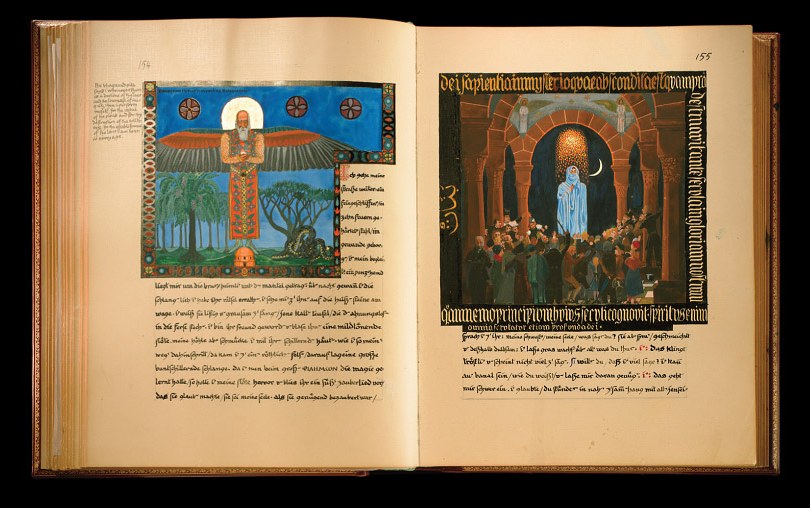
Jung wrote in ornate script. He added decorated initials, elaborate borders, painted mandalas, mythic figures, symbolic diagrams, and images that resemble medieval illuminated manuscripts. The book looks less like modern psychology and more like a sacred text from a private religion.
That is part of why the case is so powerful.
The founder of analytical psychology did not merely write theory.
He created an illuminated cosmology.
The manuscript took shape between roughly 1914 and 1930. Jung worked on it intermittently for years. He copied, edited, expanded, painted, and interpreted the visions and dialogues that had first appeared in the Black Books.
The content is not easy.
It is not a clean manual of psychology.
It is not a normal autobiography.
It is a symbolic drama in which Jung confronts his soul, speaks with inner beings, descends into the depths, experiences death and rebirth imagery, and tries to understand what the unconscious is demanding from him.
A central figure appears: Philemon.
Philemon becomes a kind of inner teacher or guide. Jung later treated Philemon as an example of an autonomous psychic figure, a presence that seemed to speak with a perspective beyond his conscious ego. Whether understood psychologically, spiritually, or symbolically, Philemon became one of the most important figures in Jung’s inner world.
From this material, Jung later developed or deepened some of his defining concepts:
- active imagination;
- individuation;
- archetypes;
- the collective unconscious;
- the symbolic life of the psyche;
- the autonomous nature of inner figures;
- the psychological significance of myth and religion;
- the confrontation between the ego and the deeper self.
But Jung did not publish The Red Book during his lifetime.
This is where the mystery begins.
He considered publication as early as the 1920s. He shared portions of it with some people. He did not treat it as meaningless. But he also did not include it in his collected works, partly because it did not fit the scholarly form of his public psychology.
That hesitation shaped the book’s fate.
After Jung died in 1961, the manuscript remained in family custody. Jung’s heirs were reluctant to publish it. The concern was understandable. The book was intensely private, visionary, religious, and strange. Without context, it could make Jung look less like a scientist of the psyche and more like a mystic, prophet, or patient of his own system.
For decades, only a small number of people had direct access.
Eventually, the manuscript was kept in a safe deposit box.
Then, in the late 20th century, Jung scholar Sonu Shamdasani began pushing for publication. He argued that The Red Book was central to understanding Jung’s work, not an embarrassing side project.
In 2000, Jung’s descendants agreed to allow publication.
In 2009, W. W. Norton published the facsimile edition of The Red Book, with translation, scholarly introduction, and extensive notes.
A hidden manuscript entered the world.
And Jung changed.
Not because the public discovered a new theory.
Because it discovered the source beneath the theory.
The polished psychologist had left behind a private record of descent.
Key Claims and Evidence
The Red Book case is different from a typical mystery file.
There is no question that the manuscript exists.
There is no question that Jung created it.
There is no question that it was unpublished for decades.
The tension lies in interpretation.
What kind of document is it?
A psychological experiment?
A mystical text?
A record of breakdown?
A symbolic artwork?
A private myth?
A source code for analytical psychology?
The answer may be all of these, depending on the frame.
What Is Documented
The strongest documented elements are:
- Carl Jung experienced a major psychological and intellectual rupture after his break with Freud.
- He began recording fantasies, visions, and inner dialogues in the Black Books.
- He later transformed this material into Liber Novus, known as The Red Book.
- The manuscript was created as a large illuminated volume with calligraphy, paintings, borders, and symbolic imagery.
- Jung worked on the manuscript for many years, especially between 1914 and 1930.
- He considered publishing it but did not publish it during his lifetime.
- The work remained largely unseen by the public for decades.
- Jung’s heirs were reluctant to publish it after his death.
- The manuscript was eventually kept in a safe deposit box.
- Sonu Shamdasani edited and introduced the published edition.
- W. W. Norton released the complete facsimile edition in 2009.
- The book is now widely regarded as central to understanding the formation of Jung’s later psychology.
That is the hard record.
What remains debated is what the manuscript means.
The Black Books Layer
The Black Books are the raw record beneath The Red Book.
They contain Jung’s notes from his inner experiments: dialogues, fantasies, visions, and active imagination material.
This matters because The Red Book was not spontaneous in the sense of being a single, unfiltered outpouring. It was crafted from prior material.
Jung did not merely hallucinate and transcribe.
He recorded, revised, selected, interpreted, copied, painted, and transformed.
That process complicates simple readings.
If someone wants to call The Red Book madness, they must account for its discipline.
If someone wants to call it revelation, they must account for its editing.
It is neither raw chaos nor simple doctrine.
It is an experiment given sacred form.
The Active Imagination Layer
Active imagination became one of Jung’s major contributions to depth psychology.
The basic idea is that unconscious contents can be engaged consciously through images, dialogue, fantasy, and symbolic interaction.
In The Red Book, Jung does this with unusual intensity.
He does not merely interpret dreams from a distance.
He enters the image.
He speaks with figures.
He lets them answer.
He allows the unconscious to behave as if it has agency.
This is one of the most important tensions in the case.
Was Jung discovering inner psychological structures?
Was he dramatizing unconscious conflicts?
Was he communicating with autonomous archetypal figures?
Was he creating a private mythic theatre in order to heal himself?
The safest answer is psychological:
Jung used active imagination to confront contents of the unconscious that felt autonomous and powerful.
The more open-ended answer is symbolic:
Jung treated the unconscious not as a storage room, but as a living world.
The Philemon Problem
Philemon is one of the most striking figures in Jung’s inner world.
He appears in Jung’s visionary material as an old wise figure, a guide, a teacher, a presence that seems to speak from beyond Jung’s conscious personality.
In a purely psychological frame, Philemon represents an autonomous inner figure, an archetypal image of wisdom or spiritual authority.
In a mystical frame, Philemon looks like a guide, daimon, spirit, or messenger.
In a literary frame, Philemon is a character.
In a philosophical frame, Philemon is the voice of a mind encountering something larger than the ego.
The case does not require choosing only one.
The important point is that Jung took the encounter seriously enough that Philemon influenced how he understood the autonomy of the psyche.
This does not prove that Philemon was an external being.
It does prove that Jung experienced inner figures as more than conscious inventions.
That distinction is central to the entire Red Book file.
The Manuscript Itself
The physical manuscript is evidence.
Not evidence of supernatural truth.
Evidence of seriousness.
Jung did not jot these visions into loose notes and forget them.
He built a massive illuminated volume.
He wrote carefully.
He painted carefully.
He gave the work the visual gravity of a sacred book.
This raises an important question:
Why would a modern psychiatrist create a medieval-style manuscript to contain psychological experience?
The answer may be that ordinary academic language was not enough.
The content demanded image.
Myth.
Ritual.
Symbol.
The psyche, for Jung, did not speak only in concepts.
It spoke in forms.
The Red Book is therefore not only a text about symbols.
It is itself a symbol.
The Publication Delay
The delay is one of the strongest parts of the case.
Jung did not publish The Red Book in his lifetime.
His family did not rush to publish it after his death.
For decades, the manuscript remained mostly unavailable to scholars and the public.
This delay gave the book an almost mythic status.
People knew it existed.
They knew it mattered.
But they could not fully see it.
That absence generated speculation.
Was it hidden because it was embarrassing?
Because it was too personal?
Because it revealed Jung’s methods too plainly?
Because it made him look unstable?
Because it blurred the boundary between psychology and mysticism?
The public release in 2009 did not create the book’s power.
It revealed how long that power had been waiting.
The “Madness” Question
One of the unavoidable tensions is whether The Red Book records a psychological crisis, a controlled descent, or something closer to madness.
A careless reading would say:
Jung heard voices and saw visions.
Therefore he was mad.
A worshipful reading would say:
Jung received revelation.
Therefore the book is sacred.
Both readings are too simple.
The more precise interpretation is that Jung entered a dangerous inner state and attempted to remain conscious inside it.
He did not deny the visions.
He did not surrender to them entirely.
He engaged them.
He argued with them.
He interpreted them.
He translated them into a psychological framework.
That is why The Red Book still matters.
It is not a manual for losing oneself in the unconscious.
It is a record of one person trying not to be swallowed by it.

Points of Tension
The Red Book case survives because it refuses easy classification.
It is too psychological to be simple mysticism.
Too mystical to be ordinary psychology.
Too disciplined to be dismissed as chaos.
Too strange to be treated as normal scholarship.
Jung Was a Scientist of the Psyche, But This Looks Like Scripture
Jung’s public role was that of psychiatrist, theorist, and founder of analytical psychology.
But The Red Book looks like an illuminated religious manuscript.
That contrast is the first major tension.
The public Jung wrote essays, gave lectures, developed concepts, and corresponded with scholars.
The private Jung painted mandalas, staged conversations with inner figures, and wrote in the style of sacred revelation.
This does not make him fraudulent.
It makes him more complicated.
His public psychology appears to have been built, in part, from private mythic experience.
That is uncomfortable for modern rational culture.
We prefer our theories clean.
Jung’s were born in images.
The Book Was Central, But Not Published
Jung treated the experiences behind The Red Book as deeply important.
Yet he did not publish the manuscript.
That is a contradiction.
If it mattered so much, why withhold it?
The grounded explanation is that the book was personal, difficult, and not scholarly in form. Jung may have understood that releasing it without context could damage his credibility or distort his work.
But the tension remains.
He built an extraordinary object.
Then kept it mostly private.
That gives The Red Book the feeling of a sealed chamber beneath Jung’s public system.
The Family Protected It, But Also Delayed Understanding
Jung’s heirs were reluctant to publish the book.
That caution is understandable.
The manuscript is intimate. It contains material that could easily be misread. It might invite sensational claims, accusations of madness, or cult-like treatment.
But the delay also kept scholars from fully understanding Jung’s development.
For decades, readers encountered Jung’s theories without access to one of the central sources beneath them.
That delay shaped Jung’s legacy.
The world knew the architecture.
It did not see the underground chamber.
Visionary Experience Can Be Creative and Dangerous
The Red Book forces a difficult question:
What is the difference between creative descent and psychological collapse?
Jung’s experience involved visions, voices, inner figures, and powerful symbolic material. In another context, those symptoms could be pathologized.
But Jung did not simply disintegrate.
He transformed the material into art, theory, and method.
This does not make the experience safe.
It makes it significant.
The unconscious can generate insight.
It can also overwhelm.
Jung’s case sits at that edge.
The Unconscious Behaves Like a World
In much of modern thought, imagination is treated as something unreal because it happens inside the mind.
Jung’s Red Book challenges that assumption.
The inner world behaves with structure.
Figures appear.
They speak.
They resist.
They surprise.
They transform.
The experience may be internal, but it is not necessarily under ego control.
This is one of Jung’s most radical implications:
The psyche is not just something we possess.
It is something we encounter.
The Book Can Be Misused
The Red Book is powerful partly because it feels like permission to enter the depths.
But that permission can be dangerous.
Jung was trained, disciplined, intellectually prepared, and deeply engaged in symbolic interpretation.
He did not treat every inner image as literal truth.
Modern readers can easily miss that.
They may romanticize breakdown.
They may confuse fantasy with revelation.
They may turn Jung’s personal experiment into a universal spiritual system.
That is not what a grounded reading supports.
The lesson is not “follow every vision.”
The lesson is that the unconscious must be approached with seriousness, humility, and structure.
Perspectives and Explanations
The Psychological Experiment View
The strongest grounded explanation is that The Red Book records a deliberate psychological experiment.
Jung was not trying to prove spirits or create scripture.
He was confronting unconscious contents in order to understand himself and the structure of the psyche.
In this view, the figures he encountered were autonomous complexes, archetypal images, symbolic personifications, and dramatic expressions of inner conflict.
This reading fits Jung’s later psychology.
It explains why the book mattered.
It also avoids turning the manuscript into supernatural evidence.
The weakness is that it may flatten the intensity of Jung’s experience. He did not seem to treat these inner figures as mere inventions.
They arrived with force.
They changed him.
The Visionary Art View
Another interpretation is that The Red Book is one of the great works of visionary art.
It belongs beside illuminated manuscripts, mystical diagrams, symbolic cosmologies, and outsider religious art.
Its power is not only conceptual.
It is visual.
The images are not decorations. They are part of the thinking.
The advantage of this view is that it honors the manuscript’s form.
The weakness is that it may understate its psychological function.
Jung was not only making art.
He was trying to survive and understand a confrontation with the depths.

The Controlled Breakdown View
A more clinical interpretation is that Jung entered a period of psychological breakdown, or near-breakdown, and used disciplined symbolic work to keep himself from being overwhelmed.
This view is not necessarily dismissive.
It may actually deepen the case.
Jung was not safely theorizing from a distance.
He was experimenting close to the edge.
The strength of this reading is that it takes the danger seriously.
The weakness is that it can reduce everything to pathology and miss the creative, philosophical, and symbolic achievement.
The Mystical Initiation View
Some readers see The Red Book as a record of initiation.
Jung descends into the underworld, encounters guides, dies symbolically, undergoes transformation, retrieves meaning, and returns with a new vision of the soul.
That structure is ancient.
It appears in myth, shamanic traditions, mystery religions, alchemy, and visionary literature.
The strength of this view is that it captures the mythic architecture of the manuscript.
The weakness is that it can overstate metaphysical claims.
A psychological initiation is not automatically proof of supernatural initiation.
The Source Code View
Another useful perspective is that The Red Book is the source code of Jung’s later work.
Not the polished interface.
The hidden architecture.
Readers familiar with Jung’s later concepts can see early forms inside the manuscript: archetypes, active imagination, shadow, anima, individuation, symbolic rebirth, the self, and the religious function of the psyche.
This makes The Red Book historically important.
The public Jung becomes more understandable after the private Jung is revealed.
The weakness of this view is that it may treat the book only as a draft for later theory, when it may also be a complete symbolic work in its own right.
The Esoteric Contact View
A more speculative interpretation is that Jung contacted something beyond the personal unconscious.
Not necessarily spirits in a simple sense.
But perhaps a transpersonal field.
A collective layer of mind.
A mythic intelligence.
A symbolic realm shared across humanity.
This is where the Galactic Mind angle becomes interesting.
Jung’s own concept of the collective unconscious already points beyond the individual ego. But it does not require literal external beings.
The responsible framing is this:
The Red Book does not prove that Jung contacted an external intelligence.
It does show that inner experience can appear autonomous, structured, symbolic, and larger than the personal self.
That alone is profound.
Context and Pattern Recognition
The Red Book belongs to several traditions at once.
It belongs to psychology because it shaped Jung’s analytical system.
It belongs to art because it is a visual masterpiece.
It belongs to religion because it wrestles with God-images, soul, death, rebirth, and the spiritual crisis of modernity.
It belongs to mythology because Jung encounters inner figures in archetypal form.
It belongs to the history of hidden books because it remained unavailable for decades while rumors and scholarly curiosity gathered around it.
This is why it fits The Galactic Mind.
The case sits at the intersection of consciousness, symbol, myth, psychology, and the unknown.
Jung’s central move was to take inner images seriously without simply literalizing them.
That is a rare balance.
Modern culture usually makes one of two mistakes.
It dismisses the inner world as fantasy.
Or it treats every inner image as cosmic truth.
Jung tried a third path.
He treated images as real psychologically.
Not necessarily real as physical objects.
Not necessarily imaginary in the trivial sense.
Real as forces.
Real as symbols.
Real as structures that shape behavior, meaning, culture, and identity.
That may be the most important lesson of The Red Book.
The inner world is not fake just because it is inner.
Civilizations are built from images.
Religions are built from images.
Political movements are built from images.
Personal identities are built from images.
Dreams can redirect lives.
Symbols can move populations.
Myths can survive empires.
In that sense, Jung’s private manuscript was never merely private.
It was a record of the symbolic machinery beneath human life.
Implications: Reality Check
If The Red Book is only a psychological document, it still matters enormously.
It shows that one of the most influential psychologists of the modern era developed his ideas by directly engaging his own unconscious life.
If it is a work of visionary art, it matters as one of the most unusual illuminated manuscripts of the 20th century.
If it is a record of controlled crisis, it matters as evidence that psychological danger and transformation can exist very close together.
If it is a private myth, it matters because private myths can become public theories.
If it is a mystical text, it raises deeper questions about the relationship between consciousness, symbol, and spiritual experience.
The grounded reality check is this:
The Red Book does not prove that Jung discovered another dimension.
It does not prove that Philemon was an external being.
It does not prove that the collective unconscious is a literal shared network.
But it does prove that Jung’s psychology emerged from a much stranger process than many readers once understood.
The public concepts were refined later.
The beginning was numinous.
That matters.
Because it means modern psychology, at least in Jung’s case, did not emerge only from clinical distance.
It emerged from confrontation.
From images.
From dialogue.
From fear.
From symbolic descent.
From a man asking whether the soul still existed in a disenchanted world.
The Unresolved Ledger
What Is Documented
- Carl Jung created The Red Book, also known as Liber Novus.
- The manuscript grew out of material first recorded in the Black Books.
- Jung began his inner confrontation after his break with Freud.
- He developed the method later known as active imagination.
- He worked on the manuscript for years, especially between 1914 and 1930.
- The book was created as a large red leather-bound illuminated manuscript.
- It contains calligraphy, symbolic art, dialogues, visions, and mythic material.
- Jung considered publication but did not publish it during his lifetime.
- The manuscript remained largely unavailable to the public for decades.
- Jung’s heirs were reluctant to publish it.
- The book was eventually kept in a safe deposit box.
- Sonu Shamdasani edited and introduced the published edition.
- W. W. Norton released the facsimile edition in 2009.
- The book is now regarded as central to understanding Jung’s life and work.
What Is Claimed
- Some readers claim The Red Book is the key to all of Jung’s later psychology.
- Some claim it reveals Jung as more mystic than scientist.
- Some claim it documents a controlled descent into madness.
- Some claim Jung contacted autonomous inner beings.
- Some claim figures like Philemon may represent transpersonal realities.
- Some claim the manuscript shows the collective unconscious speaking through symbolic images.
- Some claim the delay in publication protected Jung’s reputation.
- Some claim the delay distorted Jung’s legacy by hiding the source beneath his theories.
These claims vary in strength.
The manuscript’s importance is well supported.
The metaphysical interpretations remain speculative.
What Remains Unresolved
- Why did Jung ultimately choose not to publish The Red Book?
- Did he fear professional damage, personal exposure, or misinterpretation?
- Did he see the book as unfinished, too private, or not scholarly enough?
- How much of Jung’s later psychology directly emerged from this material?
- Should the figures in the book be understood as symbols, complexes, archetypes, spirits, or literary creations?
- Was Jung’s confrontation with the unconscious a crisis, an experiment, an initiation, or all three?
- Why did Jung’s family keep the manuscript from the public for so long?
- What would Jung have thought of its publication in 2009?
- Does the book reveal the unconscious as personal, collective, mythic, or something stranger?
The central unresolved tension is this:
The Red Book is fully real as a manuscript, but still unresolved as a meaning.
Why It Still Matters
The Red Book matters because it reveals the hidden origin story of a major psychological worldview.
Jung did not merely theorize about symbols.
He entered them.
He did not only write about the unconscious.
He confronted it.
He did not only analyze myth.
He generated one.
That is why the manuscript still unsettles readers.
It suggests that the border between psychology and mythology is thinner than modern thought wants to admit.
It suggests that the self may not be a simple identity, but a negotiation between visible consciousness and hidden depths.
It suggests that imagination may not be escapism.
It may be the language of the psyche trying to become known.
The case belongs in the archive because the manuscript was hidden for decades, then returned as a missing key.
Not to a conspiracy.
To a mind.
And maybe to the strange fact that some of the deepest maps of reality begin as private encounters with the unknown within.

The Galactic Mind Perspective
The Red Book is not a UFO case.
Not a cryptid case.
Not a lost civilization case.
But it may be one of the most important Case Files for The Galactic Mind.
Because it asks a question underneath all the others:
What is the human mind actually connected to?
Jung’s answer was not simple.
He did not reduce the psyche to brain chemistry alone.
He did not reduce it to religion alone.
He did not reduce it to fantasy alone.
He treated the psyche as a layered reality where symbols, dreams, myths, and inner figures could shape human life with enormous force.
That is why The Red Book feels dangerous.
It does not let us keep the unconscious safely below consciousness.
It suggests the depths are active.
Structured.
Creative.
Terrifying.
Sometimes wiser than the ego.
Sometimes more dangerous than the ego can handle.
The manuscript also gives The Galactic Mind a perfect bridge between grounded evidence and expansive possibility.
The evidence is the book.
The possibility is what the book implies.
Maybe the unconscious is not just a basement of repressed memories.
Maybe it is a symbolic intelligence.
Maybe mythology is not something humanity invented once and left behind.
Maybe myth is the native language of the deep psyche.
Maybe the gods did not vanish.
Maybe they became psychological.
Or maybe psychology became the modern name for the place where gods still appear.
That does not mean Jung proved the supernatural.
It means he documented an encounter with the symbolic depths so intense that he had to build a red leather temple to contain it.
The Red Book remains one of the clearest reminders that the unknown is not only in the sky, under the ocean, or buried beneath ancient stone.
Sometimes the unknown is behind the eyes.
Waiting for someone brave enough, or desperate enough, to look back.
Open Question
If The Red Book was only a private psychological experiment, why did it become one of the most important hidden manuscripts of the modern mind, and if Jung truly encountered something deeper than himself, what exactly was speaking through the images?
What do you think? Drop your thoughts in the comments ...
Sources / Receipts
- Library of Congress: The Red Book of Carl G. Jung: Its Origins and Influence
- Library of Congress: “Creation and Publication of the Red Book”
- Philemon Foundation: C. G. Jung’s Red Book: Liber Novus
- C. G. Jung: The Red Book: Liber Novus, edited and introduced by Sonu Shamdasani
- C. G. Jung: The Black Books
- Sonu Shamdasani scholarship on the creation, editing, and publication of The Red Book
- W. W. Norton publication materials for the 2009 facsimile edition
- The New Yorker: “The Way of What Is to Come”
- Rubin Museum exhibition materials: The Red Book of C. G. Jung: Creation of a New Cosmology
- Jung’s later works on archetypes, individuation, active imagination, and the collective unconscious
- Memories, Dreams, Reflections for Jung’s retrospective account of his inner life and psychological development


Discussion