
Some people study the unknown from a laboratory.
Jeremy Corbell studies it from the leak.
A video appears.
A still frame circulates.
A military sensor captures something strange.
A witness speaks.
A podcast drops.
Congress reacts.
Skeptics reconstruct the camera angle.
Government offices say the data is insufficient.
The public keeps asking what was seen.
This is not the clean world of scientific discovery.
It is the messy world of disclosure-era media.
Corbell stands inside that mess.
He is not a physicist.
He is not an aerospace engineer.
He is not a government official.
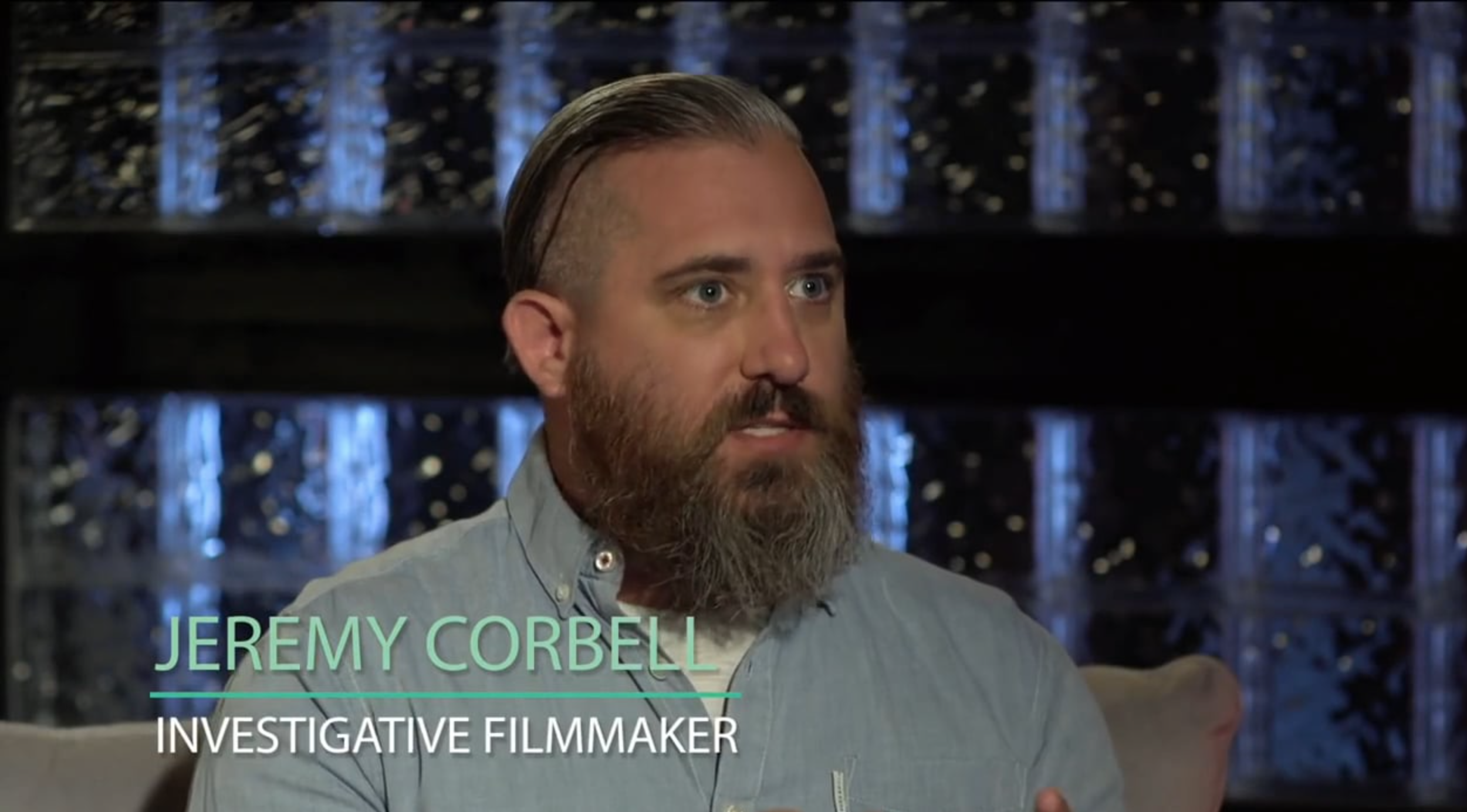
He is a filmmaker, artist, media operator, and UAP investigator whose work has helped move unidentified anomalous phenomena from late-night fringe conversation into mainstream public pressure.
His official site describes him as an American contemporary artist and investigative filmmaker whose documentaries explore UFOs, advanced technology, and the space “where science confronts the abnormal.” It also identifies him as co-host of WEAPONIZED with veteran journalist George Knapp.
That phrase matters.
Weaponized.
Corbell’s project is not passive curiosity.
It is curiosity turned into pressure.
The deeper question is not whether every video he releases proves something extraordinary.
The deeper question is why his releases keep forcing institutions, journalists, skeptics, witnesses, and the public to argue over what counts as evidence.
That is his signal.
Not proof.
Pressure.

Overview
Jeremy Kenyon Lockyer Corbell is an American filmmaker, contemporary artist, and public UAP figure known for documentaries, leaked or released UAP-related imagery, and the podcast WEAPONIZED with George Knapp.
His film platform, Extraordinary Beliefs, lists projects including Hunt for the Skinwalker, Bob Lazar: Area 51 & Flying Saucers, Patient Seventeen, I Am Nano Man, and other investigations into UFOs, aerospace mysteries, implants, paranormal claims, and fringe subjects.
Corbell’s role in the UAP conversation is not simply that he believes strange things.
Many people do.
His importance is that he has become one of the modern movement’s most visible amplifiers: releasing footage, platforming witnesses, collaborating with George Knapp, appearing across major media, and pushing the idea that the public has a right to see what government sensors have recorded.
That role places him in a complicated position.
Supporters see him as a disclosure catalyst.
Skeptics see him as a sensationalist, or as someone too willing to frame ambiguous footage as extraordinary before the evidence is fully public.
Government agencies occupy a third lane: acknowledging that UAP reports deserve serious collection and analysis, while also stating that many cases resolve to ordinary objects and that no verifiable evidence of extraterrestrial technology has been found. In 2024, AARO said it had resolved hundreds of cases as balloons, birds, drones, satellites, and aircraft, while only a small percentage remained potentially anomalous.
That tension is the point.
Corbell matters because he sits where belief, journalism, national security, spectacle, secrecy, skepticism, and public imagination collide.
He does not represent the final answer to UAP.
He represents the new way the question moves.

Origins and Background
Corbell’s public path did not begin with UFOs.
It began with art, martial arts, film, and personal transformation. By the time he became widely associated with UAP, he had already been working in visual storytelling and immersive media.
His official biography emphasizes the artist-filmmaker side of his identity first. It describes Extraordinary Beliefs as an investigative film series by Jeremy Kenyon Lockyer Corbell and frames his work as a way of exploring how unusual ideas, when held by credible people, can alter the way reality is experienced.
That is important.
Corbell’s career is built less around neutral documentation than around belief under pressure.
What happens when a person claims to have seen something impossible?
What happens when a ranch becomes a paranormal hotspot?
What happens when a military sensor captures something no one can identify?
What happens when a controversial witness tells a story that cannot be cleanly verified, but refuses to disappear?
Those are the environments Corbell enters.
One of his major early UAP projects was Patient Seventeen, a film built around claims of alleged off-world implant technology. His own film page describes the project as an attempt to verify the authenticity of an alleged alien implant removed from a patient.
Then came Hunt for the Skinwalker, based on the book by George Knapp and Dr. Colm Kelleher. Corbell’s page describes the film as an investigation into Skinwalker Ranch, a Utah location associated with reports of UFOs, orbs, animal mutilations, unknown creatures, and other anomalous events.
Then came Bob Lazar: Area 51 & Flying Saucers, Corbell’s 2018 feature centered on Lazar’s long-disputed claims about secret government work on alien craft near Area 51. Corbell’s own page calls Lazar “the singular most famous and controversial name in the world of UFOs” and frames the film as an attempt to revisit Lazar’s claims through thirty years of cultural memory.
The pattern is clear.
Corbell is drawn to the witness.
The claim.
The forbidden file.
The footage that should not exist.
The person who says the official story is incomplete.
That path eventually led him into a stronger public partnership with George Knapp, the veteran Las Vegas journalist who helped introduce Bob Lazar’s story to the public in 1989 and who has spent decades covering UFOs, secret programs, and anomalous claims.
Together, Corbell and Knapp now co-host WEAPONIZED, described as a multi-platform investigative series featuring interviews, footage, documents, audio, video, and UAP-related material. The show also invites sources to send sensitive information, images, videos, and documents directly to Corbell and Knapp through an encrypted email address.
That is where Corbell’s modern identity sharpens.
He is no longer only making films about the UFO world.
He is part of the machinery through which the UFO world now speaks.

What He’s Known For
Jeremy Corbell is known for several overlapping signals.
Extraordinary Beliefs
Extraordinary Beliefs is the platform that organizes much of Corbell’s filmwork.
The title itself tells the reader what kind of world they are entering.
Not ordinary belief.
Not established fact.
Extraordinary belief.
That phrase is useful because it reveals both the appeal and the danger of Corbell’s work.
The appeal is that he takes unusual claims seriously enough to investigate them.
The danger is that unusual claims can become compelling before they become proven.
Corbell’s documentaries often ask the viewer to enter the reality of the claimant before deciding what to believe. That can create empathy. It can also create momentum.
Momentum is powerful.
It is not the same as evidence.
Bob Lazar and Area 51
Corbell’s Bob Lazar: Area 51 & Flying Saucers helped reintroduce Lazar to a new generation of viewers.
Lazar’s claims remain some of the most famous and contested in UFO culture: secret work near Area 51, recovered craft, exotic propulsion, and a government program hidden from public view. Corbell’s film does not settle those claims. It makes them vivid again.
That is a recurring pattern with Corbell.
He does not always prove the mystery.
He reactivates it.
He brings the story back into circulation with cinematic force.
Skinwalker Ranch and the Paranormal Hotspot
Hunt for the Skinwalker expanded Corbell’s work beyond classic UFOs into the wider paranormal ecosystem.
Skinwalker Ranch is not just a UFO location in popular imagination.
It is a convergence zone: lights, creatures, poltergeist-like activity, mutilations, military interest, scientific investigation, Indigenous folklore, wealthy private research, and public mythology.
Corbell’s film page describes the ranch as a place associated with many categories of unexplained phenomena and says the film includes interviews, eyewitnesses, and previously unreleased recordings.
That matters because Corbell’s UAP worldview is not purely “nuts-and-bolts spacecraft.”
His work often sits closer to high strangeness.
The anomaly as event.
The witness as evidence.
The place as portal.
The story as signal.
Leaked and Released UAP Footage
Corbell became especially prominent for releasing or helping circulate military-related UAP imagery.
In 2021, footage and images published through Corbell’s channels and Mystery Wire gained broad attention after the Department of Defense confirmed that some triangle-shaped UAP imagery was real in the narrower sense that it was taken by Navy personnel. Business Insider reported that the leaked images and video had been published on ExtraordinaryBeliefs.com and MysteryWire.com and that the Pentagon said they were being examined by the UAP Task Force.
That distinction is essential.
“Authentic” does not mean “alien.”
It means the material came from a real source or was taken by military personnel.
What the object actually was remains a separate question.
That same pattern repeats across many UAP cases.
The image may be real.
The sensor may be real.
The witness may be sincere.
The interpretation may still be uncertain.

The Pyramid Video
One of the most widely discussed Corbell-linked releases showed triangular or pyramid-like lights over a Navy vessel.
The public story evolved.
The footage was confirmed as authentic in the sense of being taken by military personnel, but in a 2022 congressional hearing, Deputy Director of Naval Intelligence Scott Bray said officials were “reasonably confident” the triangles correlated to unmanned aerial systems in the area, with the triangular appearance resulting from light passing through night-vision goggles and being recorded by an SLR camera.
That case is a perfect Corbell-era artifact.
It created attention.
It forced response.
It produced debate.
It also showed how anomalous-looking footage can become less anomalous when more context arrives.
This does not make the release meaningless.
It makes it instructive.
The Weaponized Podcast
WEAPONIZED is Corbell’s current public engine.
The podcast, co-hosted with George Knapp, functions as a place for interviews, documents, footage, whistleblower claims, and commentary on UAP disclosure. Its official description says Corbell and Knapp “pull back the veil” on the known world to explore the unexplained.
The phrase sounds theatrical because it is.
But it also reflects the structure of the modern UAP movement.
The podcast is not only entertainment.
It is a source pipeline.
A pressure campaign.
A narrative system.
A place where claims enter the public bloodstream before institutions have finished processing them.

TMZ Presents: UFO Revolution and Sleeping Dog
Corbell’s media presence has continued expanding.
Tubi lists TMZ Presents: UFO Revolution as a documentary series with two seasons, describing it as an in-depth look at figures “sparking a UFO revolution” by sourcing and releasing evidence around what the government allegedly knows. The listing identifies Corbell as part of the cast.
In 2026, Sleeping Dog, directed by Michael Lazovsky, presented Corbell himself as the subject of a documentary about UAP disclosure. Apple TV describes the film as following Corbell as a key figure in a fight to uncover the truth about UAPs, with rare access and high personal stakes.
That is a notable shift.
Corbell is no longer only the filmmaker pointing a camera at the witness.
He has become part of the story.
The Core Idea or Signal
The core signal of Jeremy Corbell is this:
The unknown now moves through media before it moves through consensus.
That is the real shift.
A strange object is captured.
A source leaks footage.
A filmmaker releases it.
A podcast frames it.
A network amplifies it.
A congressional office asks questions.
A government agency confirms, denies, narrows, or refuses comment.
Skeptics analyze compression artifacts, lens behavior, metadata, wind direction, satellite paths, and sensor range.
The public watches the debate unfold in real time.
This is not the old UFO era.
It is not only campfire testimony.
It is not only blurry saucer photographs.
It is not only paperback mythology.
It is the age of sensor fragments.
Military clips.
Thermal imagery.
Radar screenshots.
Chain-of-custody disputes.
Anonymous sources.
Congressional hearings.
FOIA battles.
Podcasts.
Clips.
Debunks.
Counter-debunks.
Corbell’s importance is not that he resolves this world.
He intensifies it.
He functions as a pressure node between classified systems and public curiosity.
His work asks:
Who controls anomalous information?
Who gets to decide when the public can see it?
Who interprets footage when the state will not explain it?
And what happens when the unknown becomes a media event before it becomes a scientific object?
That is the Corbell signal.
Not certainty.
Disclosure pressure.
Perspectives and Interpretations
Corbell can be interpreted through several lenses.
The Disclosure Advocate View
From the disclosure advocate view, Corbell is useful because he creates pressure.
He releases material.
He keeps stories alive.
He gives witnesses a platform.
He knows how to draw attention.
In a subject historically shaped by stigma, ridicule, classification, and institutional silence, attention itself becomes a tool.
The 2021 ODNI preliminary assessment stated that sociocultural stigma and sensor limitations remained obstacles to collecting UAP data, and it noted that reputational risk could keep observers silent.
This is where Corbell’s supporters see him as important.
He helps break the silence.
He makes it harder for institutions to ignore what pilots, service members, and other witnesses say they are seeing.
The Media View
From the media view, Corbell is less a traditional journalist and more a hybrid figure.
Part documentarian.
Part advocate.
Part source handler.
Part narrator.
Part investigator.
Part promoter.
That hybridity is what makes him effective.
It is also what makes him controversial.
Traditional journalism often tries to separate reporting, advocacy, and performance.
Corbell’s world blends them.
The result is high visibility, but also constant tension over framing.
When he releases something, the release is rarely neutral.
It arrives with urgency.
It arrives with language.
It arrives with stakes.
It arrives inside a larger argument that the public has not been told the truth.
The Government View
From the government view, the UAP issue is now serious, but not settled.
The 2021 ODNI report reviewed 144 UAP reports from U.S. government sources and identified only one with high confidence as a large deflating balloon. It said most of the others remained unexplained, that many UAP were probably physical objects because they were detected across multiple sensors, and that UAP could pose flight safety and national security concerns.
That sounds close to Corbell’s worldview at first.
But the official position is more cautious.
The same report stressed limited data, inconsistent reporting, possible sensor errors, spoofing, or misperception, and the likelihood that different UAP cases require different explanations.
AARO’s more recent public posture is similarly careful. It has released official imagery pages that include unresolved cases, cases under analysis, and cases resolved as balloons, birds, or ordinary aircraft-like behavior.
In other words:
The government now says UAP are worth investigating.
It does not say UAP prove aliens.
The Skeptical View
From the skeptical view, Corbell’s work often arrives with too much conclusion and not enough context.
Skeptical analysts argue that some famous UAP imagery may be explained by camera behavior, optical effects, balloons, drones, birds, aircraft, or insufficient metadata.
The pyramid video is the clearest mainstream example. Military officials later said they were reasonably confident the triangular appearance came from light passing through night-vision equipment and being recorded by a camera, while the objects correlated with unmanned aerial systems in the area.
The “Jellyfish UAP” case has also drawn skeptical analysis. A Metabunk discussion argued that apparent temperature changes in the footage could be explained by thermal-camera auto-ranging, since the background shifts along with the object.
That does not settle every case.
But it does show why caution matters.
A strange image is not automatically a strange object.
A strange object is not automatically non-human technology.
And a real military video is not automatically proof of the most extraordinary interpretation attached to it.
The Public Imagination View
From the public imagination view, Corbell is compelling because he gives the unknown a face, a rhythm, and a release schedule.
He makes the mystery feel active.
There is always another file.
Another source.
Another whistleblower.
Another clip.
Another hearing.
Another hint that the next release will change everything.
This is the power of modern disclosure culture.
It keeps the door open.
But it can also create a permanent state of anticipation.
The next revelation becomes more important than the last unresolved claim.
That is the risk.
The unknown becomes serialized.
Strengths and Limitations
Corbell’s greatest strength is that he understands attention.
That may sound secondary, but in the UAP field it matters.
A hidden file has no public force if no one sees it.
A pilot report has limited cultural effect if no one hears it.
A classified or half-confirmed event can disappear into bureaucracy unless someone turns it into pressure.
Corbell knows how to do that.
He also has a strong instinct for witnesses. His films are built around people who claim contact with realities outside the accepted frame: Bob Lazar, Skinwalker Ranch investigators, alleged implant patients, military sources, and whistleblowers.
That witness-centered approach has emotional power.
It reminds the public that the UAP story is not only about objects.
It is also about people who say they saw something, carried something, or were told not to speak.
But the limitations are significant.
First, Corbell is not an independent scientific body.
His releases can raise questions, but they do not by themselves answer them.
Second, many UAP videos reach the public without enough metadata, full context, sensor information, or chain-of-custody transparency for outside analysts to make strong conclusions.
Third, Corbell’s framing can sometimes move faster than the evidence.
That is the central criticism.
The clip appears.
The language intensifies.
The audience leans forward.
But the underlying data may still be too thin.
Fourth, his association with controversial figures and cases (especially Bob Lazar) means his work inherits the credibility problems attached to those stories. Lazar’s claims remain culturally influential but publicly unverified in the way required to establish extraordinary claims.
A grounded ledger helps.
What is documented:
Corbell is a filmmaker and artist whose platform lists documentaries on UFOs, Skinwalker Ranch, Bob Lazar, implants, aerospace mysteries, and anomalous claims.
What is documented as public impact:
Some UAP imagery circulated by Corbell was later acknowledged by the Pentagon as being taken by Navy personnel, though that does not establish the nature of the objects.
What is officially unresolved:
The U.S. government has acknowledged many UAP reports remain unexplained because of limited data, inconsistent reporting, and collection challenges.
What is officially cautioned:
AARO says it has found no verifiable evidence of extraterrestrial beings, activity, or technology, and that many cases resolve to ordinary explanations such as balloons, birds, drones, satellites, and aircraft.
What remains speculative:
Claims that leaked UAP videos prove non-human intelligence, recovered craft, reverse-engineering programs, or a hidden extraterrestrial presence.
Those claims may be discussed.
They have not been publicly proven.

Broader Implications
Jeremy Corbell matters because the UAP conversation is no longer only about sightings.
It is about epistemology.
How do we know what we know?
Who gets access to the data?
What counts as evidence when the best sensors are classified?
What does “authentic” mean if the object remains unidentified?
What does “unidentified” mean if the public immediately fills the gap with aliens, drones, secret weapons, interdimensional beings, or psychological operations?
This is why Corbell belongs in The Galactic Mind archive.
He is not just a UFO filmmaker.
He is a figure of the evidence crisis.
Modern society is drowning in images but starving for trust.
A video can be real and misleading.
A witness can be sincere and wrong.
A government denial can be accurate or incomplete.
A skeptic can solve one case without explaining the whole phenomenon.
A believer can be right that something deserves investigation while wrong about what it proves.
This is the unstable zone Corbell occupies.
UAP are now a formal government topic. Congress has held hearings on national security, public safety, and government transparency around UAP, including the 2023 House Oversight hearing with Ryan Graves, David Fravor, and David Grusch.
NASA has also entered the conversation, but with caution. Its 2023 independent study report stated that there is no conclusive evidence in peer-reviewed scientific literature suggesting an extraterrestrial origin for UAP, while also emphasizing the need for better data.
That is the wider reality frame.
The subject has become serious.
But seriousness is not proof.
The public wants answers.
Institutions want process.
Scientists want data.
Witnesses want respect.
Skeptics want controls.
Corbell wants disclosure.
The unknown sits in the middle, refusing to become simple.
The Reality Signal
What this subject represents
Jeremy Corbell represents the disclosure-era amplifier.
He is the figure standing between source and public, between footage and interpretation, between government silence and viral release.
He represents the shift from UFO folklore to UAP media warfare.
Not warfare in the literal sense.
Warfare over narrative.
Over evidence.
Over secrecy.
Over trust.
Over who gets to define reality when institutions withhold information and the public no longer believes silence is neutral.
What reality frame it challenges
Corbell challenges the frame that anomalous information should remain locked inside institutions until official systems decide it is safe, clear, or convenient to discuss.
He challenges the old stigma around UFO reporting.
He challenges the assumption that the public should accept “no comment” as closure.
He challenges the boundary between journalist, investigator, filmmaker, advocate, and participant.
But his work also challenges the reality-inquiry community itself.
Because curiosity is not enough.
Footage is not enough.
A leak is not enough.
A witness is not enough.
If the subject is truly important, it deserves more discipline, not less.
Why it matters now
Corbell matters now because the UAP question has entered a new phase.
It is no longer confined to fringe radio, tabloid specials, or late-night speculation.
It has moved into congressional hearings, ODNI reports, AARO analysis, NASA recommendations, documentary series, podcasts, and mainstream news coverage.
At the same time, the media environment is becoming more unstable.
AI-generated imagery, selective editing, degraded sensor footage, viral compression, anonymous sourcing, and political distrust all make the interpretation of visual evidence harder.
That makes figures like Corbell more powerful.
And more risky.
They can force transparency.
They can also accelerate belief faster than verification.
What remains unresolved
What is established:
Corbell is a major UAP media figure whose work has helped publicize military-related UAP imagery, witness claims, and disclosure arguments.
What is documented:
Some imagery he helped circulate was confirmed as taken by U.S. Navy personnel, and UAP are now the subject of official government reporting and congressional attention.
What is debated:
Whether Corbell’s style helps public understanding or muddies it by attaching strong interpretations to ambiguous material.
What remains officially unresolved:
Some UAP cases lack enough data for identification; others have been resolved as ordinary objects; and official bodies continue to state that no verifiable evidence of extraterrestrial beings or technology has been found.
What remains open:
Whether the UAP issue ultimately reveals foreign technology, sensor error, classified programs, atmospheric phenomena, non-human intelligence, something stranger, or a mixed category of many different things.
That is why the subject remains alive.
Not because every claim is true.
Because the question has not been cleanly closed.
The Galactic Mind Perspective
Jeremy Corbell belongs in The Galactic Mind archive because he reveals how the unknown now enters public reality.
Not as a conclusion.
As a release.
A clip.
A leak.
A witness.
A podcast.
A denial.
A hearing.
A debate.
A frame.
Corbell’s work is not best understood as science.
It is best understood as pressure applied to secrecy.
That pressure can be valuable.
Without public pressure, institutions often move slowly.
Without uncomfortable releases, some subjects never become legitimate enough for official inquiry.
Without people willing to risk reputation, certain realities remain buried under stigma.
But pressure can distort as well as reveal.
A mystery can become a brand.
An investigation can become a performance.
A fragment can become a worldview.
A good question can be weakened by premature certainty.
The Galactic Mind position is not to worship Corbell or dismiss him.
It is to place him accurately.
He is a signal carrier.
A narrative accelerant.
A disclosure-era operator.
He has helped make UAP harder to ignore.
He has not made them easy to understand.
That is the distinction.
The deeper question is not whether every object in every Corbell release is extraordinary.
The deeper question is why the public now trusts fragments, witnesses, and independent media pressure to tell them what institutions will not.
That is not only a UFO story.
It is a reality story.
Open Thread
Jeremy Corbell leaves us with a question that belongs to the entire disclosure era.
What happens when the most important evidence about reality arrives as a leak?
Who should interpret it?
The government?
The scientist?
The journalist?
The filmmaker?
The skeptic?
The witness?
The public?
And what do we do when each one sees a different world inside the same frame?
Maybe the UAP question is not only about what moves through the sky.
Maybe it is about what moves through secrecy.
What moves through belief.
What moves through institutions.
What moves through cameras, sensors, podcasts, and public imagination.
The unknown is no longer waiting quietly at the edge.
It has entered the media system.
Now the question is whether we can study it without being consumed by the spectacle around it.
What do you think? Drop your thoughts in the comments ...
Sources / Receipts
- Jeremy Corbell / Extraordinary Beliefs official about page: filmmaker identity, documentary focus, and WEAPONIZED connection.
- Extraordinary Beliefs film list: Hunt for the Skinwalker, Bob Lazar, Patient Seventeen, and related projects.
- Hunt for the Skinwalker official film page: documentary framing, Skinwalker Ranch claims, and Corbell’s role.
- Bob Lazar: Area 51 & Flying Saucers official film page: documentary framing, Lazar subject matter, and Corbell’s role.
- WEAPONIZED official site: Corbell and George Knapp podcast platform and source-submission language.
- Business Insider report on Pentagon confirmation that triangle-shaped UAP imagery was real in the sense of being taken by Navy personnel and examined by the UAP Task Force.
- ODNI 2021 Preliminary Assessment: Unidentified Aerial Phenomena: 144 reports, limited data, stigma, safety concerns, and unresolved cases.
- ABC News report on 2022 House hearing: officials said they were reasonably confident the pyramid-shaped video objects were drones and that the triangular appearance was produced by night-vision / camera effects.
- AARO official imagery page: examples of unresolved, under-analysis, and resolved UAP reports.
- DOD / AARO 2024 reporting summary: AARO resolved many cases as balloons, birds, drones, satellites, and aircraft and found no verifiable evidence of extraterrestrial beings, activity, or technology.
- NASA UAP Independent Study Team final report: no conclusive evidence in peer-reviewed literature suggesting an extraterrestrial origin for UAP, with a call for better data.
- House Oversight 2023 UAP hearing page: official hearing listing and witnesses.
- Tubi listing for TMZ Presents: UFO Revolution.
- Apple TV listing for Sleeping Dog.


Discussion