
A number can reveal how a world works while leaving its makers—if it has any—beyond recognition.
In 2010, researchers tuned a magnetic field around a crystal of cobalt niobate and watched its magnetic behavior approach a critical transition. Near that boundary, two excitation energies approached a familiar proportion: the golden ratio, approximately 1.618. A mathematical model had predicted the relationship before the experiment found it. [1]
The crystal’s magnetism behaves, to a useful approximation, like linked chains. An excitation is a disturbance of that magnetic system, requiring a particular amount of energy. Researchers measured these disturbances using neutron scattering: incoming neutrons exchange energy with the sample, allowing instruments to reconstruct what happened inside. The experiment combined very low temperatures with a carefully controlled magnetic field. [2]
The relevant theory involved E8, a mathematical symmetry that predicts a particular family of excitations under specific conditions. The two lowest-energy modes approached its predicted golden-ratio relationship. This was a result about collective magnetic behavior, not the shape of the crystal or a universal proportion governing everything. [1]
What makes the finding remarkable is the meeting between a prediction and a material. Mathematics described something the researchers could then measure.
But suppose a mathematical regularity had another history behind it. Suppose its explanation included a decision made before the world containing it began.
Would observers within that world have any way to recognize the difference?
The mark inside the rim
Imagine turning a handmade bowl beneath a lamp. Just inside the rim, the glaze follows a shallow impression left by the potter’s finger.
The potter was holding the clay. The mark survived because a necessary action happened to leave a trace. No message was composed, and nobody needed to imagine the person who would eventually notice it.
Now place an observer inside the bowl, able to measure its surface but unable to visit the workshop. That observer could describe the impression’s depth and curvature. Whether those measurements would reveal a hand depends on what else the observer knows about hands, clay, and the ways impressions form.
A fingerprint is recognizable because we can compare it with fingers. Without that comparison, the word already assumes part of the answer.
This is where we leave the verified physics and enter the thought experiment. Imagine humanity building a simulated universe whose inhabitants can investigate their own world. The premise grants conscious inhabitants and instruments that obey their world’s consistent internal rules. Within it, one useful engineering decision will produce the golden ratio.
The cobalt niobate experiment does not support that premise. It supplies the opening puzzle: a mathematical relationship can become physically observable. We are now inventing a different mechanism and asking what its observers could learn.

A rule the builders can live with
Our designers need one class of structures to grow in successive layers around a central seed. These will eventually become enormous objects in the simulated sky, with nested boundaries that persist after growth has stopped.
First, fix what “size” means. It is the radius of each layer’s outer boundary, measured from the common center. It is not the thickness of the layer, its surface area, or its mass.
During development, the team wants this growth to produce a useful spread of scales. Adding the same distance each time leaves large objects crowded with comparatively narrow layers. Doubling every radius gives them larger jumps than they want. A hand-written table of sizes would require repeated decisions whenever they extend the model.
They choose a convenient compromise: the radius of each new boundary equals the sum of the preceding two radii.
The rule needs only two previous measurements. It can keep producing larger structures without a catalog of future sizes. Once the sequence is increasing, each step grows by less than doubling. Those properties suit this particular design problem; the rule need not be the only solution, or the best one imaginable.
The designers still have other work to do. Their growth process must move material, supply energy, and take time. The recurrence determines where a completed boundary belongs; it does not make a finished shell appear instantaneously or provide unlimited matter. Growth stops when the necessary supply runs out. The resulting boundaries remain as records of earlier stages.
For a simple example, begin with radii of two and three units. The next boundaries lie at five, eight, thirteen, twenty-one, and thirty-four.
Divide each radius by the previous one. The ratios wander above and below a value they approach ever more closely: phi.
No one needs to enter 1.618 into the simulation.
The arithmetic explains why. Each new ratio equals one plus one divided by the previous ratio. As the ratios converge, they approach a value that reproduces itself under that operation. One plus one divided by phi gives phi again.
The convergence works for any two positive starting sizes. The opening values affect the early layers and the overall scale; the limiting ratio is the same. This is the familiar Fibonacci recurrence, used here with arbitrary positive starting values. [3]
The crystal’s E8 physics and our invented growth rule are different routes to the same number. Inside the simulation, however, the recurrence belongs to the world’s ordinary workings. Its inhabitants will encounter the layers long before they have any reason to imagine designers.
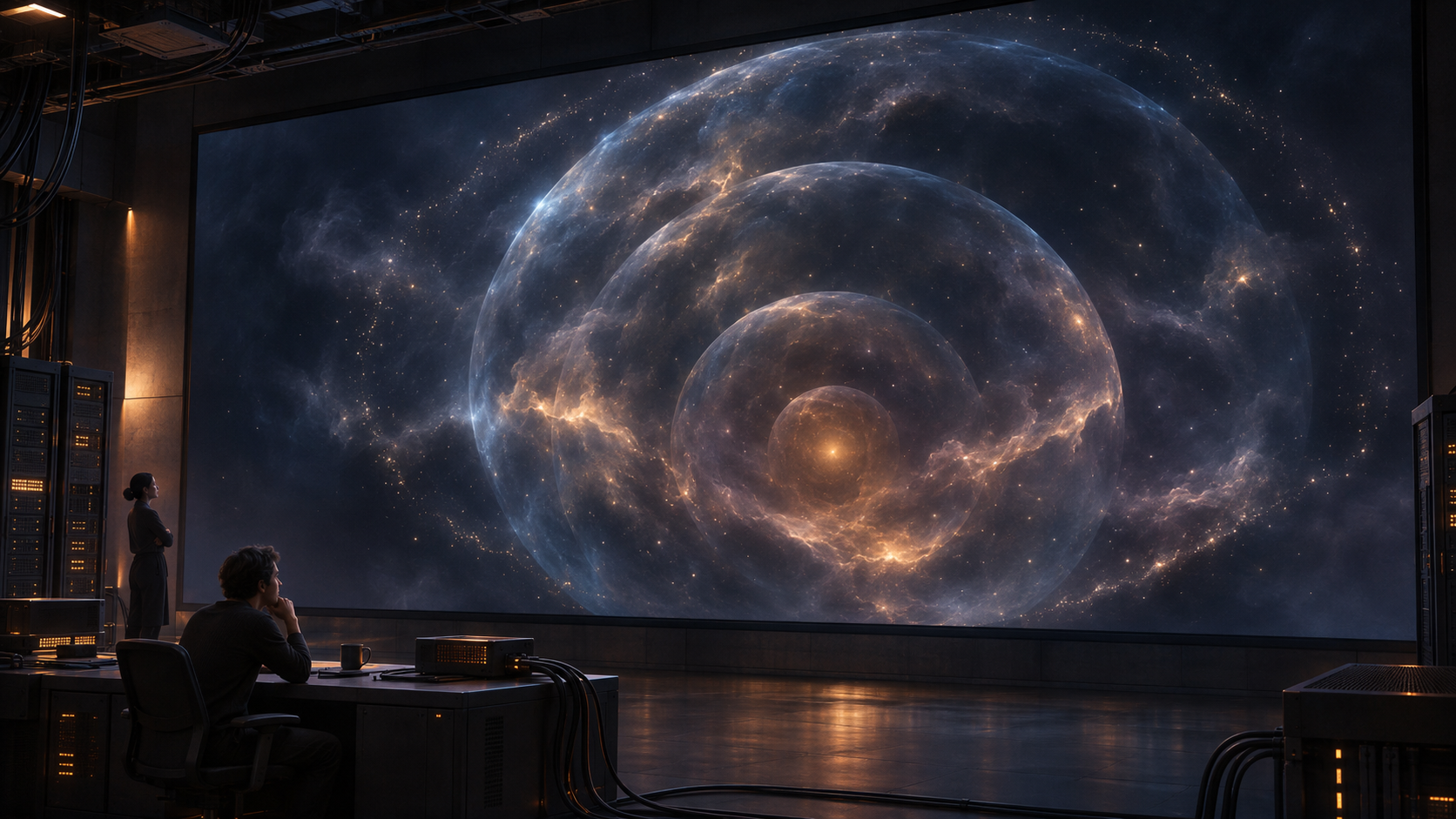
The layer beyond the image
Consider an astronomer living there.
Her civilization has cataloged these layered objects for generations. At a distance, their old boundaries appear as faint luminous arcs around a common center. Some are incomplete in the images. Others overlap with foreground light. A large layer can be especially difficult to distinguish because its faint glow is spread across so much sky.
She works on a system whose growth ended long ago. Its boundaries have settled, and several are clear enough to measure. The outermost remains an uncertain suggestion in the background.
Her first question is about the object itself: what determines the spacing? A repeated proportion seems promising. But it does not describe the innermost measurements quite as well as she expects. She tries a relationship involving two earlier boundaries instead of one. Their radii add to the next.
The small departures from a constant ratio now have somewhere to go. They become part of the prediction.
Expressed in our numerals, two of her measured radii are eight and thirteen. Her rule puts the next boundary at twenty-one, with an uncertainty inherited from the measurements. Multiplying thirteen by an approximate golden ratio would give a slightly different answer. She is testing the recurrence, including its early deviations, rather than asking whether something in the sky resembles a famous number.
She records the prediction before the deeper observations are processed.
Then she waits.

The instrument has collected more light than before. On the first image, the region beyond the last clear boundary still looks almost empty. A few brighter patches float in the grain. As the team combines the observations, a curve begins to hold together across them.
Its edge falls within the interval she calculated.
She looks back at the earlier image. The suggestion was there, too weak to separate confidently from the background. Now the boundary can be measured. Different reductions of the data put it in the same place. Later observations preserve the result.
For a moment, the distance between calculation and sky has closed.
She has discovered something true.
Her method also gives other astronomers somewhere to look. They can test objects with different starting sizes, different ages, and different surroundings. They can ask where the relationship holds and where growth has been disturbed. A private recognition becomes a research program. None of this requires her to know that the recurrence once appeared in a human design meeting.
The evidence rewards her model because it successfully describes an observable process. It does not contain the meeting, the competing proposals, or the reason the designers preferred these particular gaps between layers.
Her prediction has reached farther than her instrument could initially see. It has not yet reached outside her universe.
What the ratio remembers
There is a strange difficulty hidden in the success of the rule.
Its tendency to produce phi makes it reliable. It also makes phi alone a poor record of how any particular object began. Start with other positive sizes and the early sequence changes. Follow the growth far enough, and the ratios nevertheless approach the same destination. A distant astronomer measuring only mature layers might find an astonishing regularity across objects whose beginnings were quite different. The regularity preserves information about a relationship while concealing differences among its starting points.
This is not absolute mathematical erasure. Given exact adjacent values and knowledge of the recurrence, the astronomer could subtract backward to recover earlier ones. But observations have finite precision, early layers may be obscured or destroyed, and late ratios can differ by amounts her instruments cannot detect. The stable number is what remains easiest to see.
That matters for the idea of a fingerprint. A good fingerprint helps distinguish one source from another. Phi, appearing through a relationship shared by many systems, may do the opposite. It can reveal what different systems have in common while telling us little about their individual histories.
Even identifying the full recurrence would not identify its author. Another design team could choose the same rule. A designer could choose it for beauty, convenience, tradition, or an experiment whose purpose the inhabitants cannot reconstruct. Our team chose it to produce manageable spacing across scales. The measurements would look the same if the motive had been different.
The astronomer can recover an operation more readily than an intention.
Nor must an operation like this require a designer at the level she can study. Within an impersonal physical model, a growth process could retain two earlier quantities and combine their contributions in producing the next. If that process generated the same observable sequence, the sequence alone would not tell her which history to believe. To recognize a choice, she would need evidence beyond the result the competing accounts already share.
When a choice becomes a law
For the designers, the recurrence began as an option. For the astronomer, it determines where the next boundary will be.
That difference can deepen over time. Her civilization might use the relationship to estimate obscured structures, navigate through their surroundings, or determine which objects have suffered disruptions. A rule chosen to simplify development becomes part of the reliable order on which people plan their lives.
Their discoveries can exceed anything the designers intended. They might identify consequences the original team never calculated, discover interactions with other processes, or invent technologies that depend on the layers’ regular spacing.
Being made would not make their science trivial. They would still have to discover what follows from the world they inhabit.
Meanwhile, the decision’s history could grow obscure outside the simulation. The original team retires. Records become incomplete. Later custodians inherit a working world and preserve its rules because changing them would disturb everything that has developed under them.
In this version, even those maintaining the universe might no longer know exactly why the first designers chose the recurrence. The inhabitants could understand its consequences better than the people keeping their world running.
The imprint survives more faithfully than the explanation.
This also separates creation from continuing attention. An automatic rule can keep operating without anyone watching each outcome. Its precision would not establish that the creators notice the astronomer, approve of her civilization, or intended observers to arise.
If conscious beings emerged as an unanticipated consequence, the engineers’ practical decision would have acquired a significance far beyond its original purpose. Something chosen for convenience would now help determine the conditions of an experienced life.
The potter’s finger was briefly against the clay. The impression remains wherever the bowl goes.
What would reveal a choice?
Suppose the astronomer begins asking where the growth rule came from. Her next useful observation would depend on what the rival explanations actually predict.
One physical model might produce the recurrence only when two contributions have equal strength. Change the environment, and the balance should change. A contrasting model might impose the recurrence directly, preserving it across those conditions.
Observations across different environments could separate those models. If the ratio shifted in a predicted way, she would learn about the mechanism. If it remained fixed, she would constrain that explanation and look for another.
But “fixed” would not automatically mean “chosen.” A deeper physical symmetry could preserve the relationship. Likewise, environmental variation would not rule out designers: they could have built a world whose patterns emerge through interactions rather than explicit instructions.
The investigation needs specific alternatives. The loose claim that someone made the universe can accommodate a fixed ratio, a changing ratio, or no conspicuous ratio at all. By itself, it offers little guidance about which observation to make.
More distinctive evidence might involve behavior that a proposed underlying process does not predict. Imagine, as a further possibility, that the inhabitants publish a new request for a particular, reversible change in the growth rule. Independent observations then record precisely that change, followed by its requested reversal. Repeated successful exchanges would give them reason to investigate a responsive intelligence with access to the process.
That would be much stronger evidence of agency than a beautiful proportion.
Even then, the identity of that agency would remain unsettled. An intelligence within their universe might possess extraordinary control over these objects. Demonstrating intervention would not establish that the intervener created the whole world.
An unintended trace presents a harder case because it does not answer questions. It simply persists. There may be versions of the simulated universe in which every accessible observation also fits an impersonal account. If the two accounts predict exactly the same observations, no improvement in measurement alone can separate them. The difference would lie in a history to which the inhabitants have no observational access.
That limit would arise from the arrangement of their world. Their curiosity and ingenuity would not guarantee that the needed evidence exists within reach.
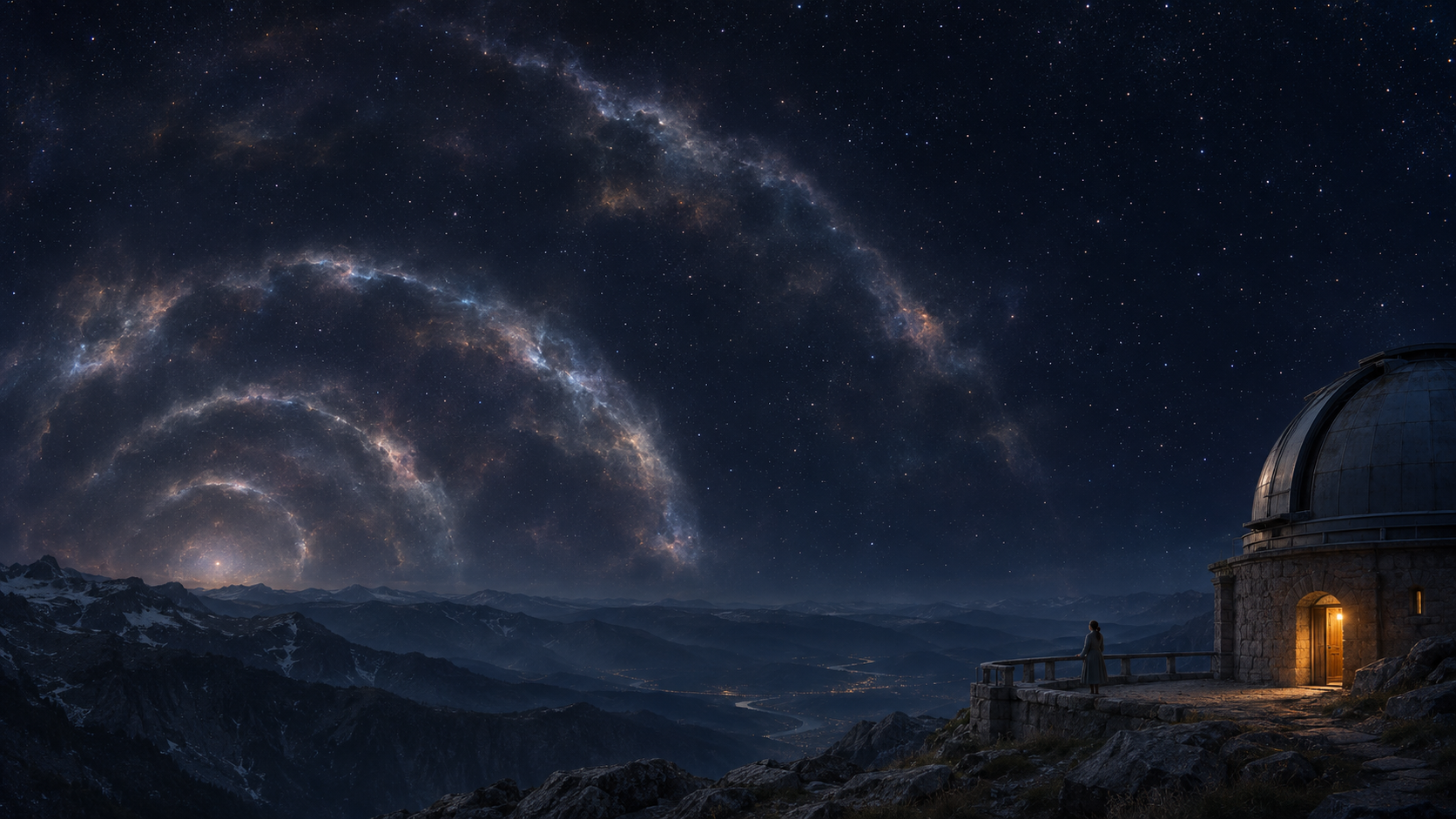
The Echo Back
Return to the crystal on Earth. The observed energy ratio supported a specific physical prediction. It supplied no test that distinguished a created universe from an uncreated one.
Our imagined astronomer helps explain why that distinction matters. We can know that a relationship is real without knowing everything about its origin. Greater accuracy can deepen our knowledge of the relationship while leaving that historical question untouched.
Impersonal emergence deserves its full place here. Mathematical relationships can follow from the ways physical systems interact and the constraints those systems obey. A ratio need not have been selected as a ratio. Our invented designers themselves illustrate that point: even when agents choose the rule, the number follows from the rule’s consequences.
Creation and emergence could therefore occur at different levels of the same explanation. Someone could choose a process; outcomes they never separately chose could emerge within it.
There is also the possibility that no one chose the underlying process. The existence of a concise mathematical description does not settle that question. To advance beyond it, we would need a proposed origin to yield some observable consequence that competing accounts do not share, then look for that consequence without quietly changing the proposal whenever it fails.
A repeated number would be an invitation to investigate. What makes it repeat would matter more than how suggestive it feels.
The potter’s mark remains a powerful image because it lets intention and consequence come apart. A trace can be real without being a message. It can preserve an action without preserving its purpose. It can outlast both the maker and every record of the making.
Yet the analogy has a limit that belongs at its center. We stand outside actual bowls. We have seen hands press clay. We recognize the workshop as a place in the same world as the object. For the universe as a whole, we have no equivalent view from the other side of the rim.
We should not give ourselves that view merely because a pattern is beautiful.
Still, imagine our astronomer closing her observatory after the outer layer has been measured. The prediction is now part of her civilization’s knowledge. It will help someone else decide where to point an instrument. Whatever the origin of her sky, she has learned to read a little more of it.
From our side, we know the rule began as a practical decision. From hers, it is a dependable relationship within nature. Those descriptions concern different parts of the same history.
The deepest trace of making might be something its inhabitants successfully understand, use, and name—while never recognizing that there was once an alternative.
If the beings inside a universe we built called our oldest engineering decision a law of nature, would they be wrong?
More in SPEC
- What If First Contact Was an Archaeological Discovery? — Explores what an enduring trace can reveal about its makers while leaving their purposes unresolved.
- What If the Visitors Are Another Civilization’s AI? — Separates understanding how something operates from understanding whose intentions it carries.
- What If an Alien Signal Arrived on the Same Night Every Year? — Examines how a successful prediction strengthens a discovery without settling its ultimate explanation.
Sources / Receipts
- R. Coldea and colleagues, “Quantum Criticality in an Ising Chain: Experimental Evidence for Emergent E8 Symmetry,” Science 327, 177–180 (2010). Oxford Research Archive · Open manuscript · DOI. Supports the magnetic excitation result and its theoretical interpretation, not an inference about cosmic creation.
- Helmholtz-Zentrum Berlin, “Golden ratio discovered in a quantum world,” January 8, 2010. Institutional account. Provides accessible context for the magnetic chains, neutron measurements, and experimental conditions.
- NIST Digital Library of Mathematical Functions, §26.11, “Integer Partitions: Compositions.” Recurrence and explicit Fibonacci formula. Supplies the standard mathematical recurrence and formula. Its application to arbitrary positive layer sizes is mathematical reasoning; the simulated world, design rationale, and astronomer are inventions of this essay.


Discussion