
How could two civilizations choose a time to meet before either had spoken to the other?
Imagine the third year. A brief radio pulse has appeared twice from the same patch of sky, one orbit of Earth apart. This time, weeks before the night in question, the astronomers publish the coordinates, the radio band, and a twenty-minute window. Anyone with a suitable telescope can check. Once the window closes, they cannot move it.
Dishes at two independent observatories turn toward the published coordinates. For most of the allotted time, the receivers record the ordinary radio sky. Then both record the pulse. By the time the window closes, people who had only the first team's word for the earlier detections have a recording of their own.
Where would anyone get the idea to reserve those twenty minutes? That part of the story begins with a real experiment.
The patch of sky opposite the Sun
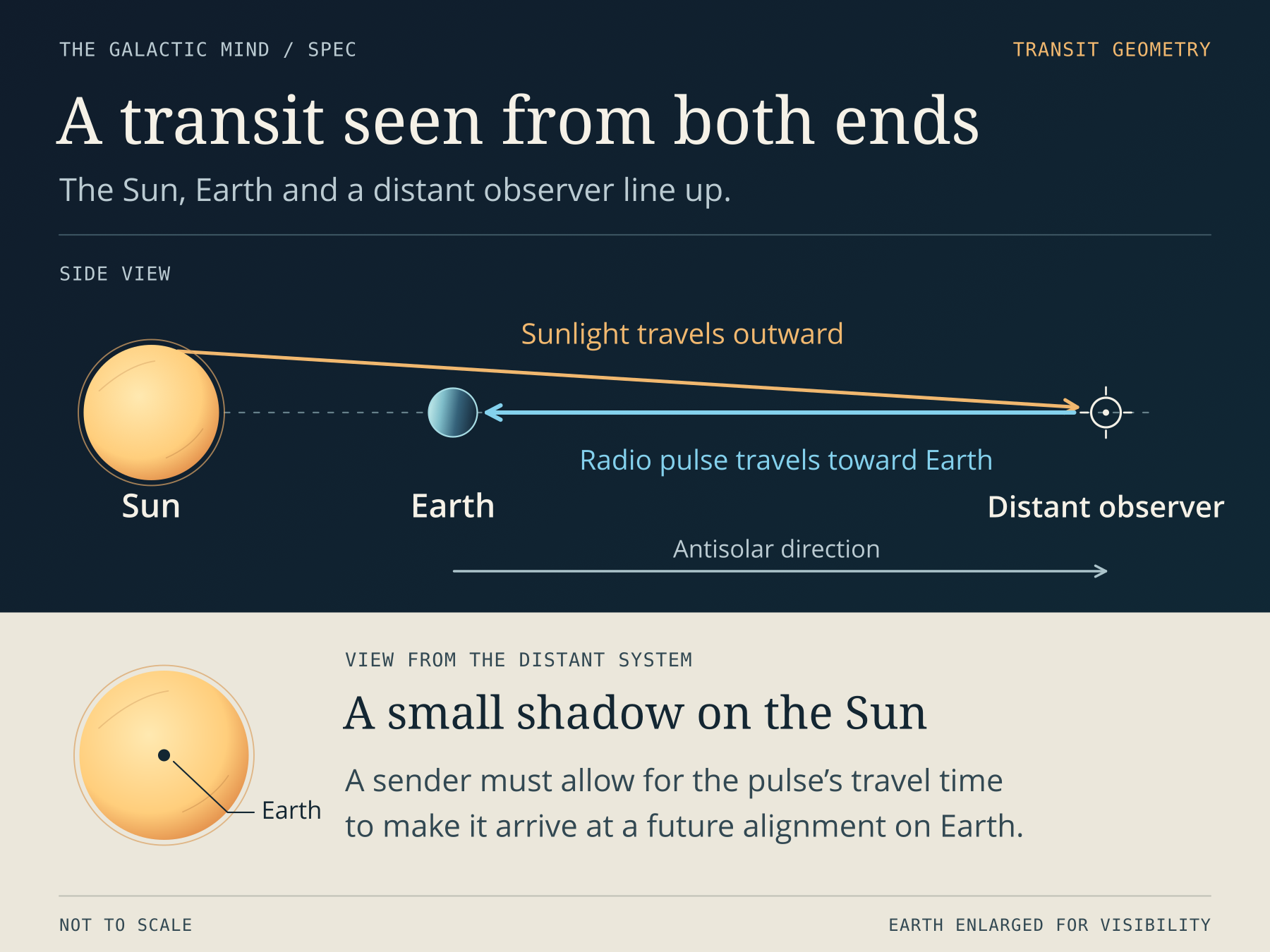
Imagine looking back at the solar system from a distant star. From high above the plane of our orbit, you would see Earth travel around the Sun without ever crossing its face. Move your viewpoint almost level with the orbit, and once each year Earth passes across a small part of the bright solar disk. Even if your telescope could not make out the planet itself, you might measure the little dip in sunlight. Astronomers call such a crossing a transit. The stars with this view occupy a narrow band around our sky.
Now come home and turn your back to the Sun. A line drawn from the Sun through Earth and out into space points to what astronomers call the antisolar point. For a star exactly on that line, this is the middle of the crossing; a star slightly to one side can see an off-center transit. As Earth moves, the point slips across the background stars. Each favorably placed system gets its own turn. The “same night” is shorthand for our return to that part of the orbit. No one elsewhere needs to know what we call November, and the moment need not fall at the same local hour, or even on the same civil date, each year.
An anniversary on a distant world would be as regular as ours, but how would we guess which one its inhabitants celebrate? A transit gives each side a reason to think the other might notice. They could see Earth dim their view of the Sun; we could work out when they have that view. In game theory, a choice that stands out to two parties who have made no prior arrangement is called a Schelling point.
The SETI Institute described a search built on this geometry on November 3, 2026. At the Allen Telescope Array in Northern California, researchers followed the direction opposite the Sun and searched for radio signals concentrated in a narrow range of frequencies. By comparing two directions at once, they could test whether a signal was confined to the patch they were studying. The pilot reported in The Astronomical Journal covered about seventeen hours over three nights in the summer of 2023. Human radio interference could account for every detection.
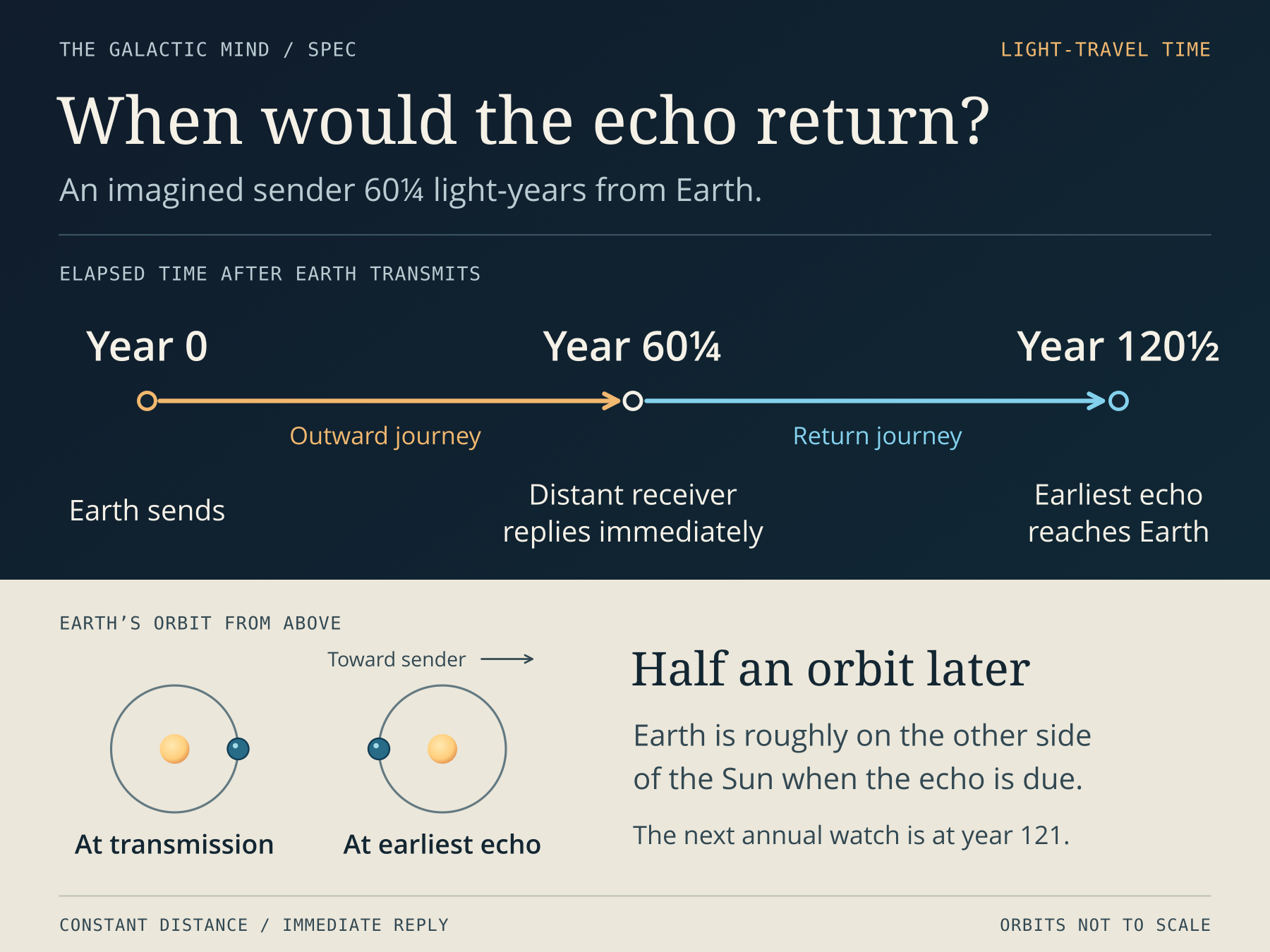
There is a catch to using a transit as an appointment. By the time the distant astronomers see Earth cross the Sun, the sunlight that carried the news has been traveling for years. A radio pulse sent straight back takes just as long to get here. Suppose, for easy arithmetic, that the distance is 60¼ light-years and changes negligibly. Send at the instant you see the dip, and the pulse reaches Earth about 120½ years after the crossing you saw. Earth is now roughly on the other side of its orbit. You have picked an excellent landmark and missed it by six months.
The solution, explored by astronomer Robin Corbet, is to choose the crossing at which the signal should arrive. Measure several transits, work out Earth's orbit, allow for the distance and relative motion, and aim at where Earth will be. In our example, the sender must transmit about sixty years and three months before the desired arrival. The receiving astronomers have the easier job: they can work out when that direction lies opposite their Sun without knowing in advance how far the signal has traveled.
The observing rule is real. The annual pulses are our addition. In the third year we imagined, the team chose those twenty minutes because both earlier pulses reached Earth when that patch lay nearly opposite the Sun. Their forecast named the next alignment. Now they have the other observatories’ recordings to compare.
What the third pulse changes
Two marks on a calendar offer plenty of room for ingenuity. Once you know both dates, you can draw a line between them, try different tolerances, and notice which anniversaries come close. A prediction made in advance gives up that freedom. A signal a week late might be interesting in its own right, but no one could use it to claim that the published twenty-minute prediction had succeeded. The astronomers took the chance of being plainly wrong. That makes their success informative.
There is a second gain. Each observatory has its own receiver, clock, and original recording. The locations of the two sites tell you what small difference to expect between the arrival times of a wave from the published direction. If the recordings match in frequency and shape and show the expected delay, a fault in one instrument becomes a poor explanation. The teams would have established that a matching radio event recurred when forecast, with evidence about the direction from which it arrived. A direction is not a distance. It cannot, by itself, put the transmitter on a particular planet or exclude a human signal reaching both sites.
Even an astronomical source can keep time. The CHIME/FRB Collaboration found a repeating source of fast radio bursts whose bursts clustered within a roughly five-day window in a cycle of about sixteen days. They did not find an individual burst arriving on cue every sixteen days. What matters here is the distinction: a natural source can have seasons of activity. One imaginable mechanism is an orbit that periodically carries a radio source clear of material that usually blocks its emission. Three short visits might sample three bright moments without revealing the longer rhythm that produced them.
Then there is a clock much closer to home: the telescope schedule. A team following the antisolar point comes back to a given patch at much the same time every year. A source that flares every few weeks might leave three annual entries in the log if those were the only weeks anyone looked. Bringing a second telescope to the third appointment makes the detection independent. It does nothing to make the dates an independent sample. Both teams came because they had read the same invitation.
Listen on the wrong nights
Here is one observation worth buying telescope time for. For six weeks on either side of the next predicted crossing, give the target twenty minutes once a week, varying the night and hour while keeping it well above the horizon. Give it an equal twenty minutes at the crossing itself. Use the same frequency band and sensitivity throughout. At each visit, record a nearby comparison patch at the same time. Before starting, agree on what counts as a pulse and keep the data from the quiet visits too.
If similar pulses turn up repeatedly from the target on ordinary nights, the original schedule has hidden part of the source's behavior. If the comparison patch lights up too, interference common to both directions deserves attention. A pulse confined to the target in the predicted interval, with quiet comparison fields and quiet weeks on either side, would strengthen the case for that interval. A natural source with an annual active period could still pass the test. And six weeks of short visits on either side cannot tell us what happened during all the hours in between.
Suppose the appointment continues to hold. For the rest of the inquiry, take the most interesting explanation on its own terms: someone chose when the pulse would reach Earth. What did that choice buy them, and what did they have to know about us to make it?

A minute of the sender’s time
Consider the decision from the far end. Someone has an antenna, a power supply, and a list of worlds that cross the faces of their stars. They know enough about the third planet of our Sun to predict a transit. They have no idea whether anything here has built a receiver. How much of the antenna's working life should they spend finding out?
At a given transmitting power, the energy needed for a full day of broadcasting could buy 1,440 calls a minute long. A steerable antenna could make those calls in different directions. In exchange for that economy, the builders inherit a terrible problem of timing: a minute sent to an inattentive planet is a minute lost in its entirety. Choosing a conspicuous event at the destination gives them a reason to favor one minute over half a million others. Repeating the call next year gives a world that heard the last few seconds time to prepare.
The trade works only up to a point. The pulse has to be strong enough to register at the other end. A narrow beam can concentrate power, but the narrower it is, the better its builders must know where to aim. An uncertainty of three days in the light travel time is a considerable embarrassment if your signal is one minute long. Spreading the call over several nearby nights would buy some insurance at the expense of the energy saved. The receiver has a problem of its own: the sky can tell it where to point, but an orbit supplies no obvious setting for the radio dial. A civilization could calculate the night perfectly, spend it listening, and go home empty-handed.
Why, then, send so little information? Think about what changes on Earth between the first pulse and the third. On the first occasion, one instrument happens to be looking. By the third, several have reserved time, asked colleagues to check their clocks, and arranged to retain their recordings. The sender can accomplish that change without encoding a single instruction. Once someone notices the recurrence, the listeners themselves do much of the work of getting ready for whatever might follow.
What looks from here like a remarkably uncommunicative transmission could be the most economical part of a much longer exchange. The first job of the beacon is to get a second telescope pointed at it.
Whose name is in the timing?
Suppose the pulse contains a single rise and fall in strength, with no finer structure we can resolve. A century of study might never extract a word from it. There is still a difference between detecting that pulse at an arbitrary instant and detecting it just as Earth crosses the Sun as seen from the source. If the sender deliberately selected the latter, it has referred to a feature of the receiver's world. It can do that without a word for Earth. In something like an address, our name could be the time we pass in front of the Sun.
That leaves an unexpectedly large class of intended recipients. A builder might have measured a planet with an atmosphere and decided to call anything there capable of recognizing a pattern. It could have adopted the rule long before there were radio astronomers here. A machine in lunar orbit could hear the invitation almost as well as we could. Even on the deliberate reading, the evidence would say more about where the listener was expected to be than about which species the sender had in mind. There is a particular intimacy in being sought by someone who knows the length of your year and may know nothing else about you.
There is also a version in which nobody is seeking us. Picture a steady, narrow beam aimed at the Sun for some other purpose. If its path is narrow enough near Earth's orbit, we can move into it near the transit and out again shortly afterward. A very brief pulse would require a correspondingly narrow footprint. The equipment at the far end need never switch off. What registers here as a pulse could be our own passage through the footprint of a continuous transmission. Even establishing an artificial origin would leave a surprisingly concrete question open: is the timing something the builders did, or something Earth did by moving?
The two readings would come apart if the sender showed it could change its behavior on our account. Until then, an annual call could sit somewhere between personal correspondence and a public service. Imagine an observatory that uses the same rule for a thousand planets, giving each a turn according to its own orbit. No planet is singled out as inhabited; each gets an opportunity to announce that it is. Someone here who worked out that rule could try it with a third world. The first thing to travel onward from the encounter might be a way of meeting strangers, learned entirely from when one of them chose to call.
A reply for someone else’s lifetime
Return to the illustrative distance of 60¼ light-years. Suppose we locate the source well enough to aim a transmission and decide, after a debate of our own, to send one at the annual alignment. Our reply includes a freshly chosen, irregular pattern of long and short intervals, something the original beacon never sent. We preserve exactly what went out and when. There is a question embedded in the act, even without shared words: can anything at the other end hear this and send it back?
The next annual pulse arrives. A student who helped send the reply can spend an entire career watching for a change. On the day she retires, the question may still be on its outward journey. Even if the distant equipment recognizes the pattern and returns it immediately, about 120½ years have to elapse between our transmission and its echo here. A startling change in year thirty would deserve investigation on its own merits. At this distance, it could not have been caused by our reply.
There is a further surprise in those numbers. Send from Earth on the annual observing night and an immediate echo, 120½ years later, would come due half an orbit away from our appointment. The source would then lie close to the Sun in our sky. People faithfully observing the usual twenty minutes could miss the answer they had waited their whole lives to hear. The far end could hold its response for roughly six months to bring it back onto our schedule. We would be counting, once again, on a stranger working out when we might listen.
Someone at the far end must also be listening at a time and frequency we can reach. The arrival schedule for calls to Earth does not tell us when their receiver is on. The beacon might still be running while the people who commissioned it have lost all interest. On our side, a record has to survive long enough for another set of observers to recognize a reply to a question that would otherwise mean nothing to them. An unfamiliar set of intervals recorded tonight could be filed as noise. The same intervals, laid beside a transmission made by one's great-grandparents, could be the first evidence that the traffic had gone both ways. Even then, a device could have returned the pattern automatically. A working connection and a conversation with a mind would be two different discoveries.
For much of that century the annual observation would still have a purpose. It would establish how the signal ordinarily behaved before an answer was physically possible. It would give new observatories a chance to learn the procedure while experienced ones were still available to compare notes. And it would leave open a quieter possibility: that this punctual, spare call was everything the other civilization meant to offer. The crew who first heard it would have no way to settle which kind of correspondence they had begun.
The logbook they would inherit
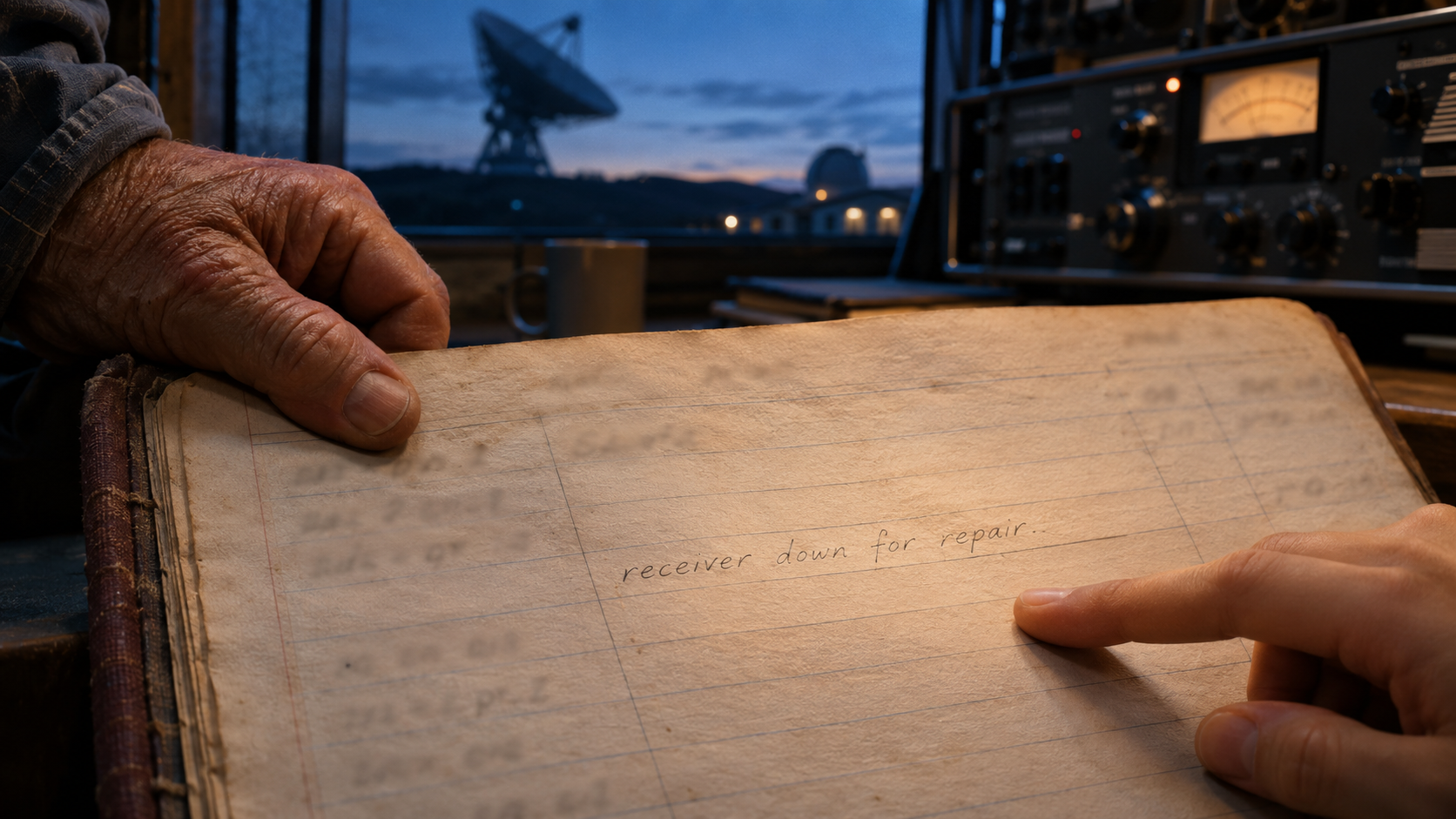
Imagine inheriting the observatory log seventy years in. A whole row is blank. The people who wrote the surrounding entries have died, the original receiver is in a museum, and you need to know whether the beacon fell silent that year. In one version of the record, someone penciled four words in the margin: receiver down for repair. In another, the blank is all you have. With the margin note, you know that the gap tells you nothing about the source. No instrument you build now can fill in that entry. The wave, if there was one, has gone past.
A useful handover would include the original recordings, the state of the instruments, and the limits of what each could detect. It would explain how to calculate the next window from the orbit, so that the appointment could survive a change of clock standard or an error in a table of dates. When a new receiver replaced an old one, the two might spend a season in service together. Otherwise the first apparent change in the voice from the sky might be the signature of a technician's work here on Earth. Particularly precious would be the recording of our own transmission, in a form someone could still open and understand a hundred years later.
The harder inheritance is a choice. A night on a telescope can be spent on something else. There will be years when an observatory can no longer justify the time, or a community that once favored sending a reply comes to regret it. The original observers could leave other sites enough information to take their place. They could say who decided to transmit and what they hoped the pattern would do. They could hardly tell an astronomer a century later what she must believe about the source, much less what she owes it in return.
There is room here for a kind of contact that no single person on either world ever experiences in full. One group sends an answer. Another keeps a record of what usually comes back. A third, born after the first group is gone, notices a departure and opens the old file. If the intervals match, the moment of recognition belongs to people the senders never met, acting on a question they did not ask. For two worlds to exchange even that much, each must find a way to give strangers in its own future a turn in the conversation.
The Echo Back: The night they named
Go back to the astronomers drafting the third-year prediction. At that point there has been no independent confirmation. There are two entries in a log, an orbital calculation, and a good chance of spending a long night explaining an empty screen. What they can offer colleagues elsewhere is quite modest: enough information to decide whether the night is worth giving up, and enough precision to recognize a miss.
Somewhere at another observatory, someone reads the notice and works out that the field will be above the horizon. There is time on a dish. She books it. Long before anyone has to decide what humanity should say, two groups who have never shared a control room have agreed to be answerable to the same piece of sky.
If the pulse comes, that observer will have a recording of her own. If it does not, she will have something of her own to say about that, too. Whatever the distant pulse might have meant, the invitation those astronomers sent each other was perfectly clear: here is where we will be looking, and here is when. You can listen for yourself.
More in SPEC
What If First Contact Was an Archaeological Discovery? -An object offers the mirror image of an annual appointment: humanity can study what someone left behind without knowing whether anyone is still there to answer.
What If the Visitors Are Another Civilization’s AI? -A beacon might run long after its builders stop tending it, raising the same question as an autonomous visitor: who, if anyone, does it still represent?
What If Something Learned to Imitate the Dead? -A phrase recurring in unrelated messages gives the reader a more intimate version of the puzzle: recognizing a pattern is easier than identifying who made it.
Sources / Receipts
Sofia Z. Sheikh, Eleanor Hort, and colleagues, “A Large-scale Technosignature Survey of the Antisolar Point with the Allen Telescope Array: Survey Design and Pilot Results,” The Astronomical Journal (2026). The original research publication on the survey design and three-night pilot. An open technical account by Isabel Gerrard and Sheikh describes how the campaign compares signals from two directions.
SETI Institute, “When Should We Listen for Alien Signals? SETI Institute Scientists Turn to Game Theory” (November 3, 2026). The team's account dates the pilot to summer 2023, reports the approximately seventeen hours of observations, and explains why none of the detections required an extraterrestrial transmitter.
René Heller and Ralph E. Pudritz, “The Search for Extraterrestrial Intelligence in Earth's Solar Transit Zone,” Astrobiology (2016). This study calculates the narrow region of the sky from which observers could detect Earth passing across the Sun.
Robin H. D. Corbet, “Synchronized SETI—The Case for ‘Opposition’,” Astrobiology (2003). Corbet develops the proposal to time a signal's arrival for opposition and examines the measurements a transmitter would need to make it work.
CHIME/FRB Collaboration, “Periodic activity from a fast radio burst source,” Nature (2020). The observed bursts clustered within a recurring window. This is an example of periodic activity in the radio sky, distinct from an individual pulse arriving at a predicted instant.


Discussion