
In June 1853, Michael Faraday reduced the controversy over moving tables to a precise question: which moved first, the table or the hands resting on it? His letter published in The Times on June 30 described an instrument for separating causes that observers could easily confuse.
The distinction mattered. A table could really move while its occupants sincerely misunderstood what was moving it. And even an unexplained movement would leave another question unanswered: why think a dead person had caused it?
The séance offered a procedure for crossing that distance. A sound could be counted. A movement could select a letter. Letters could become a name, and a name could turn an uncertain occurrence into an apparent reunion.
This Dossier follows modern Western spiritualism, chiefly in the United States and Britain from the mid-nineteenth century into the early twentieth. Its séance traditions drew on older ideas and traveled across borders, but they do not stand for every culture’s relationships with the dead. The broad title names a human aspiration; the history examined here belongs to a particular movement.
That movement made an unusually consequential promise: continued existence could be investigated through encounters available to living witnesses. Understanding its appeal means following both the people who thought they had received an answer and those who asked how the answer had been produced.
A Household Disturbance Becomes a Public Movement
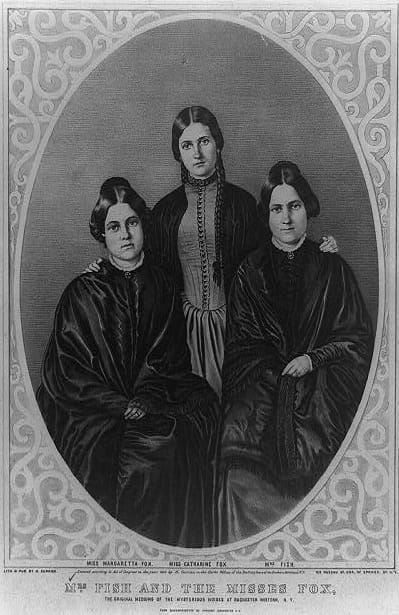
The conventional starting point is Hydesville, New York, in March 1848. Accounts describe Margaret and Catherine Fox eliciting raps that appeared to answer questions. Participants attributed them to a murdered man; that identification was part of the claim, not an independently established explanation of the sounds. Their older sister Leah helped bring the younger sisters into a wider public world. The subsequent history of the Fox sisters would include both celebrity and damaging admissions of deception.
The setting was already alive with religious experimentation. Historian Mark A. Lause places spiritualism’s development within the Christian revivals of upstate New York and New England. The séance emerged among people already debating revelation and spiritual authority. Its particular offer was to turn a belief about continued existence into something participants thought they could witness together.
The transition from household to public platform was crucial. Historian Simone Natale identifies the sisters’ November 14, 1849 appearance at Rochester’s Corinthian Hall as a turning point: paying spectators could now witness the reputed communications. Advertisements, touring performers, press controversy, and spiritualist publications helped turn local reports into a movement that others could encounter and imitate. His Supernatural Entertainments places these developments within the expanding market for public spectacle and domestic amusement.
The séance also spoke a language familiar to an age of new communications. Spiritualists compared contact with the dead to telegraphy: an unseen connection might transmit intelligible signals. That comparison made the proposition imaginable. It supplied no evidence that the proposed connection existed. A telegraph’s wire, power supply, and operator could be investigated independently of what a message said; the séance’s alleged sender was precisely what needed establishing.
There was no single constituency waiting for this promise. Oxford’s archival display on Victorian spiritualism brings together material associated with naturalists and describes believers, occasional participants, and skeptics across professions. Scientific curiosity could coexist with religious commitment, and fascination did not necessarily mean conversion.
Reform supplied another connection. In Radical Spirits, historian Ann Braude argues that early American spiritualism and the women’s rights movement were closely intertwined. That association helps explain why the movement mattered beyond supernatural claims; it does not make every séance a reform meeting. The publisher’s account of Braude’s argument also cautions against a familiar historical blind spot: religion could participate in women’s political history rather than simply stand outside it.
This chronology matters. Modern spiritualism was already developing before the American Civil War and before Darwin published On the Origin of Species in 1859. Later bereavement and religious controversy could enlarge its appeal without having created it. A history that begins and ends with people being unable to accept death misses the variety of reasons they took a seat.
How a Table Became an Instrument
A séance was a sitting organized around the possibility of communication. Its apparatus could be as ordinary as a table, paper, and the participants’ hands. The important addition was a set of conventions for deciding what an occurrence meant.
In rapping, sounds were treated as signals. In table turning, people placed their hands on a table that rotated or shifted; tipping could also supply counted responses. Movement alone was not a message. Participants had to connect it to a question, an agreed yes or no, or a sequence of letters. An alphabet procedure could turn successive selections into words, though its apparent precision depended on when people paused, repeated a question, or accepted a response.
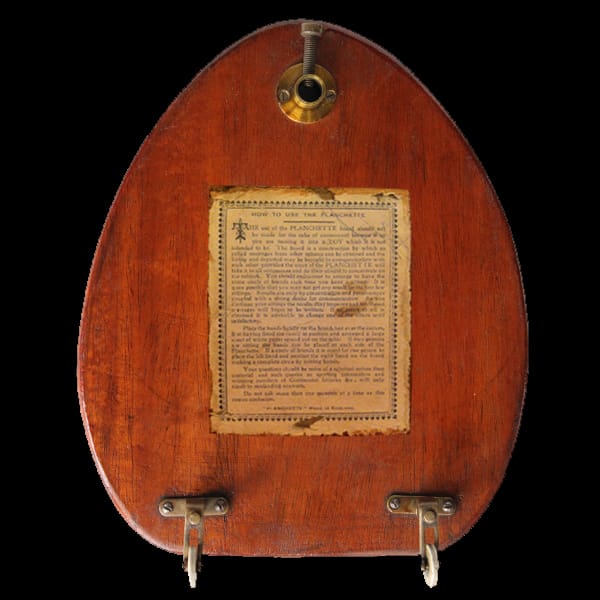
Automatic writing moved the point of contact into the writer’s own body. A person wrote while experiencing, or claiming, that the words arrived without deliberate composition. A writing planchette could make that process visible: a small wheeled platform held a pencil while hands rested on it. The National Park Service’s account of a surviving nineteenth-century planchette describes how manufacturers sold such devices for use at home. A pencil trace preserved a result that everyone could examine. It did not, by itself, preserve evidence of who had authored it.
This differed from independent slate writing, in which writing allegedly appeared without a human hand composing it. Confusing these practices conceals the different claims being tested. An involuntary hand movement and a message supposedly written inside closed slates require different investigations.
Mediumship was the broader role of mediating between the living and alleged spirits. Some mediums produced physical effects; others spoke or wrote messages. In trance mediumship, an apparently altered state could involve speech attributed to another personality. Alfred Russel Wallace’s 1874 classification of spiritualist phenomena distinguished physical manifestations from mental ones, including automatic writing and trance speech. His descriptions document what supporters claimed, including much stronger claims than a table moving beneath someone’s hands.
Here is the central interpretive sequence, expressed as an illustrative example rather than a transcript of a particular sitting. A knock occurs after a question. The group accepts it as an answer. Further answers select a familiar name. Someone recognizes a personal detail and concludes that the named person is present.
Each transition adds something. Timing supplies apparent responsiveness; a code supplies language; recognition supplies identity. The final conclusion can feel immediate even though it rests on several distinct inferences.
Grief Was One Reason to Listen
For a bereaved participant, the important message might be very small. A remembered joke or family expression could matter more than a description of the next world. It could suggest that the relationship, with its particular habits and affections, had survived.
Physicist Oliver Lodge made that connection explicit in Raymond; or, Life and Death (1916). The book joined his son’s wartime letters to records of purported communications after Raymond’s death. In its preface, Lodge explained that the scale of wartime bereavement justified exposing private sorrow to public scrutiny if other mourners might find comfort. His publication documents a father’s conviction and an attempt to present evidence; those are different from independent confirmation of survival.
The record resists reducing even prominent advocates to a single loss. Portsmouth’s Conan Doyle Collection dates Arthur Conan Doyle’s experiments and séance attendance to the 1880s, decades before his son Kingsley died in 1918. The war intensified the significance he attached to spiritualism, but it did not begin his interest.
Other participants came for company, novelty, entertainment, or investigation. Natale’s work shows how private sittings could belong to domestic leisure as well as religious practice. These motives could overlap within one person. Enjoying a performance did not necessarily mean regarding it as a trick; approaching it as an experiment did not remove emotional investment.
Nor were objections exclusively scientific. The Reverend N. S. Godfrey’s 1853 pamphlet Table-Moving Tested attributed the practice to satanic agency. For such a critic, an apparent answer could be dangerous because of its supposed source. Rejecting spiritualist interpretation did not always mean rejecting the supernatural.
Which Moved First: the Hands or the Table?
Faraday’s approach was more sharply bounded. He placed an indicator between the hands and table so that their relative movement became observable. He reported pressure in the intended direction even when participants believed they were pressing only downward. When they could watch the indicator and correct their pressure, the turning ceased in his trials. He described the participants as candid and honorable. His letter is dated June 28, 1853; it appeared two days later.
This is the ordinary mechanism associated with ideomotor action: expectations can be expressed through movement without a person recognizing that they are producing it. The experience of not choosing to move something is therefore insufficient to establish an outside mover.
The strength of the experiment was its separation of competing causes. Asking someone whether they intended to push could not settle what their hands actually did. Making the movement visible supplied a check on that self-report.
Its limits are equally instructive. These trials concerned table turning with hands in contact. They did not experimentally adjudicate every report of a distant object moving, every trance statement, or every alleged apparition. Applying the result beyond the tested conditions would turn a useful explanation into an unsupported universal one.
The wider lesson is methodological: sincerity and mechanical causation answer different questions. A participant can report an experience honestly while being mistaken about its source.
Why Some Investigators Stayed at the Table
Supporters understood the importance of that limitation. In A Defence of Modern Spiritualism (1874), Wallace argued that explaining weak examples did not answer the strongest testimony. An account of unconscious writing would not, he maintained, explain reports of writing produced without anyone touching the pencil. He presented accumulated testimony and investigations as grounds for belief.
Wallace was the naturalist who developed natural selection independently of Darwin. His commitment makes the movement harder to dismiss as an affair confined to people untouched by scientific reasoning. It does not transfer the evidential standing of his biological work to his spiritualist conclusions. The relevant question remains whether each reported effect was adequately observed and controlled.
Historian Peter Lamont makes a related point in “Spiritualism and a mid-Victorian crisis of evidence” (2004). In controversies surrounding the medium Daniel Dunglas Home, witnesses often described themselves as persuaded by experiences, rather than merely seeking relief from religious doubt. Scientists and conjurers disagreed about what testimony could establish and what an adequate explanation required. Lamont’s historical argument asks us to take those evidential disputes seriously; it does not require accepting Home’s reported powers.
Wallace’s challenge remains fair in one respect: a proposed explanation should address the actual claim. Its converse matters just as much. A witness’s inability to identify a trick or error does not establish that those possibilities have been excluded. “Unexplained to this observer” is a statement about available knowledge, not an identification of the cause.
When the Message Was Manufactured
Some investigations supplied more than alternative possibilities. The University of Pennsylvania’s Seybert Commission report, published in 1887, described methods its members said they directly observed during sittings with Henry Slade. These included prepared slate messages, substitutions, and answers written beneath the table. In one procedure, an apparently clean slate had been shown on only one side; the hidden side already carried writing.
The report’s conclusion about the Slade manifestations it witnessed was fraud. Its specificity matters: this was an account of observed manipulation, not merely an assertion that a skilled performer could conceivably have done something similar. The report is a contemporary investigators’ record, with its own argumentative stance, rather than a recording that lets us replay every movement. Its evidence bears directly on those sittings; it cannot serve as a witnessed account of every medium.
The Fox story also acquired a major confession. In 1888, Margaret publicly attributed the rappings to deception and demonstrated sounds produced through joint movement. She recanted the following year. The documented reversal complicates the use of her testimony, but does not erase the demonstration of an ordinary way to produce supposedly extraordinary sounds. Neither statement makes every episode of her career recoverable.
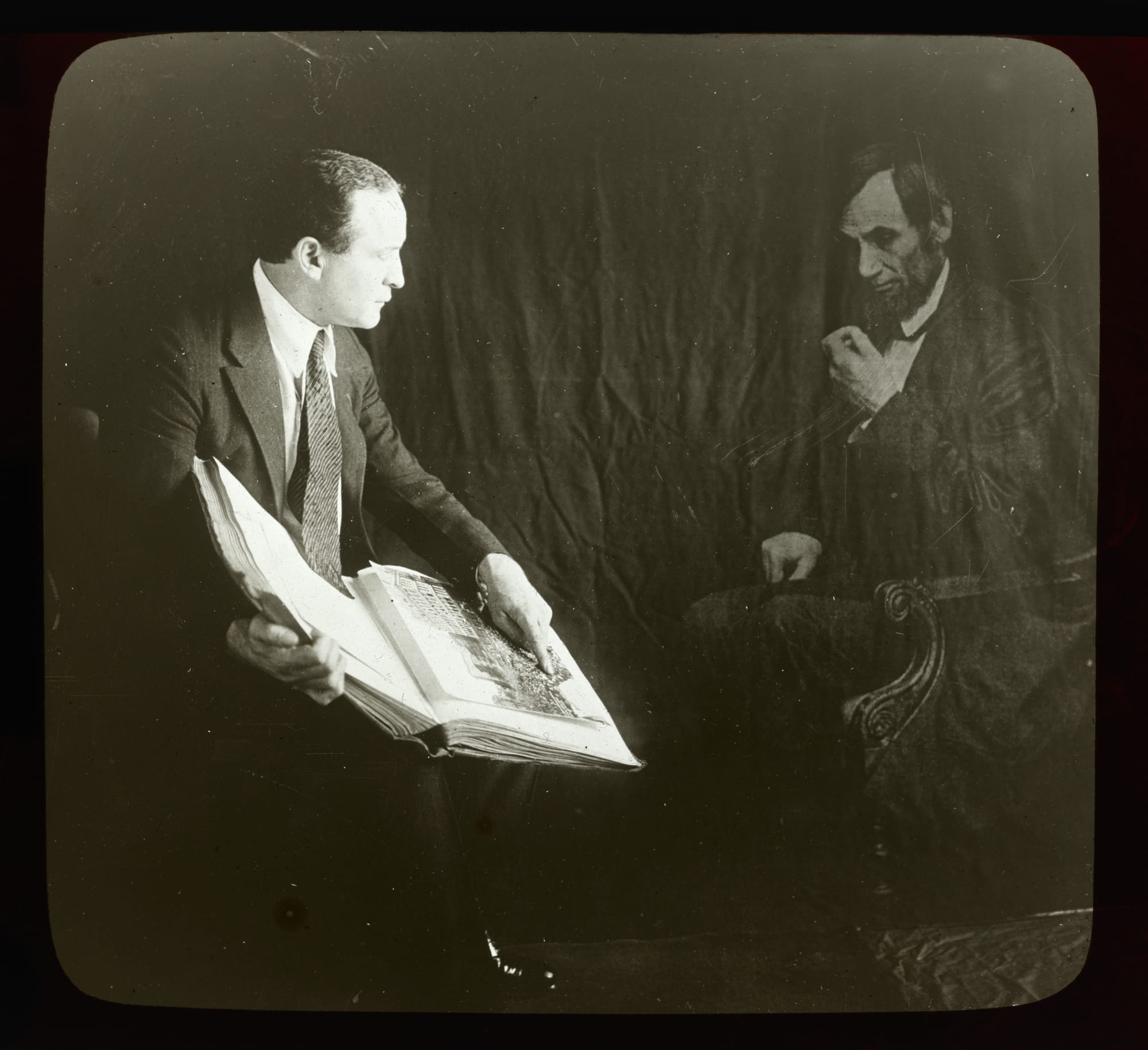
Photography supplied another warning about apparent corroboration. A surviving image shows Harry Houdini apparently sitting with Abraham Lincoln. As the Library of Congress explains, Houdini had it made to demonstrate fabricated spirit photography. The archival photograph is authentic as a historical object; the encounter it depicts is an artifice.
That distinction applies throughout the archive. A genuine letter can contain an inaccurate report. An unaltered photograph can record a staged performance. Several newspapers can repeat one witness rather than provide several independent observations. Establishing an object’s provenance begins the evaluation; it does not finish it.
Accurate Information Still Leaves an Identity Problem
Physical effects were only part of the inquiry. The Society for Psychical Research, founded in London in 1882, organized investigations and published reports on mediumship and other claimed phenomena. Figures including Henry and Eleanor Sidgwick and Frederic Myers helped make disputed experiences into subjects of sustained documentation. Membership in that enterprise did not make every investigator’s interpretation identical.
The difficult question was often not whether a medium had said something correct. It was how the information had been acquired and why its accuracy should identify a deceased speaker.
George Morris’s 2021 study of Rosalie Thompson follows SPR sittings in which she purported to voice her dead daughter Nelly. Researchers sometimes concealed a visitor’s identity and recorded preliminary conversation because it might influence the sitting. Yet the inquiry also ran through friendships, family ties, and repeated social contact. Morris shows that intimate recognition—such as a familiar manner of touching someone—could be treated as evidence. He also uncovered Thompson’s work as a private detective, complicating assumptions about what she could learn. That finding does not demonstrate how any particular message was obtained; the surviving record cannot resolve the entire case.
The problem becomes clearer if we separate four questions:
| Question | What a positive answer would establish |
|---|---|
| Did an event occur? | There is an observation to explain. |
| Did it reliably respond to a question? | The pattern warrants investigation as a possible exchange. |
| Did it convey accurate information unavailable by ordinary means? | A substantially stronger information claim requires explanation. |
| Was a particular deceased person the source? | An additional claim about identity still needs support. |
These are not automatic steps on a staircase. A correct name might have been supplied in conversation. A personal description might fit several people. A very specific fact might have a traceable source that a sitter does not know about. These are possibilities to investigate, not findings to impose on an unexamined case.
Even researchers willing to entertain paranormal explanations recognized a further complication. As Morris documents, some considered information transfer from living minds—what they called telepathy—an alternative to a deceased communicator. Telepathy was itself a hypothesis requiring evidence. Its place in their debate nevertheless exposes a logical point: accepting unusual information would not, by itself, establish survival after death.
A message’s emotional force and its evidential independence can also pull in different directions. The detail most convincing to a family may be convincing precisely because several family members know it. That makes it valuable for recognition, while creating more possible routes by which a medium could have learned it.
What a Better Test Has to Preserve
The historical investigations suggest what an assessment needs to retain: the original statements, the questions that preceded them, the conditions of observation, and the information available to everyone involved. Keeping only the striking successes removes the material needed to judge them.
For a mechanical claim, a useful control separates possible sources of force or access, as Faraday’s indicator did. For an information claim, it must address names, prior contact, correspondence, publicity, and feedback during the sitting. Independent checking should distinguish a precise match from a broad statement made specific by later interpretation. Recording failures and uncertainties matters as much as recording apparent hits.
These are methodological implications of the cases, not a claim that nineteenth-century investigators uniformly met such standards. Conditions varied, and observers disputed whether proposed controls were adequate or interfered with the phenomena. An experiment that fails to elicit an effect gives a result under those conditions; it does not automatically explain a different sitting. Equally, a claim that powers disappear whenever access is controlled creates a serious obstacle to establishing their cause.
Surviving records sometimes leave that obstacle permanent. We may lack a full transcript, an independent witness, or the opportunity to inspect an apparatus. A later memoir may preserve a person’s conviction more clearly than the circumstances that produced it. Missing evidence should narrow our conclusion, not enlarge the list of things we regard as demonstrated.
The record supports clear findings about some events and mechanisms: unconscious pressure could move tables; investigators documented deceptive slate writing; photographers could manufacture spectral company. It also preserves reports whose details cannot now be settled. That residual uncertainty is a limit of reconstruction, not positive evidence that the dead were answering.
The Reality Signal
The séance makes visible how an event acquires an identity. Participants did not merely encounter sounds or movements. They asked questions, established conventions, recognized patterns, and connected answers to people they already knew.
Why it still matters lies in that relationship between observation and interpretation. A procedure can make an event legible while also building assumptions into the reading. Once a response has been named, later ambiguities may be interpreted through the personality that the group believes is present.
The enduring distinction is between evidence of an occurrence, evidence of communication, and evidence of a particular communicator. The history of the séance shows how easily those questions can collapse into one another—and how much work it takes to pull them apart.
The unresolved historical question is often quite narrow: what happened in this room, under these conditions? The larger question requires more: what could justify recognizing an absent person through a channel whose workings remain uncertain?

The Galactic Mind Perspective
The séance deserves attention as a consequential attempt to make survival after death publicly encounterable and testable. Its promise helped sustain religious communities, commercial entertainments, reform associations, and organized investigations. Those cultural consequences remain real regardless of the truth of its strongest claims.
The evidence examined here gives the greatest weight to explanations that can be connected to observed mechanisms and documented conditions. It does not establish a dependable method for identifying communications from deceased people. Sincere testimony, scientific prestige, emotional recognition, and an unexplained remainder cannot supply that missing demonstration by themselves.
That judgment need not diminish the people involved. The desire to hear a familiar voice again deserves humane treatment. It also gives us a reason to care about the distinction between comfort and verification: the more a message matters, the more consequential the attribution becomes.
Faraday’s question remains useful because it slows the story down. Before deciding who has answered, establish what moved, what was said, and what the observation actually permits us to conclude.
Open Thread
What would a message need to establish before we could reasonably say that a particular person had returned, rather than that something had answered?
More in Dossier
- Michael Gazzaniga and the Interpreter Within — A related inquiry into how minds construct explanations from incomplete information; the connection is conceptual, not a claim that split-brain findings explain every séance.
- John Keel and the Theory of the Many Masks — Extends the question of how an apparent encounter acquires a culturally familiar identity, while keeping Keel’s interpretation separate from established history.
- Jacques Vallée and the Control System Behind the Phenomenon — Offers another perspective on anomalous reports, belief, and interpretation; this is a reading connection, not evidence of a common cause behind UFO reports and séances.
Sources / Receipts
- Michael Faraday — “Faraday to the Editor of the Times,” June 28, 1853. Epsilon transcription; published The Times, June 30, 1853, p. 8, column d. Primary record of his table-turning tests.
- Abbott Kahler — “The Fox Sisters and the Rap on Spiritualism,” October 30, 2012. Smithsonian Magazine. Later synthesis supporting the Hydesville chronology, public confession, and subsequent recantation. The article avoids disputed ages, reconstructed dialogue, and purported murdered-man corroboration.
- Simone Natale — Supernatural Entertainments: Victorian Spiritualism and the Rise of Modern Media Culture, 2016. Penn State University Press. The publisher-hosted introduction was consulted for Corinthian Hall, promotion, domestic leisure, and the telegraph comparison; the complete book was not inspected.
- Oxford University Museum of Natural History — “Presenting... Victorian Spiritualism”, undated. Institutional exhibition drawing on material associated with Wallace, Mary Buckland, and Ernest Westlake. Starting point for the movement’s varied participants and naturalists’ interest, not independent verification of spirit phenomena.
- Ann Braude — Radical Spirits: Spiritualism and Women’s Rights in Nineteenth-Century America, second edition, 2001; electronic edition listed May 2020. Indiana University Press. Publisher description and contents consulted for the book’s stated argument about spiritualism and women’s rights. No claim is made to have inspected the full book.
- David R. Daly / National Park Service — “Planchette,” November 13, 2015. Longfellow House–Washington’s Headquarters National Historic Site. Object-based explanation of writing planchettes and their commercial availability. The museum does not identify which Longfellow family member owned its example.
- Alfred Russel Wallace — “A Defence of Modern Spiritualism,” 1874. Fortnightly Review, two installments; transcription edited by Charles H. Smith. Primary advocacy, especially its criticism of explanations aimed at weaker claims and its classification of manifestations. Its reported marvels are not treated as verified findings.
- Oliver J. Lodge — Raymond; or, Life and Death, 1916. George H. Doran edition, digitized by Project Gutenberg. Preface, pp. vii–viii, and the organization of the original text support the discussion of bereavement, publication, and claimed communications. The electronic release date, 2016, is not the book’s publication year.
- Arthur Conan Doyle Collection, Lancelyn Green Bequest, Portsmouth — “How Did Conan Doyle Become a Spiritualist?”, undated. Institutional chronology distinguishing his 1880s interest from Kingsley’s 1918 death and later wartime advocacy.
- N. S. Godfrey — Table-Moving Tested. And Proved to be the Result of Satanic Agency, fourth edition, 1853. Eileen J. Garrett Parapsychology Foundation Collection, UMBC. Archival description and title consulted to document a religious objection distinct from naturalistic criticism; the full pamphlet was not inspected.
- Peter Lamont — “Spiritualism and a mid-Victorian crisis of evidence,” 2004. The Historical Journal 47(4), 897–920; DOI. Accessible repository text consulted for the argument about testimony and scientific authority. Historical interpretation, not experimental confirmation of Home’s claims.
- University of Pennsylvania, Seybert Commission — Preliminary Report of the Commission Appointed by the University of Pennsylvania to Investigate Modern Spiritualism, 1887. Primary report, opening discussion of Henry Slade and independent slate writing. Its detailed observations support the bounded fraud finding described here. The investigators’ hostile rhetoric is not adopted as evidence.
- Kristi Finefield / Library of Congress — “A Ghostly Image: Spirit Photographs,” October 31, 2011. Prints and Photographs Division explanation of photographic techniques and Houdini’s manufactured Lincoln image. Supports the distinction between an authentic archival object and a genuine depicted encounter.
- Society for Psychical Research — “History”, undated. Institutional account used for its February 1882 founding, early personnel, and organized investigations. The society’s assessment of paranormal evidence is not taken as independent adjudication.
- George Morris — “The Trance Phenomena of Mrs Thompson: Mediumship, Evidence, and Intimacy in Early Twentieth-Century Britain,” September 27, 2021. Twentieth Century British History 32(4), 608–629; DOI. Accepted manuscript consulted for investigative practices and archival limits, not proof of every message’s origin.
- Mark A. Lause — “America’s 1848: Republican Spirits in Revolt,” 2016. Prologue to Free Spirits: Spiritualism, Republicanism, and Radicalism in the Civil War Era, University of Illinois Press. Public scholarly abstract consulted for the revivalist setting; the full chapter was access-restricted and is not represented as read.
- Visual records: Janet-Lange’s Paris table-turning illustration, May 14, 1853; N. Currier’s Fox sisters portrait, 1852; Brandon Hodge’s photograph of a British writing planchette, January 16, 2013; and the Houdini/Lincoln image. Images and file records inspected. Detailed credits, dating qualifications, and reuse terms follow in the visual plan.


Discussion