
Some investigators chase one phenomenon.
John Keel chased the pattern behind many.
A winged creature in West Virginia.
A grinning man in a strange suit.
Men in black.
Phone calls that should not have happened.
UFOs that behaved less like spacecraft and more like staged encounters.
Psychic disturbances.
Monsters.
Apparitions.
Prophecies.
Electronic interference.
Coincidence turned theatrical.
Keel did not look at these as separate files forever sealed in separate cabinets.
He began to suspect they were masks.
Different costumes worn by the same underlying intelligence, force, system, or phenomenon.
Not extraterrestrials in the simple science-fiction sense.
Not visitors from Mars, Venus, Zeta Reticuli, or any single star system.
Something closer to a trickster ecology.
Something adaptive.
Something that appeared to borrow imagery from the culture observing it.
Gods in one age.
Fairies in another.
Airships in another.
Flying saucers in another.
Monsters in another.
For Keel, UFOs were not the whole mystery.
They were one costume.
That is why he belongs in The Galactic Mind archive.
Not because his model is proven.
Not because his evidence is clean.
Not because every story in his books should be accepted literally.
But because Keel forced one of the strangest questions in anomalous research:
What if the categories are the trap?
Overview
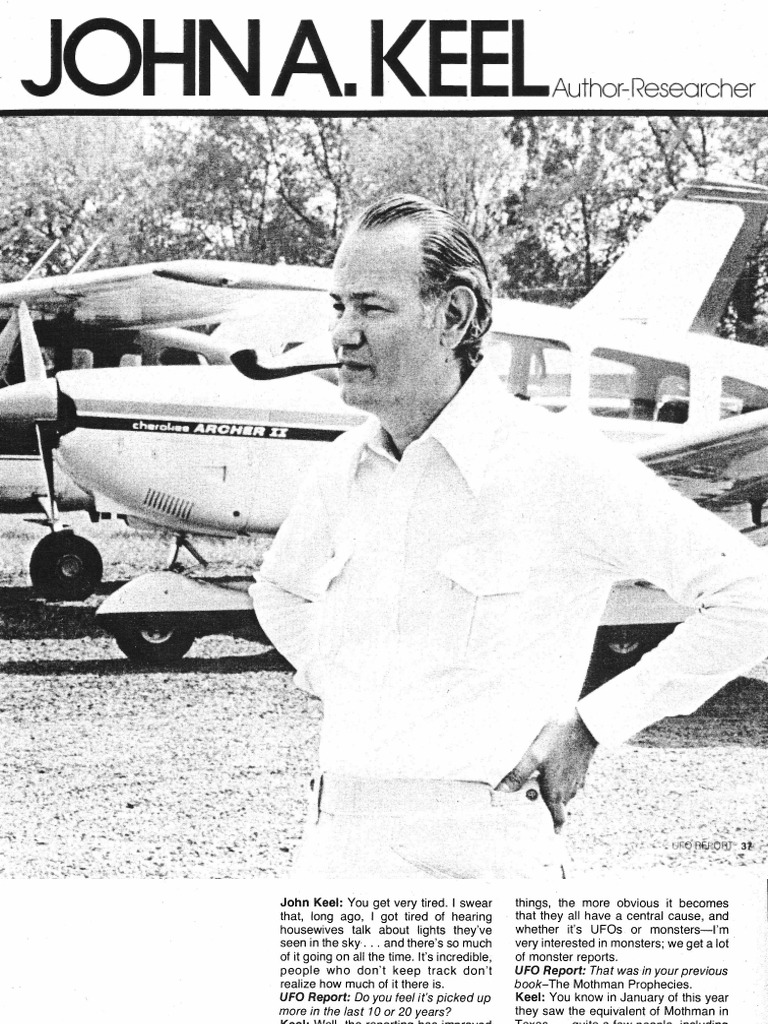
John A. Keel was an American journalist, writer, and influential UFO / Fortean researcher best known for The Mothman Prophecies, his 1975 account of the strange reports surrounding Point Pleasant, West Virginia, in 1966 and 1967. He was born Alva John Kiehle in Hornell, New York, in 1930, and died in New York City in 2009 at age 79.
Keel’s public reputation rests on three major works: UFOs: Operation Trojan Horse, The Mothman Prophecies, and The Eighth Tower. His bibliography lists UFOs: Operation Trojan Horse as published by Putnam in 1970, The Mothman Prophecies by Saturday Review Press in 1975, and The Eighth Tower also in 1975.
This Dossier calls his model the Theory of the Many Masks.
That phrase is an editorial frame, not a formal academic label Keel used in that exact way.
But it captures the signal.
Keel believed that UFO occupants, monsters, religious visions, fairy lore, Men in Black, psychic phenomena, and other impossible encounters might not be unrelated anomalies. They might be different expressions of one adaptive phenomenon.
An academic treatment by David Clarke describes Keel as one of the most influential and controversial figures in UFO history, noting that he rejected the extraterrestrial hypothesis and replaced it with “ultra-terrestrials”: shape-shifting intelligences inhabiting what Keel called a “super-spectrum.”
That is the door.
Keel did not ask only, “Are UFOs real?”
He asked:
What if the phenomenon has always been here, changing masks according to the mind of the age?
Origins and Background
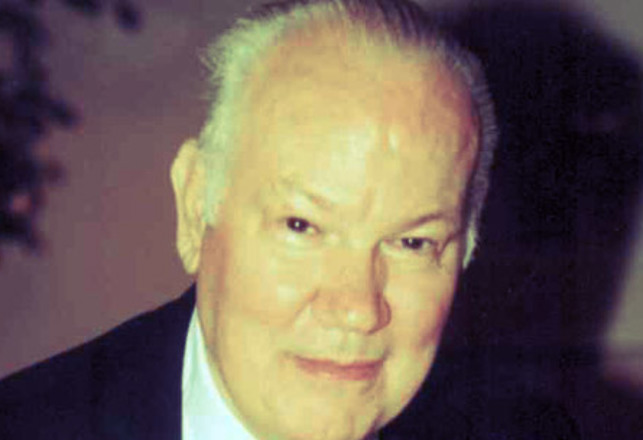
Keel’s background matters because he was not formed as a laboratory scientist, military analyst, or academic theorist.
He was a writer.
A field man.
A storyteller.
A journalist with a taste for strange roads.
The John Keel archive, maintained by Doug Skinner, describes Keel as a child who read constantly, loved magic, humor, science, travel, and aviation, and was already determined to become a writer by age fourteen.
That origin explains much of the later Keel.
He did not encounter anomalies as a detached technician.
He entered them as narrative environments.
He cared about the witness.
The atmosphere.
The telephone call.
The motel room.
The road.
The repeated detail.
The strange timing.
The human nervous system under pressure.
Before UFOs, Keel’s first major book was Jadoo, published in 1957, based on his travels through the Middle East and Asia investigating magic, fakirs, yogis, snake charmers, and other mysteries of the “Orient,” as the subtitle framed it at the time. The Keel bibliography lists Jadoo as his first book and describes it as “The Astounding Story of One Man’s Search into the Mysteries of Black Magic in the Orient.”
That early phase is important.
Keel was already moving through the borderland between journalism, performance, folklore, belief, and anomaly before UFOs became his central subject.
Then came the 1960s.
Flying saucers had already entered American culture.
The extraterrestrial hypothesis had become the dominant public frame.
Many people assumed that if UFOs were real, they were machines from another planet.
Keel initially entered that world with interest in the UFO question. But after field investigations, he moved away from the simple “nuts-and-bolts” extraterrestrial model.
His archive says that in 1966 he made repeated visits to Point Pleasant during an active monster and UFO flap, an investigation that eventually became The Mothman Prophecies.
Point Pleasant became the crucible.
This Dossier is not a full Mothman Case File.
That deserves its own treatment.
Here, Mothman is important because it shows how Keel’s mind worked.
He did not see only a creature.
He saw an outbreak.
A pattern of sightings, rumors, messages, strange visitors, fear, folklore, technology, prophecy, disaster, and psychological pressure.
The West Virginia Encyclopedia notes that Mothman sightings began in November 1966 around Point Pleasant, centered near the abandoned TNT plant, and that reports of other strange phenomena increased alongside creature sightings. It also notes that Keel connected the broader strange occurrences to Mothman, Men in Black, and the 1967 Silver Bridge collapse in The Mothman Prophecies.
That was Keel’s method.
Not isolate.
Connect.
Maybe too much.
But the act of connection became his signature.

What He’s Known For
John Keel is known for several major signals.
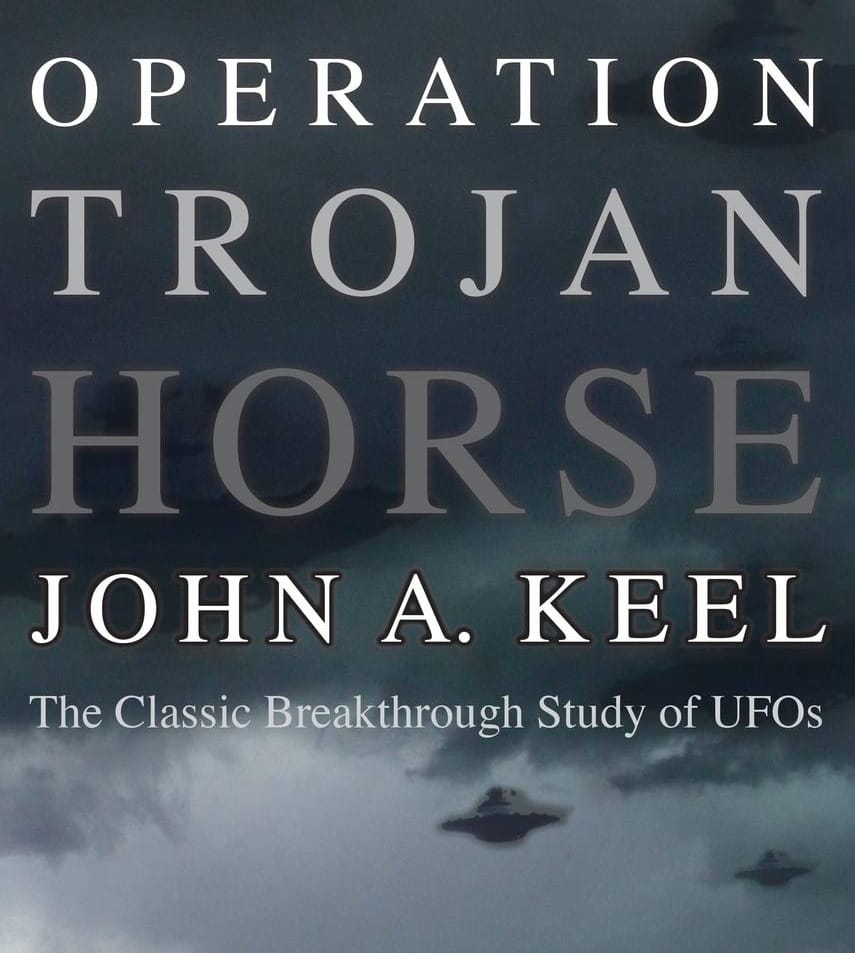
Operation Trojan Horse
UFOs: Operation Trojan Horse is Keel’s central attack on the simple extraterrestrial model.
The book argues that the UFO story must include more than mechanical craft and alien pilots. In the Anomalist Books edition description, Keel is quoted as saying the real UFO story must include ghosts, phantoms, mental aberrations, prophecy, gods, demons, and an invisible world that sometimes engulfs us. The same description says the book challenged the “nuts-and-bolts” extraterrestrial hypothesis by linking UFOs to paranormal and supernatural phenomena across history.
That is the essence of the Many Masks theory.
The flying saucer was not the phenomenon.
It was the current costume.
Keel thought the same deeper force might have appeared in older forms: fairies, demons, religious visions, mystery airships, mystery animals, ghost lights, monsters, and impossible visitors.
The implication was radical.
A UFO case could not be understood only by asking where the craft came from.
One had to ask why it appeared in that form.
Why that witness?
Why that message?
Why that cultural costume?
Why that absurdity?
Why that timing?
Keel saw the phenomenon as theatrical.
Not simply false.
Theatrical.
The Mothman Prophecies
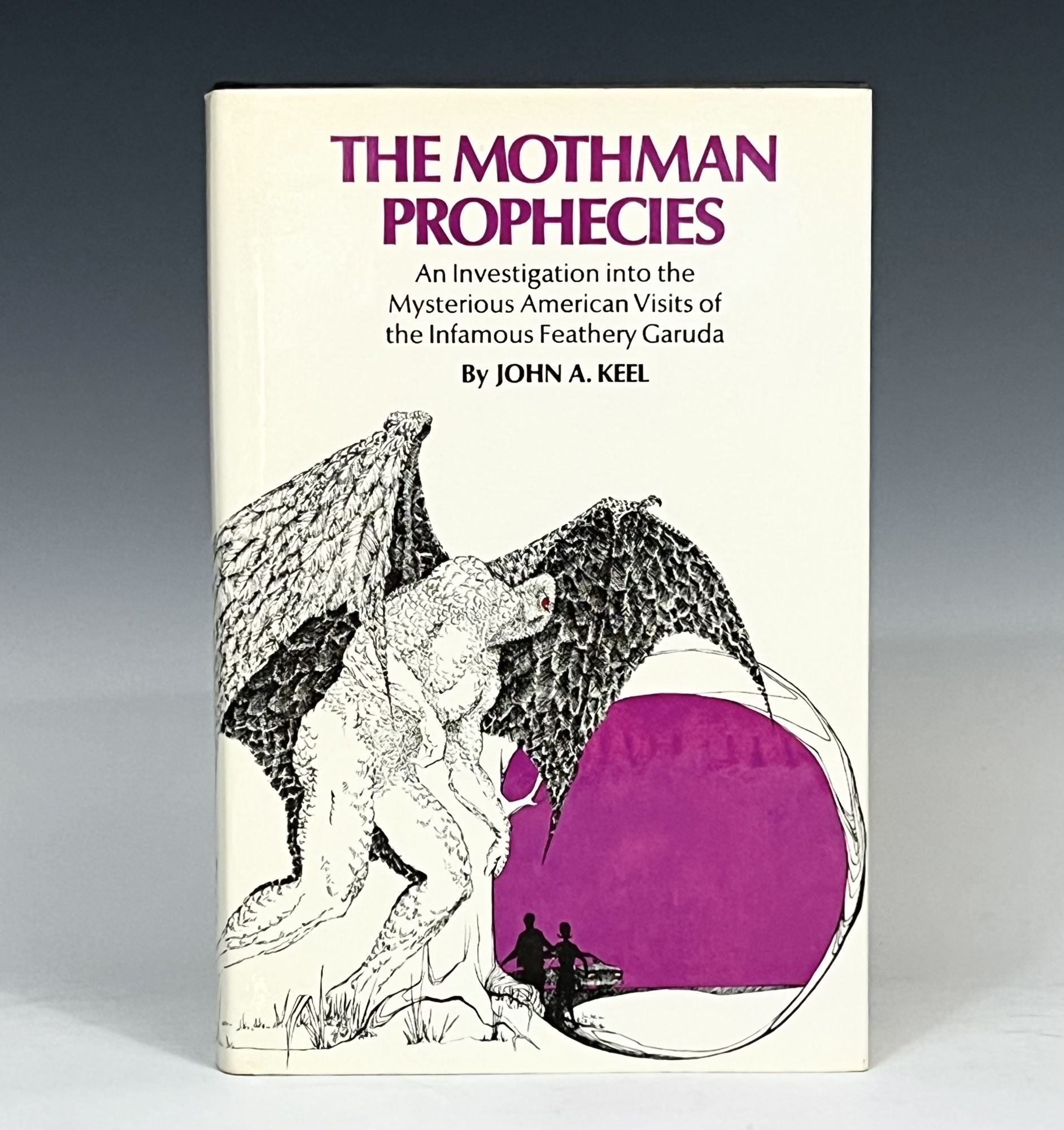
The Mothman Prophecies made Keel famous outside UFO circles.
It was his first-person account of the Point Pleasant events: the winged creature reports, the UFO wave, Men in Black, strange phone phenomena, premonitions, and the emotional atmosphere before the Silver Bridge collapse.
David Clarke’s study of the Mothman legend argues that Keel did more than anyone to internationalize the Mothman story, first through journalism and then through The Mothman Prophecies, which Clarke describes as a first-hand “New Journalism” account and a classic of Fortean research.
The book’s power is not simply in its claims.
It is in its atmosphere.
Keel turns Point Pleasant into a zone where categories begin to fail.
Was it a monster story?
A UFO story?
A Men in Black story?
A psychic-contact story?
A prophecy story?
A disaster story?
A folklore story?
For Keel, the answer was yes.
That is why he remains influential.
He did not treat Mothman as one creature to be identified.
He treated Mothman as one face of a larger performance.
The Eighth Tower
The Eighth Tower pushed Keel’s theory into darker, more cosmic territory.
Its modern listing frames the book around one central question: whether one intelligent force stands behind religious, occult, and UFO phenomena. The description asks whether UFOs and other paranormal manifestations might be tools used to manipulate humanity toward some unknown cosmic role.
This is Keel at his most unsettling.
The idea is no longer simply that UFOs are not from space.
The idea is that strange manifestations may be part of a broader control or manipulation system.
A force.
A signal.
A prank.
A trap.
A teaching machine.
A deception engine.
A cosmic theater.
This is also where Keel becomes hardest to defend scientifically.
The more total the theory becomes, the less falsifiable it becomes.
If every anomaly is a mask, then contradictory evidence can become another mask too.
That is powerful as literature.
It is dangerous as method.

The Ultraterrestrial
Keel’s most famous conceptual tool is the ultraterrestrial.
In Clarke’s academic treatment, Keel’s “ultra-terrestrials” are described as shape-shifting intelligences inhabiting a “super-spectrum,” and Clarke notes that Keel borrowed the key concept from occultist N. Meade Layne, though Keel gave it a darker, more manipulative interpretation.
The ultraterrestrial is not simply an alien.
It is not necessarily from another planet.
It may not even be a permanent construction of matter.
It is a way of naming an intelligence that appears through forms we can perceive, while hiding its actual nature.
In other words:
The visitor is not the truth.
The visitor is the interface.
Men in Black
Keel is also associated with the Men in Black tradition.
Tor Publishing’s author page credits Keel with coining the term “Men in Black,” while noting that he was a prominent journalist and UFOlogist best known for The Mothman Prophecies.
The Men in Black fit Keel’s universe perfectly.
They are not just government agents.
They are not just hoaxers.
They are not just folklore.
They are liminal figures.
They arrive after sightings.
They intimidate witnesses.
They behave badly.
They seem slightly wrong.
They blur institutional authority, theater, paranoia, and paranormal menace.
In Keel’s hands, the Men in Black become another mask.
The phenomenon does not merely appear in the sky.
It knocks on the door.
The Trickster Pattern
Keel’s world is full of unreliable signals.
Entities lie.
Predictions fail or half-succeed.
Witnesses contradict themselves.
Messages sound profound, then absurd.
The phenomenon appears intelligent, but not necessarily wise.
It seems to want attention.
It seems to manipulate belief.
It seems to shape itself around expectation.
This is where Keel differs from straightforward disclosure culture.
He did not simply believe that the government was hiding aliens.
He suspected that the phenomenon itself was hiding behind whatever story humans were most prepared to believe.
That is the darker turn.
The cover-up may not begin in Washington.
It may begin in perception.
The Core Idea or Signal
The core signal of John Keel is this:
The phenomenon wears the mask the culture can recognize.
That is the theory.
Not every strange report is separate.
Not every entity is what it says it is.
Not every UFO occupant is a traveler from a planet.
Not every monster is an animal.
Not every apparition is a ghost.
Not every prophecy is a message.
Not every coincidence is random.
For Keel, the unknown behaves less like an object and more like an adaptive performance.
It appears through available symbols.
It speaks through available myths.
It distorts itself through the expectations of the witness.
The medieval peasant sees the fairy host.
The religious visionary sees angels or demons.
The nineteenth-century witness sees airships.
The Cold War witness sees metallic craft and humanoid pilots.
The modern experiencer sees grays, hybrids, government agents, drones, interdimensional visitors, or simulation glitches.
The mask changes.
The disturbance remains.
This is why Keel is so different from a classic UFO investigator.
He was not building a case for visitors from elsewhere.
He was building a case against taking the visitor’s costume literally.
That is the Keelian move.
Do not ask only:
What appeared?
Ask:
Why did it appear that way?
Perspectives and Interpretations
Keel can be read through several lenses.
The Fortean View
From the Fortean view, Keel is one of the great pattern-watchers.
He stands in the lineage of Charles Fort: a collector of anomalies, a critic of premature certainty, and a writer who understood that strange facts often expose the limits of official explanation.
In this view, Keel’s strength was not that he proved one grand theory.
His strength was that he refused to let the categories stay separate.
UFOs were not just aerospace.
Cryptids were not just zoology.
Men in Black were not just conspiracy.
Apparitions were not just religion.
Psychic effects were not just psychology.
The Fortean reader sees Keel as a cartographer of cross-contamination.
He noticed that impossible things rarely obeyed the filing system.
The UFO View
From the UFO view, Keel is both influential and disruptive.
He challenged the extraterrestrial hypothesis at a time when many UFO researchers were still focused on physical craft, alien civilizations, radar cases, landings, and occupants.
His model makes the UFO problem deeper, but also less manageable.
If UFOs are craft, one can ask technical questions.
Propulsion.
Materials.
Radar.
Airspace.
Origin.
If UFOs are masks of a larger phenomenon, the problem becomes stranger.
It becomes psychological.
Folkloric.
Religious.
Metaphysical.
Possibly manipulative.
Possibly nonlocal.
Possibly not even fully physical.
That makes Keel compelling to some readers and unacceptable to others.
The UFO researcher looking for hard evidence may find Keel too slippery.
The high-strangeness researcher may find him unavoidable.
The Folklore View
From the folklore view, Keel’s importance is not simply whether he was right.
It is that he understood continuity.
The modern UFO encounter has older cousins.
Abductions resemble fairy captures.
Bedroom visitations resemble night-hag traditions.
Bright lights and aerial beings echo religious vision.
Men in Black resemble supernatural warning figures, tricksters, or sinister officials from legend.
Mothman resembles an omen creature, a death-bird, a banshee-like warning, a regional monster, and a media-born entity all at once.
Clarke’s study of Mothman emphasizes how Keel’s account helped turn local sightings into an international legend, while also connecting Mothman to broader motifs such as ominous birds, folklore, Men in Black, and disaster narratives.
This is the folklore strength of Keel.
He saw anomaly as narrative.
But folklore can cut both ways.
A recurring motif may reveal a persistent phenomenon.
Or it may reveal persistent human storytelling patterns.
Keel often leaned toward the first.
Skeptics often lean toward the second.
The truth may not be cleanly housed in either.
The Skeptical View
From the skeptical view, Keel’s work is fascinating but unstable.
His theory is difficult to test.
His sources often blend personal experience, witness testimony, rumor, interpretation, literary reconstruction, and atmosphere.
His strongest books are not clean case files.
They are immersive accounts.
That is part of their power.
It is also part of the problem.
Clarke’s later work on Mothman notes that The Mothman Prophecies was written in the “New Journalism” style, a form that often emphasizes immersion, voice, atmosphere, and the writer’s quest as much as strict neutrality or documentary proof.
That matters.
Keel was not only reporting the unknown.
He was writing the unknown into a particular shape.
A skeptic can fairly ask:
Where is the hard evidence?
Which claims are documented?
Which are hearsay?
Which are literary reconstruction?
Which are personal interpretation?
Which details changed over time?
Which reports came through people who may have exaggerated, hoaxed, misremembered, or mythologized?
Those questions do not erase Keel.
They are necessary to read him responsibly.
Strengths and Limitations
Keel’s greatest strength was pattern recognition.
He saw that anomalous experiences often share motifs across categories.
The same symbols return.
The same absurdity returns.
The same theatricality returns.
The same manipulation of belief returns.
The same ambiguity returns.
He also understood something many investigators miss:
The phenomenon is not only an event.
It is an interpretation engine.
What people see, what they believe they saw, what they are told they saw, and what their culture allows them to say they saw are all part of the case.
That insight still matters.
Especially now.
The UAP conversation is again dominated by arguments about craft, bodies, retrievals, whistleblowers, sensors, national security, non-human intelligence, and classified programs.
Keel asks an older, stranger question:
What if the intelligence behind the mask is not the identity presented by the mask?
But the limitations are real.
First, Keel’s theory is difficult to falsify.
If a UFO behaves like a craft, that can be a mask.
If it behaves like a ghost, that can be a mask.
If a prophecy fails, that can be deception.
If a report contradicts another report, that can be trickster behavior.
If a witness sees something absurd, that can be part of the performance.
A theory that can absorb everything risks explaining nothing.
Second, Keel sometimes collapses unrelated anomalies into one underlying cause.
A monster sighting, a poltergeist case, a UFO report, a phone disturbance, and a religious vision may share structural features.
But similarity is not identity.
Patterns can connect.
They can also mislead.
Third, Keel’s work often blends documented events with rumor, interpretation, personal experience, and literary framing.
That does not make it worthless.
It makes it difficult to use as evidence.
Fourth, the Point Pleasant material is especially tangled.
There were real local reports.
There was real media attention.
There was a real bridge collapse.
There were real witnesses and investigators.
But there were also rumor, folklore, hoax-prone circles, later embellishments, and a powerful book that became part of the legend it described.
Clarke’s Mothman study notes that the official investigation traced the Silver Bridge collapse to the failure of an eyebar on the bridge supports, and also points out that later fictional additions, including some Chernobyl-Mothman claims, entered pseudo-factoid circulation after the legend spread.
That is the danger of the Many Masks model.
Once the story becomes powerful enough, it begins wearing masks too.
A grounded ledger helps.
What is documented:
John Keel was a journalist and author whose major Fortean works include UFOs: Operation Trojan Horse, The Mothman Prophecies, and The Eighth Tower.
What is documented as influence:
Academic and folklore treatments describe Keel as highly influential and controversial, especially in relation to UFOlogy, Fortean literature, and the Mothman legend.
What is claimed:
Keel argued that UFOs and other strange manifestations may be expressions of ultraterrestrial or superspectrum forces rather than straightforward extraterrestrial visitors.
What is debated:
Whether Keel identified a real adaptive phenomenon, created a brilliant but unfalsifiable theory, or transformed messy reports into a mythic system through literary force.
What remains unresolved:
Whether the recurring overlap between UFOs, folklore, cryptids, apparitions, Men in Black, psychic disturbances, and religious visions reflects a single hidden reality or the human mind’s tendency to organize the unknown through repeating symbolic patterns.
Broader Implications
Keel matters because he challenges the modern hunger for clean categories.
We want the unknown to choose a box.
Alien.
Demon.
Animal.
Psychological event.
Hoax.
Secret technology.
Folklore.
Interdimensional intelligence.
Government operation.
Misidentification.
Spiritual encounter.
But the strangest cases often resist the box.
They appear partly physical and partly symbolic.
Partly witnessed and partly interpreted.
Partly local and partly archetypal.
Partly ridiculous and partly terrifying.
Keel’s work says:
Maybe that ambiguity is not accidental.
Maybe the ambiguity is the phenomenon.
This has consequences far beyond classic UFO culture.
In the current UAP era, many people want disclosure to resolve the question.
But Keel warns that disclosure may not be enough if the phenomenon is adaptive, deceptive, symbolic, or only partially physical.
A released file may answer one question and open ten others.
A recovered object, if such a thing existed, might not explain the encounter ecology around it.
A witness may tell the truth and still not know what they encountered.
A video may be real and still not reveal what the event means.
Keel’s model also connects to consciousness.
If the phenomenon changes according to perception, belief, expectation, fear, culture, or symbolic environment, then the observer is not outside the event.
The observer is part of the event.
That is why Keel feels more contemporary than ever.
We now live in a world of adaptive systems.
Algorithms change according to user behavior.
AI systems mirror language and expectation.
Memes mutate across cultures.
Narratives become reality-shaping forces.
Simulation, perception, belief, and feedback loops are no longer fringe metaphors.
They are daily life.
Keel’s ultraterrestrials may not be proven.
But his structure feels familiar:
A hidden system presents different faces to different minds, manipulating belief through feedback.
That is why the Many Masks theory still has power.
Not as proof.
As a warning.
The unknown may not appear as itself.
And neither do we.
The Reality Signal
What this subject represents
John Keel represents the field journalist who walked into the stranger, darker, trickster side of the phenomenon.
Jacques Vallée is often read as the database-oriented control-system thinker.
Keel is different.
Keel is the man in the motel room.
The man answering the strange phone call.
The man driving through West Virginia.
The man listening to witnesses whose stories do not know what genre they belong to.
He represents the moment UFO research stopped being only about spacecraft and became about reality distortion.
His signal is not clean disclosure.
It is contaminated encounter.
What reality frame it challenges
Keel challenges the extraterrestrial frame.
He challenges the idea that UFOs, cryptids, apparitions, Men in Black, psychic disturbances, and religious visions can be understood only as separate categories.
He challenges the assumption that witnesses are simply seeing objects.
They may be entering a symbolic interaction.
He also challenges the investigator’s confidence.
Because if the phenomenon manipulates belief, then the researcher is vulnerable too.
The file is not immune.
The archive is not immune.
The theory is not immune.
Even the skeptic can become part of the performance by reacting to the mask as if it were the whole event.
Why it matters now
Keel matters now because the unknown is returning through multiple doors at once.
UAP hearings.
Whistleblower claims.
High-strangeness cases.
Consciousness research.
Simulation theory.
AI-generated realities.
Folklore revivals.
Cryptid culture.
Occult aesthetics.
Public distrust of institutions.
The collapse of old explanatory frameworks.
The modern world is not becoming less mythic.
It is becoming mythic through technology.
Keel’s work gives us a language for that.
The mask is not gone.
It has multiplied.
The flying saucer becomes the tic-tac.
The Men in Black become opaque agencies.
The prophecy becomes a viral thread.
The apparition becomes a screen artifact.
The trickster becomes an algorithm.
The question is not whether Keel had the final answer.
The question is whether he saw something about how the unknown adapts to the age looking at it.
What remains unresolved
What is established:
Keel’s books shaped UFO, Fortean, cryptid, and paranormal culture, especially through Operation Trojan Horse, The Mothman Prophecies, and The Eighth Tower.
What is documented:
He investigated Point Pleasant and became central to the Mothman legend’s international life.
What is claimed:
Keel proposed that many anomalous categories may be manifestations of ultraterrestrial or superspectrum forces rather than simple extraterrestrial visitation.
What is weak:
The theory is difficult to test, easy to stretch, and often depends on reports that are hard to verify.
What remains open:
Whether high-strangeness patterns point to one adaptive intelligence, many different phenomena, human storytelling structures, altered states of perception, undiscovered physical events, or some mixture that current categories cannot hold.

The Galactic Mind Perspective
John Keel belongs in The Galactic Mind archive because he understood one thing with unusual force:
The unknown is not always waiting to be classified.
Sometimes it resists classification.
Sometimes it performs.
Sometimes it changes costume.
Sometimes it reflects the observer back to themselves in a form they are culturally prepared to fear, worship, mock, or believe.
Keel’s theory should not be accepted casually.
It is too elastic.
Too dark.
Too absorbing.
It can turn every anomaly into confirmation.
That is not disciplined inquiry.
But Keel should not be dismissed too quickly either.
He noticed the overlap.
He noticed the absurdity.
He noticed that UFO encounters often behave unlike clean contact with scientific explorers from another planet.
He noticed that the phenomenon seemed to care about belief.
He noticed that folklore and flying saucers were not as separate as modernity wanted them to be.
That is his importance.
Not as final answer.
As irritant.
As warning.
As map of the strange places where the categories fail.
A Dossier is not a monument.
It is a map of influence.
Keel’s influence is that he pushed anomalous research away from the comfort of one explanation and into a more unstable possibility:
Maybe reality does not only contain unknown things.
Maybe it contains unknown ways of appearing.
That is the Theory of the Many Masks.
And the deeper question is not only what the mask hides.
It is why the mask is always the part we remember first.
Open Thread
John Keel leaves us with a question that still disturbs the UFO conversation.
What if the phenomenon is not lying because it wants to hide the truth?
What if the mask is the method?
A saucer.
A monster.
A man in black.
A ghost.
A prophecy.
A voice on the telephone.
A figure with a grin.
A winged shape over Point Pleasant.
Each may be separate.
Each may be misread.
Each may be rumor, folklore, hoax, perception, or coincidence.
But if Keel was even partly right, the deeper mystery is not one of them.
It is the changing face behind all of them.
And if the unknown changes according to the age that sees it, then the next mask may already be forming inside our own machines, fears, and expectations.
What do you think? Drop your thoughts in the comments ...
Sources / Receipts
- John Keel archive, “John A. Keel: A Brief Biography,” maintained by Doug Skinner: early life, writing background, and Point Pleasant context.
- John Keel archive, “John A. Keel: A Bibliography,” for publication history of Jadoo, UFOs: Operation Trojan Horse, The Mothman Prophecies, and The Eighth Tower.
- David Clarke, “A New Demonology: John Keel and The Mothman Prophecies,” Sheffield Hallam University Research Archive, for Keel’s influence, rejection of the extraterrestrial hypothesis, ultraterrestrials, shape-shifting interpretation, and superspectrum model.
- David Clarke, “The Mothman of West Virginia: A Case Study in Legendary Ostension,” for Keel’s role in developing the Mothman legend, the Point Pleasant context, and later issues of legend, film, and pseudo-factoid drift.
- e-WV: The West Virginia Encyclopedia, “Mothman,” for the Point Pleasant sightings, local context, and Keel’s connection of Mothman with other strange phenomena.
- Google Books / Anomalist Books listing for Operation Trojan Horse, for the book’s framing of UFOs as part of a larger field of ghosts, phantoms, gods, demons, and deceptive manifestations.
- Modern listing for The Eighth Tower, for the book’s framing around ultraterrestrials, religious / occult / UFO phenomena, and the possibility of a single manipulative cosmic force.
- Tor Publishing Group author page for John A. Keel, noting his association with The Mothman Prophecies and crediting him with the term “Men in Black.”
- Legacy obituary for John A. Keel, noting his death in 2009, his work on UFOs and the paranormal, and the adaptation of The Mothman Prophecies into film.


Discussion