
Overview: Who This Is
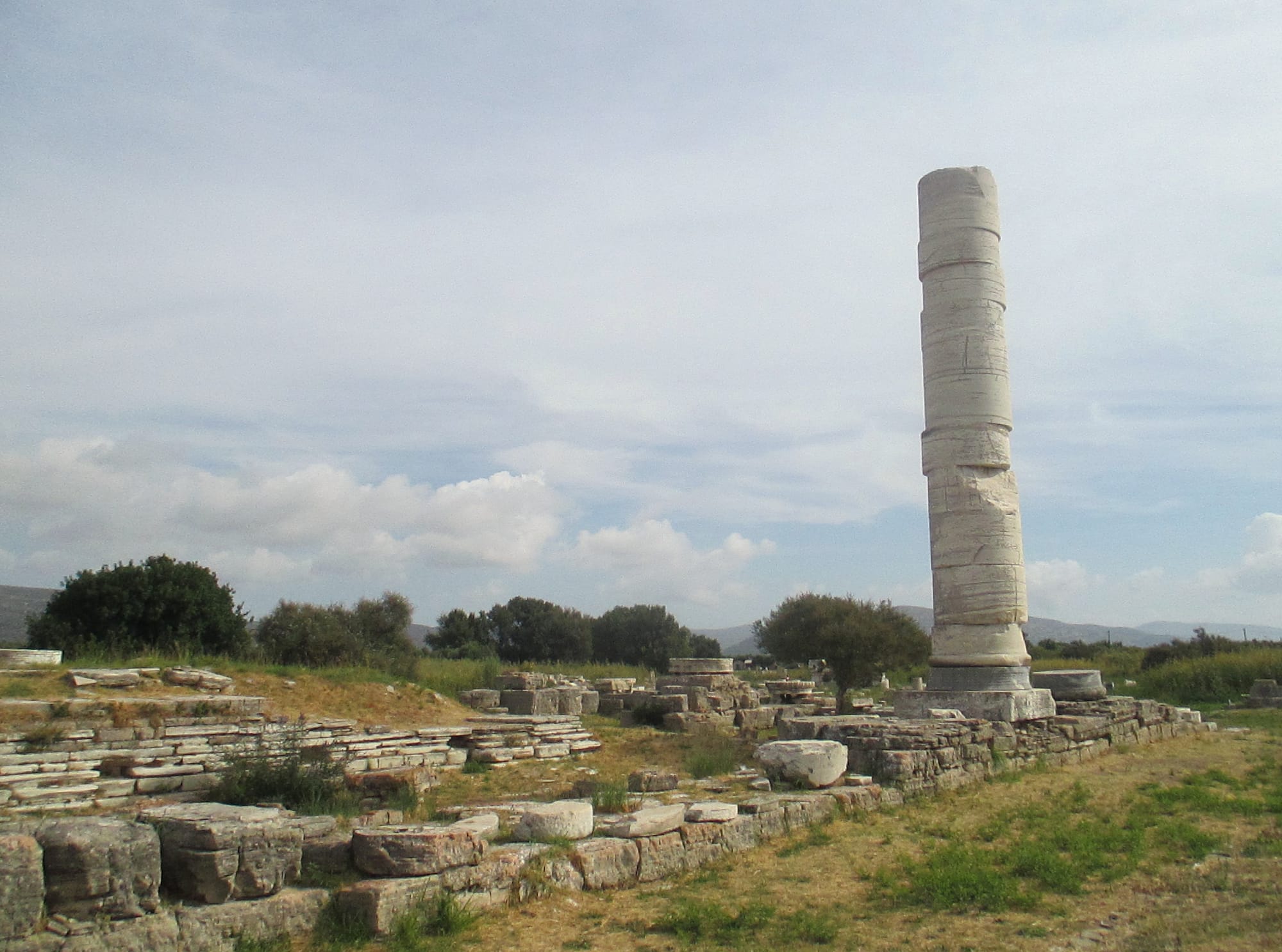
On July 26, 1984, archaeologists digging at the sanctuary of Hera on the Greek island of Samos recovered the knee end of an enormous thighbone. Bones of cattle, sheep, and goats were common at a place where people sacrificed animals and shared meals. This bone stood out for its size and because it had already fossilized. It lay among fragments of pottery from Greece’s Archaic period, in the southeastern part of the sanctuary.
The excavator, Helmut Kyrieleis, traced the fragment to the island’s fossil beds near the village of Mytilinii. He concluded that someone had brought it to Hera as an offering and that it was later discarded with the pottery. The excavation report gives us good reason to believe the bone made that journey. It cannot tell us what animal the person carrying it thought it came from.
Adrienne Mayor, a historian of ancient science and a classical folklorist at Stanford, has spent much of her career asking how someone might have answered that question. She reads the stories ancient people told about enormous bones alongside what is actually buried in the places they named. Sometimes the two records illuminate each other. Her most famous case, a griffin said to guard gold, shows how hard it is to tell when they do.
Origins and Background
Mayor grew up in South Dakota wondering what the people who had lived there long before her had made of its fossils. On an early visit to Samos, she later recalled, she saw a giant thighbone upstairs in a post office. A farmer had turned it up with his plow, and it still had dirt on it. This was a different bone from the sanctuary find. What stayed with her was the ordinariness of the discovery: if farmers found such things now, their predecessors must have had plenty of occasions to wonder about them.
In a 2025 interview with Heat Death, Mayor described her bilingual editions of Greek and Latin texts as “just bristling with post-its.” She marked passages about teeth, bones, and tracks. An ancient writer would give the location of a remarkable skeleton, and she would look to the footnotes for some account of what lay underground there. Often there was none. The missing footnote became a research project.
What She Is Known For
In The First Fossil Hunters, first published in 2000, Mayor made a modest but consequential change in how to read a sentence about giants: take the claim that someone found bones seriously enough to check the locality. A teller might be wrong about whose skeleton it was and accurate about where it came out of the ground. If a historian discarded the whole account with the word giant, the find went with it.
Mayor looked beyond the philosophers usually consulted for a history of natural science. She read reports of bones being measured, compared with human limbs, or kept where other people could see them. In her introduction, she asks what a history of fossils would look like if it included those acts. A sanctuary could figure in that history because people took things there; a poet could figure in it because he recorded what they called them.
The Core Idea or Signal
Consider a few lines about Samos in Aelian’s On Animals, book 17, chapter 28. Writing around 200 CE, Aelian credits a Greek poet of the third century BCE, Euphorion, with a story about the Neades. These creatures, he says, once made the island unsafe for people. Their roar could split the ground. Then comes a different kind of detail: Euphorion said people were still showing the creatures’ enormous bones in his own day. Aelian does not say he saw them himself.
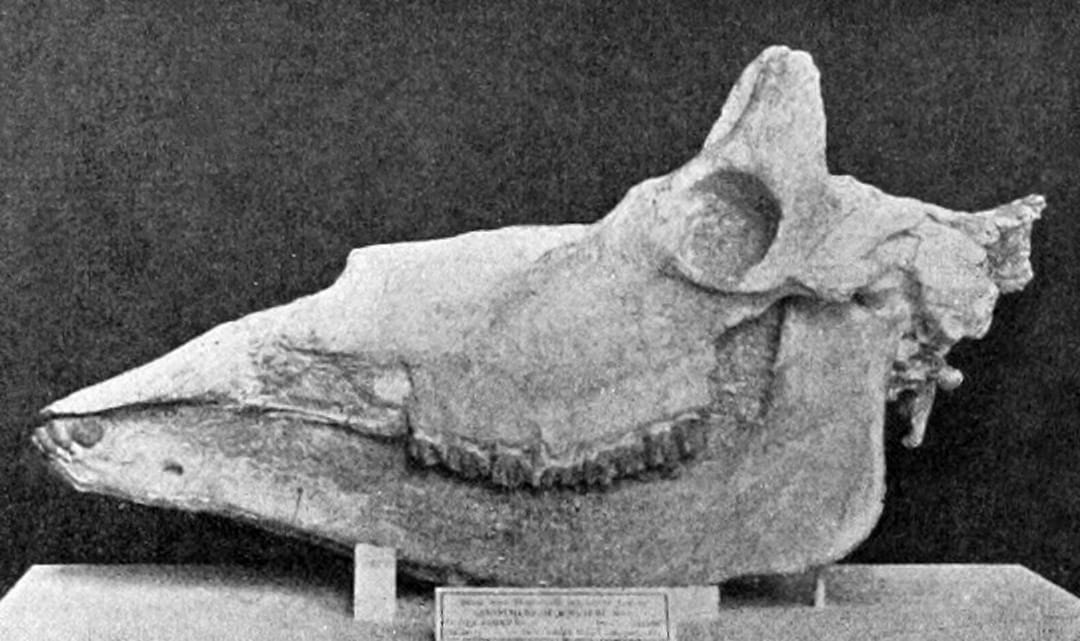
Now put down the text and look at the island. The late Miocene deposits around Mytilinii contain the remains of large extinct mammals. A rhinoceros, an elephant relative, and a member of the giraffe family are among the possibilities specialists considered for the sanctuary thighbone. Its precise identity is uncertain, but there is no need to invent a source for a story about astonishing bones on Samos. The island supplied them. A finder could recognize the end of a thighbone and see that it dwarfed the same joint in a sheep, without ever having seen the animal it belonged to.
This is where Mayor’s way of reading pays off, and where it asks for restraint. Euphorion’s story mentions a display but gives no address. Kyrieleis’s find supplies an address but no ancient name. An inscription identifying a particular bone as a relic of the Neades, or an ancient description precise enough to recognize that fragment, would bring the two closer. As things stand, someone might equally have brought the bone to Hera because it was extraordinary and they had no name for it at all.
Perspectives and Interpretations
The distance between a bone and a story grows much longer with the gold-guarding griffin. In the fifth century BCE, Herodotus recounted a poem by Aristeas: beyond a people called the Issedonians lived the one-eyed Arimaspians, and beyond them the griffins that guarded gold. Elsewhere Herodotus admits he cannot say how the gold is obtained. Here is a story that reached a Greek writer. There is no fossil discovery in his account.
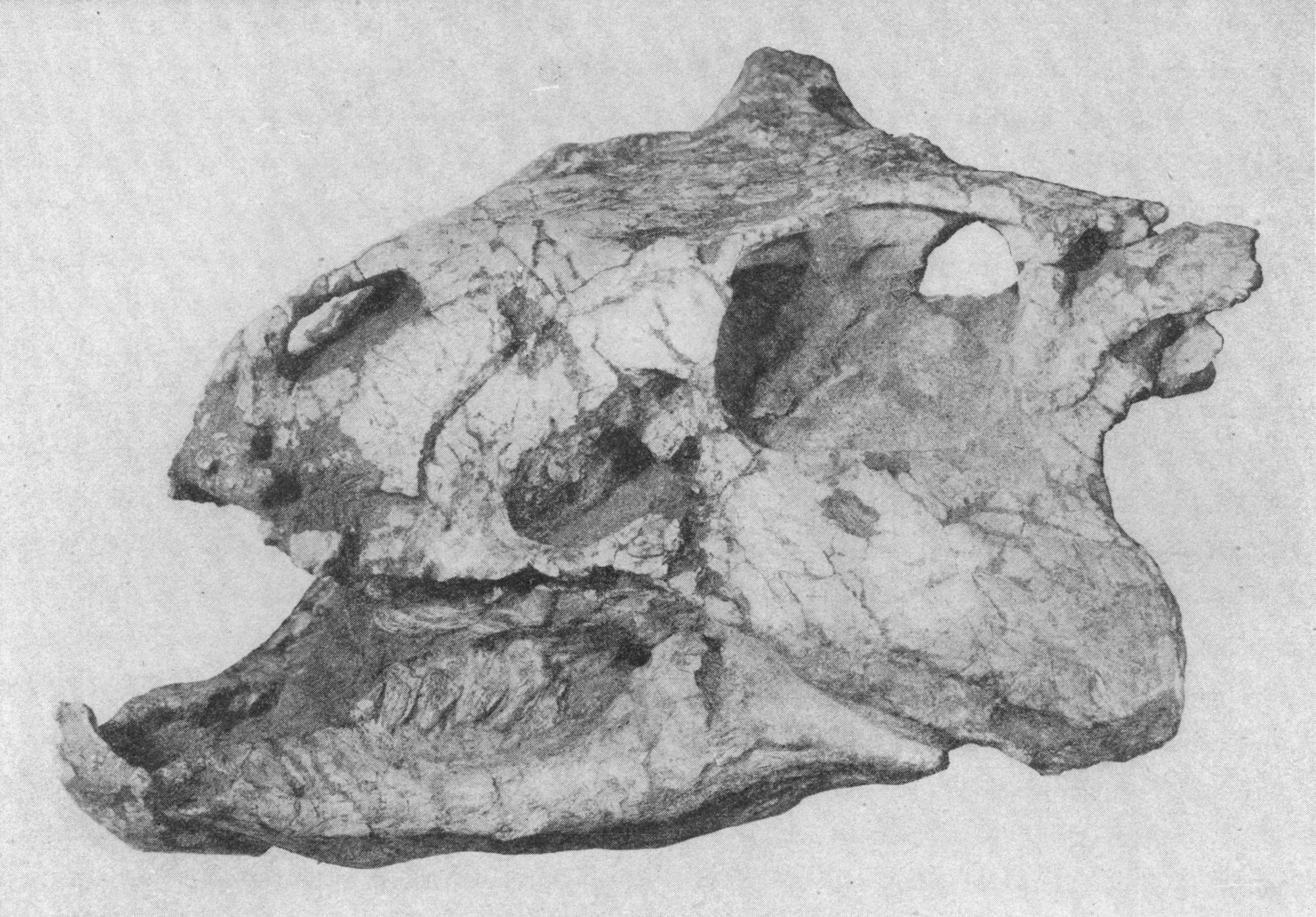
Mayor thought the geography and the creature’s peculiar body deserved a second look. The Gobi of Mongolia and northern China contains fossils of Protoceratops, a four-legged dinosaur with a conspicuous beak and a broad bony frill behind its skull. She proposed that nomadic prospectors, among them the Issedonians of the Greek account, could have come across such remains on a search for gold. Someone trying to picture the living animal had to put a birdlike face on a body that plainly walked on four legs. Fossil eggs in the same desert might even suggest a creature defending a nest. Retold by a prospector, an encounter with bones could become a warning about the animal one had to get past to reach the gold.
In a 1993 paper with Michael Heaney, in her book, and in her own later account for the Oxford Handbook of Animals in Classical Thought and Life, Mayor explored how such a story might travel. Prospectors tell neighbors; traders carry the account west; Greek listeners already know an image that fits an animal both bird and beast. Some of her writing makes the larger claim that fossils helped give the griffin its form. Much of it asks a narrower and more interesting question: could travelers’ stories have given an already familiar creature a home, a habit, and something to guard?
Strengths and Limitations
The virtue of naming a particular dinosaur is that someone else can check where it occurs. In their 2024 examination of the hypothesis, paleontologists Mark Witton and Richard Hing put known Protoceratops localities onto the map of gold deposits used in the argument. The fossil sites are several hundred kilometers east of the nearest deposits of alluvial gold marked there. Coloring a broad swath of Central Asia as dinosaur country gives a different impression from plotting the places where this dinosaur has actually been found.
That distance matters most to the gold. A traveler could have crossed both regions. But prospecting the known gold deposits would give someone no particular reason to encounter Protoceratops where they were working. It is that encounter on the goldfields that was supposed to explain why the animal guarded treasure in the first place. Nor would a passerby usually see the whole skeleton drawn in a modern book: a little bone exposed at the surface can leave nearly all the animal hidden in rock.
The artwork tests a different claim. Griffin-like combinations of bird and cat appear in Egypt and the Near East as early as the fourth millennium BCE, long before the Greek accounts of Central Asian gold. Witton and Hing also point to a twelfth-century BCE Mycenaean vase showing nesting griffins. Even that apparently lifelike detail was available to artists centuries before the proposed encounters could explain its appearance in Greece. An artist who had seen a bird of prey and a lion already knew what a hooked beak, feathered wings, and paws looked like.
The early images weigh heavily against a Central Asian dinosaur origin for the creature. They do not settle everything ever said about it: an old image can acquire a new story. In her response to The Guardian in June 2024, Mayor stood by her research and emphasized the ancient accounts of stories carried along caravan routes. As Mayor put it, “we cannot be certain that those stories were inspired by fossil observations.” We have the Greek report of a gold guardian; we still lack an account from a finder connecting that story to a dinosaur.
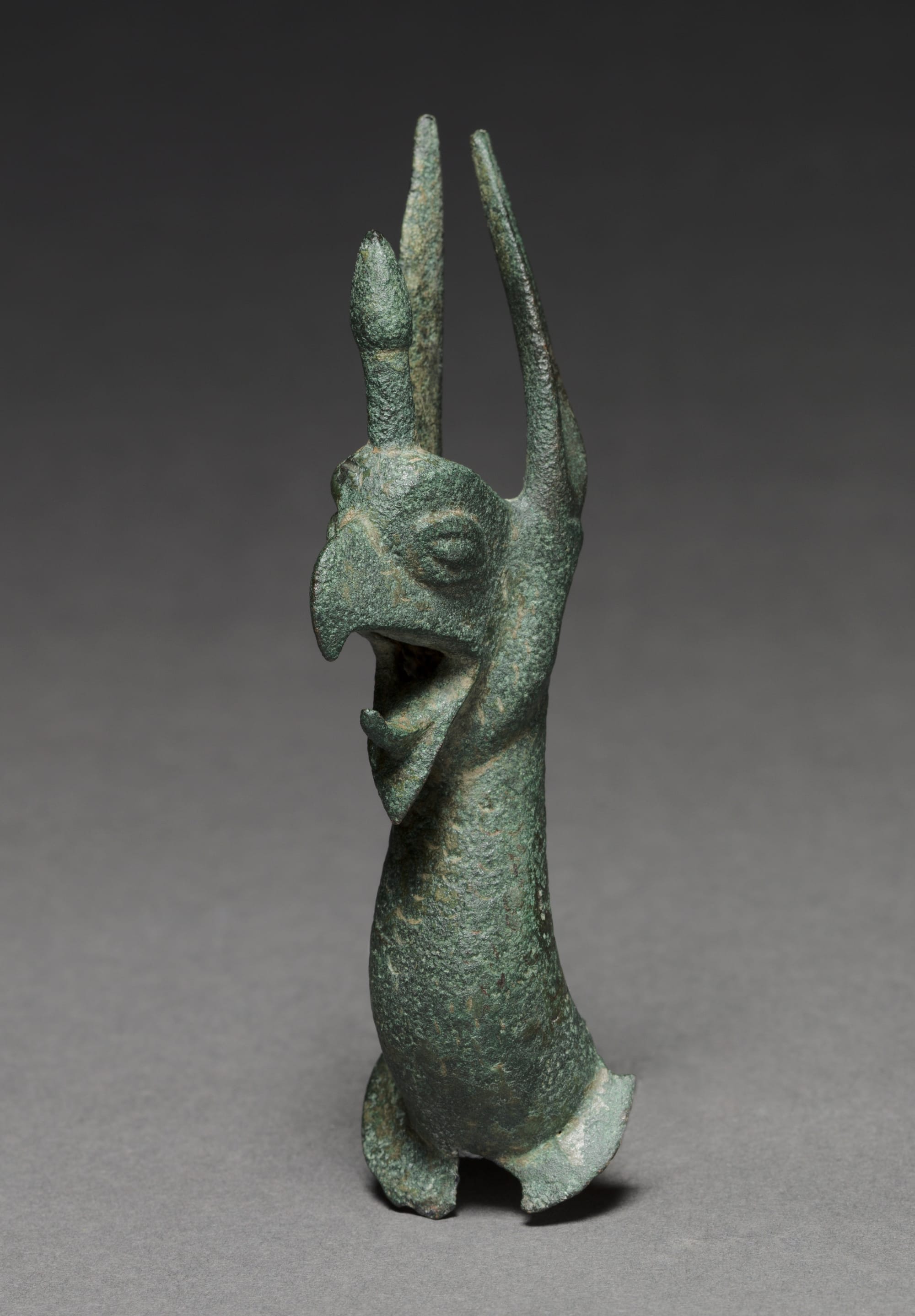
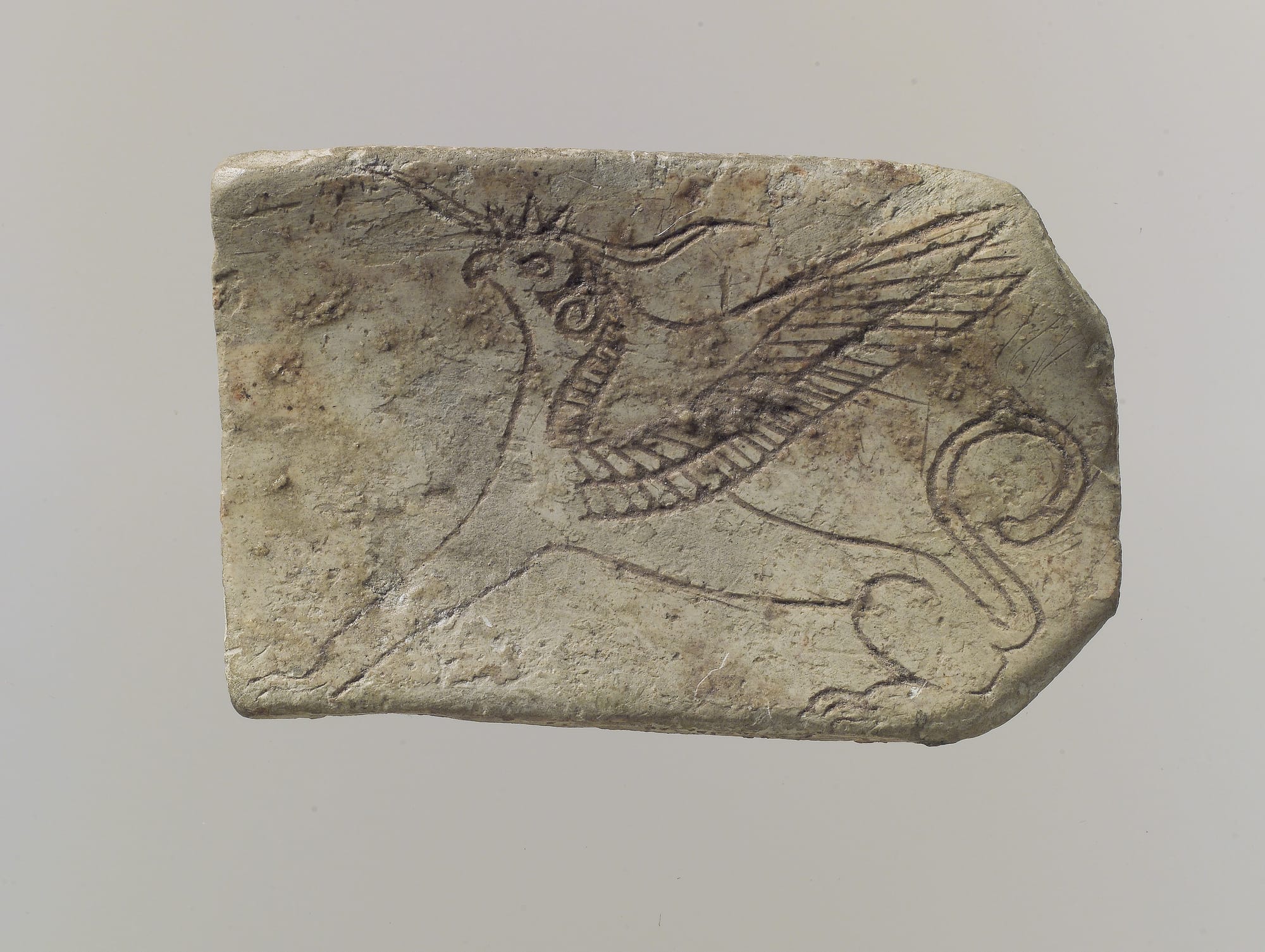
More than a thousand years separate the winged griffin carved into this Anatolian ivory plaque (c. 18th century BCE) from the open-beaked bronze griffin made in Ionia to adorn a cauldron (c. 625–575 BCE). By the time Herodotus wrote of griffins guarding gold, the creature already had a long life in art.
Broader Implications
One way to see Mayor’s influence is to follow it in two directions. In 2014, Marc Aronson’s The Griffin and the Dinosaur took her search to young readers through National Geographic. In a 2011 field study in China, Mayor, paleontologist Lida Xing, and their colleagues described a more practical use for the same listening habit: local names and accounts of strange tracks could help scientists locate actual trackways previously unknown to researchers. A tradition can be an excellent guide to where to look even when people disagree about what made the marks.
Across the Aegean from Samos, a find on the Greek mainland shows what collecting looks like when more of the evidence survives. In 2024, Jacqueline Meier, Vassiliki Pliatsika, and Kim Shelton reported a fossil ankle bone from a basement storage area at Bronze Age Mycenae. Excavated in the 1970s and later reexamined, it had been deposited there in the thirteenth century BCE. Its shape and measurements point to an extinct rhinoceros. Here the specimen, excavation records, and date support a firm conclusion: someone collected a large animal fossil. That conclusion would stand even if no ancient traveler ever saw a Protoceratops.
The Reality Signal
What This Subject Represents
Mayor makes room in the history of inquiry for the person who picks something up. No treatise on extinction survives from the giver at Samos. We have something a treatise cannot supply: evidence that an unfamiliar piece of the natural world was worth the trouble of carrying away.
What Reality Frame It Challenges
A Greek sanctuary could be a place to honor a goddess and a place to put a remarkable object where it might be seen. Asking whether an ancient response was religious or observant can erase the very combination that made someone keep a fossil.
Why It Matters Now
Modern readers have an advantage that can mislead us. We can set a prepared dinosaur skull beside a bronze griffin and see the resemblance in a second. Nobody in antiquity had those two museum labels. The historian has to put the desert journey, the work of uncovering the skull, and the intervening centuries back between the pictures.
What Remains Unresolved
The order of events matters. A find might give someone a story; someone who already knew the story might recognize its creature in a find. The same displayed bone could be the outcome of either sequence. Even evidence that once linked a bone and a name would not, by itself, tell us which came first.
The Galactic Mind Perspective
There is a matchbox in the photograph of the Samos thighbone. Five centimeters long, it was put there to give the fragment a scale. It matters more than anyone taking the picture could have expected. Kyrieleis says the bone was sent to Athens for examination. When he tried to trace it later, the specimen shown to him on Samos was a much smaller joint. His report records a single surviving photograph of the excavated fragment, too little to determine its species.
The fossil survived its ancient keeper long enough for someone to photograph it. Its modern trail then faltered, too. Yet one part of the ancient act is remarkably legible: a person moved something from a bed of old bones to a place that mattered to the living. Mayor’s achievement is to make us interested in that person before we know whether they got the animal right. The most honest thing we can leave them is the freedom to have had an idea we haven’t guessed.
Open Thread
If we found the name the Samians gave this bone tomorrow, what would tell us whether the bone had changed their story or the story had taught them how to see the bone?
More in Dossier
- The Antikythera Mechanism and the Lost Architecture of Ancient Time — In another Greek find, the surviving gears offer a rare comparison: their physical arrangement can rule out some interpretations of what the object did.
- Great Zimbabwe: The City Behind the Stone Walls — Fragments of everyday work helped archaeologists recover the history of a city long burdened by outsiders’ stories about who built it.
- The Voynich Manuscript and the Discipline of Not Knowing — A book whose materials can be dated even though its script remains unread offers another way to separate the age of a thing from its meaning.
Sources / Receipts
- Helmut Kyrieleis, Ausgrabungen im Südostgebiet des Heraion von Samos, German Archaeological Institute, 2020; digital edition, 2022. See pp. 31–32, especially note 149; catalogue VIII 11; plate 76.8. The excavation date and context, interpretation as an offering, specialist assessment, and account of the missing specimen.
- Stanford Department of Classics, Adrienne Mayor; Mayor, interview with Heat Death, October 2, 2025. Stanford identifies her fields and affiliations; the interview is her own recollection of South Dakota, the post office on Samos, and the annotated bilingual texts.
- Adrienne Mayor, The First Fossil Hunters, Princeton University Press, first published 2000. The author’s introduction explains her method; chapter 1 develops the griffin hypothesis.
- Aelian, On Animals 17.28; George D. Koufos, “History of the Samos Fossil Mammals”, Beiträge zur Paläontologie 31 (2009), pp. 1–12. Aelian preserves Euphorion’s account of the Neades. Koufos documents the island’s fossil beds independently of that tradition.
- Herodotus, Histories 4.13 and 3.116, fifth century BCE, trans. G. C. Macaulay. The first passage attributes the gold guardians to Aristeas’s poem; the second records Herodotus’s reservations.
- Adrienne Mayor and Michael Heaney, “Griffins and Arimaspeans”, Folklore 104 (1993), pp. 40–66; Mayor, “Ancient Fossil Discoveries and Interpretations”, Oxford University Press, 2014. An early joint treatment and Mayor’s later account in full of how gold seekers, fossils, and the griffin might be connected.
- Mark Witton and Richard Hing, “Did the horned dinosaur Protoceratops inspire the griffin?”, Interdisciplinary Science Reviews, online June 20, 2024. In the full paper, figures 2 and 5 compare the chronology of the art and the geography of fossils and gold.
- Nicola Davis, “Rewriting the myth: experts doubt griffin was inspired by dinosaurs”, The Guardian, June 21, 2024. Includes Mayor’s direct response to the critique.
- Lida Xing, Adrienne Mayor, Yu Chen, Jerald D. Harris, and Michael E. Burns, “The Folklore of Dinosaur Trackways in China: Impact on Paleontology”, Ichnos 18 (2011), pp. 213–220; Marc Aronson, The Griffin and the Dinosaur, National Geographic Kids, 2014. Two distinct uses of Mayor’s work: a collaborative field study and a book for young readers.
- Jacqueline S. Meier, Vassiliki Pliatsika, and Kim Shelton, “The earliest evidence of large animal fossil collecting in mainland Greece at Bronze Age Mycenae”, Scientific Reports, August 19, 2024. Archaeological context and anatomical analysis of the fossil ankle bone; its exact ancient use remains open.


Discussion