
The Antikythera Mechanism should not exist in the way it does.
Not because ancient people were incapable.
That is the lazy version of the mystery.
The deeper tension is more precise.
The mechanism appears too complete, too compressed, and too technically ambitious to sit comfortably inside the simple story many people inherit about the ancient world.
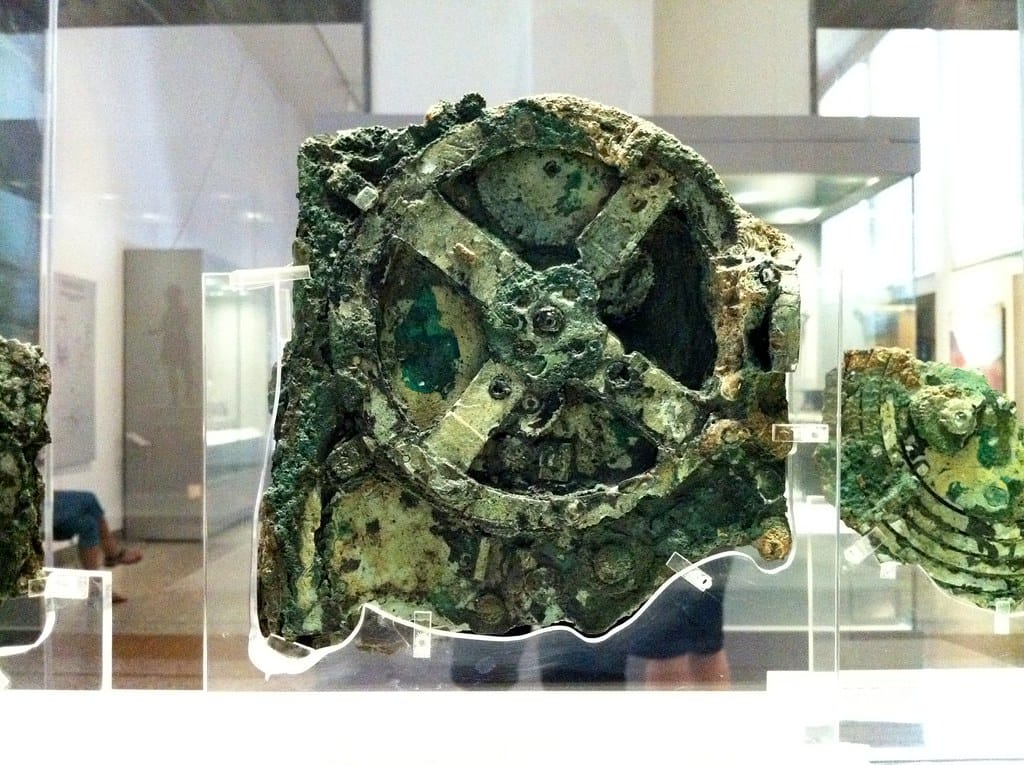
It is a corroded bronze object recovered from a shipwreck.
It is also a mechanical model of celestial order.
It tracked cycles of the Sun, Moon, eclipses, calendars, games, and possibly the visible planets known to the ancient Greeks. It turned astronomy into gears. It translated the sky into a hand-powered machine.
That is why it continues to disturb the timeline.
Not because it proves aliens.
Not because it proves a vanished global civilization.
Not because it automatically means ancient technology was secretly more advanced than our own.
It matters because it reveals that ancient intelligence was not primitive.
It was precise.
And in some cases, it was capable of building instruments so sophisticated that their context has not fully survived around them.
The Antikythera Mechanism is not just an artifact.
It is a rupture in expectation.
It reminds us that history is not always a straight climb from simple to complex. Sometimes knowledge appears, flourishes, disappears, and returns centuries later as if it had been waiting underground.
Or, in this case, under the sea.
Overview: What This Is
The Antikythera Mechanism is an ancient Greek geared device recovered from a shipwreck near the island of Antikythera, between Crete and mainland Greece.
It is widely described as the oldest known analog computer, though “astronomical calculator” may be the more careful phrase.
The surviving fragments are housed at the National Archaeological Museum in Athens. What remains is broken, corroded, and incomplete. But inside those fragments are bronze gears, inscriptions, dials, and mechanical relationships that point to an extraordinary purpose.
The mechanism was designed to calculate and display astronomical cycles.
It was not a weapon.
It was not a statue.
It was not a decorative object.
It was a compact machine for modeling time.
That is what makes it different.
It took the movements of the heavens, the repeating logic of calendars, the rhythms of lunar phases, eclipse cycles, and cultural events, then embedded them into a physical device that could be turned by hand.
In modern language, it was a machine for prediction.
In ancient language, it may have been something closer to a portable cosmos.

Origins and Background
The Antikythera shipwreck was discovered by sponge divers around 1900 near the small Greek island of Antikythera. The wreck produced statues, jewelry, glassware, coins, and other artifacts from the ancient world.
Among them were corroded bronze fragments that did not immediately reveal their importance.
At first, the mechanism looked like little more than a damaged lump of metal.
Then a gear appeared.
That discovery changed everything.
The object was eventually recognized as something far stranger than ordinary ship cargo. It contained interlocking bronze gears and inscriptions connected to astronomy and calendrical systems.
The mechanism is generally dated to the Hellenistic period, often placed around the second to early first century BC.
That period matters.
The Hellenistic world after Alexander the Great was not intellectually small. It was an age of mathematics, astronomy, engineering, philosophy, trade, and cross-cultural exchange. Greek, Babylonian, Egyptian, and other knowledge systems moved across cities, ports, libraries, workshops, and courts.
The mechanism belongs to that world.
It appears to combine mathematical astronomy, practical engineering, and elite craftsmanship.
But there is a problem.
We do not have a long chain of similar surviving machines leading up to it.
That absence creates the mystery.
A device like this usually implies a tradition.
A workshop.
A knowledge lineage.
A community of makers.
A demand for instruments of this kind.
But the historical record gives us only fragments.
So the Antikythera Mechanism sits in a strange position.
It looks like the survivor of a larger technical culture, but the larger culture is only partly visible.
What It’s Known For
The Antikythera Mechanism is known for being one of the most technically complex artifacts from the ancient world.
Its importance comes from several overlapping signals.
It mechanized astronomy
The mechanism converted celestial cycles into gear movements.
This is the central achievement.
Instead of only writing astronomical tables, observing the sky, or using static diagrams, the maker built a moving model. A user could operate the device and see relationships unfold mechanically.
That is a major shift.
It is astronomy made physical.
It predicted eclipses
One of the strongest areas of evidence concerns the back dials, which appear to encode cycles used for eclipse prediction.
The Saros cycle, a period of about 223 lunar months, was known in ancient astronomy and helped predict repeating eclipse patterns. The mechanism’s back dials appear to have used this kind of cyclical logic to indicate eclipse possibilities.
This does not mean it “saw the future” in a mystical sense.
It means the device embodied mathematical astronomy in bronze.
It tracked calendars and cultural time
The mechanism was not only concerned with abstract astronomy.
It also appears connected to calendars and athletic cycles, including a Games dial associated with a four-year cycle of Greek games.
That detail matters because ancient time was not purely scientific.
Time was religious.
Agricultural.
Political.
Civic.
Ceremonial.
Astronomical.
The mechanism seems to compress several forms of time into one object.
It revealed hidden inscriptions
Modern imaging changed the story.
X-ray computed tomography and surface imaging helped researchers see inside the corroded fragments and read inscriptions that had been hidden for roughly two thousand years.
Those inscriptions helped clarify functions, planetary cycles, and descriptions of displays that were previously invisible.
This is one of the most important aspects of the mechanism.
The object did not give up its meaning all at once.
It had to be re-read by modern machines.
A machine from antiquity needed modern imaging to reveal the intelligence inside it.
It challenged the assumed timeline of technology
The mechanism’s complexity is often compared to later medieval clockwork traditions.
That comparison is not perfect, but the point is clear.
The Antikythera Mechanism shows that highly sophisticated gearwork existed in the ancient Mediterranean far earlier than many people once assumed.
That does not mean ancient people had modern technology.
It means they had a specific kind of advanced mechanical knowledge, applied to a specific intellectual problem.
That is more interesting than exaggeration.
The Core Idea or Signal
The core signal of the Antikythera Mechanism is this:
Ancient knowledge was not always less sophisticated than later knowledge. Sometimes it was simply more vulnerable to loss.
That is the real tension.
We are used to thinking of history as accumulation.
One generation discovers.
The next improves.
The next preserves.
The next advances.
But the mechanism tells a more fragile story.
Knowledge can disappear.
Workshops can vanish.
Libraries can burn.
Trade networks can collapse.
Patronage systems can dissolve.
Languages can fade.
Tools can corrode.
A technical tradition can die without leaving enough descendants behind to explain itself.
The Antikythera Mechanism is not only proof of ancient ingenuity.
It is evidence of historical fragility.
It shows that civilization does not simply move forward.
It remembers, forgets, rediscovers, and misjudges its own past.
The mystery is not only how the device was made.
The mystery is why so little like it survived.
Perspectives and Interpretations
The Antikythera Mechanism attracts different kinds of interpretation.
Some are grounded.
Some are speculative.
Some reveal more about modern assumptions than ancient reality.
The archaeological view
From a careful archaeological perspective, the mechanism is a rare Hellenistic scientific instrument.
It reflects advanced Greek astronomy, mathematical modeling, and metalworking skill.
This view does not require lost super-civilizations or non-human intervention. It places the mechanism inside the known intellectual world of antiquity, especially the Hellenistic period, when astronomy and mathematics were highly developed.
This is the strongest foundation.
The mechanism is extraordinary, but not contextless.
Greek astronomy, Babylonian cycles, mechanical craftsmanship, and elite patronage all help explain how such a device could emerge.
The history-of-science view
For historians of science, the mechanism is a turning point because it shows that ancient people did not merely observe the sky.
They modeled it.
They mechanized it.
They built predictive systems.
This makes the device a philosophical object as much as a technical one.
It shows a world where the cosmos was not only something to worship or watch. It was something that could be calculated.
The sky had pattern.
The machine made that pattern visible.
The lost-knowledge view
For many people, the Antikythera Mechanism feels like evidence of a missing chapter in history.
This interpretation is understandable.
A device this advanced rarely appears alone. It suggests earlier models, workshop traditions, experiments, failures, apprentices, and perhaps other instruments that have not survived.
The careful version of the lost-knowledge view is reasonable:
The mechanism may be the lone survivor of a broader ancient technical tradition.
The careless version goes further:
It claims the mechanism proves a suppressed civilization, alien technology, or impossible knowledge.
That leap is not supported by the evidence.
The artifact expands our view of ancient capability.
It does not automatically rewrite all of human history.
The symbolic view
Symbolically, the Antikythera Mechanism has become a kind of ancient interface.
It sits between sea and sky.
Past and future.
Human hand and cosmic order.
It is not hard to see why people are drawn to it.
A machine lost underwater for two thousand years resurfaces and reveals that the ancient world had already built a mechanical cosmos.
That image is powerful.
But the symbolic power should not replace the evidence.
It should deepen the question.
Strengths and Limitations
The Antikythera Mechanism is one of the strongest examples of ancient technological sophistication we have.
The evidence is physical.
The fragments exist.
The gears exist.
The inscriptions exist.
The object is not based on rumor, myth, or a medieval copy of a lost text.
It is a real artifact.
That gives it weight.
The strongest claims are also the most grounded:
It was a complex geared device.
It calculated astronomical cycles.
It displayed lunar and solar relationships.
It predicted eclipse cycles.
It included calendrical and cultural timekeeping functions.
It reflects advanced Hellenistic astronomy and engineering.
Those claims are well supported.
But the limitations matter.
Only part of the mechanism survives.
Many gears are missing.
Some inscriptions are fragmentary.
The front display remains more debated than the rear dials.
Planetary reconstructions are serious, but still partly interpretive.
Researchers can build models that fit the evidence, but that does not mean every detail of the original is known.
This is the difference between reconstruction and certainty.
A reconstruction can be brilliant.
It can fit the physical evidence.
It can solve mechanical problems elegantly.
But if the artifact is incomplete, some uncertainty remains.
That uncertainty is not a weakness.
It is part of the honest map.
The mechanism is strong enough to challenge old assumptions.
But it is not complete enough to remove every question.
Broader Implications
The Antikythera Mechanism matters because it changes how we think about the past.
It weakens the simple myth of linear progress.
Modern culture often imagines ancient people as intelligent but technically limited. We picture philosophers, priests, sailors, architects, and artists, but not always mechanical model-builders capable of compressing astronomical cycles into a gear-driven device.
The mechanism disrupts that image.
It reminds us that intelligence does not always look like modernity.
An ancient civilization may lack electricity, engines, satellites, and computers, yet still possess advanced mathematical and mechanical insight.
Technology is not one ladder.
It is many branches.
Some grow.
Some break.
Some are cut off.
Some are rediscovered centuries later.
The mechanism also forces us to think about how knowledge depends on social conditions.
A machine like this requires more than a brilliant mind.
It requires materials.
Tools.
Time.
Mathematics.
Astronomical records.
Skilled hands.
Patrons.
A reason to build it.
A culture that values the relationship between sky, time, prediction, and power.
The artifact is not just evidence of an inventor.
It is evidence of an ecosystem.
That may be the most important implication.
If the Antikythera Mechanism survived by accident, what else did not?
What machines were melted down?
What diagrams decayed?
What workshops were erased?
What knowledge remained local, oral, secret, or too specialized to survive political collapse?
This is where the mechanism becomes more than an artifact.
It becomes a warning about memory.
Civilization can be brilliant and still forget itself.
The Reality Signal
What this subject represents
The Antikythera Mechanism represents compressed intelligence.
It is not only bronze, gears, and inscriptions.
It is a physical condensation of astronomy, mathematics, craftsmanship, and culture.
It represents a human desire to make the universe legible.
To take the terrifying scale of the heavens and place it inside a box.
To turn cosmic rhythm into something the hand can move.
That is why the mechanism feels almost mythic without needing mythology.
It is an object of measurement that feels like an object of wonder.
What reality frame it challenges
The mechanism challenges the idea that ancient history was technologically simple.
It also challenges the assumption that progress is continuous and guaranteed.
If a device this complex existed in antiquity, then the past was not merely a prelude to us.
It had its own peaks.
Its own lost branches.
Its own forms of genius.
The artifact also challenges a modern psychological habit:
We often confuse survival with significance.
Because few similar devices survived, we assume few existed.
That may be true.
But it may also be an artifact of preservation.
Bronze can be melted.
Wood can rot.
Workshops can vanish.
The archive is not reality.
The archive is what survived reality.
Why it matters now
The Antikythera Mechanism matters now because we are living through another age obsessed with prediction.
Algorithms forecast behavior.
Satellites track weather.
AI models search for patterns.
Financial systems predict markets.
Scientists model climate, planets, pandemics, and cosmic structure.
We are still doing what the mechanism did in miniature:
Turning reality into calculable systems.
That connection matters.
The mechanism is ancient, but the impulse behind it is modern.
It asks a question that has never left us:
Can the universe be modeled well enough to anticipate what comes next?
And if it can, who gets to hold the machine?
What remains unresolved
Many questions remain open.
Who built it?
Where was it made?
Was it a one-of-a-kind masterpiece or one example of a broader class of instruments?
Who used it?
Was it educational, ceremonial, scientific, political, elite entertainment, navigational, or some combination of these?
How complete are current reconstructions?
How many functions remain hidden in missing fragments?
Could future underwater archaeology recover more pieces?
The most important unresolved issue may be the simplest:
Was the Antikythera Mechanism an exception, or was it the survivor of a lost tradition?
That question still defines the artifact.
The Galactic Mind Perspective
The Antikythera Mechanism belongs in The Galactic Mind archive because it changes the emotional shape of history.
It does not ask us to believe in fantasy.
It asks us to respect the unknown inside the documented record.
That is a different kind of wonder.
The mechanism is powerful because it is real.
You do not need to inflate it.
You do not need to attach aliens to it.
You do not need to turn it into proof of Atlantis, ancient astronauts, or forbidden science.
The grounded version is already extraordinary.
A machine from the ancient world modeled the heavens through gears.
That alone is enough.
The deeper lesson is about humility.
Modern people often look backward with quiet superiority. We assume we are the peak, the culmination, the inevitable result of progress.
The Antikythera Mechanism complicates that posture.
It reminds us that the past was not waiting for us to become intelligent.
It was already thinking.
It was already measuring.
It was already building interfaces between mind and cosmos.
A Dossier is not a monument. It is a map of influence.
And the influence of the Antikythera Mechanism is clear:
It makes the ancient world feel less distant, less simple, and less fully known.
It does not close history.
It reopens it.
Open Thread
The Antikythera Mechanism leaves behind a question that still turns like one of its missing gears.
How much human knowledge has disappeared without leaving a machine behind?
The mechanism survived because a ship sank.
That is the strange irony.
The sea destroyed it, but the sea also preserved it.
Without that accident, we might not know this level of ancient mechanical astronomy existed at all.
So what else did history almost show us?
What else is missing because it was melted, burned, buried, looted, dismissed, or never recognized?
Maybe the Antikythera Mechanism is not only a window into ancient genius.
Maybe it is a reminder that the past is still incomplete.
And the parts we do not have may be just as important as the fragments we do.
What do you think? Drop your thoughts in the comments ...
Sources / Receipts
- National Archaeological Museum, Athens: Antikythera Mechanism exhibit and digital application
- National Archaeological Museum, Athens: Collection of Metalwork
- National Archaeological Museum, Athens: note on the Games dial and Olympiad cycle
- Tony Freeth et al., “A Model of the Cosmos in the ancient Greek Antikythera Mechanism,” Scientific Reports, 2021
- UCL News: “Experts recreate a mechanical Cosmos for the world’s first computer”
- PubMed record for Tony Freeth et al., “Decoding the ancient Greek astronomical calculator known as the Antikythera Mechanism,” Nature, 2006
- Max Planck Institute for the History of Science: “The Inscriptions of the Antikythera Mechanism”


Discussion