
Overview: Who This Is
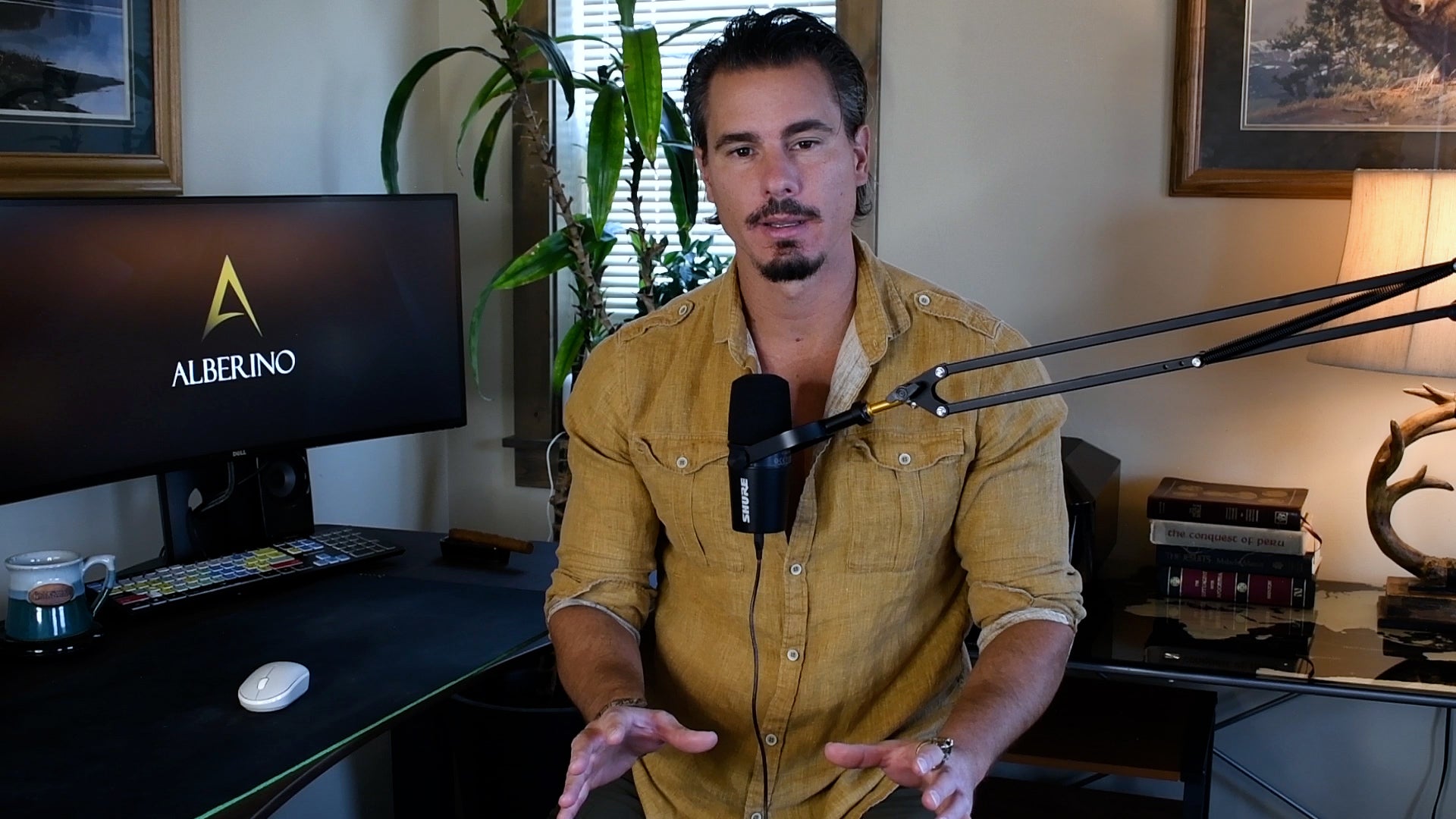
Timothy Alberino is an author, lecturer, explorer, and documentary filmmaker whose work brings biblical cosmology into direct contact with ancient mysteries, UAP, artificial intelligence, transhumanism, and the possibility of non-human intelligence. His central book, Birthright: The Coming Posthuman Apocalypse and the Usurpation of Adam’s Dominion on Planet Earth, presents human history as one phase of a much older cosmic conflict.
Alberino’s significance does not depend on proving that giants built ancient monuments, that modern UAP are fallen angels, or that emerging technologies are part of an organized posthuman campaign. His importance lies in the reality frame he has constructed around those possibilities.
In that frame, Genesis 6 is not an obscure prelude to Noah’s Flood. It is a compressed account of an ancient breach between different orders of being: heavenly Watchers descend, forbidden knowledge enters the human world, hybrid offspring appear, and humanity’s intended nature becomes contested. Alberino argues that the same pattern may be resurfacing through alien disclosure, genetic engineering, artificial intelligence, and technological efforts to redesign the human.
His audience expanded substantially when he appeared on episode 2530 of The Joe Rogan Experience on July 23, 2026. The appearance establishes his growing cultural reach. It does not independently validate the historical and theological claims discussed during that conversation.
Alberino belongs in The Galactic Mind archive because he is a system-builder. He gives audiences a way to place biblical prophecy, ancient ruins, anomalous encounters, UAP, and posthuman anxiety inside one continuous story.
The strength of that story is coherence.
Its central danger is also coherence.
Origins and Background
Alberino’s official biography describes him as an author, lecturer, and explorer whose work bridges history, mythology, and biblical scholarship. These are public-facing descriptions rather than academic credentials; his site does not present him as a professional archaeologist, historian, or credentialed biblical scholar.
The same biography says that he moved to the Peruvian Amazon at eighteen, lived in Tarapoto and along the Mazán River, became fluent in Spanish, and developed relationships that later supported his expeditions. Those details help explain his field-oriented public identity, but they remain largely self-reported through Alberino’s own platform and promotional biographies.
His documented media record becomes clearer in the mid-2010s. Alberino directed and appeared in the GenSix True Legends films Technology of the Fallen in 2015, The UnHoly See in 2016, and Holocaust of Giants in 2017. Their subjects included Andean megaliths, ancient giants, Watchers, hidden artifacts, subterranean worlds, and alleged institutional efforts to suppress evidence.
GenSix Productions supplied the larger ideological setting. Its current mission statement says the company was launched in 2014 and treats the Genesis 6 narrative as the key to the prehistoric past and a cipher for the prophetic future. Its current About page identifies Steve Quayle as its owner and producer. Alberino’s role is best described as central to its earlier documentary work, not assumed to be a current organizational position.
Alberino consolidated his worldview in Birthright, independently published in 2020. The book’s description moves from a pre-Adamic galactic rebellion to Adam’s creation, the fall of the Watchers, alien disclosure, Luciferian forces, Armageddon, and a coming posthuman crisis. By 2025 he was discussing his claimed discovery of Tawri Punku on the Shawn Ryan Show. In July 2026, Spotify described a new edition of The Book of Enoch, with Alberino’s introduction and commentary, as his latest release when it introduced him on The Joe Rogan Experience.
That trajectory matters. Alberino emerged through Christian alternative media and expedition documentaries, then moved into larger podcast culture. His ideas have not become academically established, but they have become substantially more visible.

What He Is Known For
Genesis 6 and the Watchers
Genesis 6:1–4 is the gravitational center of Alberino’s work. The passage describes the “sons of God,” the “daughters of men,” the Nephilim, and ancient “men of renown,” but provides little explanation. Its brevity created centuries of interpretive disagreement over whether the figures were divine beings, human rulers, members of a Sethite lineage, mythic heroes, or something else.
The Watchers tradition is not a modern invention. As biblical scholar Miryam Brand explains in TheTorah.com’s examination of the tradition, the Book of the Watchers—now contained in chapters 1–36 of 1 Enoch—expanded Genesis 6 during the Second Temple period. Its angels descend, take human wives, produce violent giants, and teach warfare, adornment, magic, and other forms of forbidden knowledge.
That establishes the antiquity of the narrative.
It does not establish that the narrative records literal genetic intervention, advanced prehistoric technology, or the origin of modern UAP. Those conclusions belong to Alberino’s theological interpretation of the text.

Birthright and the Posthuman Crisis
Birthright is Alberino’s most complete statement. Its underlying idea is that humanity was given a particular identity and dominion under divine authority, and that a cosmic adversary has repeatedly attempted to corrupt, replace, or usurp that inheritance.
This transforms transhumanism from a debate about medical enhancement or technological autonomy into a continuation of the Watchers problem. Artificial intelligence, biotechnology, genetic alteration, alien disclosure, and posthuman ambition become possible instruments in a struggle over what kinds of beings will inherit the Earth.
The book’s cosmic prehistory—inhabited worlds, a pre-Adamic rebellion and extraterrestrial devastation—is part of Alberino’s model. It is not established by biblical scholarship, astronomy, archaeology, or publicly available physical evidence. Its force comes from theological synthesis rather than independent confirmation.
True Legends, Ancient Giants, and Megalithic Sites
The True Legends films translated this worldview into expedition media. In Technology of the Fallen, Alberino and the GenSix crew visited the Altiplano, Lake Titicaca, Tiwanaku, Puma Punku, and Aramu Muru in search of evidence associated with Watchers, giants, lost technology, and pre-Flood civilization.
The locations are real and archaeologically important. UNESCO identifies Tiwanaku as the spiritual and political center of a sophisticated pre-Hispanic civilization that flourished into a planned city between approximately 400 and 900 CE. Its people created monumental stone architecture, accurately carved masonry, ceremonial structures, and complex drainage systems.
The existence of extraordinary ancient engineering is therefore documented. Attributing that engineering to antediluvian giants, fallen angels, or a forgotten non-human technology is a separate claim that has not been established by the archaeological record.
Alberino’s official biography also says that expeditions conducted with Anselm Pi Rambla led to the discovery of a previously unknown ruined city called Tawri Punku. The expedition and Alberino’s account are documented through his own media and later interviews. Publicly available sources reviewed for this Dossier did not reveal a formal archaeological report, government heritage record, peer-reviewed site study, or independent excavation publication confirming the site’s claimed scale and significance. Until that documentation appears, “discovery” should remain attributed to Alberino and his team.
The Amazon “Face Peeler” Investigation
Alberino traveled to the Peruvian Amazon in 2023 following reports from Ikitu communities of tall, strange beings allegedly attacking people at night. Contemporary Peruvian reporting documents that frightened residents made these allegations and sought government protection.
Various reports later circulated an explanation involving illegal miners, intimidation tactics, and even jetpacks. Illegal mining is a documented and serious problem in Loreto, but neither the extraordinary non-human explanation nor the more theatrical versions of the jetpack explanation were established through publicly released forensic evidence.
Alberino’s journey and interviews can therefore be treated as a documented field investigation. The nature of whatever frightened the communities remains unresolved in the public record.
UAP Disclosure Through a Biblical Lens
Alberino does not approach UAP as a neutral aerospace mystery. He asks whether reported non-human intelligences belong to the same spiritual ecology described in biblical and Enochic literature.
This interpretation challenges the assumption that “alien” is a sufficient category. A being might appear extraterrestrial while being spiritual, interdimensional, deceptive, embodied in an unfamiliar way, or operating through categories that modern materialism has excluded in advance.
The scientific record remains more limited. NASA’s current UAP guidance says the available high-quality data are insufficient for firm conclusions and that it has found no credible evidence connecting UAP to extraterrestrial life. Alberino’s identification of the phenomenon with an ancient rebellion is therefore a theological hypothesis, not a finding established by UAP research.
The Core Idea or Signal
The central signal of Timothy Alberino’s work is not simply that giants existed or that aliens are here.
It is that the future crisis of humanity may be the return of an ancient rebellion.
In this model, the Watchers represent an unauthorized crossing of boundaries. They bring knowledge humanity is not prepared to govern, intervene in human generation, and produce entities that disrupt the created order. The Flood becomes a response not merely to ordinary wrongdoing, but to civilizational and biological corruption.
Alberino sees a structural echo in the present. Artificial intelligence externalizes cognition. Genetic engineering makes heredity increasingly editable. Transhumanism imagines bodies and minds that can be redesigned. UAP reports reopen the possibility of intelligences that are not human. The same questions return under technological names: Who may alter the human? What knowledge should be accepted? Does greater capability constitute progress? What happens when humanity can create or be persuaded to become—its own successor?
This is where Alberino’s framework becomes more than prophecy commentary. He uses an ancient mythic structure to interpret a genuine modern problem: technological capability is advancing faster than consensus about human identity, moral limits, and responsibility.
The analogy is intellectually provocative.
The claimed historical continuity remains unproven.
Perspectives and Interpretations
Supporters see Alberino as someone willing to take the supernatural dimensions of biblical literature seriously. Within this view, modern Christianity has often reduced its own cosmology until angels, divine councils, giants, hostile powers, and heavenly rebellion survive only as uncomfortable metaphors. Alberino restores those elements and offers believers a way to face the UAP question without treating possible non-human intelligence as a defeat for biblical faith.
Students of ancient religion can recognize that Alberino is working with authentic textual material. Genesis 6 is genuinely enigmatic, and the Watchers story became an important Second Temple explanation for forbidden knowledge, violence, evil spirits, and the corruption preceding the Flood. The important scholarly boundary is that studying what an ancient community believed is not the same as demonstrating that the narrative occurred as literal biological or technological history.
Archaeologists would raise a different concern. A remarkable stone structure is not evidence of a non-human builder simply because its methods are unfamiliar to modern viewers. Tiwanaku and Puma Punku belong to a known Andean cultural setting, even where details of labor, ritual, chronology, and construction remain debated. Replacing Indigenous engineering with giants or external powers requires evidence strong enough to overcome the existing cultural and archaeological record.
The history of giant claims also demands caution. Archaeology magazine’s account of nineteenth-century “petrified giants” shows how misidentified animal remains, manufactured figures, commercial spectacle, scriptural expectation, and sensational newspaper reporting repeatedly reinforced one another. That history does not disprove every legend of unusual human stature. It demonstrates why photographs, clippings, witness recollections, and missing-skeleton stories require provenance, anatomical analysis, and a documented chain of custody.
UAP researchers may find Alberino’s category-expanding approach useful while rejecting his conclusion. The phenomenon, if it contains a genuinely unknown component, may not fit a simple extraterrestrial spacecraft model. But moving from “the category is uncertain” to “the entities are Watchers or their allies” requires evidence capable of distinguishing that explanation from extraterrestrial, psychological, folkloric, intelligence-operation, atmospheric, misidentification, or other hypotheses.
A media observer might focus less on whether Alberino’s entire system is correct and more on why it is spreading. His appearances with Shawn Ryan and Joe Rogan show that Genesis 6, Enoch, giants, disclosure, and posthumanism can now travel far beyond prophecy conferences. Alberino has become a translator between Christian supernaturalism and the wider high-strangeness podcast ecosystem.
Strengths and Limitations
Alberino’s greatest strength is synthesis. He understands that AI, biotechnology, UAP, ancient cosmology, and spiritual belief are not psychologically separate for many people. Each places pressure on inherited definitions of the human, and he gives that pressure a memorable narrative structure.
His second strength is his willingness to encounter difficult source material directly. The Watchers tradition is strange, violent, and cosmologically expansive. Treating it as part of the intellectual world of ancient Judaism can be more illuminating than pretending it does not exist. His Spanish fluency and experience in South America also give his field work a proximity that many studio-based commentators lack.
His third strength is recognizing that disclosure would be a religious event as well as a scientific and political one. If evidence of non-human intelligence were ever confirmed, billions of people would process it through existing cosmologies. Theology would not disappear when the evidence arrived. It would compete to interpret it.
The principal limitation is that Alberino’s framework can become self-sealing. Ancient ruins, legends, giant stories, UAP, occult traditions, artificial intelligence, biotechnology, institutional secrecy, and prophecy can all be absorbed into the same Genesis 6 model. The more phenomena the system can explain, the more important it becomes to ask what evidence could show that the interpretation is wrong.
A second limitation is dependence on testimony, promotional descriptions, visual resemblance, disputed artifacts, and claims whose strongest documentation remains inside the same alternative-media ecosystem that promotes them. A documentary product page proves that a claim was made. An expedition video proves that a location was visited. An interview proves that testimony was given. None of those, by themselves, proves giants, Watchers, alien adversaries, or institutional suppression.
A third limitation is the movement from analogy to identity. The Watchers bring dangerous knowledge; modern AI creates new forms of capability. That is a meaningful comparison. It does not demonstrate that AI originates with the Watchers or that contemporary technologists are consciously repeating an antediluvian program.
Finally, apocalyptic interpretation can distort proportion. It may encourage moral seriousness, but it can also make every technical advance appear coordinated, every ambiguity deceptive, and every institutional gap evidence of concealment. Once uncertainty is automatically interpreted as spiritual camouflage, investigation becomes difficult because doubt itself is absorbed into the theory.
Alberino’s work is strongest as a warning about identity, power, and ungoverned knowledge.
It is weakest when symbolic correspondence is presented as historical confirmation.
Broader Implications
Alberino reveals that the modern non-human-intelligence conversation is already colliding with ancient religion. The public may use the language of UAP, but the deeper categories remain older: angels, demons, messengers, tricksters, gods, ancestors, culture-bringers, and hostile powers. Modern vocabulary has not erased those archetypes. It has given them technological clothing.
His work also exposes a real tension inside technological culture. Before humanity can responsibly redesign cognition, heredity, bodies, or social decision-making, it must decide which parts of the human are merely contingent and which deserve protection. Alberino answers from a Christian anthropology: humanity possesses an intended form and inherited vocation that should not be surrendered to another intelligence or remade without moral authority.
One does not need to accept his cosmic history to recognize the force of that question. A society can develop more powerful machines without becoming wiser. It can expand capability while losing clarity about purpose. The Watchers story can therefore function as a durable warning about knowledge separated from moral legitimacy, even if it is read as myth rather than recovered technological history.
The larger danger is allowing myth to stop functioning as a lens and begin functioning as automatic proof. Myth can reveal recurring human fears and civilizational patterns. It cannot, without supporting evidence, identify the builders of a monument, the origin of a light in the sky, or the perpetrators of an attack in the Amazon.
Alberino’s influence sits precisely on that boundary. He preserves the possibility that ancient narratives contain more than modern readers assume. He also demonstrates how quickly a powerful narrative can recruit uncertain evidence into a predetermined war story.
The Reality Signal
What This Subject Represents
Timothy Alberino represents the return of biblical cosmology to the modern conversation about intelligence and technology. He embodies a growing interpretive movement that does not see UAP disclosure, AI, ancient ruins, and posthumanism as separate subjects, but as different surfaces of one conflict over human identity and authority.
His deeper cultural signal is the recovery of an inhabited cosmos. In his world, humanity is neither alone nor metaphysically unobserved. Other intelligences exist, history contains interventions, and technology may be entangled with spiritual allegiance.
What Reality Frame It Challenges
Alberino challenges the secular assumption that UAP can only be a scientific, military, or aerospace problem. He also challenges forms of Christianity that minimize the supernatural architecture of their own texts.
His work further challenges the progressive assumption that technological enhancement is self-justifying. More intelligence, greater longevity, editable biology, and deeper integration with machines may expand human power without answering whether the resulting being remains human in a morally meaningful sense.
These challenges can be valuable even when Alberino’s preferred explanation remains unverified.
Why It Matters Now
Alberino’s July 2026 appearance on The Joe Rogan Experience shows that his framework has moved into a much larger cultural stream. At the same time, governments and scientific institutions continue to study UAP, AI capabilities are advancing, and public debate over genetic intervention and human enhancement is intensifying.
This convergence creates an audience for interpreters who can place technological and anomalous developments inside a story of meaning. Alberino offers one of the clearest Christian versions of that story.
If disclosure ever becomes more concrete, his type of interpretation will matter. Evidence will not enter an empty culture. It will enter a civilization already carrying theological, mythological, scientific, conspiratorial, and cinematic expectations about what non-human beings are.
What Remains Unresolved
It is established that Alberino is an author, lecturer, filmmaker, and influential alternative-history commentator. His books, films, expeditions, interviews, and recent major podcast appearances are documented.
It is established that Genesis 6 and 1 Enoch contain ancient traditions involving divine beings, Watchers, giants, forbidden knowledge, corruption, and judgment. Their historical meaning and theological status remain debated.
It is self-reported that Alberino and his colleagues discovered the site they call Tawri Punku. Its archaeological significance has not been independently established in the public sources reviewed here.
It is documented that Indigenous communities in Loreto reported frightening encounters in 2023. The identity and nature of the alleged attackers have not been publicly established through verifiable physical evidence.
It remains speculative that modern UAP, alien-abduction reports, AI, genetic engineering, transhumanism, giant traditions, and megalithic mysteries are direct continuations of one Genesis 6 conflict.
The influence is real.
The full historical system remains unproven.

The Galactic Mind Perspective
Timothy Alberino belongs in The Galactic Mind archive because he has made Genesis 6 contemporary. He has taken a brief and difficult ancient passage and turned it into a map for navigating the alien and posthuman age.
The most useful part of his influence is not certainty about Watchers or giants. It is his insistence that questions about non-human intelligence and artificial intelligence are ultimately questions about the human. Who defines us? What may alter us? Which forms of knowledge enlarge human freedom, and which make humanity easier to replace or govern?
His framework also demonstrates why disciplined uncertainty matters. Ancient texts can preserve religious memory, mythic pattern, historical fragments, and profound warnings without serving as direct technical reports. Ruins can reveal extraordinary human achievement without proving non-human builders. UAP can remain unidentified without becoming evidence for one preferred cosmology.
Alberino offers a meaningful warning: knowledge without wisdom can become an invasion even when humanity creates it for itself.
The caution is that a warning becomes weaker when every mystery is made to confirm it. The strongest way to engage his work is therefore neither devotion nor dismissal. It is to preserve the question he has identified while demanding better evidence for the answer he proposes.
Open Thread
If the Watchers story survives because every technological civilization eventually faces a crisis of forbidden capability, does its deepest truth depend on the Watchers being literal beings or on humanity recognizing the pattern before it repeats?
What do you think? Drop your thoughts in the comments ...
More in Dossier
- Steve Quayle and the Prophetic Survivalist Imagination — the GenSix, giants, prophecy, and alternative-media context surrounding Alberino’s earlier work.
- Jacques Vallée and the Control System Behind the Phenomenon — a contrasting model that also questions whether UAP fit the simple extraterrestrial hypothesis.
- Why Danny Jones Became a Gateway Host for the Edge of Culture — how long-form podcast media moves fringe, religious, anomalous, and ancient-history ideas into wider culture.
Sources / Receipts
- Timothy Alberino — Official Biography: current self-description, research interests, Peru background, Tawri Punku claim, and 2023 Amazon investigation.
- Books by Timothy Alberino: Alberino’s descriptions of Birthright and his edition of The Book of Enoch.
- About GenSix Productions: founding mission, Genesis 6 framework, current ownership, and organizational claims.
- True Legends Films — GenSix Productions: official descriptions of the documentary series and its historical claims.
- Timothy Alberino — IMDb: publicly listed direction, writing, editing, and film credits.
- Miryam Brand, “The Benei Elohim, the Watchers, and the Origins of Evil”, TheTorah.com, 2016, updated 2026: Genesis 6, the Book of the Watchers, forbidden knowledge, giants, and Second Temple interpretation.
- Tiwanaku: Spiritual and Political Centre of the Tiwanaku Culture, UNESCO World Heritage Centre: cultural attribution, chronology, architecture, and archaeological context.
- Mark Rose, “When Giants Roamed the Earth”, Archaeology, November–December 2005: giant hoaxes, misidentification, biblical expectation, and evidentiary caution.
- NASA UAP Frequently Asked Questions: current institutional position on UAP data and the absence of verified extraterrestrial evidence.
- The Joe Rogan Experience #2530 — Timothy Alberino, July 23, 2026: date, duration, guest identity, and Enoch-edition description.
- Shawn Ryan Show #206 — Timothy Alberino, June 5, 2025: direct interview and public presentation of the Tawri Punku claim.
- Book of Enoch — Blurry Creatures: documentation of the Alberino and Blurry Creatures edition.
- RPP Noticias report on the Ikitu allegations, August 2023: contemporary reporting of the community’s claims.
- Peruvian Public Ministry report on illegal mining in Loreto, December 2023: official documentation of illegal mining activity and armed resistance in the region.


Discussion