
Jacques Vallée is difficult to place because he has spent his life refusing the easy category.
Scientist.
Computer pioneer.
Astronomer.
Venture capitalist.
Author.
UFO investigator.
Folklore analyst.
Reality theorist.
To some, he is one of the most serious thinkers to ever enter the UAP conversation.
To others, he is too strange for science and too skeptical for believers.
That may be why he matters.
Vallée did not become influential because he said UFOs were simply spacecraft from other planets.
He became influential because he asked a more unsettling question:
What if the phenomenon is not only physical?
What if it behaves like a system?
A system that interacts with perception.
A system that changes stories.
A system that adapts to culture.
A system that appears in different masks across history.
Fairies.
Angels.
Airships.
Flying saucers.
Visitors.
Entities.
Non-human intelligence.
The point is not that all these categories are the same.
The point is that human beings keep encountering something that arrives wearing the language of the age.
That is the Vallée problem.
Not whether UFOs are “real.”
Something is real enough to generate testimony, documents, patterns, myths, investigations, and cultural transformation.
The harder question is:
What kind of reality are we dealing with?

Overview
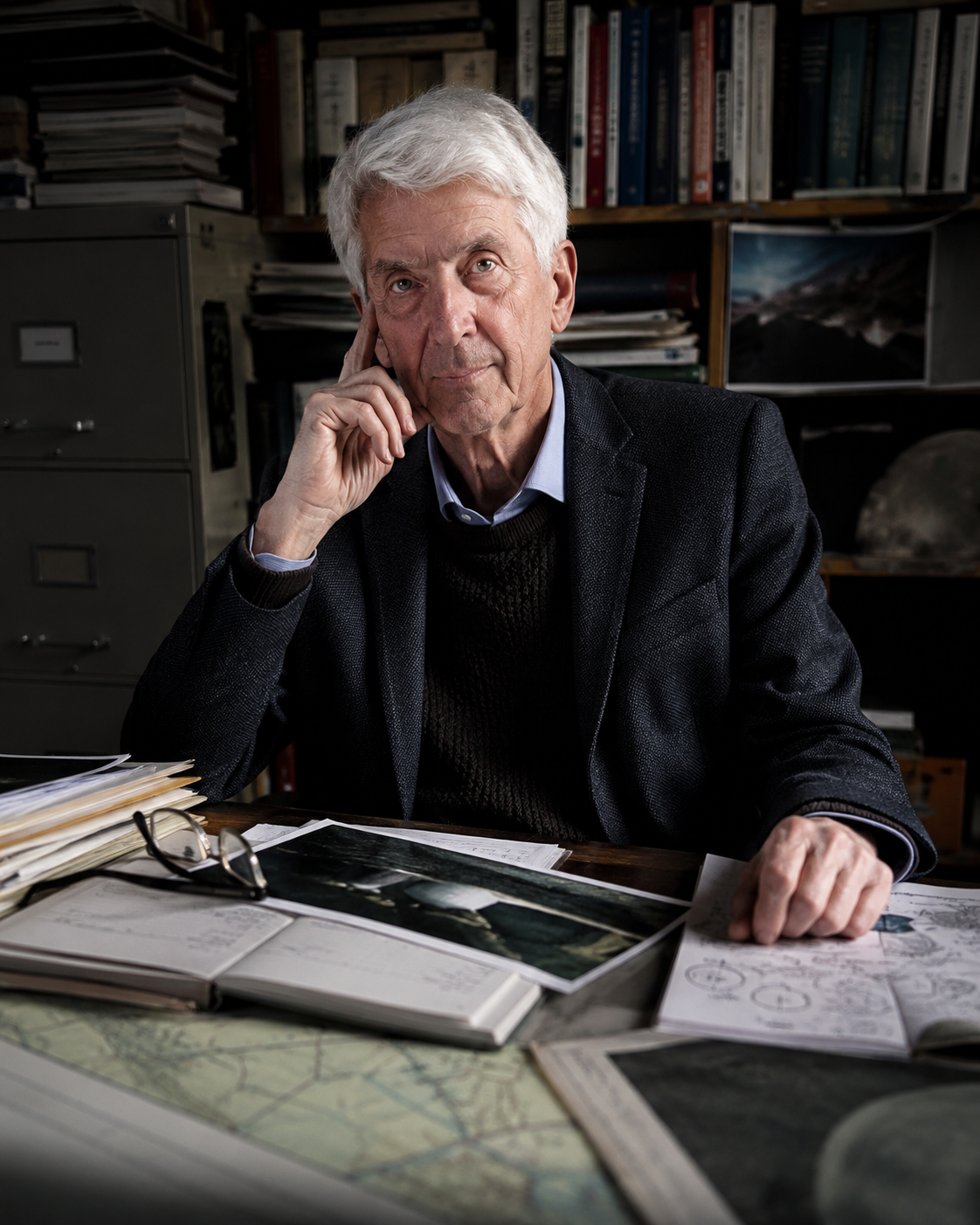
Jacques Fabrice Vallée is a French-born computer scientist, astronomer, investor, author, and long-time investigator of unidentified aerial phenomena.
His career sits across several worlds that rarely speak to each other.
He worked in astronomy.
He contributed to early computer networks.
He moved through Silicon Valley.
He helped finance technology ventures.
He studied UFO reports for decades.
He wrote some of the most influential books in the field.
And he became one of the central figures associated with the idea that the UFO phenomenon may be stranger than the simple extraterrestrial hypothesis.
That phrase matters: simple extraterrestrial hypothesis.
Vallée is not known for saying UFOs cannot involve non-human intelligence.
He is known for arguing that the phenomenon does not behave cleanly like visitors from another planet using machines in a straightforward way.
Too many cases contain absurdity.
Too many encounters feel staged.
Too many experiences resemble folklore.
Too many reports involve psychic, symbolic, theatrical, or consciousness-adjacent effects.
Too many details appear tailored to the witness, the culture, or the historical moment.
That is what made Vallée different.
He did not only ask:
Are these craft?
He asked:
What are these events doing to us?

Origins and Background
Vallée was born in France and began his professional life in astronomy.
Before becoming known in the UFO world, he was already trained in science, mathematics, astrophysics, and computing. That matters because his approach to the phenomenon was never only mystical or literary.
He came through systems.
Data.
Databases.
Networks.
Patterns.
He was part of a generation that watched computing emerge from specialized machines into a new architecture of civilization.
That background shaped the way he thought about UFOs.
Where others saw isolated sightings, Vallée saw information systems.
Where others collected stories, he wanted databases.
Where others argued over belief, he looked for patterns.
His early association with J. Allen Hynek also mattered.
Hynek, the astronomer connected to Project Blue Book, became one of the central scientific figures in modern UFO history. Vallée’s proximity to Hynek placed him close to the institutional UFO question at a time when the field was moving between ridicule, investigation, public fascination, and scientific discomfort.
But Vallée eventually moved beyond the classic UFO debate.
The standard debate was too narrow.
Either UFOs were misidentifications and hallucinations.
Or they were physical spacecraft from other planets.
Vallée became dissatisfied with both.
Not because he rejected physical data.
But because the phenomenon seemed to exceed any single explanation.
His work started to move into the space between technology, folklore, psychology, symbolic systems, and non-human possibility.
That is where his signature begins.
What It’s Known For
Vallée is known for several overlapping contributions.
Challenging the extraterrestrial hypothesis
The most common summary of Vallée is that he challenged the extraterrestrial hypothesis.
That summary is true, but incomplete.
He did not simply say “UFOs are not extraterrestrial.”
He argued that the extraterrestrial model may be too literal, too modern, and too small.
If advanced beings were physically traveling here from other planets, why would the encounters often be so absurd?
Why land in rural fields?
Why leave ambiguous traces?
Why perform impossible maneuvers, then behave like tricksters?
Why give witnesses strange messages that change with the cultural moment?
Why do entity encounters echo fairies, demons, religious apparitions, and older folklore?
Why does the phenomenon often seem less like exploration and more like theater?
Those questions pushed Vallée away from the “nuts-and-bolts spaceship” model and toward a wider interpretation.
Not necessarily less real.
More difficult.
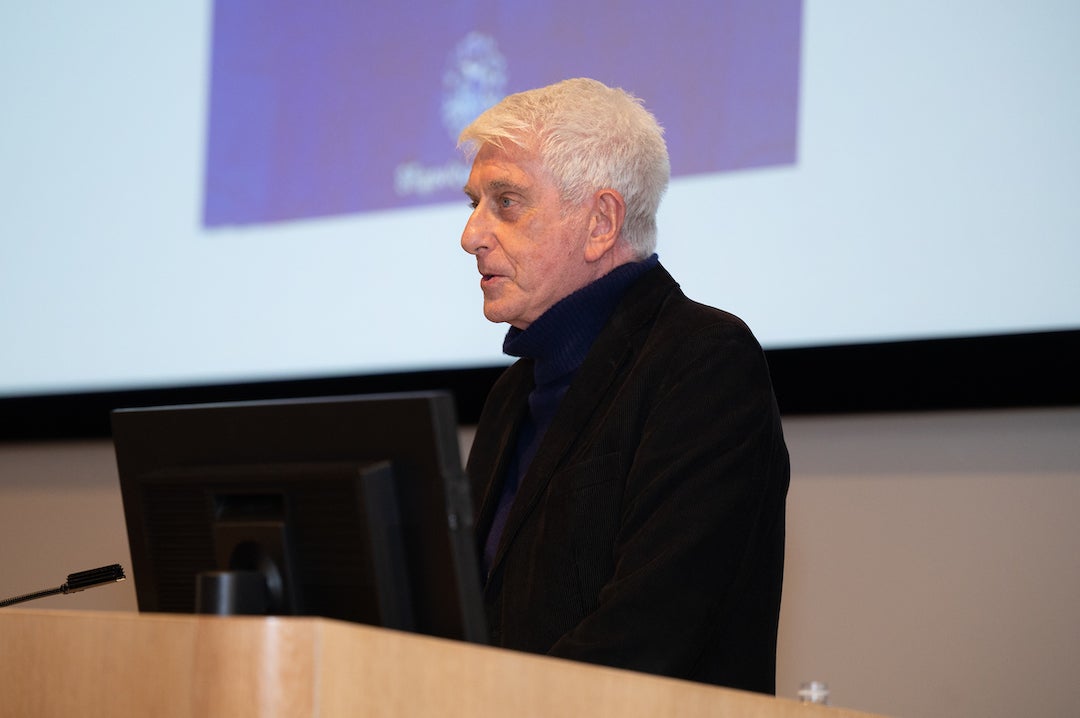
Passport to Magonia
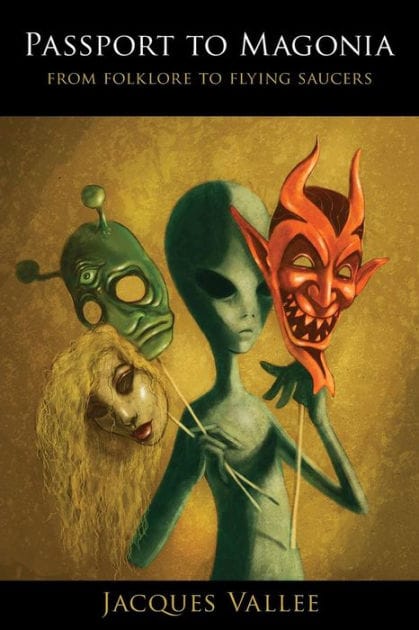
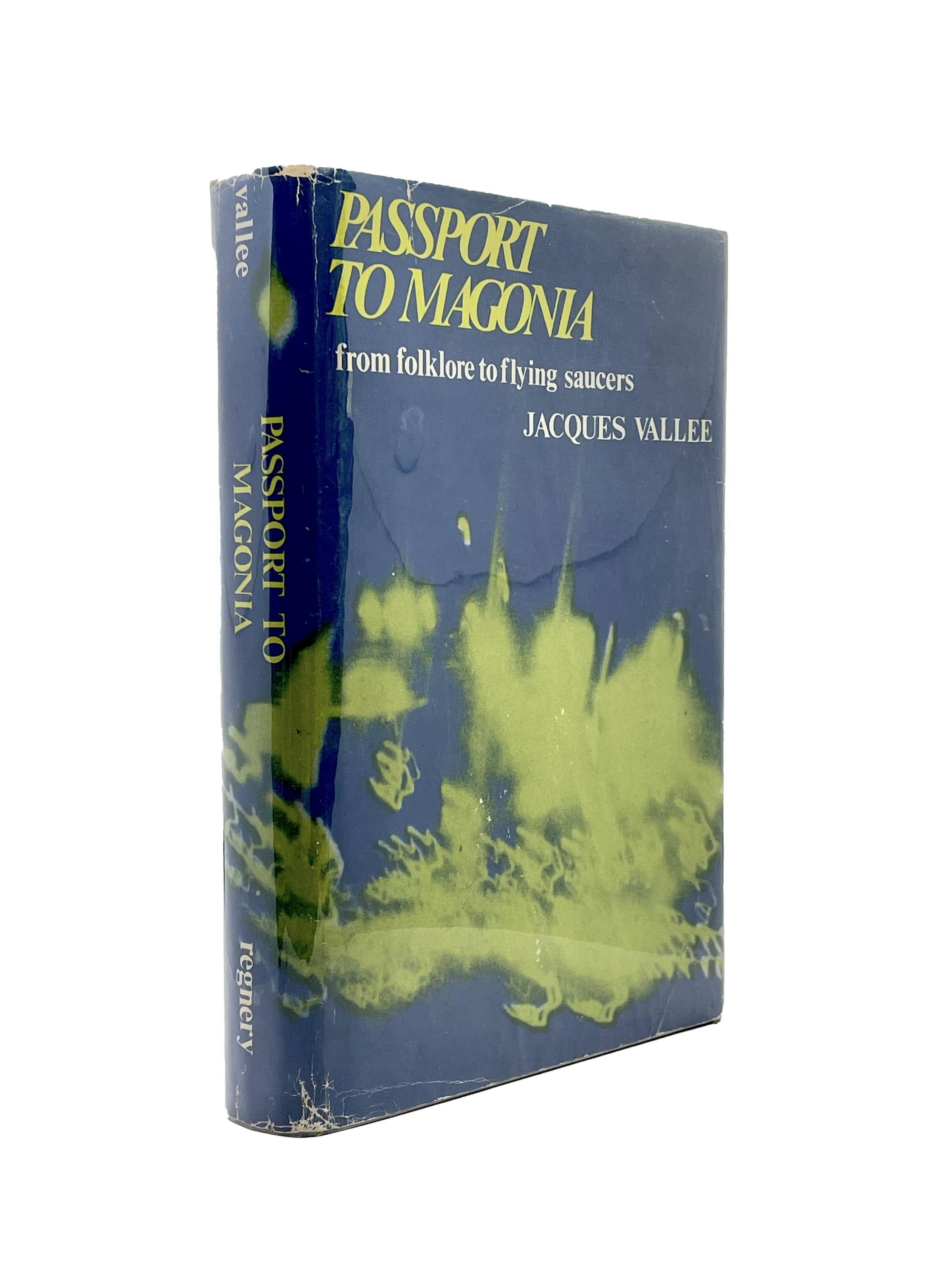
Vallée’s Passport to Magonia remains one of the most important books in the modern UFO canon.
Its core move was radical:
Look at UFO encounters beside older stories of fairies, spirits, airships, mystery lights, religious apparitions, and encounters with non-human beings.
Do not flatten them into one thing.
Do not claim they are all aliens.
Instead, notice the pattern:
Human beings across history report contact with beings and forces that feel otherworldly, symbolic, intrusive, elusive, and transformative.
The forms change.
The structure persists.
This was not a debunking of UFOs.
It was a widening of the archive.
Vallée suggested that the modern flying saucer may be one mask in a much older pattern of anomalous encounter.
That idea still shapes the best parts of the modern NHI conversation.
The control system hypothesis
Vallée is also associated with the idea that the phenomenon may operate like a control system.
This is one of his most provocative contributions.
The phrase does not necessarily mean a machine hidden behind reality.
It means the phenomenon may interact with human culture in a way that changes belief, behavior, expectation, mythology, and social direction.
A control system does not need to tell people exactly what to think.
It can introduce anomalies.
It can destabilize certainty.
It can seed symbols.
It can produce contradictions.
It can reward attention.
It can make the impossible feel near, but never fully available.
That is why the idea is so unsettling.
It suggests the phenomenon may not only be observed by us.
It may be observing, shaping, or training us.
The Invisible College
Vallée’s idea of an “Invisible College” also matters.
The phrase refers to informal networks of scientists, researchers, and serious investigators who privately studied the UFO phenomenon despite the public stigma attached to it.
This is one of Vallée’s most important cultural roles.
He helped preserve the idea that serious people were looking quietly.
Not always publicly.
Not always institutionally.
But seriously.
That idea has returned in modern UAP culture, where scientists, government insiders, technologists, philanthropists, and independent researchers often operate in overlapping semi-private networks.
Vallée understood this world early.
The UFO question did not only live in magazines and tabloids.
It also lived in quiet conversations between professionals who were not ready to attach their names to it publicly.
Field investigation and material analysis
Vallée has also kept one foot in case investigation and physical evidence.
He is not only a philosopher of the phenomenon.
He has pursued witness reports, landing cases, trace evidence, materials, and pattern analysis.
That balance is essential.
He is often read as a theorist of high strangeness, but his work repeatedly returns to the need for data.
The Vallée approach is not:
Believe every story.
It is:
Collect better information.
Respect testimony.
Study context.
Analyze physical traces where possible.
Do not reduce the phenomenon too early.
And do not assume that the strangest cases are automatically the weakest.
The Core Idea or Signal
The core signal of Jacques Vallée is this:
The phenomenon may not be a simple visitor problem. It may be a reality-interface problem.
That is the key.
A visitor problem asks:
Where do they come from?
What propulsion do they use?
What planet are they from?
What biological species are they?
A reality-interface problem asks:
How does the phenomenon enter human perception?
Why does it change form across history?
Why does it combine physical traces with symbolic absurdity?
Why does it behave like both event and message?
Why do encounters often produce belief transformation?
Why does it appear to manipulate expectation?
Why does it resist clean closure?
Vallée’s work forces the conversation away from hardware alone.
Not away from evidence.
Away from reduction.
He asks us to consider that UAP may belong to a category that includes physical manifestation, consciousness effects, cultural masks, and historical continuity.
This is why his work remains so relevant now.
As the modern disclosure conversation moves from “UFOs are real” to “what are they?” Vallée becomes harder to avoid.
Because his answer has always been:
Be careful. The obvious answer may be the trap.
Perspectives and Interpretations
Vallée can be interpreted through several lenses.
The scientific investigator view
In this view, Vallée represents one of the rare figures who brought technical seriousness into a field often dominated by belief, ridicule, and sensationalism.
His background in astronomy, computing, databases, and systems thinking shaped his UFO research.
He approached sightings as data points.
He cared about pattern recognition.
He understood the value of structured archives.
He did not treat witness testimony as automatically worthless.
This matters because science often fails at the first gate with anomalous subjects.
It dismisses before organizing.
Vallée’s scientific contribution was not that he solved UFOs.
It was that he argued they should be studied with better categories.
The folklore view
In the folklore view, Vallée is important because he refused to isolate modern UFO reports from the older history of encounter.
Humanity has always told stories about visitors from elsewhere.
Not always from space.
Sometimes from hills.
Waters.
Skies.
Underworlds.
Other realms.
Dream states.
Religious visions.
Fairy lands.
Demonic zones.
Sacred landscapes.
Vallée’s genius was to ask whether these stories belong in the same comparative archive as UFO cases.
Not because the old stories are primitive versions of modern aliens.
But because both may point toward recurring human encounters with an elusive other.
The interdimensional view
Some readers place Vallée in the interdimensional camp.
That is partly fair, but the term can become too simple.
“Interdimensional” often sounds like a clean replacement for “extraterrestrial,” as if the only change is location.
Not another planet.
Another dimension.
But Vallée’s work is stranger than that.
His point is not only that the phenomenon may come from somewhere else.
It is that “somewhere else” may not be the right frame.
The phenomenon may involve layers of reality, perception, symbolic interaction, and information transfer that do not map neatly onto geography.
The “where” question may be less important than the “how does it interface?” question.
The control system view
The control system view is the most unsettling.
Here, the phenomenon is not primarily a fleet of vehicles.
It is an adaptive force that influences human consciousness and culture over time.
It produces contact stories.
It shapes myths.
It destabilizes belief systems.
It introduces impossible symbols.
It resists full proof.
It never gives enough to settle the matter, but always gives enough to continue the question.
From this perspective, the phenomenon is not hiding because it is weak.
It is ambiguous because ambiguity is part of its function.
This is a deeply uncomfortable idea.
It means the uncertainty may not be accidental.
It may be structural.
The skeptical view
Skeptics see Vallée differently.
Some argue that his theories are too broad to test.
If UFOs can be physical, psychic, symbolic, folkloric, interdimensional, and culturally adaptive, then what would count against the theory?
That is a serious criticism.
A hypothesis that explains everything can risk explaining nothing.
Others argue that Vallée’s high-strangeness approach can pull the field away from measurable evidence and toward interpretive speculation.
This critique matters.
Vallée’s model is powerful because it is expansive.
It is vulnerable for the same reason.
The challenge is to preserve his warning against oversimplification without turning it into a theory that cannot be falsified.
Strengths and Limitations
Vallée’s greatest strength is category disruption.
He changed the UFO question by refusing the narrow debate between misidentification and extraterrestrial spacecraft.
He made the field more historical.
More anthropological.
More psychological.
More symbolic.
More systems-oriented.
More uncomfortable.
He also gave later researchers permission to take high strangeness seriously without abandoning discipline.
That is not a small contribution.
But his limitations are real.
Vallée’s work often opens better questions than it closes.
The control system hypothesis is provocative, but difficult to test.
The folklore comparison is powerful, but it can be overextended.
The interdimensional language can attract vague interpretations.
His influence can be misused by people who turn careful ambiguity into unlimited speculation.
And some of his more recent case interests have remained controversial within the UAP community.
That is the honest ledger.
What is documented:
Jacques Vallée is a trained scientist, computer pioneer, author, investor, and long-time UFO/UAP investigator whose work has influenced both mainstream and fringe discussions of the phenomenon.
What is claimed:
He argues that the phenomenon may not be explained adequately by the simple extraterrestrial hypothesis and may involve deeper relationships between physical events, consciousness, folklore, and cultural transformation.
What is interpreted:
Supporters see him as one of the most sophisticated thinkers in the field. Skeptics see his broader theories as difficult to test and vulnerable to overinterpretation.
What remains unresolved:
Whether the phenomenon is best understood as extraterrestrial, interdimensional, psychosocial, non-human, symbolic, physical, deceptive, or some combination of categories not yet named.
What is speculative:
Claims that Vallée has proven a hidden control system, proven interdimensional entities, or solved the UFO mystery.
He has not solved it.
His importance is that he made the mystery harder to trivialize.
Broader Implications
Jacques Vallée matters because the modern UAP conversation is finally catching up to the complexity he warned about.
For decades, the public debate was stuck on one image:
Flying saucers from space.
That image is still powerful.
But modern conversations around UAP and non-human intelligence are widening.
People now ask about consciousness.
Underwater domains.
Psychological effects.
Religious framing.
Folkloric parallels.
Trickster patterns.
Material samples.
Government secrecy.
Information control.
Hybrid physical and non-physical models.
The phenomenon is no longer only a question of aerospace.
It is becoming a question of reality architecture.
That is Vallée’s territory.
His work suggests that if we approach the phenomenon with only one discipline, we may miss it.
A physicist may look for propulsion.
A psychologist may look for projection.
A folklorist may look for myth.
A military analyst may look for threat.
A theologian may look for angels or demons.
A technologist may look for advanced systems.
A witness may look for meaning.
Vallée’s point is that the phenomenon may move through all of these layers.
That does not mean all interpretations are equally true.
It means the object of study may be multi-layered.
A phenomenon that appears physically but communicates symbolically cannot be understood only through radar.
A phenomenon that leaves trace evidence but behaves absurdly cannot be understood only through folklore.
A phenomenon that changes culture cannot be understood only through physics.
That is the broader implication.
The next serious phase of UAP research will need many disciplines at once.
Not as decoration.
As necessity.
The Reality Signal
What this subject represents
Jacques Vallée represents the refusal to let the phenomenon become simple.
He represents the researcher who looks at the flying saucer and asks what masks came before it.
He represents the technologist who sees UFO reports as data, but not only data.
He represents the investigator who understands that human culture is part of the evidence.
He represents the uncomfortable possibility that the phenomenon is not only something we observe.
It may be something that observes how we observe.
What reality frame it challenges
Vallée challenges the modern frame that reality can be cleanly divided into physical facts and subjective stories.
The phenomenon may sit in the seam.
Physical enough to leave traces.
Subjective enough to alter witnesses.
Symbolic enough to become mythology.
Elusive enough to resist institutions.
Adaptive enough to change with the age.
This challenges both skeptics and believers.
It challenges skeptics because it says testimony, folklore, and absurdity may not be noise.
It challenges believers because it says the extraterrestrial answer may be too easy.
It challenges everyone because it asks whether reality contains systems that interact with consciousness and culture in ways we have not learned to measure.
Why it matters now
Vallée matters now because disclosure culture is tempted by simple answers.
The public wants a clean reveal.
A craft.
A body.
A government confession.
A species name.
A home planet.
A motive.
But the phenomenon may not cooperate.
If Vallée is even partly right, the disclosure question is not only:
What has the government hidden?
It is:
What has the phenomenon been doing?
That shift matters.
Because even full government transparency would not solve a mystery that is deeper than government knowledge.
Files may reveal programs.
Programs may reveal sightings.
Sightings may reveal materials.
Materials may reveal anomalies.
But none of that automatically reveals meaning.
Vallée’s work reminds us that the phenomenon may be older, stranger, and more participatory than the modern disclosure frame allows.
What remains unresolved
The unresolved ledger is where Vallée’s influence remains alive.
What is established:
Jacques Vallée is one of the most influential UAP thinkers of the modern era, with a career spanning astronomy, computing, network technology, venture capital, field investigation, and decades of writing on unidentified phenomena.
What is claimed:
His central argument is that UFOs/UAP may not be reducible to extraterrestrial spacecraft and may involve a deeper system interacting with human perception, culture, folklore, and belief.
What remains unresolved:
Whether that system is non-human intelligence, an unknown natural process, a consciousness phenomenon, a psychosocial feedback loop, a deceptive agency, a layered reality effect, or something beyond current categories.
Why it still matters:
Because the UAP question is no longer only about objects in the sky. It is about how reality presents itself to human minds.
The Galactic Mind Perspective
Jacques Vallée belongs in The Galactic Mind archive because he represents one of the rarest traits in anomalous research:
Disciplined uncertainty.
He does not give the audience the answer they want.
He gives them a better problem.
That is why his work survives.
The simple extraterrestrial story is emotionally satisfying.
It has visitors.
Craft.
Motives.
A direction.
A familiar science-fiction shape.
Vallée’s work removes that comfort.
He asks whether the phenomenon is older than the space age, stranger than spacecraft, and more intimate than invasion.
He asks whether UFOs may be part of a long-running interaction between human consciousness and an intelligence, force, or system that adapts its symbols to the culture it enters.
That is not proof.
But it is a serious challenge.
A Dossier is not a monument.
It is a map of influence.
And Vallée’s influence is clear:
He widened the map.
He made UAP researchers look backward into folklore, sideways into psychology, downward into physical traces, outward into intelligence systems, and inward into perception itself.
For The Galactic Mind, this is the essential move.
The unknown is not only “out there.”
Sometimes the unknown appears at the interface between the world and the mind that perceives it.
That may be why the phenomenon remains so elusive.
It is not merely hiding from us.
It may be interacting with the way we search.
Open Thread
Jacques Vallée leaves us with a question that does not close.
What if the phenomenon is not trying to land?
What if it is trying to teach, provoke, confuse, or tune human perception?
What if the absurdity is not a flaw in the data?
What if absurdity is the signature?
Maybe the flying saucer was never only a vehicle.
Maybe it was a cultural mask.
Maybe the modern grey alien is not the final form.
Maybe the phenomenon has always arrived in images we are capable of recognizing, but never fully understanding.
That is the door Vallée leaves open.
Not certainty.
Not dogma.
A disciplined discomfort.
The kind that forces better questions.
What do you think? Drop your thoughts in the comments ...
Sources / Receipts
- The Sol Foundation: Jacques Vallée profile
- WIRED: “Jacques Vallée Still Doesn’t Know What UFOs Are”
- Penguin Random House: Jacques Vallée author profile
- Encyclopedia.com: Jacques Francis Vallée entry
- Audible / publisher author notes on Vallée bibliography
- Jacques Vallée, Passport to Magonia
- Jacques Vallée, The Invisible College
- Jacques Vallée, Messengers of Deception
- Jacques Vallée and J. Allen Hynek, The Edge of Reality
- Jacques Vallée, Forbidden Science journals
- Jacques Vallée and Paola Harris, Trinity: The Best-Kept Secret
- Materials relating to Vallée’s role in Close Encounters of the Third Kind and modern UAP research networks


Discussion