
Central Question
The first photographs would arrive before the first explanation.
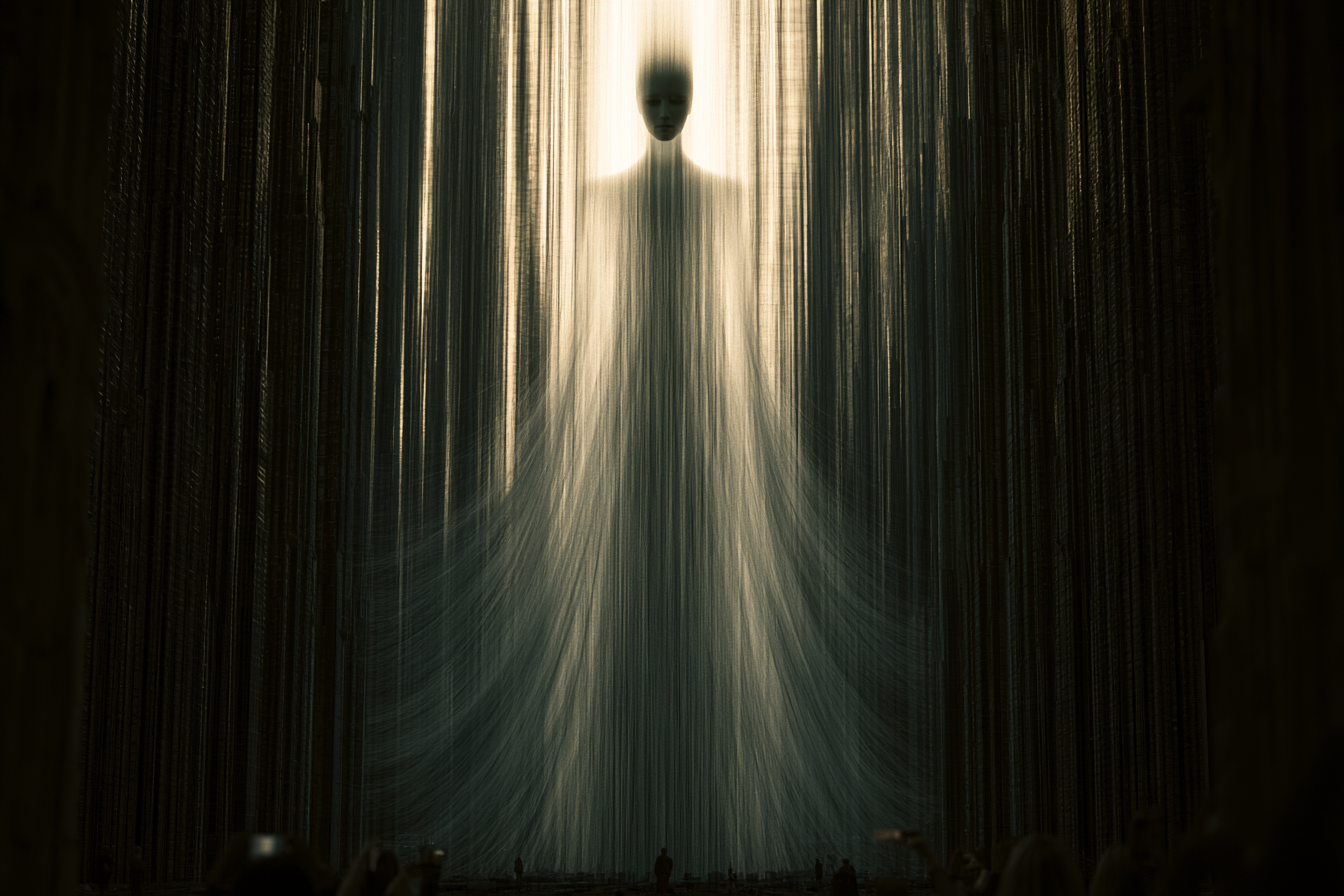
A luminous figure is suspended above a city at dusk. It has no visible wings, no obvious vehicle, and no clear means of remaining aloft. Thousands of people see it. Phones record it from different angles. Traffic cameras confirm that something occupied the sky. Radar registers an anomaly, though no one agrees on what the return means. Then the figure speaks or appears to speak and delivers a message no government can immediately explain.
Within minutes, every institution would reach for its own vocabulary.
News alerts would call it an unidentified aerial phenomenon. Defense officials might describe an airborne object or an unknown actor. Scientists would ask about propulsion, projection, atmospheric effects, and hoaxing. Intelligence agencies would consider deception. Religious communities would debate apparition, revelation, and discernment. Social media would decide, with equal confidence, that humanity had witnessed an alien, an angel, a hologram, a psyop, a demon, an artificial intelligence, or the opening move in a marketing campaign.
The event would be shared.
Its reality would not.
That is the question beneath the familiar comparison between angels and aliens: if something genuinely unfamiliar appeared today, would modern humanity recognize it more clearly than earlier cultures did—or would we simply translate it into the categories our age finds believable?
The Categories Waiting Before the Event
We often imagine observation as a clean sequence. First, something happens. Then we see it. Finally, we decide what it was.
In practice, those stages bleed into one another.
The human mind does not receive the world as a finished report. It works with incomplete sensory input, prior expectations, context, language, and memory. Predictive-processing theories in cognitive science describe perception as an active attempt to match incoming signals with models of what is likely to be present. That does not mean we hallucinate everything we see. It means perception is an achievement, not a passive recording.
Memory adds another layer. Decades of experimental research have shown that recollection can be altered by wording and information received after an event. A witness may be sincere and still remember an interpretation as if it were part of the original observation.
Culture supplies the available interpretations.
A medieval witness might understand an overwhelming light through the sacred cosmology of the time. A nineteenth-century witness might reach for airships, spirits, or celestial signs. A Cold War observer might see secret aircraft. A contemporary observer, raised on spaceflight, simulation theory, drones, and extraterrestrial speculation, may reach for non-human intelligence.
None of this proves that every unusual encounter is imaginary. It establishes something more modest and more important: a report can contain a real observation and a culturally shaped explanation at the same time.
The label may tell us something about the event.
It also tells us something about the world of the witness.
What an Angel Originally Meant
Modern popular culture often treats “angel” as if it were the name of a species: a luminous human with white wings, perhaps equipped with a halo and a calm voice. But the scriptural and historical picture is far less uniform.
The Hebrew word mal’akh and the Greek angelos both carry the basic sense of a messenger. In that older frame, “angel” identifies a role or relationship before it identifies an anatomy. A messenger is known by whom it represents, what it communicates, and what authority it is believed to carry.
The biblical texts themselves do not offer one standard angelic body. In Genesis 18, Abraham encounters three figures described as men; in the next chapter, two are called messengers. Isaiah’s vision includes seraphim with six wings. Ezekiel describes living creatures and extraordinary wheels within a prophetic vision—but the internet’s familiar “biblically accurate angel” often combines imagery from distinct beings and passages into a single modern composite.
The winged human form became a powerful artistic convention, not a universal field guide supplied by scripture.
This matters because the word angel does not simply mean “strange humanoid from the sky.” It carries claims about function, meaning, and sacred order. Calling an unfamiliar being an angel is not merely describing how it looks. It is interpreting why it is here.
“Alien” works differently.
In its contemporary extraterrestrial sense, the word proposes an origin: a being or intelligence from somewhere beyond Earth. It says little by itself about moral character, purpose, or authority. An alien could be wise, deceptive, indifferent, biological, synthetic, peaceful, predatory, or incomprehensible. Its place of origin would not tell us whether its message was true.
So angel and alien are not perfect rivals. They answer different questions.
One asks: Where might this intelligence come from?
The other asks: What role does it serve, and in whose name does it speak?

Appearance Is Not Identity
Imagine that an intelligence arrives from another star and deliberately presents itself as a radiant, winged figure because it has studied human religious symbolism. Is it an alien? By origin, perhaps. Is it an angel? That would depend on a theological judgment that appearance alone cannot settle.
Now reverse the possibility. Imagine that a genuine spiritual messenger manifests through effects our instruments can detect. Radar records a return. Cameras capture structured light. Witnesses hear the same words. Would physical evidence make the event less spiritual—or would it simply mean that whatever occurred was capable of interacting with matter?
Neither scenario can be resolved by costume.
Advanced technology is not proof of divinity. A being able to manipulate perception, disable weapons, predict events, or appear inside dreams might seem godlike without being good, truthful, or metaphysically ultimate. Human history is full of people mistaking power for authority. A civilization thousands of years ahead of ours could exploit that weakness with ease.
Religious traditions have their own versions of this caution. The need for discernment exists precisely because an impressive appearance does not guarantee a trustworthy source. The marvelous can deceive. The emotionally overwhelming can mislead. A message still has to be examined.
The same caution runs in the other direction. Calling an event a hallucination, drone, plasma effect, or cultural myth does not make it one. Skeptical language can harden into an identity claim just as quickly as religious language can.
The disciplined position is not to refuse interpretation forever. It is to stop treating the first available interpretation as the observation itself.
The Mind Between Event and Meaning
Suppose four people witness the same light descend into a field.
One is a pilot trained to estimate movement and range. One is a physicist looking for an energy source. One is a priest attentive to symbolism and message. One is a filmmaker who has spent a lifetime studying visual effects. Their expertise may help them notice different features. It may also create different blind spots.
The pilot may provide the best account of motion while assuming the object is a craft. The physicist may identify an optical effect while overlooking the social context. The priest may hear moral meaning while moving too quickly toward sacred identity. The filmmaker may spot signs of manipulation but assume manipulation where none occurred.
No observer is useless. None is complete.
This is why extraordinary events produce both testimony and fragmentation. People do not merely argue about what happened. They often argue at different explanatory levels without realizing it.
One person is talking about the sensory event: a light changed direction.
Another is talking about mechanism: the light may have been projected.
Another is talking about agency: an intelligence controlled it.
Another is talking about ontology: the intelligence was extraterrestrial or spiritual.
Another is talking about meaning: the event was a warning, deception, revelation, or invitation.
Those claims are connected, but they are not interchangeable. A camera may establish that a luminous form was present without establishing its motive. A message may contain information unknown to the witnesses without proving the speaker divine. A radar return may support physical presence without deciding whether the cause was a vehicle, an atmospheric process, or something outside current categories.
The strongest inquiry keeps the layers visible.
Five Readings of the Same Encounter
Consider the city-sky event again. There are at least five broad ways to interpret it.
The first is psychological and cultural. No external being appeared; an ambiguous stimulus, altered state, rumor cascade, or manufactured image became a shared narrative. This model gains strength if recordings fail independent verification, reports evolve through suggestion, or the event cannot be separated from expectation and media amplification.
The second is physical but conventional. A classified platform, drone formation, projection system, unusual weather event, or astronomical object produced an extraordinary appearance. This is often the least dramatic explanation, but it should not be dismissed merely because witnesses experienced awe.
The third is extraterrestrial or otherwise non-human. A real intelligence, perhaps technological and non-terrestrial in origin, interacted with the environment and with observers. This model would require evidence beyond unresolved imagery: independently verified materials, repeatable measurements, unambiguous communication, or other observations that discriminate it from terrestrial causes.
The fourth is theological. The event is not simply an unknown intelligence but a genuine messenger or agency within a sacred order. Such a claim involves meaning, revelation, and metaphysical commitments that physical instruments alone may not be able to adjudicate.
The fifth is layered. A real external intelligence may use cultural imagery as an interface. A spiritual event may produce physical effects. A technological encounter may trigger archetypal experience. This possibility is intellectually attractive because it preserves complexity—but it carries a danger. If every result can be absorbed into a layered explanation, the model can become impossible to test.
These readings should not be flattened into “all myths are aliens” or “all encounters are psychological.” Similarity is not identity. Angels, fairies, spirits, ancestors, and extraterrestrials belong to different historical traditions and carry different meanings. Comparing their patterns can be illuminating. Collapsing them into one secret species usually tells us more about the modern hunger for a master explanation than it does about the past.
The Modern Myth of Neutral Language
Modern people often assume that earlier societies had myths while we have categories.
But our language is not neutral.
“Craft” assumes something like a vehicle. “Pilot” assumes an operator. “Biological entity” assumes a body. “Higher dimension” borrows from mathematics but often functions as a spiritual elsewhere. “Download” turns sudden knowledge into a computing metaphor. “Simulation” makes cosmology sound like software. “Interface” imagines reality as a screen designed for a user.
These terms may be useful. They may even be accurate. But they also reveal the symbolic environment of technological civilization.
A culture organized around temples might interpret the unknown through messengers, heavens, and sacred signs. A culture organized around networks interprets it through information, code, signal, and systems. We have not escaped mythic thinking. We have given it technical vocabulary.
That does not make technology unreal, any more than the presence of theology made every historical observation unreal. It means that human beings still convert mystery into the metaphors that organize their world.
The result is a subtle form of confidence. We hear “extraterrestrial intelligence” and feel that the event has moved from superstition into science. Yet unless there is evidence for an extraterrestrial origin, the phrase remains an interpretation. Official terms such as unidentified anomalous phenomenon are deliberately narrower: they mark something not yet attributed, not something already established as alien.
Unidentified is a statement about the limits of knowledge.
Alien is a hypothesis about what lies beyond them.
The Question Behind the Name
Here is the frame shift.
The deepest question is not whether ancient angels were really aliens, or whether modern aliens are angels in disguise.
It is whether “angel” and “alien” describe different dimensions of a possible encounter.
An alien is usually classified by origin.
An angel is traditionally classified by relation and function.
One term belongs mainly to cosmology. The other belongs mainly to theology. They could conflict. They could overlap. They could both be wrong. But they do not automatically cancel one another, because they are not always answering the same question.
A human astronaut landing on another inhabited world would be an alien to its residents. If that astronaut carried a message from Earth, the astronaut would also be a messenger. The second description would not erase the first. It would add another layer.
Likewise, proving that a visitor came from another star would establish a location, not a moral status. It would not tell us whether to trust it, obey it, fear it, worship it, learn from it, or ask it to leave. Those judgments would remain.
And if a religious community identified a presence as angelic, that judgment would not make questions about physical mechanism irrelevant. If the event left traces, affected instruments, or endangered witnesses, empirical investigation would still matter.
The frame shift does not solve the mystery.
It shows why the old argument may have been poorly formed.

Description Before Ontology
What would a mature response to such an event look like?
It would begin with description before ontology.
Record what was observed before deciding what kind of reality produced it. Preserve original files and metadata. Separate direct witnesses from people who encountered the event through edited media. Collect independent angles. Compare radar, optical, infrared, acoustic, environmental, and biological data where available. Document the chain of custody. Ask witnesses for accounts before exposing them to one another’s language. Mark what is known, inferred, remembered, and believed.
Then build explanations that could, at least in principle, lose.
What evidence would distinguish an object from a projection? What result would count against a technological explanation? What would make extraterrestrial origin more likely than unknown terrestrial capability? Which parts of a theological interpretation rest on the content of a message, and which rest only on spectacle?
This method cannot answer every question. Science can test physical claims, compare hypotheses, and expose deception. It cannot, by measurement alone, determine that a message carries divine authority. Theology can interpret meaning, moral character, and relation to the sacred. It should not use those interpretations to erase contradictory sensor evidence.
The goal is not to place every institution in the same lane. It is to prevent any one lane from pretending it is the whole road.
This is especially important now. Synthetic media can manufacture apparent witnesses. Coordinated accounts can be generated at scale. Governments and platforms can release partial evidence without context. A real anomaly could be buried under fabricated noise; a fabricated event could gain credibility by imitating the visual grammar of disclosure.
The next “apparition” may require theologians, physicists, intelligence analysts, historians, psychologists, artists, and forensic media experts to compare notes without surrendering their differences.
The unknown may not fit inside one department.
If the Messenger Came Tomorrow
If something crossed the sky tomorrow and spoke with a voice the whole world could hear, our first impulse would be to name it.
Naming would feel like control.
Some would kneel. Some would mobilize. Some would monetize. Some would insist that no authentic event could look so theatrical. Others would treat uncertainty itself as proof that authorities were hiding the answer.
But perhaps recognition would demand a harder discipline.
We would have to hold several possibilities open without pretending they were equally supported. We would have to respect testimony without turning sincerity into proof. We would have to examine physical evidence without assuming that matter exhausts meaning. We would have to listen to the message without granting the messenger automatic authority. We would have to remember that a being can be technologically superior and morally immature—and that human beings are exceptionally vulnerable to anything that arrives wearing our oldest symbols.
Earlier cultures did not encounter a world without interpretation.
Neither do we.
The medieval witness may have seen a messenger because heaven structured the imaginable. The modern witness may see an alien because technology structures ours. Both may be translating. Either may be mistaken. And if something truly other stands behind the translation, it may exceed both names.
The most honest first statement may be the least satisfying one:
Something happened.
Here is what we can verify.
Here is what we infer.
Here is what we do not yet know.
Only after that should we ask whether the presence came from another planet, another order of reality, the hidden capacities of the human mind, or some category we have not invented.
If something crossed the boundary of the known tomorrow, would your first label help you see it—or decide what it was before you had looked?
What do you think? Drop your thoughts in the comments ...
More in Deep Think
- What If Reality Doesn’t Translate Cleanly?
If a phenomenon crosses between incompatible forms of reality, what we perceive may be a partial rendering rather than the thing itself. - What If First Contact Tests Our Values, Not Just Our Beliefs?
Contact may challenge religion less by disproving doctrine than by asking whether human ethics can expand beyond the human species. - What If There Is No View From Nowhere?
Objectivity may not require escaping perspective, but learning how different perspectives constrain and correct one another.
Sources / Receipts
- Genesis 18 and Genesis 19, Sefaria — the visitors first described as men and then as messengers.
- Isaiah 6 and Ezekiel 1, Sefaria — distinct visionary beings and imagery often merged in modern popular representations.
- David Albert Jones, Angels: A Very Short Introduction, Oxford University Press, 2010 — the theological, scriptural, and visual history of angels.
- Céline Carayon, “Cherubim: Representing Transcendence”, Signs and Society — the development of angelic and cherubic representation across traditions.
- Andy Clark, “Whatever next? Predictive brains, situated agents, and the future of cognitive science”, Behavioral and Brain Sciences 36, no. 3 (2013), doi:10.1017/S0140525X12000477 — predictive processing and the role of top-down expectations in perception.
- Elizabeth F. Loftus and John C. Palmer, “Reconstruction of Automobile Destruction: An Example of the Interaction Between Language and Memory”, Journal of Verbal Learning and Verbal Behavior 13, no. 5 (1974) — experimental evidence that post-event wording can influence memory reports.
- Jeffrey J. Kripal, review of American Cosmic and Intimate Alien, Journal of the American Academy of Religion 89, no. 1 (2021), doi:10.1093/jaarel/lfab022 — two scholarly approaches to UFO experience as religion, myth, technology, and psychology.
- All-domain Anomaly Resolution Office, U.S. Department of Defense — current official terminology for anomalous detections not yet attributed to known actors or causes.
- Original article: “If Angels Appeared Today, Would We Call Them Aliens?”, The Galactic Mind — source article revised and expanded here.


Discussion