
Overview
Great Zimbabwe is the monumental stone city in southeastern Zimbabwe that flourished roughly between the 11th and 15th centuries and became the political center of a powerful inland state tied to regional and Indian Ocean trade. UNESCO describes it as a vast site divided into the Hill Ruins, the Great Enclosure, and the Valley Ruins, while the Met identifies it as the capital of the Zimbabwe state and one of the largest and most important ancient urban centers in sub-Saharan Africa.
What makes Great Zimbabwe matter is not only its scale. It matters because it forces a correction in how power, sophistication, and urban life in precolonial Africa are imagined. Its dry-stone walls, long-distance trade connections, ritual imagery, and royal architecture are all real. Just as real is the history of colonial refusal to credit African builders for what stood in plain sight.
Origins and Background
Great Zimbabwe was built by ancestors of the Shona and expanded over several centuries in a local dry-stone tradition that used granite blocks without mortar. The site’s major monumental phases span roughly the 11th through 15th centuries, though some scholarship extends occupation later. UNESCO dates the monument broadly to about 1100 to 1450, while the Met and Smarthistory describe a longer arc of occupation and expansion centered on Shona-speaking communities.
Its location mattered. Great Zimbabwe sat between cattle country, gold-producing zones, and the routes linking the interior to the Swahili coast. Archaeological materials such as glass beads, porcelain, and other imported goods show that this was not an isolated stone complex but a node in wider exchange networks stretching into the Indian Ocean world.
The site later became the center of a bitter colonial struggle over historical authorship. European settlers and early investigators often refused to believe that Africans could have built it, preferring theories that credited outsiders. Modern archaeology overturned that prejudice, but the controversy itself became part of Great Zimbabwe’s historical afterlife.
What It’s Known For
Great Zimbabwe is best known for several things:
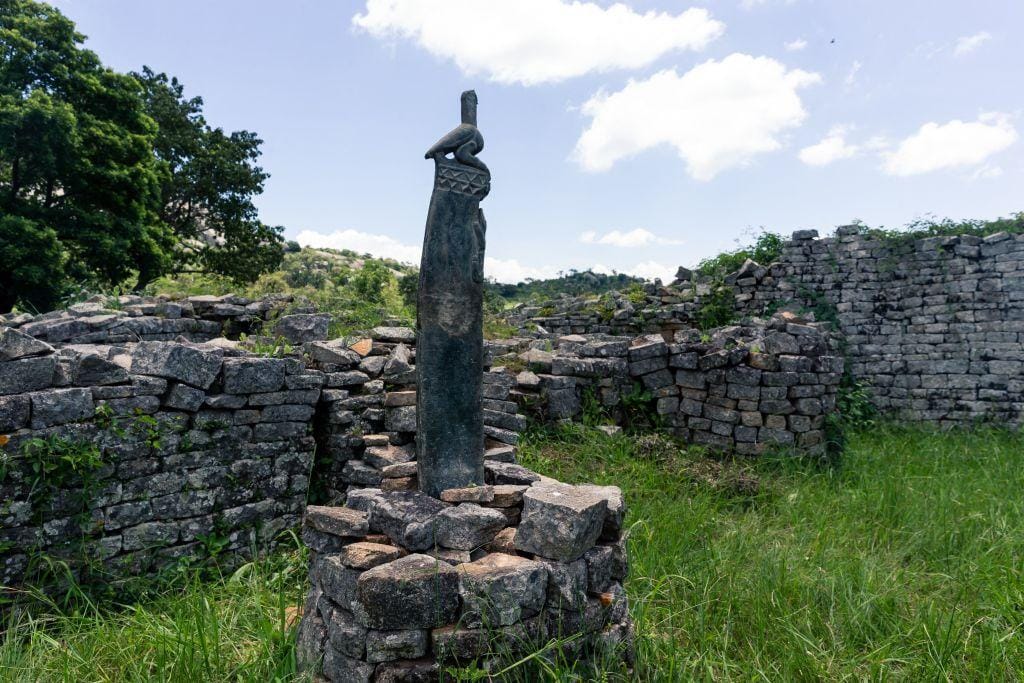
- Massive dry-stone masonry built without mortar, especially the Great Enclosure and its curving walls.
- The Hill Complex, Great Enclosure, and Valley Complex, which together reveal a large and socially differentiated urban center.
- The conical tower, one of the site’s most iconic and debated structures. Smarthistory notes that it is often interpreted as a granary or symbol of stored wealth and royal provision.
- Soapstone birds found at the site, now among the most important symbols in Zimbabwean national identity.
- Evidence of trade in gold, ivory, cattle, and imported goods that tied the city into regional and overseas exchange.
What makes the site distinct is that its architecture is monumental without depending on the visual language many people associate with “ancient civilization.” There are no pyramids, no marble columns, no imperial inscriptions in the familiar Mediterranean style. There is stone, curve, enclosure, elevation, and movement. The power is there, but it speaks in a different architectural vocabulary. This is an inference from the site’s layout and surviving structures.
The Core Idea
The deeper signal behind Great Zimbabwe is that power can be built in stone without borrowing legitimacy from the civilizations people are more used to being taught about.
That is why the site matters so much. Great Zimbabwe is not only evidence of a prosperous African polity. It is evidence of a political and symbolic order that expressed authority through enclosure, controlled movement, elevated ritual space, cattle wealth, and trade connectivity. The monument does not just show that a city existed. It shows that a worldview existed with its own logic of status, sacredness, and statecraft.
It also exposes how fragile historical recognition can be. The city stood there the whole time. The stones did not need to be discovered to exist. What had to be fought over was interpretation. Great Zimbabwe therefore represents more than architecture. It represents the politics of who gets credited with complexity.
Perspectives and Interpretations
Supportive readings of Great Zimbabwe in modern scholarship treat it as one of the clearest demonstrations of indigenous African state formation, architectural achievement, and commercial reach. UNESCO, the Met, and other major references all place the site within Shona history and read its layout and material culture as evidence of organized political, economic, and ritual life.
Some interpretations focus especially on trade and wealth. In this view, Great Zimbabwe’s power came from its position between inland resources and coastal exchange. Imported goods do not just show contact. They show a city that was plugged into larger currents of commerce and prestige.
Other interpretations emphasize symbolism and social order. The conical tower, the separation of architectural zones, the elevated Hill Complex, and the soapstone birds all suggest that Great Zimbabwe was not merely a dense settlement. It was a center where authority, ritual, and public meaning were staged spatially. Some specific interpretations, especially of the conical tower, remain debated, but the broader point about symbolic architecture is widely accepted.
A more critical interpretive layer concerns the history of research itself. Great Zimbabwe has long been read not just as an archaeological site but as a case study in how racism distorts historical interpretation. The site became famous partly because so many colonial-era observers were unwilling to let Africans be its authors. That refusal is now inseparable from the monument’s modern meaning.
Strengths and Limitations
The strongest thing about Great Zimbabwe as a historical subject is that the core case is extremely solid. The architecture survives. The trade materials survive. The site’s scale is clear. The Shona connection is the mainstream scholarly position, and the older outsider-builder theories have been discredited.
Another strength is that the site carries meaning at multiple levels at once. It is an archaeological monument, a commercial center, a political capital, a sacred landscape, and a modern national symbol. The soapstone birds especially show how artifacts from the site moved from ancient ritual context into modern nationhood.
The limitations are more interpretive than foundational. Scholars still debate certain functions and emphases, including the exact role of structures like the conical tower and the finer details of social organization and chronology. Great Zimbabwe is not historically blank, but neither is it fully transparent.
There is also the damage done by earlier excavation, looting, and ideologically driven interpretation. Colonial-era disturbance and bad-faith theorizing did not erase the site, but they did complicate how evidence was preserved and presented. That means some questions are harder to answer cleanly now than they might have been otherwise.
Broader Implications
Great Zimbabwe matters because it is one of those places where stone becomes an argument.
It argues against the old colonial habit of treating African history as peripheral, derivative, or dependent on outside civilizers. It argues for indigenous complexity, long-distance economic intelligence, and a political imagination able to organize labor, symbol, and landscape at monumental scale.
It also matters because it shows how material evidence and historical prejudice can collide. The monument itself was never subtle. What was subtle, or rather stubborn, was the ideological refusal to accept what it implied. That makes Great Zimbabwe not just a story about the past, but a story about how the past gets policed.
For The Galactic Mind, the broader resonance is clear: Great Zimbabwe is a reminder that reality is not only hidden by secrecy. Sometimes it is hidden by narrative habit. Sometimes the thing in front of everyone is hardest to see because the inherited story does not know how to accommodate it.
The Galactic Mind Perspective
Great Zimbabwe is important not because it is mysterious in the cheap sense, but because it is clarifying.
It clarifies that grandeur, trade intelligence, spiritual symbolism, and statecraft were fully present in medieval southern Africa. It clarifies that architecture can survive even when authorship is politically contested. And it clarifies that one of the hardest things for a culture to revise is not the evidence itself, but the hierarchy of who it expects sophistication to belong to.
The strongest way to read Great Zimbabwe is not as an exotic anomaly, but as a corrective. It is a site that forces the map of civilization to widen.
Open Thread
If Great Zimbabwe had stood in Europe with the same walls, birds, trade goods, and political symbolism, would its historical importance have ever been questioned in the same way?
Sources / Receipts
- UNESCO World Heritage Centre, Great Zimbabwe National Monument.
- The Metropolitan Museum of Art, Great Zimbabwe.
- The Metropolitan Museum of Art, Great Zimbabwe (11th–15th Century).
- Encyclopaedia Britannica, Great Zimbabwe.
- Scientific American, Webber Ndoro, Great Zimbabwe.
- Smarthistory, Great Zimbabwe.
- Cambridge Archaeology project page, Archaeological science and globalisation: Great Zimbabwe.
What do you think? Drop your thoughts in the comments


Discussion