
Overview: Who This Is
Look at the lower right of Salvador Dalí’s 1947 preparatory drawing for Leda Atomica. Beside the figures is a handwritten calculation. Across the paper, a circle and the intersecting lines of a five-pointed construction enclose Gala, appearing as Leda, and the swan. The curves of bodies and the straight lines of geometry occupy the same working surface.
The Dalí Foundation identifies the sheet as ink and pencil on paper. Its records also identify the person who helped Dalí think through this geometry: Matila Ghyka, a Romanian diplomat and writer who had spent decades exploring relationships between number, living form, and art.
Their connection survives in more than a resemblance between a painting and a diagram. The Foundation’s Dalí atómico catalogue reproduces a letter from Ghyka dated August 13, 1947, and reports six letters from him among Dalí’s papers. The books Dalí retained contain annotations and drawings. Together, these materials document an exchange of ideas and an artist putting them to work.
Ghyka’s larger ambition was harder to establish. He believed the golden proportion could help connect the structures of nature, the achievements of artists, and an ancient tradition transmitted through generations of makers. His story turns on the distance between a relationship that can be demonstrated on paper and a history that must be reconstructed from surviving evidence.
Origins and Background
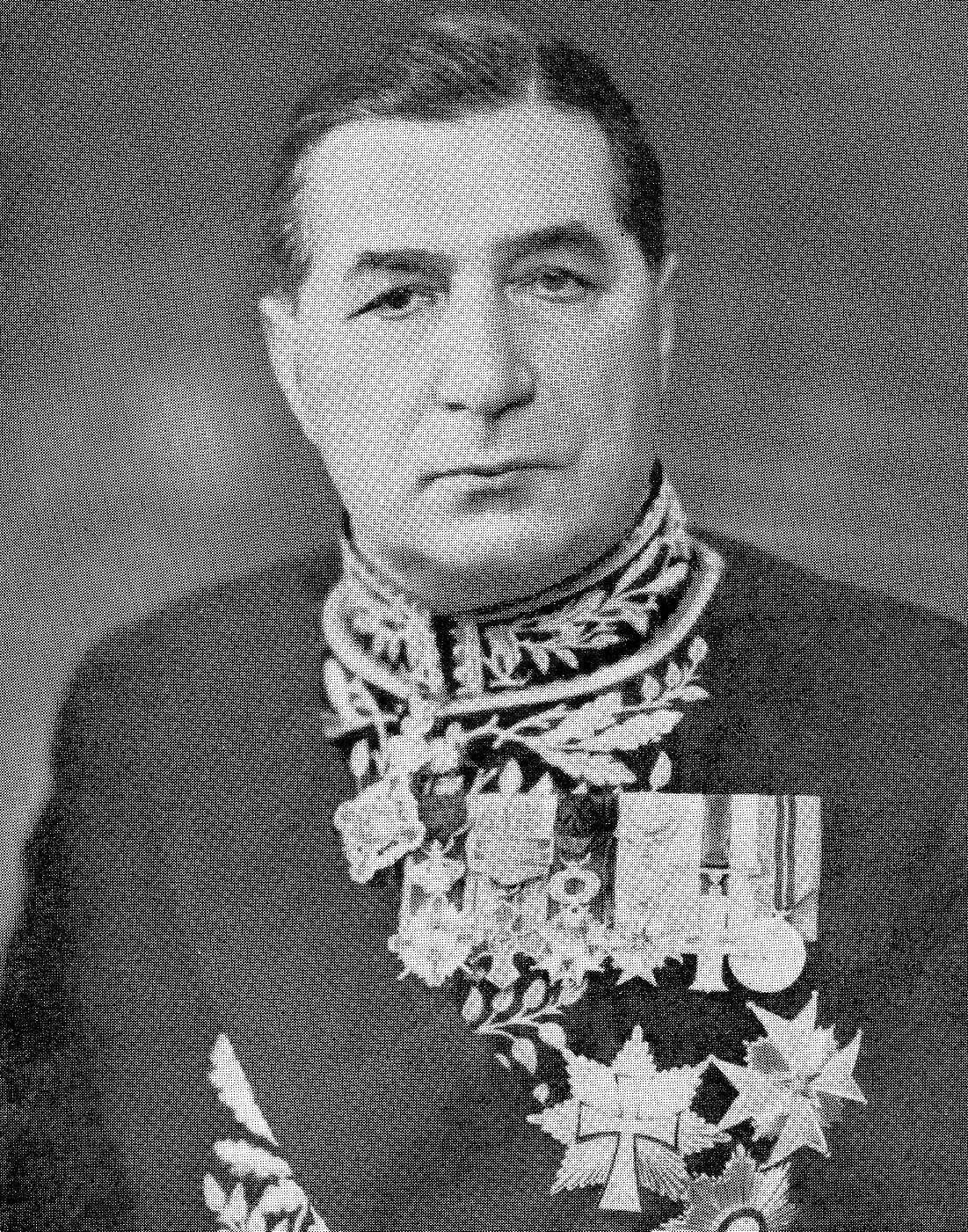
Matila Costiescu Ghyka lived from 1881 to 1965. His publisher’s biography identifies a remarkably varied career: naval officer, engineer, diplomat, novelist, and writer on aesthetics. Those activities help explain the range of his interests. He approached beauty with technical questions about construction and proportion, while treating poetry, architecture, and living organisms as parts of the same inquiry.
He also entered a debate already under way. Interwar Paris offered competing accounts of how modern art and architecture should find order. In Jean-Louis Cohen’s history of the French debate on proportion, Ghyka appears as a reader of L’Esprit nouveau, corresponding with the journal in 1925. Le Corbusier’s regulating lines, Jay Hambidge’s geometric analyses, and Ernst Mössel’s architectural reconstructions gave him contemporary material to examine alongside ancient texts.
The attraction was practical as well as philosophical. A designer facing a blank page could use a proportional system to relate one part to another. A historian might hope that the same system would explain why earlier works held together. Ghyka’s project brought those two ambitions close enough that they could illuminate—and sometimes be mistaken for—each other.
His 1927 Esthétique des proportions dans la nature et dans les arts established the subject of his inquiry. The two-volume Le Nombre d’or followed in 1931, expanding the investigation into a history of proportion and its supposed custodians. It asked how a mathematical relationship might become an artistic practice, and how that practice might survive.
What He Is Known For
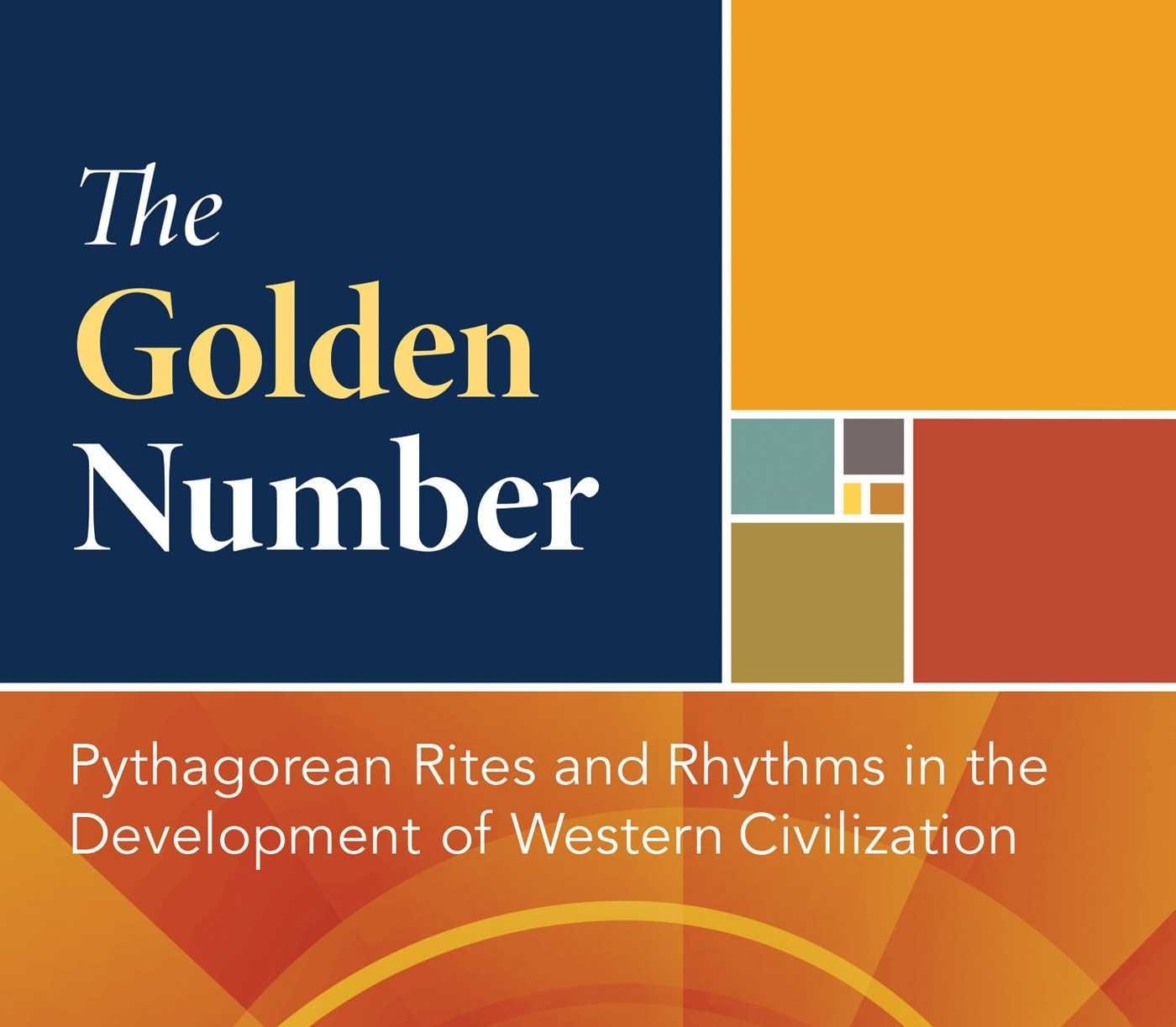
Le Nombre d’or consists of Les Rythmes—“Rhythms”—and Les Rites—“Rites.” Its English translation, The Golden Number, appeared in 2016, translated by Jon Graham. The subtitle retains the ambition of the original: Pythagorean Rites and Rhythms in the Development of Western Civilization.
This is a different book from The Geometry of Art and Life, published by Sheed and Ward in 1946. The later work presents related concerns in English, but it is not the English translation of the 1931 volumes. The distinction matters here because the Foundation specifically documents Dalí’s possession of the 1946 book.
Rhythms: relationships that recur
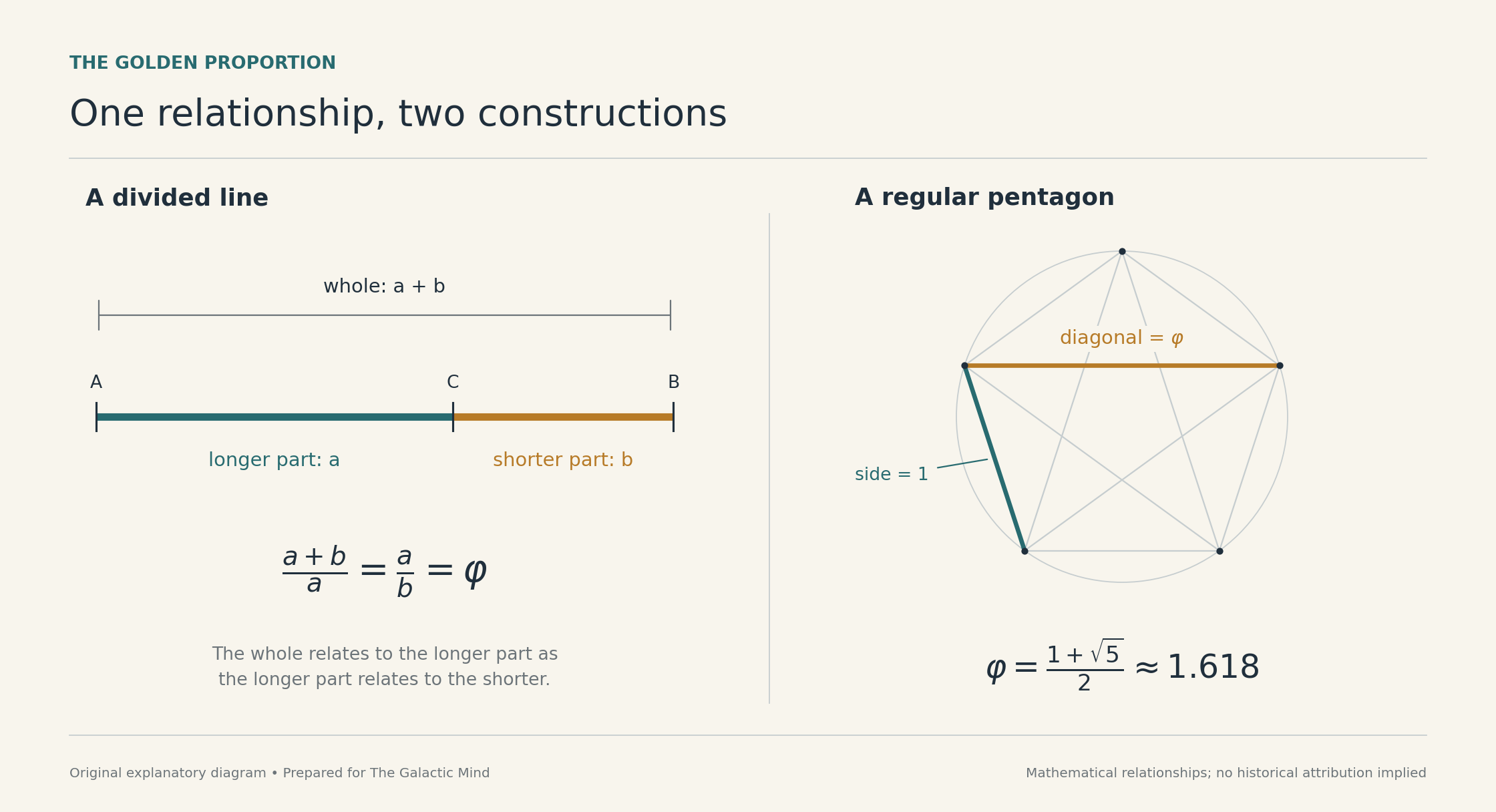
The golden proportion describes a particular way to divide a line. The whole line stands in the same ratio to its longer part as the longer part does to its shorter part. That ratio, usually written as the Greek letter phi, is approximately 1.618. It was already defined in Euclid’s Elements, Book VI, under the name “extreme and mean ratio.” Ancient mathematical knowledge is a secure starting point; its use in a particular artwork is a further question.
It has exact geometric properties. In a regular pentagon, a diagonal is phi times the length of a side. Draw all five diagonals and a smaller pentagon appears inside the star they form. The construction produces related shapes at different sizes, giving an artist a way to organize a composition through recurring relationships.
Ghyka’s “rhythms” extend beyond beats in music. He considers arrangements through time, including poetry, and arrangements through space, including architecture. In the first volume’s discussion of the divine proportion, he connects the Fibonacci sequence with phyllotaxis: the arrangement of leaves, branches, and seeds. This supplies a concrete bridge from numbers to growing things.
The sequence begins 1, 1, 2, 3, 5, 8, 13, with each new number formed by adding the previous two. Divide successive terms—13 by 8, then 21 by 13—and the results approach phi. The arithmetic relationship is exact in the limit. Whether a particular plant displays the corresponding arrangement is a question for observation.
That distinction is essential to following Ghyka. A mathematically recurring proportion gives him a model of orderly growth. Its appearance in a living form then suggests a possible affinity between the ways nature grows and artists compose. The suggestion is interesting precisely because the second step requires evidence beyond the first.
Rites: the workshop as an archive
The second volume asks how knowledge might travel through people. “Rites” encompasses initiations, symbols, and practices through which Ghyka believed communities preserved a teaching. The strongest practical version of this idea is easy to understand: a craft can survive through demonstration and apprenticeship even when its practitioners leave few explanatory books.
In “The Lamp under the Bushel,” reproduced in the English publisher’s excerpt, Ghyka examines geometric marks cut into masonry. Drawing on Franz Rziha’s nineteenth-century research, he describes marks fitted to underlying grids and associated with craftsmen and lodges. A mark becomes, in this interpretation, both a signature and evidence of an education in geometry.
Ghyka reads Vitruvius, considers Roman collegia—associations of craftsmen—and examines tools represented on funerary monuments. His argument accumulates connections: makers used geometry; communities trained makers; familiar instruments and figures recur across periods. He proposes that these practices carried something of an older Pythagorean understanding of order into later architecture.
The difficulty lies in the final connection. A compass on a monument establishes an association with a craft more readily than it establishes the philosophical ancestry of that craft. Each additional century requires evidence of who taught whom, what was transmitted, and whether its meaning remained the same.
The Core Idea or Signal
Ghyka’s central idea gives beauty a relationship to the way things are organized. An artwork can possess unity because its parts belong to a coherent proportional system. If living forms exhibit related systems, an artist might work with an order that extends beyond individual preference.
The historical claim gives this idea a human route. Ancient thinkers recognize order; generations of makers preserve useful constructions; later artists recover or renew them. In Ghyka’s account, the workshop becomes a place where thought can endure through the repeated act of making.
These are connected propositions, but they are not interchangeable. Mathematical necessity concerns what follows from a definition. A biological claim concerns organisms that can be measured. A historical claim concerns people, documents, objects, and transmission. An aesthetic claim concerns how a work is experienced and judged. Evidence can carry an argument across one boundary without carrying it across them all.
Dalí offers a particularly valuable case because an identifiable reader encounters Ghyka’s work and uses it. The modern correspondence supplies the kind of connection that Ghyka’s much longer historical narrative often has to infer.
Perspectives and Interpretations
Paul Valéry’s response is especially revealing because it appears at the beginning of Le Nombre d’or. His letter welcomes Ghyka’s undertaking while identifying a problem with turning phi into a general prescription. As Cohen explains through the letter, Valéry insists on materials, scale, and the circumstances of execution.
A geometric relationship remains the same when enlarged. A work made from particular materials may behave very differently. Valéry therefore treats proportion as an instrument requiring an artist’s intelligence and skill. The maker must negotiate between an intended form and what the actual work permits. Admiration for the number cannot settle that negotiation.
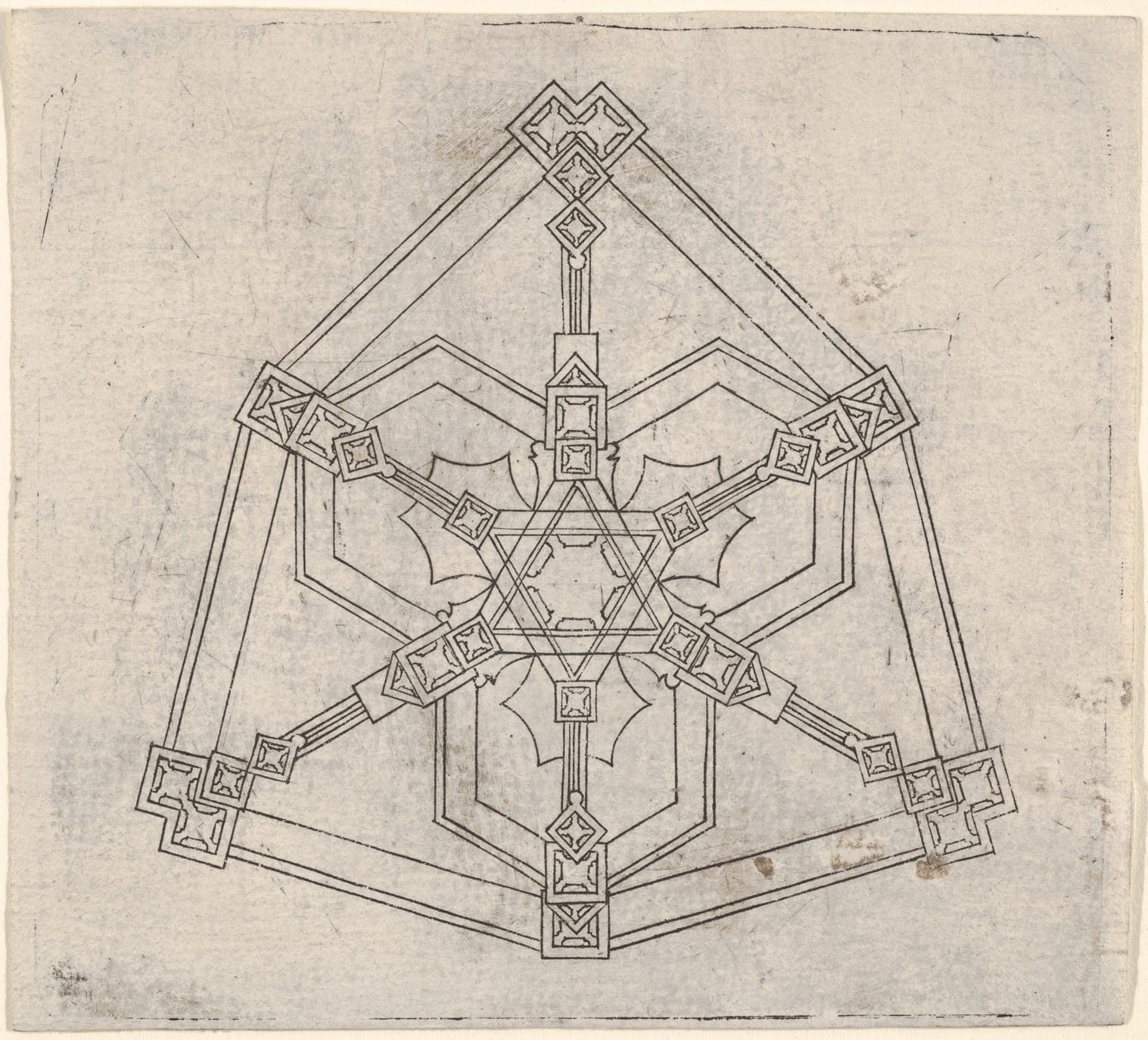
Historical evidence gives a similarly qualified answer. The Metropolitan Museum’s account of Gothic design practice describes professional knowledge guarded within workshops and later circulated in print. Matthes Roriczer’s 1486 booklet on constructing pinnacles is a surviving example of a mason explaining geometric design. The practical tradition is real; its existence does not, by itself, establish an unbroken Pythagorean lineage.
The marks themselves also admit several explanations. A 2023 archaeological study by David M. Freire-Lista and colleagues distinguishes marks for placement, assembly, identity, and the accounting of work. Their distribution can illuminate how a building was constructed. A historical investigation must establish such functions before asking the marks to carry an esoteric meaning.
The most telling reservation comes from Ghyka’s own text. In the original Rites, he acknowledges that the pentagonal grid he considers important does not appear in the masons’ marks he discusses. He proposes that it may have been a higher secret reserved for masters. This is a conjecture explaining an absence; it does not provide independent evidence of the proposed secret.
Strengths and Limitations
Ghyka’s most defensible contribution is to make proportional thinking available as a deliberate practice. A geometric construction can generate choices, coordinate parts, and give an artist something precise to vary. Its usefulness does not depend on proving that every admired work follows the same rule.
There is also genuine biological material behind his interest in numerical pattern. A 2016 study by Jonathan Swinton, Erinma Ochu, and the MSI Turing’s Sunflower Consortium collected data on 657 sunflowers. It found substantial Fibonacci structure alongside non-Fibonacci arrangements and heads for which a definitive spiral count could not be assigned. Living variation belongs inside the explanation.
The broader aesthetic argument needs a different test. Showing that a ratio occurs cannot establish that it causes beauty, that viewers prefer it under all conditions, or that other proportions are inferior. Those questions require comparisons that do more than select attractive examples after their proportions have been measured.
Historical reconstructions face a related problem. A complex façade offers many possible points from which to draw a rectangle or diagonal. The freedom to choose boundaries, dimensions, and tolerances can make a proposed fit easier to obtain. Stronger evidence would include contemporary plans, instructions, repeated construction procedures, or measurements chosen before testing the hypothesis.
An oral tradition may leave gaps. Nevertheless, a gap cannot establish the content of the missing teaching. Ghyka’s account would become stronger through securely dated links between particular people and practices, especially evidence identifying the relevant proportion and its intended meaning. Shared geometry makes transmission possible; it does not establish every proposed journey.
Broader Implications
Ghyka’s influence raises an unusual historical possibility: a reconstruction of the past can become a documented cause in the present. An artist may adopt a proportional system because a writer presents it as ancient. The adoption is a historical event even if the writer’s account of its ancient use remains uncertain.
The Dalí connection shows how that distinction works. In his 2006 study of Dalí and Leonardo, art historian David Lomas discusses Ghyka’s August 13 letter, in which he welcomes having a part in Leda Atomica and awaits a tracing. Lomas also identifies Ghyka’s books in Dalí’s library. The Foundation’s later catalogue strengthens that account with archival documentation and a firm catalogue date for the letter.
The exchange makes Ghyka more than a commentator standing outside artistic practice. His books and advice became resources within it. The surviving record does not assign every line of the drawing to a particular suggestion, but it establishes an encounter in which geometric thinking mattered.
It also changes the value of a working paper. A finished painting allows many interpretations of its organization. A preparatory sheet, supported by correspondence and annotated books, narrows the range of plausible explanations for how it was made. The archive brings the artist’s decisions closer without making them completely transparent.
The Reality Signal
What This Subject Represents
Ghyka represents an effort to move between mathematics, natural forms, and artistic practice without treating them as sealed compartments. His clearest achievement lies in making relationships visible and usable, including within an artist’s documented working process.
What Reality Frame It Challenges
His work complicates the assumption that beauty belongs entirely to spontaneous feeling: artists can consciously organize what they make through proportion. The evidence also limits the opposite assumption that a universal number can explain an artwork’s success.
Why It Matters Now
Geometric explanations remain persuasive because a diagram can make an interpretation look necessary. Ghyka’s case teaches a useful distinction between a pattern that can be drawn over an object and a procedure its maker can be shown to have used.
What Remains Unresolved
The extent of particular ancient and medieval uses must be established case by case. The larger question of how much proportional organization contributes to aesthetic experience remains separate from the historical question of who intended it.
The Galactic Mind Perspective
The Galactic Mind gives greatest weight to Ghyka as a participant in the making of modern art and as a guide to asking more precise questions about form. His attempt to reconstruct a continuous ancient teaching deserves examination, but the surviving examples do not establish the full route he proposed. His influence can be documented more securely than that genealogy.
Return to the calculation at the lower right of Dalí’s drawing. It belongs to a working object whose place in an artistic exchange is supported by letters and books. Here, geometry is part of the evidence of intention. It is possible to say substantially more than that a later observer found a pleasing pentagon.
Even this unusually helpful record has limits. It cannot isolate the proportion’s contribution from the subject, the handling of the figures, or Dalí’s judgment as he worked. Valéry’s reservation remains beside the drawing: a number can offer possibilities, while the work still has to be made.
Open Thread
When an artist’s working papers show that a proportion was deliberate, what further evidence would reveal how much it contributed to the work’s beauty?
More in Dossier
- Adrienne Mayor and the Fossil Hunters of the Ancient World — Another investigation of how historians can connect a surviving object to an explanation that may no longer survive.
- The Antikythera Mechanism and the Lost Architecture of Ancient Time — A material record of ancient mathematical knowledge, and a different way to investigate what was transmitted or lost.
- The Voynich Manuscript and the Discipline of Not Knowing — The distinction between finding a suggestive pattern and establishing what its maker intended.
Sources / Receipts
- Fundació Gala-Salvador Dalí, “‘Leda Atomica’ (Preparatory drawing for Atomic Leda)”. Collection record for the 1947 ink-and-pencil drawing. The image was inspected for the opening description.
- Carme Ruiz González, “To Become a Classic,” in Dalí atómico, Fundación Bancaria “la Caixa” and Fundació Gala-Salvador Dalí, 2018, “Matila Ghyka” passage, figure 4 and notes 15–18; catalogue entry 81. Documents the Ghyka correspondence, the August 13, 1947 letter, and annotated books. The Spanish catalogue was consulted through its indexed text; direct PDF availability may vary.
- Carme Ruiz, “Salvador Dalí and Science: Beyond a Mere Curiosity”, Pasaje a la Ciencia, 2010. The Foundation’s account connects Ghyka’s assistance with the preparatory drawings and correspondence for Leda Atomica.
- Matila C. Ghyka, Le Nombre d’or: Rites et rythmes pythagoriciens dans le développement de la civilisation occidentale, Gallimard, 1931. Original French text consulted in a third-party scan with imperfect OCR: volume I, “La Divine Proportion”; volume II, foreword and “La Torche sous le boisseau.” These passages establish what Ghyka argued, not the truth of his historical reconstruction.
- Paul Valéry, “Lettre à l’auteur,” prefacing volume I of Le Nombre d’or, 1931. Consulted in the same French scan above and against Cohen’s discussion. Supports the response concerning material, scale, execution, and artistic judgment; rendered here in paraphrase.
- Matila C. Ghyka, The Golden Number: Pythagorean Rites and Rhythms in the Development of Western Civilization, translated by Jon Graham, Inner Traditions, 2016. Publisher’s edition information and chapter 8 excerpt, “The Lamp under the Bushel,” consulted for the guild-transmission argument. The entire English edition was not inspected.
- Matila C. Ghyka, The Geometry of Art and Life, Sheed and Ward, 1946. Bibliographic record used to distinguish this separate book from the 1931 work and its 2016 translation.
- Jean-Louis Cohen, “Le Corbusier’s Modulor and the Debate on Proportion in France”, Architectural Histories 2(1), article 23, 2014, especially pp. 3–4. Scholarly account of Ghyka’s intellectual setting and Valéry’s response; consulted in a full-text PDF.
- David Lomas, “‘Painting Is Dead—Long Live Painting’: Notes on Dalí and Leonardo”, Papers of Surrealism, issue 4, Spring 2006, “Sacred Geometry,” pp. 11–12. Consulted through a mirrored text. Lomas treats the letter’s year as probable; the 2018 Foundation catalogue dates it to 1947.
- The Metropolitan Museum of Art, Gothic by Design: The Dawn of Architectural Draftsmanship, exhibition texts, and Roriczer’s Booklet on the Proper Construction of Pinnacles, 1486. Institutional documentation of workshop knowledge and a surviving printed explanation of geometric design.
- David M. Freire-Lista, Bruno B. Campos, Patrícia Moreira, Alberto Ramil, and Ana J. López, “Building Granite Characterisation, Construction Phases, Mason’s Marks and Glyptography of Nossa Senhora de Guadalupe Church, Mouçós e Lamares, Galicia-North Portugal Euroregion”, Geoheritage 15, article 24, February 3, 2023. Archaeological study and discussion of different practical functions of masons’ marks.
- Jonathan Swinton, Erinma Ochu, and the MSI Turing’s Sunflower Consortium, “Novel Fibonacci and Non-Fibonacci Structure in the Sunflower: Results of a Citizen Science Experiment”, Royal Society Open Science 3, 160091, 2016, DOI. The institutional abstract supplies the sample size and reported variation. The repository’s 2026 posting date is not the study’s publication date.
- Polirom, Matila Ghyka author biography, undated. Supports life dates, the combination of professional and literary activities, and the chronology of the principal French books.
- Euclid, Elements, Book VI, definition 3, David E. Joyce’s online edition at Clark University. Primary mathematical definition of extreme and mean ratio, with commentary linking it to the construction of regular pentagons.


Discussion