
Case Overview: The Event
The mystery begins with four words.
In Genesis 6:4, the Nephilim are said to have been on the earth “in those days—and also afterward.” The verse places them beside the “sons of God,” the “daughters of humans,” and the warriors of ancient renown. A few lines later, the Flood narrative begins. Humanity outside Noah’s ark is erased from the story.
Then the name returns.
In Numbers 13:33, Israelite scouts surveying Canaan claim to have seen the Nephilim. They connect them to the Anakites and describe themselves as grasshoppers by comparison. Deuteronomy and Joshua add other formidable populations—the Anakim, Emim, Zamzummim, and Rephaim—while later narratives place oversized warriors in Gath.
Read straight through, the sequence appears to create a contradiction. If the Flood destroyed all life outside the ark, why do giant peoples appear after it? Did the Nephilim survive? Did their ancestry enter the ark through an unnamed wife? Was there a second intrusion by the sons of God? Or did later writers reuse the vocabulary of primeval chaos to make Canaan’s enemies feel larger than history?
Those questions are ancient. The modern “Nephilim bloodline” theory is not.
The theory now circulating online usually combines several different archives: the Hebrew Bible, 1 Enoch, the Dead Sea Scrolls, stories of giant skeletons, rare-blood-type lore, ancient-astronaut ideas, and claims that royal or financial elites preserve nonhuman ancestry. These elements did not arrive as one continuous tradition. They were assembled across centuries, often without distinguishing what the sources actually say from what later interpreters need them to say.
The historical case is therefore not whether a secret bloodline can be named. No authenticated genealogy, body, genome, or archaeological population establishes one. The real case is how a brief biblical ambiguity became a Second Temple demonology, a Christian interpretive dispute, and eventually a modern theory of hidden biological power.
The surviving lineage is documented.
But it is a lineage of texts.
What Actually Happened
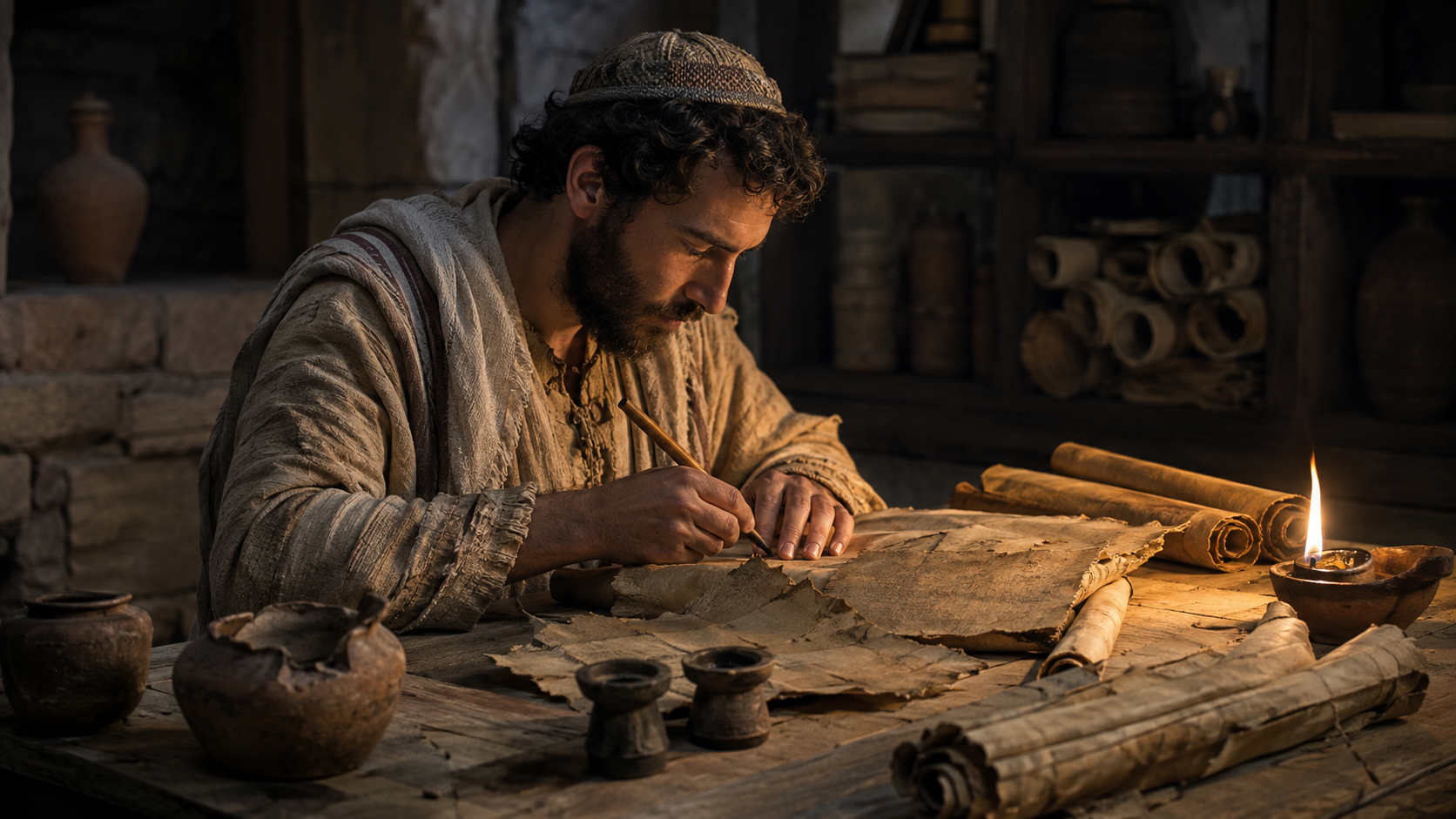
The earliest surviving layer is Genesis 6:1–4, a short and difficult passage immediately before the Flood. “Sons of God” take human women as wives. The Nephilim are present “in those days and also afterward.” The verse then refers to the “heroes that were of old, warriors of renown.”
The passage does not explain who the sons of God are. It does not plainly say that the Nephilim are their children, although that became an influential ancient reading. It does not define Nephilim. It does not tell us whether “and also afterward” means after the unions, after the famous warriors appeared, after the era being described, or after the Flood. The sentence is compact enough to invite a mythology and incomplete enough to resist one final reading.
The Flood account that follows is less ambiguous about survival. Noah, his wife, his sons, and their wives enter the ark with the animals. The narrative supplies no ancestry for the women and no hint that one carries forbidden blood. Genesis calls Noah righteous and “blameless in his generation,” but the Hebrew tamim is ethical and cultic language for completeness or integrity, not a statement about genetic purity. Reading the phrase as “perfect DNA” imports a modern biological category into an ancient moral description.
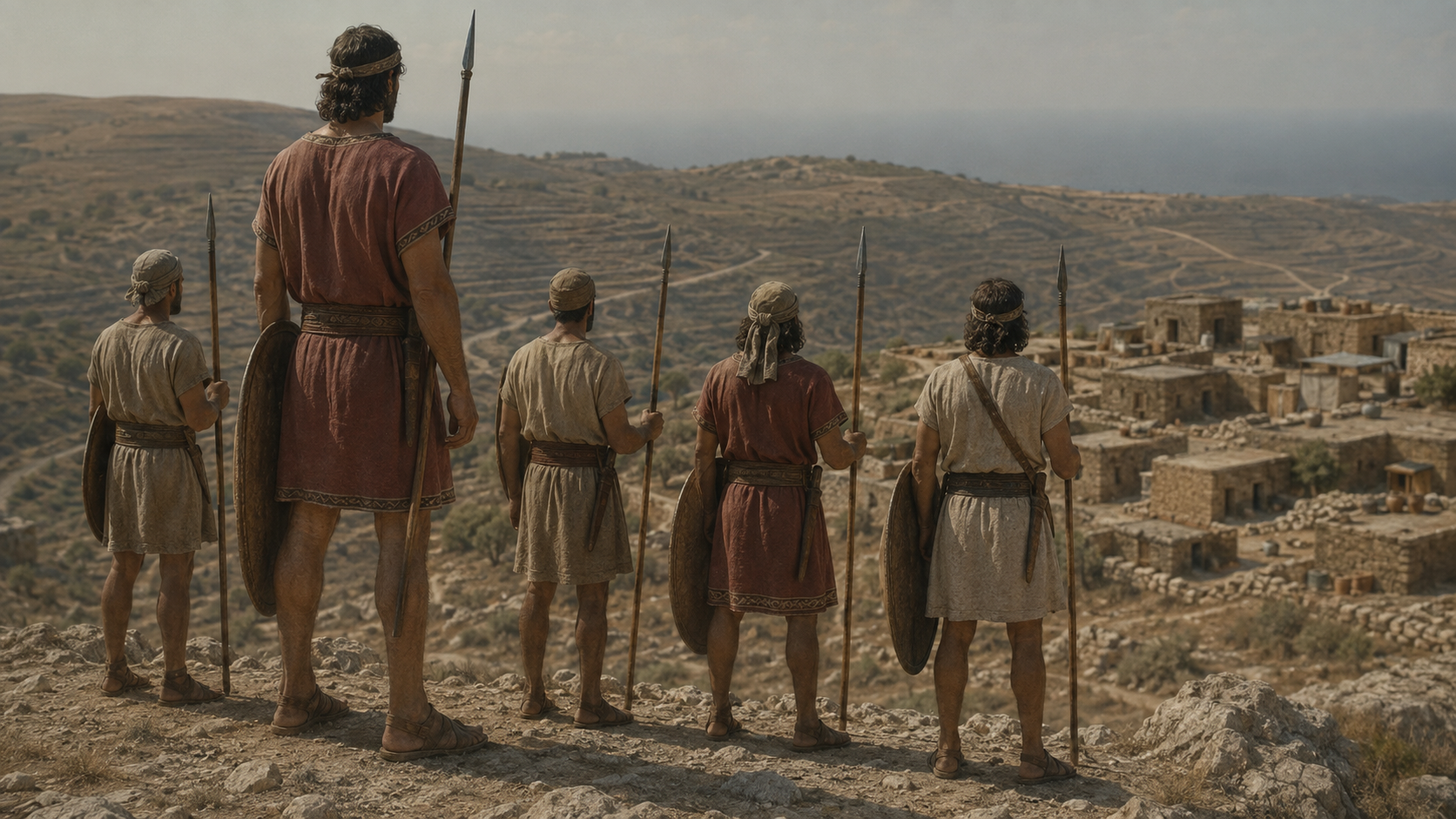
The second canonical appearance of the name comes much later in the narrative world. Moses sends twelve men to scout Canaan. They agree that the land is fruitful and its cities fortified, but they divide over whether Israel can take it. Caleb urges confidence. Ten scouts answer with what Numbers 13:32 explicitly calls a “bad report.” Inside that fearful speech, they say they saw the Nephilim and felt like grasshoppers.
This is a real textual receipt, but its setting matters. Numbers does not present a neutral census, an excavation report, or an independent genealogy. It places the claim in the mouths of frightened scouts whose rhetoric persuades a community to panic. The statement may preserve a genuine tradition about the Anakim. It may also be deliberate exaggeration: the land consumes its inhabitants, everyone is enormous, and invasion is impossible. The text records the claim without explaining how the named beings crossed the Flood.
Other biblical books develop a wider geography of giants without using Nephilim as a universal label. Deuteronomy 2:10–11 associates the Emim with the Rephaim and compares them to the Anakim. Deuteronomy 2:20–21 does something similar with the Zamzummim. Deuteronomy 3:11 calls King Og of Bashan the last remnant of the Rephaim and describes his enormous bed or funerary couch. Joshua 11:21–22 says the Anakim were removed from the hill country but remained in Gaza, Gath, and Ashdod.
That geographical detail sets up the later champions from Gath. Goliath is the most famous, but 2 Samuel 21:15–22 remembers several formidable opponents linked to Rapha, including one man with six fingers on each hand and six toes on each foot. These stories create a literary chain from primeval giants to defeated enemies on Israel’s borders. They do not preserve a continuous family tree from Genesis 6.
Even Goliath’s reported height is textually unstable. The later Masoretic Hebrew tradition gives him six cubits and a span—close to 9 feet 9 inches under a common cubit estimate. The Greek Septuagint, the early Hebrew manuscript 4QSamᵃ from the Dead Sea Scrolls, and Josephus instead preserve four cubits and a span, roughly 6 feet 9 inches. The shorter reading still describes an exceptionally imposing warrior, but the difference shows why ancient measurements cannot be treated as untouched biometric data. The University of Notre Dame’s overview of the variant rightly describes a “shorter Goliath” preserved by early witnesses.
By the Hellenistic period, Jewish interpreters were expanding the cryptic Genesis passage into a much larger story. The Greek translation commonly called the Septuagint rendered Nephilim with gigantes, a word that linked the passage to the Greek imaginative world of Giants. Manuscript traditions also varied over whether Genesis 6:2 referred to “sons” or “angels” of God, showing that interpretation was already entering transmission.
The fullest surviving expansion appears in 1 Enoch’s Book of the Watchers, composed in stages during the last centuries BCE. There, rebellious Watchers descend, take women, transmit forbidden knowledge, and father destructive giants. The giants consume the earth and one another. Judgment follows. Their bodies die.
What survives is not their DNA.
According to 1 Enoch 15–16, spirits proceeding from the dead giants remain on earth as evil spirits. The text provides an origin story for demons and persistent corruption after the Flood. It answers the survival problem spiritually, not genealogically.
The Book of Giants, preserved in fragmentary Aramaic manuscripts at Qumran, belongs to the same broad Enochic world. Its giant figures receive ominous dreams and face the destruction approaching them. The Israel Antiquities Authority’s image of 4Q530 is physical evidence that ancient Jews copied and read giant traditions near the turn of the era. It is evidence for the history of an idea, not for the anatomy of the beings in the story.
Jubilees, another Second Temple Jewish work, carries the same logic into the post-Flood world. Noah’s descendants are troubled by unclean spirits, and Noah prays for protection. In Jubilees 10, most of the spirits are bound, while a tenth remain under Mastema’s authority. Again, the inherited threat is demonic influence. No secret human dynasty is identified.
The first-century Jewish historian Josephus also treated the Genesis figures as the children of angels and women, comparing their lawless strength to the Giants known to Greek audiences. His account in Antiquities of the Jews 1.73 shows how established the angelic interpretation had become in some Jewish circles. It does not claim that their descendants occupied the ruling houses of Rome.
Christian interpretation later divided. Some early Christians accepted the angelic reading, reinforced by Jude’s reference to angels who abandoned their proper place. Others recast the “sons of God” as the godly descendants of Seth who intermarried with the corrupt descendants of Cain. Augustine gave the human-line interpretation enormous influence in the Latin West in The City of God, Book XV. The shift did not result from a newly discovered skeleton or genealogy. It was an interpretive response to theological questions about angelic bodies, marriage, and the moral logic of the Flood.
The modern bloodline story emerged from still later combinations. Biblical literalism preserved interest in post-Flood giants. Nineteenth- and twentieth-century occultism and comparative mythology reimagined ancient gods as hidden adepts, visitors, or remnants of lost civilizations. Ancient-astronaut literature converted divine beings into extraterrestrials. Conspiracy culture then attached inherited nonhuman ancestry to monarchies, financiers, political families, and “elites.” Internet circulation added giant-skeleton images, Rh-negative blood claims, and assertions of suppressed archaeology.
Several publication milestones make that construction visible. Erich von Däniken’s Chariots of the Gods? popularized ancient extraterrestrial intervention in 1968. Zecharia Sitchin’s The 12th Planet recast the Mesopotamian Anunnaki as spacefaring engineers in 1976 and used “Nefilim” inside that system. David Icke’s The Biggest Secret gave interconnecting ruling bloodlines and nonhuman ancestry a mass-market conspiratorial form in 1999. These authors did not transmit one recovered ancient teaching, and they did not all tell the same story. Later prophecy and alternative-history media fused portions of their frameworks with Genesis 6 until “Nephilim bloodline” sounded like an old category rather than a new collage.
What happened, then, is recoverable in stages.
A difficult ancient passage was written. Later biblical narratives reused giant language. Second Temple authors supplied angels, forbidden knowledge, giant offspring, and surviving spirits. Christian theologians disputed the ontology. Modern writers translated supernatural ancestry into genetics, aliens, and dynastic control.
At no point does a verified biological chain connect those stages.
Key Claims and Evidence
Claim 1: Genesis says the Nephilim lived after the Flood
What the source says: Genesis 6:4 says they were present “in those days—and also afterward.”
What the claim adds: It assumes “afterward” is a direct reference to the post-Flood world.
That reading is possible, especially when Genesis is read beside Numbers 13. It is not explicit. The phrase occurs before the Flood has been introduced as the next event, and Genesis never narrates Nephilim boarding the ark, surviving outside it, or returning afterward. Scholars have variously read the words as an editorial bridge to later giant traditions, a reference to continuing unions in the same era, or a loose marker of legendary time. Ronald Hendel’s influential study, “Of Demigods and the Deluge”, treats the passage as a fragment of ancient heroic and flood tradition whose present form has been compressed inside Genesis.
Assessment: Textually real, chronologically ambiguous, insufficient by itself to establish post-Flood survival.
Claim 2: Numbers proves a surviving Nephilim population in Canaan
What the source says: The scouts report Nephilim in Canaan and associate them with the Anakim.
What the claim adds: It treats the scouts’ identification as verified ethnography and assumes biological continuity from Genesis.
Numbers gives the strongest canonical support for a post-Flood Nephilim tradition because it uses the same name. Yet the statement appears inside the scouts’ “bad report,” surrounded by fear-amplifying claims. The narrative’s purpose is not to solve a genealogy but to dramatize Israel’s refusal to trust that the land can be entered. The report may preserve a known giant tradition while also weaponizing it rhetorically.
Assessment: Strong evidence that a biblical author or tradition connected Nephilim language with the feared inhabitants of Canaan; weak evidence for how, or whether, a biological line survived.
Claim 3: The Anakim, Rephaim, and warriors of Gath form one Nephilim bloodline
What the sources say: Biblical passages compare or associate several giant-like peoples. Anakim and Emim are counted as Rephaim in Deuteronomy. Og is a remnant of the Rephaim. Some Anakim remain in Gath. Later Gath narratives feature unusually imposing warriors.
What the claim adds: It turns overlapping labels, places, and literary motifs into a single pedigree.
The categories are less stable than a bloodline chart suggests. In the Hebrew Bible, Rephaim can refer to ancient inhabitants of the land, giant warriors, and the shadowy dead of the underworld. Ugaritic texts from the Late Bronze Age contain the related rp’um, often interpreted as ancestral or underworld figures, although the precise relationship remains disputed. Rodney Duke’s review of the evidence, “Tracking the Rephaim Through Place and Time,” shows why the term cannot safely be reduced to one biological population.
The literary linkage is meaningful. The genealogical linkage is unproven.
Assessment: A real network of ancient giant traditions, not a recoverable family tree.
Claim 4: Hybrid ancestry entered the ark through one of Noah’s daughters-in-law
What the source says: Noah’s sons and their wives survive the Flood. The women’s parentage is not supplied.
What the claim adds: One woman carried Nephilim ancestry, explaining later giants.
This is a harmonization created from silence. The proposal can make two difficult passages fit, but no biblical or Second Temple source identifies a daughter-in-law as part Nephilim. Noah’s description as tamim does not solve the question because it refers to integrity or blamelessness, not a laboratory-tested genome. A modern genetic reading may sound precise while being wholly absent from the ancient vocabulary.
Assessment: Logically imaginable within a literalist reconstruction, but unattested and untestable.
Claim 5: A second angelic incursion produced the post-Flood giants
What the source says: Genesis describes one episode involving the sons of God and human women. Later canonical books mention giant peoples.
What the claim adds: The supernatural event happened again after the Flood.
A second incursion is another way to harmonize the texts, but neither Genesis nor Numbers narrates it. The Book of the Watchers likewise concentrates on the original rebellion and judgment. Some interpreters infer recurrence from “and also afterward,” yet an inferred event is not a reported event.
Assessment: A possible theological model with no explicit ancient narrative or independent evidence.
Claim 6: 1 Enoch preserves evidence of a biological line
What the source says: Watchers father giants; the giants die; spirits emerge from them and continue afflicting humanity.
What the claim adds: Those descendants survive through reproduction and remain among human populations.
The Enochic material is the clearest ancient source for hybrid parentage, but it points away from a living bloodline. Its answer to persistent evil is that the giants’ disembodied spirits remain active after their bodies are destroyed. Jubilees builds on the same postmortem framework.
Assessment: Strong evidence for an ancient hybrid myth and a demonological survival theory; contrary evidence to the claim that the same tradition taught an ongoing biological dynasty.
Claim 7: Giant skeletons confirm the biblical races
What is documented: Archaeologists and physicians have identified rare ancient individuals of extraordinary height, including a Roman-period skeleton approximately 202 centimeters—about 6 feet 8 inches—with bone changes consistent with pituitary gigantism. The peer-reviewed report is indexed by the University of Pisa.
What the claim adds: Unusually tall remains belong to a separate hybrid species, and institutions suppress the proof.
Human gigantism is real. It is rare and medically intelligible. An exceptionally tall skeleton does not establish a breeding population, supernatural paternity, or connection to a biblical ethnonym. Meanwhile, many spectacular photographs of gigantic excavated skeletons are edited images or miscaptioned art; AFP’s examination of one recurring image traces it to manipulation rather than an archaeological discovery.
No published find accepted by mainstream archaeology has established a population of superhuman human–angel hybrids. That is not the same as saying every ancient report was invented. It means the physical evidence presently available does not carry the modern conclusion.
Assessment: Real tall individuals; no verified Nephilim population.
Claim 8: Rh-negative blood is a marker of nonhuman ancestry
What is documented: The Rh system is one of many human blood-group systems. Its major antigens are encoded by the neighboring RHD and RHCE genes. Variation in these genes explains Rh-positive and Rh-negative phenotypes; the medical relevance is especially clear in pregnancy and transfusion. The NCBI Bookshelf overview of the Rh blood group summarizes the genetics.
What the claim adds: A negative Rh factor cannot be explained by human evolution and therefore signals descent from Nephilim, aliens, or an unknown species.
That claim has no support in population genetics. Rh-negative blood is uncommon in some populations and more frequent in others, but rarity is not evidence of extraterrestrial origin. No reproducible study connects Rh status to giantism, unusual cognitive powers, elite dynasties, or nonhuman DNA.
Assessment: Ordinary human genetic variation rebranded as an ancestry mystery.
Claim 9: Powerful families preserve the Nephilim line
What is documented: Wealth, titles, land, institutions, and social advantage can pass through families for generations. Dynastic marriage has been a visible instrument of power in many societies.
What the claim adds: The continuity is biological in a nonhuman sense, and hidden ancestry explains coordinated control.
No authenticated genealogy connects a modern family to the Nephilim, Anakim, or Rephaim. The theory frequently works backward: a family is powerful, therefore it must possess unusual ancestry; evidence of privilege then becomes evidence of hybridity. This converts a measurable historical problem—inherited wealth and institutional access—into an unfalsifiable biological enemy.
The boundary also deserves ethical care. Interest in Genesis 6 is not inherently racist or antisemitic. However, some modern bloodline systems have overlapped with “serpent seed,” Christian Identity, and conspiratorial traditions that assign corruption to supposedly impure peoples. Michael Barkun’s historical work on the Christian Identity movement documents how biblical genealogy can be transformed into racial politics. That genealogy of ideas does not discredit ancient-text study. It does require vigilance when a theory stops examining power and starts inventing contaminated human categories.
Assessment: Inherited social power is real; a nonhuman ruling bloodline is unsupported.
Points of Tension
The first tension is internal to the biblical narrative. The Flood is presented as comprehensive, yet Numbers later places the Nephilim in Canaan. A strict harmonization demands a mechanism. The texts never supply one.
The second tension concerns the source of the post-Flood report. Numbers preserves the claim, but places it inside speech labeled a “bad report.” Dismissing the name as mere panic ignores the author’s deliberate reuse of an ancient category. Treating it as a verified field observation ignores the narrative’s critique of the speakers. The evidence is neither nothing nor neutral.
The third tension lies in vocabulary. Anakim, Rephaim, Emim, Zamzummim, and warriors descended from Rapha overlap in descriptions of size, antiquity, terror, and defeat. Yet the same words can carry ethnic, legendary, and underworld associations. A modern diagram can make them look like a stable taxonomy only by removing the ambiguity that makes the ancient material historically valuable.
The fourth tension appears in 1 Enoch. The work most explicit about angel–human offspring is also explicit that the giants die. Their continuing presence becomes spiritual. Modern bloodline theory often cites Enoch for the first half of that system while quietly replacing the second half.
The fifth tension is material. Ancient societies did encounter unusually tall people, preserved memories of formidable warrior groups, and built stories around bodies that exceeded the norm. But medically documented gigantism is not evidence for a race of giants. Myth can begin with an extraordinary person without becoming a literal population history.
The final tension is modern and political. Dynasties exist. Family privilege persists. Institutions conceal information. None of those truths require nonhuman genetics. A supernatural bloodline can feel like a deeper explanation while actually making power harder to investigate, because every missing record becomes proof of concealment and every elite connection becomes proof of ancestry.
The file contains a genuine anomaly in the text.
It does not contain a license to fill the gap with any lineage we fear.
Perspectives and Explanations
Literary Continuity: Primeval Chaos Enters Canaan
On this reading, Genesis and Numbers are linked deliberately. The Nephilim belong to the violent world before the Flood; invoking them in Canaan turns Israel’s enemies into a return of primeval chaos. The conquest stories then stage the defeat of forces that ordinary humans believe are unbeatable. The point is theological and literary: the God who subdued the ancient world can overcome the terrors ahead.
This model explains why the name appears without a survival account. The authors are not preserving chromosomes. They are creating narrative resonance. Recent scholarship continues to explore whether Genesis 6:1–4 anticipates later land and giant traditions rather than describing a self-contained episode; Ki-Eun Jang’s 2025 reassessment is one example of that debate.
Its limitation is that literary function does not tell us whether older memories stand behind the language.
Historical Memory: Tall Warriors and Formidable Peoples
Ancient communities often magnified powerful enemies. A population known for unusual height, elite combat, imposing armor, fortified cities, or ancestral prestige could become “giants” in collective memory. The spies’ grasshopper language works especially well as war rhetoric: the enemy’s body becomes a measure of one’s own fear.
This explanation does not require every detail to be fictional. It allows historical people, real places, and rare tall individuals to generate legendary proportions. The shorter early reading of Goliath’s height fits an exceptional but human-scale champion better than the later measurement does.
Its limitation is evidentiary. No archaeological assemblage has been securely identified as “Anakim,” and height alone could never establish the full biblical category.
Mythic Pattern: The Last Giants of a Former Age
Giant traditions appear across the ancient Mediterranean and Near East. They often inhabit the threshold between divine and human, belong to an earlier age, embody violent disorder, and fall before a new cosmic or political order. Brian Doak’s The Last of the Rephaim emphasizes how biblical giant figures can function as remnants of a heroic past and as opponents through whom kings or peoples establish legitimacy.
Mesopotamian comparison adds another possible layer. Amar Annus has argued that the Enochic Watchers invert traditions about antediluvian sages, or apkallu: culture-bringers become transgressive teachers whose knowledge corrupts the world. This is a scholarly proposal about literary transformation, not proof that either class of being existed physically.
The value of the comparative view is that it explains why the biblical material resembles other ancient stories without reducing it to plagiarism. Its risk is flattening distinct traditions into one universal “giant myth.”
Angelic Transgression With Spiritual Survival
This was a major interpretation in Second Temple Judaism and early Christianity. The sons of God are rebellious heavenly beings. Their children are giants. Their forbidden knowledge and violence help explain the Flood. After bodily destruction, the giants’ spirits become the demons that continue to trouble the world.
This model has the strongest ancient support for hybrid offspring because 1 Enoch states the relationship directly. It also solves the post-Flood persistence of evil within its own worldview.
But it does not produce a biological bloodline. The ancient mechanism is disembodied survival.
Human Intermarriage: The Sethite Interpretation
In the influential later Christian reading, “sons of God” are descendants of Seth and “daughters of humans” belong to Cain’s line. The offense is not cross-species reproduction but the collapse of a moral boundary. Augustine’s version helped normalize this interpretation in Western Christianity.
The reading avoids questions about angelic sexuality and keeps the passage within human history. It also makes the Nephilim harder to explain, since Genesis still places mysterious warriors in the scene and does not identify the women as Cainites.
This is theology interpreting an ambiguous text, not a settled translation.
Literal Biological Survival
The ark-carrier and second-incursion theories preserve a literal human–heavenly hybrid population after the Flood. They appeal because they turn the Genesis–Numbers tension into a coherent timeline.
Their weakness is decisive: the necessary event is missing. No ancient source identifies the carrier, narrates the second incursion, or traces the descendants into a historical genealogy. Each version solves one textual gap by writing a new chapter into it.
Ancient Astronaut and Elite Bloodline Models
Here the sons of God become extraterrestrial or advanced nonhuman visitors. The Nephilim become engineered hybrids. Post-Flood giants preserve the experiment, and later ruling families preserve the genes.
This model can absorb almost every ancient anomaly because theological language becomes misunderstood technology. But translation is not evidence. “Heavenly” does not automatically mean “extraterrestrial,” mythic parentage does not establish genetic engineering, and social influence does not verify nonhuman ancestry. The theory also lacks a clear falsification condition: missing evidence is routinely treated as evidence of suppression.
As speculation, it can generate questions about how ancient people encoded encounters with difference. As history, it currently outruns every available receipt.
Context and Pattern Recognition
The Nephilim case sits at a crossroads of flood myth, heroic-age memory, demonology, and political theology.
Flood traditions organize time into a world before and a world after. The earlier age is often larger, longer-lived, more violent, closer to the gods, or less stable than ordinary history. A surviving giant is therefore not just a large person. It is a fragment of the wrong age that has crossed a cosmic boundary.
That pattern helps explain Og’s “last remnant” status and the survival of Anakim in specific coastal cities. The narratives repeatedly narrow the giant world. First it fills the primeval earth. Then it occupies feared territories. Then remnants survive in borderlands. Finally individual champions fall in combat. Mythic time is domesticated through geography and victory.
The pattern also explains why manuscripts matter. The Greek translation’s gigantes invited comparison with Greek Giants. 1 Enoch supplied names, motives, illicit knowledge, and a demonology. The Book of Giants circulated the story in another form. Jubilees carried its spirits into Noah’s post-Flood world. Josephus made the tradition legible to Greco-Roman readers. Augustine redirected it toward human moral history.
Each interpreter inherited an unresolved sentence and made it answer a new question.
For Genesis, the question may have concerned violence, fame, and the limit placed on human life. For Enochic writers, it concerned the origin of forbidden knowledge and demonic evil. For Augustine, it concerned the moral division within humanity. For modern ancient-astronaut theory, it concerns intervention in human evolution. For bloodline conspiracy, it concerns why power persists across generations.
This is where pattern recognition must remain disciplined. Similarity can reveal transmission, adaptation, or a recurring human concern. It does not automatically reveal one concealed event behind every version.
There is also a recognizable escalation pattern in contemporary media:
An ambiguous verse becomes a literal hybrid account. Separate giant peoples become one race. A missing genealogy becomes evidence of secrecy. Rare medical conditions become archaeological confirmation. Blood-group variation becomes alien inheritance. Visible family privilege becomes proof of covert biology.
Each step feels small when encountered alone. Together, they produce a total system in which almost any fact can be absorbed and no contradiction can close the claim.
That is why the real historical context matters. It returns each layer to its date, genre, language, and evidentiary function. Genesis is not a genomic report. Numbers is not an independent archaeological survey. 1 Enoch is not a modern field notebook. A Dead Sea Scroll fragment proves that a text circulated, not that its characters were excavated beside it.
Wonder survives that correction.
It becomes more precise.
Implications: Reality Check
If authenticated remains showed a stable population of anatomically extraordinary humans in Bronze or Iron Age Canaan, the discovery would transform the archaeological discussion. If recoverable ancient DNA contained an unexplained lineage outside known human variation, the implications would be larger still. If a securely provenanced inscription connected a named population to the Anakim or Rephaim, scholars would have new evidence for the historical background of the texts.
None of that evidence presently exists.
The absence does not prove that every giant tradition was created from nothing. Ancient stories can preserve distorted memories of migrations, warrior elites, disease, unusual stature, defeated peoples, and religious encounters. But the distance between “this story may contain historical memory” and “a nonhuman bloodline rules modern institutions” is not one missing link. It is an entire missing chain.
The most defensible conclusion is therefore layered:
The Nephilim are securely documented as figures in an ancient text.
The Watchers and their giant offspring are securely documented as an influential Second Temple interpretation.
Post-Flood giant peoples are securely documented within biblical narrative.
Rare human gigantism is securely documented in the archaeological and medical record.
A continuous human–nonhuman bloodline is not documented.
That distinction has a practical implication. If we want to understand inherited power, we already possess tools that can be tested: land records, corporate ownership, political donations, marriage networks, school access, legal privilege, colonial extraction, and intergenerational wealth. Replacing those mechanisms with hidden DNA can make a theory feel cosmic while moving it away from the evidence that could hold anyone accountable.
The real discovery is not a secret family.
It is how readily human beings turn moral, political, and spiritual continuity into blood.
The Unresolved Ledger
What Is Documented
- Genesis 6:4 names the Nephilim and includes the phrase “and also afterward.”
- Numbers 13:33 records frightened scouts claiming that Nephilim were present in Canaan and associating them with the Anakim.
- Deuteronomy and Joshua preserve traditions about Anakim, Emim, Zamzummim, Rephaim, Og of Bashan, and giant-associated locations including Hebron, Gaza, Gath, and Ashdod.
- Early textual witnesses differ significantly over Goliath’s reported height.
- Second Temple Jewish works, especially 1 Enoch, expand Genesis 6 into a narrative of rebellious Watchers, forbidden knowledge, and giant offspring.
- 1 Enoch and Jubilees explain post-Flood affliction through surviving spirits, not a named biological dynasty.
- Aramaic fragments of the Book of Giants were preserved among the Dead Sea Scrolls.
- Josephus knew the angelic interpretation; later Christian writers, especially Augustine, helped establish a human-line alternative.
- Rare cases of human gigantism are medically and archaeologically documented.
- The Rh blood group is explained by ordinary human genetic variation involving RHD and RHCE.
- No authenticated genealogy, archaeological population, or genetic study has established living Nephilim descendants.
What Is Claimed
- “And also afterward” means the Nephilim survived the Flood.
- One of Noah’s daughters-in-law carried hybrid ancestry onto the ark.
- A second group of heavenly beings fathered giants after the Flood.
- The Anakim, Rephaim, Og, Goliath, and all other giant figures belong to one biological line.
- Giant skeletons have been found and systematically concealed.
- Rh-negative blood identifies nonhuman or Nephilim ancestry.
- Royal, political, financial, or religious families preserve the line today.
- Ancient gods and angels were extraterrestrial genetic engineers.
These are not equally old claims, and repetition does not give them a shared chain of evidence.
What Remains Unresolved
- What did the earliest author or editor of Genesis 6:1–4 mean by “sons of God,” Nephilim, and “also afterward”?
- Does Genesis 6 intentionally anticipate the scouts’ report in Numbers, or did later traditions connect originally separate materials?
- How should the Anakim and Rephaim be understood—as historical peoples, legendary warrior classes, ancestral dead, literary symbols, or changing combinations of these?
- What historical experiences, if any, contributed to Israelite memories of giant inhabitants and champions?
- Which reading of Goliath’s height stands closest to the earliest recoverable form of the story?
- How directly did Mesopotamian sage traditions and other ancient giant myths influence the Enochic Watchers narrative?
The existence of a modern hybrid dynasty is not unresolved in the same evidentiary sense. It remains an unsupported claim unless recoverable evidence appears.
Why It Still Matters
The case preserves one of humanity’s oldest boundary questions: what happens when the divine and human worlds cross?
Ancient writers used the question to explain violence, forbidden knowledge, evil spirits, terrifying enemies, and the disappearance of a heroic age. Later readers used it to debate angels, sin, and the limits of nature. Modern culture uses it to talk about genetic engineering, nonhuman intelligence, inherited power, and the fear that history is being managed by something older than us.
The texts do not confirm that fear.
They do reveal its ancestry.
The Galactic Mind Perspective
The strongest version of this case is not that the Flood failed to end a bloodline.
It is that the Flood failed to end the problem the Nephilim represented.
Violence survived.
Forbidden knowledge survived.
The terror of overwhelming enemies survived.
The suspicion that power comes from an illicit union survived.
Second Temple writers gave that persistence a spiritual mechanism: the bodies of the giants died, but their spirits remained. Biblical conquest narratives gave it a political geography: remnants occupied the land until they were defeated. Modern conspiracy theory gives it a genetic mechanism: the line hides inside families and institutions.
Only the first two mechanisms belong to the ancient archive. The third is a modern reconstruction.
That does not make the central anomaly disappear. Genesis says “and also afterward.” Numbers says the scouts saw Nephilim. The texts leave a seam visible. A careful reader should notice it.
But an open seam is not a blank check.
The responsible position is to keep the levels separate. There may be a historical memory beneath the giant traditions. There is certainly a deep mythic pattern. There is extensive evidence for the transmission and transformation of the story. There is no credible evidence that a hybrid lineage can be followed from the ancient Near East into modern ruling families.
The bloodline theory survives because it turns systems into persons and history into heredity. It promises that the hidden architecture of power can be exposed by identifying the wrong kind of human. The harder reality is usually less cinematic: power reproduces itself through wealth, law, institutions, marriage, education, violence, and access.
Perhaps that is why the older texts remain more unsettling than the modern theory.
They do not say evil belongs to one secret family.
They say the conditions that produced the giants can return wherever power crosses a boundary and refuses a limit.
Open Question
Did the post-Flood giants preserve a historical memory of unusually powerful peoples or did biblical writers deliberately carry the language of primeval chaos into Canaan so that every later giant would feel like the return of an unfinished age?
What do you think? Drop your thoughts in the comments ...
More in Case Files
- The Voynich Manuscript and the Discipline of Not Knowing — Another materially real textual mystery where the evidence demands restraint.
- Baalbek and the Megalithic Stress Test of Ancient Engineering — A useful companion on how real ancient achievement attracts giant and nonhuman explanations.
- The 1561 Nuremberg Sky Battle: What Did Hans Glaser Record? — A case built around an authentic historical artifact whose imagery does not settle what physically occurred.
Sources / Receipts
Primary Texts and Manuscripts
- Genesis 6:4 — NRSVUE comparison. The first biblical reference to the Nephilim and the phrase “and also afterward.”
- Numbers 13:30–33 — NRSVUE. The scouts’ report, including the Anakim–Nephilim association and its “bad report” narrative context.
- Deuteronomy 2:10–11, Deuteronomy 3:11, and Joshua 11:21–22. Rephaim, Og, Anakim, and their narrative geography.
- 2 Samuel 21:15–22 — NRSVUE. The Gath warriors associated with Rapha.
- 1 Enoch 6–16 — Book of the Watchers excerpt. The angelic rebellion, giants, judgment, and surviving spirits.
- Jubilees 10. Noah, Mastema, and the post-Flood unclean spirits.
- Israel Antiquities Authority — Book of Giants fragment 4Q530. A primary manuscript artifact from the Qumran corpus.
- Josephus, Antiquities 1.73. A first-century Jewish interpretation of angels, women, and giant offspring.
- Augustine, The City of God, Book XV. A major source for the later human-line interpretation in Western Christianity.
- NETS: New English Translation of the Septuagint. Scholarly English translation resources for the Greek biblical tradition.
Scholarship and Context
- Ronald Hendel, “Of Demigods and the Deluge: Toward an Interpretation of Genesis 6:1–4”. Foundational study of the passage’s mythic and literary background.
- Wojciech Kosior, “The Fallen (Or) Giants?”. Study of how the Hebrew Bible characterizes the Nephilim and the problems surrounding the “giant” identification.
- Ki-Eun Jang, “The Identity and Role of the Nephilim Reassessed”. Recent literary reassessment connecting Genesis 6 with later land traditions.
- Rodney K. Duke, “Tracking the Rephaim Through Place and Time”. Survey of the Rephaim as giant warriors, ancient peoples, and figures associated with the dead.
- Amar Annus, “The Antediluvian Origin of Evil in the Mesopotamian and Jewish Traditions”. Comparative study of Enochic Watchers and Mesopotamian antediluvian traditions.
- Brian R. Doak, The Last of the Rephaim. Study of biblical giants as figures of chaos, heroic-age memory, politics, and theological order.
- Ludwig Maximilian University of Munich — Critical Edition of the Aramaic Book of Giants. Recent academic work on the Qumran fragments.
- University of Notre Dame — “A Shorter Goliath”. Accessible account of the four-cubit and six-cubit manuscript variants.
Archaeology, Medicine, and Modern Claims
- University of Pisa — “Pituitary disease from the past”. Peer-reviewed osteological report on a Roman-period individual with probable gigantism.
- NCBI Bookshelf — The Rh Blood Group. Medical and genetic overview of RHD, RHCE, and Rh phenotypes.
- AFP Fact Check — Manipulated giant-skeleton image. Provenance check for one recurring piece of false archaeological evidence.
- Michael Barkun, Religion and the Racist Right. Historical context for the point at which some biblical bloodline interpretations become racial ideology.
- Penguin Random House — Erich von Däniken, Chariots of the Gods?. Publication receipt for a major late-20th-century ancient-astronaut source.
- Simon & Schuster — Zecharia Sitchin, The 12th Planet. Publication receipt for the modern extraterrestrial-Anunnaki framework.
- WorldCat — David Icke, The Biggest Secret. Catalog record for the 1999 bloodline-control text; included as provenance for the modern claim, not validation of it.


Discussion