
On November 14, 2004, a routine naval training exercise off Southern California was interrupted by a contact the pilots sent to investigate could not identify.
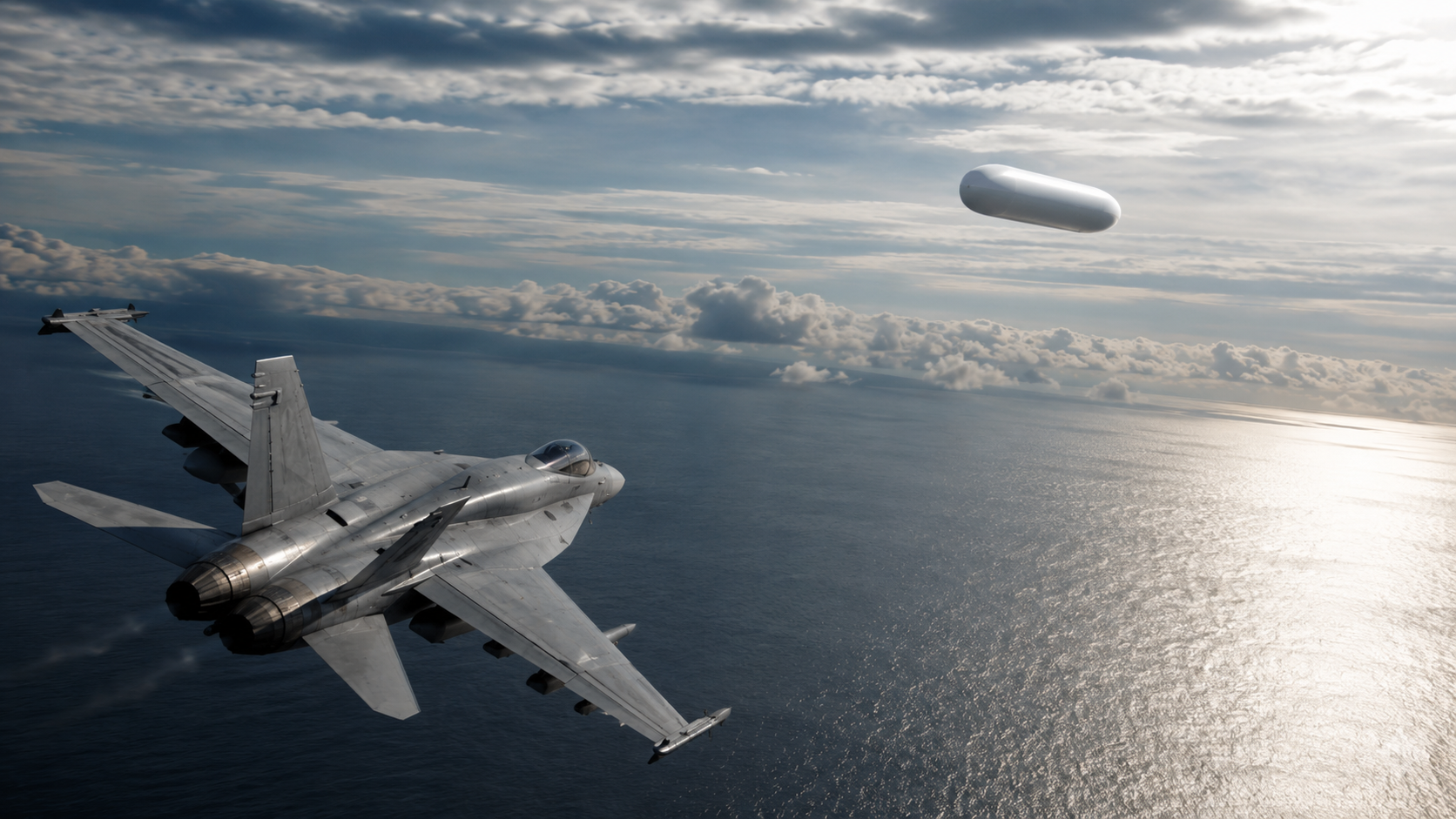
According to their later testimony, four Navy aviators observed a small, white object moving above an area of disturbed ocean water. It had no visible wings, rotors, exhaust plume, or conventional control surfaces.
Commander David Fravor reported that the object reacted to his approach, climbed toward his aircraft, and then accelerated out of sight. Controllers aboard the USS Princeton reportedly detected it moments later near the flight’s designated combat air patrol point.
A later aircrew captured infrared footage of an object associated with the encounter.
In 2020, the Department of Defense formally released the footage, confirming that it was genuine Navy video and that the phenomenon depicted remained characterized as unidentified.
That confirmation established the video’s provenance.
It did not confirm the object’s reported speed, origin, propulsion system, or relationship to every other part of the encounter.
The Nimitz incident does not prove extraterrestrial technology, a classified aircraft, or a breakthrough in propulsion.
But it remains one of the most consequential modern UAP cases because credible military testimony, reported radar tasking, direct visual observation, and authenticated footage converge around an event that has never received a publicly demonstrated explanation.
Case Overview: The Event
On November 14, 2004, aircraft from the Nimitz Carrier Strike Group were conducting predeployment training exercises over the Pacific Ocean off Southern California.
Commander David Fravor, then commanding officer of Strike Fighter Squadron 41, was leading a two-aircraft F/A-18F training flight. According to his later written testimony to Congress, the exercise was suspended when controllers aboard the USS Princeton redirected his flight toward an unknown radar contact.
Fravor testified that the Princeton had been observing unusual contacts during the preceding two weeks. These objects reportedly descended from above 80,000 feet to approximately 20,000 feet, remained there for extended periods, and later ascended again.
The raw radar data needed to independently verify those reported movements has not been released publicly.
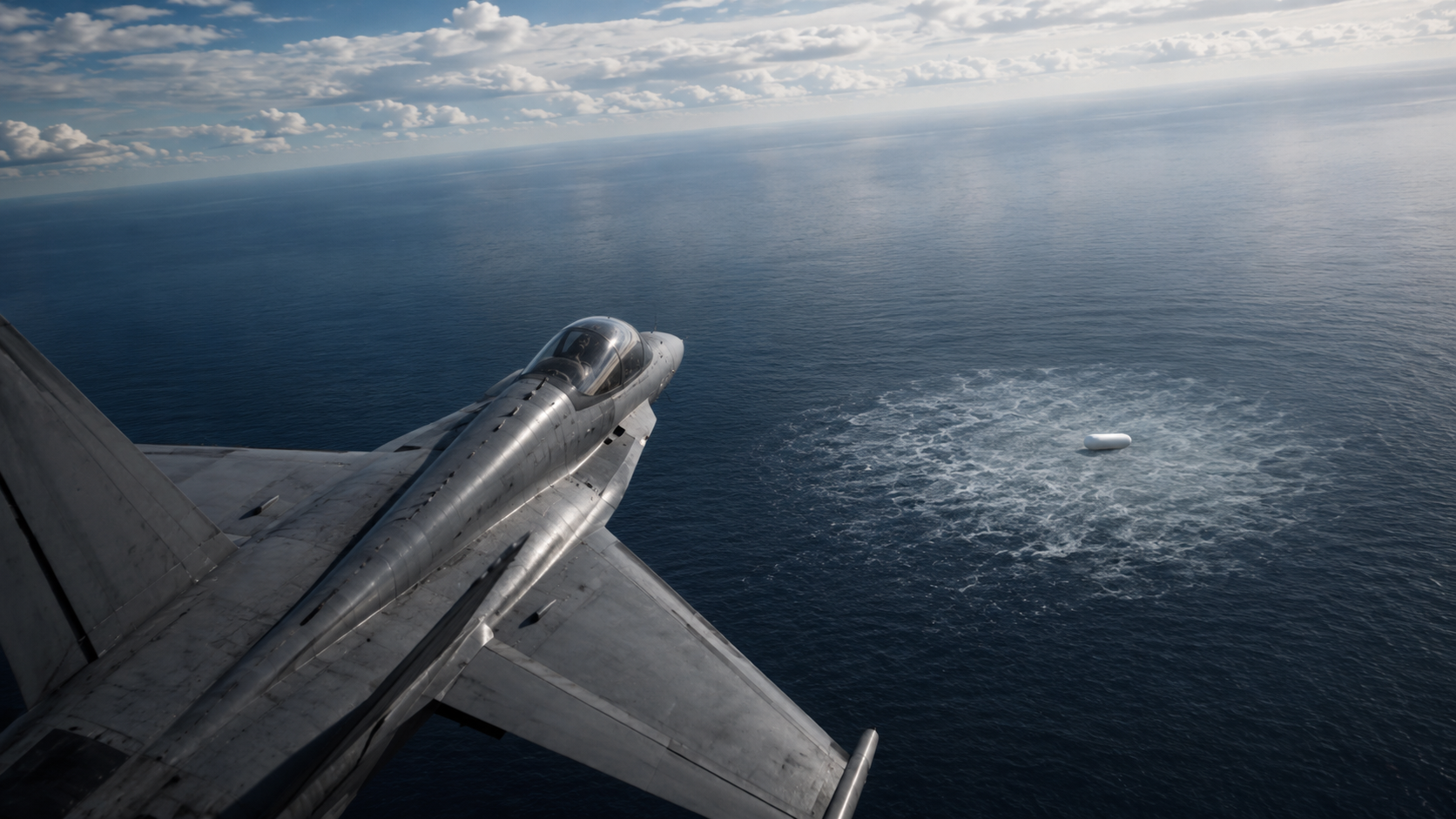
When Fravor’s flight reached the contact area, he said all four aviators observed a small, white, elongated object moving above a patch of disturbed water. It had no visible wings, rotors, exhaust, or recognizable flight-control surfaces.
It would become known as the “Tic Tac.”
Fravor reported that the object responded to his descent, climbed toward his aircraft, and rapidly accelerated from view. Controllers then reportedly informed the pilots that the contact had appeared near their combat air patrol point roughly 60 miles away.
Later that day, another Navy aircrew recorded infrared footage of an unidentified object. The Department of Defense formally released that footage in April 2020 alongside two Navy videos recorded in 2015.
The direct visual encounter and the later recording were operationally connected, but they were not the same moment.
That distinction is central to the case.
What makes the Nimitz encounter important is not simply the existence of a strange video. It is the convergence—and incomplete public verification—of radar reports, four eyewitnesses, infrared footage, military documentation, and an identity that remains unresolved.
What Actually Happened
The Radar Reports
According to Fravor’s 2023 written statement to the House Oversight Committee, controllers aboard the USS Princeton had been observing unusual radar contacts during the roughly two weeks before his encounter.
Fravor testified that the contacts appeared at high altitude, descended rapidly to around 20,000 feet, remained in the area, and later moved upward again.
This is an important distinction:
The radar activity is part of Fravor’s sworn public testimony and other witness accounts. The underlying raw radar tapes or complete telemetry have not been released publicly in a form that allows independent verification of the reported performance.

The Intercept
Fravor and his wingman were flying F/A-18F Super Hornets as part of a scheduled air-to-air exercise. When they checked in with the USS Princeton, they were informed that training had been suspended for real-world tasking.
They were directed toward a contact west of their combat air patrol point.
Fravor stated that his aircraft did not initially detect the object on its own radar. As the flight arrived in the area, the controller aboard the Princeton called a “merge plot,” indicating that the aircraft and the contact were within the same radar resolution cell.
Looking below, the four aviators observed an area of disturbed white water in an otherwise calm ocean.
Above that disturbance was a small white object.
Fravor described it as shaped like a Tic Tac, with its long axis positioned north to south and moving abruptly over the water. He reported seeing no wings, no rotors, no rotor wash, and no visible control surfaces.
Fravor began descending toward the object while the second aircraft remained higher to observe.
According to his account, the object shifted orientation, aligned with his aircraft, and began climbing in a turning motion. When Fravor moved to intercept it more directly, the object rapidly accelerated away and disappeared from view.
The other aircraft also reportedly lost visual contact.
When the pilots returned their attention to the ocean below, the white-water disturbance was gone.
![DVIDS - Images - Nimitz Conducts Flight Operations [Image 2 of 28]](https://images.openai.com/static-rsc-4/PeO172Sui4sGyw6YB3ehB6KUFMzLAjD43qFvlhCmswQY_OAoBrSbiVw5eO6sdg3a6VAaDI8UB0WVjSHpf0qO5t5dwwJt_uQ0WBLsK2rgCW-drBAebzUNy98MKgLtHWWM-AwPkzUshRIky8-vVw6yX_jDP2tlzHtqk4ID4NegCng_3YciIPsrvoswza8ZagBE?purpose=fullsize)
The Reported Reappearance
Fravor further testified that, as his flight turned back toward its combat air patrol point roughly 60 miles away, the Princeton informed them that the object had reappeared at that location.
If accurate, that reported movement would be the most difficult part of the incident to explain through ordinary aircraft performance.
But once again, the distinction matters:
This claim rests on witness testimony about radar information. Publicly available raw radar data has not been produced to independently confirm the distance, timing, acceleration, or identity of the object involved.
The Infrared Video
After Fravor returned to the USS Nimitz, another aircrew launched and captured infrared footage of an unidentified object using an aircraft targeting system.
Pilot Chad Underwood later stated publicly that he recorded the footage and coined the description “Tic Tac.” He also clarified that he observed the object through his aircraft systems rather than with his own eyes.
That separation is critical.
Fravor’s encounter involved direct visual observation.
Underwood’s encounter produced the video most commonly associated with the case.
The public record strongly connects these events operationally, but the available footage alone cannot prove that the object in the video was the exact same object Fravor visually observed earlier.
In 2017, the footage became widely public through media reporting.
In 2020, the Department of Defense formally released the November 2004 video, along with two Navy videos from 2015, stating that the aerial phenomena observed in them remained unidentified.

Key Claims and Evidence
The Nimitz encounter contains several different forms of evidence.
They should not be treated as equally established.
What Is Officially Documented
- A Navy infrared video recorded in November 2004 exists.
- The Department of Defense formally released the footage in April 2020.
- The Department stated that the phenomenon depicted remained characterized as unidentified.
- The Naval Air Systems Command FOIA library lists the FLIR footage among its released materials.
- David Fravor submitted a written statement about the encounter to the House Oversight Committee in 2023.
- Fravor, Alex Dietrich, and Chad Underwood have publicly discussed their involvement in the event.
These records establish that a military encounter was reported and that the footage originated from a Navy recording.
They do not establish what the object was.
Direct Witness Testimony
Fravor testified that:
- Controllers aboard the USS Princeton had tracked unusual radar contacts before his flight was redirected.
- Four aviators observed a white, elongated object above disturbed ocean water.
- The object had no visible wings, rotors, exhaust plume, or conventional control surfaces.
- It appeared to respond to his aircraft’s approach.
- It accelerated out of sight during the attempted intercept.
- Controllers later reported that the contact had appeared near the flight’s combat air patrol point.
- The reported movement covered approximately 60 miles in less than a minute.
Alex Dietrich has publicly confirmed that she participated in the intercept and observed the object.
Their testimony is significant because it involves trained aviators operating together in daylight.
It remains testimony. The public does not possess the complete sensor record needed to reconstruct the encounter independently.
Recorded and Sensor Evidence
The primary publicly available recorded evidence is the infrared footage commonly called FLIR1.
Chad Underwood stated that he recorded the footage during a later flight and tracked the object through his aircraft systems. His recording is the video most often shown when the Nimitz encounter is discussed.
However, the video does not independently reveal:
- the object’s precise size;
- its exact distance from the aircraft;
- its verified speed or acceleration;
- its material composition;
- its propulsion system;
- its relationship to the disturbed water;
- whether it was the same object Fravor had seen earlier.
Authentication means the footage is genuine Navy video.
It does not mean every extraordinary interpretation of the footage has been authenticated.
Radar Claims
The radar component is one of the most consequential parts of the case.
According to testimony and later witness accounts, the USS Princeton detected unusual contacts descending from extreme altitude, remaining near 20,000 feet, and moving through the operating area.
Fravor also testified that the object reappeared on the Princeton’s radar at the combat air patrol point after leaving visual range.
There have also been claims of radar jamming or interference during the later recording.
The difficulty is that the complete raw radar data, metadata, and telemetry have not been made publicly available.
The radar narrative therefore remains credible testimony about sensor information rather than independently testable public evidence.
Physical Evidence
No physical material has been publicly connected to the Nimitz encounter.
There is:
- no recovered object;
- no debris;
- no material sample;
- no preserved trace from the ocean disturbance;
- no publicly released physical artifact associated with the Tic Tac.
The case is strong in testimony and official provenance.
It is limited in independently testable data and physical evidence.
Broader Government Documentation
The 2021 ODNI preliminary UAP assessment examined 144 government reports dating from November 2004 through March 2021. It stated that 80 reports involved observations across multiple sensors.
That assessment provides important context for the wider UAP issue.
It should not be treated as independent confirmation of every reported detail from the Nimitz incident.
The documentation confirms that an event entered military and government records.
It does not establish the identity or origin of the object.
Points of Tension
The Nimitz case becomes significant where its strongest evidence meets its largest gaps.
The Video Is Authentic, But Limited
The video is real Navy footage.
That matters.
But authentication is not identification. The Department of Defense confirmed the video’s provenance, not the object’s origin, speed, material composition, or technology.
Infrared video can establish that a sensor tracked something.
Without full range, telemetry, sensor-mode context, and environmental data, it is much harder to establish how large the object was, how far away it was, or how dramatically it actually moved.
The Most Extraordinary Claims Depend on Unreleased Data
The most unusual reported behaviors do not come from the public video alone.
They come from testimony regarding:
- objects descending from extreme altitude;
- rapid movement toward the ocean;
- an object reaching a point roughly 60 miles away in less than a minute;
- possible radar interference or jamming.
If those claims could be confirmed through released raw data, the case would become far more consequential.
But those records are not publicly available in sufficient detail for independent analysis.
The case therefore remains suspended between credible testimony and incomplete verification.
The Visual Encounter and the Video Are Connected, But Not Identical
The public often treats the Tic Tac case as a single moment captured on film.
It was not.
Fravor and the aviators in his flight reportedly saw an object directly.
Underwood captured video during a later flight.
The events may involve the same phenomenon. They may involve related objects. They may involve separate targets encountered within the same operational environment.
The current public evidence does not fully settle that question.
No Public Resolution Has Closed the Case
The encounter was significant enough to reach congressional testimony and official video release.
Yet there is no publicly accepted explanation identifying the object as a balloon, aircraft, sensor error, foreign system, American prototype, or something more unusual.
That does not prove the most extraordinary possibility.
It does mean the central question is still open.
The tension is not that an alien craft has been proven. The tension is that trained observers reported a highly unusual event, official footage survives, and the data needed to resolve the case has never become publicly available.
Perspectives and Explanations
The Nimitz case has attracted several competing explanations. Each addresses part of the evidence. None publicly resolves every element of the reported event.
Sensor Misinterpretation or Camera Effects
Skeptical analysts have argued that the FLIR video alone may be consistent with a distant conventional object, potentially appearing unusual because of infrared imaging, tracking behavior, zoom changes, parallax, or loss of sensor lock.
This explanation is important because it challenges the assumption that the video visibly demonstrates extraordinary speed or propulsion.
Its limitation is equally important: it primarily addresses the released video.
It does not, by itself, explain Fravor’s direct visual account, the reported white-water disturbance, the multiple observers, or the radar narrative attributed to the USS Princeton.
A convincing conventional resolution would need to account for the entire event, not simply the most famous clip.
A Composite or Multi-Event Case
Another possibility is that the Nimitz incident combines several related—but not necessarily identical—events.
The complete case includes:
- radar contacts reported during the preceding weeks;
- the object visually observed by Fravor’s flight;
- the disturbance seen on the ocean surface;
- the contact reportedly detected at the combat air patrol point;
- the object recorded by Underwood during a later flight;
- possible radar interference associated with that later encounter.
These elements may all have involved the same phenomenon.
But the public evidence does not demonstrate that conclusively.
The radar contacts could have included more than one object or source. The visual encounter and the later infrared recording may have involved related targets, separate targets, or different interpretations produced inside the same operational environment.
Under this model, the case does not require every witness to be wrong or every sensor to have failed.
It suggests that several ambiguous observations may have been combined into one continuous narrative because they occurred in the same area and within the same operational period.
This possibility could explain why individual parts of the Nimitz case appear more conventional when isolated, while the combined story remains extraordinary.
It also reinforces the need for the missing radar data and complete telemetry.
Without them, the public cannot determine whether the case represents one remarkable object—or several events that later became one file.
A Classified American Program
Another possibility is that the aviators encountered a highly classified U.S. aircraft or test platform.
This would help explain why an unusual object might be observed near a naval training group and why information surrounding the event remained fragmented.
It would also carry significant implications of its own. Testing an advanced platform in proximity to unsuspecting military pilots could create serious safety and operational risks.
The 2021 ODNI preliminary assessment acknowledged that some UAP observations could potentially involve U.S. government or industry developmental programs. However, it stated that the task force was unable to confirm that such systems accounted for the UAP reports it had reviewed.
No publicly released record identifies the Nimitz object as an American prototype.
A Foreign Adversary System
A foreign surveillance or aerospace platform is another conventional possibility.
If a rival nation possessed technology capable of penetrating U.S. military operating areas and evading identification in 2004, the case would represent a major national security failure.
But no public evidence has connected the object to a foreign state.
The reported behavior, if taken at face value, would also suggest performance far beyond publicly known aircraft capabilities at that time.
A Misidentified Ordinary Object
Balloons, aircraft, atmospheric effects, sensor errors, and other ordinary causes explain many unusual aerial observations.
Any responsible investigation must keep those possibilities open.
But the full Nimitz account is difficult to reduce to a single ordinary object without dismissing major portions of the witness testimony or assuming that several observations were misunderstood at once.
That is possible.
It is not demonstrated.
An Unknown Technology
The most open interpretation is that the aviators encountered a real object whose capabilities and origin remain unknown.
This does not require jumping directly to non-human intelligence.
An unknown object could represent undisclosed American technology, foreign development, an unusual sensor event, or a category not yet publicly recognized.
But if the reported performance were independently verified, the implications would extend beyond a single naval encounter.
It would point toward technology operating in Earth’s atmosphere without the aerodynamic signatures expected from conventional flight.
That possibility remains unproven.
It is also the reason the case refuses to disappear.
Context and Pattern Recognition
The Nimitz encounter did not remain an isolated military curiosity.
In later years, Navy aviators operating off the East Coast reported recurring unidentified objects in military training areas. Those encounters became associated with the GIMBAL and GOFAST videos, both recorded in 2015 and formally released by the Department of Defense alongside FLIR1 in 2020.
The later reports helped shift UAP from a culturally stigmatized subject into questions of pilot safety, restricted-airspace awareness, sensor interpretation, and national security. Former Navy pilot Ryan Graves has become one of the most visible advocates for treating unexplained military encounters as aviation-safety concerns regardless of their ultimate explanation.
The 2021 ODNI preliminary assessment reviewed 144 government reports covering incidents from November 2004 through March 2021. Eighty involved observations across multiple sensors.
That finding did not mean 80 extraordinary craft were confirmed.
It meant that some reports contained more than one observation channel, such as radar, infrared systems, optical sensors, or direct visual observation.
Government analysis has since resolved many UAP reports as balloons, birds, satellites, drones, aircraft, or sensor effects. AARO has also published a resolution for the 2015 GOFAST footage, concluding that the object shown did not demonstrate anomalous speed.
That later resolution does not resolve the Nimitz encounter.
It demonstrates why authentic military footage must still be analyzed before apparent motion is treated as extraordinary performance.
As of August 1, 2026, AARO’s public case-resolution library does not contain a resolution report identifying the object or objects involved in the 2004 Nimitz incident.
That absence does not prove that every part of the case remains unexplained inside classified systems. It means no public AARO resolution has closed the complete event.
The Nimitz incident is important because it established several recurring lessons for UAP analysis:
- Military environments provide experienced observers and sophisticated sensors.
- Those same environments contain classified systems, electronic warfare, operational secrecy, and restricted data.
- Trained witnesses can make sincere and valuable observations without being immune to error.
- Genuine footage can document an unidentified target without demonstrating exotic performance.
- An unresolved case describes the condition of the evidence—not the origin of the object.
The Nimitz encounter did not place UFOs into the official record for the first time.
Government UFO records existed decades earlier.
Its significance is that it became a defining event in the modern UAP debate: a military encounter serious enough to demand examination, but incomplete enough to resist a confident conclusion.
Implications: Reality Check
The implications of the Nimitz encounter depend on which parts of the reported event are accurate.
If sensor limitations, distance, camera behavior, or misidentification explain the footage, the case demonstrates how easily incomplete military imagery can create an impression of extraordinary performance.
That would not make the incident meaningless.
Identifying ambiguous objects in sensitive training areas is an operational problem even when the eventual explanation is ordinary.
If the aviators encountered a classified American platform, the case raises questions about oversight and safety. Testing advanced technology near unsuspecting military personnel could interfere with exercises and expose pilots to unnecessary risk.
If the object belonged to a foreign state, its presence near a U.S. carrier strike group would represent a serious intelligence and airspace-security failure.
And if the reported performance were independently confirmed—rapid acceleration, extreme altitude changes, movement without visible propulsion, and arrival at a point roughly 60 miles away in less than a minute—the implications would become larger.
It would suggest either a technological capability beyond what has been publicly acknowledged or a failure in how multiple witnesses and sensors interpreted the event.
Both possibilities matter.
But the present evidence does not allow the public to choose confidently between them.
The Nimitz case therefore reveals a broader problem in UAP research:
The most dramatic claims often depend on information that remains classified, missing, degraded, or unavailable for independent review.
That leaves the public with enough evidence to confirm that something was recorded and reported but not enough to determine what actually occurred.
The real tension is not that an extraordinary origin has been proven.
It is that the evidence needed to test the extraordinary claims has never fully entered the public record.
The Unresolved Ledger
What Is Documented
- On November 14, 2004, aviators from the Nimitz Carrier Strike Group were redirected from a training exercise toward an unknown contact.
- David Fravor was commanding officer of Strike Fighter Squadron 41 and led the two-aircraft flight.
- Fravor later submitted written testimony describing the encounter to Congress.
- Fravor testified that four aviators observed a small, white object above disturbed ocean water.
- Alex Dietrich has publicly confirmed her participation in the visual encounter.
- A later Navy aircrew recorded infrared footage of an unidentified object.
- Chad Underwood has publicly identified himself as the aviator who recorded the footage.
- The Department of Defense formally released the video in 2020.
- The Department characterized the phenomenon shown in the video as unidentified.
- No public AARO case-resolution report currently identifies the Nimitz object.
What Is Claimed
- The USS Princeton tracked unusual objects during the two weeks before the encounter.
- Those contacts reportedly descended from above 80,000 feet to approximately 20,000 feet.
- The visually observed object appeared to react to Fravor’s aircraft.
- The object accelerated from view without visible conventional propulsion.
- A contact reportedly appeared at the flight’s combat air patrol point roughly 60 miles away in less than a minute.
- Underwood’s later sensor encounter reportedly included unusual movement or radar interference.
- The object in the infrared footage was the same phenomenon Fravor saw earlier.
These claims may be accurate.
The public evidence does not verify all of them independently.
What Remains Unresolved
- What did the four aviators actually observe?
- What caused the disturbance on the ocean surface?
- Did the Princeton track one object, multiple objects, or anomalous radar returns?
- Was the object in Underwood’s footage the same object seen by Fravor’s flight?
- Did either encounter involve verified extraordinary acceleration?
- Was reported radar interference caused by the target, equipment behavior, or another source?
- Why has the complete radar and telemetry record not entered the public domain?
- Was the incident caused by misidentification, sensor effects, classified technology, foreign technology, or something outside the available categories?
Why It Still Matters
The Nimitz case remains important because it demonstrates the difference between an authentic record and a resolved event.
The video is real.
The testimony exists.
The military context is documented.
The identity and reported capabilities of the object remain unestablished.
The encounter helped transform UAP from a stigmatized subject into a legitimate question involving aviation safety, intelligence collection, scientific standards, and government transparency.
It does not prove an extraordinary answer.
It proves that a meaningful question survived.

The Galactic Mind Perspective
The Nimitz encounter is often reduced to one grainy infrared video.
But the video is not the complete case.
The complete case exists across several layers:
Four aviators reported seeing an unfamiliar object.
A warship reportedly tracked unusual contacts.
A second crew recorded something through an infrared system.
The government later authenticated the footage.
And the data needed to reconstruct the most extraordinary claims has never been made fully available to the public.
That combination deserves attention.
It does not deserve certainty.
An authentic video proves that a genuine recording exists. It does not automatically prove extraordinary movement.
A credible witness deserves serious consideration. Credibility does not make perception infallible.
An unidentified object is genuinely unidentified. That label does not secretly mean extraterrestrial, non-human, or technologically impossible.
The strength of the Nimitz case is not that it proves an alien craft entered military airspace.
It does not.
Its strength is that neither the extraordinary interpretation nor a complete conventional explanation can be demonstrated from the public record.
Perhaps the missing sensor data would collapse the event into something ordinary.
Perhaps it would confirm that the pilots encountered a technology operating beyond familiar performance limits.
Perhaps the case contains several separate events that became fused into one narrative.
We cannot presently know.
That is the line the archive must preserve.
Wonder without evidence becomes belief.
Skepticism without access to the evidence becomes assumption.
The responsible position remains between them: recognize what is documented, isolate what is claimed, and refuse to convert missing information into either proof or dismissal.
The Nimitz case remains open not because the unknown must be extraordinary.
It remains open because the public record is still incomplete.
Overall Interpretation
The USS Nimitz Tic Tac encounter is one of the strongest unresolved modern UAP cases in the public record.
Its strength does not come from proof of exotic origin.
It comes from the convergence of trained witnesses, authenticated footage, military context, and the continuing absence of a publicly demonstrated explanation.
Its weakness is equally clear: the most consequential performance claims rely on data and records the public cannot independently test.
That leaves the case credible, significant, and unresolved.
Open Question
If the most important evidence from the Nimitz encounter exists somewhere beyond public view, what would it show: a misread event finally explained, a classified technology hidden in plain sight, or an object that still refuses to fit inside the limits of known flight?
What do you think? Drop your thoughts in the comments
More in Case Files
The Tehran UFO Incident: The F-4 Encounter That Entered the Official Record
In 1976, Iranian F-4 pilots reported radar contact, communications failures, and weapons-system interference during an attempted aerial intercept over Tehran.
The Belgian UFO Wave: The Triangle Sightings That Put a Country on Alert
A months-long series of triangular-object reports led to police observations, disputed radar contacts, and a Belgian Air Force F-16 scramble.
Rendlesham Forest: The Military UFO Case That Still Refuses to Close
Military witnesses, an official memorandum, field recordings, disputed ground traces, and decades of evolving testimony define Britain’s best-known UFO case.
Sources / Receipts
- U.S. Department of Defense — Statement on the Release of Historical Navy Videos, April 27, 2020
- Naval Air Systems Command — FOIA Document Library
- David Fravor — Written Statement for the House Oversight Committee, July 2023
- House Oversight Committee — UAP Hearing and Witness Testimony, July 26, 2023
- Office of the Director of National Intelligence — Preliminary Assessment: Unidentified Aerial Phenomena, June 2021
- AARO — Public UAP Case-Resolution Reports
- CBS News / 60 Minutes — Navy Pilots Recall the 2004 Nimitz Encounter
- CBS News — The Story Behind the Tic Tac UFO Sighting
- New York Magazine Intelligencer — Chad Underwood Discusses Recording the Tic Tac Video
- Metabunk — Technical and Skeptical Analysis of the FLIR1 Footage


Discussion