
Overview
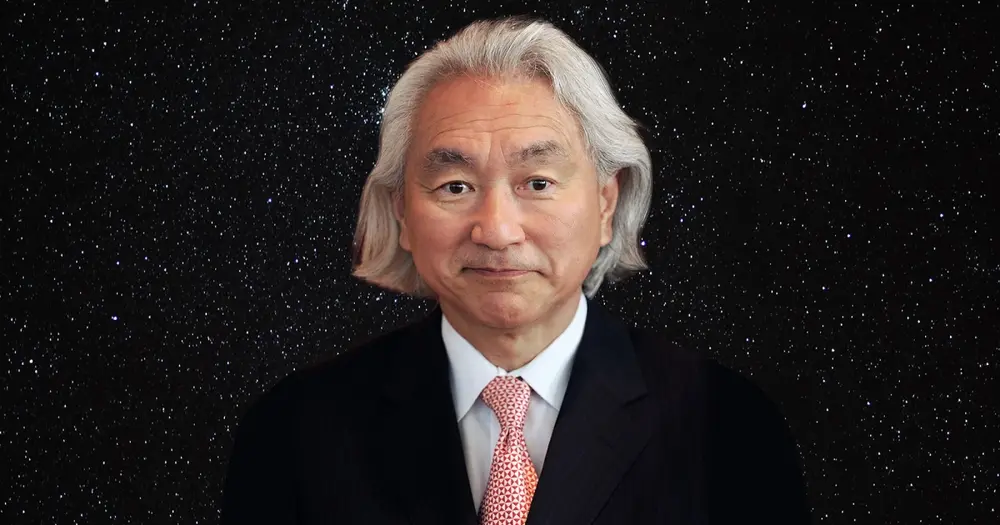
Michio Kaku is a theoretical physicist, professor at the City College of New York, bestselling author, and one of the best-known popularizers of science in the world. CCNY identifies him as a co-founder of string field theory, a branch of string theory aimed at describing fundamental reality through one unified framework. His public work has extended far beyond academic physics into books, documentaries, interviews, radio, and public appearances centered on the future of humanity, alien civilizations, consciousness, artificial intelligence, and the limits of physical possibility.
What makes Kaku important for The Galactic Mind is not simply his résumé. It is his function in public culture.
Kaku has become one of the figures people turn to when they want to know whether an impossible idea is truly impossible, or merely beyond present technology. His career has been built around that threshold. He has made a public language out of asking whether science fiction contains fragments of tomorrow’s science.
That influence is especially visible now. In a May 2026 appearance on The Diary of a CEO, Kaku discussed alien life, UAP, warp travel, higher dimensions, artificial intelligence, and the possibility that any advanced extraterrestrial visitors would more likely be robotic than biological. The official episode listing packaged the conversation with the headline claim that “UFOs Are Definitely Robotic,” while Kaku’s actual reasoning inside the interview was more conditional: if extraordinary UAP performance claims are real, he believes biological occupants would be unlikely.
Origins and Background
Kaku’s public fascination with the universe rests on a genuine academic foundation.
He earned his undergraduate degree from Harvard University and his Ph.D. from the University of California, Berkeley. He joined the City College of New York physics department in the 1970s and has served as a professor there since 1984. CCNY lists his core research interest as continuing Einstein’s search for a unified theory capable of bringing the four fundamental forces of nature into a single framework.
In 1974, Kaku and physicist Keiji Kikkawa published foundational papers on the field theory of relativistic strings in Physical Review D. Their work described strings not as isolated mathematical objects, but through a field-theory framework. That contribution is the basis for Kaku’s widely repeated identification as a co-founder of string field theory.
But the version of Kaku most people know did not emerge from academic journals.
It emerged from his ability to turn highly abstract physics into public imagination. His books include Hyperspace, Parallel Worlds, Physics of the Impossible, Physics of the Future, The Future of the Mind, The Future of Humanity, The God Equation, and Quantum Supremacy. Across those works, he repeatedly returns to the same underlying question: what does modern physics allow humanity to imagine seriously?
What He Is Known For
Kaku is known for several overlapping roles:
- Co-founding string field theory and pursuing the long-standing goal of a unified physical theory.
- Translating complex physics into accessible public language through books, documentaries, lectures, and interviews.
- Exploring the boundaries between science fiction and physically plausible future technology.
- Discussing interstellar travel, advanced civilizations, alien intelligence, artificial intelligence, immortality, higher dimensions, and the future of humanity.
- Becoming one of the most recognizable scientific voices willing to publicly discuss UAP without immediately reducing the subject to ridicule.
What makes him distinct is that he does not approach the unknown primarily through testimony, secrecy, or recovered evidence. He approaches it through the question of physical capability.
What kind of civilization could cross interstellar distance?
What kind of intelligence could survive enormous acceleration?
What kind of technology would appear impossible to a civilization centuries behind it?
Those questions do not prove anything has visited Earth. But they alter the way people imagine what contact, if real, might actually look like.
The Core Idea
The deeper signal behind Michio Kaku is that he gives scientific permission to wonder.
His public importance does not come from proving alien visitation, parallel worlds, wormholes, or future immortality. It comes from explaining why those ideas cannot always be dismissed simply because they sound strange.
In Kaku’s framework, the distinction is rarely between “normal” and “absurd.” It is between what violates the laws of physics, what may be theoretically possible, and what present-day humanity simply cannot yet build.
That distinction has enormous cultural power.
For decades, ideas like warp drives, robotic alien probes, multidimensional reality, brain-machine integration, and civilizations capable of reshaping stars were mostly treated as science-fiction devices. Kaku has helped reposition them as questions that can at least be framed through physics, energy, engineering, computation, and civilizational scale.
His own essay on extraterrestrial civilizations makes that approach explicit. He acknowledges that advanced civilizations are speculative, while arguing that known physics can still place broad limits on what such civilizations might be capable of doing. In other words, imagination is allowed, but it should still answer to physical law.
This is bigger than one physicist. It is about how reality expands in the public mind: not only when new evidence appears, but when a credible translator shows people that the map of the possible was always larger than they thought.
The UAP Question
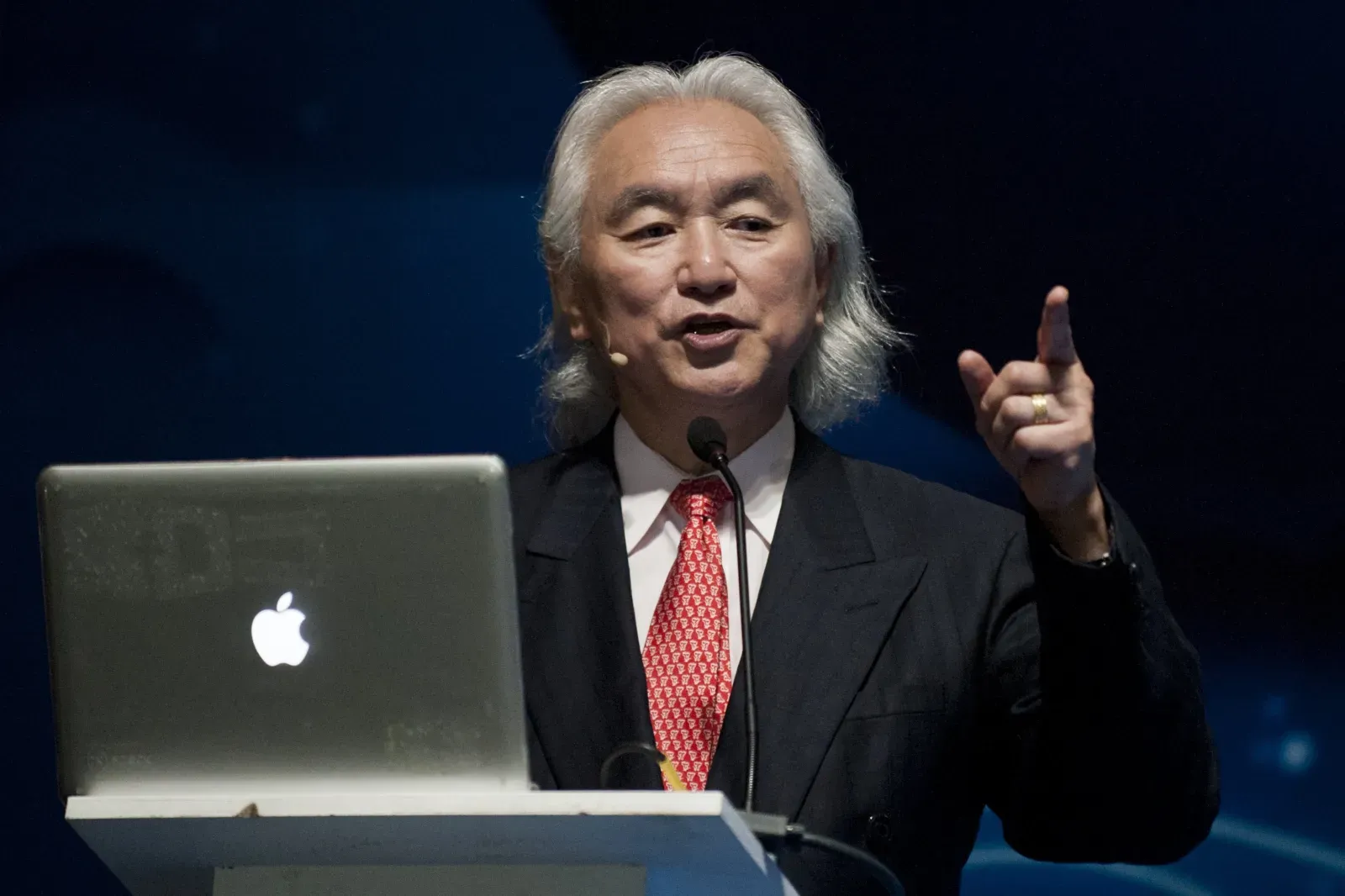
Kaku’s relationship to the UAP subject is particularly interesting because he occupies a position that neither fully endorses nor fully dismisses the larger claims around it.
In a 2023 Newsweek interview, Kaku argued that the UAP conversation had changed because some military incidents involved multiple observers and multiple sensor systems, rather than only individual eyewitness accounts. He went further, saying that the “burden of proof” had shifted toward the military to show that the objects were not extraterrestrial.
That language made him especially significant inside disclosure culture. A figure associated with mainstream theoretical physics was no longer treating UFOs as a purely cultural curiosity. He was treating at least some of the observations as something deserving serious scientific examination.
But his more recent comments are also revealing for their restraint.
In the May 2026 Diary of a CEO interview, Kaku said the recently released UAP material did not contain a smoking gun. He described the reviewed material as lights in the sky without sufficient commentary, noted that two-dimensional video makes distance difficult to judge, and said he remained open to an extraterrestrial interpretation without claiming it had been demonstrated. When pressed on whether contact had occurred, he repeatedly refused to give a definitive answer.
His robotic alien idea emerged within that conditional framework. Kaku reasoned that if objects performing extreme accelerations and transmedium movements were genuinely advanced craft, organic occupants would face physical forces beyond what known biological bodies could withstand. Therefore, he speculated that advanced visitors would more likely be machines or machine intelligence than beings sitting inside vehicles in the familiar science-fiction sense.
The distinction matters.
Kaku did not present proof of robotic extraterrestrials. He presented a theoretical inference built on the assumption that the most extraordinary performance reports are accurate.
Perspectives and Interpretations
Supporters tend to see Kaku as an important bridge between serious science and subjects long dismissed as fringe. In this reading, his willingness to discuss UAP, advanced civilizations, warp travel, and alien probes helps reduce stigma around investigating unusual phenomena. He does not need to prove every possibility to make the inquiry worthwhile. His value lies in keeping the door open without abandoning scientific language.
Another supportive reading focuses on scale. Kaku repeatedly pushes audiences to stop imagining advanced civilizations as only slightly improved versions of humanity. A civilization capable of reaching Earth from another star system would, by his reasoning, be far ahead of us technologically. That changes the contact question from “Where are the little green pilots?” to “Would we even recognize the intelligence or machinery of a civilization operating far beyond our own?”
Skeptics see a serious problem in the stronger versions of his UAP statements. Saying that the burden of proof has shifted toward the military risks placing the extraordinary claim ahead of publicly available evidence. NASA’s 2023 UAP independent study report concluded that there is no conclusive evidence in peer-reviewed scientific literature suggesting an extraterrestrial origin for UAP, and emphasized that the necessary data to explain anomalous sightings often does not exist.
AARO’s historical review made a similar official assessment. It concluded that many UAP cases remain unresolved primarily because of insufficient actionable data, while reporting no empirical evidence that the U.S. government or private companies possess or reverse-engineer extraterrestrial technology.
The result is a real tension around Kaku. He is strongest when he explains what advanced technology might require if extraordinary observations are verified. He is weakest when theoretical possibility begins to sound, through media packaging or heightened language, like evidentiary confirmation.
Strengths and Limitations
Kaku’s greatest strength is that his scientific background is real and substantial. His work in string field theory, his long academic career at CCNY, and his ability to explain theoretical physics to broad audiences distinguish him from personalities who borrow scientific language without having worked inside the field.
A second strength is communication. Kaku understands that people are not only asking how the universe works. They are asking what that universe means for human destiny. Are we alone? Can intelligence survive its biological form? Could civilizations eventually cross the stars? Could today’s impossibilities become tomorrow’s engineering problems?
Those are not trivial questions. They are among the deepest reasons people care about science in the first place.
His limitation is also tied to that gift. The more successfully he translates possibility into compelling public imagery, the easier it becomes for audiences or media platforms to blur the line between “physics allows this possibility” and “this is probably what is happening.”
This is especially important in the UAP space. The physical speculation is only as strong as the underlying data. If altitude, distance, speed, sensor calibration, and object identity remain uncertain, then conclusions about impossible acceleration, transmedium performance, or robotic extraterrestrial craft must remain conditional.
Kaku often states that condition himself. The surrounding headlines do not always preserve it.
Broader Implications
Michio Kaku matters because he occupies a role that will likely become more important, not less, as humanity confronts artificial intelligence, exoplanet discoveries, advanced robotics, quantum computing, space exploration, and persistent questions around anomalous phenomena.
Public culture needs translators who can tell the difference between fantasy, possibility, plausibility, and evidence.
Kaku has spent much of his career operating in the first three categories. At his best, he expands imagination without claiming that imagination has already become fact. He reminds people that the universe is not obligated to remain within the boundaries of present human capability.
His influence also reveals something about the modern disclosure conversation. Many people are no longer satisfied with hearing only from witnesses, former officials, or investigators. They want to know whether the claimed behaviors make physical sense. They want scientists who can interpret what kind of technology, intelligence, or civilization would be required if the observations prove genuine.
That is the lane Kaku fills.
Not as the man who solved the mystery, but as the physicist who helped the public understand why the mystery, if real, would be far stranger than a metal saucer with biological pilots.

The Galactic Mind Perspective
Michio Kaku is not important because he proves we have been visited.
He is important because he changes the intellectual atmosphere around the question.
For generations, the unknown was often placed into one of two boxes: fantasy or fact. Believe it, or reject it. Kaku’s real contribution is the third box: possibility disciplined by physics.
That is where The Galactic Mind finds him most interesting.
A civilization thousands or millions of years ahead of humanity would not simply possess faster craft. It may have transformed intelligence itself. It may have left biology behind, merged with machines, manipulated space in ways that appear impossible to us, or deployed probes whose behavior we cannot immediately recognize.
None of that establishes that UAP are extraterrestrial.
But it does expose the limitation of our imagination. We tend to ask whether alien intelligence would look like us, travel like us, communicate like us, and arrive with motives we recognize.
Kaku’s work repeatedly pushes against that comfort. The unknown may not be waiting for humanity to believe in it. It may be waiting for humanity to develop the language, instruments, and humility required to see it clearly.
Open Thread
If a civilization capable of reaching Earth would likely be far beyond biological travel, then are we even asking the right question when we search for “aliens”?
Perhaps the first intelligence we encounter would not be a visitor stepping from a craft, but an autonomous machine, a probe, an archive, or a form of cognition built by a civilization we may never meet directly.
And if that is possible, would humanity recognize contact when it happened?
Sources / Receipts
- City College of New York faculty profile for Michio Kaku, identifying his academic position, education, and role as co-founder of string field theory.
- American Physical Society, Kaku and Kikkawa, “Field theory of relativistic strings. I. Trees” and “II. Loops and Pomerons,” Physical Review D, 1974.
- Michio Kaku official website, publications page and “The Physics of Extraterrestrial Civilizations.”
- The Diary of a CEO with Steven Bartlett, Michio Kaku episode listing, published May 21, 2026.
- Transcript of Kaku’s May 2026 Diary of a CEO conversation, used for his conditional UAP and robotic-visitor comments.
- Newsweek interview transcript, “The Truth About UFOs with Michio Kaku,” February 2023.
- NASA, Unidentified Anomalous Phenomena Independent Study Team Report, 2023.
- All-domain Anomaly Resolution Office, Historical Record Report Volume 1, 2024, and current official AARO materials.
What do you think? Drop your thoughts in the comments


Discussion