
Case Overview
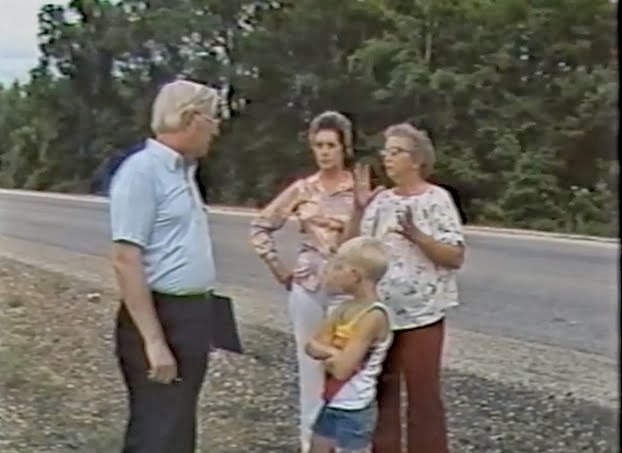
On the night of December 29, 1980, Betty Cash, Vickie Landrum, and Vickie’s grandson Colby told U.S. Air Force officials they encountered a bright, heat-emitting object while driving on Farm to Market Road 1485 between New Caney and Huffman, Texas, sometime between 9:00 and 9:30 p.m. They later described the object as diamond-shaped and said it was accompanied, or soon followed, by multiple twin-rotor helicopters.
The case remains notable because it combines three elements that rarely stay together in one UFO file: named witnesses, reported physical aftereffects, and a real federal lawsuit against the U.S. government. But those same elements also produce the central tension of the case. The witnesses’ suffering appears sincere and well documented in later interviews, while the object, the helicopters, and the exact mechanism of injury never settled into a single verifiable explanation.
What Actually Happened
According to Betty Cash’s August 1981 Bergstrom Air Force Base interview, the group was driving along FM 1485 when they saw an intensely bright object ahead. Cash said the heat and light were strong enough that she hesitated between fleeing and returning to the car. She told interviewers she had to use the bottom of her leather jacket to touch the door handle because it was too hot to grasp directly.
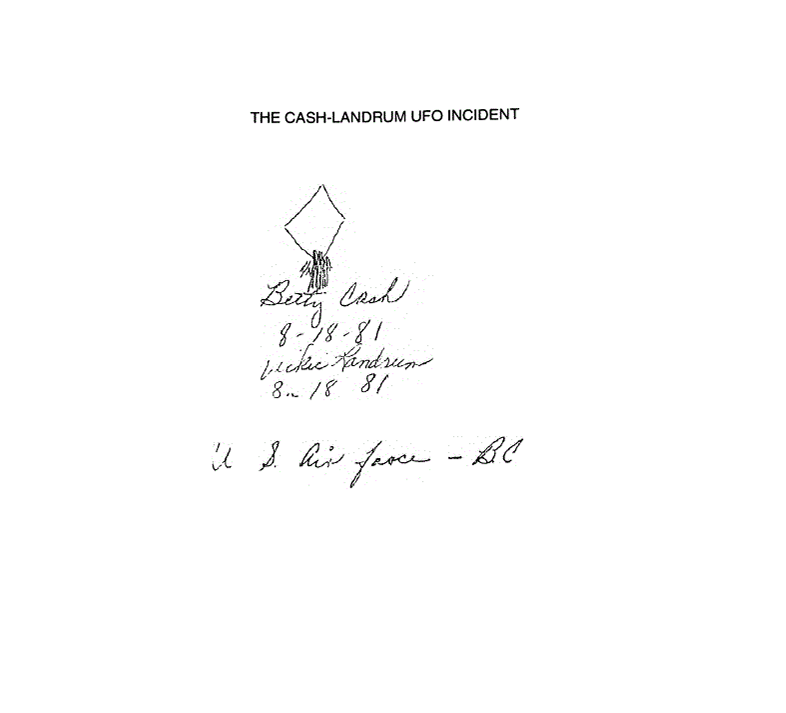
During the same interview, Betty drew what she called a diamond shape, and Vickie agreed with the drawing while adding that flames were coming down from the bottom. Betty described the object as being roughly the size of a large water tower and hovering above the road near tall pine trees.
The helicopter claim became central almost immediately. Betty told Air Force personnel that helicopters were “completely around the object,” that she counted 23, and that they were the twin-rotor type. She also said she saw markings she took to be United States Air Force, though even in the interview her count varied from Vickie’s and she acknowledged the witnesses were hot, sick, and frightened.
The medical side of the case began almost immediately in the witnesses’ telling. In the Bergstrom interview, Betty said she stayed in Parkway Hospital in Houston for about a month, described ongoing headaches, stomach problems, weakness, swelling, and heat sensitivity, and said her family barely recognized her when she was hospitalized. Vickie described blisters, eye irritation, sunlight sensitivity, fingernail loss, nausea, and later hair loss.
The case then shifted from encounter report to accountability battle. Cash and Landrum pursued claims through Bergstrom Air Force Base and later sued the U.S. government for $20 million. By August 21, 1986, the case was dismissed after years of testimony and review because no documentary evidence tied the reported craft or helicopters to the U.S. government.
Key Claims and Evidence
- Witness testimony
- Betty, Vickie, and Colby gave named accounts to Air Force officials in August 1981.
- Betty placed the event on FM 1485 between New Caney and Huffman on December 29, 1980, between 9:00 and 9:30 p.m.
- Betty and Vickie both endorsed a diamond-shaped sketch during the Bergstrom interview.
- Physical and medical claims
- Betty said the door handle was too hot to touch barehanded.
- Betty told investigators Vickie’s hand pressed into a softened dashboard.
- Both women described nausea, heat sensitivity, blistering, eye pain, and later hair loss in the Bergstrom interview.
- Aircraft claims
- Betty said the helicopters were twin-rotor and that she counted 23, while Vickie’s count differed.
- The helicopter presence is why the witnesses pursued a government claim in the first place.
- Paper trail
- The case produced a lengthy Bergstrom AFB interview transcript and later a federal lawsuit.
- It is one of the rare UFO-related cases that moved into a real U.S. courtroom.
Points of Tension
The first tension is sincerity versus verification. The Bergstrom interview strongly suggests the witnesses believed they experienced something real and harmful. Their accounts are detailed, emotionally consistent in places, and tied to concrete complaints. But sincerity is not the same as external proof. Even sympathetic summaries of the case note that no solid independent evidence ever fully substantiated the central claims.
The second tension is injury versus mechanism. The reported symptoms are what make this case feel different from an ordinary close-encounter story. But skeptical review has long pushed back on the popular idea that this was straightforward ionizing radiation sickness. Robert Sheaffer, summarizing earlier medical criticism, noted that analysts argued the timing and survival pattern did not fit classic ionizing radiation syndrome.
The third tension is military appearance versus military denial. The witnesses centered helicopters in their account and explicitly linked them to the U.S. government. Yet later summaries of the case state that no documentary evidence ever emerged connecting the reported helicopters or craft to any government agency, and that the 1986 court dismissal turned on exactly that gap.
The fourth tension is dramatic event versus uncertain location. A later skeptical review argued that neither the witnesses nor investigator John Schuessler could pinpoint the exact site, reducing it to a stretch of road “between a beer joint and some kind of highway warning sign.” That matters because uncertainty about the exact site weakens later efforts to verify scorch marks, collect environmental traces, or reconstruct line of sight.
Perspectives and Explanations
One interpretation is that the witnesses encountered an exotic military craft or test article, possibly one in distress or under escort. This view gains force from the reported heat, the twin-rotor helicopters, and the later decision to seek damages from the government rather than treat the event as purely extraterrestrial. Even in the Bergstrom transcript, Vickie explicitly says she believed it had to be manmade.
A skeptical interpretation is that the case combines real illness, memory drift, uncertain location, and unsupported aerospace assumptions. Sheaffer’s review argues there was no solid independent evidence to substantiate the core claims despite years of searching, and it specifically highlights how much of the case depends on unverified follow-on retellings rather than independently anchored scene evidence.
A middle interpretation is that something real happened, but not enough of it is classifiable now. In that view, the witnesses may have experienced a genuine stimulus and genuine illness, but the leap from those facts to a specific craft, a specific government unit, or a specific radiation mechanism is too large for the surviving evidence. That is an inference, but it is consistent with both the sincerity of the witnesses’ accounts and the later inability to prove causation in court.
Context and Pattern Recognition
Cash-Landrum sits inside a small category of UFO cases that are remembered less for lights in the sky than for claimed bodily effects and legal aftermath. That is why the file remains unusually durable. It is not just a sighting report. It is a roadside encounter that produced a medical narrative, an Air Force interview, and a federal damages claim.
It also fits a recurring pattern in anomaly history: the strongest cases are often the most frustrating. If the witnesses’ story is taken at face value, ordinary explanation struggles. If the government denial and lack of hard corroboration are taken at face value, the extraordinary parts become harder to sustain. The case persists because neither side cleanly erases the other.
Implications
If even part of the witnesses’ account is accurate in its strongest form, the implication is serious. It would suggest an aerial technology capable of intense heat exposure operating in proximity to civilians, with multiple helicopters nearby, and with no public accounting afterward. That would make the case less a folklore file and more a question of hidden aerospace capability and institutional opacity.
If the case is instead a mixture of real illness and mistaken attribution, its implications are still significant. It would show how quickly a dramatic event can harden into a single explanatory story before the evidence is ready, especially when medical distress, military imagery, and fear are all present at once.

The Galactic Mind Perspective
The Cash-Landrum encounter does not endure because it proves one extraordinary answer. It endures because it leaves pressure on multiple answers at once. The witnesses appear earnest. The suffering appears real. The paper trail is stronger than in most roadside UFO files. But the thing that should anchor the whole case, a verifiable cause, never arrives.
That is what makes this a true Case File. It is not just about a diamond-shaped object in the dark. It is about what happens when documented distress meets uncertain attribution. Reality does not collapse neatly into belief or debunking here. It stays under tension.
Open Question
Did Betty Cash and the Landrums encounter a hidden human technology, misread a catastrophic but ordinary event, or experience something that still has no stable category because the evidence never caught up to the harm they believed they suffered?
Credibility Meter
Witness Reliability: 4/5
Three named witnesses gave formal statements, and the Bergstrom interview shows a level of detail that is hard to dismiss casually. But the count of helicopters, exact markings, and some scene details remain dependent on memory under stress.
Physical Evidence: 2/5
There are reported injuries, photos, and claims of heat effects on the car, but no publicly decisive trace evidence tying those effects to a specific craft or exposure source.
Documentation: 4/5
The case has an unusually rich paper trail for a single roadside encounter, including the Bergstrom AFB interview and a federal lawsuit.
Expert Analysis: 2/5
The case has been heavily debated, but there is no consensus explanation that accounts cleanly for the object, helicopters, injuries, and legal failure all at once. Skeptical review has especially challenged the radiation interpretation and the site reconstruction.
Interpretation
Cash-Landrum is a high-tension, medium-credibility case. Its strength lies in its names, documents, and aftermath. Its weakness lies in causation. The witnesses produced a memorable account, but the event never crossed the threshold from dramatic allegation to verified mechanism.
Sources / Receipts
- Transcript of taped interview held at Bergstrom Air Force Base, 17 August 1981, via CUFON.
- Robert Sheaffer, “Between a Beer Joint and a Highway Warning Sign: The ‘Classic’ Cash-Landrum Case Unravels,” Skeptical Inquirer (2014).
- UPI Archives, “Three suing government over UFO radiation” (1985).
- Discovery UK, “Highway Encounter: The Cash-Landrum Incident” (2026 summary of the court outcome and documentary gap).
- Micah Hanks summary citing the 1982 Army IG review and lack of confirmed military helicopter link.
What do you think? Drop your thoughts in the comments


Discussion