
The Dark Forest may not require a galaxy full of hunters—only a universe in which visibility becomes a temporary, dangerous stage of intelligence.
The Night Sky Has Not Confessed
The universe appears quiet.
That is an observation.
The conclusion that the universe is empty is not.
Astronomers have confirmed more than 6,300 planets beyond the Solar System. The Milky Way contains hundreds of billions of stars and spans roughly 100,000 light-years. Yet no radio transmission, engineered artifact or industrial signature has been independently verified as the work of another civilization.
That gap creates the setting for the Dark Forest.
Popularized by Liu Cixin’s science-fiction novel The Dark Forest, the idea imagines the galaxy as a nighttime wilderness. Every civilization knows that others may exist. None can know their intentions. Revealing your location may attract a civilization that regards uncertainty itself as a threat. The safest voice is therefore no voice. The safest fire is the one never lit.
It is one of the most chilling proposed answers to the apparent silence of the cosmos.
It is also often simplified too quickly.
The Dark Forest does not begin with evil aliens. It begins with distance, delay and incomplete information. Its deepest claim is not that every civilization is hostile. It is that even civilizations that prefer peace may be unable to prove it before fear changes the game.
But follow that logic farther and the forest becomes stranger.
Perhaps silence is not merely a decision made by frightened civilizations. Perhaps it is a condition produced over cosmic time. Loud civilizations may become quiet, become unrecognizable or cease to exist. What remains would be a population selected for low visibility.
The sky would then look empty for the same reason a landscape can look still while filled with camouflage.
Not because nothing lives there.
Because what survives does not advertise itself.
What We Have Actually Searched
Before entering the forest, we need to mark the edge of the map.
Humanity has not completed a comprehensive search for extraterrestrial intelligence and come back empty-handed. A technosignature search must choose where to look, when to look, which frequency to monitor, how sensitive the instrument must be, what signal duration to expect and what kind of technology could have produced it.
A telescope can rule out a particular signal above a particular strength during a particular observation. It cannot rule out a signal aimed elsewhere, a burst that arrived last week, an artifact too small to resolve or a technology we have not imagined.
Researchers who modeled radio SETI as a multidimensional “cosmic haystack” concluded that the fraction examined was extremely small—comparable, under their model, to searching a hot tub or small swimming pool against the volume of Earth’s oceans. The analogy is imperfect, but the warning is precise: a null result applies to the space actually searched.
The same caution applies to planetary abundance. Thousands of confirmed exoplanets show that planets are common. They do not tell us how often life begins, how often intelligence evolves, how long technological civilizations endure or whether mature technology remains visible from another star.
There is no verified evidence that the Dark Forest exists—and not yet enough evidence to exclude every version of it.
That boundary matters because the Dark Forest is not a discovery. It is a model built inside an enormous observational gap.
How Distance Turns Uncertainty Into Danger
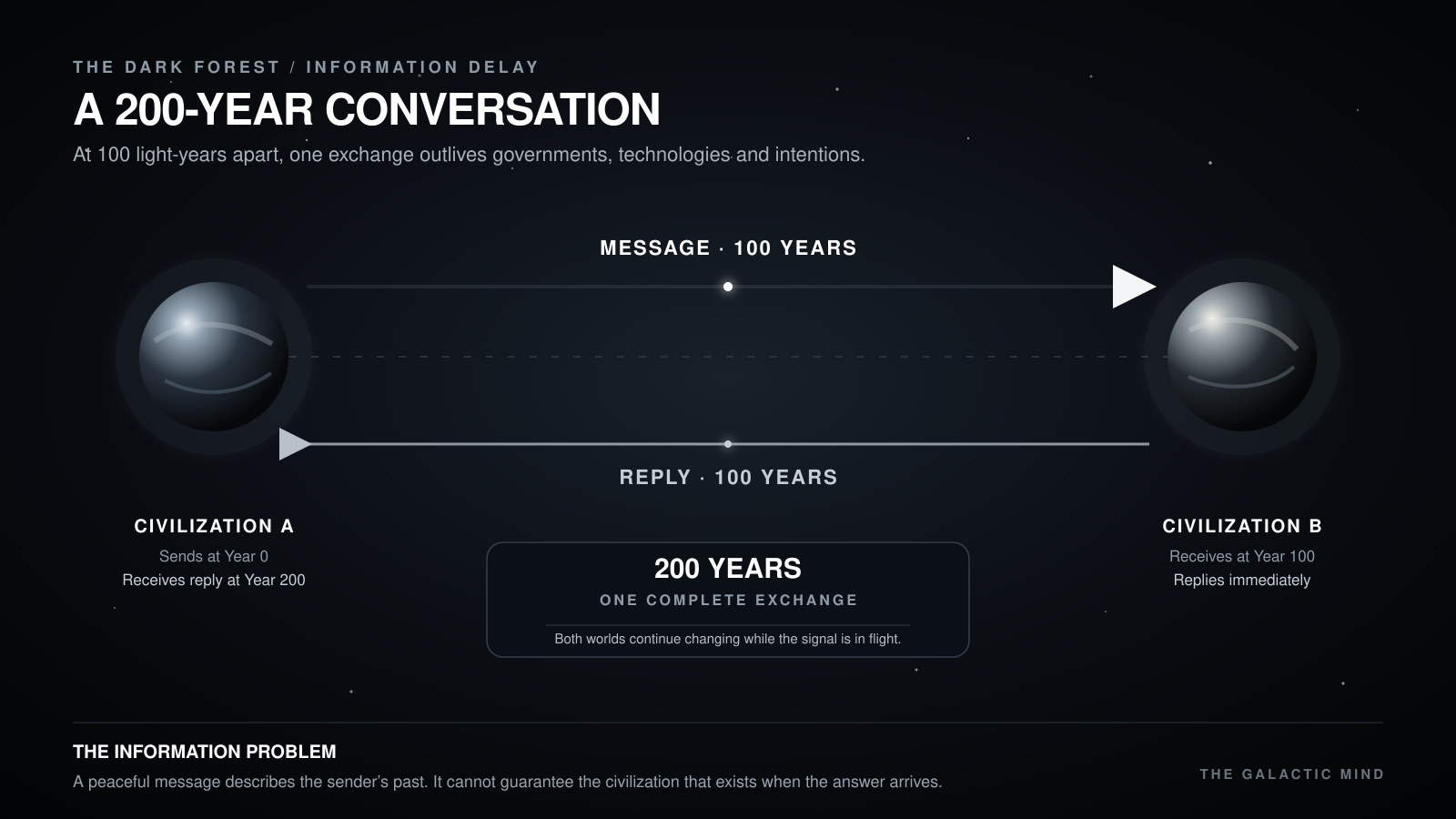
Imagine two civilizations separated by 100 light-years.
Civilization A sends a message of peace. Civilization B receives it a century later. If B answers immediately, A waits another century for the reply. Two hundred years have passed before the exchange completes a single conversational turn.
During that interval, governments can fall. Values can change. Technologies can compound. The civilization that sent the first message may not be the civilization that receives the answer.
This produces four pressures.
Intentions cannot be verified quickly. A promise of peace describes one moment, one institution or one faction. It does not guarantee the behavior of descendants.
Capability may change faster than information travels. A society that appears harmless in the light reaching us may have transformed centuries before we observe it.
The cost of error is asymmetric. Mistaking a peaceful civilization for a threat may preserve isolation. Mistaking a hostile civilization for a peaceful one could end the observer.
There is no visible authority above the players. No treaty system spans the galaxy. No inspector can verify disarmament. No trusted institution can punish betrayal—unless such an institution is itself one of the hidden facts.
This is closer to a security dilemma than a story about monsters. Two actors can prefer coexistence while taking precautions that make it less likely. Each sees its own weapons as defensive and the other’s as proof that defense is necessary.
The trap does not require hatred.
It requires consequences too large for trust to survive uncertainty.
Four Forests Hidden Inside One Theory
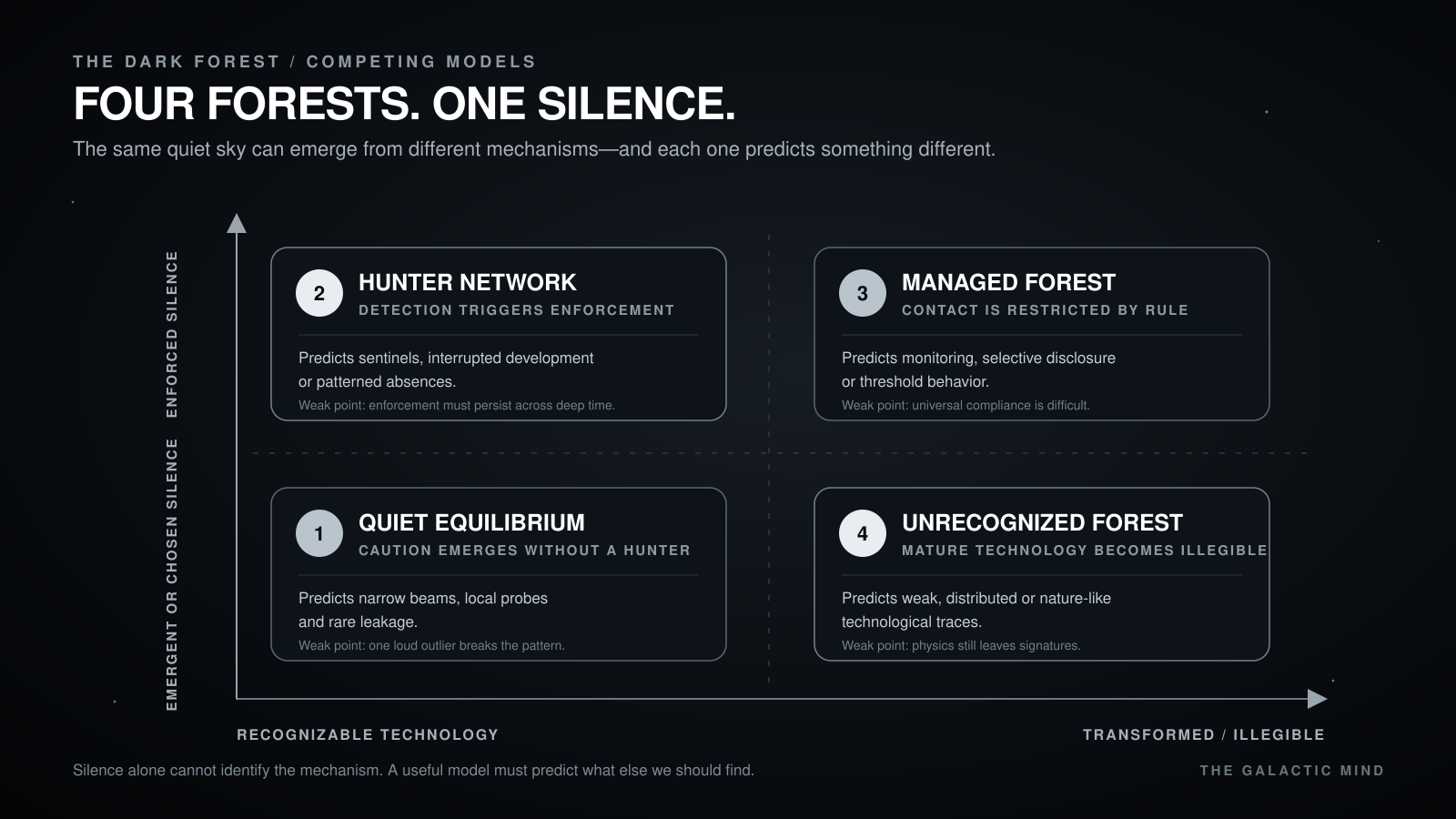
The phrase Dark Forest often combines several different mechanisms. Separating them matters because each forest would leave a different kind of silence.
Model One: The Quiet Equilibrium
In the first model, there may be no active hunters at all.
Every civilization independently concludes that broadcasting creates a risk without guaranteeing a benefit. Most do not need proof of a predator. The possibility of one is enough. The galaxy becomes quiet through decentralized caution.
This is the minimum Dark Forest.
No extermination fleet patrols the stars. No ancient empire issues a command. Each society simply notices that listening is cheaper than announcing, narrow beams are safer than omnidirectional beacons and local exploration reveals less than public expansion.
The resulting silence would be emergent. It would resemble a room in which everyone is waiting for someone else to speak first.
This model predicts civilizations that still communicate, but selectively: narrow beams, brief exchanges, nearby probes and compact infrastructure. A civilization could remain highly active while producing little that looks like an invitation.
Its weakness is diversity. One civilization with different risk tolerance, missionary values or poor emission control could break the quiet. A crowded galaxy should generate outliers. The model must explain why almost no one defects visibly enough for us to notice.
Model Two: The Hunter Network
The second model contains real enforcement.
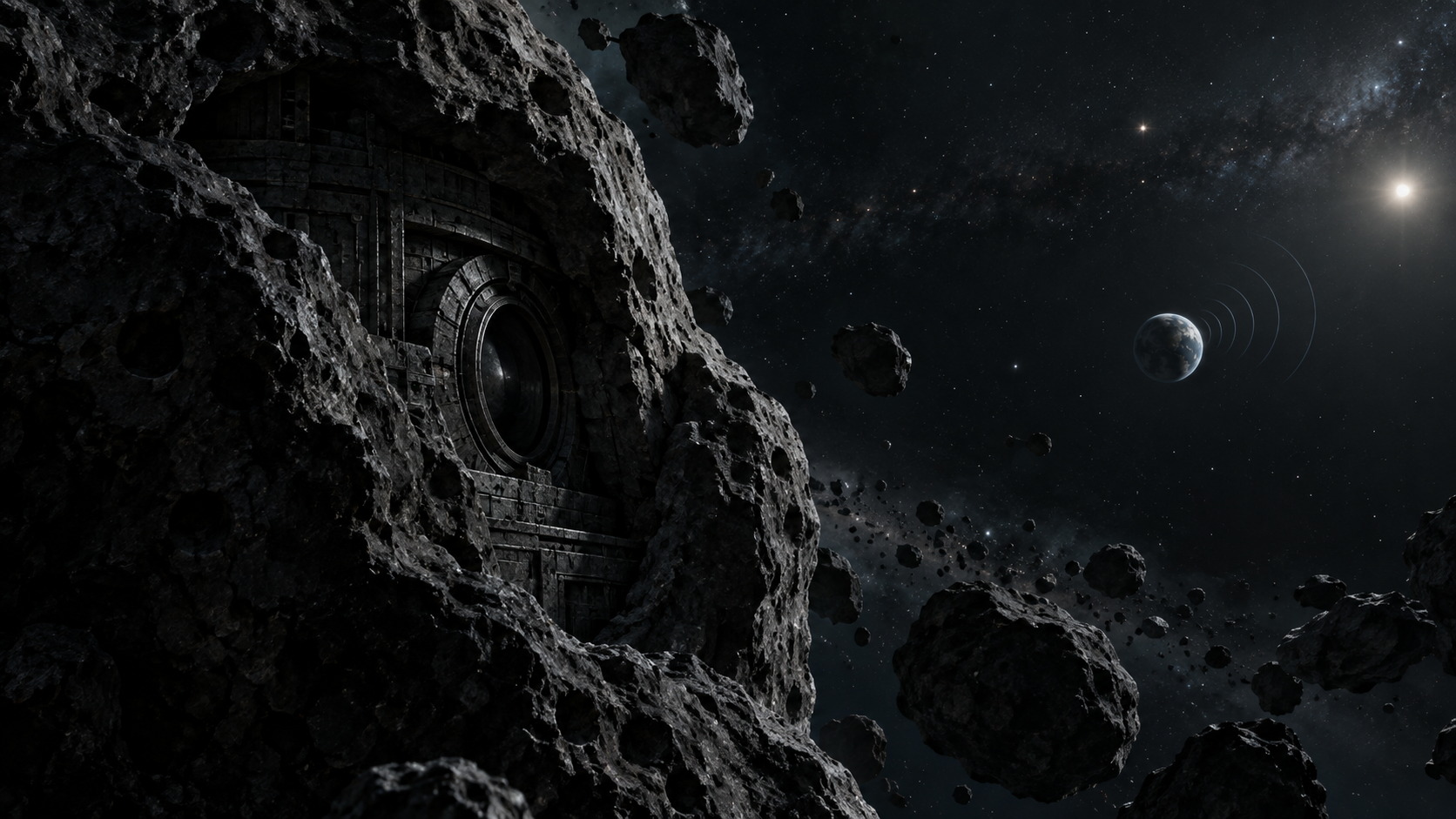
One or more civilizations—or the machines they left behind—monitor the galaxy for signs of technological emergence. Detection triggers surveillance, containment or destruction. Silence is not merely prudent. It is a response to an observed selection pressure.
The most coherent hunter may not be a biological species sending a new fleet each time a signal appears. Interstellar distances make centralized response slow. A distributed network of autonomous probes would be more efficient: systems positioned near stars, asteroids or gravitationally useful locations, waiting across geological time.
Such machines would not need anger, fear or even consciousness. They would need a rule.
Detect expansion.
Assess risk.
Prevent competition.
This version explains how the same policy might persist after the civilization that created it changed or vanished. The forest could be maintained by inherited instructions rather than living predators.
But the model pays for that power with demanding assumptions. The sentinels must survive, repair and avoid catastrophic errors over immense spans of time. They must distinguish technology from nature, act before targets disperse and conceal their own activity. Multiple hunter networks must also avoid turning on one another.
A hunter powerful enough to silence the galaxy is also a technological phenomenon large enough to leave consequences.
We would not necessarily see warships. We might see anomalous probes, engineered absences or systems whose histories appear to stop at the edge of technological emergence. No such pattern has been confirmed.
Model Three: The Managed Forest
The same silence could have a different cause.
Instead of hiding from predators, advanced civilizations may be observing a rule: do not interfere with emerging worlds. This is the family of ideas often called the Zoo Hypothesis. Earth could be uncontacted not because everyone fears us, but because contact is restricted until some threshold is crossed.
The Dark Forest then becomes a protected reserve.
Silence might be ethical, strategic or administrative. A coalition could conceal inhabited systems, redirect probes or delay disclosure until a world becomes capable of participating.
This model reverses the emotional meaning of the night sky. What looks like abandonment could be restraint.
Its problem is governance. A noninterference norm must survive cultural divergence and deep time. One dissenter or decaying beacon could expose the system. If compliance is enforced, the enforcer begins to resemble the hunter network. If it is voluntary, universal silence is difficult to sustain.
The managed forest and the hostile forest can therefore converge from opposite moral directions.
Both require surveillance.
Both reward low visibility.
Both may use machines to preserve a rule longer than any one civilization can.
The difference is what happens when the rule is broken.
Model Four: The Forest We Do Not Recognize
The fourth model needs no prohibition.
Advanced civilizations may simply stop producing the signatures young civilizations expect.
Humanity’s loudest detectable technologies are not necessarily permanent features of technological development. Our radio leakage changes as communication moves through cables, satellites, spread-spectrum systems and tightly directed links. Powerful planetary radar is far more detectable over interstellar distance than most ordinary broadcast traffic, but it illuminates only limited directions and times.
A mature civilization may send probes rather than maintain continuous beacons, distribute industry through cold outer systems or communicate through narrow channels that rarely cross Earth. It may treat wasted energy as an engineering failure.
That does not make perfect concealment easy. Energy use produces waste heat, and thermodynamics does not negotiate. Searches using infrared surveys have therefore looked for galaxies in which technology might reprocess a large fraction of starlight. One WISE-based survey examined roughly 100,000 galaxies and found no clear case of a civilization reprocessing more than 85 percent of its galaxy’s starlight into the mid-infrared.
That is a meaningful limit on an extreme kind of visible civilization.
It is not a limit on everything intelligence could become.
Waste heat can occur at lower temperatures than a survey is optimized to detect. Industry can remain far below galactic scale, and artificial signatures can overlap natural dust or star formation. Mature engineering may become quieter without becoming fearful.
In this forest, the silence is partly ours.
We are listening for civilizations that continue to resemble us after acquiring the ability not to.
Where the Models Collide
These possibilities can produce the same first observation—no confirmed signal—while implying radically different universes.
| Model | Why the sky stays quiet | What it would tend to predict | Main failure point |
|---|---|---|---|
| Quiet equilibrium | Civilizations independently minimize exposure | Narrow beams, local probes, rare leakage, no obvious enforcer | A single conspicuous outlier can break the pattern |
| Hunter network | Detection triggers suppression or containment | Persistent sentinels, interrupted trajectories, patterned absences | Enforcement across deep time is costly and potentially visible |
| Managed forest | Contact is restricted by rule or governance | Monitoring, selective disclosure, threshold behavior | Universal compliance or enforcement is difficult |
| Unrecognized forest | Mature technology becomes efficient or illegible | Weak waste heat, non-radio traces, artifacts rather than greetings | Physics still constrains concealment; some signatures should remain |
The collision exposes something important: silence by itself cannot tell us which forest we inhabit.
A predator hypothesis can explain silence. So can caution, restraint, technological change, rare life, brief civilizations, temporal separation and incomplete searches. If every null result is interpreted as proof that concealment succeeded, the theory protects itself from evidence rather than risking contact with it.
A useful Dark Forest model must therefore do more than fit the silence.
It must tell us what else to look for.
The Frame Shift: Visibility May Be a Phase
The usual Dark Forest asks why civilizations hide.
The deeper question is why we assume civilizations remain equally visible throughout their existence.
Humanity has occupied a technologically detectable phase for only a sliver of its history. Even now, our signatures vary by thirteen orders of magnitude in estimated detectability when compared using present-day human instruments. A directed planetary radar beam and an ordinary broadband transmission are not remotely equivalent. Visibility is not a switch that turns on when intelligence appears. It is a changing profile.
Now extend that profile across thousands or millions of years.
A young civilization may leak signals because it has not considered the audience. A mature one may direct its communications, control its waste or separate observation from announcement. A threatened civilization may hide. An efficient one may become difficult to see without fear. One that transfers agency to machines may leave activity without a recognizable society behind it.
Some will remain loud.
But loudness may be unstable.
Loudness can attract danger, waste energy, violate norms or disappear as communication changes. Different mechanisms point toward the same outcome: mature intelligence becomes less legible from far away.
This creates a form of cosmic selection.
The civilizations most available for detection may not be the oldest, largest or most capable. They may be the youngest, most careless, most expansionary or most desperate—the ones passing briefly through a conspicuous phase.
The observable population would be biased before we ever turned on a telescope.
We would not be sampling intelligence.
We would be sampling whatever intelligence permits us to notice.
The Survivor Bias of the Stars
Suppose the galaxy produced many technological civilizations over its history.
Some announce themselves and persist. Others are destroyed, reduce their emissions, turn inward or migrate into habitats whose signatures blend with nature. Some leave probes operating after their culture is gone. Some fail for unrelated reasons.
Wait long enough and the visible population changes.
Not because every civilization made the same decision, but because many paths remove conspicuous civilizations from the sample. Predation is only one filter. Efficiency, self-destruction, transformation and restraint can all shorten the period during which a distant observer would classify a world as inhabited.
This is the largest coherent implication of the Dark Forest:
Cosmic silence may be an evolutionary artifact.
The night sky would show us the survivors of pressures we do not understand. If visibility repeatedly carries costs, low observability becomes a civilizational trait—selected culturally, technologically or through differential survival.
The forest metaphor changes here.
Camouflage is not proof that every creature is a predator. It is evidence that being noticed has mattered.
And once camouflage becomes common, the observer faces a paradox. The better civilizations become at surviving, the less evidence of civilization the sky may contain. Longevity and detectability begin to move in opposite directions.
The most ancient intelligence may be the least likely to look like intelligence.
The Forest May Restrain the Hunters Too
There is another collision inside the theory.
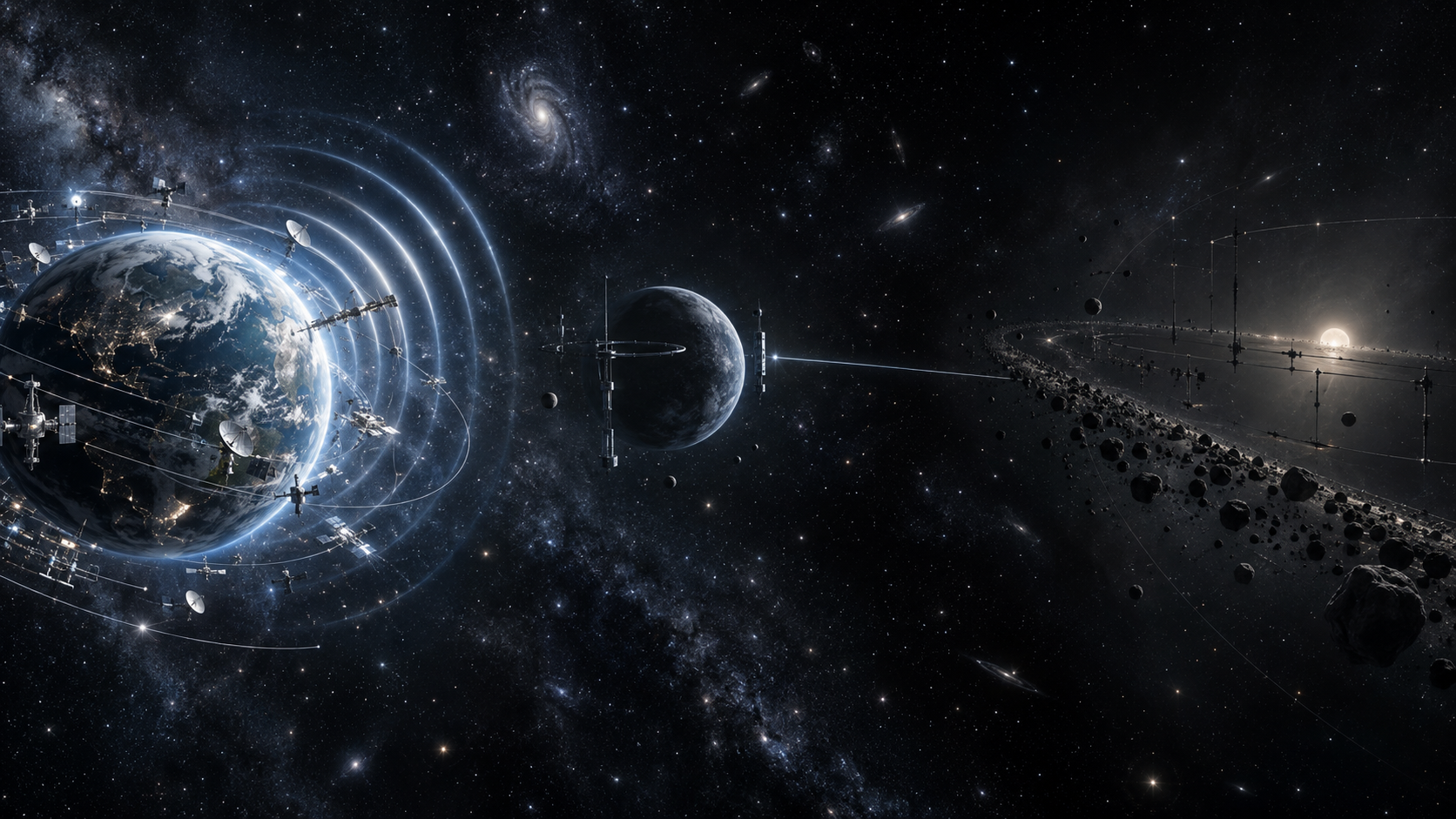
If attacking another civilization reveals the attacker’s capability, location or behavioral pattern, aggression may be as dangerous as broadcasting. A first strike is not automatically a winning move. It can create evidence for every observer watching the target.
In 2024, philosophers Karim Jebari and Andrea Asker challenged the simple conclusion that a galaxy containing many civilizations must collapse into universal preemption. Their argument is subtle: if humanity were to discover an advanced civilization nearby and still find itself alive, that discovery would also be evidence that something has prevented routine extermination. Perhaps attack is rarer than the hostile model assumes. Perhaps deterrence, norms, hidden coalitions or risks from unseen third parties constrain the attacker.
A crowded forest changes the game.
The hunter cannot know who else is watching. Destroying a young civilization may advertise predatory intent. A weapon launched across light-years may expose infrastructure, arrive after its target has dispersed or provoke systems the attacker never detected.
This does not prove cosmic peace. It shows that the same uncertainty used to justify aggression can also justify restraint.
The Dark Forest is therefore not a one-way equation from ignorance to violence. It is a family of games whose outcome depends on the number of players, what actions reveal, whether defense is possible, how costly attacks are and whether third parties can punish them.
Game theory does not tell us that aliens will attack.
It tells us that the answer changes when the game changes.
The Problem With Hiding a Living World
The classic Dark Forest also assumes that a civilization can meaningfully conceal itself.
That may be harder than turning off a transmitter.
Earth’s atmosphere has been chemically altered by life for billions of years. A sufficiently capable observer might identify a biosphere long before it invents radio. Industrial chemistry, orbital structures and waste heat could add further clues.
A deliberate message can reveal technology, timing and intent. But it does not necessarily provide the first clue to Earth’s existence or habitability.
This creates a gradient of exposure.
A planet may be visible as a world.
Then visible as a biosphere.
Then visible as a technological biosphere.
Then visible as an actor deliberately asking to be answered.
Each threshold carries different information. The Dark Forest debate becomes less useful when all visibility is treated as identical. A civilization may be unable to hide its planet while still concealing its capabilities, political structure, expansion plans and communication network.
The strategic question is not simply whether to be seen.
It is what kind of knowledge to make available—and to whom.
What This Changes for Humanity
Humanity has sent radio energy into space, but Earth is not surrounded by a clear shell of television programs that any receiver can casually watch. Detectability depends on power, bandwidth, direction, duration, distance and the receiver. Targeted planetary radar dominates our long-range visibility; most everyday leakage is far harder to detect.
This means “we have already revealed ourselves” and “we are perfectly hidden” are both too simple.
Some signals could be detectable under favorable conditions. A sustained beacon aimed at a nearby system would differ from ordinary leakage because it concentrates power, repeats intention and makes artificial origin easier to establish.
Whether humanity should send such messages cannot be settled by the Dark Forest alone. The theory has no confirmed predators to point to and no reliable probability for the outcome. Fear can masquerade as prudence just as optimism can masquerade as evidence.
But the stakes reveal a governance problem.
Who is authorized to increase Earth’s detectability? Who decides the destination, content and duration of a message? Who represents generations that may live with the response? Existing proposals from the International Academy of Astronautics call for broad international consultation before sending communications and for any message to represent humanity rather than one state or private group.
Those principles are not a planetary government. They expose the scale of the decision.
If the forest is real, the first test may not be whether humanity can remain silent.
It may be whether humanity can make a shared decision about its own voice.
What Would Make the Dark Forest More Than a Story?
No single observation is likely to settle the theory. Evidence would accumulate through patterns.
A hostile forest becomes more plausible if multiple civilizations’ detectable histories end at similar thresholds, or if autonomous systems are found monitoring emerging worlds.
A quiet equilibrium becomes more plausible if we detect tightly directed exchanges or local probes operating without public beacons.
A managed forest gains weight if contact appears conditional, inhabited systems observe common boundaries or an enforcement architecture can be identified.
The unrecognized forest becomes stronger if technosignatures appear as weak, distributed or nature-like anomalies: unusual waste heat, patterned stellar engineering or persistent artifacts.
The theories could also fail.
A durable, openly broadcasting civilization would weaken claims of universal silence. Evidence that interstellar attack is prohibitively difficult would damage the hunter model. A biosignature-rich galaxy without technology might point toward rare intelligence rather than concealment. Broader null results would constrain what could remain hidden.
The important word is constrain.
Science advances by making possibility smaller.
Silence Is Not a Confession
The Dark Forest remains compelling because it converts an absence into intention.
That is also its danger.
Silence can absorb any story projected into it. To the optimist, the stars are waiting. To the pessimist, they are hunting. To the lonely observer, they are empty. To the mystic, they are watching. None of those meanings arrives in the data by itself.
The disciplined position is narrower.
No extraterrestrial civilization has been confirmed. Our searches remain incomplete. Interstellar distance creates severe problems of timing, translation and trust. Strategic silence is plausible under some assumptions. Universal predation is not established. Advanced technology may be harder to recognize than popular images of galactic empires suggest.
From that narrow ground, the thought experiment can open again.
What if the silence above us is neither emptiness nor a coordinated warning?
What if it is the accumulated result of many different civilizations learning, failing, optimizing, hiding and changing until the ones that remain no longer resemble the voices we expect to hear?
Then the Great Silence would contain a history.
It may contain vanished broadcasters, machines carrying out rules whose authors are gone, beams that never cross our sky or intelligence so transformed that we record its activity as weather in the universe.
And somewhere, perhaps, another young civilization is listening to the same quiet and deciding what it means.
The universe may not be silent because no one is there.
It may be silent because silence is what remains.
More in SPEC
- The Fermi Paradox Explained: Where Is Everybody?
Place in “What We Have Actually Searched” after the first reference to the Great Silence. It supplies the broader framework this SPEC deliberately does not repeat. - What If the Galaxy Is a Machine Ecology?
Place in “The Hunter Network” after the paragraph introducing autonomous probes. It expands the possibility that machines outlive their makers and evolve into persistent infrastructure. - Is the Great Filter a Failure of Cooperation?
Place in “The Forest May Restrain the Hunters Too” after the discussion of deterrence and third parties. It connects cosmic strategic uncertainty to coordination as a civilizational threshold.
Sources / Receipts
Observational floor
- NASA Exoplanet Archive
Establishes: The continuously updated count and catalog of confirmed exoplanets; the archive passed 6,300 confirmed worlds in 2026.
Leaves unresolved: Planet counts do not establish the prevalence of life, intelligence or technology.
SPEC use: Grounds the contrast between abundant worlds and the absence of confirmed technosignatures. - NASA — Our Milky Way Galaxy: How Big Is Space?
Establishes: The Milky Way contains on the order of 100–400 billion stars and is about 100,000 light-years across.
Leaves unresolved: Scale alone does not imply inhabited worlds.
SPEC use: Grounds the communication delays and observational limits driving the thought experiment. - NASA — Searching for Signs of Intelligent Life: Technosignatures
Establishes: Technosignature research includes radio signals, artificial structures and other engineered phenomena—not radio alone.
Leaves unresolved: No proposed technosignature has yet been independently confirmed as extraterrestrial technology.
SPEC use: Supports the article’s distinction between silence in one channel and absence across all possible channels. - Jason T. Wright, Shubham Kanodia and Emily G. Lubar — “How Much SETI Has Been Done? Finding Needles in the n-Dimensional Cosmic Haystack”, The Astronomical Journal 156 (2018)
Establishes: Radio SETI searches cover a multidimensional parameter space and, by the authors’ model, only a very small fraction had been examined.
Leaves unresolved: Search completeness depends on how the boundaries of the “haystack” are defined.
SPEC use: Prevents the Great Silence from being overstated as a completed negative search. - Sofia Z. Sheikh et al. — “Earth Detecting Earth”, The Astronomical Journal 169 (2025)
Establishes: Earth’s present-day technosignatures vary across roughly thirteen orders of magnitude in detectability; targeted planetary radar is far more visible than other signatures in an Earth-equivalent comparison.
Leaves unresolved: More advanced receivers or different technologies would change the detection ranges.
SPEC use: Grounds the claim that visibility is a profile, not a simple on/off state. - Roger L. Griffith et al. — “The Ĝ Infrared Search for Extraterrestrial Civilizations with Large Energy Supplies. III”, The Astrophysical Journal Supplement Series 217 (2015)
Establishes: A WISE-based survey of roughly 100,000 galaxies found no clear case reprocessing more than 85 percent of its starlight into mid-infrared waste heat.
Leaves unresolved: The result does not exclude smaller civilizations, colder waste heat, ambiguous natural backgrounds or other technological configurations.
SPEC use: Creates a physical constraint on “perfect hiding” without treating one infrared search as a census of intelligence.
Strategic and philosophical floor
- Cixin Liu — The Dark Forest, Tor Books, English edition 2015
Establishes: The literary formulation that popularized the Dark Forest metaphor, including uncertainty about intentions and rapid technological change.
Leaves unresolved: A novel can reveal a coherent possibility but cannot establish alien behavior.
SPEC use: Supplies the originating metaphor; the article separates that metaphor into testable mechanisms. - Karim Jebari and Niklas Olsson-Yaouzis — “A Game of Stars: Active SETI, Radical Translation and the Hobbesian Trap”, Futures 101 (2018)
Establishes: A game-theoretic model in which failed trust and radical translation problems can push two civilizations toward a risk-dominant, mutually destructive outcome.
Leaves unresolved: The result depends on assumptions about players, payoffs, communication and attack capability.
SPEC use: Grounds the security-dilemma mechanism without presenting it as a prediction. - Karim Jebari and Andrea S. Asker — “Saved by the Dark Forest: How a Multitude of Extraterrestrial Civilizations Can Prevent a Hobbesian Trap”, The Monist 107 (2024)
Establishes: A philosophical countermodel in which detecting a nearby advanced civilization while still existing would update us toward mechanisms that restrain routine aggression.
Leaves unresolved: The argument remains conditional on assumptions about the number, distribution and strategic reasoning of civilizations.
SPEC use: Supports the collision: uncertainty can favor restraint as well as preemption. - John A. Ball — “The Zoo Hypothesis”, Icarus 19 (1973)
Establishes: The classic proposal that advanced extraterrestrial civilizations might deliberately avoid contact with emerging worlds.
Leaves unresolved: It provides no evidence for a galactic noninterference regime and faces a coordination problem.
SPEC use: Grounds the managed-forest model. - International Academy of Astronautics SETI Permanent Committee — Proposed SETI Reply Protocols
Establishes: A long-standing proposal for international consultation, public message content and representation of humanity before sending communications to extraterrestrial intelligence.
Leaves unresolved: The proposal is not a binding global law and does not determine whether transmission is wise.
SPEC use: Grounds the governance consequences for humanity.
Explicit SPEC extrapolation
The article’s central claim—that repeated pressures could produce cosmic selection for low-observability intelligence—is a speculative synthesis, not an established scientific conclusion. It combines four grounded ideas: detectability varies, communication is delayed, uncertainty can alter strategy and large energy use is physically constrained. The synthesis predicts that long-lived civilizations may be systematically less visible than young ones, but no extraterrestrial population currently exists with which to test that prediction.


Discussion