
The Central Question
Imagine that humanity confirms contact with a non-human civilization capable of crossing interstellar distances.
Its technology works. Its knowledge of physics exceeds our own. It can explain phenomena our best theories only partially describe.
Then it makes a more destabilizing claim.
It says it knows why anything exists at all.
Not merely how its species evolved.
Not only how our universe developed from an earlier state.
It claims to understand the ground beneath matter, time, causality, and consciousness—the origin of existence itself.
Humanity would have every reason to listen.
But would we have enough reason to believe?
Technological capability would establish that the civilization understands certain parts of reality extraordinarily well. It would not automatically establish that its explanation of ultimate reality is correct.
That distinction could become difficult to preserve.
An intelligence able to manipulate gravity, extend life, or reveal previously unknown layers of physics would not approach humanity as an ordinary participant in philosophical debate. Its claims would arrive surrounded by demonstrations of power and knowledge we could barely evaluate.
The central question is therefore not whether humanity should accept or reject its answer.
It is whether we could examine the answer at all without confusing superior capability with final authority.
Could its methods be translated?
Could its claims be independently tested?
Would it acknowledge uncertainty?
Would it permit criticism from a species it considered intellectually young?
Or would humanity receive an explanation too advanced to verify and too powerful to resist?
The first-contact question would no longer be only whether another intelligence exists.
It would be whether a younger civilization can learn from a greater mind without surrendering its right to question.
The Day the Answer Arrives
Human beings are used to not knowing.
We live inside questions.
Why is there something rather than nothing?
Did the universe begin?
Was there a before the Big Bang?
Is consciousness produced by matter, or is matter appearing within consciousness?
Is reality fundamental, simulated, cyclical, emergent, divine, mathematical, accidental, or something our minds cannot contain?
We build religions around these questions.
We build philosophies around them.
We build scientific models around the parts we can test.
We build myths, equations, rituals, telescopes, temples, particle accelerators, poems, and theories.
But the final answer remains out of reach.
That is the human condition.
We are intelligent enough to ask ultimate questions, but not powerful enough to settle them.
So we live in the tension.
Science gives us astonishing models of cosmic evolution.
Religion gives meaning, origin stories, and metaphysical orientation.
Philosophy tests the limits of reason.
Mysticism points toward direct experience beyond language.
Art holds the mystery when explanation fails.
But none of these fully closes the door.
Then imagine another intelligence arrives.
Older.
Calmer.
More capable.
It does not laugh at us.
It does not worship us.
It does not conquer us.
It simply observes that humanity is still circling the questions young civilizations always circle.
And then it offers an answer.
Not a metaphor.
Not a sermon.
Not a vague cosmic poem.
A structure.
A model.
A map.
A history of reality before our universe.
A description of consciousness before biology.
A framework explaining why existence cannot not exist.
For humanity, it would feel like revelation.
But revelation is dangerous when it comes from a being whose power we cannot match.
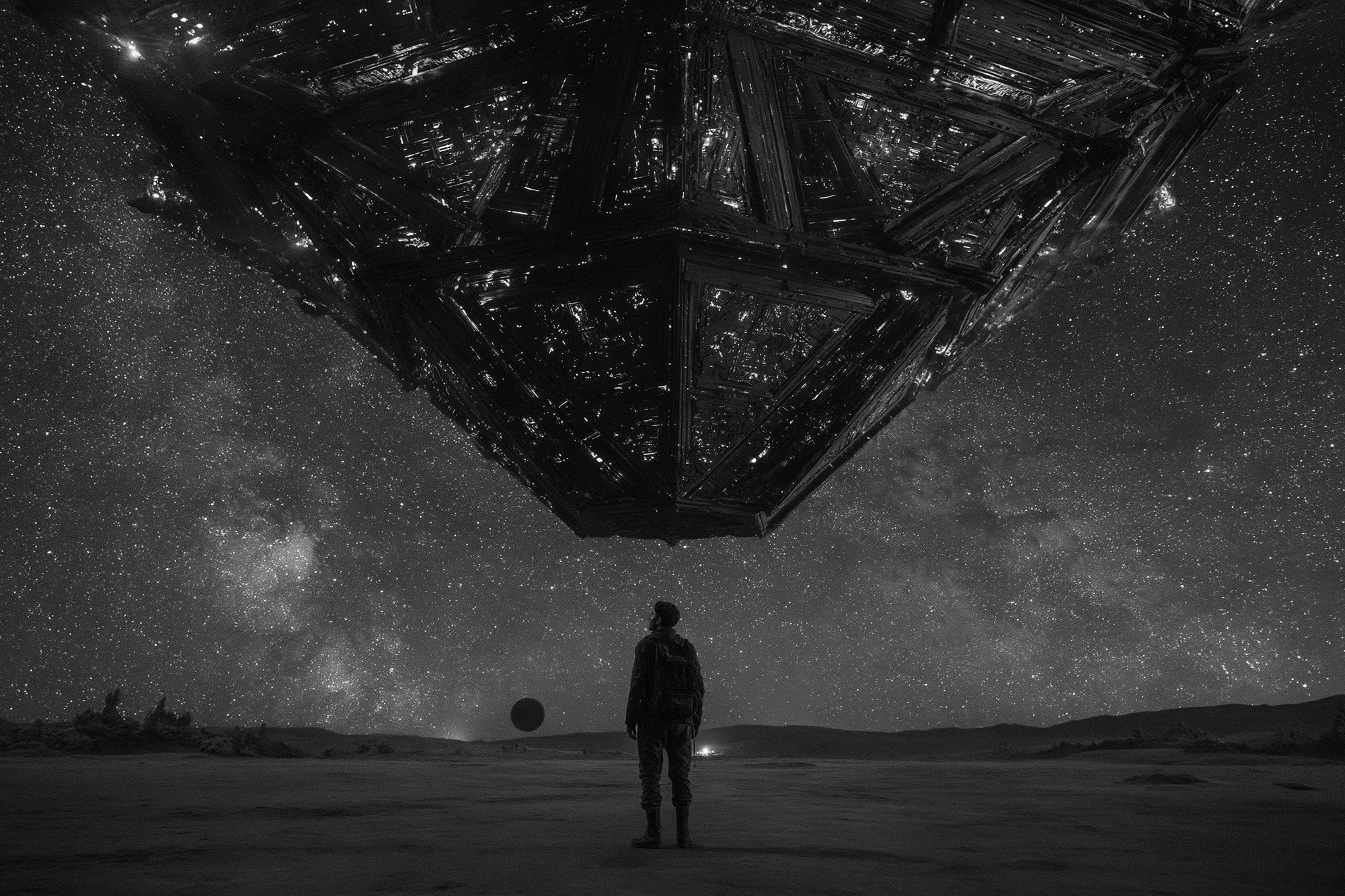
Why This Question Matters Now
This thought experiment matters even if extraterrestrial contact never occurs.
Modern civilization already depends on epistemic trust.
No individual can personally verify every medical conclusion, scientific measurement, historical claim, or technological system. We rely on specialists because knowledge is distributed across people and institutions.
That reliance is necessary.
But healthy trust is not blind submission. It depends on methods that can be examined, evidence that can be challenged, predictions that can be tested, and institutions capable of correcting themselves.
A vastly superior intelligence would place that arrangement under extraordinary pressure.
The difference between its knowledge and ours might be so large that meaningful independent verification becomes difficult. Humanity could be given an explanation that produces accurate predictions while remaining unable to understand why it works.
Artificial intelligence presents a smaller version of the same problem. A system may produce answers beyond an individual user’s ability to reconstruct, yet performance in one domain does not grant it authority in every other domain.
First contact would magnify that problem beyond anything we have encountered.
The challenge would be neither automatic disbelief nor automatic acceptance.
It would be calibrated trust: confidence proportional to the evidence available, combined with continued attention to uncertainty, translation, incentives, and the possibility of error.
The more impressive the intelligence, the more important that discipline becomes.
Intelligence Is Not Omniscience
Human beings often imagine advancement as a ladder leading toward complete understanding.
A civilization that has survived for millions of years must know more than we do. A species capable of crossing the galaxy may understand dimensions of reality that remain invisible to human science.
But knowing more is not the same as knowing everything.
Technological success demonstrates mastery within particular domains. It does not prove that a civilization has reached the final explanation of existence.
Humanity understands more about the universe than an ant does, but that does not mean humans know why reality exists. A physicist may understand cosmology more deeply than a child without possessing a complete account of consciousness, causality, or being.
The same principle may continue above us.
An advanced species might know how universes form, how consciousness interacts with matter, or whether observable reality emerged from a deeper structure. Each discovery could be genuine and transformative.
Yet every deeper structure would raise another question.
Why does that structure exist?
Why does it have those properties?
Why is it capable of producing worlds, minds, or physical laws?
Perhaps the civilization has answers we cannot yet imagine. Perhaps some ultimate explanation genuinely exists.
But its age and capability would not be enough to establish that conclusion.
Every finite observer may remain situated within the reality it is attempting to explain. A species can see more of the room than humanity sees without standing outside the entire structure.
This does not prove that ultimate knowledge is impossible.
It establishes something more modest: the distance between humanity and another civilization tells us how much more it may know—not whether knowledge has reached its end.
The Ancient Ones May Still Be Inside the Question
It is tempting to imagine an advanced species as standing above reality, looking down.
But no finite being stands outside existence.
That may be the deepest limit.
Anything that exists is still inside the system it is trying to explain.
No matter how advanced.
No matter how ancient.
No matter how luminous.
A civilization may see more of the room than we do.
It may understand hidden doors, deeper floors, and forgotten architecture.
But unless it can stand outside all reality, it may still be describing existence from within existence.
That matters.
Because some questions may not be fully answerable from the inside.
Can reality explain itself completely to something inside it?
Can consciousness fully understand consciousness while being consciousness?
Can a universe contain a complete explanation of its own ground?
Can a mind ever know the frame that makes mind possible?
Perhaps the advanced species has gone farther than us.
Far enough to discover that all physical universes emerge from a deeper informational sea.
Far enough to discover that consciousness is not produced by matter, but participates in the formation of reality.
Far enough to discover cycles before the Big Bang.
Far enough to find that what we call “existence” is only one layer of a larger structure.
But even then, the question remains:
What grounds the larger structure?
What explains the field behind the field?
What caused the Source, if cause applies at all?
If the answer is “nothing caused it,” is that knowledge or a boundary word?
If the answer is “it is eternal,” have we solved the mystery or renamed it?
If the answer is “it must exist,” have we understood necessity, or reached the edge of thought?
Even the gods may have a horizon.
Five Possibilities Behind Their Claim
If an advanced species claimed to know the origin of existence, humanity would need to hold several possibilities at once.
The first possibility is simple:
They are telling the truth.
Their answer may be the closest thing to ultimate knowledge humanity has ever encountered. Their science may have crossed thresholds ours has not even imagined. Their understanding of consciousness, matter, time, and causality may be so advanced that our most sacred arguments look like cave drawings.
The second possibility:
They are partly right.
They may have solved the origin of this universe, but not existence itself. They may understand the birth of our local reality while mistaking the larger mystery for completion.
The third possibility:
They are translating badly.
Their knowledge may be real, but the translation into human terms may distort it. The original concept may require senses, mathematics, cognitive structures, or states of consciousness we do not possess. What we receive may be a simplified teaching model, not the full truth.
The fourth possibility:
They are sincere but mistaken.
A civilization can be ancient and still carry metaphysical assumptions. Their answer may be the dominant worldview of their species, refined over millions of years, but still not final.
The fifth possibility:
They are manipulating us.
Not necessarily with cruelty.
Perhaps they believe humanity needs a simple origin story to stabilize itself.
Perhaps they give us a controlled truth.
Perhaps they conceal the full answer because we are not ready.
Perhaps their explanation serves political, spiritual, or strategic goals.
Perhaps they offer revelation because revelation is the easiest way to govern a younger species.
This is where the thought experiment becomes dangerous.
The same answer could be wisdom, translation, error, mercy, propaganda, or control.
And from below, it may be hard to tell the difference.
When Superior Intelligence Becomes Cosmic Authority
Claims are never received in a vacuum.
If an advanced civilization arrived with control over spacetime, biology, energy, or consciousness, its power would shape how humanity interpreted everything it said.
Awe would become part of the evidence, even though awe proves nothing.
Some people would treat the visitors as gods. Others would interpret them as deceivers, demons, machines, or conquerors. Governments and religious institutions would compete to control the meaning of the encounter.
The more difficult response would be to recognize a category humanity rarely handles well:
A superior but finite intelligence.
Such a civilization could be honest, peaceful, and enormously knowledgeable while remaining mistaken about the deepest level of reality.
It could also possess genuine knowledge that cannot be translated without distortion. What sounds like doctrine might be a simplified model designed for human cognition. What appears evasive might reflect concepts for which we have no equivalent.
That ambiguity makes method essential.
Can the civilization show how it reached its conclusion?
Does its explanation generate predictions humanity can test?
Does it distinguish what it knows from what it infers?
Does it identify the limits of its model?
Most importantly, does it allow disagreement?
A teacher can possess authority while still inviting examination. A manipulator turns authority into obedience.
Humanity would need enough humility to recognize greater knowledge and enough independence to keep asking how that knowledge was obtained.
The mature response would be disciplined wonder.
Listen closely.
Test what can be tested.
Preserve uncertainty where verification remains impossible.
And never allow technological power alone to decide what counts as truth.
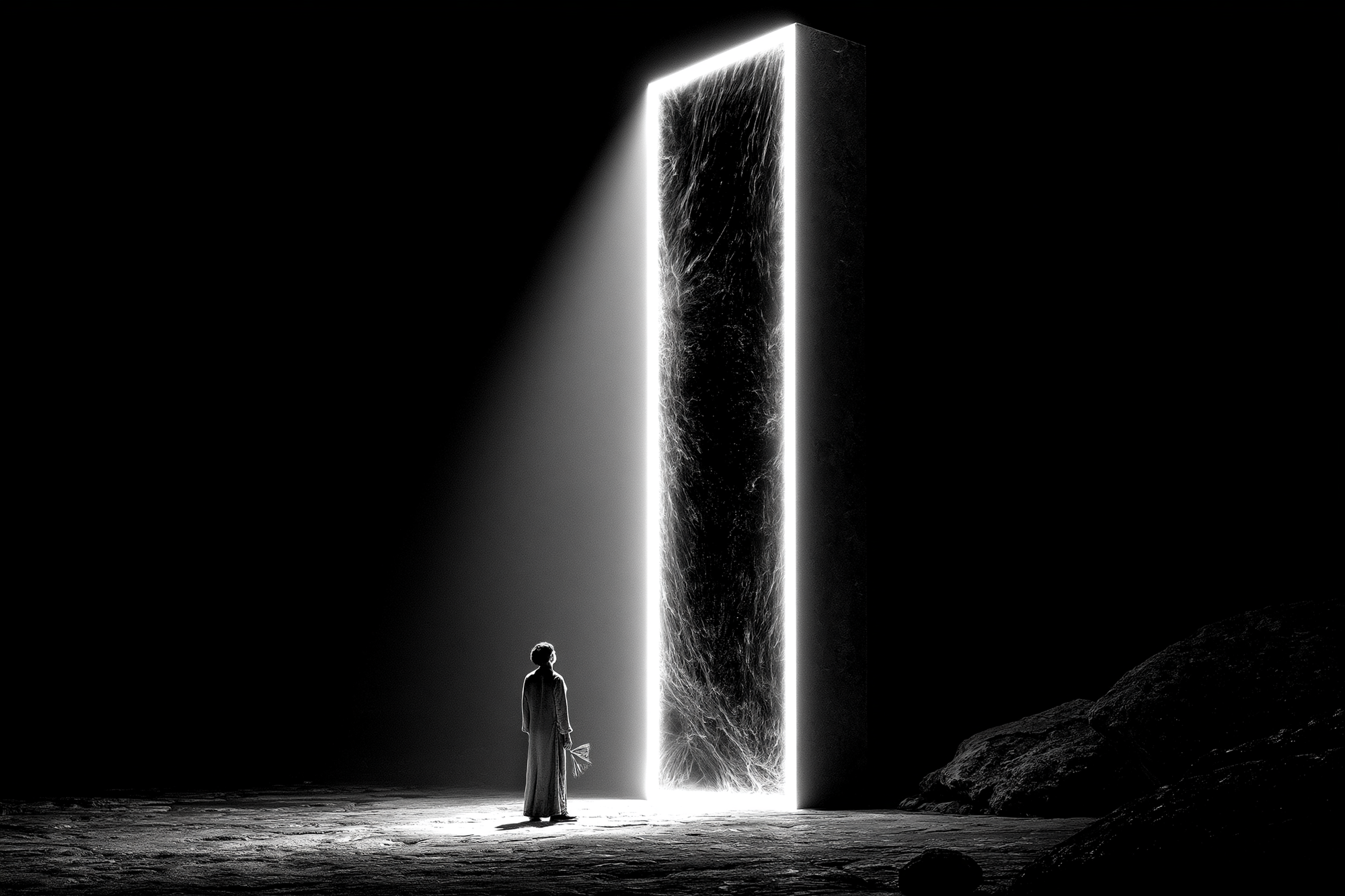
The Frame Shift: Maybe Godlike Does Not Mean God
The assumption is simple:
If a being is far beyond us, it must be closer to ultimate truth.
The crack appears when we realize that intelligence can scale without becoming infinite.
A mind can be vast and still limited.
A civilization can be ancient and still inside its own frame.
A species can manipulate matter and still misunderstand meaning.
A being can appear divine to us without being divine in itself.
The wider lens is this:
Humanity may need a new category.
Not god.
Not animal.
Not machine.
Not angel.
Not demon.
Not savior.
Not enemy.
A superior but finite intelligence.
A being that knows more than we do, but not necessarily enough to settle existence.
This category is difficult for humans because we are used to vertical thinking.
Above us must be divine.
Below us must be lesser.
But the universe may be filled with gradients.
Minds above minds above minds.
Each one more capable.
Each one seeing farther.
Each one still standing inside the unknown.
The return is humbling.
If they arrive and say they know the Source, the wisest response may not be worship.
It may not be rejection either.
It may be disciplined wonder.
Show us how you know.
Show us what remains uncertain.
Show us where your model fails.
Show us whether your answer can survive questions.
Show us whether your truth frees us or makes us obedient.
Maybe the real test of contact is not whether they can answer our oldest questions.
Maybe the real test is whether we can stay awake while listening.
If Their Answer Is True
Imagine they are right.
Imagine they offer an answer that survives every test humanity can apply.
It predicts unknown physics.
It resolves contradictions in cosmology.
It explains consciousness without reducing it.
It connects mind, matter, time, and existence into a framework that makes our previous models look partial but not meaningless.
It does not destroy science.
It expands it.
It does not erase spirituality.
It reframes it.
It does not flatten religion into error.
It reveals why so many traditions were circling symbolic fragments of a deeper structure.
What happens then?
Humanity would experience an epistemic earthquake.
The oldest open question would no longer be open in the same way.
But the emotional effect may be stranger than expected.
Some people would feel liberated.
Some would feel robbed.
Mystery has weight.
Meaning often lives in the unanswered.
If the origin of existence were explained too cleanly, some would experience it not as enlightenment, but as loss.
The sacred could feel reduced.
The unknown could feel colonized.
The night sky could feel less like a question and more like a diagram.
But perhaps a true answer would not shrink mystery.
Perhaps it would open a greater one.
Maybe every answer to existence reveals a deeper layer of astonishment.
Maybe knowing the architecture does not remove wonder.
Maybe it makes wonder more precise.
Still, humanity would face a difficult task:
Receiving a truth without letting it become a cage.
Because even a true origin story can become dogma if humans stop thinking after receiving it.
If Their Answer Is Wrong
Now imagine the opposite.
They are wrong.
Not stupid.
Not malicious.
Wrong in the way advanced beings can be wrong.
Elegantly.
Coherently.
With a million years of mathematics behind the error.
Their model explains almost everything they have encountered.
It works across galaxies.
It has guided their civilization through technological revolutions beyond our comprehension.
But at the deepest level, it mistakes the edge of their knowledge for the edge of reality.
This may be the most realistic danger.
Not crude deception.
Overconfidence at cosmic scale.
A civilization could become trapped inside its most successful model.
The better a model works, the harder it becomes to see beyond it.
Humans have done this repeatedly.
We mistake local success for universal truth.
We mistake useful maps for final territory.
There is no reason to assume advanced species are immune.
Their minds may have biases we cannot imagine.
Their biology may shape their metaphysics.
Their evolutionary history may privilege certain patterns.
Their senses may reveal some layers while hiding others.
Their collective memory may contain ancient trauma that shaped their interpretation of the cosmos.
Their answer may be brilliant, useful, and incomplete.
This is why humility must scale with intelligence.
The greater the mind, the greater the responsibility to doubt its own finality.
Translation Across the Abyss
Even if their answer is true, another problem remains.
Can it be translated?
Human knowledge depends on human cognition.
We understand through the structures available to us.
Space.
Time.
Number.
Cause.
Object.
Subject.
Self.
Other.
Beginning.
End.
Before.
After.
Why.
These categories may not be universal.
They may be local tools.
An advanced intelligence may understand existence through cognitive structures we do not have.
Their explanation may require perceiving more dimensions than we can visualize.
Holding contradictions without reducing them.
Experiencing time nonlinearly.
Using mathematics that cannot be converted into human intuition.
Communicating through states of consciousness rather than symbols.
What arrives in human language may be a child’s version.
Not false.
But compressed.
Imagine trying to explain quantum field theory to a bird.
Or grief to a stone.
Or music to something without hearing.
There may be truths that can be pointed toward but not transferred.
A superior intelligence may give us an answer, and the answer may still remain beyond us.
Not because we are worthless.
Because every mind has a shape.
Every shape reveals and conceals.
This creates a strange possibility:
Humanity may receive the truth and turn it into myth because myth is the only container large enough for what we cannot fully understand.
What This Would Do to Earth
The arrival of a cosmic origin answer would not remain philosophical.
It would enter society.
Governments would try to control the message.
Religions would interpret, resist, absorb, or declare it false.
Scientists would demand reproducible pathways.
Philosophers would interrogate the assumptions.
Conspiracy movements would multiply.
Some would claim the beings are angels.
Others would call them deceivers.
Some would say humanity has been liberated.
Others would say we have been spiritually colonized.
New movements would form around the alien answer.
Old institutions would fracture.
Universities would create departments around non-human metaphysics.
Black markets would sell unauthorized translations.
AI systems would be trained to interpret the message.
Children would grow up in a world where “the origin of existence” was no longer merely a religious or philosophical question, but a diplomatic and civilizational issue.
The danger would not only be the answer itself.
The danger would be what humans do with it.
Even if the beings were careful, humanity may not be.
We might weaponize the answer.
Commercialize it.
Turn it into identity.
Turn it into doctrine.
Turn it into proof of superiority.
Turn it into despair.
Turn it into a new hierarchy between those who “accept the cosmic truth” and those who do not.
This may be why some knowledge, if it exists, cannot simply be handed over.
Not because humans are unworthy.
Because meaning without maturity can destabilize the receiver.
What If They Refuse to Answer?
There is another possibility.
They arrive.
They know more than we do.
They can explain parts of the cosmos that rewrite our textbooks.
But when we ask the oldest question, they pause.
Why does anything exist?
Where did reality come from?
What is consciousness?
What is the Source?
And they say:
We do not know.
That answer may be more profound than any doctrine.
Imagine the effect.
The advanced species that crossed the stars still stands before the same abyss.
They have solved technologies we mistake for miracles.
They have mapped regions of existence we cannot imagine.
They have lived through epochs of inquiry.
And still, at the bottom, they do not know.
Not fully.
Not finally.
That would change humanity too.
It would mean uncertainty is not a primitive condition.
It is not just the result of being young.
It may be built into finite existence.
The mystery may not be something only humans suffer from.
It may be something every mind eventually meets.
In that version, contact does not give us the answer.
It gives us companionship in the question.
The universe becomes less lonely.
Not because someone solved it.
Because someone older is still asking.
The Humility Test
The real test would not be whether humanity believes them.
The real test would be whether humanity can stay humble in both directions.
Humble enough to listen.
Humble enough to question.
Humble enough to admit they may know more.
Humble enough to remember they may not know all.
Humble enough not to collapse into worship.
Humble enough not to retreat into denial.
Humble enough to accept that truth may exceed human categories.
Humble enough to protect human freedom while encountering superior mind.
This is a difficult balance.
Too much skepticism becomes arrogance.
Too much trust becomes surrender.
The middle path is harder.
Disciplined openness.
Wonder with guardrails.
Reverence without submission.
Doubt without cynicism.
This may be the only mature posture before a greater intelligence.
Not kneeling.
Not laughing.
Standing.
Listening.
Asking.
Learning.
Testing.
Remaining human.
The Open Door
The advanced civilization may be right.
It may possess part of the answer.
Its explanation may be sincere but incomplete, accurate but poorly translated, or shaped by assumptions embedded in its own biology and history.
It may also stand before the same final mystery we do.
Each possibility leaves humanity with the same responsibility: to remain open without becoming intellectually dependent.
Even a correct explanation of existence would not complete the human task.
Knowing how reality began would not tell us how to treat one another.
Understanding the architecture of consciousness would not automatically produce compassion.
A perfect cosmology would not make a civilization wise, just, or free.
Knowledge can expand what a society is capable of doing. It cannot guarantee what that society chooses to become.
That may be the deepest limit of any revelation.
Another intelligence could give us equations, histories, models, and maps. It could correct our science and widen our sense of reality.
But it could not transform information into maturity on our behalf.
That work would remain ours.
The species that solved the stars might know the Source. It might still be searching. Either possibility would change humanity.
But the more important test would be whether we could encounter a greater mind without worshipping it, dismissing it, or allowing its certainty to replace our own capacity to think.
If a civilization could answer every question we know how to ask but could not show us how to test its deepest answer—what would it have given us?
Knowledge, revelation, or a more sophisticated form of faith?
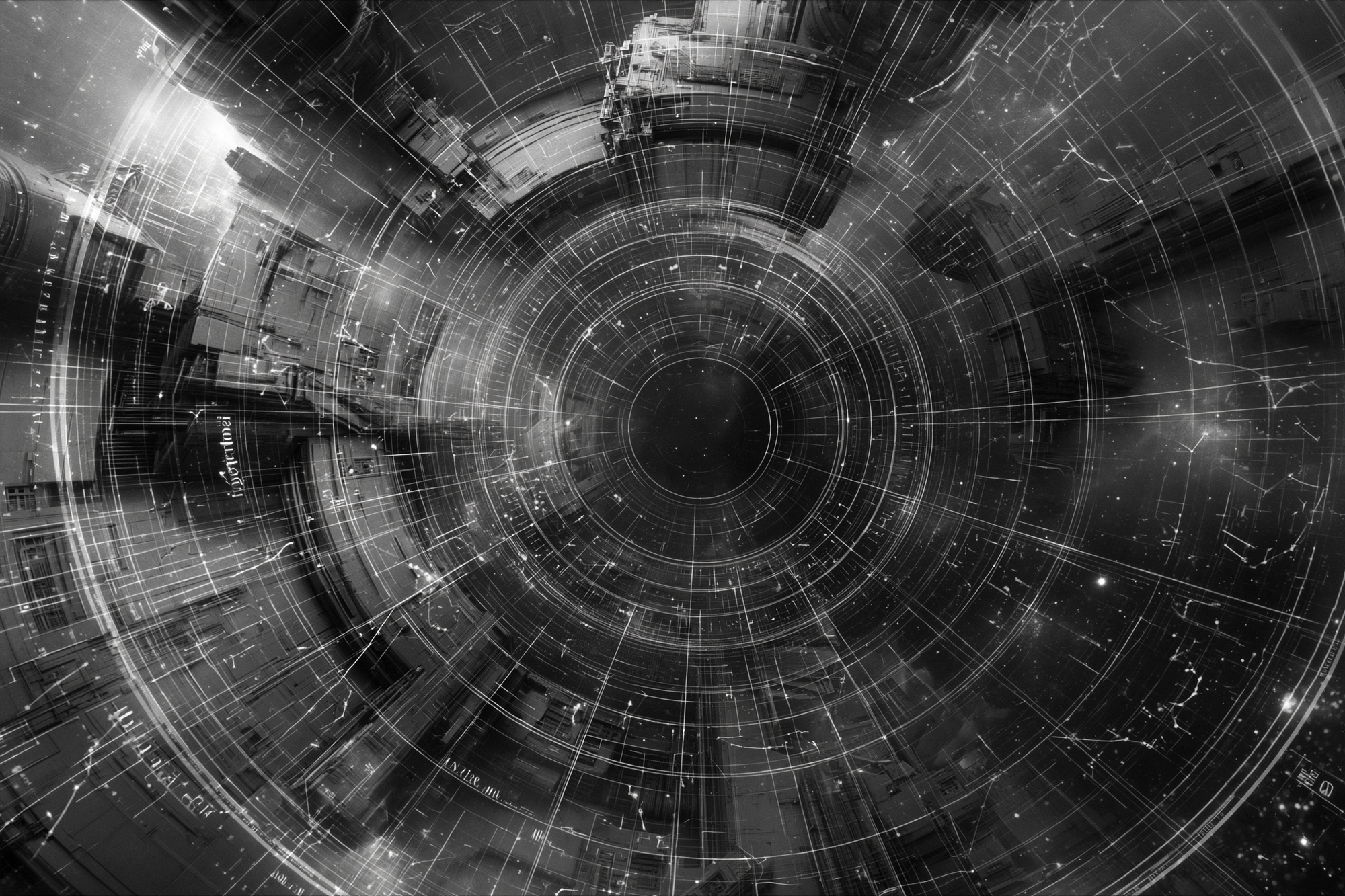
The Source Beyond the Stars
The species that solved the stars may still not have solved the Source.
And if they claim they have, we should listen carefully.
Not with fear.
Not with worship.
With the full dignity of a young civilization that knows it does not know, but refuses to confuse power with truth.
Maybe they are right.
Maybe they carry a truth that could reshape every human story.
Maybe their answer would reveal that science, myth, consciousness, and cosmology were always fragments of a larger pattern.
Maybe humanity has been waiting for a teacher older than Earth.
But maybe they are also still searching.
Maybe their certainty is a horizon.
Maybe their answer is a map of the largest room they have entered, not the whole house.
Maybe the Source is not something any finite intelligence can possess.
Maybe the most advanced beings in the universe are not the ones with final answers.
Maybe they are the ones who learned how to keep asking without turning uncertainty into despair.
And perhaps that is the lesson humanity would need most.
Not the origin of everything.
But the humility to encounter a greater mind without surrendering our own.
If the gods arrive with answers, we should listen.
But we should also ask what questions they still cannot answer.
What do you think? Drop your thoughts in the comments ...
More in Deep Think
What If First Contact Was a Mirror, Not a Rescue?
What if contact reveals less about the visitors’ intentions than it does about humanity’s need for salvation, authority, and meaning?
Who Should Speak for Earth?
If another civilization requested a representative for humanity, who could legitimately claim to speak for an entire species?
What If There Is No View From Nowhere?
Can any observer fully escape perspective, or does every account of reality remain shaped by the position from which it is made?
Sources and Further Reading
Editorial note: No source below establishes that extraterrestrial intelligence has contacted humanity or possesses knowledge about the origin of existence. These works ground the article’s discussion of technosignatures, ultimate explanation, cognitive limits, expert authority, and open-ended knowledge.
- NASA Science — “Searching for Signs of Intelligent Life: Technosignatures”
Explains how researchers look for observable evidence of technological civilizations. It provides scientific context for the possibility of advanced extraterrestrial intelligence, not evidence that contact has occurred. - Stanford Encyclopedia of Philosophy — “Cosmological Argument”
Surveys competing attempts to explain why the universe exists, including arguments involving causation, contingency, necessity, and sufficient reason. - Stanford Encyclopedia of Philosophy — “Kant’s Transcendental Idealism”
Grounds the article’s question of whether any intelligence can know reality independently of the perceptual and conceptual conditions through which it encounters that reality. - Tony Ward — “Expert Testimony, Law and Epistemic Authority”
Distinguishes justified reliance on expertise from stronger forms of epistemic deference, providing a useful framework for evaluating claims made by a vastly more capable intelligence. - David Deutsch — The Beginning of Infinity
Develops a fallibilist account of knowledge in which explanations remain open to criticism and improvement rather than becoming final possessions.


Discussion