
Case Overview: The Event
In 2005, researchers Petter Johansson, Lars Hall, Sverker Sikström, and Andreas Olsson published an experiment in Science built around an almost impolite question: if the result of a simple choice were secretly reversed, would the person who made it notice?
At Lund University, 120 participants were shown pairs of grayscale photographs of women’s faces and asked to indicate which face they found more attractive. On selected trials, the experimenter used a card-conjuring technique to hand the participant the face they had just rejected. The participant was then asked to explain why they had chosen it.
Most manipulated trials did not produce an immediate objection. Some participants instead gave calm, specific, and apparently sincere reasons for preferring the face now in their hands. The researchers called the effect choice blindness: a failure to report a mismatch between an intended choice and the outcome presented as its result.
The switch itself is documented. The low rate of reported detection is documented. The verbal explanations are documented. What remains under pressure is the meaning of the silence. Did participants truly fail to notice? Did they briefly register conflict but trust the experimenter over their own memory? Did some notice and decide not to interrupt? Or did the new outcome become part of the preference almost as soon as it was presented?
That uncertainty does not erase the experiment. It makes the case more exact.
What Actually Happened
The researchers recruited a mixed student and non-student sample with a mean age of 26; 70 of the 120 participants were women. Two participants were later removed from the analysis because flawed presentations allowed them to work out how the card trick had been performed. The reported analysis therefore covered 118 participants and 354 manipulated trials—three for each participant retained.
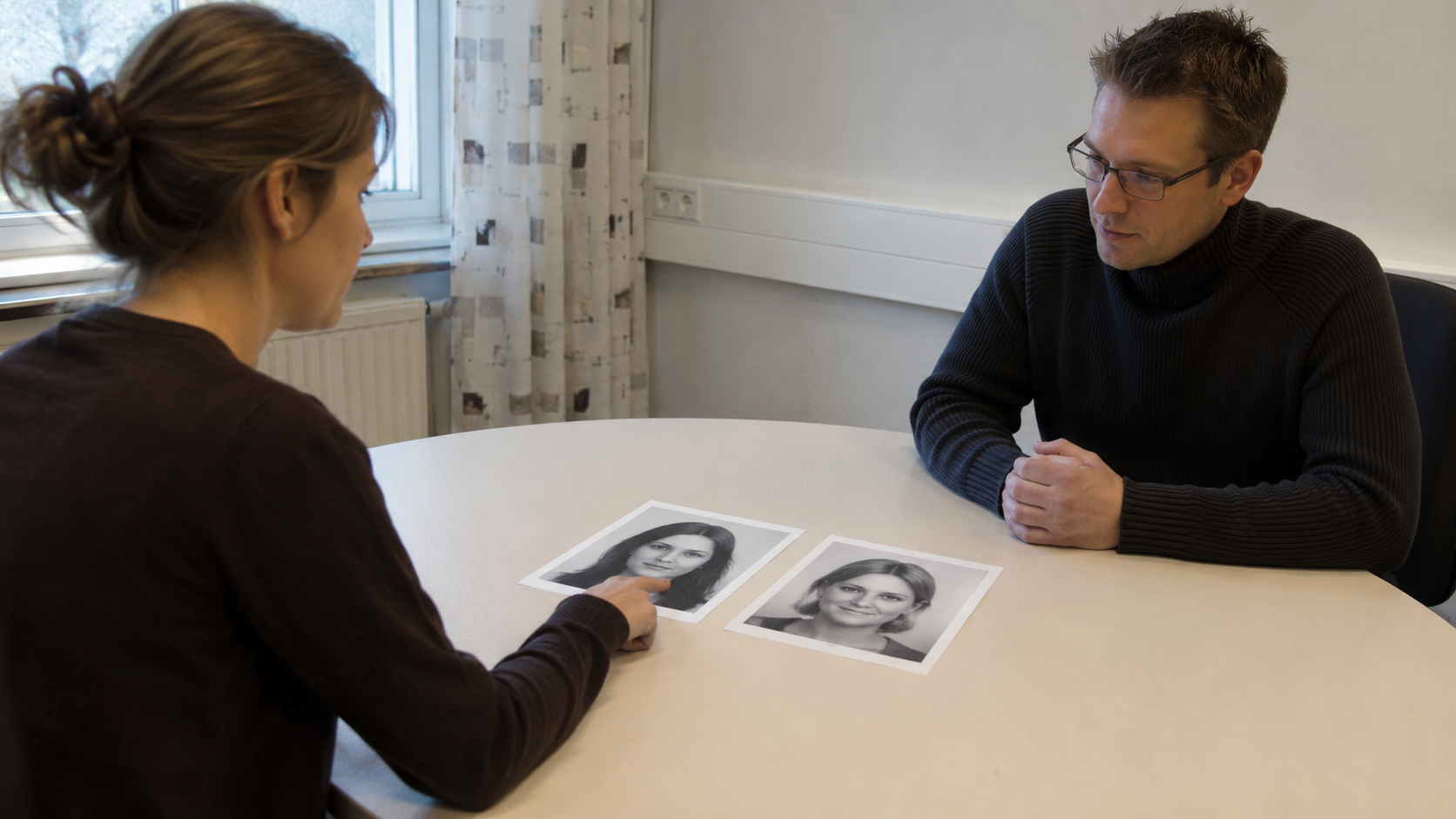
The cover story was straightforward. Participants were told that the researchers were studying choice and facial attractiveness. On each trial, the experimenter placed two grayscale face photographs on the table. The participant looked at the pair and pointed to the face they preferred.
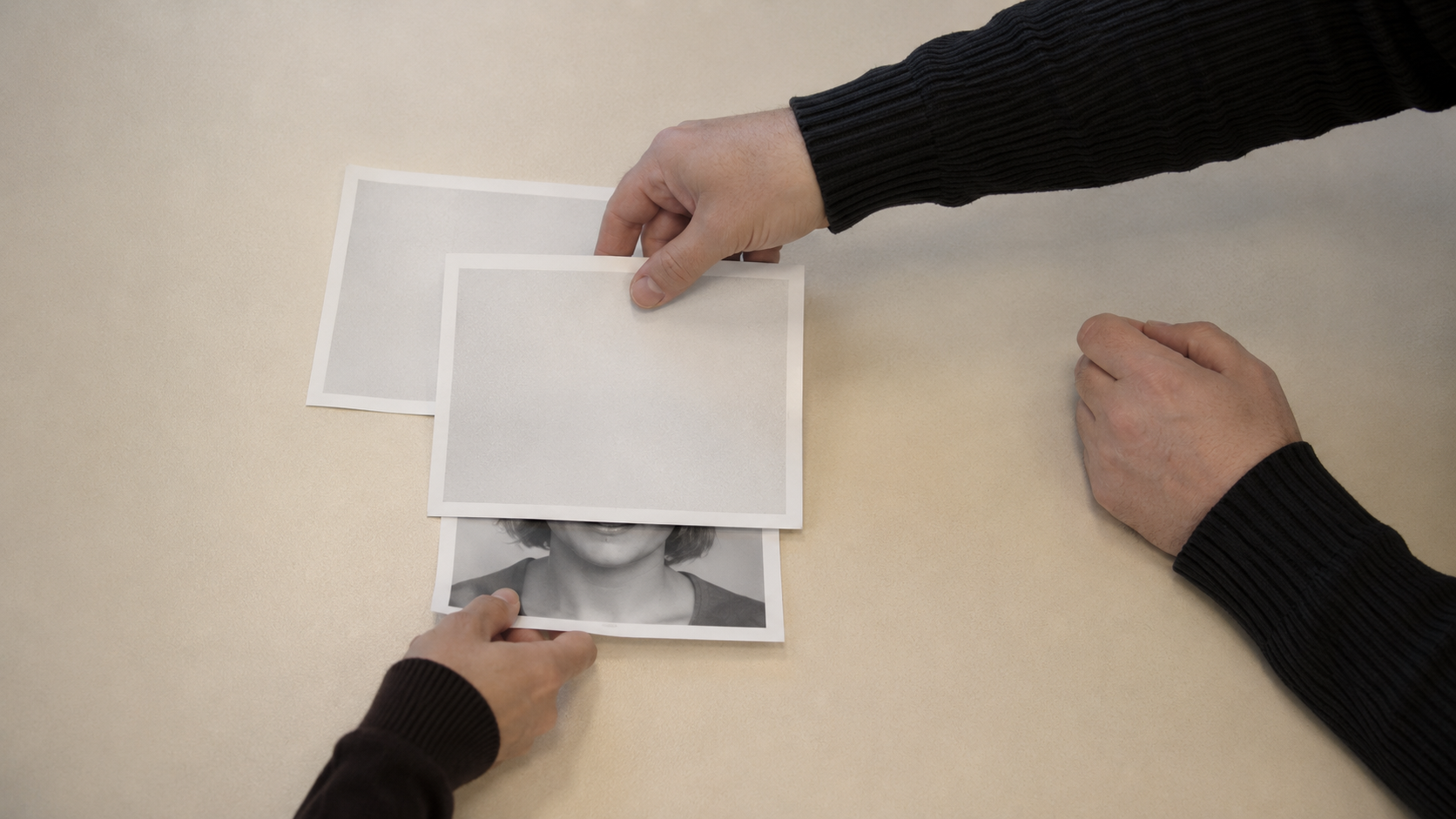
The physical setup contained the deception. Behind the visible alternatives were concealed cards that allowed the experimenter to return the non-selected face. After the participant pointed, the experimenter turned the pictures face down. As one card was moved toward the participant, the experimenter’s arm and sleeve occluded the tabletop. During that movement, the concealed photograph was slid forward instead of the face that had actually been selected.
The full interval from the cards being turned down to the participant picking up the returned photograph was approximately two seconds. The participant then held a face that had been present in the original pair—but it was the opposite of the one they had indicated.
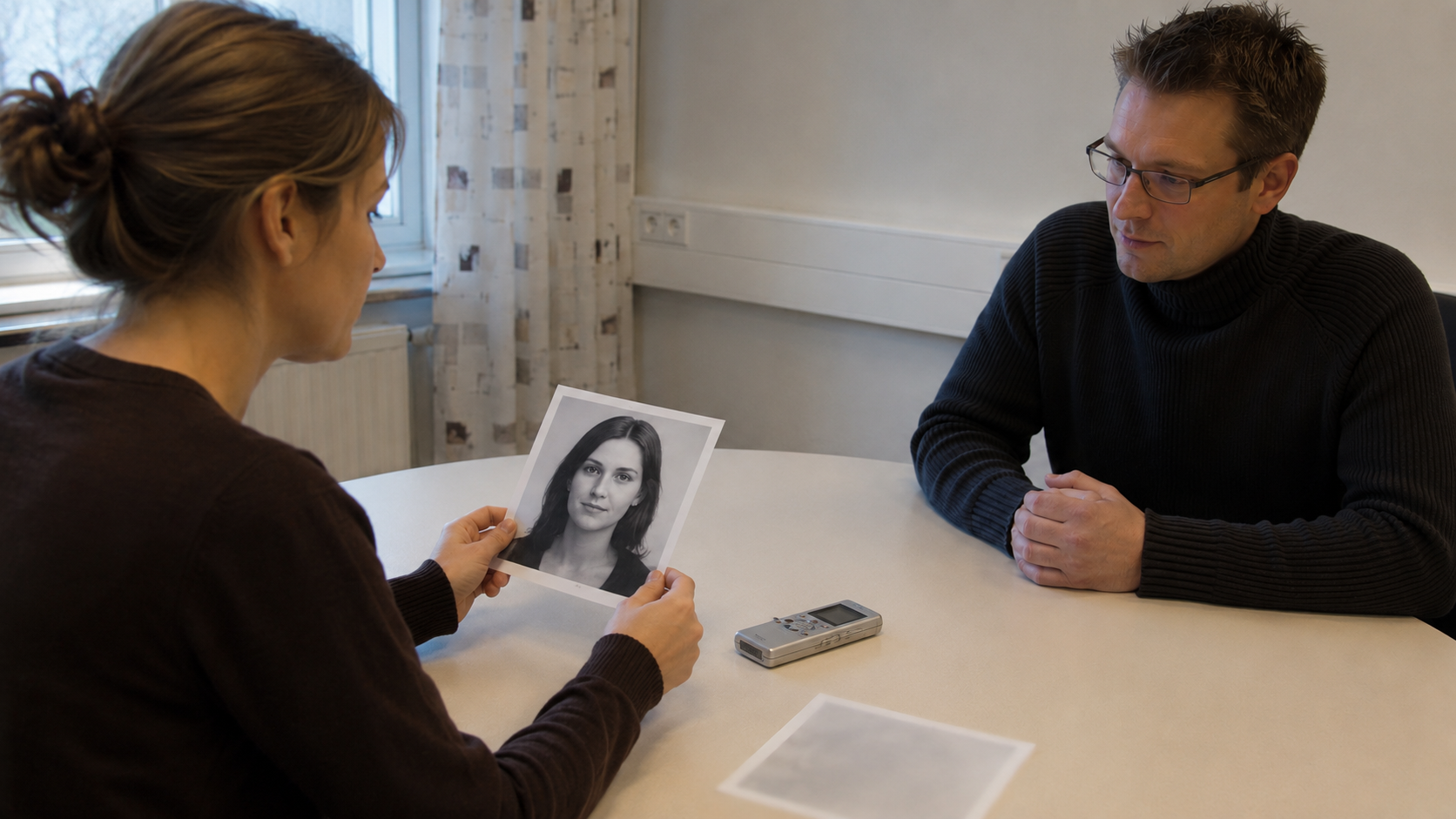
Each person completed 15 face-pair trials. Three trials, appearing at positions 7, 10, and 14, were manipulated. On those three trials, participants were immediately asked to explain the reasons for their choice. The researchers also requested explanations after three ordinary, non-manipulated choices so that the two classes of verbal report could be compared. The reports were recorded and transcribed.
The study varied two conditions. Participants received either two seconds, five seconds, or unlimited time to deliberate. They were also assigned manipulated pairs judged to be relatively similar or relatively dissimilar. Independent raters had scored the high-similarity set at an average of 5.7 and the low-similarity set at 3.4 on a 10-point similarity scale. This mattered because a switch between visibly different faces should, in principle, be harder to miss.
The central procedure was therefore not a memory test announced in advance. It was a normal-looking preference task in which no one had been told to monitor for substitutions. The manipulation depended on a familiar structure of everyday trust: you point, the experimenter hands you what you pointed to, and the interaction continues.
That structure was the trap.
Key Claims and Evidence
The Switch Was Real and Systematic
The strongest part of the case is procedural. This was not a retrospective story about people forgetting what they had chosen. The choices were made in front of the researchers, the substitutions were deliberately introduced on three fixed trials, and the participants’ responses were recorded. The original Science paper includes a photographic sequence of the double-card procedure, while its supporting material describes the timing, trial order, face selection, interview process, and exclusions.
The manipulation did not always work invisibly. Forty-six of the 354 manipulated trials were detected during the task, a concurrent detection rate of 13%. A trial counted as concurrently detected if a participant explicitly said the faces had been switched or showed any other sign that something had gone wrong with the choice.
The remaining silence cannot be treated as one simple psychological state, but it is still behavioral evidence. On the great majority of manipulated trials, participants did not stop the procedure to reject the photograph they had been handed.
How Detection Was Measured
The 13% figure is the most memorable result, but it was not the researchers’ only detection measure. After the task, they conducted a graduated interview. Participants were first asked broad questions about what they thought of the experiment, then whether anything had seemed odd, and finally whether they had noticed anything strange about the stimuli.
Those who had not voiced suspicion were given a hypothetical description of an experiment in which chosen faces might secretly be exchanged. They were asked whether they believed they would notice such a change. The real method was then disclosed during debriefing, and participants were asked whether anything resembling that manipulation had occurred during their own session.
If a participant now reported suspicion, the researchers allowed them to sort through the photographs they had received and identify which outcomes might have been switched. Correctly identifying a manipulated photograph counted as retrospective detection. Correct identifications accompanied by false positives were placed in a more permissive category called possible retrospective detection.
The authors intentionally leaned toward counting borderline cases as detection. Even with concurrent, retrospective, and possible retrospective detection combined, no more than 26% of manipulated trials were classified as exposed. They also noted that if the interview had stopped after the first general question about whether anything seemed odd, only one retrospective detection would have been registered.
There was an additional complication. Once a participant detected one switch, later trials were no longer psychologically equivalent: suspicion increased and the task became a monitoring exercise. The researchers therefore also recalculated the results after discarding every trial that followed a participant’s first detection. Detection became significantly lower under that correction, although the paper did not replace its main figures with one simplified corrected percentage.
What Participants Said
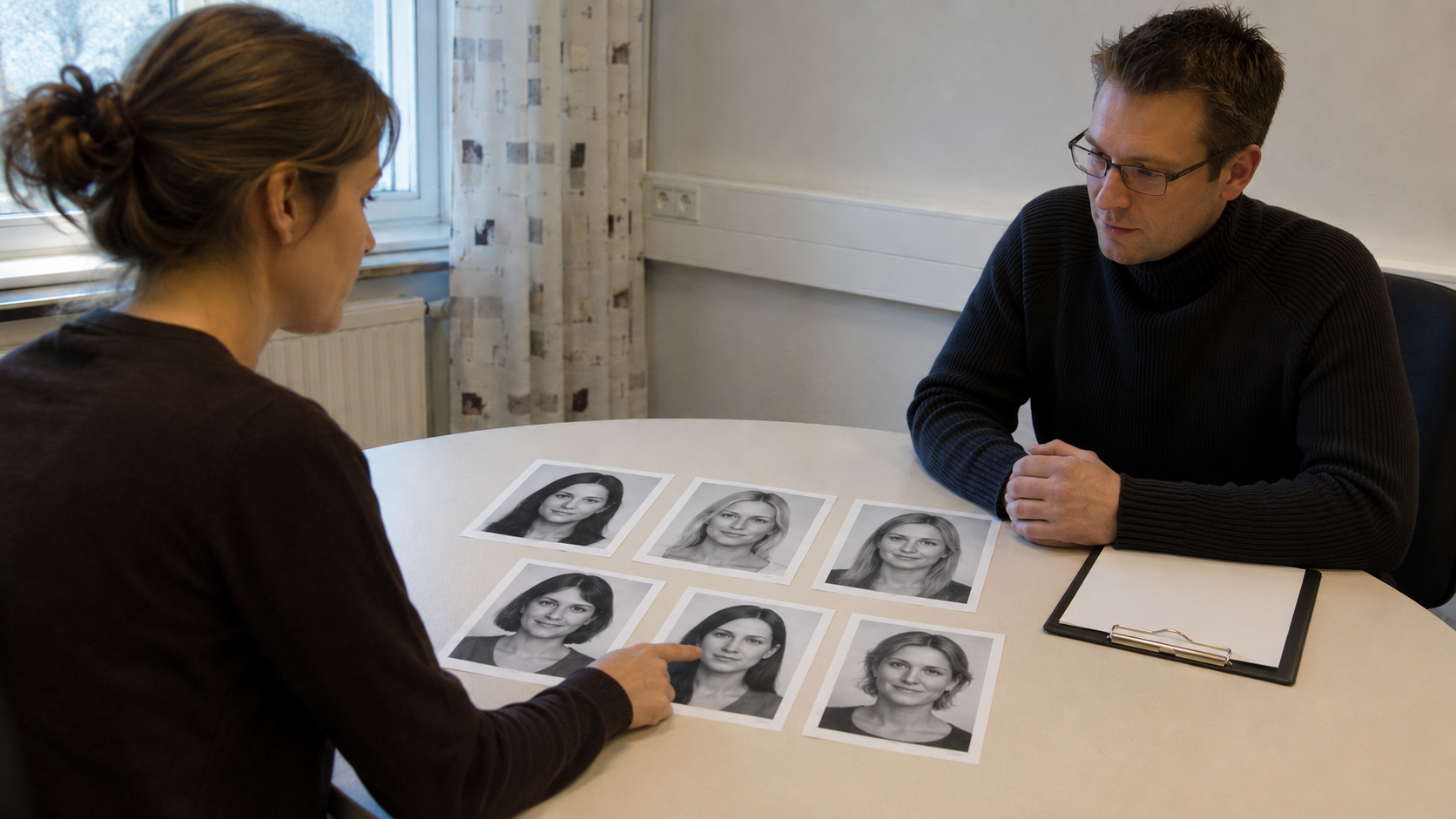
The verbal reports are the part of the experiment that made it famous. Participants were not merely handed the rejected face and sent onward. They were asked to account for a preference they had not expressed.
Some explanations were generic enough to fit either face. A participant might say the displayed woman had a pleasant appearance or seemed likable. Others were more emotional, including the translated statement, “I simply love this girl.” Still others referred to a feature that was unique to the substituted photograph. In those cases, the explanation could not have been a faithful report of the original basis for choice because the cited feature belonged to the face the participant had rejected.
Yet the reports did not all point in the same direction. Some preserved information from the original choice. The paper describes a participant who referred to a smile while holding the solemn-faced alternative. That explanation was inconsistent with the photograph in hand but consistent with the face originally selected. The switch had captured the outcome, but not fully overwritten the earlier intention.
The researchers therefore placed the manipulated reports along a rough continuum. At one end were specific confabulations tied to a unique feature of the substituted face. In the middle were broad explanations that could not confidently be assigned to either photograph. At the other end were reports that still referred to the original choice. Statements such as “I don’t know” were treated as uncertainty rather than strong evidence of confabulation.
This distinction matters. The experiment did not show that every participant invented a detailed defense of the rejected face. It showed that some clearly did, many supplied explanations compatible with the presented outcome, some expressed uncertainty, and some retained traces of the choice they had actually made.
The Manipulated Explanations Did Not Look Obviously Weaker
Independent blind raters compared reports from manipulated and non-manipulated trials. They looked for empty responses, nervous laughter, length, verb tense, emotional engagement, specificity, certainty, and dynamic self-commentary—moments when a participant seemed to reconsider or question their own motives.
The manipulated reports were not shorter. They were not more likely to be empty. They did not contain more laughter, nor were they reliably less emotional, less detailed, or less confident. Dynamic self-commentary did occur significantly more often after a switch, but it appeared in only about 5% of manipulated reports.
The result was not simply that people said something when prompted. Their explanations, as a class, were difficult for blind raters to distinguish from explanations of choices they had actually made. That finding supports a narrow but consequential conclusion: the fluency and confidence of a reason do not, by themselves, establish that the reason was present before the outcome appeared.
Time Helped, but Similarity Did Not Behave as Expected
Participants with unlimited deliberation detected more manipulations than those in the fixed-time conditions. The two-second and five-second groups did not differ significantly. Even in the combination that should have favored detection—unlimited viewing and relatively dissimilar faces—concurrent detection did not exceed 27% of trials.
The similarity manipulation produced no significant overall difference in detection between the high- and low-similarity sets. The original authors treated this as evidence that the effect was not confined to nearly interchangeable faces. That conclusion belongs to this experiment, however, and should not be inflated into a universal rule. Later work has found that discriminability, familiarity, confidence, and personal relevance can influence whether a mismatch is noticed or reported.
One final result captured the metacognitive tension. Among participants who had failed to notice any manipulation, 84% said they believed they would have detected the hypothetical switch that the researchers described. People were not only vulnerable to the manipulation; they were poor at predicting that vulnerability.
Points of Tension
The original result is strong as a demonstration that an externally presented outcome can pass through a choice procedure without provoking an immediate correction. It is weaker as proof that every silent participant remained completely unaware of the mismatch. Detection was inferred mainly from behavior and report. A person who noticed something but hesitated, assumed personal error, distrusted their memory, or chose not to challenge the experimenter could be counted as non-detecting.
The original researchers understood part of this limitation. In their supporting discussion, they acknowledged that a forced-choice detection task would probably have produced more detections and that most participants likely would have caught the switches if the experiment had been framed explicitly as a monitoring exercise. Their question concerned relaxed, unsuspecting choice—the kind of situation in which people ordinarily assume the world will return the outcome they selected.
That ecological defense is reasonable, but it changes the claim. The experiment shows what happens under low suspicion, brief retention, unfamiliar stimuli, and strong procedural trust. It does not establish that people are generally unable to recognize when important, familiar, or high-stakes decisions have been reversed.
There is also a difference between accepting an outcome and failing to register conflict. The card trick provided physical evidence that the photograph in the participant’s hand was the one they had chosen. If a faint memory said otherwise, the participant had to choose between two possibilities: the experimenter had just performed an impossible-looking substitution, or their own quick preference was less stable than it felt. Trusting the visible outcome may have been an ordinary inference under deceptive conditions, not evidence that the original choice left no trace.
A 2025 study by Pablo R. Grassi and colleagues sharpened this objection. Across two computerized choice-blindness experiments with 64 participants, the researchers measured pupil dilation, retrospective recognition, and participants’ explanations for not speaking up. They found evidence that many people noticed manipulated outcomes without reporting them immediately. Pupil responses were larger on manipulated trials even when no manipulation was reported, and many participants later identified the affected trials or said they had assumed the mismatch was an error or part of the experiment.
That study does not erase the 2005 result. It used computerized presentation rather than the original physical double-card deception, and its authors explicitly cautioned that their findings may not transfer fully to magic-based designs. Its pupil measure also indicates surprise or conflict more securely than it proves a fully conscious identification of the switch on every trial. But it does expose a genuine weakness in the popular interpretation: no report is not necessarily no detection.
The deepest tension, then, is not whether the concealed switch occurred. It is what happened in the interval between noticing, interpreting, and speaking.
Perspectives and Explanations
Weak Encoding or Failed Comparison
The most direct explanation is that participants did not encode the selected face in enough detail, or failed to compare the returned face with the memory of the original choice. The two-second occlusion interrupted the visual sequence, and the photographs were unfamiliar. A person could form a real preference without storing a durable, consciously accessible representation of the selected identity.
This account fits the ancestry of the experiment in change-blindness research. People can miss large visual changes when the movement that would normally reveal the change is masked or interrupted. The choice-blindness procedure added intention to that structure: the changed item was not merely something seen, but something selected.
Its limitation is conceptual. If a choice can be made without preserving enough information to recognize its opposite seconds later, then everyday “intention” may be thinner and more context-dependent than it feels. The explanation protects ordinary perception, but pressures the common idea of a stable chooser carrying a complete internal record from decision to outcome.
Post-Outcome Construction
Another interpretation is that people often explain choices by working backward from the outcome available to them. Once the substituted face was in hand and socially presented as “your choice,” the mind searched that face for defensible features. The explanation may have been sincere even if it was assembled after the decision point.
The reports tied to unique features of the rejected face offer the strongest evidence for this process. Those particular reasons could not have caused the original selection. They were responses to the current outcome. But this mechanism should not be projected onto every report: broad explanations remain ambiguous, and references to the original face show that prior information sometimes survived the substitution.
Memory Updating and a Change of Mind
A participant may have detected a weak mismatch, then revised the preference. Attraction judgments between unfamiliar faces can be uncertain. When the experimenter confidently returned the alternative, the participant may have treated that outcome as evidence, allowed the initial preference to shift, and explained the now-current judgment.
Later face-choice studies found that manipulated outcomes could influence subsequent choices and ratings, although the size and interpretation of preference change have varied by design. This suggests that choice and feedback may form a loop. We do not always discover a finished preference and then report it; sometimes the act of choosing, receiving an outcome, and explaining it helps stabilize what the preference becomes.
Covert Detection and Reporting Reluctance
The 2025 evidence supports a different layer: some participants may notice the mismatch yet remain silent. They may assume they pressed incorrectly, believe the odd outcome is intentional, wait for more evidence, avoid accusing the experimenter of manipulation, or decide that correcting a low-stakes choice is not worth disrupting the task.
This explanation accounts for why immediate report can underestimate awareness. It also explains why detection tends to rise after a first exposed manipulation: suspicion changes the social and cognitive cost of speaking. Its limitation is that it cannot be retroactively assigned to every silent participant in 2005. The original study did include increasingly specific interviews and a liberal retrospective category, and the majority of manipulated trials remained unidentified even then.
A Mixed Account
The available record best supports a mixed explanation. Some switches were consciously detected and reported. Some may have been registered as conflict but not identified or voiced. Some were probably missed because the chosen face was weakly encoded or not compared with the outcome. Some participants appear to have generated new reasons from the substituted face, while others preserved elements of the original decision.
Choice blindness may therefore be less like a single mental defect and more like a junction where perception, memory, inference, social trust, uncertainty, and self-explanation meet. The effect is real at the behavioral level. The mechanism is not singular or finally settled.
Context and Pattern Recognition
The experiment grew directly from research on change blindness—the failure to notice alterations in a visual scene when the normal signal of change is interrupted. Johansson and colleagues asked what would happen if the altered object were also the outcome of a personal choice. That move made the result feel less like a quirk of vision and more like a challenge to self-knowledge.
Subsequent research extended the method beyond face photographs. Participants have been given switched samples of jam and tea, reversed moral answers, and altered accounts of witnessed events. These studies show that the broad paradigm can operate across sensory preferences, attitudes, and memory. They do not show that every domain is equally vulnerable. Detection changes with the strength of prior belief, confidence, familiarity, personal relevance, stimulus difference, delay, and how costly it feels to correct the outcome.
This wider record argues against two easy conclusions. The first is that the 2005 result was merely a clever card trick with no psychological depth. Related effects have appeared through different media and procedures. The second is that people have no access to their own choices. Detection can be high when the choice is memorable, consequential, or strongly held, and newer work indicates that physiological or retrospective evidence may reveal conflict beneath an apparently compliant response.
The stable pattern is narrower: under some conditions, people can accept feedback that contradicts a recent choice and produce a coherent account aligned with that feedback. The unstable part is why. Memory failure, weak preference, social compliance, inference, belief updating, and active confabulation may contribute in different proportions from one trial to another.
Implications: Reality Check
The choice-blindness experiment does not prove that free will is an illusion. It does not establish that conscious thought never participates in decision-making. It does not show that every reason we give is fabricated, or that deeply held commitments can be reversed by a simple trick.
What it does show is more disciplined and, in some ways, more useful. A reason can feel immediate, specific, and confident without being a reliable transcript of the process that produced the original choice. Introspection may provide access to thoughts and feelings that are present now while remaining incomplete about when those thoughts arose and whether they caused the action being explained.
That distinction matters anywhere institutions ask people to explain themselves. Consumer interviews, political surveys, clinical conversations, eyewitness questioning, hiring decisions, algorithmic feedback systems, and ordinary arguments all rely on verbal reasons. The experiment warns that fluency should not be mistaken for provenance. A person may be honest about the explanation they can currently see while mistaken about its role in the earlier decision.
The 2025 challenge adds a second reality check: behavior that looks like acceptance may conceal uncertainty or unspoken detection. Researchers and the rest of us should distinguish at least three events that are often collapsed into one: noticing a mismatch, deciding what the mismatch means, and choosing whether to report it.
The case therefore weakens neither the human mind nor the value of introspection. It demands a better model of both. The self may be capable of choosing, monitoring, revising, and explaining, but these functions need not share one complete record. What feels like a single narrator may be a negotiation among partial signals arriving at different times.
The Unresolved Ledger
What Is Documented
The 2005 study used a concealed double-card method to reverse the outcome of face-preference choices. Of 120 participants recruited, two were excluded after flawed presentations revealed the method, leaving 118 participants and 354 manipulated trials in the main analysis. Only 46 manipulated trials—13%—were detected concurrently. When the researchers added retrospective and possible retrospective detections through graduated interviews, debriefing, and photograph sorting, no more than 26% of manipulated trials were classified as exposed.
Participants gave recorded explanations after manipulated and ordinary trials. Blind ratings found no reliable difference between the two sets in emotionality, specificity, or certainty. Some manipulated reports referred to features unique to the substituted face; some were generic; some expressed uncertainty; and some retained features of the face originally chosen.
What Is Claimed
The original researchers argued that participants can fail to notice conspicuous mismatches between intention and outcome and can offer introspectively derived reasons for choices they did not make. Later choice-blindness research has claimed related effects across taste, smell, attitudes, and memory, sometimes including changes in later preferences or reports.
Critics and newer investigators claim that traditional report-based detection measures may overestimate blindness. The 2025 pupillometry study argues that many apparently silent participants detect a mismatch covertly, attribute it to error, accept it as part of the experiment, change their minds, or hesitate to challenge the researcher.
What Remains Unresolved
The original data cannot reveal one mental process shared by every undetected trial. It remains unknown how often participants entirely missed the substitution, experienced a vague conflict without identifying it, consciously detected it but remained silent, distrusted their own memory, or revised their preference after seeing the new outcome.
It also remains unsettled how far the result generalizes beyond unfamiliar, low-stakes aesthetic choices under deceptive laboratory conditions. Later studies establish that the paradigm is not confined to one card trick, but they also show that personal relevance, confidence, discriminability, and reporting conditions can change the outcome.
Why It Still Matters
The experiment matters because it placed a physical wedge between a choice and its reported reason. For some individual reports, the researchers could show that the stated feature belonged to the rejected outcome and therefore could not have caused the original selection. That is stronger than merely observing that people sometimes give poor explanations.
The unresolved debate matters just as much. If participants were fully blind, the case reveals a deep vulnerability in intention and introspection. If many noticed but did not report, it reveals a different vulnerability in how researchers infer awareness from behavior. If both occurred, the case offers a more realistic picture of the self: not a perfect witness to its own decisions, but not an empty storyteller either.
The Galactic Mind Perspective
The strongest current reading is not that the conscious self is fake. It is that the conscious self receives an incomplete file.
The face experiment established a real mismatch between selection and outcome, then showed that a coherent explanation could be built on the wrong side of that mismatch. In its clearest cases, the mind did not retrieve the cause of the original choice. It interpreted the evidence now in front of it. Yet other reports preserved the original face, and newer research suggests that some apparently compliant participants may have noticed more than they said.
That mixture is more revealing than the simplified claim that people will defend anything. Human beings appear to monitor their choices with variable resolution. We trust the structure of the situation. We weigh our memory against what the world hands back. We sometimes update. We sometimes confabulate. We sometimes notice and stay quiet. Then, when asked for one clean reason, we compress that unstable process into a sentence.
The case belongs in The Galactic Mind archive because it puts reality under tension from the inside. The external event was small: a photograph crossed a table. The internal problem was much larger: the outcome changed, the explanation adapted, and the person speaking could not always tell where the reason had begun.
Open Question
When we explain a choice, are we recovering the reason that caused it or constructing the reason that best fits the outcome now in front of us?
What do you think? Drop your thoughts in the comments ...
More in Case Files
The Red Book: The Private Manuscript Carl Jung Hid From the World
A related investigation into the autonomy of the inner world and the difficulty of separating deliberate authorship from psychological material that seems to arrive from beyond the conscious ego.
The Pam Reynolds Operation: What Did She Perceive During Standstill?
A consciousness case built around the gap between subjective report, measurable conditions, memory, and what external evidence can—or cannot—establish about an inner experience.
Fátima Case File: The Apparition, the Crowd, and the Sun
A larger-scale examination of perception, expectation, testimony, and interpretation, where the documented event and the meaning assigned to it cannot be treated as the same evidentiary layer.
Sources / Receipts
- Petter Johansson, Lars Hall, Sverker Sikström, and Andreas Olsson, “Failure to Detect Mismatches Between Intention and Outcome in a Simple Decision Task,” Science, Vol. 310, No. 5745, October 7, 2005, pp. 116–119. The Lund University author copy includes the published article, Materials and Methods, supporting text, supplementary figures, and detection criteria. Read the paper and supporting material. DOI record.
- Petter Johansson, Lars Hall, Sverker Sikström, Betty Tärning, and Andreas Lind, “How Something Can Be Said About Telling More Than We Can Know: On Choice Blindness and Introspection,” Consciousness and Cognition, Vol. 15, 2006, pp. 673–692. Used for the extended analysis of manipulated and non-manipulated verbal reports and the limits of classifying them as truthful or confabulatory. Read the author copy. DOI record.
- Pablo R. Grassi, Lena Hoeppe, Emre Baytimur, and Andreas Bartels, “Restoring Sight in Choice Blindness: Pupillometry and Behavioral Evidence of Covert Detection,” Frontiers in Psychology, Vol. 16, December 4, 2025. Used for the contemporary challenge that detection and reporting can diverge in computerized choice-blindness tasks. Read the open-access study. DOI record.
- Lars Hall, Petter Johansson, Betty Tärning, Sverker Sikström, and Thérèse Deutgen, “Magic at the Marketplace: Choice Blindness for the Taste of Jam and the Smell of Tea,” Cognition, Vol. 117, 2010, pp. 54–61. Used to establish that the paradigm was later extended beyond face photographs to taste and smell. DOI record.
- Lars Hall, Petter Johansson, and Thomas Strandberg, “Lifting the Veil of Morality: Choice Blindness and Attitude Reversals on a Self-Transforming Survey,” PLOS ONE, Vol. 7, 2012, e45457. Used for the extension of the method to moral attitudes. Read the open-access study. DOI record.
- Petter Johansson, Lars Hall, Betty Tärning, Sverker Sikström, and Nick Chater, “Choice Blindness and Preference Change: You Will Like This Paper Better If You (Believe You) Chose to Read It!,” Journal of Behavioral Decision Making, published online 2013. Used for the later finding that manipulated outcomes can influence subsequent preferences under some experimental conditions. Read the author copy. DOI record.
- Lotta Stille, Emelie Norin, and Sverker Sikström, “Self-Delivered Misinformation—Merging the Choice Blindness and Misinformation Effect Paradigms,” PLOS ONE, Vol. 12, 2017, e0173606. Used for the later application of choice blindness to reports and recollections of a witnessed event. Read the open-access study. DOI record.


Discussion