
Case Overview: The Event
On October 13, 1917, tens of thousands of people gathered at Cova da Iria near Fátima, Portugal.
They came because three shepherd children, Lúcia dos Santos and her cousins Francisco and Jacinta Marto, had said that a heavenly lady would appear there and perform a sign “so that all may believe.”
The event did not emerge suddenly.
According to the Catholic record preserved by the Sanctuary of Fátima, the children had reported a series of apparitions beginning on May 13, 1917. The final apparition, on October 13, drew an estimated crowd of 50,000 to 70,000 people.
What followed became known as the Miracle of the Sun.
Witnesses reported that after rain and heavy clouds, the sun appeared to change. Some said it spun. Some said it gave off colors. Some said it seemed to descend or zigzag toward the Earth. Others reported seeing only unusual light. Some saw nothing unusual at all.
The Catholic interpretation understands Fátima as a Marian apparition: a private revelation centered on prayer, repentance, the Rosary, and devotion to the Immaculate Heart of Mary. The Vatican’s theological framing places Fátima within the category of private revelation, not as something that completes Christian public Revelation, but as something that may help believers live the Gospel more fully in a particular historical moment.
That distinction matters.
This Case File does not reduce Fátima to a “UFO event.”
It also does not treat the Catholic interpretation dismissively.
Fátima is powerful precisely because it sits at the intersection of religious testimony, public expectation, mass perception, contemporary journalism, optical possibility, and enduring mystery.
The central question is not simply:
Did the sun move?
If the sun had physically moved in the sky, the event would have been visible far beyond Portugal.
The deeper question is:
What did tens of thousands of people gather to witness, and why did so many leave convinced that something extraordinary had happened?

What Actually Happened
The reported apparitions began in 1917, during World War I and during a period of deep tension in Portugal’s political and religious life.
The three children were from rural families near Fátima.
Lúcia was the oldest.
Francisco and Jacinta were younger cousins.
According to the Sanctuary of Fátima’s narrative, the first apparition took place at Cova da Iria on May 13, 1917. The children said they encountered a radiant lady who asked them to return on the 13th day of each month and to pray the Rosary.
The pattern continued.
In June, a small group was present.
By July, thousands were reportedly gathering.
In August, local authorities interrupted the children and detained them, so the apparition associated with that month was later reported at Valinhos on August 19.
By September, the crowd had grown dramatically.
By October, expectation had become enormous.
The children had said that a miracle would occur so that people would believe.
On October 13, the crowd gathered in wet, muddy conditions.
Accounts describe rain before the event.
The children were present.
Believers, skeptics, journalists, local people, clergy, and curiosity-seekers were all there.
The Sanctuary record states that the Lady identified herself to the children as Our Lady of the Rosary and asked that a chapel be built in her honor. In Lúcia’s later account, after the apparition, the light associated with the Lady was reflected on the sun, and the children saw further religious visions involving Saint Joseph, the Child Jesus, Our Lady of Sorrows, and Our Lady of Carmel.
The crowd did not all report seeing the same thing.
Some saw the sun appear like a pale disc.
Some saw it spin.
Some saw colors.
Some saw it plunge toward Earth.
Some saw the clouds part.
Some saw radiant light.
Some saw nothing beyond ordinary weather and sky.
Avelino de Almeida, writing for the secular Portuguese newspaper O Século, became one of the most important contemporary witnesses. The Sanctuary’s chronology quotes his October 15, 1917 account describing the crowd looking upward as the sun appeared to tremble and “dance,” according to the expression used by the people present.
The event lasted only minutes.
Its afterlife lasted more than a century.
In 1930, the Bishop of Leiria declared the Fátima apparitions “worthy of belief” and permitted public devotion to Our Lady of Fátima. That approval did not make Fátima part of obligatory Catholic doctrine in the way public Revelation is understood. It allowed the faithful to receive the apparition with prudence and devotion.
That distinction is essential.
Fátima is not only a question of what happened in the sky.
It is also a question of how religious communities discern visionary experience, how institutions interpret reported miracles, and how mass events become part of sacred history.

Key Claims and Evidence
The Fátima case rests on several different evidence layers.
They should not be treated as equal.
There is the children’s testimony.
There is the public prediction.
There is the crowd.
There is press coverage.
There are witness reports of solar effects.
There are later memoirs and Church documents.
There are skeptical explanations.
There are later UAP reinterpretations.
The difficulty is that the strongest parts of the case are also the hardest to measure.
What Is Documented
Several elements are well documented:
- Three children reported apparitions near Fátima in 1917.
- The reported apparitions occurred across a series of months.
- The children said that a sign would occur in October.
- A large crowd gathered at Cova da Iria on October 13, 1917.
- Contemporary newspapers reported on the event.
- Witnesses described unusual solar phenomena.
- Not all witnesses reported the same thing.
- The Catholic Church later approved the apparitions as worthy of belief.
- The Vatican has preserved and interpreted the Fátima message within the framework of private revelation.
This establishes Fátima as a real historical-religious event.
It does not settle the physical nature of what the crowd saw.
The Children’s Testimony
The core witnesses were Lúcia, Francisco, and Jacinta.
They claimed to see and hear a lady whom they understood, within the Catholic framework, as Mary.
The Sanctuary’s narrative preserves their account of a sequence of apparitions and messages: prayer, sacrifice, conversion, the Rosary, peace, the end of war, and the construction of a chapel.
The children’s testimony is central.
But it is also limited.
Only the children saw the apparition itself.
The crowd did not see the Lady in the same way.
This is consistent with the Catholic theological understanding of private revelation and interior vision. The Vatican document on Fátima explicitly distinguishes forms of perception, noting that such visions are not ordinary external perception in the same way that one sees a tree or house.
That does not dismiss the children’s experience.
It places it in the correct category.
The apparition belongs first to visionary testimony.
The solar event belongs to public witness.
They are connected, but not identical.
The Prediction
The prediction is one of the case’s strongest features.
The children reportedly said ahead of time that a sign would occur on October 13.
This created expectation.
It also created a test.
People came because they expected something.
That makes the case stronger in one sense and weaker in another.
Stronger, because the event did not appear randomly afterward. It was anticipated.
Weaker, because expectation can shape perception.
A crowd that arrives expecting a miracle may interpret ambiguous sky effects differently than a crowd with no prior belief.
That does not mean the event was invented.
It means expectation is part of the evidence.
The Crowd
The crowd is the central public element.
The Sanctuary’s account places the number at 50,000 to 70,000 people for the October 13 apparition.
That is enormous.
A private apparition became a mass event.
But crowd size alone does not prove the physical explanation.
A large number of witnesses can strengthen a case.
It can also magnify suggestion, emotion, social contagion, and interpretive momentum.
The crowd contained believers, skeptics, journalists, and curious observers.
This mixture matters.
If only devout believers had reported the phenomenon, the case would be easier to reduce to expectation.
But contemporary secular coverage complicates that dismissal.
At the same time, the reports were not uniform.
That prevents the crowd from functioning as a single clean witness.
The Solar Reports
The most famous claims concern the sun.
Reported elements include:
- the clouds parting after rain;
- the sun appearing as a pale or silver disc;
- spinning or rotating motion;
- colored light cast across the crowd and landscape;
- zigzagging movement;
- the sun seeming to descend toward Earth;
- sudden drying of clothes or ground;
- intense fear among some witnesses;
- others seeing nothing unusual.
These reports form the anomaly.
They are also where the case becomes most difficult.
If the actual sun moved, the event would have been global.
It was not.
So either the phenomenon involved local atmospheric, optical, or perceptual effects, or the reports describe a visionary or miraculous event experienced locally rather than astronomical motion of the sun itself.
That distinction is essential.
The question is not whether the star at the center of the Solar System physically danced.
The question is what witnesses perceived when they looked toward it.
The Press Record
Contemporary press coverage is one of the strongest documentary layers.
The O Século report is especially important because the paper was secular and not simply devotional. The Sanctuary’s chronology explicitly cites Avelino de Almeida’s October 15, 1917 report as part of the documentary record.
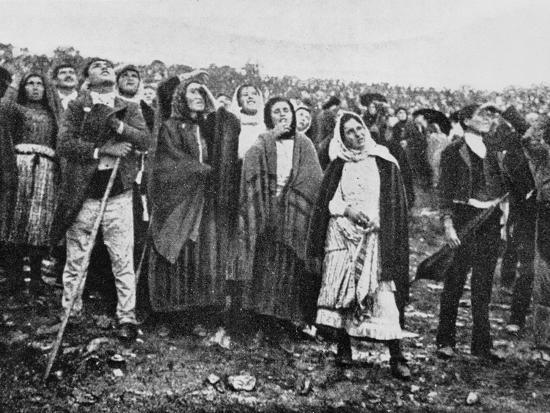
There are also photographs of the crowd looking toward the sky, including images published in Ilustração Portuguesa. A Wikimedia Commons file identifies one such page from the October 29, 1917 issue, showing the crowd looking at the sun during the Fátima event, and lists the scan as public domain.
The press record shows that the event was publicly reported soon after it happened.
It does not prove every description.
But it prevents the case from being dismissed as a late legend invented decades afterward.
The Photographic Problem
Photographs exist of the crowd.
They do not clearly show the sun behaving anomalously.
That matters.
The absence of a clear photograph of the solar phenomenon does not disprove witness perception.
But it does limit the physical evidence.
If the event involved optical effects visible only to viewers staring toward the sun through clouds, a camera might not capture the subjective experience.
If the event involved a real luminous object or atmospheric effect, one might expect stronger photographic evidence.
The photographic record therefore supports the crowd event.
It does not settle the phenomenon.
The UAP Reinterpretation Layer
Later UAP-oriented writers have sometimes reinterpreted Fátima through the lens of anomalous aerial phenomena: a luminous object, selective visibility, strange light effects, predicted appearances, and religious framing.
This approach should be handled carefully.
Fátima should not be flattened into “the Fátima UFO.”
That misses the spiritual, cultural, and Catholic meaning of the event.
But the UAP reinterpretation does reveal something useful.
It shows how the same event can be translated through different symbolic systems.
To Catholic believers, Fátima is Marian.
To skeptics, it is optical, meteorological, psychological, or sociological.
To some UAP theorists, it resembles a structured anomaly interpreted through the religious language of the time.
The event itself remains the same file.
The frame changes.
That is why Fátima belongs in The Galactic Mind archive.

Points of Tension
Fátima becomes difficult because every explanation accounts for something, but not everything.
The Event Was Predicted
The children said a sign would occur.
A crowd came.
Many reported seeing something.
That gives the event a strong structure.
A predicted public sign is harder to dismiss than a private vision revealed years later.
But prediction also creates expectation.
Expectation can prepare the mind.
It can sharpen attention.
It can also shape what people believe they saw.
That is the first tension.
Prediction strengthens the case.
Prediction also primes the crowd.
The Crowd Was Large, But Not Uniform
Tens of thousands reportedly gathered.
That matters.
But they did not report a single identical phenomenon.
Some accounts emphasize the sun spinning.
Others emphasize colors.
Others describe the sun descending.
Others describe fear.
Others saw nothing unusual.
Skeptical Inquirer summarizes this difficulty clearly: some reported the sun dancing, others saw brilliant colors, and others saw nothing unusual at all.
A uniform mass observation would be stronger as evidence.
A varied mass observation is more human.
And more difficult.
If the Sun Moved, the World Should Have Seen It
This is one of the strongest skeptical points.
The literal sun cannot zigzag toward Earth over Portugal without global consequences.
No global astronomical event was recorded.
Therefore, the phenomenon was not the actual sun moving through space.
This does not disprove miracle in a theological sense.
It does constrain the physical interpretation.
Whatever happened, it was local to perception, atmosphere, light, or visionary experience.
The event may have involved the sun as viewed.
Not the sun as an astronomical body.
Staring at the Sun Can Produce Effects
Prolonged viewing of the sun, especially through clouds or shifting brightness, can create retinal afterimages, color effects, apparent movement, and visual distortion.
That is a serious skeptical explanation.
It can explain why some saw colors.
It can explain spinning or pulsing impressions.
It can explain inconsistent accounts.
But it does not fully account for all claims, especially reports of coordinated crowd reaction, apparent drying, and witnesses at different distances who later said they observed unusual effects.
A retinal explanation may explain much.
Whether it explains all remains debated.
Weather and Atmosphere Matter
The reports mention rain, cloud breaks, and changing sky conditions.
That makes atmospheric explanation plausible.
Thin clouds can make the sun appear pale or disc-like.
Moving cloud layers can create apparent motion.
Moisture, dust, or ice crystals can produce color effects, halos, or unusual light.
Skeptic Joe Nickell and others have proposed optical and meteorological mechanisms: sunlight through thin clouds, atmospheric refraction, moisture droplets, cloud-density shifts, and suggestibility.
That cluster of explanations is serious.
But it also depends on reconstructing weather conditions from imperfect historical records.
The Catholic Interpretation Is Not the Same as a Physical Mechanism
For Catholic believers, the event is not primarily a physics problem.
It is a sign.
A divine confirmation of the children’s message.
The Vatican’s own theology of private revelation is careful: approved private revelations do not complete public Revelation, but may help the faithful live more fully in a given period of history.
That means the religious meaning of Fátima does not require reducing the event to astronomical mechanics.
A miracle, in this frame, is not merely an unexplained phenomenon.
It is an event interpreted through faith, message, timing, and spiritual fruit.
The UAP Reinterpretation Is Interesting, But Incomplete
The UAP frame notices real features:
A predicted appearance.
A crowd looking skyward.
Luminous phenomena.
Selective perception.
Physical-effect claims.
Witness disagreement.
Later institutional interpretation.
But the UAP frame can also distort the case.
The three children did not describe a spacecraft.
The Catholic record is not built around machinery.
The meaning of Fátima is devotional, theological, and spiritual.
Reframing it as a UAP case may reveal structural similarities with later anomalous-event reports, but it should not erase the religious context.
Perspectives and Explanations
The Catholic Marian Interpretation
Within Catholic tradition, Fátima is understood as an apparition of Mary, Our Lady of the Rosary, given to three children during a period of war, political upheaval, and spiritual crisis.
The message emphasizes prayer, repentance, sacrifice, peace, conversion, and devotion to the Immaculate Heart of Mary.
This interpretation is not an afterthought.
It is the native frame of the event.
The children understood the Lady religiously.
The Church investigated the apparitions.
Devotion grew.
The site became one of the most important Marian shrines in the world.
The strength of this view is coherence.
The solar event fits the children’s prediction, the religious message, and the Catholic language of signs.
The limitation is that it rests on faith, testimony, and ecclesial discernment, not on a laboratory explanation of what the crowd physically saw.
Optical and Retinal Effects
A major skeptical explanation is that witnesses stared toward the sun after being told a miracle would occur.
Under cloud-filtered conditions, the sun may have been dim enough to look at directly for short periods.
Staring at the sun can produce afterimages, color distortion, apparent movement, and intense subjective effects.
This explains variation.
It explains why people could see colors or movement.
It explains why some saw nothing.
It also respects the possibility that witnesses were sincere.
They may have seen what they described.
The question is whether the experience was produced by eye and brain rather than by an external moving object.
Meteorological Effects
Cloud layers, moisture, dust, haze, and changing sunlight can produce unusual appearances.
A bright sun passing through moving clouds may seem to pulse, spin, or shift.
Atmospheric droplets may refract color.
Sudden clearing after rain can transform the visual field dramatically.
This explanation is especially plausible because the event occurred after wet weather.
The limitation is that meteorology alone may not explain the timing, crowd intensity, and the most dramatic descent reports.
It may explain the visual stimulus.
It may not explain the full event as experienced.
Mass Expectation and Suggestion
The crowd was not neutral.
They came expecting a sign.
That matters.
Expectation can influence perception.
It can make ambiguous stimuli meaningful.
It can make one person’s reaction spread.
A few people shouting that the sun is moving can focus the attention of thousands.
Social confirmation can stabilize an interpretation.
This does not require fraud.
It requires humanity.
Mass expectation is a serious factor in any large visionary event.
But it does not necessarily reduce the event to nothing.
It explains how perception can become collective.
Religious Vision as Interior Perception
The Vatican’s theological commentary on Fátima offers a nuanced category: interior perception.
It does not treat such visions as ordinary sensory perception of an external object in space, nor as mere fantasy. It describes a middle category in which the visionary experiences something with the force of presence, though not in the same way one sees a physical object.
This framework is important.
It gives a respectful way to discuss the children’s apparitions without forcing them into either material object or hallucination.
The solar event is different because it involved the crowd.
But the apparition itself belongs primarily to this category.
UAP / Anomalous-Phenomenon Interpretation
Later anomalous-phenomenon writers have interpreted Fátima as part of a broader pattern in which unusual events appear through the cultural-symbolic framework of the witnesses.
In this reading, 1917 Portugal interpreted the event as Marian.
A later technological culture might interpret similar features as UAP.
This is speculative.
It should not replace the Catholic frame.
But it raises a useful question:
Do anomalous experiences take the form of the symbols available to the people who encounter them?
If so, Fátima becomes important not as “the Fátima UFO,” but as a case in cultural translation.
A Mixed Event
The most grounded interpretation may be mixed.
The children had visionary experiences.
A public prediction drew a large crowd.
Weather conditions created unusual solar visibility.
Some witnesses experienced optical effects.
Expectation amplified perception.
Journalists recorded the event.
Catholic belief gave it meaning.
Later generations reinterpreted it through their own frameworks.
This does not prove the miracle.
It does not debunk it.
It shows how an event can be real, experienced, documented, and still remain interpretively unstable.
Context and Pattern Recognition
Fátima belongs to several patterns at once.
It belongs to the history of Marian apparitions.
It belongs to the history of mass religious events.
It belongs to the study of visionary experience.
It belongs to the psychology of crowds.
It belongs to the history of anomalous sky reports.
And it belongs to the broader question of how cultures interpret the unknown.
The case is especially important because it occurred in public.
Many apparition cases depend on private vision.
Fátima includes that layer.
But it also includes a mass gathering and a reported public sign.
That public component gives the case its unusual force.
It also makes the case vulnerable to multiple interpretations.
The event also occurred during World War I.
Europe was in crisis.
Portugal itself had experienced intense political and religious conflict after the establishment of the First Portuguese Republic.
This historical setting matters.
Fátima’s message of prayer, peace, repentance, Russia, war, and conversion did not emerge in a neutral world.
It arrived in a world under strain.
Anomalous events often become most powerful when they appear during historical pressure.
The sky becomes meaningful when the ground is unstable.
Fátima also shows a pattern The Galactic Mind returns to often:
The unknown does not appear raw.
It appears interpreted.
For the children, it was Our Lady.
For believers, a miracle.
For skeptics, optical and psychological effects.
For UAP writers, perhaps an anomalous encounter wearing a religious form.
The same event produces different maps.
That does not mean all maps are equal.
It means the event is larger than any single frame can easily contain.

Implications: Reality Check
If Fátima was entirely optical and psychological, it still matters.
It would be one of the most powerful examples of how expectation, weather, perception, and religious meaning can generate a mass visionary event.
That would not make it trivial.
It would make it a major case in the study of human consciousness, belief, and collective experience.
If Fátima was a genuine miracle within the Catholic understanding, the implications are spiritual rather than technological.
It would mean that a private revelation was confirmed through a public sign, not to replace Christian revelation, but to call attention to prayer, repentance, and the signs of the time.
If Fátima involved an unknown atmospheric or luminous phenomenon, the implications become scientific.
A rare local light event, occurring at the exact time predicted by three children, would still be extraordinary.
If Fátima is best understood as a mixed event, the implication is subtler.
It would show that reality under pressure does not divide cleanly into “real” and “imagined.”
A weather event can be real.
A vision can be real to the visionary.
A crowd response can be real.
A religious meaning can be real within a community.
A skeptical explanation can be partly right.
And still, something can remain unresolved.
That is the value of Fátima as a Case File.
It does not ask us to choose too quickly.
It asks us to examine how perception, faith, expectation, and anomaly become one historical event.
The Unresolved Ledger
What Is Documented
- Three children near Fátima reported apparitions in 1917.
- The reported apparitions occurred over a sequence of months.
- The children said a sign would occur in October.
- On October 13, 1917, a large crowd gathered at Cova da Iria.
- The Sanctuary of Fátima places the crowd at roughly 50,000 to 70,000 people.
- Contemporary newspapers covered the event.
- Avelino de Almeida’s O Século report became one of the most important press accounts.
- Photographs exist of the crowd looking toward the sky.
- The Catholic Church later approved the apparitions as worthy of belief.
- The Vatican later published theological commentary placing Fátima within the framework of private revelation.
What Is Claimed
- The children claimed they saw the Virgin Mary.
- They claimed she asked for prayer, repentance, the Rosary, and devotion.
- They claimed a sign would occur in October.
- Witnesses claimed to see the sun spin, tremble, change color, descend, or move strangely.
- Some claimed wet clothes and ground dried quickly.
- Some claimed to see religious visions.
- Some witnesses saw only light or color effects.
- Some witnesses saw nothing unusual.
- Catholic believers claim the event was a miracle confirming the apparition.
- Skeptics claim optical, meteorological, retinal, and psychological factors can explain the reports.
- Some later UAP-oriented interpretations claim Fátima resembles a culturally framed anomalous aerial event.
What Remains Unresolved
- What exactly did the crowd perceive on October 13, 1917?
- Why did witness reports differ so significantly?
- How much did expectation shape what people saw?
- Could cloud-filtered sunlight, retinal effects, and atmospheric conditions explain the main reports?
- What accounts for the timing of the event, given the children’s prediction?
- Were the reported drying effects physical, exaggerated, or misremembered?
- Why did some people see dramatic solar motion while others saw nothing?
- Does the Catholic category of private revelation explain the event at a different level than physical causation?
- Do later UAP reinterpretations reveal a broader pattern, or impose a modern frame onto a religious event?
The central unresolved tension is this:
Fátima is documented as a public religious event, but the nature of the solar phenomenon remains unsettled.
Why It Still Matters
Fátima matters because it preserves a rare convergence.
A prediction.
Three children.
A mass crowd.
Press coverage.
A solar anomaly.
Divergent witness reports.
Institutional religious discernment.
Skeptical counter-explanations.
A century of interpretation.
The case matters because it asks how humans encounter signs.
Do we see what is there?
Do we see what we expect?
Do we see through the symbols of our culture?
Or can an event be more than one thing at once?
Fátima remains in the archive because it refuses to become simple.
It is not merely an optical illusion.
Not merely a newspaper story.
Not merely a crowd event.
Not merely a doctrine.
Not merely a UAP precursor.
It is a religious-historical anomaly under tension.

The Galactic Mind Perspective
Fátima is one of the most delicate cases in the archive.
It should not be stripped of its Catholic meaning.
It should not be inflated into a technological mystery it did not claim to be.
It should not be dismissed as mass hysteria without care.
And it should not be treated as settled physical proof of miracle without acknowledging the inconsistencies in the witness record.
The Archivist’s position is to hold the layers apart.
The children’s apparitions belong to religious testimony.
The crowd event belongs to public witness.
The sun reports belong to perception and anomaly.
The Church’s approval belongs to theological discernment.
The skeptical explanations belong to optical, meteorological, and psychological analysis.
The UAP reinterpretations belong to a later symbolic framework.
A Case File is not a verdict.
It is a record of tension.
Fátima may not answer the question of what happened in the sky.
But it reveals something about how reality is received.
An event does not enter the world as pure data.
It enters through eyes, bodies, weather, fear, hope, doctrine, history, and expectation.
At Fátima, the unknown did not look like a machine.
It looked like a sign.
And that may be the deepest pattern.
Every age gives the unknown a language.
In 1917 Portugal, that language was Marian.
Today, it might be technological.
Tomorrow, something else.
The question remains:
What is the event before we name it?
Open Question
Was Fátima a miracle, a mass perception event, an atmospheric anomaly, or something that only becomes visible when faith, expectation, and the unknown meet in the same field?
What do you think? Drop your thoughts in the comments ...
Sources / Receipts
- Vatican: The Message of Fatima, Congregation for the Doctrine of the Faith.
- Sanctuary of Fátima: Narrative of the Apparitions.
- Sanctuary of Fátima: Chronology of the Three Seers.
- Avelino de Almeida, O Século, October 15, 1917, as cited by the Sanctuary of Fátima.
- Ilustração Portuguesa, October 29, 1917 crowd photographs, public-domain scan via Wikimedia Commons.
- Philippe Dalleur, “Fatima pictures and testimonials: in-depth analysis,” Scientia et Fides, 2021.
- Benjamin Radford, “Fatima Miracle Claims All Wet,” Skeptical Inquirer, 2019.
- Joe Nickell’s skeptical work on optical, meteorological, and psychological explanations of the solar reports.
- Historical studies of Marian apparitions, private revelation, crowd perception, and religious experience.
- Later UAP-oriented reinterpretations, including Jacques Vallée-style comparisons between religious apparitions and anomalous aerial phenomena.


Discussion