
A civilization that no longer needs to pave the distance between places could change far more than the way people travel.
We usually picture flying cars by looking upward. Vehicles pass between towers, traffic flows through several levels of sky, and a familiar city acquires another dimension.
But look down.
If those vehicles carried everyone who currently travels along a highway, what would happen to the highway? If freight no longer needed tracks, tunnels, or ports, what would happen to the landscapes organized around them?
The future becomes much larger when we imagine what transportation might allow us to remove.
Tesla’s October 15, 2026 Roadster demonstration brought the flying-car image back into view. The prototype used built-in thrusters for brief airborne maneuvers, including a jump and rotation. That is a different achievement from sustained, everyday aerial transportation.
Still, the image opens a worthwhile question. Suppose humanity eventually developed clean, quiet flight that was affordable, dependable, and capable of moving heavy goods as well as people. Suppose autonomous systems could coordinate that movement safely at enormous scale.
Could we begin dismantling the continuous transport networks that divide Earth’s surface?
There are several problems inside that possibility. Getting airborne is one. Coordinating millions of journeys is another. Replacing a freight train or container ship requires capabilities far beyond carrying a commuter. Returning the released land to nature requires a deliberate choice about what happens after the machines leave.
Solve those problems together, and the flying car becomes an entry point into a different arrangement of civilization.
Where today’s flying machines leave us
Electric vertical takeoff and landing aircraft, often shortened to eVTOLs, use electric propulsion to rise without a conventional runway. Their physical advantage is access: they can connect places without constructing a continuous surface route between them.
Their environmental advantage is conditional. A 2019 physics-based study found that the modeled aircraft’s energy-intensive takeoff and hover made short journeys less favorable than car travel. Results changed with journey length, passenger occupancy, and electricity supply. Electric flight does not automatically mean lower environmental impact.
Nor does electricity eliminate the air pushed around by rotors. NASA has studied aircraft-generated winds around prospective air-taxi operations, while FAA vertiport guidance includes landing infrastructure and protection from downwash and outwash—the moving air directed downward and then outward near the ground.
Autonomy has a factual starting point, too. In tests reported in December 2023, NASA flew small drones that navigated around obstacles and one another without a pilot controlling their flight. These were research demonstrations supporting future air-taxi capabilities, rather than evidence that an entire passenger network was ready.
The ecological opportunity is real enough to investigate. Habitat-fragmentation experiments show that separating habitats can reduce biodiversity and impair ecosystem functions. Reconnecting land could therefore accomplish something more substantial than adding greenery beside existing infrastructure.
That is our factual floor: flight, automation, and ecological restoration already exist in partial forms. The system imagined here requires them to develop together, well beyond their demonstrated combination.
What follows explores a future in which clean, quiet, low-disturbance aerial transport becomes the main way humanity moves people and goods over distance. This is a speculative operating condition, not a forecast for the Roadster or today’s air taxis. The further possibility of routine space travel will require an additional breakthrough.
Three ways to build a world above the ground
The first model is an extension of familiar aviation. Aircraft use rotors for departure and wings for efficient forward flight. Better energy storage, lightweight structures, and clean electricity expand what they can carry. Shared fleets connect purpose-built landing sites.
This could produce a useful aerial layer above existing transport. It would also preserve much of the world beneath it. If heavy freight still depends on rails and ships, and most local journeys still depend on roads, there is little reason to dismantle those networks. A civilization can acquire flying cars while retaining almost all its asphalt.
The second model changes the balance. Aerial vehicles become capable enough to replace most mechanized surface journeys, with very low disturbance around settlements and wildlife. Passenger cabins, communal carriers, and large freight craft perform different jobs. The technological leap is shared across a family of machines, rather than squeezed into a single car-shaped object.
One route could retain aerodynamic lift while using larger lifting areas, gentler airflow, and departure sites separated from sensitive places. That approach carries a spatial cost: quieter operation can require more room, larger vehicles, or less convenient boarding. Compact, nearly silent hovering beside every doorstep would demand a much greater advance. Naming it “antigravity” would leave the mechanism unexplained. Any proposed replacement must account for energy, heat, and the transfer of momentum that produces its motion.
For this second model, grant that those requirements are eventually met. Humanity can now concentrate transport infrastructure at destinations while releasing many of the continuous corridors between them. This is the model in which widespread road removal becomes conceivable.
The system would work through a chain of changes. Inexpensive clean power and efficient heavy lifting would make shared freight carriers practical. Robotic loading would let those carriers exchange standardized cargo quickly at compact logistics centers. A community could receive its supplies through a few well-used arrival sites, with short local distribution routes. Once that service could reliably replace the full workload of a surface connection, its road or rail corridor could be retired. The unknown lift technology supplies the capability; coordinated logistics turns it into land that can actually be released.
The third model adds a further capability: the transport system also reaches orbit. It may use specialized orbital vehicles and shared transfer facilities, or a later propulsion technology able to work both inside and outside an atmosphere. Its implications extend beyond Earth, but its requirements are different enough that we will return to them separately.
These models can develop alongside one another. They also reveal why a spectacular demonstration does not tell us which future follows. The decisive question is how much of the old system the new one can actually replace.
The sky would need a shared intelligence
The science-fiction version often preserves the human driver. Someone turns a wheel and threads a vehicle between towers. At the scale imagined here, that arrangement creates a coordination problem.
On a road, the surface constrains where most vehicles can go. In the air, a vehicle can approach from above, below, or an intersecting trajectory. Weather changes usable space. A delayed landing affects the arrivals behind it. An emergency can close an entire approach.
In this model, autonomy becomes the normal operating arrangement. Passengers choose destinations; the system handles flight.
Each vehicle would maintain its own immediate safety: detecting obstacles, monitoring its condition, and avoiding collisions. A wider coordination layer would allocate routes, departure windows, and landing reservations. Regional services would account for weather, emergency access, and areas where flight is restricted. Human institutions would set the rules and remain responsible for their consequences.
A journey could reserve a moving volume of air for a particular period. Other aircraft would receive compatible trajectories. If conditions changed, the network would revise the reservations before a conflict developed.
Yet a safe system could not rely on every machine receiving perfect information. Aircraft would need independent ways to remain stable, preserve separation, and reach a safe destination when communications failed. Different operators could share standards without depending on one central computer. NASA’s identification of cybersecurity challenges in distributed advanced-air-mobility systems shows that this concern already belongs to the field.
Congestion would persist wherever journeys converged. An open sky does not make a popular landing site infinitely large. The system might group passengers, stagger arrivals, or ask someone to walk to a nearby departure point. At busy times, a large shared carrier could serve a neighborhood better than hundreds of individual cabins.
The experience of personal freedom would depend on an extensive structure of cooperation.
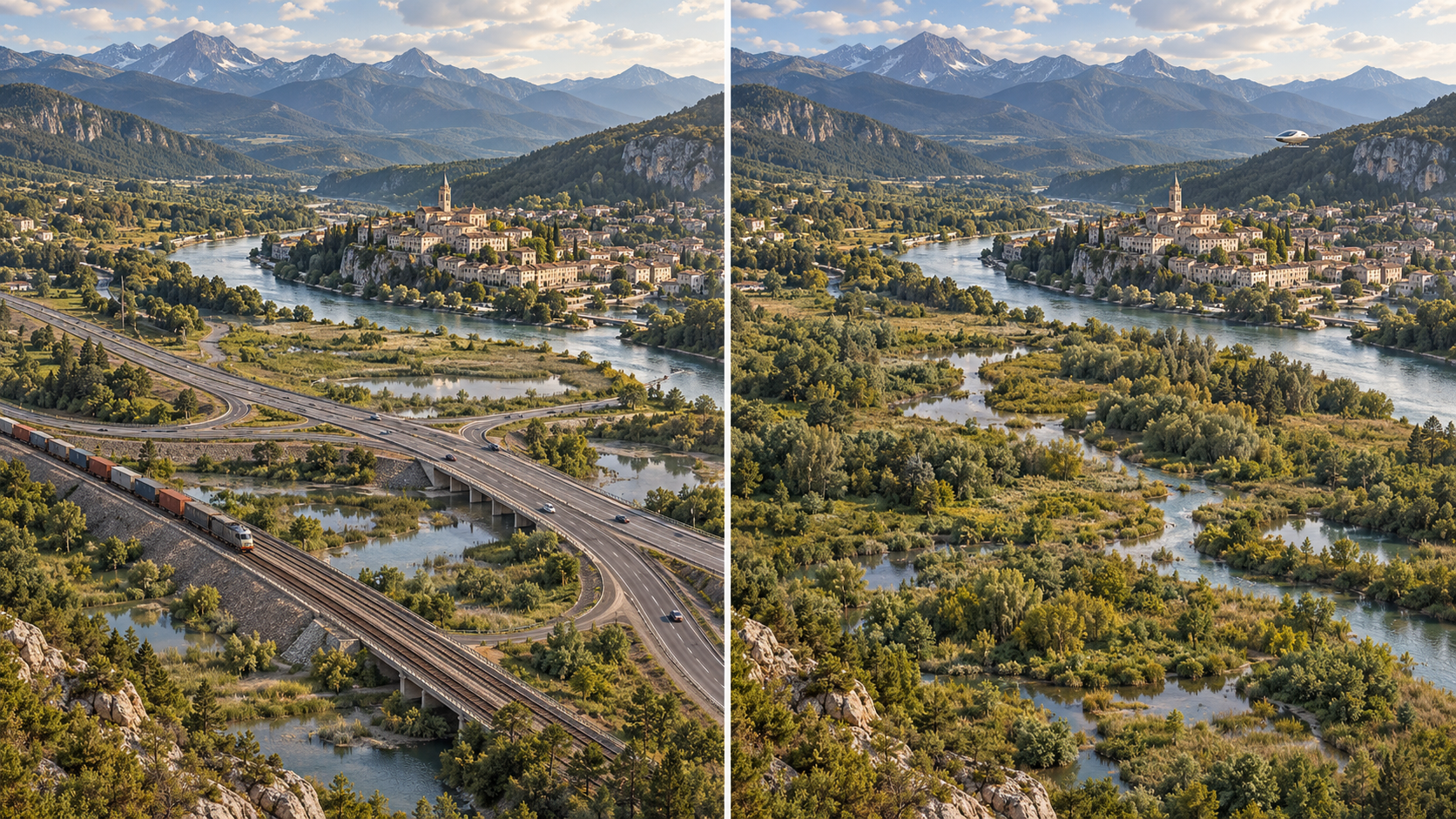
When a highway becomes a living corridor
A road occupies more than the strip beneath its tires. Its embankments, drainage structures, junctions, barriers, and approaches shape the land around it.
Removing one would be a construction project in reverse. Crews would recover pavement and reusable material, assess contaminated ground, loosen compacted soil where appropriate, and restore water movement. Some bridges might remain as walking routes or historical structures. Others could be removed to reopen a valley.
There is a small-scale precedent for this kind of work. Research on logging-road removal in California’s Lost Man Creek watershed found temporary sediment disturbance during restoration, followed by rapidly declining sediment loads and turbidity after the work was completed. Its results concern a particular watershed, but they demonstrate why restoration involves intervention and time.
Now extend the principle across a transport network.
Former highway verges could join into woodland. A rail embankment could be reshaped to reconnect a wetland. A junction occupying the space between neighborhoods could become a park, housing, or a combination of public space and restored habitat. Some released land would serve people directly; other stretches could become places where human presence diminished.
The greatest ecological gain might come where two surviving habitats finally meet. An animal would no longer need a specially engineered crossing to pass between them. Water could follow a restored channel without being forced beneath traffic. Plant and animal populations could regain routes through a landscape that had become a collection of islands.
None of this promises an exact return to an earlier Earth. Climate, species distributions, soil, and surrounding land use would continue changing. Restoration would create future ecosystems from the conditions available.
The deeper shift concerns continuity. Today, we often preserve natural areas inside a connected human transport network. Under this model, extensive natural networks could surround more compact human places.
Civilization would still be present. Its connections would require fewer permanent cuts through the living ground.
A city designed around arriving people
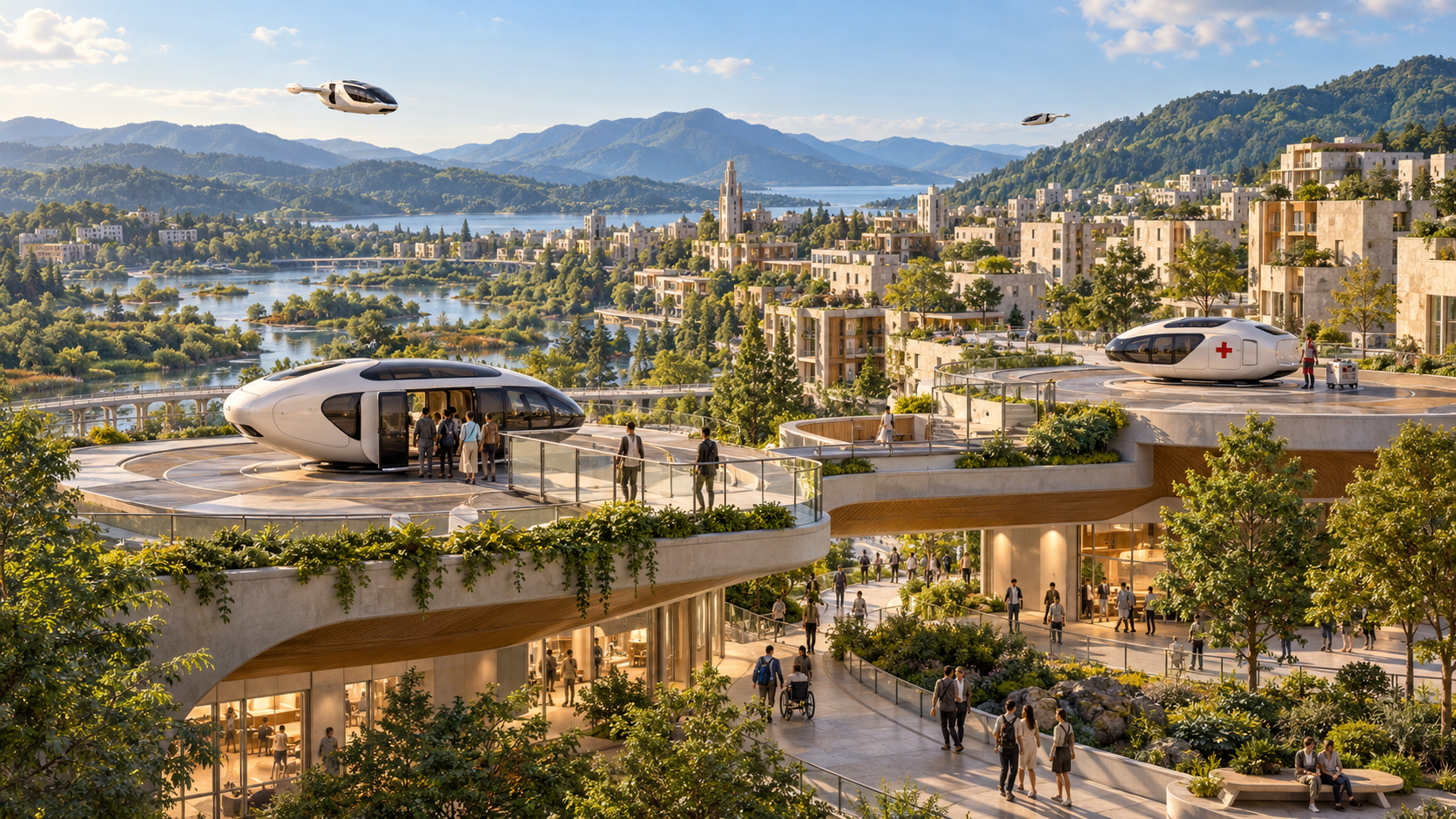
Once routine motor traffic leaves the surface, the street acquires different possibilities.
Neighborhoods could remain connected by walking and cycling routes, shaded public spaces, and places to gather. Children could move through areas formerly organized around passing vehicles. A building entrance would no longer need to address a curb where cars circulate continuously.
Landing sites would become important pieces of civic design. Some could sit at neighborhood edges; others could connect directly to hospitals, workplaces, or dense residential buildings. Their value would depend on how comfortably people could reach and use them. A roof pad accessible only by stairs would offer little independence to someone who cannot climb stairs.
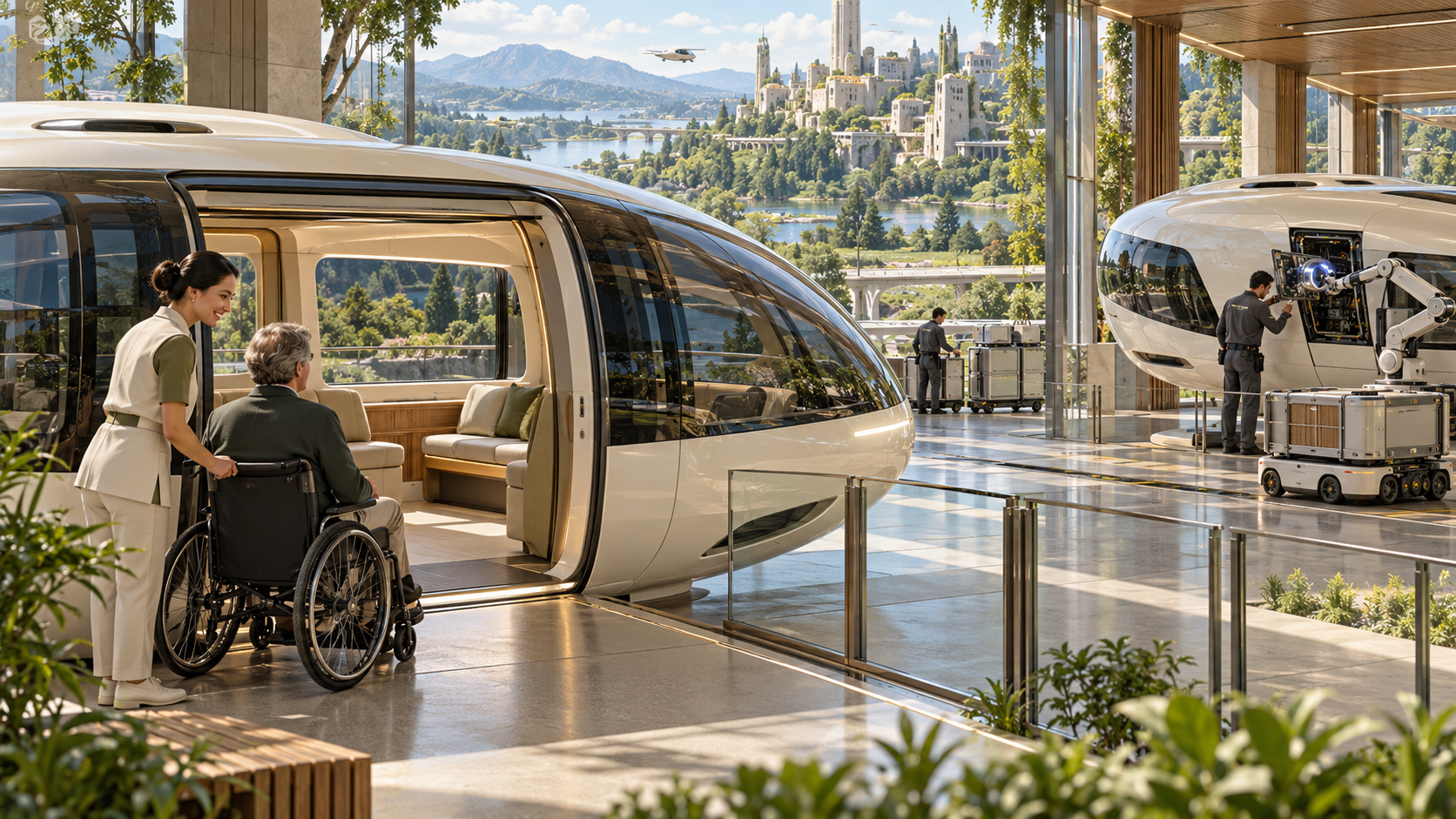
Passenger vehicles might gradually lose their resemblance to cars. Without a driving position, a cabin could be arranged around conversation, rest, medical support, or wheelchair access. A school carrier would have different boarding arrangements from a freight machine. A family could use a small shared cabin for one journey and join a larger vehicle for another.
This would also change the meaning of remoteness. A community separated from a hospital by difficult terrain could gain a direct connection. Some towns might become viable without a new highway. People could retain access to services while living in smaller settlements.
But cheap access could also scatter buildings across recovering landscapes. A forest becomes easier to protect when it no longer needs a road; it becomes easier to develop when every clearing can become an arrival point.
The rewilded version therefore needs a settlement policy. Compact communities, protected habitat, and limits on landing access would help preserve the land released by transport. Without those choices, flight could exchange linear fragmentation for a dense scattering of human disturbance.
The technology opens both futures. Institutions determine which one spreads.
The machines behind an ordinary journey
A civilization dependent on aerial transport would also depend on continuous maintenance. Inspection, cleaning, charging, component replacement, and freight handling would have to happen at the pace of daily life.
That is where the wider presence of AI and robotics becomes consequential.
AI systems could forecast demand, coordinate energy use, identify emerging faults, and schedule vehicles around maintenance. Robots could inspect structures, exchange standardized components, move cargo, and help passengers board. Human workers could supervise difficult cases, investigate failures, and decide when a machine should return to service.
In this arrangement, an individual aircraft is one visible part of a much larger working system. Its apparent simplicity depends on workshops, energy infrastructure, software, and material supply chains that passengers rarely encounter.
Some of the same capabilities could support restoration. Machines used to handle transport materials could recover obsolete infrastructure. Robotic surveying could help track drainage, soil conditions, and vegetation, while ecologists and local communities decided what recovery should mean in each place.
Automation would not need to govern the wilderness it helped restore. Its role could be to reduce the amount of machinery required there over time.
The social bargain would be substantial. A fleet could give people who cannot drive greater independence, provided service remained affordable and accessible. It could also make daily movement dependent on operators able to deny service, change prices, or record sensitive journeys. Public access obligations, privacy, and alternatives during outages would become part of transport design.
Humanity would be delegating much of the act of movement while retaining the harder responsibility of deciding whom the system serves.
The last freight train and the quieter ocean
Passenger transport alone cannot release the planet’s transport corridors. Food, construction materials, industrial equipment, and everyday goods must move as well.
Railways would be a particularly demanding replacement. Carrying many people or large loads along a shared surface route solves a different problem from flying a small cabin. An aerial alternative would need to justify its full energy, material, reliability, and capacity costs before dismantling useful rail infrastructure made sense.
The ocean raises the scale again. UN Trade and Development identifies shipping as carrying over 80 percent of world trade by volume. Replacing that function means moving the substance of the global economy.
Under the advanced model, specialized freight craft could move between compact logistics centers, with local robotic systems managing the final delivery. Manufactured goods might circulate in standardized modules. Large or dense loads would require much bigger lifting systems, or changes in production that reduced the need to move them at all.
This creates another possible convergence. If fabrication and material recovery became more local, society could need fewer long-distance bulk shipments. A transport revolution could develop alongside a manufacturing revolution, each reducing the demands placed on the other.
Shipping lanes have no pavement to tear up. Their ecological release would take another form. NOAA identifies vessel noise, whale strikes, and fuel or oil leakage among the impacts of cargo vessels. A major reduction in shipping could reduce those pressures, while selected industrial shorelines could be restored where port functions became unnecessary.
Boats could remain for recreation, science, rescue, and activities that belong on the water. The imagined change concerns the ocean’s role as an industrial transport system.
Its quieter future would depend on freight technology meeting a much higher standard than the first flying car.
When the atmosphere stops being the boundary
The space-travel possibility begins with an important distinction. An aircraft can rise by pushing against air. A propeller cannot keep doing that in a vacuum. NASA’s explanation of rocket thrust makes clear why rockets can operate where atmospheric propulsion cannot: they carry and accelerate their own working material.
Orbit also demands more than height. Near the International Space Station’s altitude, roughly 400 kilometers, an orbiting vehicle travels around Earth at about 7.7 kilometers per second. Reaching that motion, matching a destination, and returning safely are separate challenges from hovering above a city.
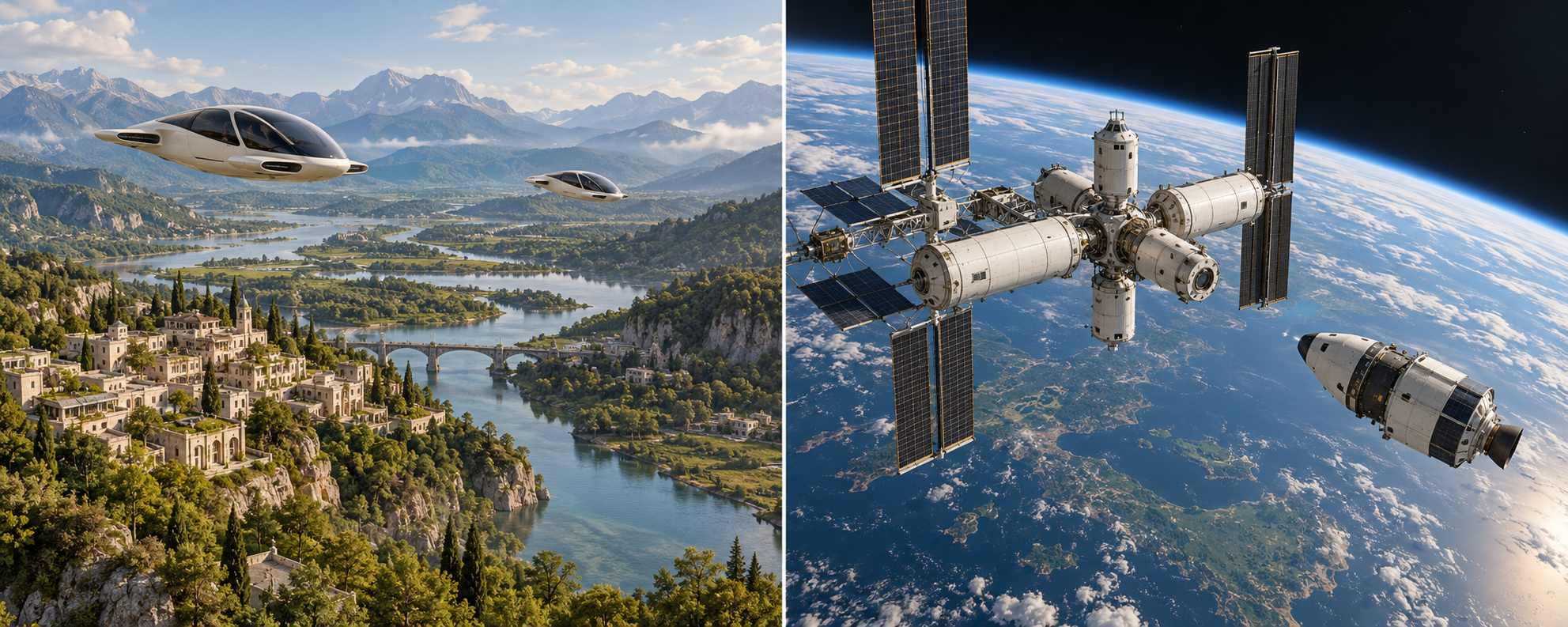
One future keeps the technologies distinct. Clean aerial transport carries people and freight to dedicated launch facilities. Autonomous logistics, robotic maintenance, and reliable energy systems make access more organized, while orbital vehicles remain specialized.
A more ambitious pathway uses infrastructure to share the work of moving from low orbit toward more distant destinations. Researchers have studied rotating tethers that would transfer momentum to payloads already in low Earth orbit and then restore their own orbital energy. Such proposals are engineering concepts, rather than an operating transport service, but they show how part of a journey could be distributed between a vehicle and a larger system.
The furthest model grants a propulsion advance that works beyond the atmosphere and supports repeated orbital journeys with acceptable energy use, acceleration, environmental effects, and return conditions. Within this scenario, it would transform the relationship between Earth and nearby space.
An orbital station could become a destination served by scheduled transport. Specialized cabins could transfer passengers between atmospheric and orbital vehicles. Robotic systems could inspect equipment, assemble structures, and maintain supply routes above the atmosphere. The surface transport network would gradually connect to another network whose geography was defined by orbits and transfer opportunities.
Construction could become continuous. A station could receive replacement parts and new living modules through a regular service, while robotic crews assembled them outside. Its population could change without each arrival requiring a bespoke expedition. Over time, nearby space could acquire the ordinary rhythms of a working human environment: maintenance shifts, returning residents, shared facilities, and structures built to serve people who expected to stay.
That would expand humanity’s working environment without making every destination equally accessible. Radiation, life support, heat management, and the distances beyond Earth would retain their importance.
Earth could become one inhabited layer within a larger system of human places. The more extraordinary achievement would be learning to operate across those layers while reducing the burden placed on the planet below.
A different kind of planetary footprint
There is a deeper possibility inside this arrangement. A world could become more technologically organized while much of its surface became more ecologically continuous.
Its intelligence would be expressed through coordination: machines arriving when needed, supplies moving through compact centers, infrastructure maintained before it failed. Large areas between human communities could follow the rhythms of water, vegetation, and animal movement. Farms, energy facilities, and industry would still occupy land; the change would concern how much additional territory had to be permanently engineered to connect them.
The transport system could begin responding to the living landscape. Routes could shift around seasonal migrations. Landing access could remain restricted near breeding areas. Some regions could retain protected skies as well as protected ground. Ecological conditions would become information that shaped the network’s daily operation.
That would create a different relationship between artificial and living systems. Advanced machinery could help maintain the boundaries within which human activity concentrated, allowing extensive habitats to function with less intervention. Success would include knowing where service should remain limited and where a convenient new destination should never be built.
From above, such a civilization might appear less industrial across its surface than its technical capabilities suggested. Its energy use and machines would still leave physical traces. But the amount of land covered by transport infrastructure would become a poor guide to how connected or capable its inhabitants were.
The familiar image of the advanced planet is crowded with structures. This model allows another image: a living world whose people have become extraordinarily good at connecting their places without occupying everything between them.
What would count as progress
The first airborne car would be an inadequate measure of this future. More revealing evidence would concern the whole system: disturbance across repeated flights, energy and material use across an aircraft’s lifetime, dependable service in difficult weather, and safe behavior when important components failed.
Clean operation would require clean power and responsible material cycles. Exhaust-free vehicles could still depend on damaging extraction, manufacturing, or disposal. Heavy freight would have to be demonstrated at useful scale. A network replacing surface transport would need reserves and recovery plans for prolonged disruption.
The ecological test would happen on the ground and water. Did redundant corridors actually disappear? Did habitat connections improve? Were protected areas quieter? Did the new access system encourage settlement to remain compact?
There would also be a question of ownership. If only a wealthy minority used the sky, society could retain the roads while adding another transport layer. Broad access is one condition for broad replacement. A civilization that dismantled shared infrastructure would need confidence that its successor remained available to everyone who depended on it.
The models would therefore leave different signatures. An added aerial service would produce more landing sites alongside largely intact roads. A genuine substitution would produce shrinking transport corridors and expanding habitat connections. An extension into space would produce repeatable orbital logistics, rather than isolated feats.
The strongest evidence for the imagined future might eventually be a map of what humanity had stopped needing to build.
The ground after the road
We have inherited a picture of technological progress in which more capable societies leave more extensive structures behind them. Greater movement seems to demand wider roads, larger junctions, deeper ports, and more permanent occupation of the spaces between destinations.
Clean autonomous flight opens another possibility. A civilization could become more connected while allowing much of the land between its communities to become less engineered. AI and robotics could support that arrangement by maintaining the systems people depended on and helping remove those they had outgrown.
This would require an unusual measure of success. The purpose of easier movement would have to include preserving places through which we no longer needed to pass.
From a vehicle above a restored forest, the old highway might eventually become difficult to identify. The two sides would have grown together. A journey that once required a permanent division in the landscape would leave only a passing presence in the air.
The larger horizon is a humanity whose reach keeps expanding while its occupation of Earth’s surface becomes more deliberate.
We could learn to travel farther, and leave more of the world connected behind us.
More in SPEC
- What If the Visitors Are Another Civilization’s AI? — Extends the question of delegated intelligence into machines operating on behalf of a wider civilization.
- What If the Galaxy Has a Second Biosphere? — Explores how interdependent machines could become a larger system with ecological consequences.
- What If First Contact Was an Archaeological Discovery? — Offers another perspective on what a civilization’s physical traces might reveal about its history and priorities.
Sources / Receipts
- Reuters — Tesla’s new Roadster turns in air with SpaceX thrusters. Reporting on the October 15, 2026 demonstration supports the opening reference to brief thruster-assisted maneuvers.
- Kasliwal et al. — Role of flying cars in sustainable mobility, Nature Communications, 2019. A physics-based comparison supports the discussion of hover energy and the importance of distance, occupancy, and electricity supply. Its conceptual aircraft model is not a measurement of every current design.
- NASA — NASA Studies Wind Effects and Aircraft Tracking with Joby Aircraft, 2025. Supports the physical importance of aircraft-generated airflow around landing areas.
- FAA — Engineering Brief 105A, Vertiport Design, December 2024. Supports the need for landing facilities and downwash/outwash protection. It does not describe the far-future autonomous system imagined here.
- NASA — NASA Flies Drones Autonomously for Air Taxi Research, 2023. Supports the limited demonstrated foundation for autonomous obstacle avoidance and coordinated flight.
- Haddad et al. — Habitat fragmentation and its lasting impact on Earth’s ecosystems, Science Advances, 2015. Supports the ecological importance of habitat connectivity. It does not predict the size of benefits from future highway removal.
- NASA — Cybersecurity Challenges for Advanced Air Mobility, 2024. Identifies security challenges arising from distributed and decentralized air-mobility architecture; the article’s proposed safeguards are speculative design choices.
- Klein and Ozaki — Effects of logging road removal on suspended sediment loads and turbidity, 2017. A watershed study illustrates both temporary restoration disturbance and subsequent improvement. It is a precedent for a process, not a direct forecast for highway removal.
- UN Trade and Development — Review of Maritime Transport 2025 release. Establishes the large share of world trade carried by shipping, explaining why freight replacement is a separate threshold.
- NOAA — Vessel Impacts at Monterey Bay National Marine Sanctuary. Supports the discussion of vessel noise, whale strikes, and pollution risks.
- NASA Glenn — Rocket Thrust. Explains why propellers need surrounding air and rockets can produce thrust in vacuum.
- NASA JPL — A Hard Day’s Flight: Dawn Achieves Orbital Velocity, 2013. Provides the approximate speed of a low Earth orbit near the station’s altitude.
- NASA NTRS — Orbital Propagation of Momentum Exchange Tether Systems, 2002. Documents a researched momentum-transfer concept. It supports the infrastructure pathway, not a claim that orbital tether transport is operational.


Discussion