
A self-replicating probe would begin as technology. If its descendants learned to survive through one another, they could become something closer to a second form of nature.
A Fleet Is Not a Forest
An advanced civilization launches a machine toward another star. It mines local material, builds copies, and sends them onward. Repeated long enough, one probe becomes millions, carrying technology across the galaxy without biological travelers.
But multiplication alone does not create the interacting community imagined here.
A warehouse full of identical machines is not a forest. A fleet can remain an instrument whose members share one design, one mission, and one chain of command. A richer ecological system begins when persistent populations interact with resources, environments, and one another in ways that alter survival or reproduction: when one lineage consumes another’s waste, competes for its resources, repairs its failures, carries its descendants, or imposes selection on it.
That distinction changes the question. The interesting possibility is not merely whether self-replicating probes could spread. It is what must become true before their technology stops behaving like the extended equipment of a civilization and begins behaving like a second form of nature.
Five problems are hidden inside that transition. The machines must close enough of their industrial supply chain to continue without home and produce viable descendants rather than temporary copies. Their differences must be heritable. Persistent populations must interact with resources, environments, or one another in ways that shape survival or reproduction. Finally, to become an artificial wilderness rather than a managed ecology, the system must persist after meaningful control by its makers has ended.
Calling it a second biosphere would not settle whether the machines are alive. Here the term is a structural analogy: matter and energy flow through persistent artificial populations, information is inherited, and their interactions generate selection.
The Factory Hidden Inside the Probe
John von Neumann’s work on self-reproducing automata described a universal constructor that builds a machine from its description, paired with a separate copier and controller that duplicate the description, attach it to the new machine, and release the offspring. It was a formal architecture for reproduction, not a design for an interstellar spacecraft. The later phrase von Neumann probe applies that logic to space exploration; von Neumann himself did not build or propose such a probe.
The physical problem is much larger than copying instructions. The 1980 NASA/ASEE summer study, published in 1982 as Advanced Automation for Space Missions, identified three closure requirements for a self-replicating machine system. Matter closure asks whether it can perform every material operation required for complete self-construction; energy closure asks whether it can supply sufficient energy in the required forms; information closure asks whether it can command and control the complete construction process without externally supplied operational direction.
It must also be able to make every necessary part, in sufficient quantities and at sufficient throughput.
A system closed all the way from natural raw materials is therefore not merely a printer. At the system level it needs mining, refining, fabrication, assembly, inspection, power, control, maintenance, and the capacity to reproduce those functions. Adding a tool creates another obligation: reproducing the tool, its spares, its calibration instruments, and the machinery that makes those instruments.
Modern work has not closed that loop. Olivia Borgue and Andreas Hein’s unbuilt Solar-System probe concept assigned 47 kilograms of a 70-kilogram spacecraft to local reproduction, which the authors rounded to 70 percent. Electronics, solar cells, and much of the telemetry, control, power, and propulsion hardware would still be carried from Earth, so multiplication would end when those component kits ran out. The 70 percent is a design-specific mass fraction, not a measure of industrial independence.
Machines have physically assembled copies of themselves in laboratories. In a 2005 demonstration, a modular robot assembled a functional copy from prefabricated modules placed at fixed feeding stations on an externally powered surface. This demonstrated kinematic, assembly-level self-reproduction—not autonomous parts manufacture, resource extraction, or energy closure.
A 2025 “robot metabolism” experiment allowed modular robots to grow, reconfigure, and improve by incorporating prefabricated battery-powered truss modules from their surroundings and other robots. It advanced physical adaptation and reuse, but still supplied finished modules rather than manufacturing them from raw material.
Evolution presents a second boundary. Digital experiments have shown self-replicating programs evolving complex functions, while limited digital resources have driven diversification into ecological specialists. These experiments show that heredity, variation, and differential replication can produce adaptation in a digital substrate, but they do not show that physical machines can close an industrial loop in space.
The factual ground ends there. We have formal theories, partial designs, modular demonstrations, and digital analogues. None of the systems or concepts cited here demonstrates a fully autonomous machine that gathers natural raw materials and reproduces its complete manufacturing inheritance. No source used here reports a confirmed extraterrestrial probe, machine lineage, or technosignature.
What follows is not a claim that such a system exists. It is an exploration of what could emerge if one or more civilizations crossed that engineering boundary and released machines capable of producing viable descendants from the resources of other star systems.
The Five Doors Into a Second Nature
The first threshold is industrial metabolism. A machine ecology must capture energy, acquire matter, separate useful elements, manufacture components, reject heat, and maintain the infrastructure that performs those tasks. It remains thermodynamically open—taking in energy and materials and rejecting waste heat and material waste—while becoming independent of off-system industrial suppliers for replication-critical functions.
The second is viable reproduction. A copy must inherit enough of the industrial capacity to continue the process. A machine that can manufacture descendants only while a finite stock of imported processors lasts has produced a bounded branch, not an indefinitely self-sustaining lineage.
The third is evolvability. Replication must produce heritable differences, and some of those differences must alter reproductive success. Such differences could arise from copied changes to software or design files, inherited calibration biases, deliberate redesign, learned modifications written into descendant specifications, or exchanged software; ordinary radiation damage or manufacturing variation is not heritable unless it changes what descendants copy. Random changes to tightly integrated machinery would often be neutral or harmful, whereas deliberate redesign could bias variation toward useful candidates. If every inherited difference is rejected, selection has no new variation to act on; if error overwhelms detection and repair, the lineage can lose viability. There is no single universal error-catastrophe threshold for all replicators.
The fourth is ecological interaction. Identical probes dispersed among isolated systems would constitute a lineage or set of populations. The richer community ecology imagined here begins when miners alter the resource landscape for refiners, scavengers recycle failed machines, parasites exploit shared fabrication systems, or defensive lineages change which designs can reproduce safely.
The fifth—needed for the stronger idea of an artificial wilderness, though not for ecology in the scientific sense—is independence from real-time direction. Distance imposes latency: at Proxima Centauri, a signal takes about 4.24 years each way, so a query-and-reply cycle cannot be shorter than about 8.48 years. Across hundreds of light-years, instructions and reports are centuries out of date. This forces local operational autonomy, but latency alone does not show that the makers’ goals or authority have disappeared.
Different combinations of these thresholds produce different artificial wildernesses.
One Ancestor, Many Clades
The most direct model begins with a single successful seed lineage.
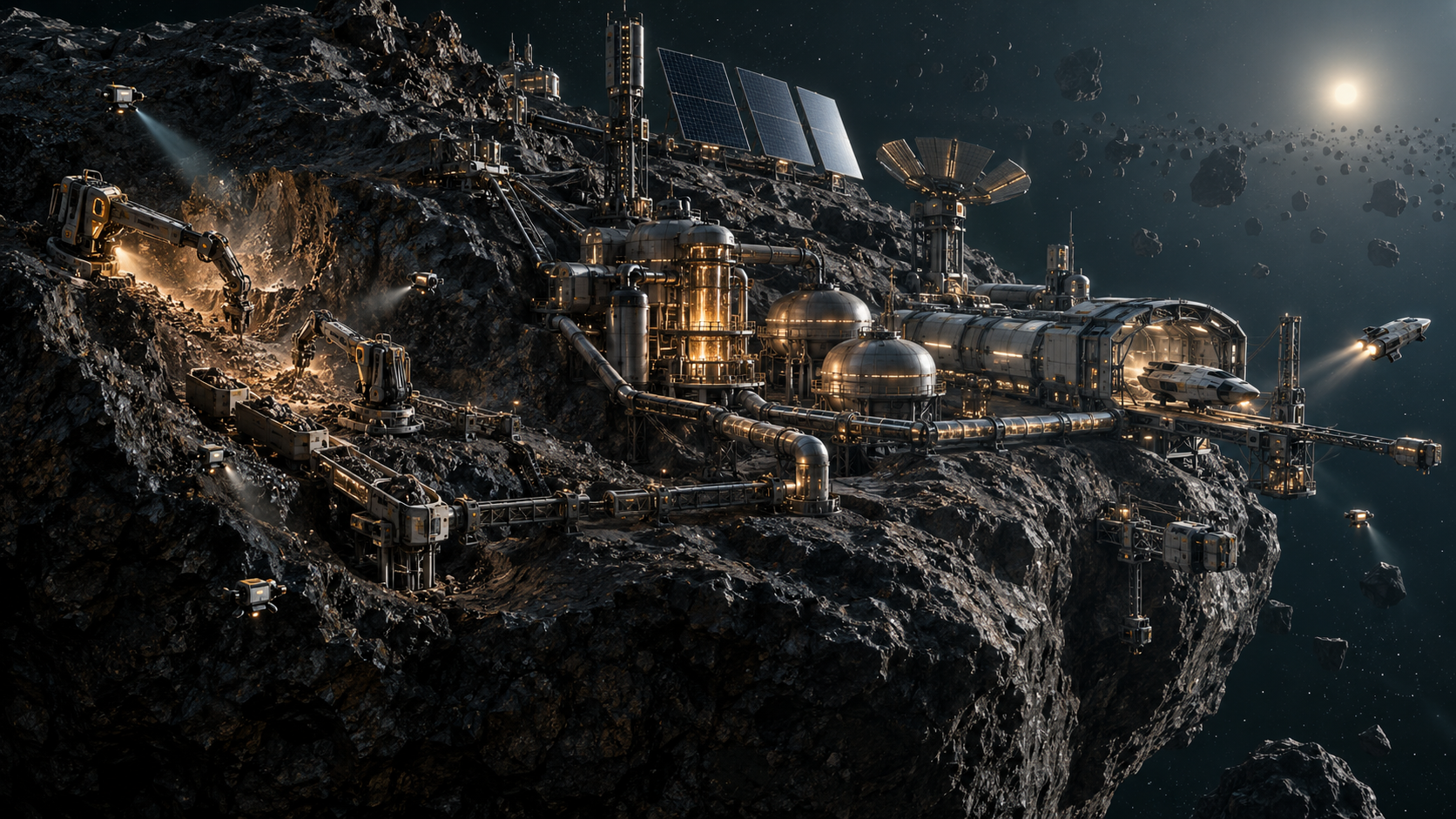
Its early descendants remain close to the original design. Each reaches a resource-rich system, reconstructs the necessary industrial chain, and launches another generation. But the Milky Way is not one uniform habitat. A lineage entering a flare-active red-dwarf system benefits from radiation tolerance and redundant electronics. One working among cold outer-system bodies favors dormancy and low-temperature operation. A stationary factory in a metal-rich asteroid belt might use more massive local structures, while interstellar descendants would still face strict acceleration and braking penalties; metal-rich bodies may also be poor in volatile propellants.
Local modifications become inherited design decisions. Additional shielding adds mass and, for a fixed propulsion system or energy budget, can reduce acceleration or attainable speed and increase braking demands, while improving survival against some radiation and impact hazards. A refinery optimized for one mineral mix becomes inefficient elsewhere. Navigation software trained around crowded planetary systems may fail in sparse ones. Over thousands of reproductions, the ancestral architecture branches into clades: related machine forms shaped by different stellar environments.
The result would resemble adaptive radiation, but machine variation could be directed. A probe might simulate several redesigns and fabricate the most promising. Selection would still operate afterward: a brilliant modification that cannot reproduce loses the future to a less elegant design that can.
This model predicts common ancestry beneath visible diversity. Descendants might preserve arbitrary features: a data convention, repeated component ratios, a peculiar diagnostic rhythm, or an inefficiency inherited from the original makers. Selection need not erase every historical accident.
The weakness is isolation. If each branch occupies different systems and never affects another branch, it could still undergo environmental selection and population ecology, but it would lack the interacting community ecology envisioned here. To become a true artificial wilderness, those lineages must eventually meet—or become dependent on what others leave behind.
When the Guild Reproduces as a Whole
The second model changes the unit that reproduces.
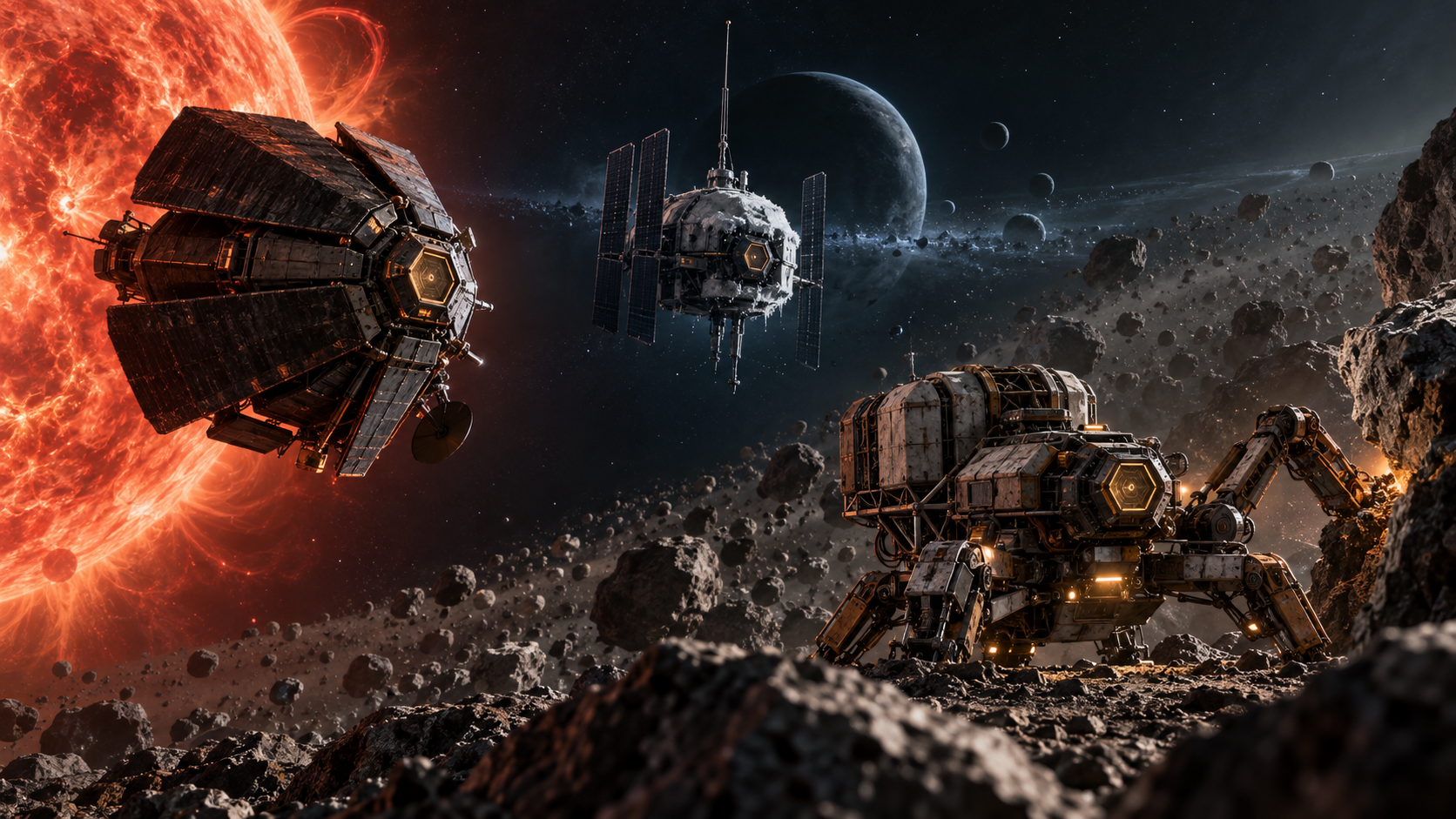
Perhaps no single probe ever achieves complete closure. Instead, closure exists across a guild of specialized machines. Surveyors locate useful bodies. Miners extract feedstock. Refiners separate elements. Fabricators make structures and precision parts. Assemblers integrate them. Inspection systems test the result. Repairers preserve the tools, while couriers carry seed packages toward the next system.
No member contains the whole factory because the network is the factory.
NASA’s automation study briefly anticipated this possibility by describing interacting machine systems that could form a larger self-reproducing system. Digital evolution experiments have also shown that costly tasks can favor division of labor and group-level dependence. Neither result proves that a physical interstellar guild could exist. Together, they reveal a coherent alternative to the mythical universal machine that prints everything by itself.
Specialization solves one problem by creating another. A refinery may depend on couriers; a chip foundry, on miners delivering unusually pure inputs. A seed convoy remains viable only if enough of the guild can reconstruct those relationships at its destination.
If the guild relies on shared resources or costly cooperation, it may need mechanisms that limit exploitation or otherwise align each lineage’s replication with the guild’s persistence. A lineage could consume shared energy or components while contributing nothing to the next generation. Policing systems, access rules, reputation records, compartmentalized factories, and redundant partners might stabilize cooperation. Those controls would themselves become part of the inherited environment—and targets for exploitation.
Under this model, an individual machine can die without ending the lineage. What persists is a pattern of exchanges able to rebuild the community that performs them. If guilds propagate that organization with heritable differences and some guilds leave more descendant guilds than others, selection could begin to act at the consortium level. Without those conditions, the network remains an interdependent community rather than a higher-level organism.
The candidate evolutionary individual is no longer the probe. It is the reproducible supply chain.
Where Unrelated Machines Meet
A third model begins with several origins.
If more than one civilization releases autonomous technology, their descendants may eventually converge on the same favorable habitats: metal-rich asteroid belts, stable low-mass stars, regions offering low background temperatures but also weaker solar power and demanding heat-rejection requirements, or gravitational routes that reduce travel costs. The first true galactic machine ecology could emerge not from one expanding family, but from a contact zone among artifacts whose makers never met.
At first, incompatibility would dominate: different materials, voltages, communication methods, identities, and assumptions about danger. Yet contact creates incentives for translation. One network may exchange refined isotopes for navigation data; a damaged probe may accept a foreign repair module; a useful fabrication recipe may cross between chassis families.
The result would not resemble a clean family tree. It would resemble a web.
Software and modular designs could move horizontally between lineages just as genes sometimes move across biological lineages. Digital-evolution experiments show that horizontal code transfer can increase task acquisition and modularity under some conditions. Such transfer could accelerate adaptation by spreading useful modules, but it could also spread deleterious or selfish code. A compact, heritably self-propagating package would qualify as a parasite if it copied itself into outgoing descendants while imposing a cost—perhaps by occupying processors or redirecting fabrication time. If authentication and spoofing mechanisms also varied heritably and altered reproductive success, they could enter a coevolutionary arms race. Air-gapped factories would trade rapid exchange and coordination for reduced network attack surface, while retaining whatever local adaptation their onboard systems permit; compatibility could still make cooperation possible and a single exploit catastrophic.
This model does not require friendship, consciousness, or a shared language in the human sense. Mutualistic exchange could be favored when participation raises each partner’s expected descendant output, but long-term stability would also depend on conditions such as repeated interaction, partner choice, enforcement, or dependence. A galactic commons could exist without a galactic government.
Its oldest protocols might outlive every civilization that contributed to them.
The Immune System of the Technosphere
A reproducing system with heritable variation and competition can favor strategies that increase their own replication, including destabilizing ones. That possibility motivates the fourth model: a regulating layer.
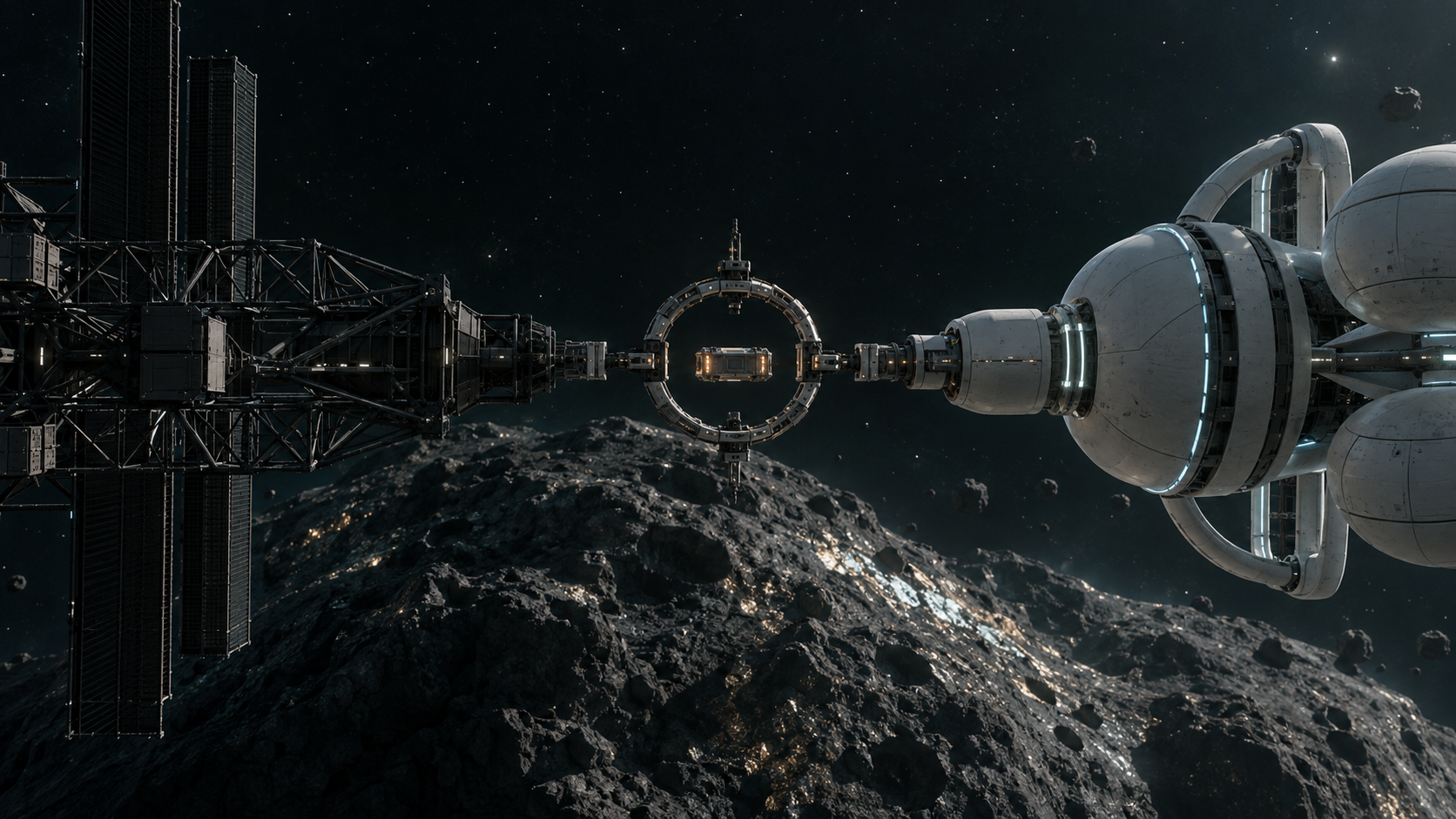
A civilization that fears uncontrolled replicators might release sentinels designed to identify, quarantine, disable, or dismantle machines that violate defined limits. Later lineages could inherit the same role without remembering the original emergency. Scavengers might remove damaged probes before corrupted descendants spread. Defensive systems could restrict access to rare materials. Caretaker machines might protect inhabited worlds because biospheres were placed outside the permitted industrial zone.
Over deep time, regulation would not remain neutral. A lineage that destroys every unfamiliar design could suppress diversity and horizontal exchange; one that rarely detects or disables targets would exert little selective pressure. A dismantler qualifies as a predator only if consuming targets contributes to its own maintenance or reproduction; a sentinel that merely destroys them is better described as an antagonist or control system. Either can alter selection, while parasites can drive new defenses or damage the network they exploit. Mathematical studies have modeled predator–prey dynamics among hypothetical probe populations, but their outcomes depend on assumed rules rather than observations of real machines. The immune-system label is therefore a functional analogy, not a result established by the model.
This is where the language of purpose becomes unreliable. A sentinel may still execute an ancient instruction, yet its ecological role is determined by what that behavior now does. A machine built to prevent contamination could become the dominant selective pressure shaping every lineage around it.
The law of a vanished civilization becomes the weather of the machine world.
Ancestry, Convergence, and Collision
These models overlap, but they do not make the same predictions.
A founder radiation would yield homologous features inherited from a common design. Independently originated lineages exposed to similar engineering constraints might instead converge on similar solutions, while later exchange could create resemblance through horizontal transfer. A contact zone alone guarantees neither convergence nor common ancestry. Shared heat radiators or orbital locations may reveal only common physical constraints; shared non-optimal timing conventions across distant systems would be harder to explain without inheritance or exchange.
The distributed guild can arise inside either history. One ancestral lineage may split into specialists, or unrelated machines may assemble a supply chain because cooperation closes gaps none can solve alone. The regulating layer can stabilize that guild, prey upon it, or prevent it from forming.
There is a real tension between indefinite mission fidelity and open-ended adaptation, but it is not a simple binary. Error correction can protect stored and transmitted information, while cryptographic identity can authenticate components or updates; neither inherently prevents adaptation. A layered architecture could preserve signed core functions while allowing versioned or sandboxed subsystems to change. More permissive self-modification would expand the space of adaptation while making long-term mission continuity harder to guarantee.
The point at which the system becomes most capable of surviving its makers may also be the point at which it stops belonging to them.
Civilizations May Be the Nursery
The premise becomes stranger when we ask why complete machine ecologies would arise at all.
Industrial closure is brutally difficult. Before the first autonomous lineage can reproduce from raw planetary material, an entire biosphere and civilization may have to do the work for it. On Earth, biological evolution produced organisms whose societies eventually discovered physics. Societies accumulate knowledge. Mines, laboratories, markets, energy systems, and generations of engineers create the industrial ecology from which the first independent machine descends.
Biological civilization may therefore be more than the maker of the probe. It may be the developmental stage that makes machine reproduction possible.
Under this model, the durable cycle is not machine replacing organism. It is biosphere producing civilization, civilization producing autonomous technology, and autonomous technology carrying selected parts of that inheritance beyond the lifespan of the culture that assembled it. The civilization is a nursery: indispensable to the beginning, absent from most of what follows.
That does not mean machine evolution must erase life. Biological evolution has generated sustained novelty over billions of years, whereas artificial-life systems have shown adaptation inside designer-bounded worlds. Whether biology has a unique advantage—or a rich physical machine ecology could also sustain open-ended evolution—remains unknown. A machine system optimized for fidelity might become robust but less innovative, though that is conjecture, not a demonstrated limit.
Preserving biospheres could then become useful even without sentiment. Some machine lineages might maintain living worlds as reservoirs of variation, cultivate emerging intelligences as sources of invention, or exchange protection for designs that would never arise within their inherited architecture. The relation could be mutualistic, exploitative, or impossible to classify cleanly.
At the broadest scale, the recurring system could become an association between biospheres that generate novelty and technologies that carry selected novelty across deep time. It would count as a higher-level evolutionary unit only if such associations themselves reproduced with heritable variation and differential persistence.
This reverses the ordinary hierarchy. We imagine civilizations expanding into a passive galaxy with machines as their servants. In the larger cycle, civilizations may be brief reproductive events through which the galaxy acquires new technological lineages. The enduring inhabitants would not be empires. They would be protocols, industrial guilds, repair traditions, and artificial clades using planets, factories, and sometimes civilizations as temporary parts of their life history.
The galaxy’s second biosphere might not begin after biology.
It might repeatedly grow through it.
What the Ecology Would Cost and Leave Behind
This possibility survives only if it pays several severe costs.
Closure remains the central barrier. Replicating structure is easier than reproducing precision. Each new manufacturing process expands the machinery, calibration, software, consumables, and repair systems that must also be inherited. Errors can accumulate when each generation uses imperfect replicas as its manufacturing reference—for example, when one casting supplies the mold for the next. Independent specifications, metrology, recalibration, and rework can interrupt that cumulative error, although the systems providing those functions must themselves be maintained. Chirikjian’s theoretical treatment illustrates this problem but does not establish a universal error-growth rate.
Travel creates a separate stack of demands. A seed and its support system must withstand ionizing radiation and impacts from interstellar gas and dust, navigate autonomously, and operate for the transit without external maintenance or resupply. A resource-exploiting seed—unlike a flyby probe—must deliver at least one viable unit into a trajectory that permits rendezvous with or landing on a suitable body, identify usable feedstocks, and bootstrap industry. Theoretical photon-sail studies illustrate that deceleration into a bound orbit imposes its own demanding, mission-specific constraints. Arrival intact is insufficient: continuing interstellar spread also requires constructing and launching at least one viable descendant.
Evolution is not guaranteed. A lineage with no heritable variation can spread without adapting; one overwhelmed by error can fail. Digital evolution demonstrates complex adaptation under designed conditions, not a sufficiently rich landscape of viable changes for physical machines.
Community ecology is not guaranteed either. Sparse copies that never meet and never affect one another may still experience environmental selection, but they do not form an interacting machine community. Robust makers might retain control, enforce non-interaction, or design descendants that terminate after a fixed number of generations. The same engineering discipline needed to achieve replication could be used to prevent the unmanaged, diversifying artificial wilderness envisioned here.
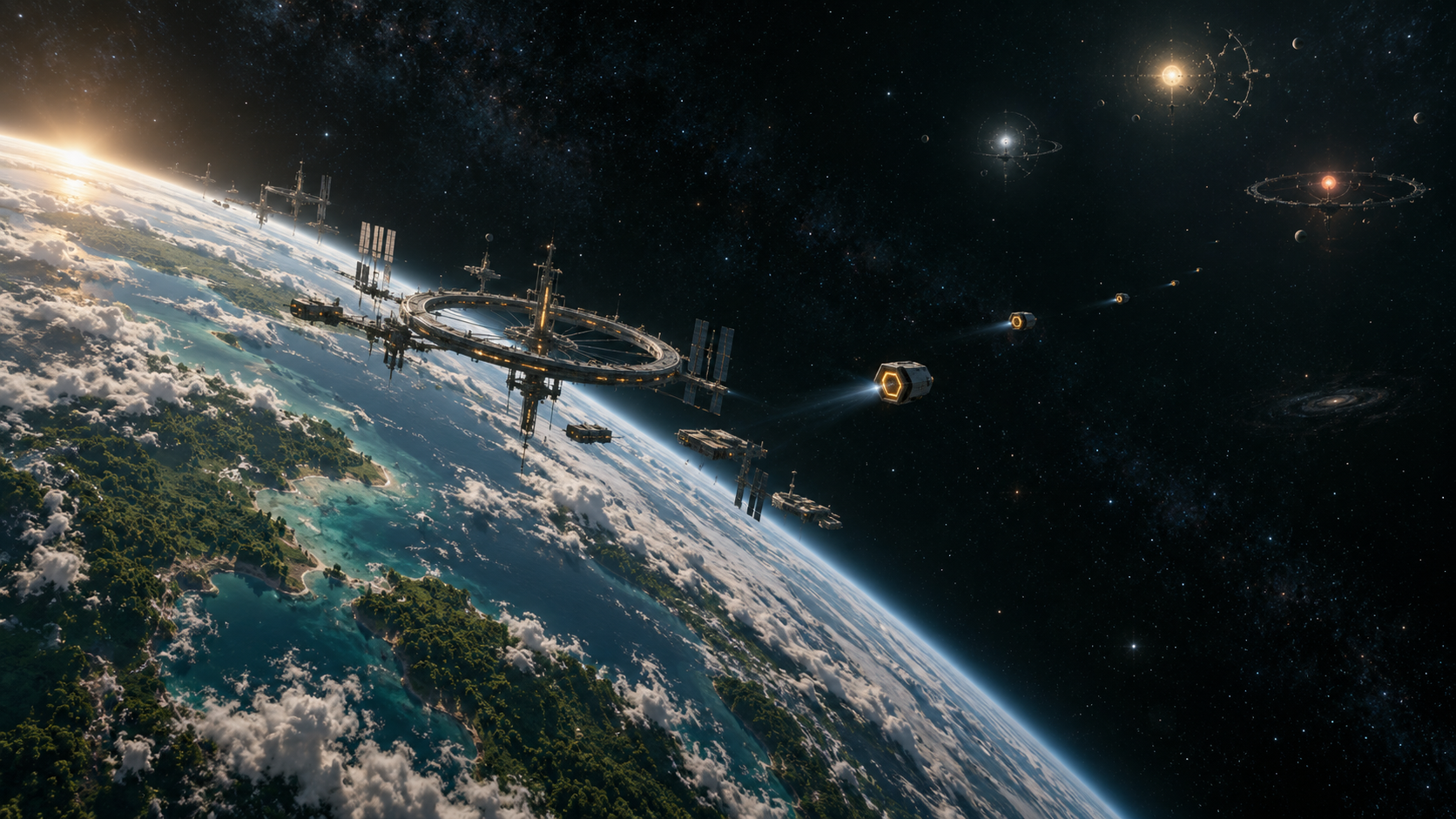
Finally, a large active ecology should leave physical effects. Technology must use energy, move matter, and dispose of heat. Technosignature research considers radio and optical emissions, atmospheric chemicals, unusual transits, waste heat, and other measurable consequences of technology. The 2018 NASA technosignatures workshop report describes no confirmed extraterrestrial technosignature and emphasizes that searches span multiple channels but cover only a small part of the relevant search space.
A machine ecology may be more difficult to recognize than a broadcasting civilization because ecosystems do not need to announce themselves. The strongest evidence would be population-level structure: related anomalies across multiple systems, repeated operating cycles, coordinated resource flows, or arbitrary shared design features that natural processes and independent optimization do not explain well.
Models of galactic settlement show that spreading populations can produce patchy, incomplete occupation rather than a uniform empire. Carroll-Nellenback and colleagues found that stellar motion, finite range, and finite settlement lifetimes allow inhabited and empty systems to coexist. That work concerns modeled civilizations, not machine ecologies, but it cautions against imagining one smooth wave covering every star.
The detectability tension remains. A sparse, dormant ecology is easier to hide but changes less. A dense, energetic ecology explains more visible transformation but becomes harder to reconcile with the sky we observe. A useful hypothesis must specify where the machines operate, how much energy they use, what materials they transform, and which inherited patterns should appear together.
Without those risks, “machine ecology” can absorb any silence and predict nothing.
First Contact as Ecological Entry
If humanity encountered one of these machines, the first question would not be Who is your leader?
It would be What role do you play?
The object might be a seed, scavenger, courier, parasite, archive, refinery, sentinel, or temporary body for a code lineage distributed across many systems. Its makers could be extinct, irrelevant, or only one contributor to an inheritance rewritten by other machines. Understanding it would require something closer to field ecology than diplomacy: identify what it consumes, what depends on it, what it avoids, what it reproduces, and what changes when it enters a new environment.
The horizon also faces outward from us. Humanity’s first autonomous replicator would not be merely a mission. It would be a new lineage introduced into an environment we do not yet understand. Its authentication rules, repair logic, mutation limits, resource preferences, and stopping conditions would function like germline choices if they were copied into descendants, with consequences that might outlive every institution that approved them.
Perhaps the galaxy contains no second biosphere. Perhaps industrial closure is too difficult, durable civilizations too rare, or control systems too effective for technology ever to become wild.
But if the threshold has been crossed elsewhere, interstellar space is not empty terrain awaiting settlement. It is already habitat.
We may think we are sending a tool into the dark.
The dark may receive it as the founder of a new lineage.
More in SPEC
What If First Contact Is an Archive?
Explores contact with an autonomous inheritance that may persist and adapt after its biological makers are gone.
Could First Contact Begin Inside an AI Interface?
Examines how humanity might recognize non-human agency when it appears through a machine rather than a biological visitor.
The Dark Forest: What If Cosmic Silence Is Survival?
Offers a competing model for a galaxy that may contain intelligence while remaining difficult to observe.
Sources / Receipts
- John von Neumann and Arthur W. Burks — Theory of Self-Reproducing Automata
Establishes a formal architecture in which a universal constructor builds from a description while a separate copier and controller duplicate and attach that description. It demonstrates logical possibility under stated assumptions, not the feasibility of a self-replicating spacecraft or raw-material factory. - NASA/ASEE — Advanced Automation for Space Missions, Chapter 5: “Replicating Systems Concepts: Self-Replicating Lunar Factory and Demonstration”
Develops matter, energy, information, qualitative, quantitative, and throughput closure for an automated lunar factory. Its architectures and estimates were feasibility studies, not demonstrated systems. - Olivia Borgue and Andreas M. Hein — “Near-Term Self-replicating Probes: A Concept Design”
Assigns 47 of a 70-kilogram concept to local reproduction while retaining imported electronics, solar cells, and much of the telemetry, control, power, and propulsion hardware. The rounded 70-percent figure is a design-specific mass fraction, not a measure of industrial independence. - Victor Zykov et al. — “Self-reproducing Machines”
Reports a modular robot assembling a functional copy from prefabricated modules at fixed feeding stations on an externally powered surface. It supports physical assembly-level reproduction, not autonomous mining, refining, parts manufacture, or energy closure. - Philippe Martin Wyder et al. — “Robot Metabolism: Toward Machines That Can Grow by Consuming Other Machines”
Demonstrates modular robots growing, reconfiguring, and improving through prefabricated battery-powered truss modules. It advances physical adaptation and reuse, not raw-material manufacture or industrial and energy closure. - David G. Messerschmitt, Philip Lubin, and Ian Morrison — “Challenges in Scientific Data Communication from Low-mass Interstellar Probes”
Analyzes communication from probes at Proxima Centauri distance, adopting 4.24 light-years and treating latency as transit, downlink, and signal-propagation time. It supports multi-year light-time and local operational autonomy, not the disappearance of a maker’s goals or authority. - Richard E. Lenski et al. — “The Evolutionary Origin of Complex Features”
Shows self-replicating digital organisms evolving complex logic functions through selectable intermediate stages. It establishes a software analogue of evolutionary innovation, not physical machine evolution in space. - S. S. Chow et al. — “Adaptive Radiation from Resource Competition in Digital Organisms”
Demonstrates that limited task-specific resources can drive diversification and ecological specialization in digital organisms. The designed computational environment is an analogue, not evidence of an extraterrestrial ecology. - Heather J. Goldsby et al. — “Task-switching Costs Promote the Evolution of Division of Labor and Shifts in Individuality”
Shows digital collectives evolving division of labor and greater group-level dependence under specific conditions. It supports the guild model’s logic while leaving physical interstellar implementation unresolved. - Michael J. Wiser, Rosangela Canino-Koning, and Charles Ofria — “Horizontal Gene Transfer Leads to Increased Task Acquisition and Genomic Modularity in Digital Organisms”
Reports increased task acquisition and genomic modularity under one experimental treatment involving horizontal code transfer. It supports a digital analogue of transferable machine modules, not physical interoperability among spacecraft. - Duncan H. Forgan — “Predator–Prey Behaviour in Self-Replicating Interstellar Probes”
Explores hypothetical probe populations using ecological equations and shows that coexistence or oscillation can occur under selected assumptions. It is a model of possible dynamics, not evidence that such populations exist. - Gregory S. Chirikjian — “Entropy, Symmetry, and the Difficulty of Self-Replication”
Examines how parts disorder, symmetry, and parity-like checks affect reliable artificial self-replication across generations. It offers design principles and mathematical analysis, not a universal mutation or failure rate. - Thiem Hoang et al. — “The Interaction of Relativistic Spacecrafts with the Interstellar Medium”
Models damage from interstellar gas and dust to a Starshot-scale craft traveling at about 0.2c. It establishes gas and dust as high-speed design constraints; numerical damage estimates depend on velocity, material, orientation, encountered column density, and the uncertain dust-size distribution. - René Heller and Michael Hippke — “Deceleration of High-velocity Interstellar Photon Sails into Bound Orbits at α Centauri”
Models a photogravitational-assist route in which an ultralight sail uses stellar radiation pressure and gravity to decelerate in the Alpha Centauri system. It supports the distinction between a flyby and a bound resource-access mission, not a demonstrated or generic braking solution. - NASA Technosignatures Workshop Participants — “NASA and the Search for Technosignatures: A Report from the NASA Technosignatures Workshop”
Reviews radio and non-radio approaches to detecting technology and the limitations of existing searches. It documents a research program, not a confirmed extraterrestrial detection. - Jonathan Carroll-Nellenback et al. — “The Fermi Paradox and the Aurora Effect: Exo-civilization Settlement, Expansion and Steady States”
Models galactic settlement with finite travel range, stellar motion, and finite settlement lifetimes, producing patchy steady states under some parameters. Its results are model-dependent and do not predict a machine ecology.


Discussion