
Overview
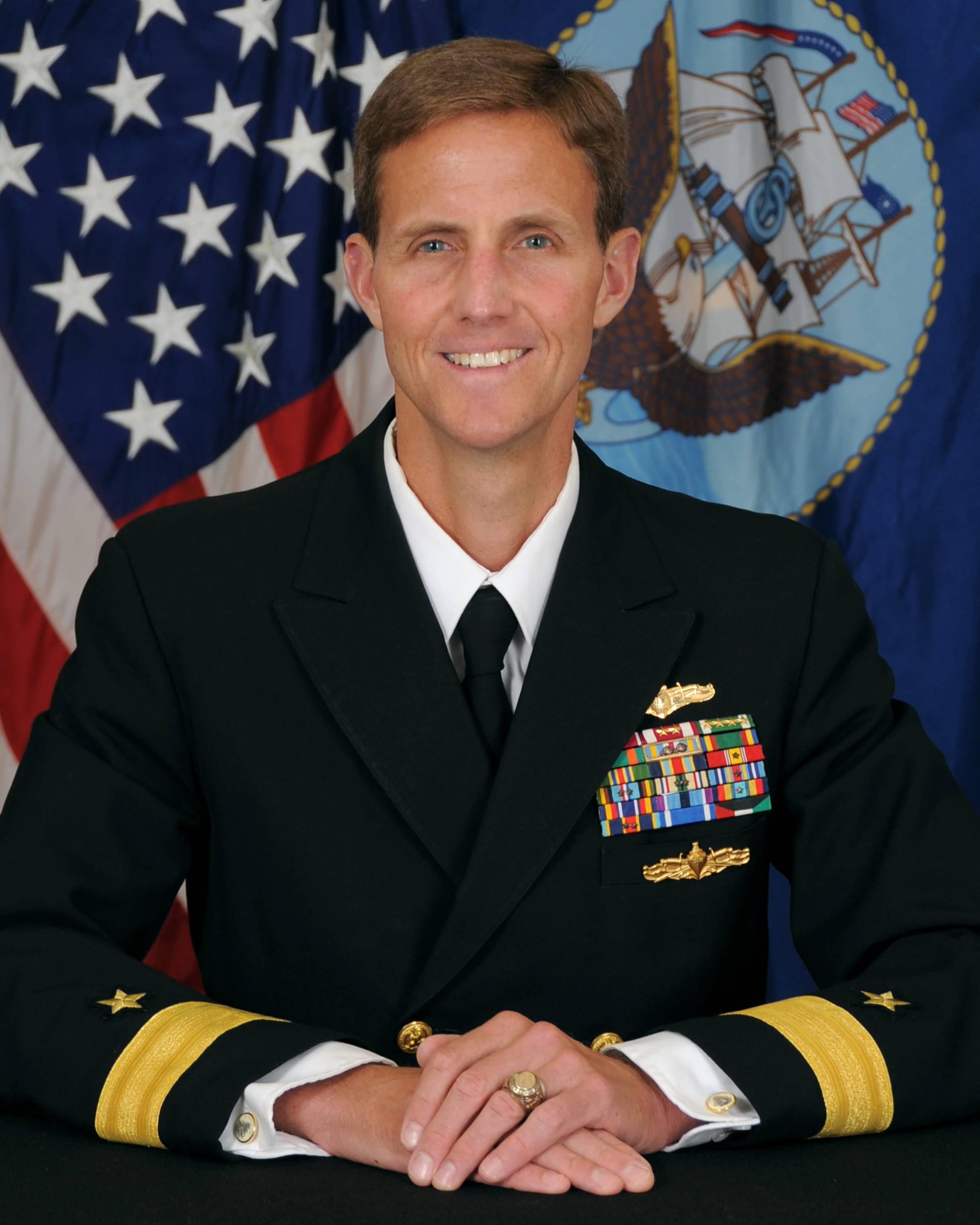
Tim Gallaudet is a retired U.S. Navy rear admiral, career oceanographer, former Oceanographer of the Navy, and former acting NOAA administrator who has become one of the most visible public advocates for taking UAP seriously, especially in and around the ocean. His current public bios place him at Ocean STL Consulting, while his 2024 House hearing biography also lists him as affiliated with the Galileo Project, Americans for Safe Aerospace, the UAP Disclosure Fund, and the Sol Foundation.
What makes Gallaudet matter is not only that he talks about UFOs. It is that he brings an unusually specific lens to the subject: the sea. In his public writing and testimony, he has argued that the ocean is not a side note in the UAP question but one of the most important places to look, because so many unexplained cases appear to involve transmedium behavior or activity near water.
He is especially relevant now because his public profile has widened. Beyond his UAP advocacy, a recent 2026 Free Press interview framed him not only as an outspoken believer in nonhuman intelligence but also as someone willing to entertain, and discuss publicly, the possibility that Atlantis was real and potentially findable. That does not make Atlantis central to his career, but it does show how far his public reality-map has expanded beyond conventional oceanography.
Origins and Background
Gallaudet’s mainstream scientific and institutional background is substantial. Navy and House materials state that he earned a bachelor’s degree in oceanography from the U.S. Naval Academy and master’s and doctoral degrees in oceanography from Scripps Institution of Oceanography. He completed a 32-year Navy career that included operational assignments, command of Naval Meteorology and Oceanography Command, and service as Oceanographer of the Navy.
After retiring from the Navy, he moved into federal civilian leadership. His current Ocean STL biography states that from 2017 to 2021 he served in senior NOAA roles, including assistant secretary of commerce for oceans and atmosphere, deputy NOAA administrator, and acting NOAA administrator. The House hearing bio summarizes the same period and presents him as a figure who moved between military oceanography, federal science administration, and later technology and advisory work.
That background matters because Gallaudet did not come into public UAP culture from the usual route of fringe media, experiencer testimony, or speculative podcasting. He came from the professional worlds of ocean science, naval operations, and federal environmental administration. That is a large part of why he lands differently in the disclosure space.
What It’s Known For
Gallaudet is best known for several overlapping things:
- Serving as Oceanographer of the Navy and later in top NOAA leadership roles, giving him unusual credibility at the intersection of maritime science, national security, and public policy.
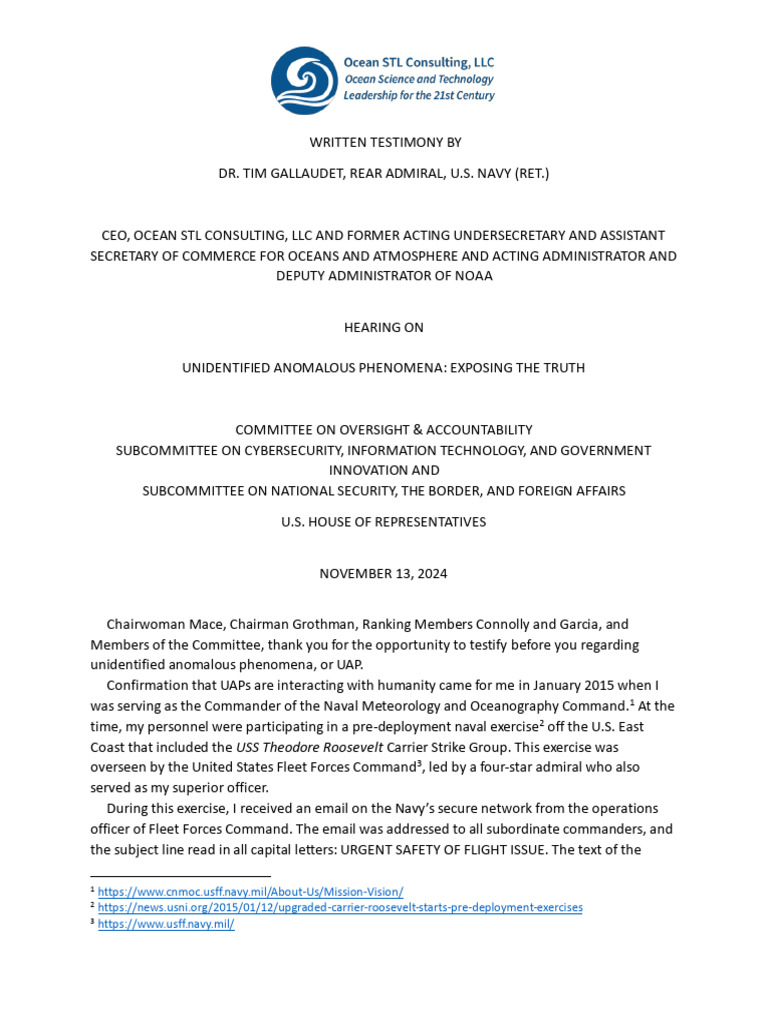
- Publicly describing a 2015 Navy incident in which he says he received a secure-network email warning of multiple near-midair collisions during the Roosevelt exercise, with what is now known as the “Go Fast” video attached, and later found that the email had disappeared without explanation.
- Urging the scientific and defense communities to take undersea and transmedium anomalous phenomena more seriously, including through public essays and Sol Foundation work focused on the oceanic dimension of UAP.
- Becoming one of the more outspoken former senior officials to say publicly that nonhuman intelligence is real and that the government has not been candid about what it knows.
- More recently, entering a broader hidden-history lane through a Free Press interview that explicitly framed him as open to the idea that Atlantis was real and findable.
What makes him distinct is that he does not frame the unknown primarily as a sky problem. He frames it as a maritime problem, a sensor problem, a national-security problem, and increasingly a civilizational-history problem as well. That widening scope is a key part of his public influence.
The Core Idea
The deeper signal behind Tim Gallaudet is that he represents an oceanic turn in disclosure.
That is what separates him from many other UAP figures. In Gallaudet’s version of the phenomenon, the most important blind spot is not only institutional secrecy. It is environmental location. He repeatedly points toward the sea as the domain where the public, the military, and even the scientific community may be least prepared to look seriously, despite the ocean covering most of the planet and remaining comparatively under-observed.
This matters because it changes the emotional and conceptual feel of disclosure. The classic UFO story is vertical: lights in the sky, aircraft, radar, the upper atmosphere. Gallaudet pushes the story downward. He makes the ocean, with its depth, opacity, and weak public visibility, feel like the more natural habitat for enduring mystery. That is an inference from his public writing and testimony, but it is strongly supported by the way he structures his case.
His more recent Atlantis comments suggest that this oceanic turn may be widening into something even larger. The same undersea domain he treats as important for UAP may also, in his current public imagination, hold clues to lost chapters of human civilization. That move is much more speculative than his ocean-UAP argument, but it reveals the broader interpretive arc he is now tracing.
Perspectives and Interpretations
Supporters tend to see Gallaudet as one of the strongest bridge figures in the entire UAP space. Their case is simple: he has real scientific training, real operational experience, real senior-government credibility, and a public message that is more specific than vague “something is out there” rhetoric. His focus on undersea and transmedium cases also gives him a lane that feels less recycled than the standard disclosure talking points.
Another supportive reading is that Gallaudet helps widen the aperture of inquiry without fully abandoning institutional seriousness. His House bio emphasizes not only his military and NOAA background but also his current affiliations with scientific and disclosure-adjacent organizations, which makes him look, to supporters, like someone trying to build an actual research posture around taboo material rather than merely chase an audience.
Skeptics will focus on a different problem. His strongest public UAP claims still outrun the public evidence currently attached to them. The 2015 email story is compelling, but the disappeared message is not itself a released proof set. Likewise, his public certainty about nonhuman intelligence goes beyond what his congressional testimony alone can independently establish for outsiders.
The Atlantis turn raises a second layer of skepticism. In the Free Press interview, even the framing of the piece signaled that the conversation had moved into more speculative territory. For observers who were willing to follow Gallaudet into UAP because of his oceanographic and naval credentials, Atlantis can look like a credibility stretch that blurs the line between disciplined curiosity and expansive belief.
A neutral reading lands somewhere in the middle. Gallaudet may be wrong about some of his largest conclusions, but he is still historically important because he has helped move maritime science and undersea awareness into the UAP conversation in a way few others have. Even if his strongest claims prove overstated, the oceanic blind spot he keeps emphasizing is a real and useful contribution to the discourse.
Strengths and Limitations
Gallaudet’s greatest strength is obvious: he has real institutional and scientific credibility. He is not borrowing seriousness from proximity alone. His career includes Navy command, federal science leadership, and formal oceanographic training at the doctoral level. That background gives him more weight than a standard commentator speculating from outside the system.
A second strength is that his public focus is unusually concrete. Rather than only repeating broad disclosure slogans, he has developed a particular argument about undersea and transmedium phenomena. His essays and white-paper work make the case that the ocean is understudied in anomalous-phenomena research and that science should put observation ahead of stigma. That narrower emphasis gives his public role more definition.
The limitations are serious. His most extraordinary claims, especially about nonhuman intelligence and concealed truth, remain far ahead of the publicly released evidence. His congressional testimony shows conviction, but conviction is not the same thing as demonstration. The same is even more true of Atlantis, where the accessible public record currently shows discussion and belief, not a rigorous public evidentiary case.
There is also a category problem. Oceanography, naval operations, and NOAA leadership make Gallaudet a strong voice on maritime systems and institutional blind spots. They do not automatically make him a final authority on Atlantis, lost civilizations, or the ontology of nonhuman intelligence. His public authority is strongest where it stays close to the oceanic and operational questions he actually knows best.
Broader Implications
Tim Gallaudet matters because he changes the geography of the unknown.
For decades, modern mystery culture has been dominated by the sky. Gallaudet helps push the center of gravity toward the sea, and that shift matters. The ocean is harder to monitor, less publicly visible, and culturally less integrated into everyday imagination than the air above us. When a senior oceanographer says the undersea domain deserves serious anomalous-phenomena study, he is not just adding another opinion. He is redirecting the map.
He also matters because he shows how public authority now travels. A former admiral and NOAA leader can move from conventional institutional power into the disclosure ecosystem without fully shedding establishment prestige. That hybrid role is increasingly important in how people decide which reality-challenging claims feel “serious” enough to consider.
The Atlantis piece adds a more volatile implication. Once a figure like Gallaudet begins connecting UAP, undersea anomaly, and lost-civilization possibility, the boundary between scientific frontier and speculative cosmology gets much thinner. That does not automatically invalidate the questions. But it does raise the stakes for how carefully they are asked.

The Galactic Mind Perspective
Tim Gallaudet is valuable not because he proves the biggest claims now attached to his name. He is valuable because he changes where and how those claims are being asked.
His strongest contribution is not Atlantis. It is not even certainty about nonhuman intelligence. It is the insistence that the ocean is not a side corridor to the unknown, but one of its main chambers. That is a meaningful reframing, and it fits The Galactic Mind well because it expands the map of where reality may still exceed us.
The disciplined read, though, is to keep the lanes separate. Gallaudet’s maritime and institutional authority makes him especially useful on undersea anomaly, oceanic blind spots, and the operational side of UAP. His Atlantis comments are more speculative and should be treated that way. The dossier gets stronger, not weaker, when those categories stay clear.
Open Thread
If Tim Gallaudet’s biggest legacy ends up being that he pushed the mystery from the sky into the sea, then what comes next: a new science of the oceanic unknown, or a wider collapse between credible undersea inquiry and the older human urge to hide lost worlds beneath the water?
Sources / Receipts
- U.S. Navy retired flag officer biography for Rear Adm. Timothy Gallaudet.
- House Oversight witness biography for Tim Gallaudet, November 2024.
- House Oversight written testimony, November 13, 2024.
- Ocean STL Consulting CEO biography.
- Scripps Institution of Oceanography profile on his appointment as Oceanographer of the Navy.
- RealClearScience reprint of Gallaudet and Mellon’s undersea UAP argument.
- Sol Foundation white-paper listing for Beneath the Surface.
- Free Press interview framing his current UAP and Atlantis public stance.
What do you think? Drop your thoughts in the comments


Discussion