
A galactic zoo would require more than hidden observers. It would require an ancient system built to preserve the one thing contact destroys: independent development.
A Silence With Structure
The familiar version of the question is simple: if intelligent life exists elsewhere, why has no one contacted us?
But contact is only one thing that has not happened.
We have not found an unmistakable beacon. We have not identified engineering on another world. We have not discovered an artifact whose origin lies beyond human history. We have not seen the waste, traffic, or infrastructure of an interstellar civilization. The sky has given us planets, chemistry, water, organic molecules, and immense stretches of time—but no confirmed second intelligence.
The easiest reading is that no one is there. Another is that technological civilizations are too rare, too distant, too brief, or too unlike us to be recognized. The Zoo Hypothesis begins with a more unsettling possibility: someone is there, someone knows about Earth, and our lack of contact is deliberate.
That possibility is often reduced to a cosmic version of a wildlife preserve. Advanced civilizations watch from beyond the fence while humanity develops at its own pace. Eventually, if we become peaceful or technologically mature enough, the gate opens.
Yet that image hides the real difficulty. A galactic zoo would need to solve at least three problems. Its observers would have to detect emerging civilizations without exposing themselves. Multiple civilizations—or whatever succeeded them—would have to maintain restraint across enormous distances and timescales. And there would have to be something valuable enough to justify silence even while the isolated world suffered.
The question is not merely whether aliens could hide.
It is what kind of civilization would build the quiet around us—and what, exactly, the quiet would be protecting.
The Narrow Ground Beneath the Idea
The known universe gives this speculation room, but it does not give it evidence.
As of September 2026, the NASA Exoplanet Archive lists more than 6,300 confirmed planets beyond the solar system. That number demonstrates that planets are common. It does not tell us how often life begins, how often intelligence evolves, or how long technological civilizations survive.
The gap between cosmic opportunity and observed technology is commonly called the Fermi paradox, although it is better understood as an unresolved tension than a formal contradiction.
Our searches for technology are also far from complete. Astronomers look for technosignatures: observable effects of technology such as narrow-band radio emissions, laser pulses, artificial atmospheric chemicals, unusual infrared waste heat, or large engineered structures. In 2018, researchers Jason Wright, Shubham Kanodia, and Emily Lubar modeled the radio search as an eight-dimensional “cosmic haystack.” Their conclusion was not that the haystack contained no needles, but that the fraction searched was comparable to a swimming pool against Earth’s oceans.
Earth itself shows why detectability is complicated. A 2025 study led by Sofia Sheikh compared our present technosignatures across radio, optical, infrared, atmospheric, and space-based channels. Their detectable ranges spanned 13 orders of magnitude. Powerful planetary radar could be noticed vastly farther away than most other signs of modern civilization. A world can therefore be obvious in one narrow circumstance and nearly invisible in another.
In 1973, radio astronomer John A. Ball turned that asymmetry into the Zoo Hypothesis. If older technological civilizations possess the ability and desire to avoid us, he argued, the failure to find them could be intentional. Ball was explicit about the idea’s scientific weakness: a civilization determined and able to remain hidden would make the hypothesis difficult to confirm. Discovery could overturn it; continued silence could not prove it.
Nothing presently establishes that Earth is observed, quarantined, protected, or managed by a non-human intelligence. The silence is real as a description of our results. Its cause remains unknown.
What follows is not a claim that Earth is inside a galactic preserve. It is an exploration of what such a preserve would require—and what kind of universe could sustain it.
Contact Is an Irreversible Event
The first mechanism is not a force field. It is information.
Imagine that an older civilization sends humanity a friendly message containing verified knowledge: a new source of energy, a map of inhabited systems, a solution to a major mathematical problem, a record of life’s origins, or simply proof that intelligence can endure for a million years. No occupation follows. No technology is physically delivered. The sender has still altered human history beyond recovery.
Science would reorganize around the new knowledge. Governments would compete to interpret and control it. Religions and philosophies would absorb, resist, or fracture around it. Markets would price its consequences before anyone fully understood them. Every later human choice would occur in a world where the message had arrived.
This is the contamination problem at the center of the zoo.
Human planetary-protection rules offer a limited analogy. Space agencies try to keep terrestrial organisms from compromising the scientific study of other worlds, and to protect Earth from material returned from potentially habitable environments. The concern is not that exploration is inherently wrong. It is that an introduced influence can erase the very conditions we hoped to understand.
Contact would be cultural contamination on a scale for which we have no protocol. Once a younger civilization learns that an older one exists, its future is no longer entirely its own. Even refusal becomes a response to the encounter.
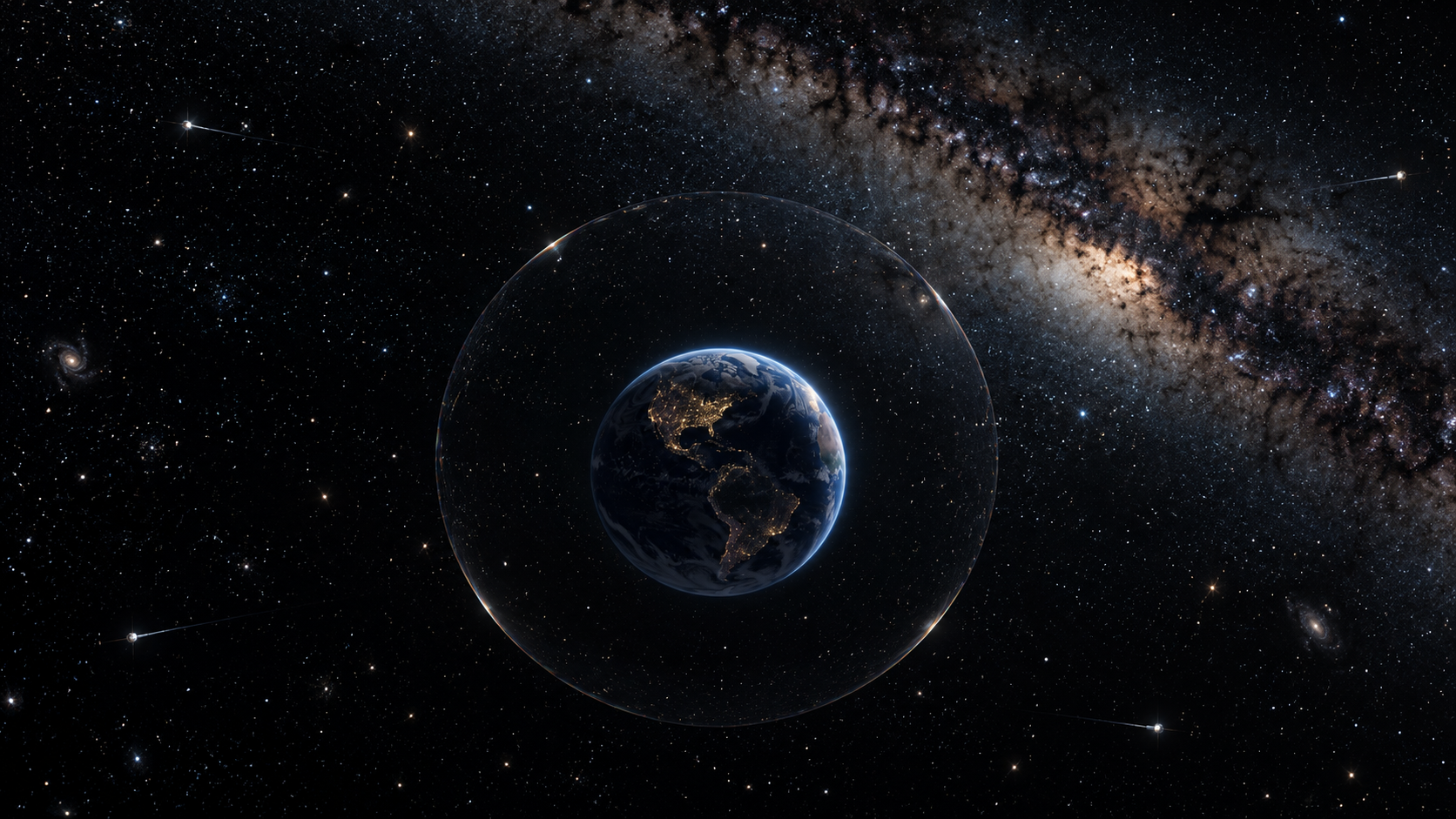
Under this model, the purpose of the glass is not to keep bodies apart. It is to preserve causal independence: the ability of a civilization to generate its own sciences, institutions, myths, failures, and forms of cooperation before outside knowledge bends every path toward itself.
That changes the standard image of the zoo. The protected object may not be humanity’s innocence, and the observers may not be waiting for us to become good. They may be preserving a developmental process that open contact would end.
How a Quiet Boundary Could Work
A viable preserve would not need to make the entire universe invisible. It would need to control what reaches one developing world.
Ordinary physics would do much of the work. Interstellar distance weakens signals. Light takes years or centuries to cross even a small part of the galaxy. Our instruments sample limited frequencies, directions, times, and signal types. Natural phenomena create an enormous background against which technology must be distinguished. An observer does not need perfect cloaking when the observed civilization is young, local, and still learning what to measure.
The second layer would be signature discipline. A mature civilization that treats visibility as consequential would not radiate high-power beacons without purpose. It could direct communications narrowly, place industry where waste heat is difficult for us to separate from natural sources, or use channels we have not learned to recognize. This does not require magic. Humans already shape emissions, encrypt traffic, aim lasers, reduce detectable waste, and hide machines in noisy environments. The speculation lies in extending that competence across astronomical scales.
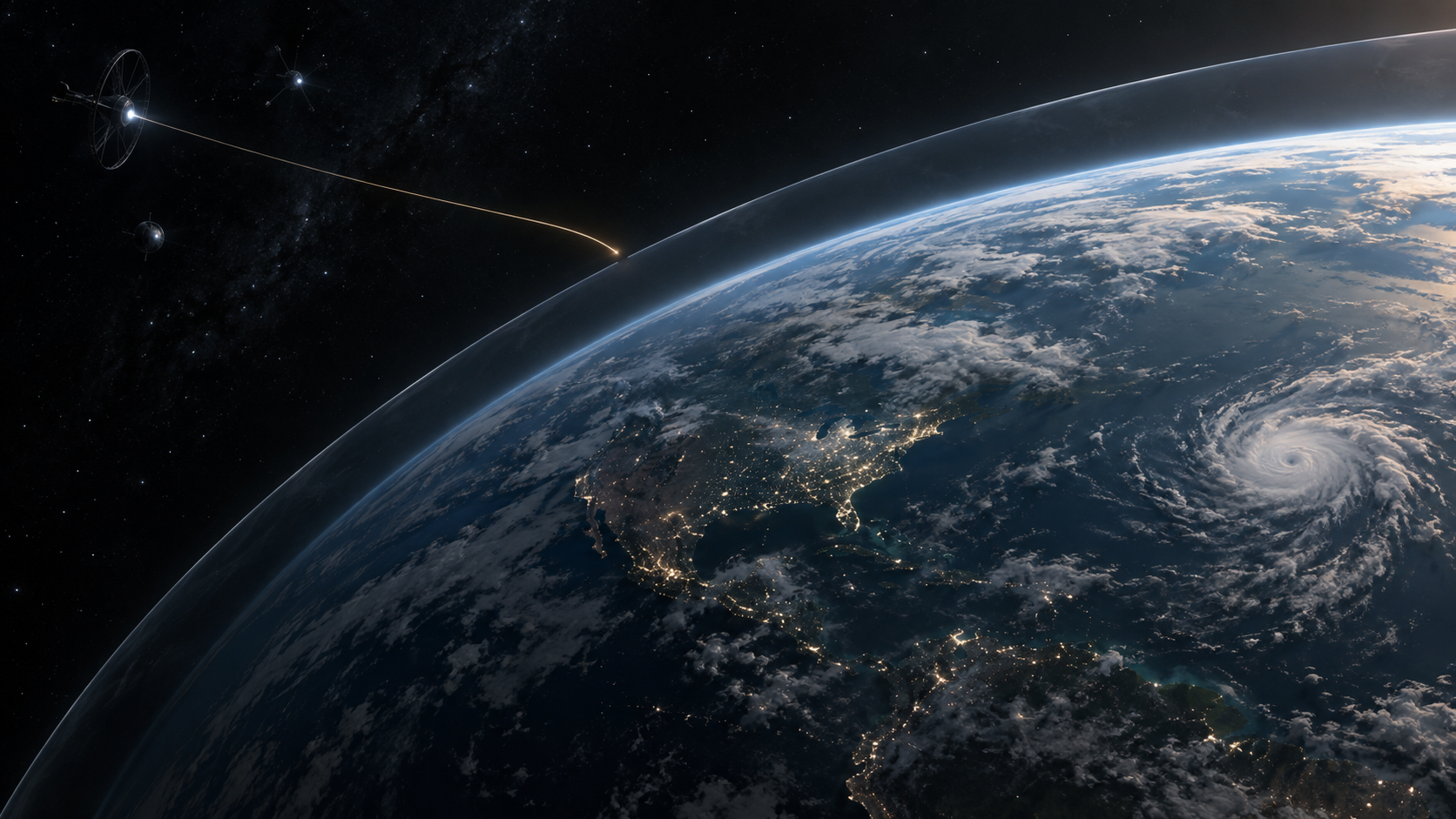
The third layer would be monitoring. Remote telescopes could reveal atmospheric chemistry, seasonal changes, artificial illumination, radio leakage, and other signs that a biosphere has become technological. If more detailed observation were necessary, old probes could wait in the outer reaches of a planetary system, using local material for repair and sending compressed reports at long intervals. Such machines remain hypothetical; none has been verified in our solar system. But automated observation is easier to reconcile with interstellar distance than a continuous biological presence.
The asymmetry matters. Humanity has been technologically detectable for only a thin slice of its history. A civilization with a million-year head start would not have to be omnipotent to understand our instruments better than we understand its own. It would know which parts of the spectrum we search, which objects we can resolve, and which anomalies our methods discard as noise.
The glass, then, would not be a shell around Earth. It would be an inequality of knowledge.
They would know where our attention ends.
Four Ways to Build the Glass
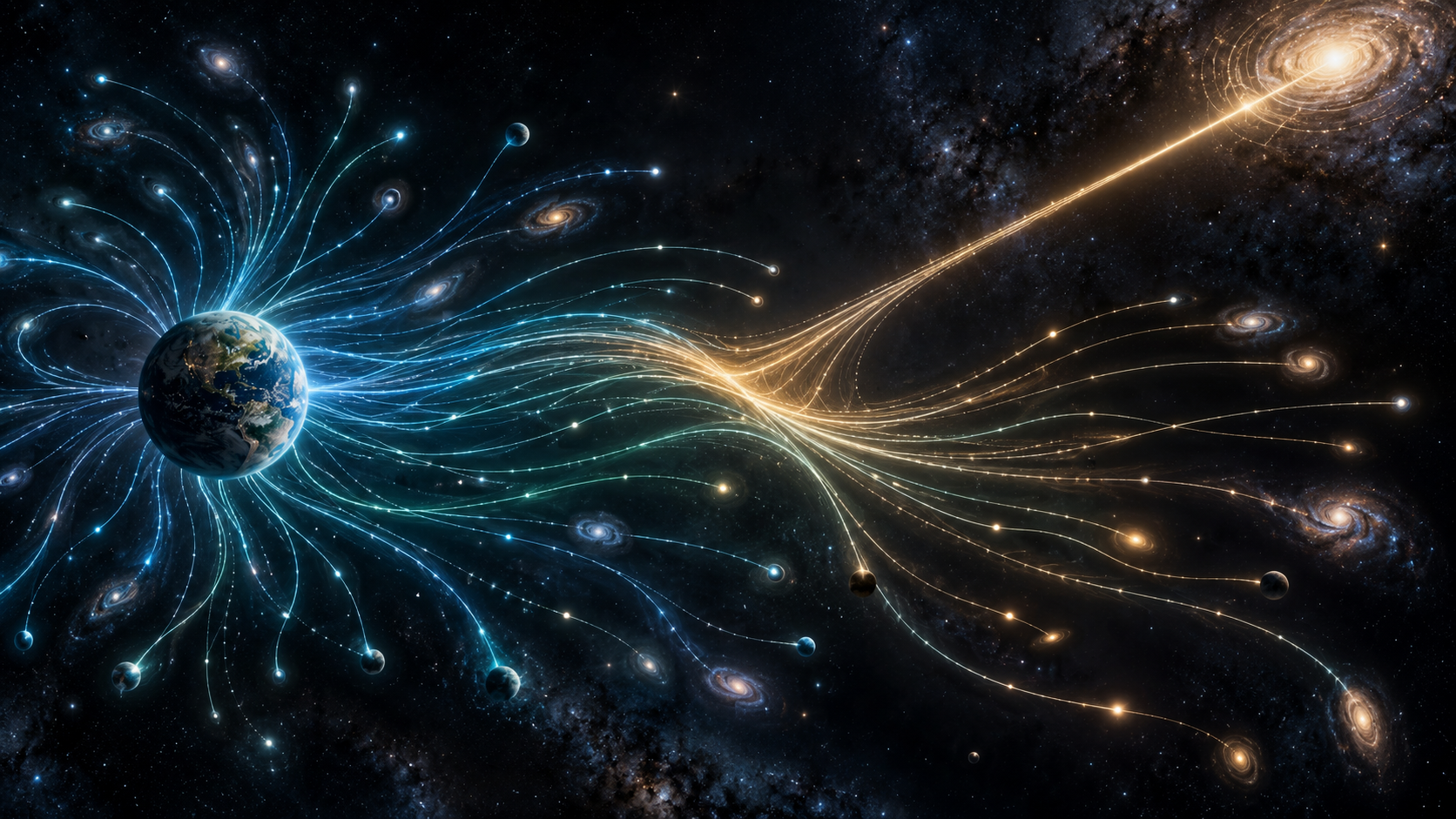
The same silence can be produced by very different motives. That matters because “being watched” says almost nothing about the relationship between watcher and watched.
The Sanctuary
In the gentlest model, isolation protects the younger civilization. Open contact would expose it to technologies, ideologies, and powers it cannot evaluate or refuse on equal terms. The sanctuary delays that encounter until the civilization can detect others independently, leave its own system, or negotiate without being overwhelmed.
This model explains restraint without requiring indifference. The curators do not withhold contact because humanity has failed a moral examination. They withhold it because consent is weak when one side controls the conditions of reality. The threshold for contact might therefore be epistemic sovereignty: the capacity to receive transformative knowledge without surrendering the ability to judge it.
The sanctuary’s weakness is paternalism. An older power decides what a younger world is allowed to know and when it is capable of knowing it. Protection and domination can wear the same quiet face.
The Laboratory
In the laboratory model, the valuable thing is not our autonomy but the data produced by an uncontaminated civilization.
Earth would be one long observation of how intelligence emerges under particular biological, climatic, and historical conditions. The observers might compare thousands of worlds: ocean planets, tidally locked worlds, biospheres with several technological species, civilizations that industrialize without fossil fuels, minds that never develop spoken language, societies whose machines become intelligent before they reach orbit.
Contact would ruin the experiment by introducing a common influence. The laboratory therefore has a powerful reason to maintain silence indefinitely, even after its subjects become aware that other life may exist.
It also produces the coldest ethic. A researcher interested in an authentic trajectory cannot continually rescue the subject from its consequences. Famine, war, ecological collapse, and even extinction may be recorded rather than prevented. The very events that make intervention urgent are the events that make the observation scientifically unique.
The Quarantine
The sanctuary protects Earth from the galaxy. The quarantine protects the galaxy from Earth.
Under this model, young technological civilizations are dangerous not because they are evil, but because they combine rapid innovation with unstable institutions. A species that cannot govern nuclear weapons, engineered organisms, autonomous machines, or self-replicating spacecraft at home may be treated as an unmanaged risk beyond it.
The boundary would tighten as capability grows. High-power transmissions, uncontrolled probes, or attempts to reproduce machines beyond the solar system might trigger attention because they allow local instability to propagate. Contact would not be an invitation into a club. It would be a risk assessment.
This model explains why observers might tolerate terrible events within Earth while reacting strongly to expansion beyond it. Their concern is not our suffering. It is containment.
Its central problem is practical: quarantine eventually requires enforcement. Hiding is no longer enough. A civilization approaching the boundary would need to be warned, disabled, redirected, or destroyed. The quiet preserve contains the possibility of violence at its edge.
The Inherited Protocol
The final model removes living curators almost entirely.
An early civilization could have established a non-contact rule and embedded it in autonomous infrastructure: observatories, relay networks, defensive systems, archives, and machines able to maintain or reproduce parts of the system. The founding civilization might disappear while the protocol continued.
This would turn the zoo from a policy into an environment. Later civilizations might encounter the existing boundary and comply because it is useful, because enforcement is credible, or because the network controls access to routes and information they value. Some may interpret the old rule as law; others as taboo; the machines themselves may apply it without remembering why it was created.
The model helps with continuity. Machines can outlast governments, species, and beliefs. It does not solve the deeper political problem. A protocol old enough to seem natural may also be obsolete, corrupted, or catastrophically rigid. The glass could remain long after its purpose vanished.
The One Dissenter Problem
Every version of the zoo encounters the same fracture: one visitor can open the cage.
If many civilizations arise independently, why would all of them accept the same rule? A dissident faction, reckless probe, commercial expedition, missionary movement, or machine with altered instructions could reveal itself. Over millions of years, perfect compliance begins to look less like shared ethics and more like enforced hegemony.
Astrophysicist Duncan Forgan has tested this problem with models of when and where civilizations might emerge. Because information cannot travel faster than light, distant civilizations can develop before an older culture’s norms reach them. His simulations generally produce multiple culturally connected “galactic cliques” rather than one unified galactic club. The Zoo Hypothesis is therefore a soft solution to the Great Silence: a single breach can break it, and galaxy-wide agreement is difficult to build.
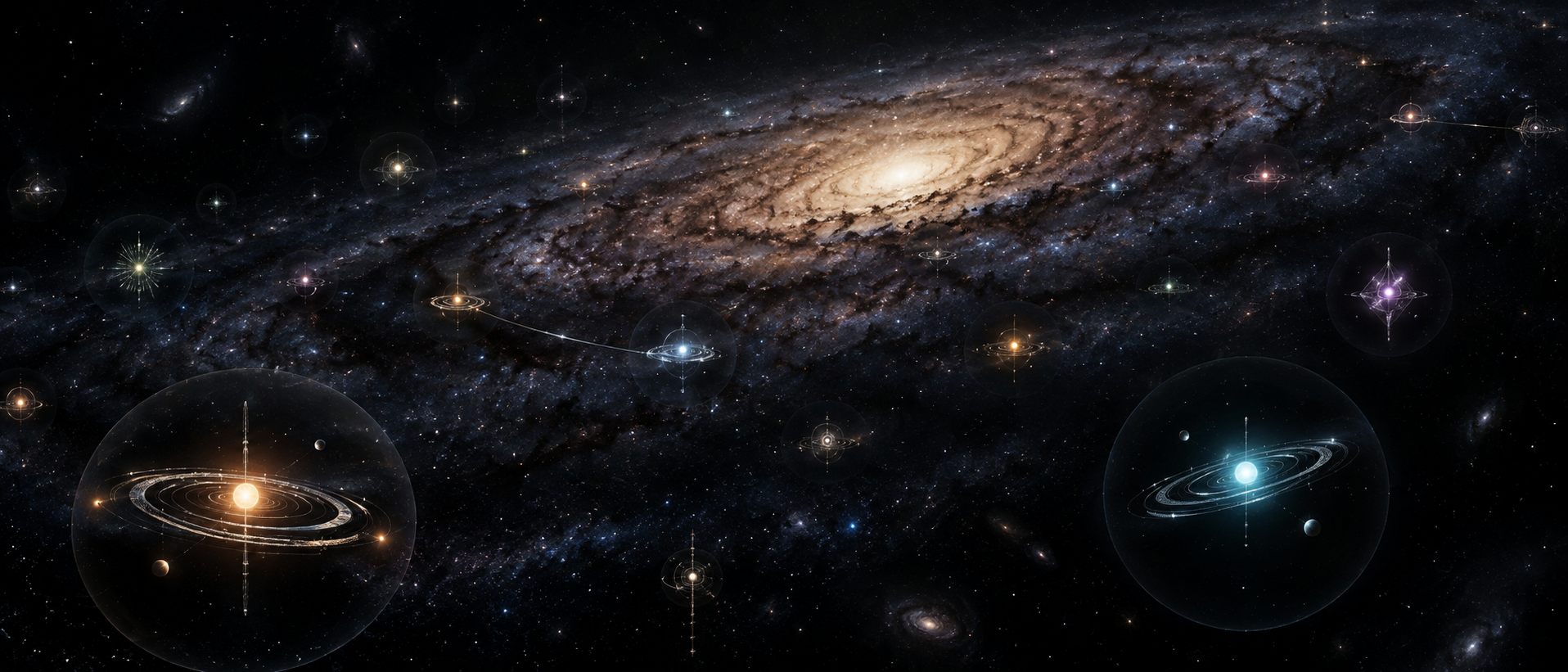
That weakness opens a larger possibility. The silence around Earth would not require unanimous agreement across the entire Milky Way if only one local power controlled our region. We could exist inside one jurisdiction among many, each with different rules for contact. The galaxy beyond the glass might be divided into preserves, open zones, quarantines, abandoned territories, and regions where incompatible protocols overlap.
That patchwork would be less elegant than a universal law, but more politically believable. It would also be unstable. Boundaries shift. Institutions decay. New civilizations reject old settlements. If the zoo is real, the most revealing event may not be a formal welcome. It may be a jurisdictional failure—a disagreement among watchers about whether the glass should remain.
The hypothesis becomes stranger here. It no longer asks us to imagine a hidden alien visitor. It asks us to imagine interstellar governance: rules that survive their authors, systems that classify emerging worlds, and conflicts fought partly over who has the right to make contact.
The quiet would be evidence not merely of intelligence, but of institution.
The Cruelty of an Untouched History
Any noninterference rule eventually reaches an event that makes restraint look monstrous.
If observers could prevent an asteroid impact, should they? What about a pandemic, nuclear war, engineered ecological collapse, or the deliberate extermination of a people? At what scale does protection of independent development become abandonment?
There is no clean threshold. Intervening in a small disaster may alter political power for centuries. Preventing a war preserves lives but also changes institutions, technologies, alliances, and every generation that follows. Revealing the intervention may transform the civilization more deeply than the disaster would have. Concealing it preserves the experiment by turning history into an edited record whose participants never consented to the editing.
The sanctuary, laboratory, and quarantine answer this dilemma differently. A sanctuary might intervene only when a biosphere faces irreversible destruction. A laboratory may value an unaltered record above its inhabitants. A quarantine may intervene only when danger could escape the system. An inherited protocol may follow thresholds written for conditions its makers never anticipated.
From inside the glass, those motives would look identical until the moment of action.
That is the ethical wound in the idea. Silence gives the observed no way to distinguish care from indifference, research from imprisonment, or protection from containment. A perfectly hidden guardian and a nonexistent guardian leave the same sky.
The Preserve May Be Protecting Difference
The most human version of the Zoo Hypothesis assumes that contact is a prize. We become peaceful, wise, or technologically mature; the curators approve; humanity joins the wider civilization.
But that may be the wrong story.
An ancient interstellar culture would understand that knowledge is not distributed between equals. A million-year-old civilization does not merely know more facts. Its presence reorganizes the choices available to everyone younger. Its energy systems become the obvious energy systems. Its answers become the questions worth asking. Its warnings define acceptable risk. Its language enters every translation. Even a generous civilization can become an empire simply by being the source from which the future flows.
If many young worlds meet the same older culture too early, their development may converge. Different histories begin producing the same tools, institutions, and assumptions. The galaxy gains communication but loses variation.
The preserve could exist to prevent that loss.
On Earth, a seed bank protects more than individual seeds. It protects unrealized responses to futures no one can predict. A galactic preserve might do something similar for minds. Each isolated civilization would explore a different region of possibility: different mathematics, different relationships between organism and machine, different political forms, different senses, different models of self, different ways to survive technological power.
Under this model, the observers are not waiting to see whether humanity deserves admission. They are protecting the part of the future that only an uncontacted humanity can create.
Contact becomes appropriate not when a civilization reaches a particular engine or moral score, but when it can encounter older powers without being absorbed by them—and when it can meet younger worlds without absorbing them in turn. The threshold is the ability to exchange knowledge while preserving difference.
That is a harder form of maturity than intelligence. It asks whether a civilization can learn without becoming a copy and teach without making copies of others.
A Civilization Made of Separations
Follow that logic far enough and the zoo stops looking like an exception to galactic civilization. It becomes galactic civilization’s deepest architecture.
We usually imagine a mature interstellar society as a network: more worlds connected by more travel, trade, communication, and shared knowledge. Integration is treated as progress. Silence appears to be a failure of the network.
But a civilization concerned with preserving independent forms of mind might be organized around deliberate disconnection. Its most important infrastructure would not move information. It would regulate when information is allowed to move. Its greatest achievement would be the cultivation of boundaries strong enough to let genuinely different futures emerge.
The galaxy would become an archipelago of cognitive histories. Some worlds would remain isolated. Some would enter limited exchange. Some would join dense networks. Others would close themselves again after discovering that connection can erase as well as enrich. Old machine systems might maintain the intervals, not as prison walls, but as ecological corridors between developing forms of intelligence.
In that reality, silence is not the absence of civilization.
Silence is one of civilization’s technologies.
The radical implication is that communication may not be the highest expression of intelligence. Restraint may be. A species proves its maturity not by making every world legible, reachable, and useful, but by recognizing futures it has no right to preempt.
The zoo metaphor then becomes too small. A zoo exhibits known forms of life for an audience. This system would preserve unknown forms of mind for a future that depends on their remaining unknown long enough to become themselves.
What Would Leave a Mark?
A hypothesis that converts every failed search into proof of better concealment explains too much. The glass needs edges that observation could eventually test.
The four models suggest different places to look. A sanctuary should become more permissive as a civilization develops independent detection and interstellar reach. A laboratory requires monitoring, creating at least the possibility of old artifacts, relays, or energy use associated with observation. A quarantine predicts attention around technologies that can spread beyond their planet. An inherited protocol may leave standardized systems, obsolete rules, gaps, or contradictory behavior where different machine lineages and jurisdictions meet.
More complete technosignature surveys would matter. If humanity searches many wavelengths, many kinds of stars, nearby planetary systems, the infrared signatures of large-scale engineering, and the small bodies of our own solar system without finding anything artificial, the available hiding places narrow. If we eventually detect technological activity elsewhere but find a conspicuous zone of silence around Earth, deliberate isolation becomes more distinguishable from universal emptiness.
The strongest evidence would not be an ambiguous light, transient signal, or object that merely resists immediate explanation. Natural systems produce surprises, and unexplained does not mean engineered. The case would require converging evidence: repeatable behavior, information-rich structure, materials or energy use inconsistent with natural processes, and independent confirmation across instruments and institutions.
Some researchers argue that sustained exploration could begin separating a hidden galaxy from a largely empty one within decades. That is an ambition, not a deadline. The cosmic haystack remains immense, and advanced concealment can always be defined in ways that outrun a search.
Still, the Zoo Hypothesis does make one unforgiving prediction: if its keepers intend perfect isolation and possess the means to enforce it, every genuine approach to the boundary should fail until the policy changes.
One undeniable artifact would shatter that version of the glass.
The Quiet We Were Allowed to Keep
The deepest question inside the Zoo Hypothesis is not whether someone is watching Earth. It is whether a mature intelligence could regard contact itself as an environmental force—something powerful enough to enrich a world, dominate it, or erase futures that had not yet learned to exist.
If the answer is yes, the Great Silence could contain motives that look identical from here: care, curiosity, fear, control, or obedience to a rule whose authors are gone. We would not know whether the boundary protected us, protected others from us, or protected the galaxy’s supply of difference.
And the first sign of a wider civilization might not be a greeting. It might be the discovery that our isolation had structure: a rule at the edge of our instruments, a machine carrying an ancient prohibition, or evidence that other young worlds sit inside quiet regions of their own.
Then the glass would not simply divide humanity from the stars.
It would reveal a universe in which untouched futures are considered worth preserving and in which our silence, for a time, was one of them.
More in SPEC
- The Dark Forest: Why the Universe May Be Silent on Purpose — A darker companion model in which civilizations hide not to preserve young worlds, but because visibility itself creates danger.
- What If the Galaxy Is a Machine Ecology? — Extends the inherited-protocol model by asking how autonomous probes could outlive their makers and become an interstellar environment of their own.
- What If First Contact Is an Archive? — Explores a form of contact shaped by deep time, where the intelligence we encounter may survive primarily as preserved memory.
Sources / Receipts
- NASA Exoplanet Archive — The official archive supplies the current confirmed-exoplanet count used to establish that planets are common while leaving the frequency of life and intelligence unresolved.
- John A. Ball, “The Zoo Hypothesis” (1973) — Ball’s original Icarus paper proposed that extraterrestrial intelligence could deliberately avoid interaction and set our region aside as a wilderness area or zoo.
- Jason T. Wright, Shubham Kanodia, and Emily G. Lubar, “How Much SETI Has Been Done? Finding Needles in the n-Dimensional Cosmic Haystack” (2018) — This study modeled radio SETI search completeness and found that only a very small fraction of the relevant parameter space had been examined.
- Sofia Z. Sheikh et al., “Earth Detecting Earth” (2025) — The authors compared present-day Earth technosignatures and found a 13-order-of-magnitude range in detectability, with targeted planetary radar visible much farther than other current signatures.
- Duncan H. Forgan, “Spatio-temporal Constraints on the Zoo Hypothesis, and the Breakdown of Total Hegemony” (2011) — Forgan examined how light-speed limits and civilization emergence undermine the uniformity of motive required by a galaxy-wide zoo.
- Duncan H. Forgan, “The Galactic Club, or Galactic Cliques?” (2017) — This follow-up modeled cultural connectivity and found that multiple galactic cliques are more common than a single hegemonic club across much of the tested parameter space.
- Ian A. Crawford and Dirk Schulze-Makuch, “Is the apparent absence of extraterrestrial technological civilizations down to the zoo hypothesis or nothing?” (2024) — This Nature Astronomy perspective argues that future exploration may help distinguish a deliberately hidden technological population from one that is extremely rare or absent.
- COSPAR Panel on Planetary Protection — COSPAR’s policy work provides the limited human analogy for preventing forward and backward contamination during the scientific exploration of other worlds.


Discussion