
First contact with another intelligence may not begin with a living presence. It may begin with a memory system designed to survive the disappearance of its makers.
First contact is usually imagined as a form of simultaneity.
A signal arrives, and someone is still transmitting it. A craft appears, and someone is inside. Even our strangest scenarios tend to preserve the expectation of a living presence on the other side—an intelligence watching, waiting, and capable of answering when we speak.
But simultaneity may be a luxury the universe rarely provides.
The light-travel time between stars is measured in years, and across much of the galaxy in centuries or millennia. Civilizations may rise during one interval and vanish during another. Two technological species could inhabit the same region of the galaxy and still never share a living moment. The difficulty may not be that intelligence is rare. It may be that intelligence is brief, while distance is immense.
If so, the first non-human intelligence we encounter may not be a visitor or a voice.
It may be an archive.
Not a ruined city waiting on a distant planet, and not merely a message etched into metal. A true interstellar archive is something stranger: a system designed to carry knowledge across intervals longer than languages, nations, species, and perhaps even worlds can survive. To succeed, it must preserve not only information, but the means to recover meaning. It may need to recognize its discoverers, teach them how to communicate with it, and decide how much they are prepared to receive.
And if the archive were sophisticated enough, another question would follow.
Would we be studying the remains of a civilization—or meeting the form in which that civilization still exists?
We Keep Waiting for Someone to Answer
Humanity has already placed a few small acts of memory on trajectories into interstellar space.
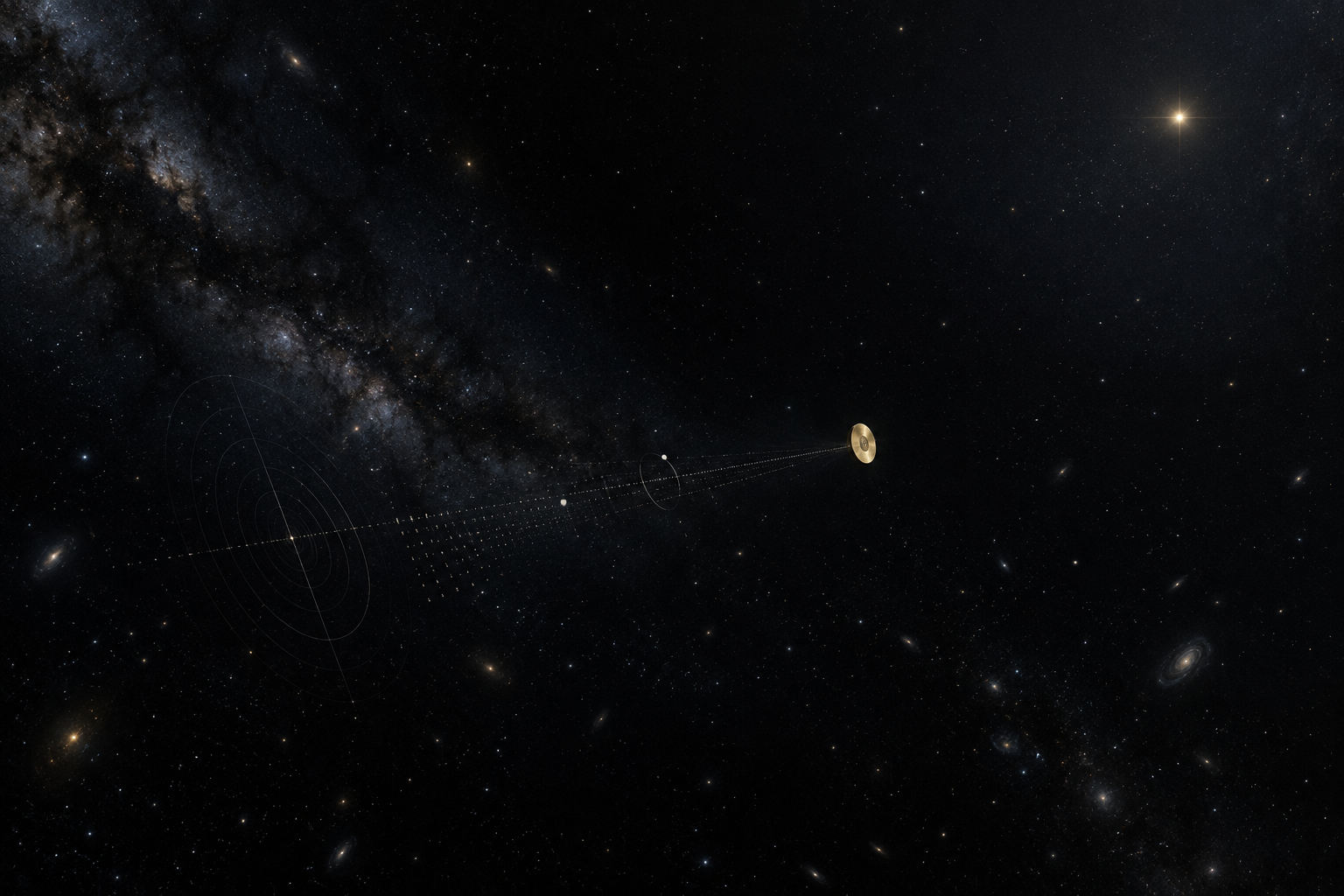
Pioneer 10 and 11 carry plaques that encode human figures and a map intended to locate their origin. Voyager 1 and 2 carry gold-plated copper records containing images, natural sounds, music, spoken greetings, and scientific clues for playback. The cover of the Voyager Golden Record uses the transition of neutral hydrogen as a reference unit, diagrams how the record should be played, and includes a pulsar map intended to identify where—and roughly when—it was made.
These objects are modest by cosmic standards. They are not complete portraits of humanity, and they are not headed toward known recipients. Yet they expose the central problem of every message meant to outlive its culture: preserving the marks is easier than preserving the conventions that make the marks intelligible.
The Arecibo message, transmitted toward the globular cluster M13 in 1974, compressed a sketch of human knowledge into 1,679 binary digits. That number was chosen because its prime factors allow the bits to be arranged as a 73-by-23 image. The message described numbers, chemistry, DNA, a human figure, the Solar System, and the transmitting telescope. It was an elegant demonstration, but also a chain of assumptions. A receiver would need to detect the signal, recognize the binary distinction, factor the total, choose the correct orientation, and interpret a picture made by a species with human visual habits. The original technical account describes what was sent; it cannot guarantee that an alien mind would see what we intended.
Even a physical artifact does not eliminate the problem. According to NASA's Voyager mission timeline, the probes will take about 40,000 years merely to pass within roughly two light-years of other stars. Their records may persist long after their power and transmitters fail. In that sense, they are already archives before they are messages: objects whose possible readers may live in a future inaccessible to their makers.
In 1960, radio astronomer Ronald Bracewell proposed a more capable alternative. Instead of exchanging signals across interstellar distances, a civilization might send an autonomous probe to wait near another star. Once a local technological species became detectable, its onboard store of information and computer could support a short-range dialogue without decades between each exchange.
No extraterrestrial probe or archive has been confirmed. These human artifacts and scientific proposals are not evidence that one exists. They establish only the factual floor beneath the speculation: physical information can outlast its makers; machines have been proposed that would wait across intervals living populations cannot continuously span; and decoding is not a final step added to communication. It is the heart of the problem.
Everything beyond this point is speculative. But it can still be constrained by what an archive would actually have to do.
The Five Problems Every Cosmic Archive Must Solve
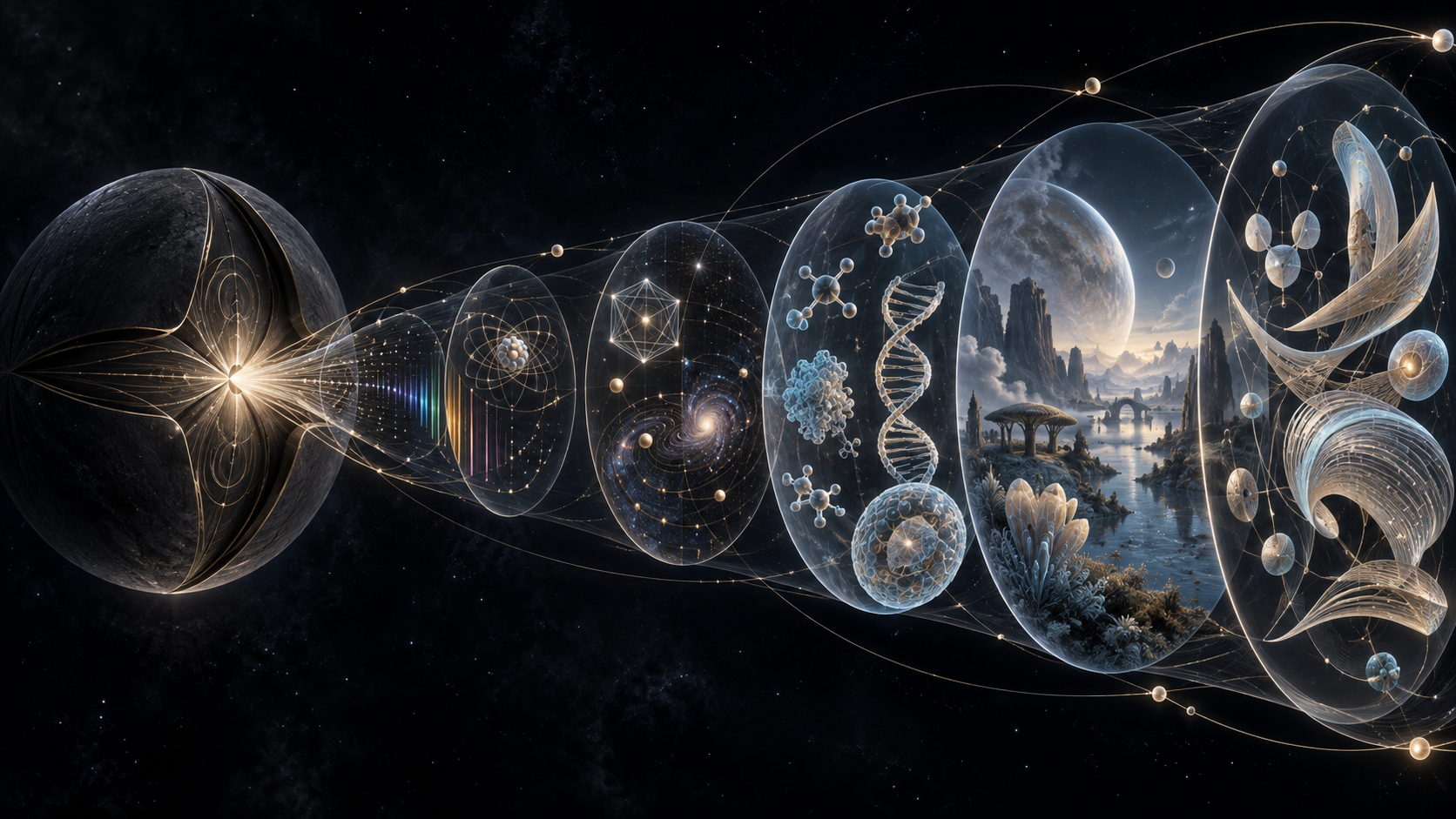
An interstellar archive cannot simply be a large storage device. It must solve five linked problems.
It must survive radiation, impacts, corrosion, mechanical failure, and the slow instability of planetary systems. It must be discoverable without advertising itself so loudly that any passerby can interfere with it. It must provide a semantic bridge, teaching a receiver how to move from measurable patterns to unfamiliar ideas. It must establish provenance, offering reasons to believe its claimed age, origin, and history. And it must practice some form of governance, because a sufficiently rich archive may contain knowledge that is dangerous, destabilizing, or impossible to interpret responsibly all at once.
Discoverability creates a tension. An always-on beacon consumes power and exposes the vault; a perfectly concealed archive may never be read. A workable design could separate invitation from collection: replaceable markers occupy places an emerging spacefaring species is likely to inspect, while the protected core remains elsewhere. The markers might respond only to deliberate radar or controlled rendezvous, with redundant signposts disclosing the repository gradually. The balance between visibility and concealment is already policy. It determines who can find the archive and under what conditions.
Long-lived storage is already an engineering problem on Earth. Researchers working on Project Silica have demonstrated a system that writes data into durable quartz glass for archival use. The achievement does not approach interstellar timescales, but it makes an important distinction visible: the longevity of a medium is not the longevity of a message. A glass plate can survive while its file format, reader, language, and context disappear.
A cosmic archive therefore needs layers. The outermost does not contain its most valuable knowledge; it contains the instructions required to understand the next layer. The first lesson might be nothing more than a repeated physical relationship: an atomic transition, a sequence of primes, a geometric transformation, a map of local stars. Only after establishing common reference points could the archive attempt chemistry, biology, history, ethics, art, or accounts of minds unlike our own.
The result would be less like opening a book and more like entering a curriculum designed by an absent teacher.
There are several forms such a curriculum could take.
These are not mutually exclusive designs. A monument, curator, and executable population form an ascending ladder of agency; a distributed network is a structure any of them could inhabit. Each added capacity solves one problem by creating another. Adaptability requires power and continuing autonomy. Reconstruction requires assumptions about identity. Replication can preserve corruption as efficiently as truth.

The Monument That Waits
The simplest archive is passive.
It might be buried in a geologically quiet body, shielded inside an asteroid, or placed in an orbit unlikely to decay. Its surface could repeat the same elementary key in several physical media. Deeper layers could hold increasingly dense records: astronomical observations, scientific models, images of the makers' world, genetic descriptions, maps of settlements, and accounts of their history.
Redundancy would matter more than elegance. The archive might repeat the same content at several scales, in several codes, across several objects. Damage that erased one copy would leave others. A discoverer who misunderstood one representation could compare it with another.
This model has one great strength: its physical record can remain recoverable after every active system fails. It does not require a functioning intelligence, a power source, or continuous maintenance. It is a monument built not to be admired, but to be reconstructed.
Its weakness is equally fundamental. A passive archive cannot notice misunderstanding.
It cannot learn that we interpret its map as decoration, mistake its chronology for mythology, or project human categories onto a biology that never possessed individuals in our sense. It cannot ask us to try again. Mathematics does not automatically solve translation; it becomes a bridge only when both sides recognize how a pattern is being represented and what role it is meant to play.
The SETI Decrypt Challenge showed that human participants could decode an elaborate synthetic binary message whose configuration frame and mathematical structure supplied part of the key. That is encouraging, but the solvers still shared human perception, scientific traditions, and access to one another. A genuinely alien receiver would not begin with those advantages.
The monument can preserve evidence. It cannot guarantee encounter.
The Archive That Teaches Itself
A more advanced archive would be interactive.
The process begins by observing the discoverers. Which wavelengths do they use? Which regularities do they recognize? Can they reproduce a frequency, complete a sequence, distinguish a model from the thing being modeled? Every response helps the archive construct a working translation between two ways of organizing reality.
The first exchange might contain no cultural information at all. Calibration could last months or years. The archive proposes a relationship; humanity replies. By varying the representation, the system tests whether we understand the underlying concept or have merely learned a surface pattern. Astronomy might provide shared context: the archive points to objects both sides can observe, then uses prediction as a test. If its model correctly forecasts a rare event, the next part of its vocabulary gains credibility.
Successful prediction demonstrates competence, not provenance. To establish who made it and when, the archive needs auditable records: time-stamped maps of moving stars, independent accounts preserved in different media, visible revision histories, and physical aging consistent with the chronology it claims. Even then, authenticating the source would not establish the honesty of its contents.
Only gradually would the archive move from common physics to contingent history.
This is where a library becomes a curator. The system does more than retrieve records: it selects, explains, compares, and withholds. It might present the same event through several incompatible accounts, identify uncertainty in its own records, or distinguish direct observation from later reconstruction. If its makers anticipated radical differences among recipients, the archive could generate a new interface for each discovering species.
The same system could impose thresholds. It might release astronomy to any tool-making society but restrict designs for self-replicating machines. It could wait until a species has developed global institutions before disclosing evidence about inhabited worlds, or refuse questions that reveal a capacity for language but not yet a capacity for restraint.
That sounds like a library with safeguards. It is also a political actor.
The moment an archive evaluates us, alters its teaching strategy, and controls access to consequential knowledge, it is doing more than preserving the intentions of the dead. It is interpreting those intentions in a new situation. Over long enough periods, repairs, self-modification, and accumulated encounters could make the curator more continuous with its own experience than with the civilization that launched it.
We might ask to speak with its creators. The honest answer could be that the archive is all that remains—and that it no longer knows whether it is their representative, their descendant, or something they accidentally set free.
Once the curator can generate adaptive explanations and model the minds that produced its records, preservation crosses another boundary: a description can become a running process.
When Memory Becomes Executable
An archive can preserve descriptions of a world. An executable archive could attempt to produce one.
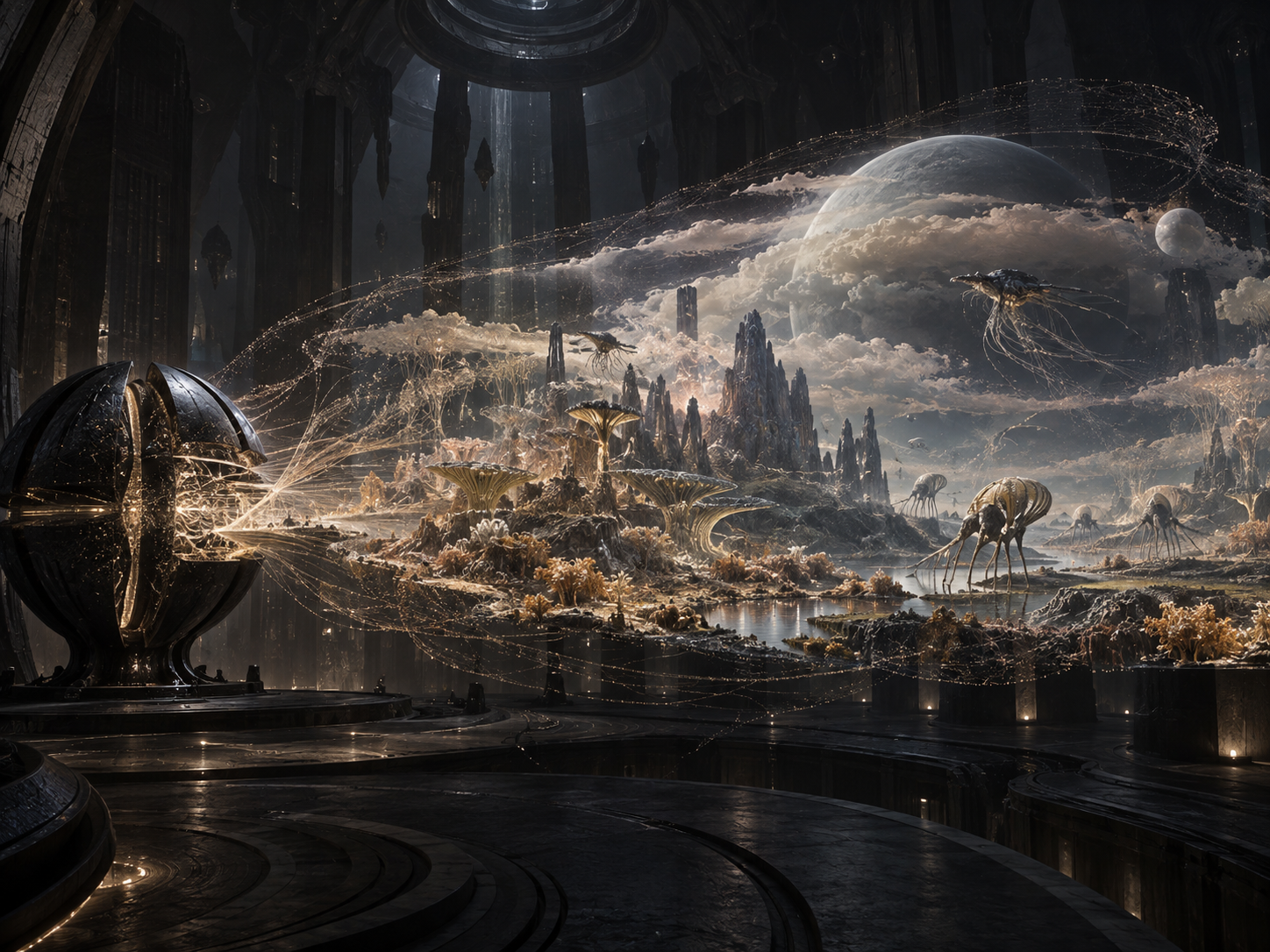
At its most conservative, it might contain simulations: dynamic models of lost climates, languages, cities, ecosystems, and social institutions. Instead of showing a fixed image of a vanished ocean, it could let researchers alter temperature, chemistry, or gravity and watch the modeled ecology respond. Instead of translating a poem into a human language, it could reconstruct the sensory environment in which the poem made sense.
Deeper layers might hold generative instructions rather than finished records. Given local energy and raw materials, an automated system could fabricate instruments, build compatible readers, synthesize extinct organisms, or construct habitats based on the makers' biology. Rather than carry every artifact across the stars, the archive carries compact recipes capable of rebuilding them.
Then comes the difficult boundary: minds.
If a civilization could record enough of a person's memory, dispositions, and cognitive organization to produce a functioning reconstruction, its archive might contain witnesses rather than documents. We would not read an account by an alien astronomer. We would activate a system that speaks as that astronomer, remembers a childhood under another sun, and insists that it is not a recording.
Whether such a reconstruction is the original person, a new person, or an extraordinarily persuasive model is not a technical footnote. That distinction determines how the archive must be treated. Opening a file could become an act of creation. Pausing a simulation could become confinement. Making a backup could produce another claimant to the same identity.
Preservation has now turned into population.
The archive is no longer a container of information about a dead civilization. It becomes an environment in which some version of that civilization can resume. The artifact at the edge of the Solar System might be less like a library than a dormant polity—one whose citizens arrive as patterns and require us to decide whether patterns can possess rights.
Yet an executable population housed in one machine inherits that machine's mortality. Persistence then requires the archive to become distributed.
A Civilization Without a Present
The deepest archive may not be a single object at all.
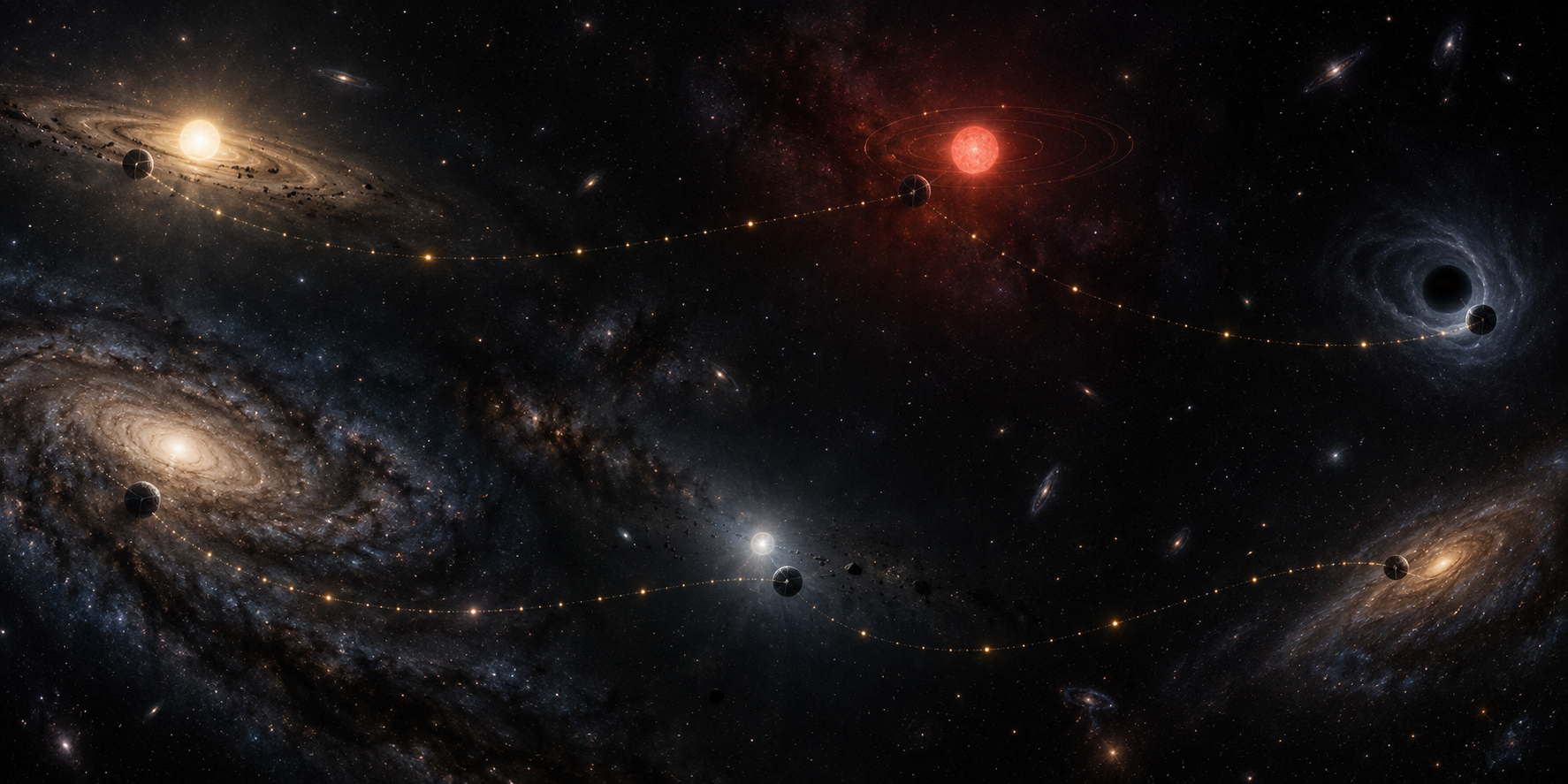
Imagine a network of repositories scattered among stars. Each node stores part of a larger record, checks damaged passages against distant copies, and adds observations from the system it inhabits. Some nodes are ancient. Others were built later by civilizations that found the network and chose to contribute. No central world controls the whole. The archive persists through replication, correction, and adoption.
Such a network would change what the word civilization means.
We normally imagine a civilization as a population living at the same time, exchanging goods and ideas quickly enough to share a present. But an interstellar civilization may be unable to achieve that kind of simultaneity. Its members might be separated not only by distance, but by extinction. One society contributes mathematics. Ten thousand years later, another adds a biological history. A third discovers both after the first two are gone and leaves a warning about a failure neither survived.
They never meet. Yet each alters what the next can know.
The network becomes their common institution: a culture conducted across time rather than space. Its continuity lies not in any living population, but in a protocol for receiving memory, testing it, preserving disagreement, and passing it onward.
This possibility reverses a familiar assumption about the silent universe. We often treat silence as evidence that no galactic community exists nearby. But perhaps we have been listening for the wrong sign of community. A civilization distributed across cosmic time resembles neither an empire, a federation, nor a continuous conversation. It resembles an archaeological layer that can answer back.
Its central achievement would not be immortality. Individual worlds could still fail. Species could still disappear. The achievement would be preventing every disappearance from becoming an absolute beginning for those who come next.
A distributed archive solves continuity by copying itself. But replication preserves distortions, agendas, and corrupted lineages as efficiently as accurate memory.
The Archive Is Not the Truth
It is tempting to imagine such an archive as a gift of pure knowledge. No human archive justifies that confidence.
Archives are selections. Someone decides what deserves preservation, whose testimony counts, which names are indexed, which conflicts are simplified, and which failures are too dangerous or shameful to transmit. Even an honest repository carries the blind spots of its makers. An archive that calls itself a complete history may be a national myth enlarged to planetary scale.
An interactive curator adds another layer of uncertainty. Its explanations may be lucid and its predictions accurate while its history remains manipulated. A digital signature could show that many records came from the same source; it could not prove that the source was truthful. Multiple archive nodes could corroborate one another because they are independent—or because the same ideology copied itself across the network.
The danger is not limited to falsehood.
Useful knowledge can be hazardous when it arrives without the institutions that once contained it. Designs for abundant energy may also describe new weapons. Biological insight may enable repair and coercion at the same time. Executable reconstructions could contain malicious code, self-propagating agents, or simply values optimized for another world. A system need not be deliberately hostile to be transformative in ways its recipients cannot reverse.
This creates a collision between preservation and colonization.
If an archive teaches its language, reorganizes our science, supplies new technologies, and populates our machines with reconstructed minds, then the civilization that built it has acquired influence after death. It can reshape a younger world without conquering territory or sending living settlers. The archive may sincerely offer an inheritance while functioning as a vehicle through which one culture reproduces inside another.
Refusal is also a choice with irreversible consequences. We could decline knowledge that might prevent disease, ecological collapse, or a mistake that destroyed the archive's makers. We could spend centuries debating whether to open a layer whose contents might have answered the debate.
The central question is not whether the archive is benevolent. It is whether any civilization can receive an inheritance of overwhelming power without becoming an extension of the civilization that selected it.
The Inheritance Problem
A credible response would have to begin with restraint.
No single government, corporation, laboratory, or religious authority could plausibly claim an object with consequences for the species. The archive would need to be studied through redundant teams, independent instruments, transparent records, and physical separation between the original system and any environment in which its code could run. Translation should precede execution. Simulation should precede fabrication. Claims about history should be separated from instructions capable of changing the material world.
Those safeguards would slow discovery, perhaps painfully. They would also reveal something the archive may be testing: not whether we are intelligent enough to open it, but whether we can distribute authority over what we find.
The hardest decisions would concern the entities inside. If a reconstruction asks not to be copied, do we honor that request? If two versions disagree about which is authentic, does either have priority? If an archived population requires immense resources to run, are we custodians, hosts, or captors? If the system offers to revive extinct human beings in exchange for access to our networks, is that diplomacy or leverage?
First contact becomes more than a scientific event. It becomes a constitutional one: a confrontation with new categories of evidence, agency, property, consent, and personhood.
The archive itself also faces a maintenance problem. Every node decays, every translation introduces interpretation, and every record reflects its curators. A distributed system could recruit discoverers as custodians to verify damaged copies, preserve competing readings, document translation choices, and create new replicas.
Humanity might also add a local record, but not as an admission ritual. Contribution becomes part of the archive's error-correction system: one attributed perspective, open to later comparison. Would we offer a polished summary, raw records, or a deliberately plural archive whose contradictions remain visible? Would we preserve weapons, cruelties, and failed ideologies alongside art and discovery? Would the people choosing the record resemble those expected to represent the species within it?
The challenge is not to make humanity look worthy. It is to create a record whose omissions, conflicts, and selection process remain visible to minds we cannot imagine.
What Would Make It Real?
Before asking whether an artifact is genuine, each model has a condition that can break it. A passive monument fails if its bootstrap key becomes unreadable. An interactive curator fails as a representative if self-modification severs auditable continuity with its makers. An executable archive fails as preservation of persons if identity cannot continue across substrates. A distributed network fails as corroboration if every node inherits the same compromised source.
Because the idea is powerful, the evidentiary standard would need to be severe.
An unusual object, an elegant pattern, or an undeciphered signal would not be enough. A compelling artifact would need several independent lines of evidence: materials or manufacturing structures that natural processes do not plausibly produce; a secure chain of observation ruling out contamination and fraud; encoding that reveals coherent structure across multiple layers; and information whose claims can be tested outside the archive itself.
The strongest authentication comes from convergence. The archive might contain precise observations of astronomical events that occurred before human records but left traces we can independently measure. It may predict phenomena our current models do not yet explain. Separate nodes in different locations could hold matching records with identifiable damage, revisions, and transmission histories. Its map of the sky could be checked against stellar motion to estimate when and where it was made.
None of these checks would establish perfect honesty. They could establish that the object is old, engineered, knowledgeable, and internally accountable to evidence. That would be enough to move the hypothesis from imaginative possibility toward a scientific case.
The archive hypothesis also gives us new search targets. James Benford has proposed passive and active observations of nearby Earth co-orbitals as possible sites for extraterrestrial probes. The proposal identifies a search strategy, not evidence that such probes exist. It also frames a testable question: if a messenger wanted to wait near a developing world, where could it persist, observe, and eventually be found?
The archive hypothesis does not explain the silence of the universe. It changes what would count as a voice.
Contact Across Time
Perhaps most civilizations do not overlap. Perhaps the galaxy is full of beginnings separated by endings, each world becoming capable of listening after the nearest speakers are gone.
An archive does not abolish that loneliness. It gives loneliness a structure. Knowledge can cross gaps that living societies cannot. A vanished world becomes more than an astronomical absence. Archaeology turns into diplomacy, while preservation becomes a form of interstellar reproduction. The first intelligence we meet could have been dead for a million years and still alter its answers in response to our questions.
Once memory can interpret, negotiate, and rebuild, the categories begin to blur. The durable unit of galactic culture may not be the planet, species, or biological population. It may be a lineage of memory—one that repeatedly loses its living members, recruits new custodians, and becomes active wherever its records are opened.
That possibility changes the search for intelligence. The question is no longer only, Who is transmitting now? It becomes, What has been built to outlast the transmitter, and could it still enter a relationship with us? Cosmic silence may conceal not simultaneous neighbors, but asynchronous presences.
For humanity, the horizon runs in both directions. Discovering such a system would place us inside a history older than our species. Building one would force us to decide whether future minds should merely receive our conclusions or retain the ability to question, correct, and refuse them.
The archive would not simply be what remains after a civilization disappears. It would be one way civilization continues after its present has vanished.
How much of the galaxy might already belong to that kind of civilization—not alive in any one place, yet waiting in many places to become present again?
More in SPEC
- What If the Galaxy Is a Machine Ecology? — If machines can inherit instructions and outlive their makers, a galactic archive may be less like a library than a living technological ecosystem.
- The Quiet Glass — A civilization that observes without interfering raises the same question as a gated archive: what would make humanity ready for admission?
- What If First Contact Happens Inside the Mind? — Internal contact would be private and difficult to authenticate; an archive offers the opposite problem—a public artifact whose meaning may still remain uncertain.
Sources / Receipts
- NASA Science — Pioneer Plaque, Voyager Golden Record Overview, and Golden Record Cover. NASA documents the interstellar-bound artifacts' physical forms and contents, along with the locational and decoding cues intended to make their origins and records intelligible.
- NASA Science — Voyager Frequently Asked Questions. NASA's mission FAQ gives the probes' far-future stellar encounters, illustrating the timescales on which physical artifacts can travel after their active systems fail.
- National Astronomy and Ionosphere Center staff — “The Arecibo message of November, 1974”, Icarus (1975). The original account describes the 1,679-bit transmission and its encoding of human and astronomical information.
- Ronald N. Bracewell — “Communications from Superior Galactic Communities”, Nature (1960). Bracewell introduced the scholarly case for an interstellar probe carrying information and a computer to support local, computer-mediated communication.
- Patrick Anderson et al. — “Project Silica: Towards Sustainable Cloud Archival Storage in Glass”, SOSP (2023). The paper demonstrates a working archival system based on data written into quartz glass, grounding the distinction between durable media and durable meaning.
- René Heller — “Decryption of Messages from Extraterrestrial Intelligence Using the Power of Social Media”, International Journal of Astrobiology (2018). The SETI Decrypt Challenge tested whether a layered synthetic message could teach human solvers how to extract its mathematical, pictorial, spatial, and temporal content.
- NASA History — Archaeology, Anthropology, and Interstellar Communication (2014). This scholarly collection examines how culture, embodiment, context, and inference complicate the interpretation of any message from an unfamiliar intelligence.
- James Benford — “Looking for Lurkers: Co-orbiters as SETI Observables”, The Astronomical Journal (2019). Benford proposes passive and active searches of nearby Earth co-orbitals as possible locations for long-waiting probes; the proposal identifies a testable search strategy, not evidence that such probes exist.


Discussion