
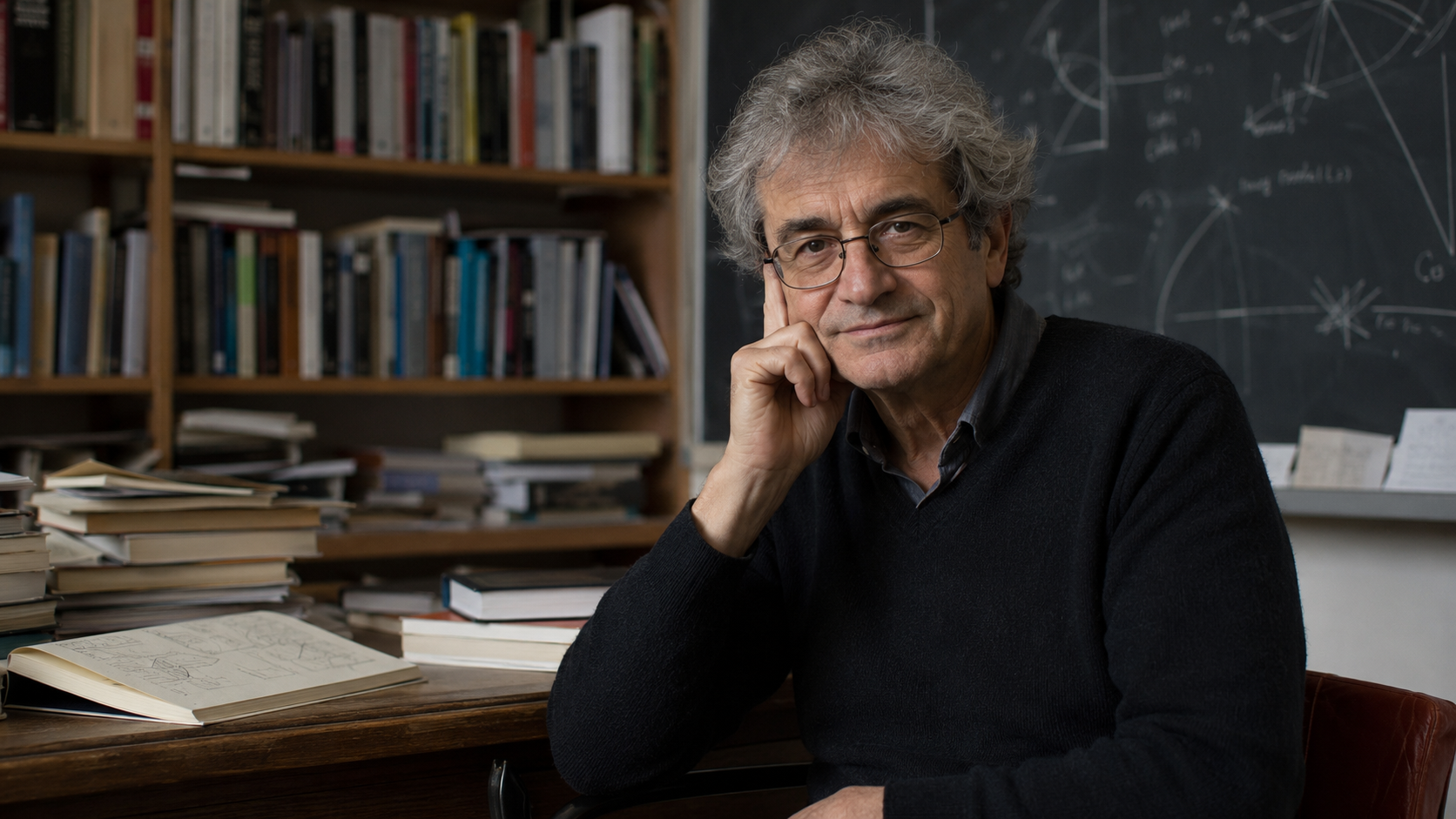
Carlo Rovelli does not simply write about physics.
He writes about what reality becomes when physics removes the familiar furniture.
Time.
Space.
Objects.
Certainty.
The self-standing thing.
The fixed background.
The clean separation between observer and observed.
In Rovelli’s world, reality is not a stage filled with solid objects moving through a universal clock.
It is stranger than that.
More fragile.
More relational.
More unfinished.
The world is not made of things first.
It may be made of events.
Interactions.
Relations.
Processes.
Measurements.
Information between systems.
Time may not be fundamental.
Space may not be smooth.
The flow we feel may be an emergent feature of perspective, entropy, memory, and ignorance.
That is why Rovelli belongs in The Galactic Mind archive.
He is not a fringe mystic.
He is not arguing that “everything is consciousness.”
He is not selling easy cosmic certainty.
He is doing something more disciplined and more unsettling.
He is showing how modern physics can dissolve ordinary reality without abandoning rigor.
For Rovelli, the mystery is not outside science.
The mystery is what science reveals when it is taken seriously enough.

Overview
Carlo Rovelli is an Italian theoretical physicist, writer, and public intellectual best known for his work in quantum gravity, loop quantum gravity, relational quantum mechanics, the thermal time hypothesis, and the philosophical foundations of physics.
He is also one of the most widely read science writers of the modern era.
His books, including Seven Brief Lessons on Physics, Reality Is Not What It Seems, The Order of Time, Helgoland, Anaximander, and White Holes, have brought some of the hardest ideas in physics into public conversation without flattening them into slogans.
Rovelli’s significance comes from a rare combination:
technical physics
philosophy
history of science
literary style
political and ethical concern
a deep suspicion of certainty
He is part of the scientific lineage trying to reconcile general relativity and quantum mechanics.
General relativity tells us that space and time are dynamic.
Quantum mechanics tells us that the microscopic world does not behave like ordinary objects with fixed properties independent of interaction.
Quantum gravity asks what happens when both are true.
That is where Rovelli works.
But his public influence goes beyond technical physics.
He has become one of the clearest voices arguing that reality may be less object-like, less time-bound, and less certain than our inherited worldview assumes.
That makes him important to The Galactic Mind.
Because Rovelli does not ask us to believe in mystery.
He shows us that the ordinary world is already mysterious when examined deeply enough.
Origins and Background
Carlo Rovelli was born in Verona, Italy, in 1956.
His early life unfolded in the cultural and political turbulence of 1970s Italy. He was involved in student movements, alternative political culture, and free radio.
That background matters.
Rovelli’s later scientific worldview is not built on obedience to inherited frameworks.
It is built on the value of questioning them.
He has often described science not as a temple of certainty, but as a disciplined rebellion against what we think we know.
This attitude runs through his work.
Physics, for Rovelli, is not the accumulation of final answers.
It is the art of changing the conceptual frame when reality demands it.
He studied physics at the University of Bologna and completed his doctorate at the University of Padua.
His career took him through Italy, the United States, and France. He held positions or affiliations at institutions including the University of Pittsburgh and Aix-Marseille University, and later became associated with the Centre de Physique Théorique in Marseille, Perimeter Institute, Western University’s Rotman Institute of Philosophy, and the Santa Fe Institute.
That institutional path matters because Rovelli sits between multiple worlds.
Physics and philosophy.
Europe and North America.
Technical research and public writing.
Scientific rigor and poetic communication.
He is not only a physicist explaining equations to the public.
He is a thinker trying to show how physics changes the meaning of the world.
What It’s Known For
Rovelli is known for several major contributions.
Loop quantum gravity
Rovelli is one of the founders and major public voices of loop quantum gravity.
Loop quantum gravity is one of the leading attempts to build a quantum theory of gravity.
The basic problem is simple to state and extremely difficult to solve:
General relativity describes gravity as the curvature of spacetime.
Quantum mechanics describes the behavior of matter and energy at small scales.
But when gravity itself becomes quantum, the old smooth picture of spacetime may break down.
Loop quantum gravity approaches this problem by treating geometry itself as quantum.
Space is not assumed to be a smooth background.
Instead, at the smallest scales, geometry may have a discrete structure.
Areas and volumes may come in quanta.
The gravitational field may be represented through networks of relations rather than a fixed stage.
This is one of Rovelli’s deepest scientific contributions.
The implications are enormous.
If loop quantum gravity is correct, then space is not fundamentally the continuous container we intuitively imagine.
Space itself has quantum structure.
The floor beneath reality may be woven, not smooth.
Spin networks and spin foams
Loop quantum gravity uses mathematical structures called spin networks.
A spin network is not a picture of particles flying through empty space.
It is closer to a quantum state of space itself.
Nodes and links encode relationships that correspond to geometrical quantities like area and volume.
Spin foams extend this idea into histories of quantum geometry, describing how spin networks may change.
This is difficult material.
But the visual metaphor is powerful.
The world is not made of little objects placed inside space.
The structure of space may be a network of relations.
This fits Rovelli’s broader view.
The primary thing is not the object.
The primary thing is the relation.

Relational quantum mechanics
Rovelli’s relational quantum mechanics is one of his most important philosophical contributions.
The idea is that the properties of a quantum system are not absolute in the old sense.
They are relative to another physical system.
A particle does not simply have a fixed set of properties in isolation.
Its state is defined through interaction.
This does not mean consciousness creates reality.
It does not mean the universe depends on human observers.
It means that physical properties are relational.
One system has information about another through interaction.
Reality is not made of self-contained objects with complete properties waiting to be discovered.
Reality is made of systems affecting one another.
This is the Rovelli signal in miniature:
Things are not what they are alone.
They are what they are in relation.

The Order of Time
The Order of Time brought Rovelli’s thinking about time to a much wider audience.
The book argues that the time we experience is not the simple universal flow we assume.
Physics has already weakened the ordinary idea of time.
Relativity showed that time is not the same for everyone everywhere.
Thermodynamics ties the direction of time to entropy.
Quantum gravity suggests that fundamental laws may not require time in the ordinary sense.
The experience of time may emerge from perspective, memory, heat, disorder, and the limited way we interact with the world.
This is not a simple claim that “time is fake.”
That would be too crude.
The better reading is:
The time of ordinary experience is not fundamental in the way we think.
Time is layered.
Local.
Thermodynamic.
Relational.
Emergent.
Human beings live inside one layer of time and mistake it for the whole.

Helgoland
Helgoland is Rovelli’s book on quantum mechanics and his relational interpretation.
The title refers to the island where Werner Heisenberg retreated in 1925 and developed crucial ideas that opened the quantum revolution.
For Rovelli, quantum mechanics is not only strange because particles behave strangely.
It is strange because it tells us something about what can be said to exist.
Quantum theory weakens the old idea that properties belong to things absolutely.
Instead, what exists may be interaction.
The world is not a collection of independent objects.
It is a web of events where each system becomes real for another through relation.
This is why Helgoland matters to The Galactic Mind.
It turns physics into a philosophical rupture.
Not because physics becomes mysticism.
Because matter itself becomes less object-like than the modern mind expected.
Science as learned rebellion
Rovelli has also written about Anaximander and the birth of scientific thinking.
His view of science is deeply important.
Science is not certainty.
Science begins when inherited certainty becomes questionable.
For Rovelli, science is a process of humility, imagination, rebellion, correction, and conceptual courage.
It does not give us eternal doctrine.
It gives us better questions, better models, and the willingness to abandon what no longer works.
That is why Rovelli’s public writing has such force.
He does not present science as a closed institution.
He presents it as an unfinished adventure.
The Core Idea or Signal
The core signal of Carlo Rovelli is this:
Reality is not made of isolated things. Reality is made of relations.
That is the key.
Objects are not primary.
Events may be primary.
Relations may be primary.
Interactions may be primary.
Information is not mental decoration.
It is physical correlation between systems.
Time is not a universal river flowing outside everything.
It is something that emerges from the structure of events, entropy, perspective, and the way we belong to the world.
This is where Rovelli becomes important beyond physics.
Modern culture often thinks in isolated units.
Individuals.
Objects.
Facts.
Moments.
Particles.
Nations.
Selves.
Certainties.
Rovelli’s physics pushes against that.
Nothing is fully itself alone.
Everything exists through relation.
That idea does not prove spirituality.
It does not prove consciousness-first reality.
It does not prove simulation.
It does not prove ancient wisdom.
But it does loosen the materialist picture that many people inherited.
The world is not a pile of things.
It is a network of happenings.
Perspectives and Interpretations
Rovelli can be interpreted through several lenses.
The quantum-gravity view
From the quantum-gravity view, Rovelli is one of the major figures in loop quantum gravity.
His work belongs to the technical effort to understand what happens when spacetime itself is treated quantum mechanically.
This is not metaphor.
It is mathematical physics.
The question is whether loop quantum gravity can become a complete, empirically successful theory of quantum spacetime.
That remains unresolved.
But the project matters because it asks one of the deepest scientific questions:
What is space made of?
Not what is inside space.
Space itself.
The relational view
From the relational view, Rovelli’s deepest contribution is the idea that reality is not built out of self-contained substances.
It is built out of relations between systems.
This connects physics with a wider philosophical shift.
The self is not isolated.
Objects are not fully independent.
Measurement is not passive.
Information is not just something stored in minds.
The world is event-like.
Rovelli gives this intuition a rigorous scientific context.
He does not make the mistake of turning it into vague “everything is connected” language.
He argues from physics.
That is what makes the relational frame powerful.
The time view
For many readers, Rovelli is the physicist who helped make time feel strange again.
The Order of Time succeeded because it addressed a question everyone feels but few can answer:
What is time?
Not clock time.
Not calendar time.
But the flow.
The difference between past and future.
The way memory gives direction.
The way entropy creates asymmetry.
The way human beings experience change as a river.
Rovelli shows that the ordinary experience of time is not simple.
It is layered.
It is rooted in physics, but also in perspective.
That makes time not less real, but more mysterious.
The science-writer view
Rovelli is also important as a science writer.
He has a rare ability to communicate difficult physics without draining it of beauty.
He does not simplify by making the world less strange.
He simplifies by making the strangeness readable.
That matters.
Many science communicators explain facts.
Rovelli explains transformations of worldview.
He shows how a physical theory changes the emotional architecture of reality.
That is why his books reached readers far beyond physics.
The critic’s view
Critics may raise several objections.
Loop quantum gravity remains an incomplete program without decisive experimental confirmation.
Relational quantum mechanics is one interpretation among others, not a settled replacement for all rival interpretations.
Rovelli’s public writing can sometimes make technical debates feel more philosophically resolved than they are.
His poetic style can invite readers to treat provisional theories as cosmic truth.
These critiques matter.
A grounded Dossier should not turn Rovelli into a prophet of reality.
He is a physicist and thinker working within active, unresolved debates.
His strongest ideas are powerful.
They are not final.
Strengths and Limitations
Rovelli’s greatest strength is conceptual courage.
He is willing to let physics revise common sense at the deepest level.
Not just in details.
In structure.
Time may not be fundamental.
Space may be quantum.
Objects may not be primary.
Relations may come first.
Certainty may be less scientific than uncertainty.
This is a rare kind of scientific imagination.
He also understands that science is not opposed to wonder.
Science is one of wonder’s most disciplined forms.
His writing carries beauty without surrendering rigor.
His limitations are tied to the same strengths.
The deeper the conceptual claim, the easier it is for audiences to overread it.
“Time is not fundamental” can become “time is not real.”
“Reality is relational” can become “nothing exists.”
“Quantum mechanics is strange” can become “anything is possible.”
Rovelli does not deserve blame for every bad simplification of his work.
But the risk is real.
A grounded ledger helps:
What is documented:
Carlo Rovelli is a theoretical physicist and writer known for loop quantum gravity, relational quantum mechanics, the thermal time hypothesis, and major popular science books about physics, time, and reality.
What is claimed:
His work argues that spacetime may have quantum structure, that time may not be fundamental in the ordinary sense, and that physical properties are relational rather than absolute.
What is interpreted:
Supporters see Rovelli as one of the clearest modern voices showing how physics transforms our picture of reality. Critics see some of the surrounding interpretations as still speculative, incomplete, or too easily popularized beyond the evidence.
What remains unresolved:
Whether loop quantum gravity is the correct theory of quantum spacetime, whether relational quantum mechanics is the best interpretation of quantum theory, and how time emerges from the deeper structure of the world.
What is speculative:
Claims that Rovelli’s physics proves spirituality, simulation theory, consciousness-first reality, or mystical unity.
It does not.
His work is powerful enough without that overreach.
Broader Implications
Rovelli matters because modern civilization still lives inside outdated intuitions.
We think of space as container.
Time as river.
Objects as separate.
Facts as fixed.
The observer as outside the system.
Reality as something made of things.
Physics keeps weakening those assumptions.
Rovelli is one of the thinkers explaining what that weakening means.
This has implications far beyond physics.
For consciousness, it reminds us that the observer is not outside the world.
For philosophy, it challenges substance-based thinking.
For spirituality, it gives a scientific language for humility without turning science into religion.
For AI, it raises questions about information, relation, and what it means for systems to interact.
For ancient philosophy, it reconnects modern physics with old questions about change, being, and reality.
For The Galactic Mind, Rovelli belongs in the same reality-frame archive as Donald Hoffman, Bernardo Kastrup, David Bohm, and Carlo Sagan.
Each challenges the obvious world from a different angle.
Hoffman challenges perception.
Kastrup challenges materialism.
Bohm challenges fragmentation.
Sagan challenges human centrality.
Rovelli challenges things themselves.
The world may not be made of objects.
It may be made of relations.
That is a quiet idea.
It is also a radical one.
The Reality Signal
What this subject represents
Carlo Rovelli represents the scientist as reality poet.
Not because he replaces physics with poetry.
Because he understands that physics, when expressed clearly, can change the poetry of existence.
He represents a form of science that is humble, rebellious, relational, and unfinished.
He also represents the danger and beauty of public physics:
the more profound the idea, the more carefully it must be handled.
What reality frame it challenges
Rovelli challenges the frame that reality is made of solid things moving through universal time.
He challenges the frame that science is certainty.
He challenges the frame that the observer can be cleanly separated from what is observed.
He challenges the frame that the world exists as a complete set of absolute properties independent of interaction.
He also challenges the frame that mystery belongs outside science.
For Rovelli, science deepens mystery by clarifying it.
Why it matters now
Rovelli matters now because the old materialist imagination is being revised from multiple directions.
Quantum theory.
Relativity.
Information theory.
Black holes.
Cosmology.
Consciousness studies.
AI.
Complex systems.
All of them are pressuring the simple picture of isolated objects in a fixed world.
Rovelli offers one of the clearest scientific languages for that revision.
Not everything is mind.
Not everything is illusion.
Not everything is mystical.
But everything may be relational.
That alone changes the map.
What remains unresolved
The unresolved ledger is where Rovelli’s signal remains alive.
What is established:
Rovelli is one of the best-known modern physicists working on quantum gravity and one of the most influential public communicators of the strange implications of modern physics.
What is claimed:
His work claims that space, time, and physical properties are not fundamental in the everyday sense, but arise through quantum geometry, thermodynamic perspective, and relational interaction.
What remains unresolved:
Whether his preferred theoretical frameworks will become experimentally confirmed, remain one powerful interpretation among many, or be replaced by a deeper theory still to come.
Why it still matters:
Because even unfinished physics can reveal that the reality we take for granted is not the reality physics is describing.
The Galactic Mind Perspective
Carlo Rovelli belongs in The Galactic Mind archive because he shows how radical reality becomes without leaving science.
That is important.
Many people come to big questions through mysticism, psychedelics, religion, consciousness, UAP, ancient texts, or metaphysical speculation.
Rovelli comes through physics.
Equations.
Concepts.
History.
Scientific humility.
And yet the destination is still strange.
The self-contained object dissolves.
The universal clock dissolves.
The fixed background dissolves.
The observer outside the world dissolves.
What remains is relation.
Event.
Interaction.
A world that is not a static inventory of things, but a living web of physical happenings.
For The Galactic Mind, this matters because it gives us a disciplined way to say:
The ordinary worldview may be wrong.
Not because we want it to be wrong.
Because science itself has been telling us for a century that common sense is not enough.
Rovelli’s gift is that he makes that rupture beautiful.
He does not hand us a fantasy.
He hands us a harder reality.
One where time is layered, space is quantum, knowledge is relational, and certainty is less honest than wonder.
That is the Rovelli doorway.
The world is not what it seems.
And maybe the reason is simpler and stranger than we thought:
Nothing exists alone.
Open Thread
Carlo Rovelli leaves us with a question that feels small until it changes everything.
What is a thing?
A particle?
A place?
A moment?
A person?
A memory?
A universe?
If everything is what it is through relation, then reality is not a collection of isolated objects.
It is a web of encounters.
A process.
A conversation.
The world does not sit there fully finished, waiting to be described from outside.
We are inside it.
Part of it.
Describing it through interactions that are themselves part of the world.
This does not make reality less real.
It may make it more real.
Less like a pile of matter.
More like a living grammar of events.
What do you think? Drop your thoughts in the comments ...
Sources / Receipts
- Carlo Rovelli official homepage and curriculum materials
- Aix-Marseille / Centre de Physique Théorique materials
- Perimeter Institute and Rotman Institute profile materials
- Carlo Rovelli, Quantum Gravity
- Carlo Rovelli and Francesca Vidotto, Covariant Loop Quantum Gravity
- Carlo Rovelli, Seven Brief Lessons on Physics
- Carlo Rovelli, Reality Is Not What It Seems
- Carlo Rovelli, The Order of Time
- Carlo Rovelli, Helgoland
- Carlo Rovelli, White Holes
- Carlo Rovelli, “Relational Quantum Mechanics”
- Carlo Rovelli and Alain Connes, work on thermal time
- Carlo Rovelli, “Loop Quantum Gravity”
- Scholarly material on loop quantum gravity, spin networks, spin foams, and relational quantum mechanics


Discussion