
Case Overview
On October 20, 1967, Roger Patterson and Bob Gimlin claimed they filmed a large, hair-covered, bipedal figure near Bluff Creek in Northern California.
The footage was short.
Roughly one minute of 16 mm film.
A shaky camera.
A figure walking across a creek bed.
A brief turn toward the lens.
Then the subject disappears into the trees.
That was enough.
The Patterson-Gimlin film became the most famous piece of alleged Bigfoot evidence ever recorded. For believers, it remains the strongest visual case for an undiscovered North American primate. For skeptics, it remains one of the most successful creature hoaxes in modern folklore.
What makes the film notable is not that it proves Bigfoot exists.
What makes it notable is that, more than half a century later, the footage still sits in a strange unresolved space. It is clear enough to provoke analysis, but blurry enough to resist certainty. It is physical evidence, but not biological evidence. It shows something, but it does not settle what that something was.
That is why the film endures.
Not as proof.
As tension.
What Actually Happened
Patterson and Gimlin were in the Bluff Creek area of Northern California, a region already tied to Bigfoot reports and large footprint claims. They were traveling on horseback and reportedly searching for evidence connected to the creature.
According to their account, they came upon a large, upright figure near the creek. Patterson’s horse reacted, and Patterson dismounted, retrieved his camera, and began filming.
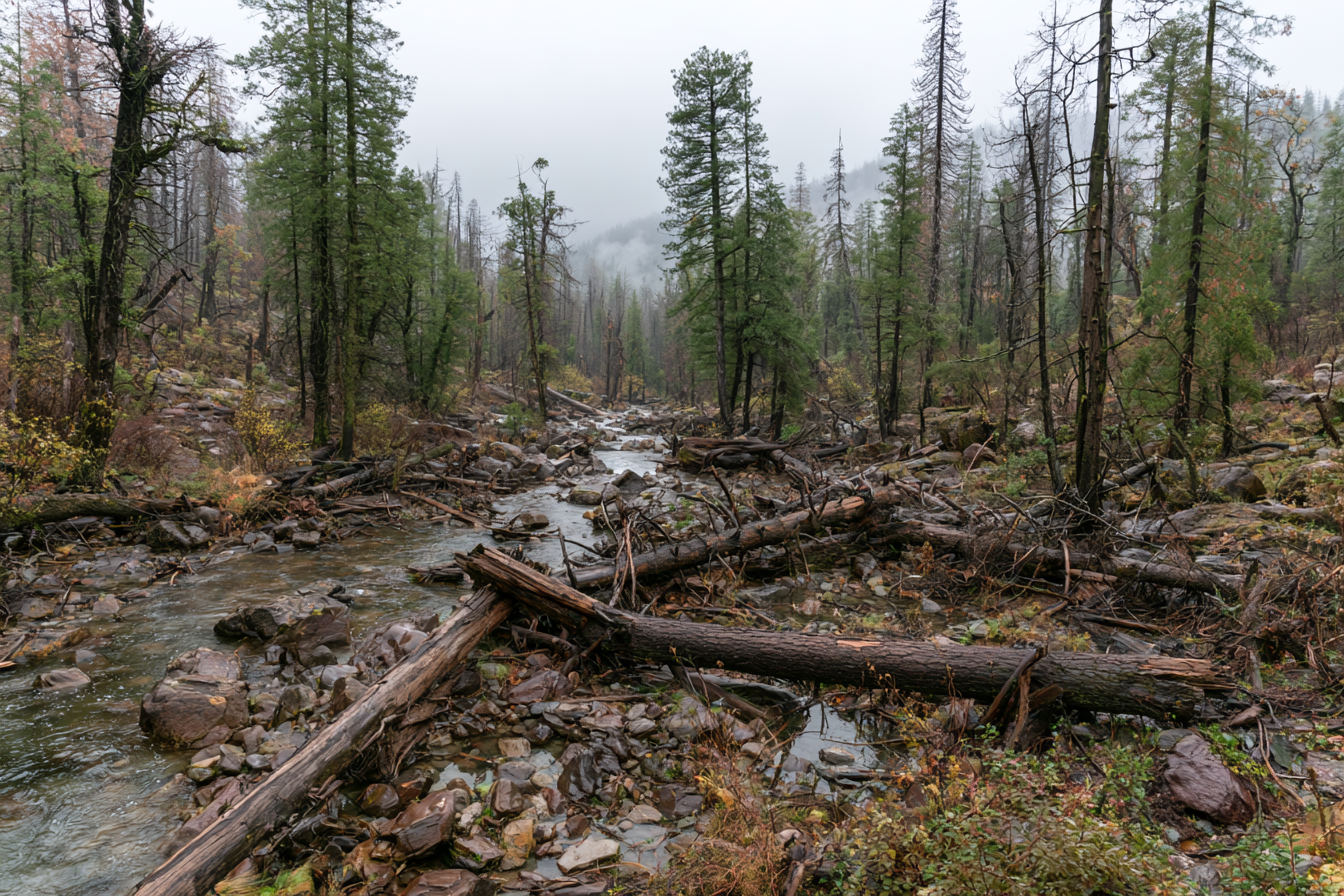
The resulting footage shows a dark, hair-covered figure walking away from the camera across a cleared creek bed. The subject appears broad, heavy, and upright. At one point, it turns its upper body and head back toward the camera before continuing toward the tree line.
This moment became the famous “look back.”
The film was later shown publicly and became one of the central artifacts of modern Bigfoot culture. The figure in the film was eventually nicknamed “Patty,” partly because many observers interpreted the subject as female due to apparent breasts visible in the footage.
The film did not arrive in a vacuum.
Patterson had already been interested in Bigfoot and had been working on a Bigfoot-related film project. That fact is important because it cuts both ways.
For supporters, it means he was intentionally searching in a place where Bigfoot had been reported.
For skeptics, it means he had motive, subject matter, and a prepared context for staging a dramatic encounter.
The film has been analyzed, stabilized, enlarged, slowed down, debated, defended, dismissed, and revived for decades.
But the central question remains unchanged:
Was the figure in the film a real unknown animal, or a person in a costume?
Key Claims and Evidence
The Patterson-Gimlin case rests on several layers of evidence and claim.
The Film Itself
The primary evidence is the 16 mm footage.
It shows a large, dark, hair-covered, upright figure walking across a creek bed. The subject’s body shape, gait, proportions, shoulder width, and apparent surface movement have all been used by supporters to argue that the film shows something more than a human in a suit.
The footage is real in the simple sense that it exists.
But the film’s existence does not prove the subject’s identity.
The Witness Claim
Patterson and Gimlin maintained that they encountered and filmed a real creature.
Gimlin, in particular, became important to the case because he lived for decades after the incident and continued to deny that he had knowingly participated in a hoax.
Still, the direct witness base is narrow.
There were no independent scientific observers present at the moment of filming. No field team documented the site immediately under controlled conditions. No biological sample tied to the subject was recovered and verified.
The Tracks
Patterson and Gimlin reported finding tracks at the site. Casts were reportedly made.
Footprint evidence is central to Bigfoot history, but it is also vulnerable to hoaxing, misidentification, casting problems, and later interpretation.
In this case, the tracks do not independently prove the subject was real.
They are part of the claim.
Technical Analysis in Favor
Some analysts, including Bill Munns and Jeff Meldrum, have argued that the film contains enough usable image data for serious analysis. Their work has emphasized the integrity of the film image, the subject’s proportions, the apparent movement of tissue or body mass, and the difficulty of reproducing such a figure with ordinary 1967 costume methods.
This does not prove the subject was a real unknown animal.
But it does explain why some defenders do not view the footage as easily dismissible.
Skeptical and Hoax Claims
Skeptics argue that the film is best understood as a staged hoax.
The skeptical case often points to:
- Patterson’s prior Bigfoot interest and film project
- the lack of biological evidence
- uncertainty around camera speed and filming details
- the possibility of a costume
- claims from Bob Heironimus that he wore the suit
- claims connected to costume-maker Philip Morris
- the broader history of Bigfoot hoaxes and unreliable evidence
These claims have also been disputed by defenders of the film.
The result is not a clean resolution.
It is a contested record.
Points of Tension
The Patterson-Gimlin film survives because it contains several unresolved tensions at once.
The Footage Is Physical Evidence, But Not Biological Evidence
The film is more substantial than a story.
It is not just someone saying they saw something in the woods. There is footage. There is a moving figure. There are frames that can be studied.
But the film is not a body.
It is not DNA.
It is not hair with a verified chain of custody.
It is not a specimen.
It shows a figure, but it does not prove what the figure is.
That distinction matters.
The Figure Looks Human Enough to Doubt, But Strange Enough to Debate
To skeptics, the subject looks like a person in a fur suit.
To supporters, the subject’s gait, proportions, shoulder width, apparent muscle movement, and overall body structure look difficult to fake.
The problem is that the footage is not clear enough to force one reading.
It allows both.
A viewer can see a costume.
Another viewer can see an animal.
Both can point to the same frame.
That is the power and weakness of the film.
The Context Helps Both Sides
Patterson being interested in Bigfoot before the encounter can be read two ways.
He was looking for Bigfoot in an area associated with Bigfoot reports.
Or he was a filmmaker with a Bigfoot project who had every reason to create the footage he needed.
The same fact supports opposite interpretations.
The Missing Standard of Proof
For an undiscovered large primate to exist in North America, the expected evidence would eventually need to go beyond film.
A body. Bones. Clear DNA.
Consistent ecological evidence.
A breeding population.
That evidence has not been produced in a way accepted by mainstream zoology.
This does not automatically prove the film is fake.
But it creates a major problem for the claim that the film shows a real species.
The Film Has Never Fully Gone Away
The strongest skeptical argument is simple:
After decades of cameras, trail cams, smartphones, drones, and wildlife monitoring, why has nothing better emerged?
The strongest believer response is also simple:
If the film was fake, why has no recreation fully settled the matter for everyone?
Both questions have weaknesses.
A lack of better footage does not prove a hoax.
A lack of perfect recreation does not prove authenticity.
But together, they explain why the Patterson-Gimlin film remains suspended between evidence and myth.
Perspectives and Explanations
A Man in a Costume
The most common skeptical explanation is that the film shows a person wearing a Bigfoot costume.
This explanation accounts for the basic shape, the human-like walk, Patterson’s prior interest in Bigfoot, and later claims by people who said the film was staged.
It also fits the broader pattern of cryptid hoaxes, where ambiguous visual evidence becomes powerful because it is just clear enough to suggest something strange and just unclear enough to avoid final disproof.
The limitation is that no universally accepted original suit has been produced. Claims about who made or wore the suit remain disputed. Defenders also argue that the figure’s apparent anatomy and movement exceed what a simple 1967 costume could plausibly achieve.
Still, from a conventional standpoint, a costume remains the most likely explanation.
A Misidentified Human or Known Animal
Another possibility is that the subject was not an elaborate hoax but a misidentified known figure or animal.
This is less persuasive than the costume theory because the figure is clearly upright and human-shaped in the footage. A bear explanation, for example, struggles with the consistent bipedal walking sequence.
Misidentification can explain many Bigfoot sightings.
It is harder to apply cleanly to this specific film.
A Real Unknown Primate
The most extraordinary interpretation is that Patterson and Gimlin filmed a real, undocumented North American primate or relic hominin.
This possibility is why the film became legendary.
If true, it would be one of the most important wildlife films ever recorded.
But this interpretation carries the heaviest burden. A large breeding population would be expected to leave more than disputed tracks, sightings, and ambiguous footage. Mainstream science has not accepted the existence of such an animal because the physical evidence has not met the required standard.
The film may look compelling.
But compelling is not the same as confirmed.
A Cultural Artifact That Became Larger Than the Evidence
There is another explanation that does not depend entirely on proving or debunking the footage.
The Patterson-Gimlin film may be most important as a cultural artifact.
It arrived at the right time, in the right medium, with the right image.
A mysterious figure.
A wild American landscape.
A camera struggling to keep up.
A creature that looks close to human, but not fully human.
That combination gave Bigfoot a visual body.
Before the film, Bigfoot was mostly stories, tracks, newspaper reports, and regional legend. After the film, Bigfoot had a walk, a silhouette, and a face turned back toward the camera.
Whether the footage is real or staged, it changed the mythology.
Context and Pattern Recognition
The Patterson-Gimlin film belongs to a much older pattern: the wilderness encounter that becomes evidence only after the moment has passed.
There is no controlled observation.
No specimen.
No immediate scientific field team.
No independent chain of custody from the moment of discovery.
Instead, there is a story, a recording, and a long afterlife of interpretation.
This pattern appears again and again in anomalous cases.
A brief encounter becomes an artifact.
The artifact becomes a debate.
The debate becomes culture.
The original event becomes almost impossible to separate from everything that came after it.
Bluff Creek also matters because Bigfoot was already rooted in the Pacific Northwest. The region’s forests, logging roads, Indigenous traditions, footprint reports, and postwar media environment all helped shape the creature into something more than a rumored animal.
Bigfoot became a symbol.
Of wilderness.
Of the unknown.
Of the possibility that the modern world had not mapped everything.
The Patterson-Gimlin film gave that symbol motion.
Implications
If the Patterson-Gimlin film is a hoax, it still matters.
It shows how a short piece of footage can create a durable reality in the public imagination. A costume, a camera, and a believable landscape may have been enough to shape decades of belief, research, tourism, documentaries, and identity.
If the film shows a real unknown animal, the implications are enormous.
It would mean a large bipedal primate existed in North America in the modern era without being formally documented by science. That would challenge assumptions about wilderness, species detection, and how much of the natural world remains hidden in plain sight.
If the film remains unresolved, the implication is subtler but still important.
It shows that evidence does not always produce certainty.
Sometimes evidence creates a permanent question.
A single image can become a mirror. People bring their assumptions to it. Skeptics see the mechanics of a hoax. Believers see the limits of official science. Others see something more psychological: the human need for the wild to still contain a threshold.
The Patterson-Gimlin film may not prove Bigfoot.
But it proves something about us.
We are not only asking whether the creature is real.
We are asking whether the world is still allowed to surprise us.
The Galactic Mind Perspective
The Patterson-Gimlin film is not strong enough to confirm Bigfoot.
But it is too culturally powerful to ignore.
Its endurance comes from the space between clarity and ambiguity. The subject is visible, but not fully knowable. The body is recognizable, but not explainable to everyone’s satisfaction. The film is physical, but incomplete.
That is where the case lives.
Not in proof. Not in dismissal.
In the unstable zone where evidence becomes interpretation.
The most grounded position is to say this:
The Patterson-Gimlin film remains an unresolved cultural and evidentiary artifact. It may show a person in a suit. It may show something stranger. But without verified biological evidence, airtight filming metadata, and a stronger chain of custody, it cannot carry the burden placed on it by believers.
And yet, the film still asks a meaningful question.
What happens when the unknown walks into frame for less than a minute, looks back, and leaves us arguing for the rest of our lives?
Credibility Meter
Witness Reliability: 2 / 5
Patterson and Gimlin consistently maintained the encounter was real, and Gimlin continued denying knowing involvement in a hoax for decades. However, the witness base is narrow, the event was not independently observed, and Patterson’s prior Bigfoot project complicates the context.
Physical Evidence: 2 / 5
The footage is real and available for analysis. But no verified body, bones, DNA, hair sample, or biological trace tied to the subject has been accepted by mainstream science.
Documentation: 3 / 5
The film has been preserved, copied, digitized, stabilized, and analyzed many times. However, key filming conditions, camera speed, full chain-of-custody questions, and original-context metadata remain contested.
Expert Analysis: 3 / 5
There is significant analysis on both sides. Supporters argue for anatomical and film-integrity features that resist simple dismissal. Skeptics argue the subject is consistent with a human in a suit and that the broader evidence for Bigfoot remains insufficient.
Overall Interpretation:
The Patterson-Gimlin film is one of the strongest pieces of Bigfoot media ever produced, but not strong enough to prove Bigfoot exists. Its credibility lies in the film’s persistence as an analyzable artifact. Its weakness lies in the absence of independent biological confirmation.
It remains compelling.
It remains contested.
It remains unresolved.
Open Question
If the Patterson-Gimlin film is not proof, but also not easily forgotten, what does its survival reveal: a hidden animal, a brilliant hoax, or the human need to believe the wilderness still has secrets?
What do you think? Drop your thoughts in the comments ...
Sources / Receipts
- Wikimedia Commons: public-domain Patterson-Gimlin film file and stabilized version
- Oregon Public Broadcasting: 50-year retrospective on the film and its cultural impact
- Munns and Meldrum: Analysis Integrity of the Patterson-Gimlin Film Image
- Munns and Meldrum: Surface Anatomy and Subcutaneous Adipose Tissue Features in the Analysis of the Patterson-Gimlin Film Hominid
- Skeptical Inquirer: skeptical analysis and hoax claims involving Bob Heironimus
- Boston College Magazine: Tracking Bigfoot, including Bluff Creek reporting, film-site rediscovery context, and debate overview
- People / SXSW reporting on the 2026 documentary Capturing Bigfoot, included only as a recent claim, not as settled proo


Discussion