
Case Overview: The Event
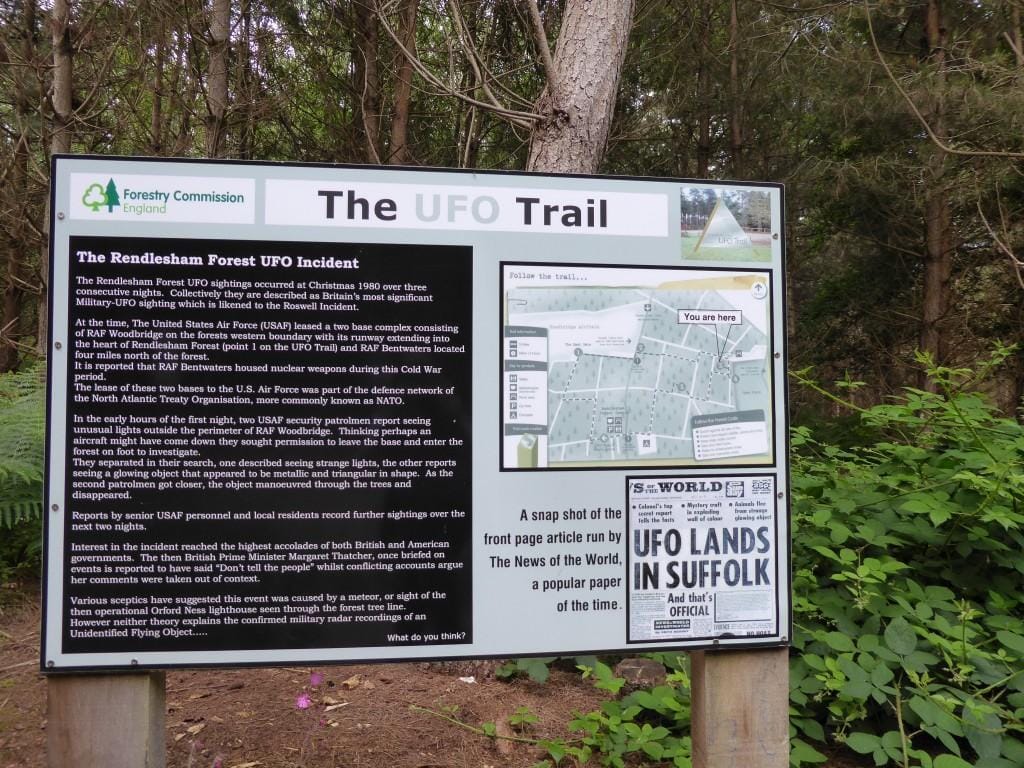
In late December 1980, United States Air Force personnel stationed at RAF Woodbridge and RAF Bentwaters in Suffolk, England, reported a series of unusual lights in and around Rendlesham Forest.
The events unfolded near the East Gate of RAF Woodbridge, a strategically sensitive military installation used by the U.S. Air Force during the Cold War.
The incident became known as “Britain’s Roswell.”
The comparison is dramatic, but the two cases are structurally different. Roswell became a crash-retrieval story. Rendlesham is a multi-night military-witness case involving unusual lights, disputed ground traces, an audio recording and an official memorandum.
The reason Rendlesham matters is not because it proves that a craft from elsewhere landed in the forest.
It does not.
It matters because the case contains several elements rarely found together in UFO history:
- military witnesses;
- a formal memorandum written by a deputy base commander;
- an audio recording made during one of the investigations;
- reports of ground impressions and radiation readings;
- official Ministry of Defence records;
- later testimony that expanded the story considerably;
- continuing disagreement over whether conventional explanations account for the complete event.
The central claim is straightforward.
Servicemen reported strange lights beyond the base perimeter. Some later described a structured object. Lt. Col. Charles Halt subsequently wrote a memorandum to the British Ministry of Defence titled “Unexplained Lights.”
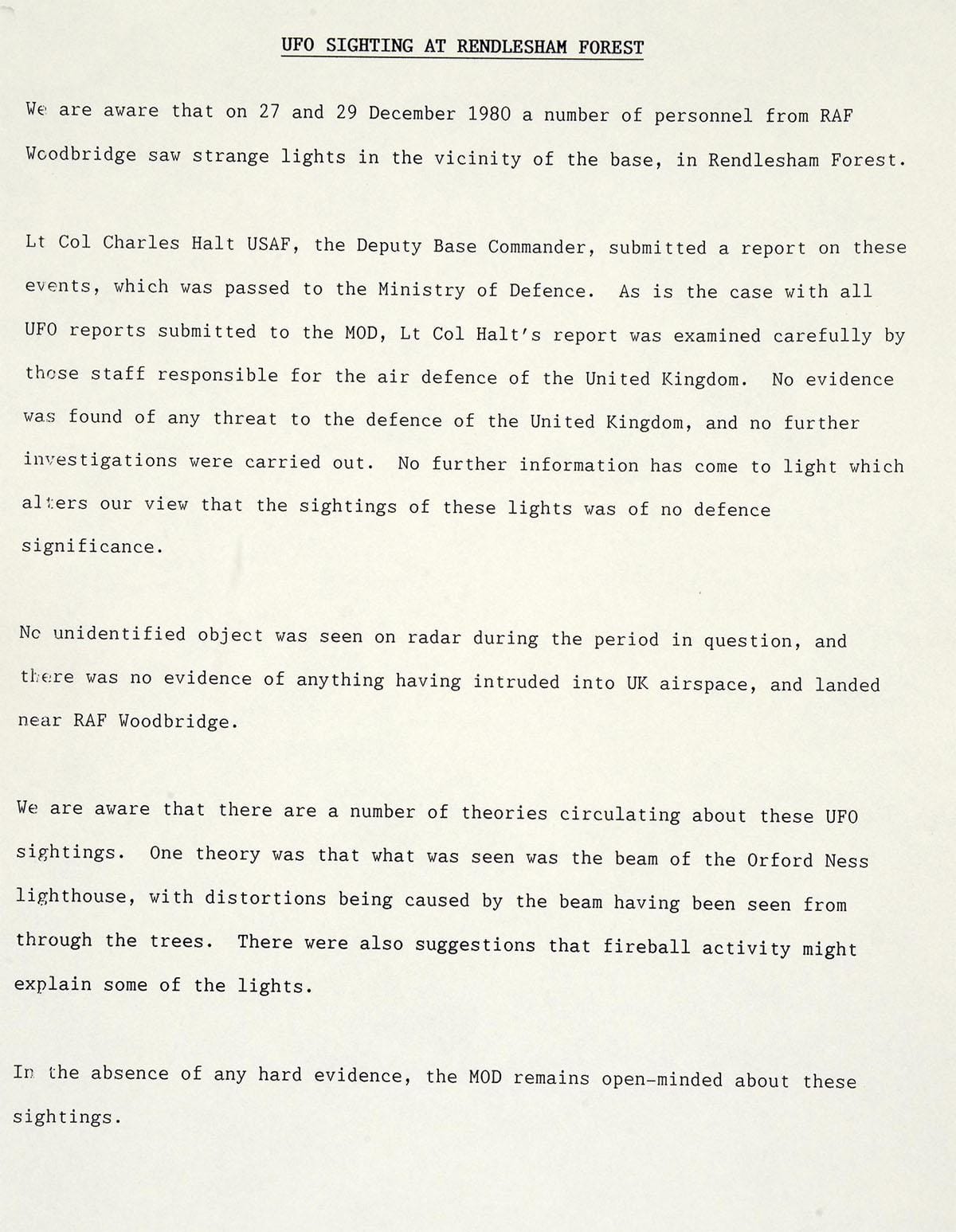
The official position remained restrained. The Ministry of Defence did not consider the incident a threat to national security.
Skeptical explanations propose a convergence of ordinary causes: a bright fireball, Orfordness Lighthouse, stars near the horizon, animal marks and misperception inside a dark forest.
Yet the witness record, official documentation and later claims have never settled into one universally accepted explanation.
Like Project Blue Book, Rendlesham demonstrates that an institution can document an unexplained report without identifying its cause.
Rendlesham is not proof.
It is a record under pressure.
What Actually Happened
The reported events took place across several nights in late December 1980.
The exact timeline is one of the case’s complications. Halt’s memo gives dates that have been debated, and later reconstructions often distinguish between the first reported sighting in the early hours of December 26 and Halt’s later expedition into the forest.
For clarity, the case can be separated into three layers.
The First Night
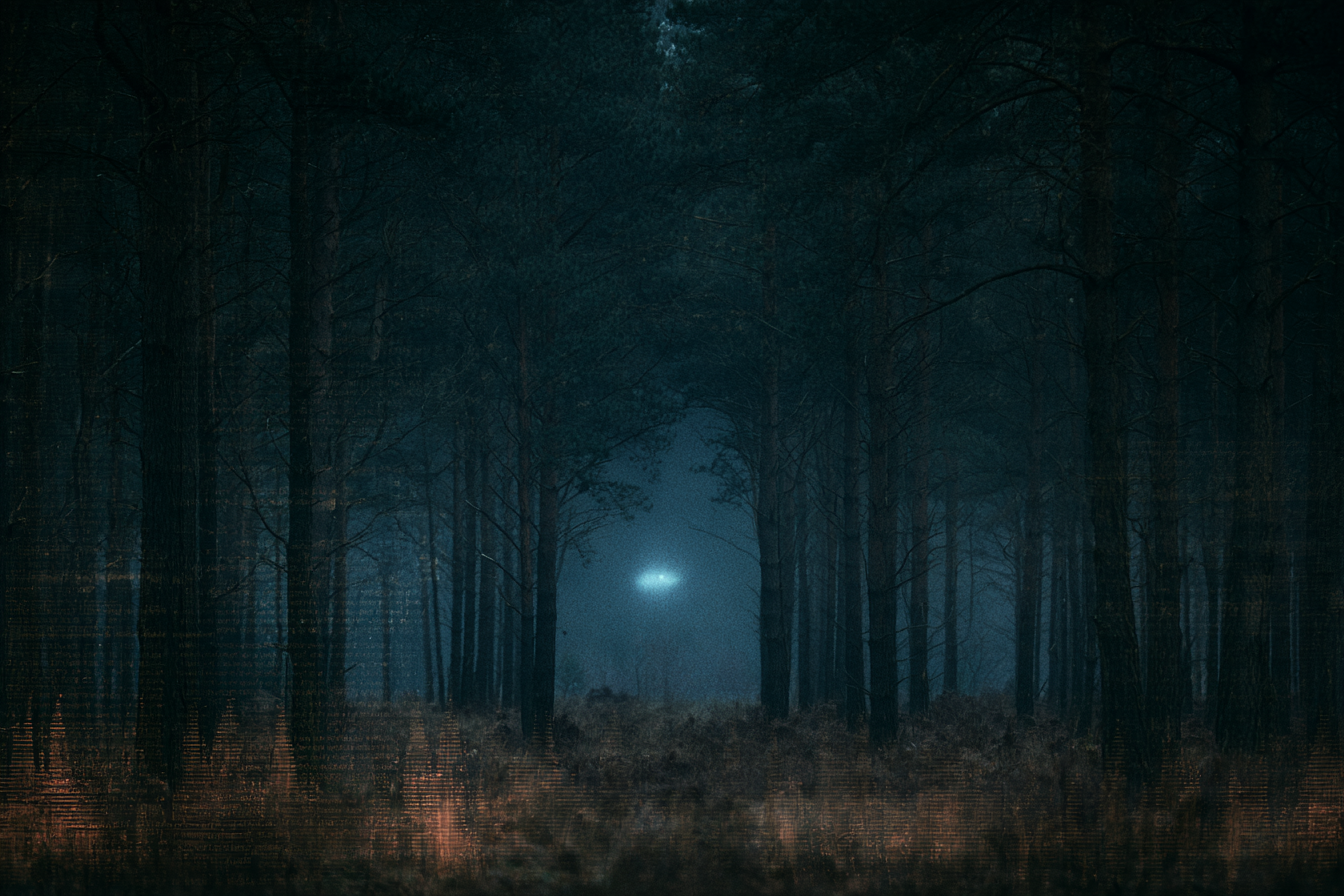
In the early hours after Christmas, U.S. Air Force security personnel near RAF Woodbridge’s East Gate reportedly saw strange lights beyond the base perimeter.
The lights appeared to be in Rendlesham Forest.
Because the area was close to an active military installation, the initial concern was practical: an aircraft may have crashed or come down in the woods.
Several airmen went to investigate.
The names most often associated with the first-night encounter are John Burroughs, Jim Penniston, and Ed Cabansag. Their accounts have not remained identical over time, and some later details became far more elaborate than the earliest written statements.
The core early report involved strange lights in the forest.
Later versions included a structured triangular craft, close approach, symbols on the surface, unusual physical sensations, and, in Penniston’s later account, a sequence of binary code received after touching the object.
Those later claims are part of the Rendlesham story.
They are not all equally supported by the earliest documentation.
The Morning After
After the first reported encounter, personnel returned to the forest.
Three small depressions were reportedly found in the ground in a triangular pattern. There were also claims of marks or damage on nearby trees.
These details became central to the idea that something may have landed.
However, the ground impressions and tree marks remain disputed. Skeptical interpretations suggest the marks may have been animal activity or ordinary forest damage.
No recovered material, debris, or verified craft component was produced.
Halt’s Expedition
A later investigation was led by Lt. Col. Charles Halt.
Halt entered the forest with other personnel and carried a tape recorder. The resulting audio, often called the “Halt tape,” became one of the most unusual pieces of the case.
On the tape, Halt and his team discuss the ground impressions, take radiation readings, note lights in the distance, and describe unusual movements in the sky.
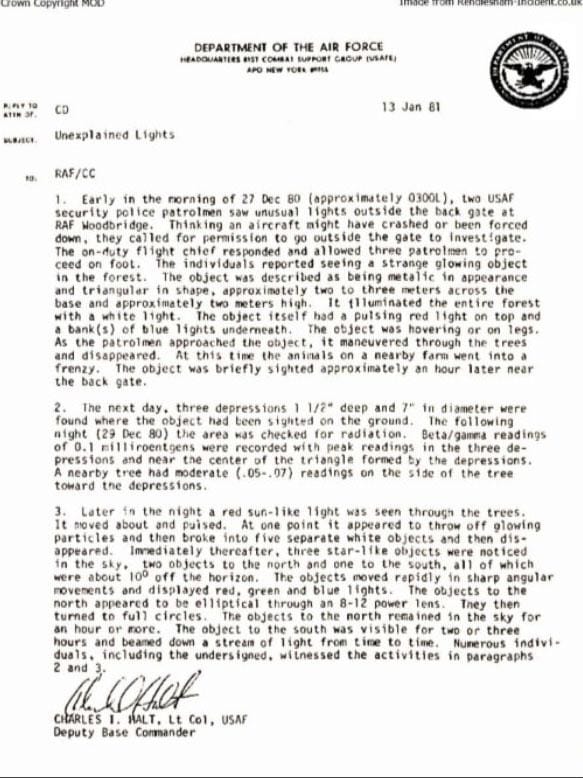
Halt later wrote a memo to the Ministry of Defence titled “Unexplained Lights.” In it, he described security police seeing an unusual glowing object in the forest, a metallic-looking triangular form, blue and red lights, ground depressions, radiation readings, and later star-like objects in the sky.
This memo became the backbone of the official record.
It is also the reason Rendlesham remains different from many UFO reports.
A senior officer did not merely hear a rumor.
He put the incident into writing.
Key Claims and Evidence
The Rendlesham case rests on a mix of official documentation, witness testimony, audio recording, physical claims, and later interpretation.
These layers need to be separated carefully.
What Is Documented
The strongest documented elements are:
- U.S. Air Force personnel reported unusual lights near RAF Woodbridge and Rendlesham Forest.
- Lt. Col. Charles Halt wrote an official memorandum titled “Unexplained Lights.”
- The memorandum was dated January 13, 1981, and entered official channels connected to the British Ministry of Defence.
- The UK National Archives holds correspondence concerning the Rendlesham Forest incident under catalogue reference DEFE 24/1948/1.
- A field audio recording attributed to Halt’s investigation survives.
- Ministry of Defence files contain later correspondence and internal discussion surrounding the case.
- The Ministry of Defence concluded that the incident had no defence significance, citing the absence of a confirmed threat and a lack of supporting radar evidence.
This documentation does not prove that a craft landed in Rendlesham Forest.
It proves that military personnel reported an incident and that the report entered official government records.
Documentation confirms the existence of the case.
It does not identify what the witnesses encountered.
Witness Statements
Witnesses reported different aspects of the event, including:
- strange lights beyond the East Gate;
- lights moving through or beyond the trees;
- a possible object in the forest;
- a red light or sun-like object;
- star-like lights in the sky;
- unusual movement;
- ground marks;
- radiation readings;
- later claims of close contact with a structured craft.
The earliest reports are generally less dramatic than later retellings.
That does not automatically make the later details false.
But it does make the timeline of testimony important.
When a case grows over decades, the first record becomes critical.
The Halt Memo
The Halt memorandum is the case’s most important official document.
Dated January 13, 1981, and titled “Unexplained Lights,” it describes security personnel seeing unusual lights outside the back gate of RAF Woodbridge and entering the forest to investigate.
The memorandum describes a glowing object reported as metallic and triangular, approximately two to three metres across. It also records three ground depressions, radiation readings and later observations of red and star-like lights in the sky.
Its importance comes from its official origin. A senior officer placed the incident into writing and sent it through military channels.
Its limitations are equally important.
The memorandum was written more than two weeks after the first reported encounter. Its dates appear to be incorrect by approximately one day, and parts of its summary do not perfectly align with the contemporaneous audio recording or earliest witness statements.
Those problems do not make the document inauthentic.
They do limit how precisely it can reconstruct the events.
The memorandum confirms that an incident was reported.
It does not independently prove every detail contained within that report.
The Halt Tape
The Halt tape gives the case an unusually immediate evidentiary layer.
Recorded during the later forest investigation, the audio captures Halt and other personnel discussing ground impressions, taking radiation readings and attempting to interpret lights in the distance.
Unlike cases reconstructed entirely through memories recorded years later, the tape preserves part of the investigation as it unfolded.
That makes it valuable.
It also has limits.
The tape does not clearly record a physical craft, establish the distance of the lights or identify their source. Instead, it captures military personnel trying to understand ambiguous observations in darkness and under uncertain conditions.
The recording confirms the experience of the investigating team.
It does not, by itself, establish what caused that experience.
Physical Evidence Claims
The physical evidence claims include:
- three ground depressions;
- possible tree marks;
- radiation readings taken with a military survey meter;
- reports of lights or beams.
The problem is that none of these became decisive.
The depressions were not preserved under controlled forensic conditions.
The tree marks were disputed.
The radiation readings have been interpreted as close to background levels by skeptics.
No object, material, soil sample, or instrument record has publicly established an extraordinary source.
Later Claims and Narrative Expansion
Some of Rendlesham’s most extraordinary elements emerged in later accounts, particularly those associated with Jim Penniston.
These claims include:
- close inspection of a dark triangular object;
- physical contact with the object;
- symbols or glyphs on its surface;
- unusual physical or psychological effects;
- a sequence of binary information allegedly received through contact;
- interpretations involving time travel or future humans.
These claims belong to the wider witness history of Rendlesham, but they should not be treated as equivalent to the earliest documentation.
The first accounts focused primarily on unusual lights, a possible object and observations made inside the forest. The binary-code and time-travel elements are absent from the original military statements and Halt memorandum.
That does not automatically prove that the later claims are false.
Witnesses can initially omit information. Memory can also change, expand or become influenced by repeated interviews and public retellings.
The evidentiary distinction therefore matters.
The later a claim entered the record, the more independent support it requires.
Descriptions of a triangular object also place Rendlesham beside later cases such as the Belgian UFO Wave. Similarity of shape may be noteworthy, but it does not establish that the incidents shared a common cause.
The later claims make Rendlesham stranger.
They do not necessarily make it stronger.
Points of Tension
Rendlesham becomes difficult because the evidence is strong enough to matter, but not strong enough to settle the claim.
The Official Record Exists, But Does Not Prove the Object
The Halt memo is real.
The tape is real.
The MoD files are real.
But documentation is not identification.
An official document can confirm that personnel reported unusual lights without proving those lights were a non-human craft, secret technology, or anything beyond misidentified sources.
Rendlesham’s official status makes it serious.
It does not make every claim true.
The Earliest Reports Are Less Dramatic Than Later Retellings
One of the biggest tensions is the difference between early accounts and later stories.
The first reports focused on lights, a possible object, and forest observations.
Later versions expanded into close contact with a craft, symbols, lost time, binary information, and speculative meanings.
That does not automatically invalidate the later claims.
Memory can recover details.
Witnesses can withhold information.
Official statements can be incomplete.
But in an evidentiary case, later expansion always matters.
The further a claim moves from the first record, the more carefully it has to be handled.
The Lighthouse Explanation Fits Some Details, But Not Every Claim
The most developed skeptical reconstruction argues that the recurring light seen through the forest was the beam from Orfordness Lighthouse.
Science writer Ian Ridpath visited Rendlesham and photographed the lighthouse from the relevant area. His reconstruction of the incident argues that the beam appeared close to ground level when viewed through the trees and flashed at intervals resembling those described during the investigation.
The explanation is not unreasonable.
It fits the direction, visibility and repeated flashing of some of the reported lights. It also demonstrates how a distant fixed source can appear to move when observers change position inside a dark forest.
The lighthouse theory does not automatically explain every reported detail.
Supporters of the extraordinary interpretation argue that it cannot account for descriptions of a close structured object, ground impressions, radiation readings or lights reportedly moving overhead.
The strongest conventional model may explain a substantial portion of the event.
The unresolved question is whether it explains enough.
The Radiation Readings Remain Ambiguous
Radiation readings are frequently presented as the case’s strongest physical evidence.
Halt’s memorandum reported elevated beta-gamma readings around three ground depressions and on the side of a nearby tree. Because numbers were recorded, the evidence can initially appear more decisive than witness testimony alone.
The measurements remain disputed.
Supporters interpret the readings as evidence that an unusual physical event affected the site. Skeptical analyses argue that the instrument was not used under controlled forensic conditions and that the recorded levels were compatible with ordinary background variation.
Ian Ridpath’s analysis of the fireball, lighthouse and radiation evidence concludes that the measurements did not establish unusual radiation at the location.
No preserved control samples, repeatable measurements or independently verified environmental effects have publicly demonstrated an extraordinary source.
The readings therefore remain part of the case.
They do not function as conclusive physical evidence.
The MoD Position Was Clear, But Not Fully Satisfying
The Ministry of Defence concluded that the incident had no defence significance.
That does not mean nothing happened.
It means the case was not judged to represent a threat to UK airspace or national security.
The MoD also noted the lack of radar detection and the delayed, low-key handling of the report.
For skeptics, that weakens the extraordinary interpretation.
For supporters, the lack of a deeper investigation is itself troubling.
Both readings exist inside the same record.
The Surviving Archive Is Incomplete
Rendlesham is surrounded by reports of missing, destroyed or incomplete Ministry of Defence records.
Some material connected to the case is absent from the surviving file sequence, and later reporting has raised questions about whether every relevant document was retained. The Ministry of Defence also appears to have conducted only a limited investigation rather than the exhaustive inquiry later mythology sometimes assumes.
An incomplete archive matters.
It restricts what researchers can reconstruct and leaves open questions about how the incident was assessed internally.
But missing material does not automatically prove a cover-up.
Government archives are shaped by retention schedules, administrative decisions, miscataloguing, duplication and records that were never created in the first place. Absence can result from concealment, but it can also result from ordinary institutional failure.
The same tension appears in other British cases, including the Calvine Photograph, where an official paper trail survives without providing a complete public resolution.
Rendlesham’s incomplete archive preserves suspicion.
It does not establish conspiracy.
Perspectives and Explanations
Lighthouse, Fireball, and Stars
The most developed skeptical explanation is that Rendlesham was not one event, but a chain of misidentified ordinary lights.
Under this view:
- the initial descending light may have been a bright meteor or fireball;
- the recurring flashing light may have been Orfordness Lighthouse;
- distant stars near the horizon may have appeared to move or flash due to atmospheric effects;
- ground marks may have been caused by animals;
- stress, darkness, military context, and expectation amplified the experience.
This explanation is grounded and coherent.
Its strength is that it does not require exotic technology.
Its weakness is that it must compress several nights of testimony, emotional witness certainty, and reported physical traces into overlapping misperceptions.
That may be correct.
But it is not emotionally satisfying to many witnesses or researchers.
A Military Misperception Event
Another explanation is that the incident reveals how even trained personnel can misread ambiguous stimuli under pressure.
The forest was dark.
The personnel were near a sensitive Cold War installation.
They believed an aircraft may have crashed.
Once that frame entered the mind, every strange light, sound, and mark could become part of a larger threat picture.
This explanation does not accuse the witnesses of lying.
It suggests they were sincere but wrong.
The question is whether that model accounts for the full range of reports.
A Prank or Deception
Some theories suggest the incident may have involved a prank, perhaps by British personnel or another group.
Prank theories can explain confusion and strange lights, but they require evidence of the prank itself.
Without that, they remain speculative.
A prank could explain some elements.
It does not clearly explain why the case generated official correspondence, long-term witness insistence, and decades of debate.
Secret Technology
Another possibility is that personnel encountered classified military technology or an experimental test.
This would fit the Cold War setting and the proximity to military bases.
But no public record has identified the object as a known classified platform.
There is also a practical problem: testing secret technology near unsuspecting security personnel at a major base would create risk and confusion.
Still, secret technology remains one of the more grounded alternative interpretations because it does not require non-human origin.
Non-Human or Exotic Craft
The most extraordinary interpretation is that something genuinely unknown entered or appeared near Rendlesham Forest.
Under this view, the lights, ground marks, radiation readings, and later witness claims are pieces of a real encounter with non-human technology or something outside conventional explanation.
This interpretation fits the witness certainty most directly.
But it carries the greatest burden of proof.
No recovered material.
No clear photograph.
No radar confirmation in the public record.
No physical evidence strong enough to meet the standard required for such a claim.
The possibility remains part of the interpretive landscape.
It is not established.
High-Strangeness Experience
There is also a more ambiguous interpretation.
Perhaps Rendlesham was not simply a craft case, and not simply misperception.
Perhaps it was an event where ordinary stimuli, military stress, environment, memory, and later narrative created a high-strangeness experience that became larger than any single source.
This does not solve the case.
But it may explain why the story feels both grounded and unstable.
Something was seen.
Something was recorded.
Something entered official channels.
But the meaning of the event kept changing.
Context and Pattern Recognition
Rendlesham fits several broader patterns in modern UAP history.
Military Witnesses Near Sensitive Sites
The incident occurred beside strategically significant Cold War military installations.
That context matters.
Reports near military bases receive greater attention because they involve restricted areas, security personnel, possible surveillance and the possibility of unknown aerospace activity. Even when the observed source is ordinary, uncertainty near a military installation can carry operational consequences.
Rendlesham therefore belongs to a broader category of military UAP cases in which the setting increases the seriousness of the report without automatically validating the extraordinary interpretation.
The 1976 Tehran UFO incident presents a comparable tension: military personnel responded to something they could not immediately identify, official documentation followed, but the surviving public record remained insufficient to settle every claim.
A strange light above an ordinary field is one kind of report.
A strange light outside a sensitive military installation is another.
The context does not tell us what the object was.
It explains why the report could not simply be ignored.
The Archive Problem
Rendlesham also fits a recurring pattern in anomalous cases: official documentation exists, but it is not enough.
There is a memo.
There is a tape.
There are files.
There are later statements.
But the public record still lacks the kind of complete dataset that could resolve the event.
This is common in major UFO cases.
The available evidence confirms that something was reported.
It does not confirm what the reported thing was.
Narrative Drift
Many unexplained cases become more elaborate over time.
Rendlesham is a strong example.
The early record emphasizes lights and observations.
Later retellings include craft contact, symbols, binary code, time themes, and health effects.
This does not mean all later claims are false.
But it does show how a case evolves.
The incident becomes an archive.
Then it becomes a legend.
Then the legend loops back into the archive.
The British Roswell Effect
Calling Rendlesham “Britain’s Roswell” gives the case cultural weight, but it also distorts it.
Roswell is a crash-retrieval mythology.
Rendlesham is a multi-night military-witness light-and-forest incident with disputed physical traces.
They are not the same.
The comparison is useful only in one sense: both cases became national containers for questions about UFOs, secrecy, and official denial.
Rendlesham did not need to be Roswell to matter.
It has its own unresolved structure.
Implications: Reality Check
If Rendlesham was a chain of misidentifications, it still matters.
It would show how trained military personnel, in a high-security environment, can misinterpret lights, stars, environmental cues, and ambiguous ground marks under pressure.
That has real implications.
Not paranormal implications.
Operational ones.
If a lighthouse, fireball, and stars could trigger a multi-night military UFO case, then perception near sensitive sites is a national-security issue in itself.
If Rendlesham involved classified technology, the implications shift.
The case would become a window into Cold War secrecy, compartmentalized testing, and the risk of leaving security personnel unaware of what is happening around them.
If the event involved something genuinely anomalous, the implications become larger still.
A structured object.
Ground traces.
Radiation readings.
Military witnesses.
A memo.
A tape.
If even part of that framework points to an unknown technology, then Rendlesham becomes one of the most important unresolved cases in the modern record.
But the strongest implication may be more subtle.
Rendlesham shows that reality does not only break at the event.
It breaks in the record afterward.
Witnesses disagree.
Documents appear.
Files go missing.
The government minimizes.
Researchers amplify.
Skeptics reconstruct.
The public myth grows.
And somewhere inside all of it, the original event becomes harder to reach.
The Unresolved Ledger
What Is Documented
- U.S. Air Force personnel reported strange lights near RAF Woodbridge and Rendlesham Forest in December 1980.
- Lt. Col. Charles Halt wrote a memo titled “Unexplained Lights.”
- The memo described a glowing object, ground depressions, radiation readings, and later lights in the sky.
- A field audio recording attributed to Halt’s investigation exists.
- The incident entered Ministry of Defence correspondence and later National Archives material.
- The MoD concluded the event had no defence significance.
- Skeptical explanations involving Orfordness Lighthouse, a fireball, stars, and animal marks have been developed and remain part of the public debate.
What Is Claimed
- Some witnesses claimed they encountered more than distant lights.
- Jim Penniston later claimed he saw and touched a triangular craft.
- Later accounts included symbols or glyphs on the object.
- Penniston later described a binary-code experience connected to the encounter.
- Some accounts suggest physical effects, health consequences, or unusual radiation exposure.
- Supporters claim the official explanation does not account for all witness observations.
- Some researchers and former officials have argued the case deserves serious attention because of the military witnesses and documentation.
These claims are part of the case.
They are not all equally documented.
What Remains Unresolved
- What exactly did the first-night witnesses see in the forest?
- Did any structured object physically land, or were lights misinterpreted as a craft?
- Were the ground depressions connected to the sighting or ordinary animal activity?
- Were the radiation readings meaningful or within normal variation?
- How much weight should be given to later claims that are absent from early reports?
- Did missing or incomplete files reflect routine archival failure, or something more deliberate?
- Can a single conventional explanation account for all major elements of the case?
The central unresolved tension is this:
Rendlesham has official documentation strong enough to preserve the incident, but physical evidence too weak to prove the extraordinary claims.
Why It Still Matters
Rendlesham matters because it forces a difficult question about evidence.
What should we do when trained military personnel report something strange, official records exist, but the available evidence remains incomplete?
Dismissal is too easy.
Belief is too fast.
The case matters because it sits between those reflexes.
It reveals how military perception, official secrecy, environmental ambiguity, witness memory, and cultural mythology can converge into a single unresolved file.
Rendlesham may not show us a craft.
But it does show us how an unexplained event becomes impossible to fully put away.
The Galactic Mind Perspective
Rendlesham Forest is not a clean UFO case.
It is an archive under tension.
There is enough documentation to keep the case alive.
There is enough contradiction to keep it unstable.
The value of this case is not that it proves the impossible.
The value is that it shows where ordinary explanations begin to thin, and where extraordinary claims still fail to fully land.
A lighthouse may explain some of the lights.
A fireball may explain the first spark of confusion.
Stars may explain objects near the horizon.
Animal marks may explain the impressions.
But the full human record remains messier than that.
Military witnesses believed something serious had happened.
A deputy base commander recorded himself investigating the site.
A memo moved through official channels.
Later claims expanded the event into something far stranger than the first record alone can support.
That is the line The Archivist has to hold.
Rendlesham does not deserve blind belief.
It also does not deserve lazy dismissal.
A Case File is not a verdict.
It is a record of tension.
And Rendlesham remains one of the most important tension points in the modern UFO archive: a forest, a base, a tape recorder, a memo, and a question still walking between the trees.
Open Question
If Rendlesham was only a misreading of ordinary lights, why did it leave such a deep official and personal record, and if it was something more, why has the clearest evidence never fully emerged?
What do you think? Drop your thoughts in the comments ...
More in Case Files
Roswell: The Flying Disc, the Balloon Program, and the Birth of the UFO Cover-Up
A grounded examination of the 1947 event that became America’s defining story of UFO crashes, government secrecy and disputed evidence.
The Tehran UFO Incident: The 1976 Iran F-4 Encounter
Military pilots, radar reports and alleged equipment failures turned an unidentified light above Tehran into one of the strongest documented intercept cases.
The Belgian UFO Wave: The Triangle Sightings That Put a Country on Alert
Police witnesses, military aircraft and disputed radar returns placed reports of silent triangular objects inside an official national response.
The Calvine Photograph: A Genuine Image, an Unknown Object, and a Missing Explanation
A surviving photograph, a documented path into the British Ministry of Defence and an object that has never received a conclusive public identification.
The USS Nimitz Tic Tac: The Encounter That Moved UAPs Into the Official Record
Trained aviators, authenticated military footage and incomplete sensor data transformed a 2004 encounter into a central case in the modern UAP debate.
Sources / Receipts
- UK National Archives — UFO Reports and Rendlesham Forest Correspondence — Official archive overview containing the Rendlesham correspondence entry under catalogue reference DEFE 24/1948/1.
- The Halt Memorandum: “Unexplained Lights” — Public-domain scan of the memorandum written by Lt. Col. Charles Halt on January 13, 1981.
- The Halt Tape — Public-domain audio attributed to Halt’s forest investigation on December 28, 1980.
- Original First-Night Witness Statements — Statements and drawings attributed to John Burroughs, Ed Cabansag, Jim Penniston, J. D. Chandler and Fred Buran.
- Rendlesham Forest UFO Explained: The Original Investigation — Ian Ridpath’s skeptical reconstruction involving the Orfordness Lighthouse, ground marks and environmental conditions.
- Rendlesham Forest UFO Explained: Fireball, Radiation and Other Lights — Ridpath’s analysis of the initial fireball report, radiation readings and star-like objects.
- UFO Files at the UK National Archives — Dr. David Clarke’s overview of British government UFO records and the Ministry of Defence’s handling of Rendlesham.
- The Rendlesham Forest Mystery: “The Perfect Storm of a UFO Case” — The Guardian’s 2026 examination of the witnesses, documentary record, later claims and continuing missing-file debate.


Discussion