
Case Overview: The Event
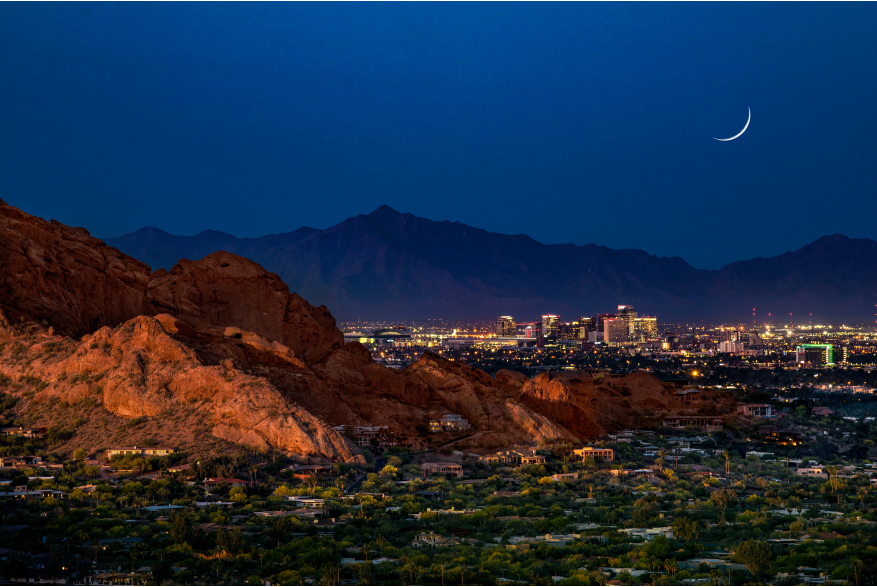
On March 13, 1997, people across Arizona and parts of Nevada reported unusual lights moving through the night sky.
The case became known as the Phoenix Lights.
But the name can be misleading.
The Phoenix Lights were not one clean event.
They were likely at least two separate events that became fused together in public memory.
The first involved a moving V-shaped or chevron-like formation reported across a wide path, beginning near Henderson, Nevada, then continuing through northern and central Arizona toward the Phoenix area.
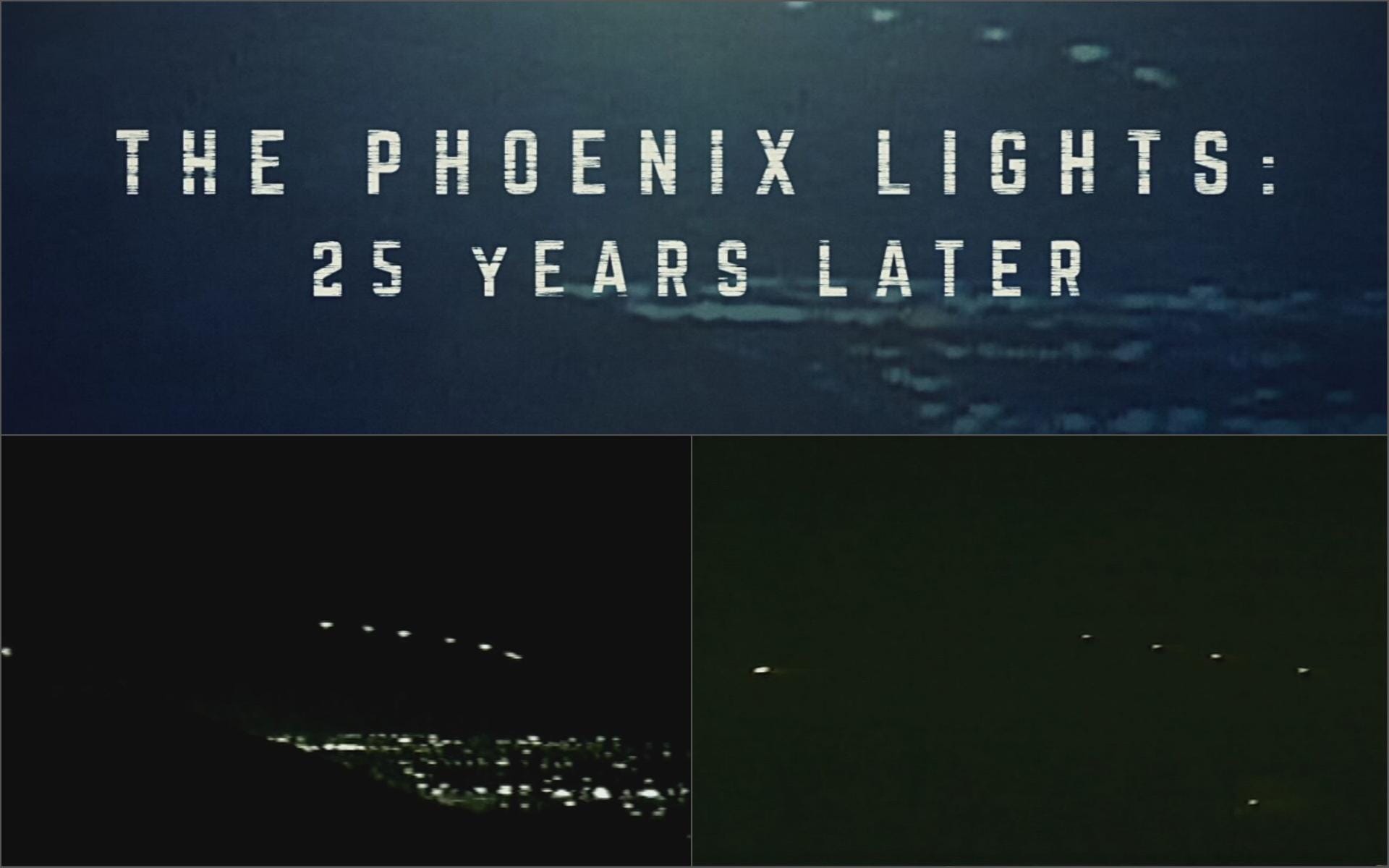
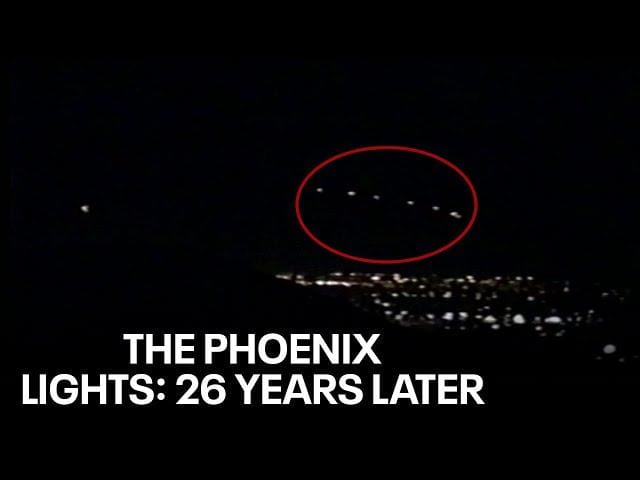
The second involved a row of bright, near-stationary lights seen later over the Phoenix area, especially toward the southwest, near the Estrella Mountains. This second event was widely filmed and is the visual most people associate with the Phoenix Lights.
The later lights have a strong conventional explanation: military illumination flares dropped by Air National Guard A-10 aircraft during training over the Barry M. Goldwater Range.
The earlier moving formation remains more debated.
Some witnesses described separate lights moving in formation.
Others described a single massive, silent, dark object blocking out stars as it passed overhead.
That is where the case becomes difficult.
The Phoenix Lights do not prove extraterrestrial visitation.
They do not prove a secret aircraft.
They do not prove that a city-sized object crossed Arizona.
But the case remains important because it shows how witness testimony, military activity, public confusion, media coverage, and official response can collide into one of the most enduring UAP stories in American history.
It is not a clean mystery.
It is a layered one.
And the layers matter.

What Actually Happened
The sightings occurred on the evening of March 13, 1997.
Reports began around 7:55 p.m. near Henderson, Nevada, where a witness described a large V-shaped object moving southeast.
Additional reports followed across Arizona.
In northern Arizona, witnesses near Paulden, Chino Valley, Prescott, and Prescott Valley described lights moving across the sky. Some saw a formation. Some described a structured object. Some reported silence. Some said it was large enough to block out the stars.
By roughly 8:30 p.m., similar reports were being made around the Phoenix metropolitan area.
Families, pilots, drivers, and residents saw lights or a V-shaped pattern moving across the sky. Some witnesses later said the object passed directly overhead. Others saw lights from a distance and interpreted them as part of a larger structure.
Then, later that night, around 10:00 p.m., a separate set of lights appeared over the Phoenix area.
These lights were bright, orange-white, and appeared to hover in a line over the horizon. They were filmed by multiple people and became the most famous visual record of the event.
Those later lights were eventually linked to military flare drops.
Maryland Air National Guard A-10 aircraft, operating in Arizona as part of winter training, were reported to have dropped high-intensity illumination flares over the Barry M. Goldwater Range southwest of Phoenix. The flares descended slowly by parachute and appeared to hang in the sky before disappearing, likely as they burned out or dropped behind the mountain line.
This explanation fits the later footage better than it fits the earlier moving V-shaped reports.
That distinction is the heart of the case.
The Phoenix Lights are often treated as one massive sighting.
But the record is cleaner when separated:
- Earlier event: a moving V-shaped formation or object reported across Nevada and Arizona.
- Later event: stationary or slowly descending lights over Phoenix, likely military flares.
The second event has a strong explanation.
The first event remains the more interesting question.
Key Claims and Evidence
The Phoenix Lights case rests on witness testimony, videos, photographs, media coverage, military explanations, and later analysis.
Each layer has to be handled separately.
What Is Documented
Several things can be stated carefully:
- A large number of people reported unusual lights over Arizona on March 13, 1997.
- Reports came from multiple locations across a wide geographic path.
- The sightings occurred across several hours.
- A later set of lights over Phoenix was filmed by multiple witnesses.
- Military officials later stated that Air National Guard A-10 aircraft dropped illumination flares over the Barry M. Goldwater Range that night.
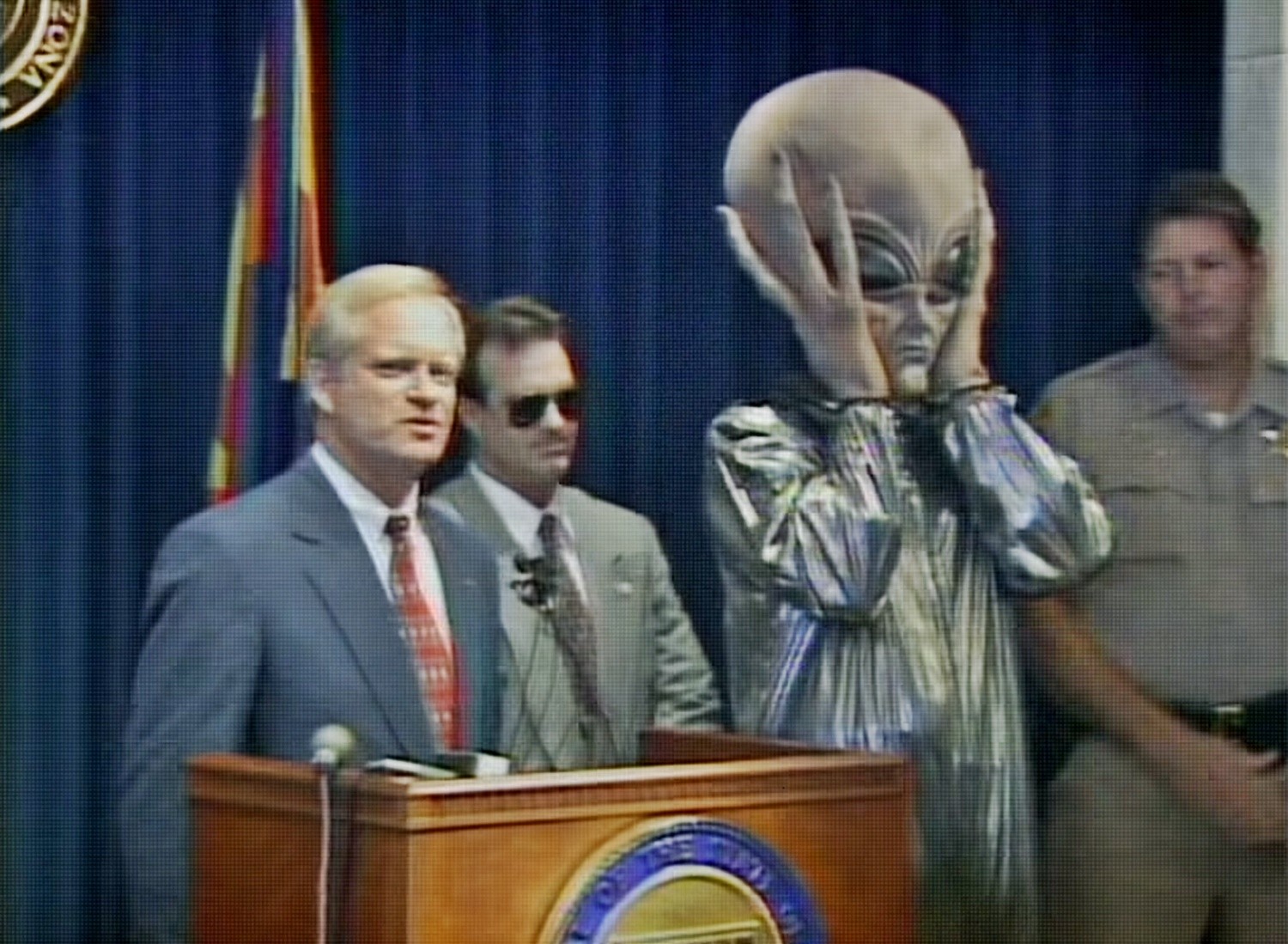
- Former Arizona governor Fife Symington initially mocked the situation during a press event, then later said he had personally seen something that did not look like flares.
- The incident became one of the most famous UFO cases in American public memory.
Witness Claims
Witnesses described several different things.
The most common claims include:
- a V-shaped or boomerang-shaped formation;
- lights arranged in a wide chevron pattern;
- slow, steady movement;
- little or no sound;
- a dark mass or structure behind the lights;
- stars allegedly disappearing behind the object;
- a later line of bright lights hanging over Phoenix;
- lights vanishing one by one.
The strongest witness claims concern the earlier moving formation.
The strongest video evidence concerns the later stationary lights.
This creates a key tension.
The best footage appears to show the part of the case most easily explained by flares.
The strangest testimony concerns the part of the case with weaker physical documentation.
Video and Photographic Evidence
The most circulated Phoenix Lights videos show a row of lights over the Phoenix area around 10:00 p.m.
These videos are real in the basic sense that they show lights in the sky.
But they do not prove a structured craft.
Skeptical analyses argue that the lights match flare behavior: bright illumination points descending slowly over a distant military range, appearing stationary because of distance and perspective, then disappearing as they burn out or drop behind terrain.
The earlier V-shaped object is less well documented visually.
That matters.
The case’s most extraordinary claims are not matched by equally strong footage.
Military Explanation
The later flare explanation is one of the most important conventional elements in the case.
Military officials said visiting Maryland Air National Guard A-10 aircraft were training over the Barry M. Goldwater Range and dropping high-intensity flares. Those flares would have been visible from parts of the Phoenix area under the right conditions.
This explanation does not solve every Phoenix Lights report.
It does address the later, widely filmed lights over the southwest Valley.
That distinction is essential.
The Fife Symington Layer
Fife Symington was Arizona’s governor at the time.
In 1997, he famously held a press conference where his office mocked the UFO panic by presenting a staff member in an alien costume.
Years later, Symington said he had seen the lights himself and described the object as something large, structured, and not like any aircraft he recognized.
His later statement gave the case renewed attention.
But it remains eyewitness testimony.
Important, but not proof.
A former governor saying he saw something unusual matters.
It does not settle what the object was.
Credibility Meter
Witness Reliability: 4 / 5
The witness layer is unusually strong because of the number of reports, geographic spread, and diversity of observers. The case included ordinary residents, families, pilots, and later public figures who said they saw something unusual.
The score does not reach 5 because witness accounts varied, many observations occurred at night, and some later interpretations may have been influenced by media coverage and public discussion.
Physical Evidence: 2 / 5
There are videos and photographs of the later lights, but they do not clearly show a solid object. The most famous footage is strongly associated with the flare explanation.
There is no recovered material, no confirmed landing trace, no radar record in the public domain that resolves the case, and no verified high-resolution image of the earlier V-shaped formation.
Documentation: 3 / 5
The case is well documented in media coverage, witness reports, videos, and later analyses. The military flare explanation provides a documented conventional anchor for the later event.
The score does not go higher because there is no complete public investigative file that synchronizes all sightings, flight activity, flare drops, witness bearings, video locations, and timelines into one definitive reconstruction.
Expert Analysis: 3 / 5
Skeptical analysis explains the later lights well and offers aircraft-formation explanations for the earlier V-shaped reports. UFO researchers and witnesses argue that the earlier formation remains insufficiently explained.
The expert-analysis score remains moderate because the case is partly explained, partly debated, and still affected by conflation between the two events.
Overall Interpretation:
The Phoenix Lights are credible as a large-scale witness event and credible as a documented cultural incident.
They are not strong as physical proof of an unknown craft.
The later lights are well explained as flares.
The earlier moving formation remains the unresolved core.
Points of Tension
The Phoenix Lights case becomes difficult because the explanation is both strong and incomplete.
The Case Is Often Treated as One Event, But It Was Likely Two
This is the most important point.
The later lights over Phoenix have a strong flare explanation.
But the earlier moving V-shaped formation was reported before the flare event and across a wider path.
When the two are merged into one event, analysis becomes muddy.
Skeptics can point to flares and say the case is solved.
Believers can point to the earlier V-shaped reports and say the flare explanation misses the real event.
Both sides are partly reacting to different parts of the same night.
The first tension is not in the sky.
It is in the timeline.
The Best Footage May Show the Most Explainable Part
Most people associate the Phoenix Lights with video of bright lights hanging over the city.
That footage is compelling.
But it likely shows the later flare event.
The earlier moving formation, the part witnesses described as a massive object, is not supported by equally strong video evidence.
That creates a difficult imbalance:
- the strongest visual evidence is likely conventional;
- the strangest witness testimony is visually weak.
That does not dismiss the earlier reports.
It shows why the case remains unresolved.
Witnesses Described Structure, Not Just Lights
Some witnesses did not merely report lights in the sky.
They described a dark shape connecting the lights.
Some said it blocked out stars.
Some described it as huge, silent, and moving slowly overhead.
If those observations were accurate, a simple formation of aircraft would not fully explain them.
But there is a known problem.
At night, the human brain can connect separate lights into a single object. This is especially true when the lights move in stable formation. The mind fills in structure between points.
That means the same experience can be interpreted two ways:
A giant craft with lights on its underside.
Or separate aircraft lights perceived as one structure.
The case turns on that difference.
Silence Is Difficult, But Not Decisive
Many witnesses emphasized that the object was silent.
That matters because a huge low-flying aircraft should produce sound.
But sound is not always reliable.
Wind, distance, altitude, terrain, city noise, and observer position can all affect what people hear.
If the formation was much higher or farther away than some witnesses believed, silence becomes less unusual.
If the object truly passed low overhead, silence becomes harder to explain.
The problem is that witness estimates of altitude and size are notoriously fragile at night.
Without reliable distance, there is no reliable size.
Without reliable size, there is no reliable performance.
The Governor’s Later Statement Keeps the Case Alive
Symington’s later admission that he saw something unusual gives the case a powerful public witness.
But it also introduces a timing problem.
He did not say this publicly in the same way at the time.
He first responded through humor and public deflection.
Years later, he changed the public meaning of his role.
That does not make him dishonest.
It does mean his testimony belongs in the witness category, not the proof category.
The Flare Explanation Explains a Lot, But Not Everything
The later event fits flares well.
The lights appeared near the direction of a military range.
They looked like bright points hanging in the sky.
They disappeared one by one.
Military officials later connected them to A-10 flare drops.
But the flare explanation does not fully address the earlier reports of a moving V-shaped formation crossing Arizona before the 10:00 p.m. footage.
This is the central unresolved tension:
The Phoenix Lights are partly explained.
But a partly explained case is not the same as a fully closed file.
Perspectives and Explanations
Military Flares
The strongest conventional explanation applies to the later lights over Phoenix.
Illumination flares dropped from A-10 aircraft can appear as bright, suspended lights from a distance. If dropped over the Barry M. Goldwater Range, they could appear low over the southwest horizon when viewed from Phoenix.
As they descend by parachute, they can seem stationary.
As they burn out or pass behind mountains, they can vanish one by one.
This explanation fits the later videos well.
Its limitation is that it does not fully account for earlier moving V-shaped reports across Nevada and northern Arizona.
Aircraft Flying in Formation
Another explanation is that the earlier V-shaped formation was a group of aircraft.
This could explain several features:
- lights moving in a steady formation;
- a wide V or chevron shape;
- silence if the aircraft were high or distant;
- witnesses interpreting separate lights as one object;
- no clear radar panic or crash response;
- the path toward Tucson or military training routes.
This is a plausible explanation.
But it depends on the assumption that witnesses misjudged distance, altitude, and structure.
For some reports, that may be enough.
For the closest and most dramatic witness claims, it remains debated.
Perception and Night-Sky Interpretation
The Phoenix Lights are a strong example of how human perception can struggle at night.
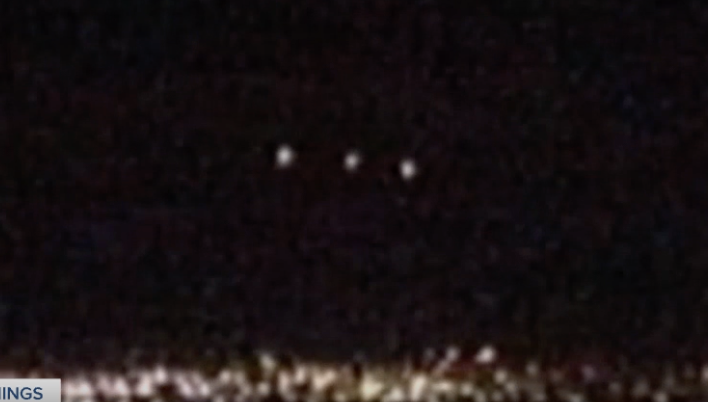
When there is no visible horizon, no clear distance marker, and only points of light, the brain tries to construct form.
A few lights can become a triangle.
A formation can become a craft.
A distant flare can become a hovering object.
A slow descent can appear motionless.
This does not mean witnesses lied.
It means perception is not a camera.
The question is whether perception explains all of the testimony or only some of it.
Secret Military Aircraft
Some have suggested the early V-shaped formation may have been a classified military platform.
This explanation has appeal because Arizona has deep military aerospace connections, including training ranges, air bases, and desert test corridors.
A classified aircraft could explain a large object, low observability, and official ambiguity.
But there is no publicly confirmed aircraft that cleanly matches the reported size, silence, and behavior.
Secret technology remains possible.
It is not established.
A Genuine Unknown
The most open-ended interpretation is that at least part of the earlier event involved a genuine unknown.
This does not automatically mean extraterrestrial.
Unknown could mean unidentified aircraft, classified technology, unusual formation behavior, misperceived conventional activity, or something outside public categories.
The responsible position is narrow:
The later flare event is strongly explained.
The earlier moving formation is less settled.
That is where the unknown remains.
Context and Pattern Recognition
The Phoenix Lights belong to a wider pattern of mass sightings involving lights, formations, and public confusion.
Several features are familiar:
- sightings occur at night;
- witnesses see lights rather than clear structures;
- reports spread quickly;
- media coverage amplifies attention;
- officials respond slowly or awkwardly;
- a conventional explanation addresses part of the case;
- witnesses feel the explanation does not match what they experienced;
- the event becomes cultural memory.
The case also belongs to the “black triangle” tradition of UAP reports.
These often involve large dark objects, edge lights, low speed, silence, and a sense of massive scale.
The Phoenix Lights became one of the most famous American examples of that pattern.
But Phoenix also shows why these cases are so difficult.
A dark object is hard to prove when only its lights are visible.
A formation can create the illusion of structure.
A military exercise can create real lights that look strange.
A witness can be sincere and still misjudge distance.
A government explanation can be partly true and still feel incomplete.
Phoenix sits at the intersection of perception, military airspace, media, and memory.
That is why it endures.
Not because the evidence is clean.
Because the evidence is messy in a way that still matters.
Implications: Reality Check
If the Phoenix Lights were entirely explained by aircraft and flares, the case still matters.
It would show how military activity, viewed without context by large numbers of people, can generate a major national UFO event.
That has real implications for public communication, airspace transparency, and how institutions respond when thousands of people report the unusual.
If the earlier V-shaped formation was a group of aircraft, the case becomes a study in perception.
It shows how lights moving in formation can become a perceived structure.
That does not make the witnesses foolish.
It makes the human mind powerful.
We do not only see light.
We infer shape.
If the earlier event involved a classified platform, then Phoenix becomes a secrecy case.
A large silent craft moving over populated areas would raise questions about testing, oversight, and why the public was left with only partial answers.
If the earlier event involved a genuine unknown, then the implications widen.
Something large, silent, and visible to many people crossed the American Southwest without leaving behind a clean public record.
That would not prove non-human intelligence.
But it would raise serious questions about what can pass through public airspace without being clearly identified.
The deeper implication is this:
Reality does not always become clearer when more people witness it.
Sometimes mass witnessing creates more uncertainty.
More angles.
More emotion.
More memory.
More contradiction.
More myth.
The Phoenix Lights show how an event can be seen by many people and still remain unstable.
The Unresolved Ledger
What Is Documented
- On March 13, 1997, many people reported unusual lights across Arizona and parts of Nevada.
- Reports occurred across several hours.
- The case involved at least two major sighting clusters: an earlier moving V-shaped formation and a later row of lights over Phoenix.
- The later lights were widely filmed.
- Military officials later said Air National Guard aircraft dropped illumination flares over the Barry M. Goldwater Range.
- Media coverage turned the event into a major public story.
- Fife Symington’s office publicly mocked the sightings in 1997 with an alien-costume press event.
- Symington later said he personally witnessed something unusual that night.
What Is Claimed
- Witnesses claimed to see a huge V-shaped or boomerang-shaped object.
- Some claimed the object was silent.
- Some claimed it blocked out stars.
- Some described the object as massive, structured, and moving slowly overhead.
- Supporters claim the flare explanation only addresses the later lights, not the earlier formation.
- Skeptics claim the earlier formation can be explained by aircraft flying in formation.
- Some believe the event involved secret military technology or a non-human craft, but those interpretations remain speculative.
What Remains Unresolved
- What exactly caused the earlier moving V-shaped reports?
- Were witnesses seeing separate aircraft lights or a single structured object?
- How much did nighttime perception cause people to connect lights into a solid craft?
- Were the earlier and later events connected, or only fused together afterward?
- Why did some witnesses describe a dark mass if only aircraft lights were present?
- Why did the official explanation arrive slowly enough for mistrust to take root?
- Can all of the strongest early reports be explained by aircraft formation alone?
The central unresolved tension is this:
The Phoenix Lights are partly explained by flares, but the earlier moving formation remains less securely resolved in the public record.
Why It Still Matters
The Phoenix Lights matter because they show how difficult it is to separate signal from narrative.
A real military exercise happened.
Real witnesses saw strange lights.
Real videos were recorded.
A real public panic formed.
A real explanation covered part of the case.
And still, something remained unsettled.
The case matters because it asks how we should treat a mass sighting when the explanation fits some evidence better than others.
It also reveals something about institutions.
When the public sees something strange and official answers come late, incomplete, or dismissive, the mystery grows.
Phoenix became more than a sighting.
It became a trust problem.
The Galactic Mind Perspective
The Phoenix Lights are not best understood as a single question.
They are a layered file.
One layer is likely military flares.
Another layer may be aircraft formation.
Another layer is witness interpretation.
Another layer is public memory.
Another layer is mistrust.
Another layer remains unresolved.
The mistake is forcing the case into one box.
Believers often treat every light as part of one enormous craft.
Skeptics often treat the flare explanation as if it closes the entire night.
The record suggests something more complicated.
Some of the mystery may be solved.
Some of it may be psychological.
Some of it may be military.
Some of it may be cultural.
And perhaps a small part of it still does not fully sit inside the available explanation.
That is where The Archivist pauses.
Not to declare proof.
Not to dismiss the witnesses.
But to separate the file carefully.
The value of this case is not that it proves the impossible.
The value is that it shows how ordinary explanations can be strong, and still not fully absorb the human record.
A Case File is not a verdict.
It is a record of tension.
And the Phoenix Lights remain one of the clearest examples of modern American sky mystery: many witnesses, partial explanation, enduring doubt, and a night that still refuses to become only one thing.
Open Question
If the Phoenix Lights were a mixture of military flares, aircraft formation, witness perception, and something still unresolved, what remains after we separate the explained from the unknown?
What do you think? Drop your thoughts in the comments ...
Sources / Receipts
- Skeptical Inquirer: analysis separating the Phoenix Lights into two incidents and connecting them to Operation Snowbird
- Deseret News: 1997 report that Maryland Air National Guard A-10s dropped high-intensity flares over a bombing range near Phoenix
- Axios Phoenix: 2024 retrospective distinguishing the V-shaped reports from the later lights and noting the Maryland Air National Guard flare explanation
- Phoenix New Times: oral history on the Phoenix Lights, including witness recollections, the two-event structure, and cultural aftermath
- ABC News: later mainstream recap noting high-intensity flares as the explanation for the filmed 1997 lights
- Fife Symington later public statements about witnessing something unusual
- National UFO Reporting Center reports and summaries, used as witness-report context rather than verified proof
- Local Arizona media coverage and retrospective reporting on the incident


Discussion