
Case Overview: The Event
In April 2015, three small exposure panels carrying dried bacterial samples left Earth aboard SpaceX CRS-6. The panels were installed on the Japanese Experiment Module Kibo, then moved through an airlock to an external platform on the International Space Station. For the next three years, the samples remained outside the station in low-Earth orbit, subjected to vacuum, ultraviolet radiation, ionizing radiation, desiccation, and repeated temperature changes.
The bacteria were not ordinary laboratory microbes. The experiment used species of Deinococcus, a genus known for exceptional resistance to radiation and dehydration. The cells were dried into pellets of different thicknesses so researchers could test an idea that had emerged from earlier ground experiments: perhaps microbes do not need a rock to cross space if enough cells travel together.
Panels were returned after approximately one, two, and three years. When the last samples reached the laboratory in August 2018, some bacteria from aggregates at least 500 micrometers thick could still form colonies. The result was direct and experimentally documented. Cells that had spent 1,126 days outside the ISS were still viable.
What the result means is less simple. Tanpopo established that particular dried bacterial aggregates can survive a multiyear exposure in a controlled low-Earth-orbit experiment. It did not demonstrate that living cells have traveled naturally from one planet to another, that such aggregates can escape a planet, or that life on Earth arrived from elsewhere.
The experiment opened a route through one part of the panspermia problem. It did not complete the journey.
What Actually Happened
Tanpopo—Japanese for “dandelion”—was the first Japanese astrobiology mission conducted on the ISS. The name reflected the mission’s larger question: could the seeds of life, or at least the chemistry and microorganisms associated with life, spread between worlds? The full program included the exposure of microbes and organic compounds, the capture of micrometeoroids and orbital particles in aerogel, radiation measurements, and tests of the capture hardware. The three-year bacterial survival study was one part of that wider investigation.
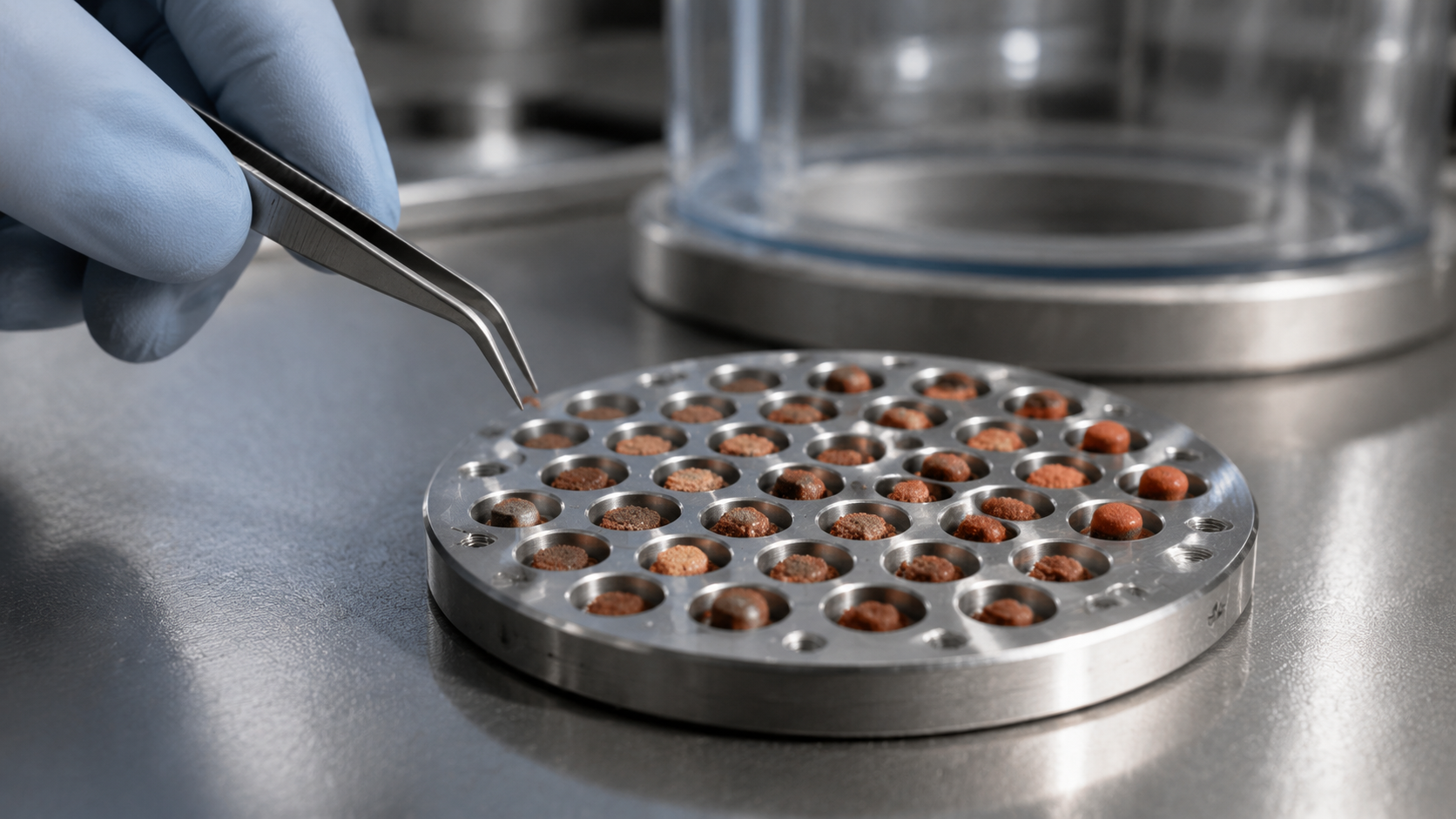
Before launch, researchers prepared dried cells of Deinococcus radiodurans R1 and Deinococcus aerius TR0125, along with several D. radiodurans strains lacking selected DNA-repair genes. The cells were deposited into two-millimeter-wide wells in aluminum plates and dried in successive layers. The finished samples represented approximate thicknesses of one, 100, 500, 1,000, and 1,500 micrometers.
The sample design separated different kinds of exposure. An upper plate sat beneath a magnesium-fluoride or quartz window and received ultraviolet light above the wavelength passed by that material. A lower plate was stacked beneath it as a dark control, exposed to other aspects of the space environment but shielded from direct UV. Matching samples were stored inside the ISS and in a ground laboratory.
The hardware launched on April 14, 2015. Astronaut Scott Kelly mounted the three Exposure Panels on the zenith-facing side of the Exposed Experiment Handrail Attachment Mechanism, known as ExHAM. After 12 days in the Kibo airlock under vacuum to reduce possible effects from material outgassing, the assembly was positioned outside the station by robotic arm.
The schedule gave the experiment its unusual strength:
| Exposure set | Time outside the ISS | Return to Earth |
|---|---|---|
| First panel | 384 days | August 2016 |
| Second panel | 769 days total | September 2017 |
| Third panel | 1,126 days total | August 2018 |
Because comparable samples were retrieved at three intervals from the same orbital setting, the team could observe survival over time instead of relying on a single endpoint. The samples were also accompanied by ultraviolet and ionizing-radiation dosimeters, allowing the researchers to relate biological survival to the environment the panels actually experienced.
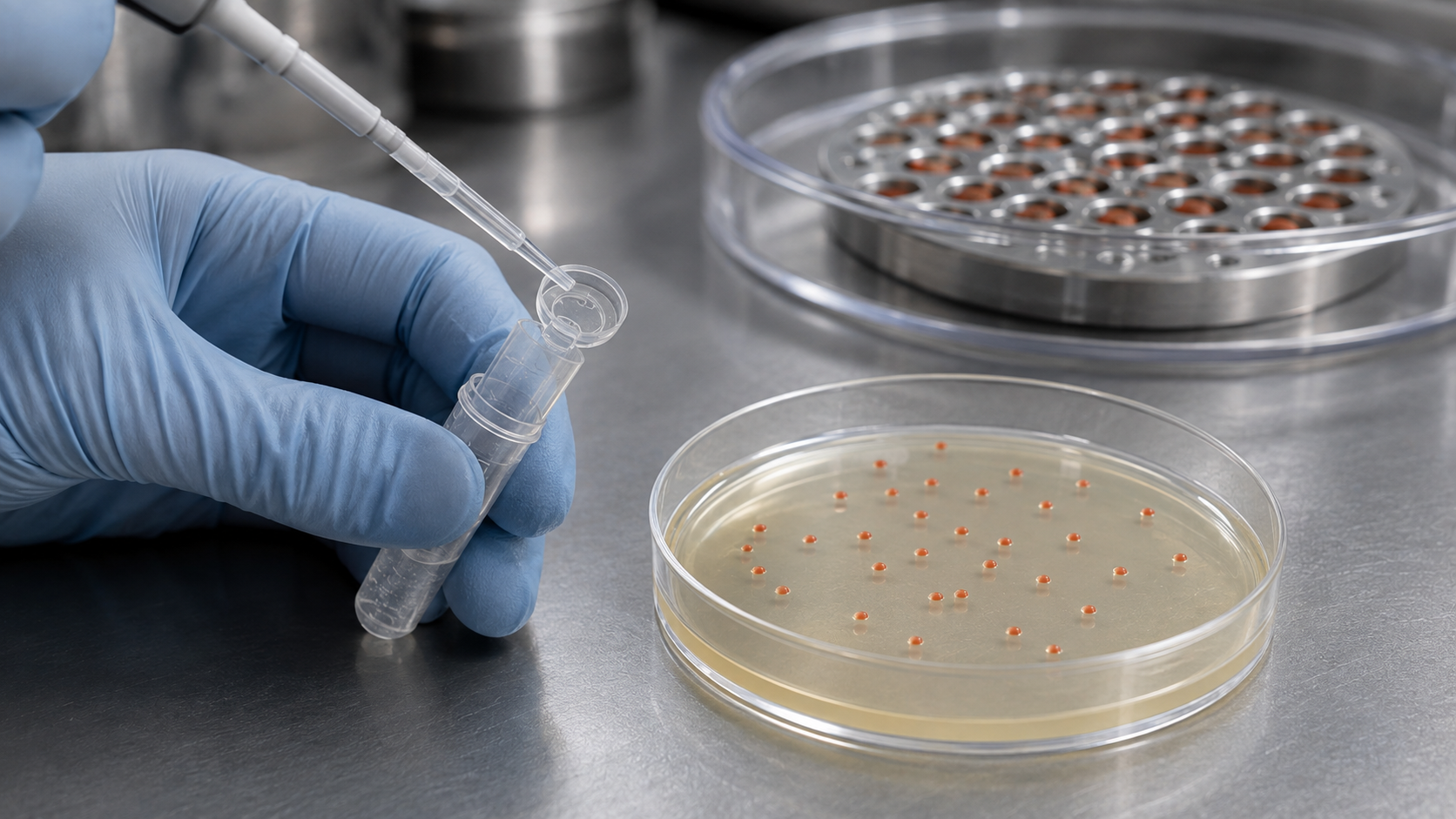
Back on Earth, the dried pellets were resuspended in sterile buffer. The researchers diluted the recovered material, placed it on growth medium, and counted the colonies that appeared. This is the operational meaning of “survived” in the study: at least some exposed cells remained capable of resuming growth and reproduction when returned to suitable laboratory conditions.
The team also measured intact portions of bacterial DNA, examined large-scale DNA fragmentation, and compared normal D. radiodurans with repair-deficient mutants. The experiment therefore did more than ask whether any cells grew. It investigated why survival changed with aggregate thickness and which forms of damage the returning bacteria had to repair.
Key Claims and Evidence
Viable bacteria remained after three years
The central claim is well supported. After 1,126 days outside the ISS, viable Deinococcus cells were recovered from sufficiently thick dried pellets. Colony formation provided direct evidence that exposure had not killed every cell in those samples.
Thickness mattered. In the three-year UV-exposed samples, the thinnest layers performed poorly. No surviving cells were detected in the approximately single-cell layers of D. radiodurans, while 100-micrometer pellets showed low survival. Pellets 500 micrometers thick or greater produced survival broadly similar to the corresponding ground controls.
The second species showed a stricter threshold. UV-exposed D. aerius pellets 100 micrometers thick produced no detected survivors, 500-micrometer pellets showed low survival, and pellets 1,000 micrometers thick or greater approached the survival of ground controls. The difference was consistent with earlier measurements showing that dried D. radiodurans layers attenuated damaging ultraviolet light more efficiently than dried D. aerius layers.
The result was therefore not that “bacteria can survive space” without qualification. It was that particular radiation-resistant bacteria, dried and arranged in sufficiently thick aggregates inside experimental hardware, retained viable cells after three years in low-Earth orbit.
The aggregates acted as their own shield
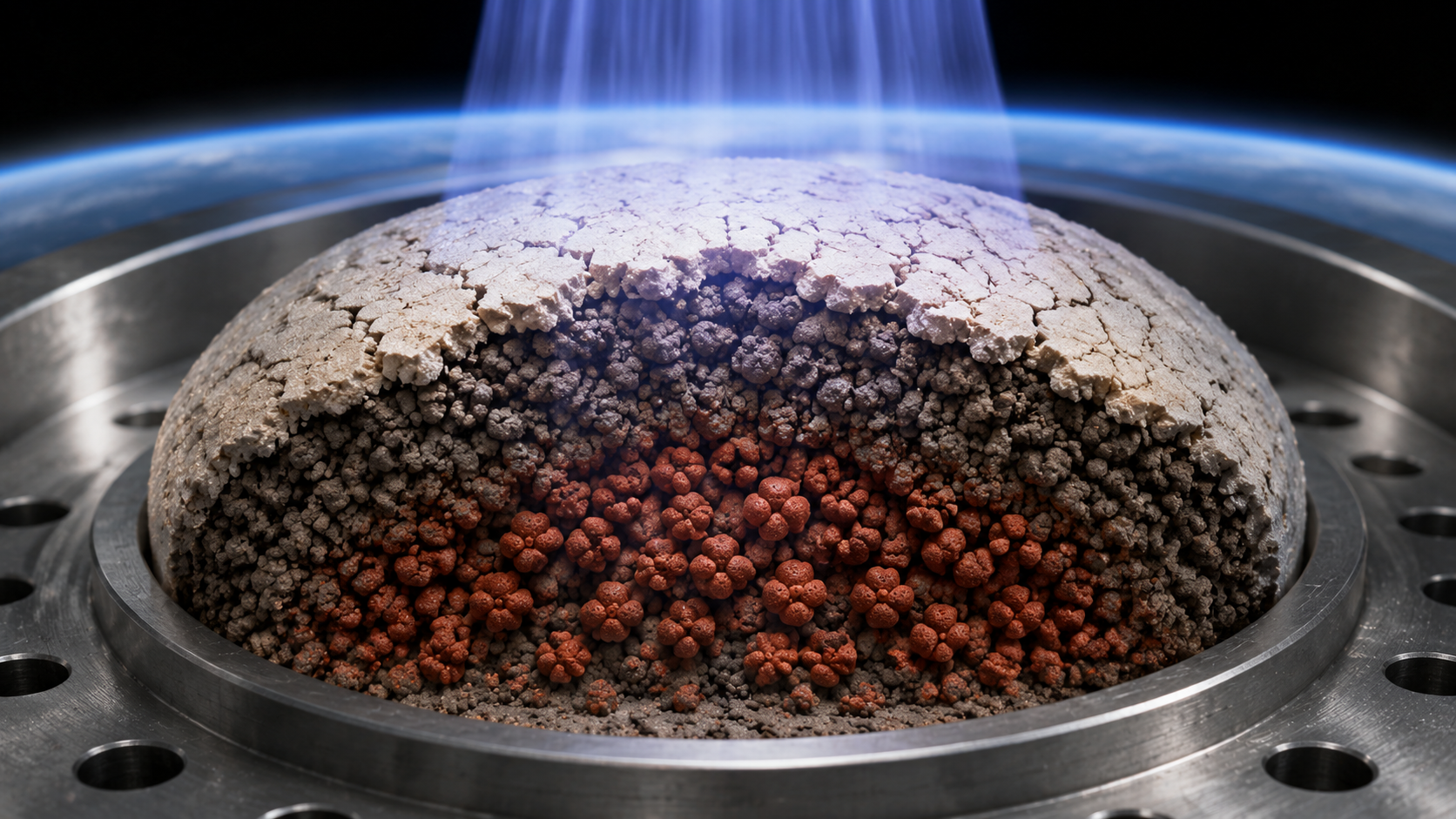
The most important mechanism was collective rather than individual. Ultraviolet radiation damaged or killed cells near the exposed surface. Those outer layers absorbed enough of the incoming radiation to reduce the dose reaching cells below them. The exposed face of the pellets became slightly discolored, while the middle and lower portions showed no comparable visible change.
Survival and DNA-damage measurements supported this interpretation. In D. radiodurans, the 100-micrometer pellets accumulated much greater damage in a tested segment of the rpoB gene than the 500- and 1,000-micrometer pellets. The thicker samples performed similarly to one another, suggesting that once enough cellular material existed above the protected region, adding more depth produced less dramatic improvement.
This was not an active shield constructed in space. The bacteria were dried and dormant during exposure. The protection emerged from geometry and sacrifice: cells on the outside absorbed lethal damage, leaving some cells deeper in the aggregate intact enough to recover.
Survival also depended on repair after return
Shielding did not keep every surviving cell undamaged. Analysis of repair-deficient strains indicated that short-wavelength UV created lesions normally handled by nucleotide-excision and UV-damage-excision pathways involving the uvrA and uvdE genes. Separate DNA analysis found additional double-strand breaks in space-exposed material.
The surviving bacteria therefore did not return untouched. Their resilience combined physical protection within the aggregate with the extraordinary capacity of D. radiodurans to repair damaged genetic material once favorable conditions were restored. A related one-year Tanpopo analysis found elevated molecular responses associated with DNA repair, oxidative stress, transport, and recovery after the cells were rehydrated.
The distinction matters. Tanpopo was not simply a test of how hard it is to kill one cell. It tested whether a damaged population could preserve enough living members—and enough working repair machinery—to resume biological activity later.
The experiment supports a possible “massapanspermia” stage
Before the flight, members of the Tanpopo team proposed the term massapanspermia for interplanetary transfer by a mass of aggregated cells. Unlike lithopanspermia, which places microorganisms inside shielding rock, the proposed ark is the microbial clump itself.
Tanpopo directly supports one component of that idea: aggregated cells can provide meaningful UV protection during multiyear orbital exposure. Using the one-, two-, and three-year survival curves, the researchers estimated that a roughly one-millimeter aggregate could endure approximately two to eight years under an adjusted interplanetary UV exposure. That range was an extrapolation from the measured decay curves and the amount of sunlight the ISS-mounted panels actually received.
The two-to-eight-year figure was not a second experiment. No pellet was released from the ISS and followed through interplanetary space for eight years. It was a model derived from the observed low-Earth-orbit data.
Points of Tension
“Outside the ISS” is not the same as unprotected interplanetary space
The samples encountered real vacuum, radiation, temperature cycling, and ultraviolet exposure. But they remained attached to a large spacecraft in low-Earth orbit, inside Earth’s magnetic environment and beneath material windows and mesh. The ISS also entered Earth’s shadow roughly every 90 minutes and the panels were sometimes shaded by the station or its solar arrays. The team measured only about 41 to 63 equivalent interplanetary solar days of relevant UV exposure per year, depending on the window.
The experimenters adjusted for that lower illumination when calculating the two-to-eight-year estimate. Even so, a mathematical correction cannot recreate every condition of a small object rotating freely between planets. The authors explicitly noted that a future exposure beyond the Van Allen belts would provide a better estimate.
The geometry favored survival
On the ISS, ultraviolet light reached the pellets mainly from one direction. A real aggregate tumbling through space could be illuminated from changing directions. The authors accounted for this conceptually by arguing that an all-sided exposure would require roughly twice the protective depth, leading to their estimate that an aggregate about one millimeter across could protect its center.
That remains a reasoned inference, not a tested flight configuration. The actual pellets sat in two-millimeter aluminum wells with a dark side and surrounding hardware. Tanpopo demonstrated self-shielding under that arrangement; it did not release free, rotating microbial clumps into space.
Transit is only the middle of the journey
Natural panspermia requires several successful stages. Microbes must be lifted or blasted away from their original world, survive the acceleration, shock, heating, and radiation associated with ejection, persist during transit, encounter another planetary body, survive atmospheric entry or impact, and reach an environment where recovery and reproduction are possible.
Tanpopo tested none of those transitions as one continuous process. The bacteria were cultured on Earth, deliberately dried, transported safely to orbit inside a spacecraft, installed in purpose-built wells, recovered by another spacecraft, and revived in nutrient-rich laboratory media. The study addressed survival during a selected exposure stage. It did not demonstrate a natural route from one biosphere to another.
The shortest trip is not the typical trip
The paper notes that rare fragments traveling between Earth and Mars may make the crossing in months or a few years, while many transfer trajectories take vastly longer. The estimated endurance of a naked cell aggregate overlaps only the unusually short end of that range. Rock shielding could extend survival, but that returns the discussion toward lithopanspermia rather than an aggregate traveling alone.
This does not erase Tanpopo’s result. It defines its scale. The experiment makes a short interplanetary crossing more biologically plausible under favorable conditions. It does not show that such favorable chains occur often enough to seed worlds.
Survival does not establish origin
Panspermia is a transport hypothesis. Even if microbes can cross from one planet to another, the result does not reveal where life first began. It may relocate the origin problem without solving it.
Tanpopo also found no extraterrestrial organism in the exposed pellets. Every bacterium in the survival study came from Earth. The experiment tested the durability of known terrestrial life, not the existence of life elsewhere.
Perspectives and Explanations
The narrow scientific interpretation
The strongest current interpretation is also the least dramatic: Tanpopo was a successful low-Earth-orbit survival experiment. It showed that aggregate thickness substantially changes the survival of dried Deinococcus under a defined set of space conditions. It also produced evidence for surface-layer UV shielding and for repair processes involved in recovery.
This explanation accounts for the data without requiring natural panspermia to have occurred. It treats the experiment as a measured biological result with implications that remain conditional.
Massapanspermia as a viable mechanism
The Tanpopo team’s broader interpretation is that cell aggregates could function as a small biological ark. The mechanism has two advantages: colonies can naturally reach millimeter scales, and the dead exterior can shield the living interior without requiring a rock.
Tanpopo gives this concept experimental support during the exposure phase. Its weakness lies outside the apparatus. The natural production, ejection, persistence, trajectory, arrival, and successful colonization of such aggregates remain unobserved as a complete chain.
Lithopanspermia remains the more shielded route
The conventional panspermia model often places microorganisms inside rock ejected by an impact. Rock can shield microbes from ultraviolet and some radiation for much longer periods than an unprotected cell mass. Meteorites from Mars demonstrate that solid material can move naturally between planets, although their arrival does not demonstrate that they carried viable organisms.
Tanpopo does not displace lithopanspermia. It tests whether a much smaller and less protected vehicle might sometimes suffice for a rapid crossing.
Planetary protection is the immediate practical implication
The findings also point toward a less romantic consequence. If robust terrestrial microbes can endure prolonged exposure on spacecraft surfaces or in protected clusters, missions to Mars and other potentially habitable environments carry a real contamination concern. Forward contamination could complicate future life-detection experiments by moving Earth organisms or biological signatures into environments scientists hope to study.
In this frame, Tanpopo is not evidence that alien life reached Earth. It is evidence that Earth life may be harder to keep on Earth than mission planners would prefer.
Context and Pattern Recognition
Tanpopo belongs to a longer history of exposing organisms beyond the atmosphere. Earlier missions had already shown that spores, lichens, fungi, seeds, and other resistant biological material could survive selected space conditions, especially when shielded from direct solar ultraviolet radiation. Experiments involving multilayers of Bacillus subtilis spores also demonstrated that a population could survive where a single layer did not.
Tanpopo’s contribution was not the first discovery that biology can persist in space. Its distinctive value came from varying aggregate thickness and retrieving comparable panels after one, two, and three years. That made it possible to connect survival to both time and physical depth, then test the resulting pattern against DNA damage and repair.
The experiment also shifts the image of a biological traveler. Popular panspermia often imagines a microbe sealed inside a meteorite like a passenger inside a capsule. Tanpopo examined something more minimal: a colony protecting itself through its own accumulated matter. The boundary between organism and vehicle becomes less clear. The ark is not separate from the passengers.
That pattern already exists on Earth. Biofilms, colonies, spores, and microbial communities often tolerate hazards better than isolated cells because structure changes exposure. Tanpopo extended that principle into orbit. Survival was not only a property of the species. It was a property of the arrangement.
Implications: Reality Check
If microbial aggregates can occasionally escape a world and make a short crossing, neighboring planets may not be biologically independent. Early Earth and early Mars could have exchanged material during periods when both were more habitable. Discovering similar life on Mars would then raise a difficult question: would it represent a second genesis, or distant relatives transported between planets?
That possibility changes how astrobiology interprets future evidence. Shared biochemistry would not automatically prove that life arises easily in the universe. It might instead reveal one origin spreading through a connected planetary system. Conversely, a genuinely independent Martian biology would provide much stronger evidence that life can begin more than once.
Tanpopo also narrows the boundary between a living world and its technological reach. Human spacecraft already move microbes beyond Earth, intentionally or otherwise. A mechanism once discussed mainly as an ancient natural process is also a modern engineering problem. Civilization can become an agent of directed or accidental panspermia before it knows whether other worlds are sterile.
The experiment therefore matters at two scales. It makes a natural transfer mechanism less biologically implausible, while making human responsibility for contamination more immediate. Neither implication requires claiming that panspermia has already happened.
The Unresolved Ledger
What Is Documented
Tanpopo placed dried pellets of D. radiodurans, D. aerius, and selected repair-deficient D. radiodurans strains in exposure hardware outside the ISS. Comparable panels were recovered after 384, 769, and 1,126 days. When returned to the laboratory, viable cells were recovered from sufficiently thick aggregates. For three-year UV-exposed samples, D. radiodurans pellets 500 micrometers thick or greater showed survival similar to ground controls; D. aerius required greater thickness for comparable performance.
The study documented a strong relationship between aggregate thickness, DNA damage, and survival. The evidence supports UV shielding by the outer cellular layers and shows that DNA repair remained important when surviving cells resumed growth.
What Is Claimed
The researchers proposed that aggregated microbes could function as an “ark” for massapanspermia. From the measured one-, two-, and three-year survival curves, they estimated that a cell pellet about one millimeter across could survive approximately two to eight years under adjusted interplanetary UV exposure. They argued that this range could overlap the rare shortest transfer trajectories between Earth and Mars.
Those conclusions are scientifically motivated extrapolations. They are not observations of a microbial aggregate completing an interplanetary journey.
What Remains Unresolved
It remains unknown whether naked microbial aggregates are naturally ejected from a planet in viable form, how often they enter rapid transfer trajectories, whether their structure survives long free flight, and whether viable inner cells could endure arrival and establish themselves on another world. Tanpopo did not test exposure beyond Earth’s magnetic environment, uncontrolled rotation in interplanetary sunlight, atmospheric entry, impact, or recovery in a natural extraterrestrial habitat.
It also remains unresolved whether life has ever moved between Earth and Mars, whether panspermia played any role in Earth’s biological history, and whether any future extraterrestrial organism would represent an independent origin.
Why It Still Matters
Tanpopo replaced one assumption with a measured boundary. It is no longer reasonable to treat several years outside a spacecraft as automatically fatal to every unshielded microbial population. A cluster of the right organism, at the right thickness, can preserve viable cells through at least three years of orbital exposure.
The result matters because major questions are often separated into stages. Tanpopo did not prove panspermia, but it showed that one stage is less impossible than it appeared. It also demonstrated why planetary protection cannot assume that vacuum and radiation will reliably sterilize every biological passenger.
The Galactic Mind Perspective
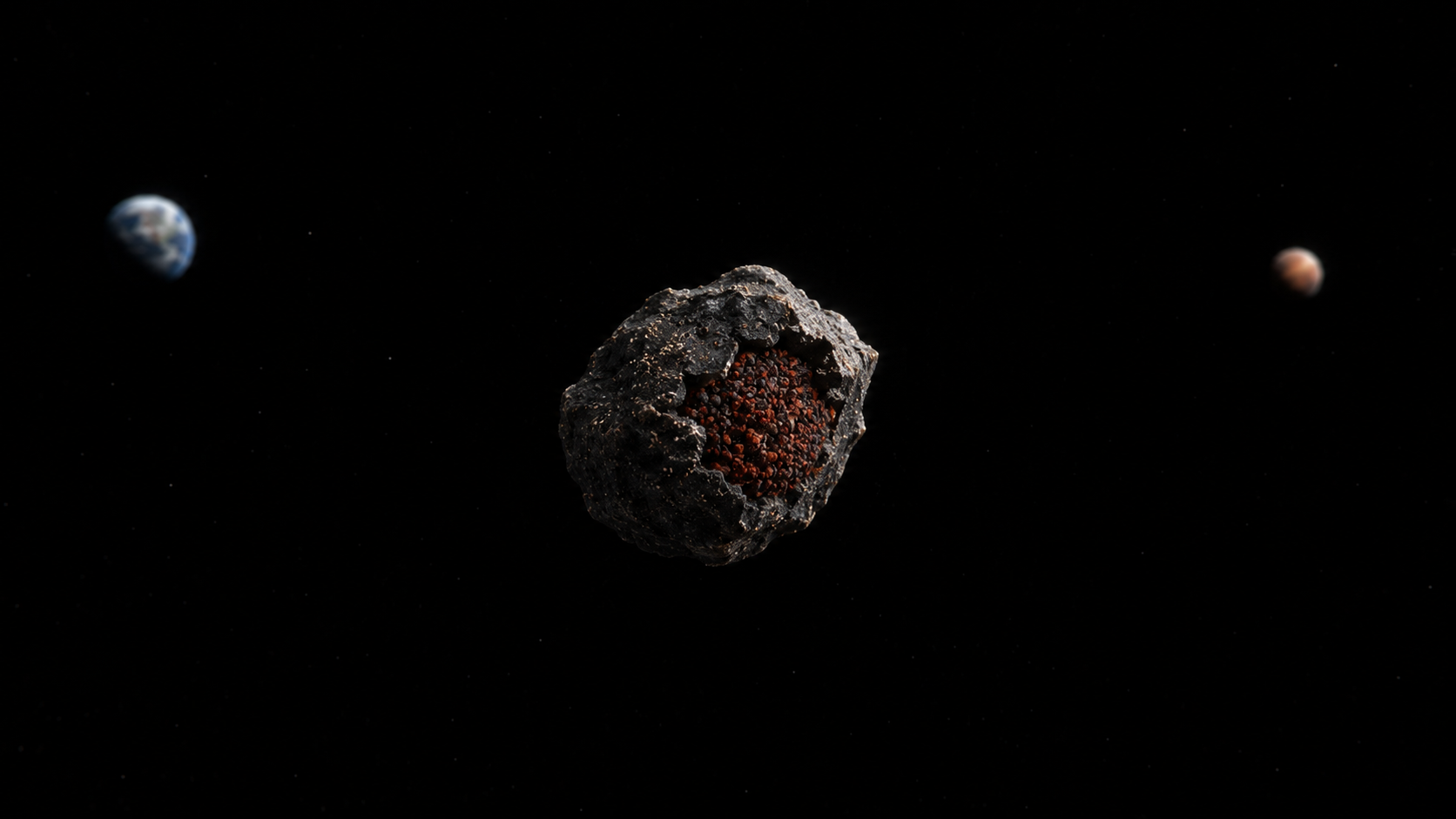
Tanpopo belongs in the archive because it reveals how a large possibility can rest on a very small piece of matter. The decisive object was not a meteorite, a spacecraft, or a fossil. It was a dried layer of cells less than a millimeter thick.
The strongest interpretation is restrained. Tanpopo demonstrated durable terrestrial biology in a controlled low-Earth-orbit experiment. The evidence does not establish that life crossed naturally between planets, and the route from ejection to colonization remains full of untested transitions. Any claim that the experiment proved panspermia moves beyond the record.
But the central result should not be minimized. The aggregate changed the outcome. An isolated cell faced the environment alone; a colony converted its outer dead layers into protection for the living interior. Survival emerged not from invulnerability, but from structure, redundancy, sacrifice, and repair.
That is the deeper reality signal. Life may not need to defeat every hostile condition. It may only need to preserve a small recoverable core until conditions change.
Tanpopo leaves the interplanetary question open, but not untouched. It does not tell us that life has crossed the space between worlds. It tells us that, under favorable conditions and for a limited time, the space between worlds may not be an absolute biological wall.
Open Question
If a millimeter-scale colony can preserve life through years outside Earth, what other barriers between worlds have we mistaken for permanent simply because we have not yet tested the right form of survival?
What do you think? Drop your thoughts in the comments ...
More in Case Files
Von Neumann Probes: The Self-Replicating Machines That Turn the Fermi Paradox Into a Clock
Tanpopo asks whether biological life can spread through space; this Case File asks whether intelligence may spread instead through self-replicating machines.
Hawking Points: Did We Find Scars From a Previous Universe?
Another investigation into the boundary between a real scientific result, a larger extrapolation, and the extraordinary claim the current evidence cannot yet establish.
USS Nimitz Tic Tac: The 2004 Navy UAP Encounter That Remains Unresolved
A different kind of case with the same evidentiary discipline: verified data can establish that something occurred without establishing its ultimate origin.
Sources / Receipts
- Yuko Kawaguchi et al., “DNA Damage and Survival Time Course of Deinococcal Cell Pellets During 3 Years of Exposure to Outer Space,” Frontiers in Microbiology 11 (August 26, 2020). Primary survival study, experimental methods, exposure dates, DNA analysis, results, and interplanetary survival estimates.
- Akihiko Yamagishi et al., “Four-Year Operation of Tanpopo: Astrobiology Exposure and Micrometeoroid Capture Experiments on the JEM Exposed Facility of the International Space Station,” Astrobiology 21, no. 12 (2021): 1461–1472. Mission hardware, panel placement, operational chronology, and environmental context.
- Akihiko Yamagishi et al., “Scientific Targets of Tanpopo: Astrobiology Exposure and Micrometeoroid Capture Experiments at the Japanese Experiment Module Exposed Facility of the International Space Station,” Astrobiology 21, no. 12 (2021): 1451–1460. Scope of the Tanpopo mission and the distinction between its panspermia, organic-chemistry, capture, and engineering objectives.
- Yuko Kawaguchi et al., “The Possible Interplanetary Transfer of Microbes: Assessing the Viability of Deinococcus spp. Under the ISS Environmental Conditions for Performing Exposure Experiments of Microbes in the Tanpopo Mission,” Origins of Life and Evolution of Biospheres 43 (2013): 411–428. Preflight simulations, aggregate-thickness hypothesis, and introduction of “massapanspermia.”
- Yuko Kawaguchi et al., “Investigation of the Interplanetary Transfer of Microbes in the Tanpopo Mission at the Exposed Facility of the International Space Station,” Astrobiology 16, no. 5 (2016): 363–376. Mission rationale and experimental design.
- Emanuel Ott et al., “Molecular Repertoire of Deinococcus radiodurans After 1 Year of Exposure Outside the International Space Station Within the Tanpopo Mission,” Microbiome 8 (October 29, 2020): 150. Independent molecular analysis of recovery, stress response, and DNA-repair activity in one-year samples.
- NASA, “Station Science Top News: March 7, 2025.” Documentary photograph of the Tanpopo panels on ExHAM, credited to JAXA/Takuya Onishi.


Discussion