
David Bohm did not simply ask what quantum physics means.
He asked what kind of reality could make quantum physics possible.
That question took him far beyond the normal boundaries of theoretical physics.
Into hidden variables.
Nonlocality.
Wholeness.
The implicate order.
Dialogue.
Consciousness.
Thought itself.
To some, Bohm was one of the most original physicists of the twentieth century.
To others, he wandered too far from physics into philosophy, metaphysics, and speculation.
Both readings contain part of the truth.
Bohm’s scientific work was serious.
His questions were dangerous.
He was not satisfied with prediction alone.
He wanted understanding.
He wanted an image of reality that could explain why the quantum world behaves as if separateness is not fundamental.
That was the key.
Modern thought breaks the world into parts.
Particles.
Objects.
Observers.
Nations.
Minds.
Bodies.
Systems.
Disciplines.
Arguments.
Selves.
Bohm suspected that this fragmentation was not only a scientific problem.
It was a civilizational problem.
What if the world is not made of separate things interacting?
What if separation is the surface?
What if the deeper reality is an undivided movement, unfolding into the visible world we mistake for independent objects?
That is the Bohm signal.
Reality may not be built from parts.
Parts may be how wholeness appears when viewed through a divided mind.

Overview
David Joseph Bohm was an American-born theoretical physicist known for his work in quantum theory, plasma physics, the Aharonov-Bohm effect, pilot-wave theory, the implicate order, and later explorations of consciousness, thought, dialogue, and wholeness.
He is one of the rare figures who belongs in several different archives at once.
The archive of quantum foundations.
The archive of hidden-variable theory.
The archive of Cold War science and exile.
The archive of consciousness studies.
The archive of philosophy of mind.
The archive of thinkers who tried to bridge physics and meaning without reducing one to the other.
Bohm’s career began inside rigorous physics.
He studied under J. Robert Oppenheimer.
He worked on plasma theory.
He wrote a major textbook on quantum theory.
He developed a deterministic interpretation of quantum mechanics that challenged the dominant Copenhagen view.
With Yakir Aharonov, he helped define one of the most important quantum effects showing that potentials, not only fields, can have physical significance.
Later, he developed the idea of implicate and explicate order, a vision of reality as an unfolding from deeper levels of hidden structure.
This is where Bohm becomes especially important to The Galactic Mind.
He was not simply asking how particles behave.
He was asking whether the entire modern habit of fragmentation, in science, society, language, and thought, was distorting our contact with reality.
Bohm’s deepest question was not only:
What is the quantum world?
It was:
What if reality is whole, and thought keeps breaking it apart?
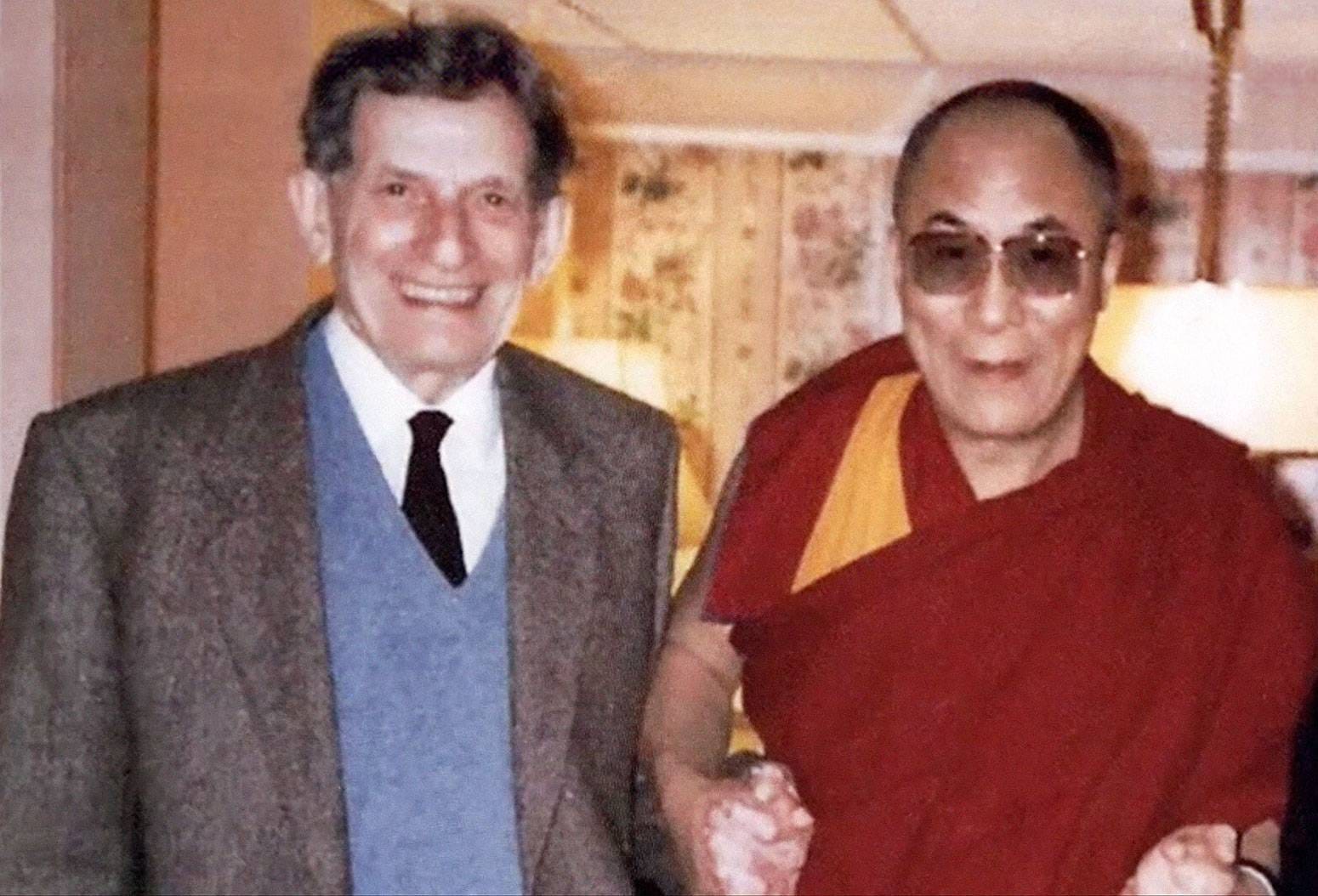
Origins and Background
David Bohm was born in Wilkes-Barre, Pennsylvania, in 1917.
He studied physics at Pennsylvania State College, then pursued graduate work at the University of California, Berkeley, where he worked under J. Robert Oppenheimer.
That placed Bohm near the center of twentieth-century physics at one of its most intense historical moments.
Quantum mechanics had already transformed the scientific picture of matter.
The Second World War had fused theoretical physics with military power.
The atomic bomb had revealed that abstract equations could become planetary danger.
Bohm’s generation did not inherit science as a quiet search for knowledge.
They inherited science as revelation and weapon.
This context matters.
Bohm’s later concern with fragmentation, violence, thought, ideology, and the misuse of reason was not abstract.
He had seen physics enter history.
During the war period, Bohm worked on plasma-related research and theoretical calculations connected to the Manhattan Project era, though security restrictions complicated his direct access to some of his own work.
After the war, he became an assistant professor at Princeton University and worked near Albert Einstein at the Institute for Advanced Study.
Then came the Cold War.
Because of earlier political associations and the climate of McCarthyism, Bohm was called before the House Un-American Activities Committee in 1949. He invoked the Fifth Amendment and refused to testify against colleagues.
Though later acquitted of contempt, his academic position in the United States collapsed.
Princeton did not renew him.
He left the country.
Brazil.
Israel.
The United Kingdom.
Eventually, Birkbeck College in London.
The exile matters because it shaped the reception of his work.
Bohm was not only scientifically controversial.
He became politically inconvenient.
A physicist asking unpopular questions about quantum reality became a person displaced by a society unable to tolerate certain forms of dissent.
His life became one of the twentieth century’s strange crossings:
Quantum uncertainty.
Political suspicion.
Scientific isolation.
Philosophical depth.
A lifelong search for wholeness.
What It’s Known For
David Bohm is known for several major contributions.
Bohmian mechanics and hidden variables
Bohm’s most famous scientific challenge was his 1952 interpretation of quantum mechanics, often called Bohmian mechanics or the de Broglie-Bohm theory.
The standard Copenhagen interpretation had treated quantum reality in a way that many physicists accepted pragmatically but found philosophically unsettling.
Particles did not have definite properties in the old classical sense until measurement.
The observer and measuring apparatus became central.
Probability was not merely ignorance.
Reality itself seemed incomplete until observed.
Bohm offered another possibility.
What if particles do have definite positions?
What if they are guided by a wave?
What if quantum probabilities emerge from a deeper deterministic order?
Bohm’s theory did not overthrow quantum predictions. It reproduced the empirical results of standard quantum mechanics.
But it gave a different picture of what might be happening underneath.
That mattered.
It showed that the orthodox interpretation was not the only possible reality-story compatible with the equations.
Even if one disagrees with Bohmian mechanics, its existence changed the philosophical landscape.
It reopened the question:
Are the mysteries of quantum mechanics features of reality itself, or features of the framework we use to describe it?

Nonlocality
Bohm’s work also pressed directly into nonlocality.
In ordinary thinking, objects separated by distance are expected to have independent local states.
Quantum theory disturbs that expectation.
The famous Einstein-Podolsky-Rosen problem had raised deep questions about whether quantum mechanics was complete.
Bohm later reformulated the EPR argument in a clearer spin-based form, making the issue sharper and helping set the stage for John Bell’s later theorem and the experimental exploration of quantum nonlocality.
This is one of Bohm’s most important scientific roles.
He helped clarify the question that would reveal something deeply strange about nature.
Quantum systems can display correlations that cannot be explained by simple local hidden variables.
This does not mean information travels faster than light in the science-fiction sense.
It means the universe does not behave like a collection of fully separable parts in the way classical intuition expects.
For Bohm, this was not merely technical.
It was a clue.
Reality may be less fragmented than it appears.
The Aharonov-Bohm effect
In 1959, David Bohm and Yakir Aharonov published work on what became known as the Aharonov-Bohm effect.
The effect showed that a charged particle can be influenced by electromagnetic potentials even in regions where the classical electromagnetic fields are zero.
This was not just a mathematical curiosity.
It challenged assumptions about what is physically real in quantum theory.
Something previously treated by many physicists as a kind of mathematical convenience became physically significant.
The visible field was not the whole story.
The potential mattered.
For The Galactic Mind, that is almost too fitting.
Bohm’s scientific work repeatedly presses on the same theme:
The apparent surface is not the whole reality.
What is hidden may still shape what appears.

Wholeness and the Implicate Order
Bohm’s 1980 book Wholeness and the Implicate Order became his most influential philosophical statement.
The title itself contains the signal.
Wholeness.
Not fragments.
Order.
Not chaos.
Implicate.
Enfolded.
Hidden.
Not merely visible.
Bohm proposed that the reality we ordinarily perceive, the world of separate objects, positions, events, and categories, is the explicate order.
The unfolded order.
The visible surface.
But beneath it may be a deeper implicate order, where what appears separate is enfolded into a more fundamental wholeness.
He often used the hologram as an analogy.
In a hologram, each part of the plate can contain information about the whole image.
The whole is enfolded in each part.
This analogy has sometimes been overused or simplified into vague “holographic universe” language.
But Bohm’s point was more disciplined.
He was not saying reality is just an optical hologram.
He was looking for a way to think about a universe where separateness is not fundamental, where the whole is active within the part, and where unfolding processes create the world we experience.
The Undivided Universe
Near the end of his life, Bohm’s collaboration with Basil Hiley culminated in The Undivided Universe: An Ontological Interpretation of Quantum Theory.
The word “ontological” matters.
Bohm wanted a theory about what exists.
Not only predictions.
Not only measurement outcomes.
Not only instrumental success.
He wanted clarity about the nature of reality.
This was one of his main tensions with the mainstream.
Many physicists were satisfied with “shut up and calculate” practicality.
Bohm was not.
He wanted a coherent image of the world.
This can be both strength and risk.
Science needs calculation.
But civilization also needs meaning.
Bohm believed the hunger for understanding could not be dismissed as childish metaphysics.
The question of reality matters.
Dialogue and thought as a system
Later in life, Bohm became increasingly concerned with thought itself.
Not just individual thoughts.
Thought as a system.
A social, cultural, psychological process moving through people.
He believed thought often mistakes its abstractions for reality.
It divides the world into categories, then forgets it created the divisions.
Nations.
Ideologies.
Religions.
Disciplines.
Selves.
Problems.
Enemies.
Thought creates fragmentation, then tries to solve the problems caused by fragmentation using the same fragmentary process.
Bohm’s idea of dialogue was an attempt to address this.
Not debate.
Not argument.
Not persuasion.
Not winning.
Dialogue, for Bohm, meant creating a space where people could observe the movement of thought together.
Suspending assumptions.
Listening.
Watching reactions arise.
Not forcing immediate conclusions.
This may sound soft compared to quantum physics.
It is not.
For Bohm, fragmentation in thought was tied to fragmentation in society, and perhaps to fragmentation in our image of reality itself.
The Core Idea or Signal
The core signal of David Bohm is this:
Reality may be whole, while thought keeps teaching us to experience it as broken.
That is the center.
Bohm’s physics, philosophy, and dialogue work all circle this same problem.
Quantum theory suggests that separateness is not as fundamental as classical thinking assumed.
The implicate order suggests that the visible world may unfold from a deeper, hidden wholeness.
The Aharonov-Bohm effect suggests that unseen structures can have real physical consequences.
Bohmian mechanics suggests that quantum reality may have a deeper order beneath probability.
Bohm dialogue suggests that human conflict may arise because thought mistakes its fragments for the whole.
This is why Bohm matters now.
He did not simply propose a different quantum interpretation.
He proposed a different posture toward reality.
Do not begin with fragments.
Do not assume the part is primary.
Do not confuse the map with the movement.
Do not mistake thought’s divisions for nature’s divisions.
Perspectives and Interpretations
Bohm can be interpreted through several lenses.
The physicist view
From the physicist view, Bohm is a serious and original figure in quantum foundations.
His textbook Quantum Theory was respected.
His work in plasma physics contributed to mid-century physics.
His hidden-variable interpretation challenged orthodoxy.
His collaboration with Aharonov produced an effect that remains important in quantum mechanics.
His EPR reformulation helped sharpen the path toward Bell’s theorem and the experimental study of nonlocality.
This is the grounded Bohm.
Before the implicate order.
Before dialogue.
Before consciousness speculation.
He was a physicist asking technical questions with mathematical seriousness.
That foundation matters because Bohm’s later philosophical work did not come from ignorance of physics.
It came from dissatisfaction with a physics that could calculate but often refused to interpret.
The quantum rebel view
Bohm can also be seen as a quantum rebel.
He challenged the intellectual atmosphere around the Copenhagen interpretation at a time when many physicists viewed foundational questions as distractions.
This made him unfashionable.
Bohm’s hidden-variable theory was often dismissed, ignored, or treated as a step backward.
But later developments made the foundations of quantum mechanics harder to brush aside.
Bell’s theorem, entanglement experiments, quantum information, and renewed interest in interpretations have all made the old dismissal look less secure.
This does not mean Bohm was right in every detail.
It means he was right to insist that interpretation matters.
A theory that predicts is powerful.
A theory that also explains is different.
Bohm wanted the second.

The wholeness view
For many readers, Bohm’s deepest contribution is the concept of wholeness.
He saw fragmentation everywhere.
In physics.
In society.
In language.
In politics.
In thought.
In the self.
He believed fragmentation was useful in limited contexts, but dangerous when mistaken for reality.
Science breaks the world into parts so it can study them.
That is necessary.
But if we begin to believe the parts exist independently of the whole, the method becomes a worldview.
Bohm resisted that.
For him, the world was better understood as movement.
Process.
Unfolding.
Relationship.
Wholeness.
Not a pile of separate things, but an ongoing activity in which apparent things are relatively stable patterns.
This is where Bohm begins to resonate with consciousness studies, systems theory, ecology, Eastern philosophy, and process thought.
The consciousness view
Bohm’s work has attracted people interested in consciousness because he refused to treat mind and matter as entirely separate problems.
He explored whether consciousness and matter might be different aspects of a deeper order.
This does not mean Bohm proved quantum consciousness.
He did not.
That phrase is often abused.
His work should not be reduced to “quantum physics proves consciousness creates reality.”
That is not the disciplined Bohm.
The stronger point is subtler:
If the physical world is not made of separate objects in the way classical thought assumed, then the old separation between mind and matter may also need rethinking.
Bohm’s conversations with Jiddu Krishnamurti intensified this interest.
Together, they explored thought, observer and observed, fear, time, self, and the possibility that psychological fragmentation mirrors the fragmentation of human society.
For The Galactic Mind, this is fertile territory.
But it must be handled carefully.
Bohm opens a door.
He does not give permission to turn quantum theory into vague mysticism.
The dialogue view
Bohm’s dialogue work may be one of his most practical contributions.
He believed human beings rarely think together.
They debate.
Defend.
React.
Persuade.
Perform.
But they do not often observe thought itself while it is operating.
Dialogue was meant to reveal the assumptions beneath speech.
The hidden structure beneath conflict.
The automatic reactions behind identity.
The cultural programming moving through the individual.
In this sense, dialogue was not just communication technique.
It was a collective form of self-inquiry.
A way for thought to become aware of itself.
This connects directly to modern culture.
Social media is mostly anti-dialogue.
It accelerates fragmentation.
It rewards reaction.
It turns identity into performance.
It converts thought into tribal signaling.
Bohm’s dialogue work may be more relevant now than when he wrote it.
The critic’s view
Critics of Bohm raise several important objections.
Some physicists view Bohmian mechanics as useful but not necessary, since it reproduces standard quantum predictions while adding hidden structure.
Others argue that its nonlocal features and configuration-space framework create their own conceptual problems.
Some see the implicate order as too metaphorical, too broad, or too close to metaphysics to function as physics.
Others worry that Bohm’s popularity in spiritual circles has encouraged vague “quantum wholeness” claims that go far beyond the evidence.
These critiques matter.
Bohm should not be turned into a mystic mascot.
His scientific contributions should be separated from later metaphysical interpretations.
His analogies should not be treated as proof.
His vision of wholeness should not be used to flatten every distinction.
The strongest Bohm is not anti-science.
He is anti-fragmentation.
There is a difference.
Strengths and Limitations
Bohm’s greatest strength was his refusal to accept shallow clarity.
He did not confuse calculation with understanding.
He did not accept that quantum mechanics should remain philosophically opaque simply because its predictions worked.
He did not accept that mind and matter had to remain permanently divided by inherited categories.
He did not accept that human conflict could be solved by better arguments alone.
He kept moving toward the deeper pattern.
What is the whole?
What are the parts?
What is hidden?
What is unfolded?
What is thought doing?
How does reality become fragmented in perception?
This makes him powerful for The Galactic Mind because his work challenges the operating assumptions behind many modern debates.
Science and spirituality.
Mind and matter.
Self and world.
Observer and observed.
Individual and society.
Particle and field.
Visible and hidden.
Bohm does not collapse all these distinctions.
He asks whether they are secondary.
Relative.
Useful but not ultimate.
His limitations are real.
His later language can become difficult to separate from metaphor.
The implicate order is profound, but not always easy to test.
His ideas have been absorbed by New Age and spiritual movements in ways that sometimes weaken their rigor.
Bohmian mechanics remains one interpretation among several, not a settled replacement for standard quantum mechanics.
His critique of fragmentation is powerful, but sometimes too universal.
Not every distinction is false.
Not every boundary is an illusion.
Some fragmentation is method.
Some categories protect clarity.
The challenge is knowing when distinction becomes division.
A grounded ledger helps.
What is documented:
David Bohm was a theoretical physicist whose work contributed to quantum foundations, plasma physics, the Aharonov-Bohm effect, pilot-wave theory, nonlocality, and the philosophical interpretation of quantum mechanics.
What is claimed:
Bohm argued that reality may be better understood as an undivided whole, with the visible world unfolding from deeper orders, and that human thought fragments reality in ways that shape science, society, and conflict.
What is interpreted:
Supporters see Bohm as one of the most original thinkers of modern physics and consciousness-adjacent philosophy. Critics see some of his later ideas as speculative, metaphorical, or vulnerable to misuse.
What remains unresolved:
Whether Bohm’s implicate order can be developed into a fully scientific framework, whether Bohmian mechanics is the best interpretation of quantum theory, and whether his ideas about thought and dialogue can meaningfully transform collective culture.
What is speculative:
Claims that Bohm proved quantum mysticism, proved consciousness creates reality, proved all things are literally one in a spiritual sense, or solved the mind-matter problem.
He did not solve everything.
He made the fragmented worldview harder to trust.
Broader Implications
David Bohm matters because fragmentation may be one of the defining crises of modern civilization.
We divide knowledge into disciplines.
Then forget they are connected.
We divide people into nations, parties, classes, and identities.
Then wonder why conflict deepens.
We divide mind from matter.
Then struggle to explain consciousness.
We divide humanity from nature.
Then produce ecological collapse.
We divide facts from meaning.
Then produce intelligence without wisdom.
We divide technology from ethics.
Then build systems we cannot govern.
Bohm saw this pattern.
His physics gave him a language for wholeness.
His exile gave him a personal experience of ideological fragmentation.
His dialogues with Krishnamurti gave him a psychological lens.
His later work gave him a civilizational concern.
This is why Bohm belongs beside figures like Carl Sagan, Carl Jung, Bernardo Kastrup, Donald Hoffman, Alan Watts, and Jacques Vallée in The Galactic Mind archive.
Each one challenges a different form of surface reality.
Sagan challenges human centrality.
Jung challenges the transparent ego.
Kastrup challenges materialism.
Hoffman challenges perception.
Watts challenges separateness.
Vallée challenges the simple category of the phenomenon.
Bohm challenges fragmentation itself.
He asks whether the modern mind is trapped because it keeps turning the whole into pieces, then treating the pieces as ultimate.
That question reaches everywhere.
AI.
UAP.
Consciousness.
Quantum theory.
Ecology.
Politics.
Spirituality.
Media.
The self.
The future.
A civilization that cannot perceive wholeness may not survive the power of its own fragments.

The Reality Signal
What this subject represents
David Bohm represents the search for hidden order beneath apparent disorder.
He represents the physicist who could not stop at prediction.
He represents the thinker who saw quantum mechanics not as a weird exception, but as a clue that the world is less divided than our thought makes it.
He also represents the danger of crossing too many boundaries.
Because when physics, consciousness, philosophy, dialogue, and spirituality begin to overlap, clarity becomes harder to protect.
That tension is part of the signal.
What reality frame it challenges
Bohm challenges the frame that reality is made of separate objects with external relations.
He challenges the frame that science is only calculation.
He challenges the frame that thought is a neutral tool.
He challenges the frame that mind and matter are permanently separate categories.
He challenges the frame that dialogue is merely communication.
Most importantly, he challenges the assumption that fragmentation belongs to the world rather than to our way of perceiving and thinking.
For Bohm, the whole is not assembled from parts.
The parts are abstractions from the whole.
Why it matters now
Bohm matters now because fragmentation has gone planetary.
Information is fragmented.
Attention is fragmented.
Politics is fragmented.
Identity is fragmented.
Science is fragmented.
Spirituality is fragmented.
The internet turns thought into fragments and then monetizes the conflict between them.
Bohm’s warning is no longer theoretical.
The world is drowning in parts.
Data without wisdom.
Connectivity without communion.
Opinion without dialogue.
Intelligence without wholeness.
Bohm gives us one of the clearest questions for this moment:
Can thought become aware of its own fragmentation before that fragmentation destroys the systems it depends on?
What remains unresolved
The unresolved ledger is where Bohm’s influence remains alive.
What is established:
David Bohm was a major theoretical physicist whose work shaped quantum foundations, nonlocality debates, the Aharonov-Bohm effect, pilot-wave theory, and later philosophical inquiry into wholeness, thought, and dialogue.
What is claimed:
He claimed that the apparent separateness of the world may unfold from a deeper implicate order, and that human thought creates destructive fragmentation by mistaking its abstractions for reality.
What remains unresolved:
Whether Bohm’s deeper vision of implicate order can be made scientifically precise, whether his dialogue approach can scale beyond small groups, and whether his metaphysics of wholeness describes reality or functions mainly as a powerful interpretive framework.
Why it still matters:
Because the modern world is built on fragments, and Bohm may be one of the few scientists who saw that the fragmentation of thought, society, and reality are not separate problems.

The Galactic Mind Perspective
David Bohm belongs in The Galactic Mind archive because he does something rare.
He makes physics feel like a doorway into civilization’s deepest wound.
Not because quantum mechanics magically explains everything.
It does not.
Not because the implicate order proves spiritual unity.
It does not.
Not because “everything is connected” is enough.
It is not.
Bohm matters because he saw a pattern repeating across reality and mind:
The part mistakes itself for the whole.
That may be one of the defining errors of modern life.
The ego mistakes itself for the person.
The nation mistakes itself for humanity.
The discipline mistakes itself for knowledge.
The model mistakes itself for reality.
The measurement mistakes itself for truth.
The ideology mistakes itself for the world.
The thought mistakes itself for the thinker.
This is Bohm’s warning.
Fragmentation is not just a mistake in how we think.
It becomes a world.
For The Galactic Mind, Bohm is not a final authority.
He is a signal flare.
A reminder that the unknown may not only be hidden in exotic phenomena, ancient ruins, UAP, altered states, or cosmic mysteries.
The unknown may be hidden in the false separations we assume before inquiry even begins.
Maybe reality is stranger than we think.
But maybe it is also more whole than we can currently perceive.
That is Bohm’s doorway.
Open Thread
David Bohm leaves us with a question that feels increasingly urgent.
What if the crisis of modern civilization is not only political, technological, or ecological?
What if it is perceptual?
What if thought keeps breaking the world into pieces, then fighting over the pieces?
What if the whole was never absent?
What if it was only hidden by the way we learned to look?
Quantum theory forced physics to confront a world where separateness is not simple.
Bohm took that lesson seriously.
Maybe too far for some.
Not far enough for others.
But the question remains.
If reality is an undivided movement, then every isolated thing is only relatively isolated.
Every self.
Every nation.
Every species.
Every thought.
Every particle.
Every belief.
The visible world may be the explicate order.
The unfolded surface.
But beneath it, something deeper may be moving.
Hidden.
Enfolded.
Whole.
What do you think? Drop your thoughts in the comments ...
Sources / Receipts
- B. J. Hiley, “David Joseph Bohm. 20 December 1917–27 October 1992,” Biographical Memoirs of Fellows of the Royal Society
- David Bohm, Quantum Theory
- David Bohm, “A Suggested Interpretation of the Quantum Theory in Terms of Hidden Variables,” Physical Review
- David Bohm and Yakir Aharonov, “Significance of Electromagnetic Potentials in the Quantum Theory,” Physical Review
- David Bohm, Wholeness and the Implicate Order
- David Bohm and Basil Hiley, The Undivided Universe
- David Bohm, Thought as a System
- David Bohm, On Dialogue
- David Bohm and F. David Peat, Science, Order, and Creativity
- Olival Freire Jr., “Science and exile: David Bohm, the hot times of the Cold War, and his struggle for a new interpretation of quantum mechanics”
- F. David Peat, Infinite Potential: The Life and Times of David Bohm
- Krishnamurti Foundation materials on David Bohm and Jiddu Krishnamurti dialogues
- Recent scholarship and commentary on Bohmian mechanics, nonlocality, and quantum foundations


Discussion