
The Central Question
DMT can produce the overwhelming impression of entering an inhabited world beyond ordinary perception. Is the brain creating that world, or briefly allowing consciousness to perceive something normally hidden?
Most hallucinations distort the world already in front of us.
DMT can appear to replace it.
At sufficient intensity, users do not merely report colors becoming brighter or familiar objects changing shape. They describe leaving ordinary reality altogether and entering elaborate environments populated by seemingly autonomous intelligences.
The experience frequently carries an unusual conviction: this was not something imagined. It was somewhere visited.
Science can show that DMT radically alters brain activity. It can identify receptors, map changing communication between neural networks, and correlate those changes with the intensity of the experience.
But does demonstrating what happens in the brain also establish where the experience comes from?
Or could the brain be the instrument through which another order of reality becomes perceptible?
A Molecule and an Impossible World
N,N-Dimethyltryptamine is a short-acting psychedelic compound found in numerous plants and detected in trace amounts within mammalian biology. It primarily produces its psychedelic effects through serotonin receptors, especially the 5-HT2A receptor.
Popular culture has surrounded the molecule with claims that the pineal gland releases large quantities during dreams, birth, or death. Those ideas remain speculative. The body can produce DMT, but there is no compelling evidence that the human pineal gland releases psychedelic quantities during these events.
The documented mystery is already strange enough.
In controlled research, intravenous DMT can produce an immersive altered state within seconds. Its most intense effects generally subside within minutes, yet participants may experience a journey that seems far longer.
They report tunnels, impossible geometries, unfamiliar architecture, disembodiment, death-like transitions, and contact with presences that appear to think and act independently.
The remarkable feature is not simply what people see.
It is the structure of the encounter.
The Place That Feels Discovered
People often describe dreams as unstable. Characters change identity. Locations merge. Events proceed according to emotional association rather than consistent physical rules.
The DMT realm is frequently described differently.
It can feel ordered, coherent, and already in progress. Users sometimes report arriving somewhere that appears to exist independently of their presence. Its inhabitants may seem surprised, amused, welcoming, indifferent, or hostile.
In a Johns Hopkins survey of more than 2,500 people who reported DMT-associated entity encounters, respondents commonly attributed consciousness, intelligence, agency, and continued existence to the encountered presence. Many considered the experience among the most meaningful events of their lives, and a large majority said it changed their underlying conception of reality.
That does not establish that the entities exist outside the mind. The survey selected people who already believed they had experienced an encounter, relied on retrospective self-reporting, and could not control for expectation, culture, memory, or prior exposure to DMT mythology.
But it establishes something important:
The entities are not typically experienced as passive images.
They are experienced as encounters with another center of awareness.
Why Do People Encounter Similar Things?
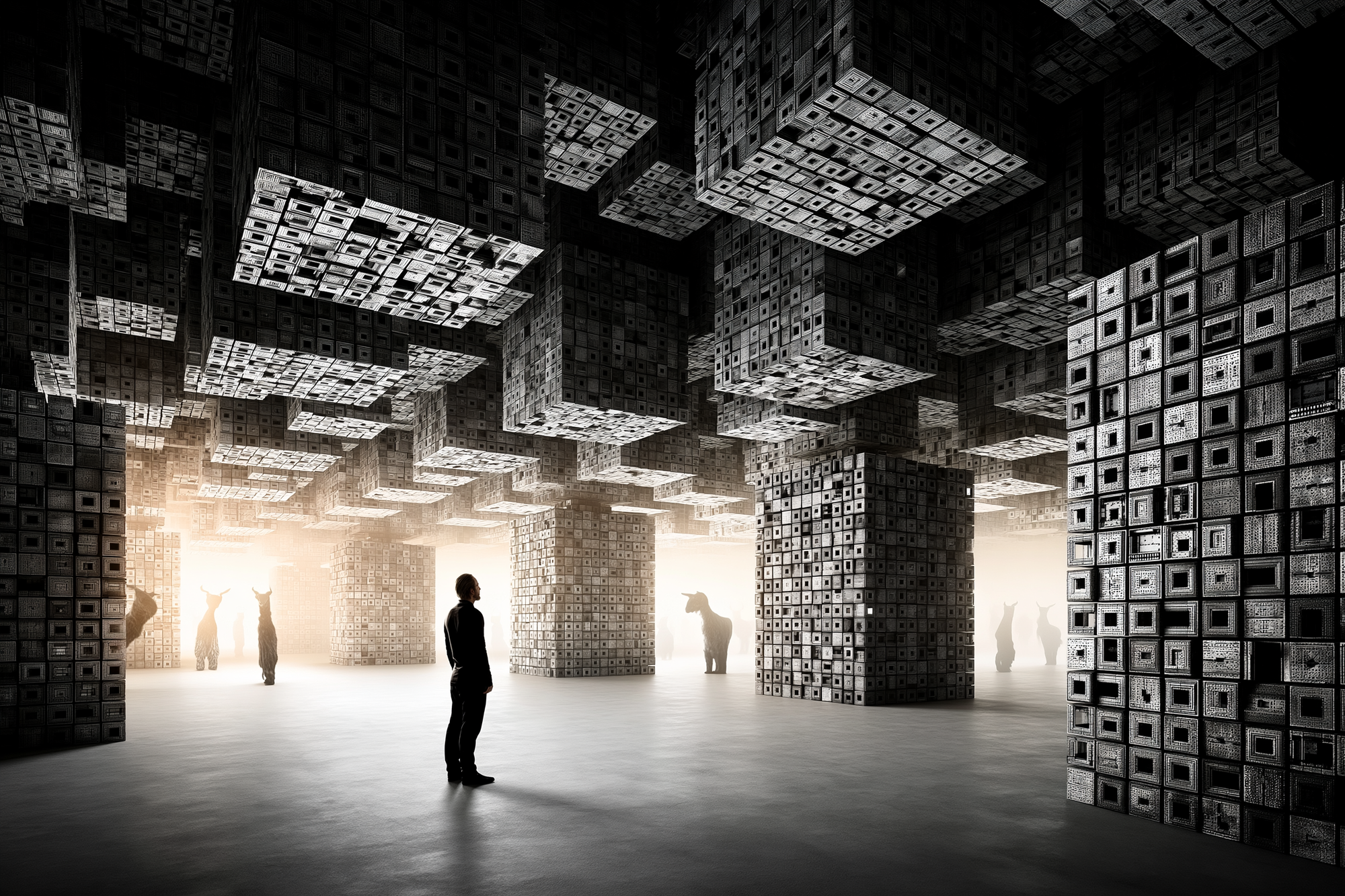
DMT accounts contain recurring motifs: geometric passageways, technologically complex spaces, surgical or diagnostic procedures, insect-like beings, humanoid figures, deities, jesters, elves, aliens, and intelligences made from light or movement.
A large analysis of thousands of publicly posted experience reports also found recurring themes involving other worlds and entities.
There are several explanations for this apparent convergence.
Human beings share broadly similar nervous systems. The same compound acting on similar receptors may produce related perceptual structures, just as migraine auras often generate comparable geometric patterns across different people.
Our brains also contain powerful systems for detecting agents. Identifying whether something in the environment possesses intention has enormous survival value. When ordinary perceptual constraints loosen, the brain may assign agency to internally generated forms.
Culture contributes another layer. Once “machine elves,” alien laboratories, and DMT hyperspace become familiar ideas, later users may enter the experience with expectations they do not consciously recognize.
And the similarities are often broader than they first appear. Two people may both report “entities” while describing beings with entirely different appearances, behaviors, environments, and messages. Categorizing both as entity encounters can create the impression of agreement where only a general theme is shared.
Yet cultural influence does not settle the matter either.
Expectations can shape how an unfamiliar experience is interpreted without necessarily creating the entire experience. If several witnesses saw an unknown natural phenomenon, their cultural language would influence their descriptions, but that would not prove there was nothing there.
Similarity is not proof of an external realm.
It is also not meaningless.
What the Brain Reveals
Modern imaging has begun to show what happens as ordinary reality gives way.
A combined EEG and functional MRI study found that DMT increased global communication across the brain while disrupting the usual organization and separation of established networks. The normal hierarchy between systems became less distinct, and brain activity became more diverse and less constrained.
Earlier EEG research likewise found reduced alpha and beta power alongside increased signal diversity, with measurable changes tracking the intensity of participants’ experiences.
These findings support a powerful neurological explanation.
Ordinary perception is not a direct recording of reality. The brain continuously organizes incomplete sensory signals according to predictions, learned models, and assumptions about what is likely to exist.
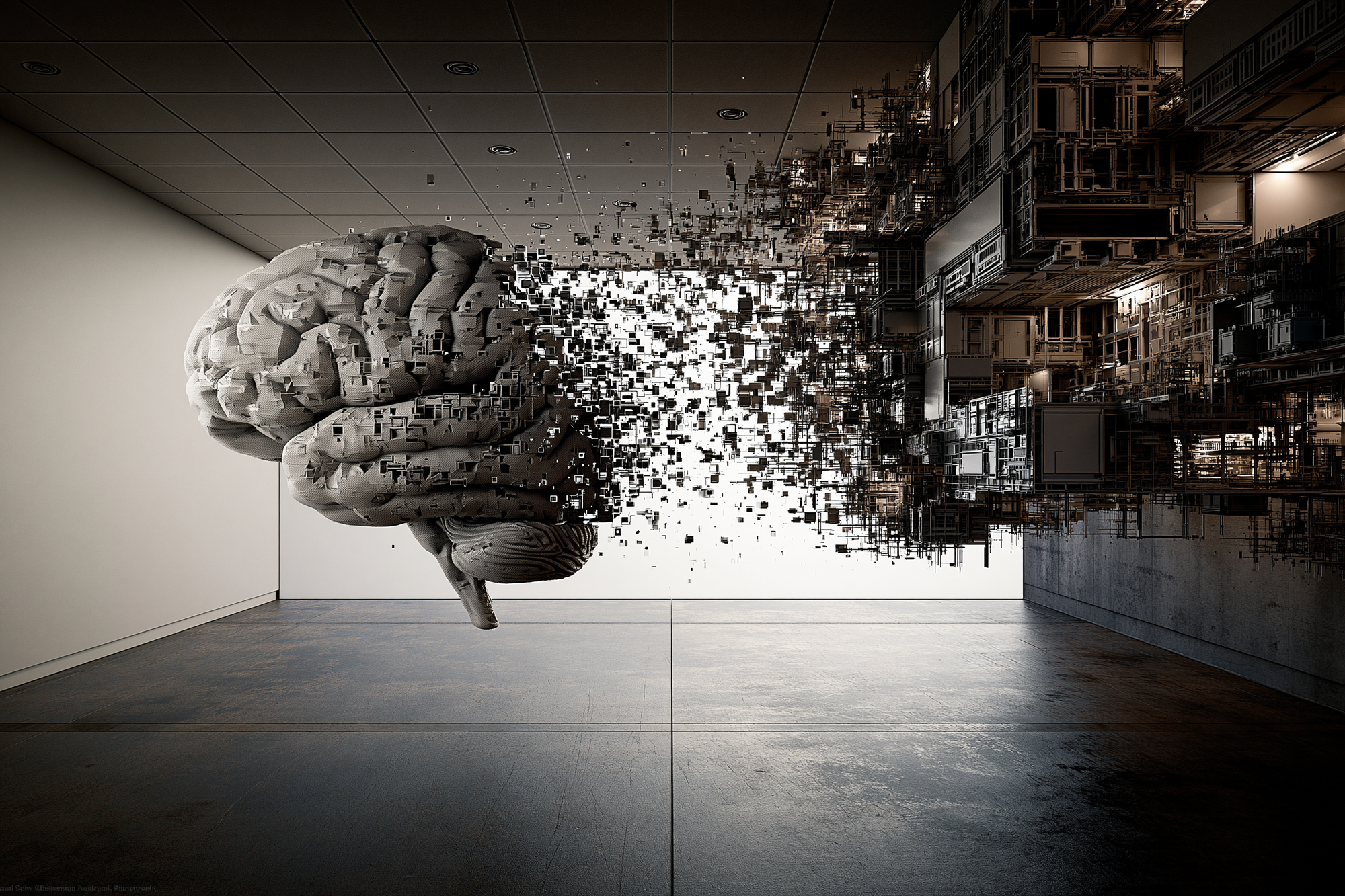
Under DMT, some of those organizing constraints weaken. Brain systems that normally operate within relatively stable boundaries begin communicating in unusual combinations. Visual, emotional, autobiographical, social, and conceptual material can become fused into a single immersive world.
The mind may not be receiving another dimension.
It may be constructing one from previously separated parts of itself.
The World-Making Brain
The construction model becomes more persuasive when we recognize that the brain already creates our ordinary experience.
Color is not located in light exactly as we perceive it. Sound is not waiting in the air as music. The brain converts wavelengths, vibrations, chemical signals, pressure, and memory into a usable world.
We do not consciously experience that construction process. We experience its result as reality.
DMT may disrupt the rules governing that process while leaving its reality-producing power intact. The brain continues building a world, but it is no longer tightly constrained by ordinary sensory input or its familiar assumptions.
The REBUS model proposes that psychedelics relax the influence of high-level beliefs, allowing normally suppressed information and lower-level activity to exert greater influence over conscious experience.
Under this model, DMT entities may be internally generated social agents. Their apparent autonomy could emerge because the processes creating them operate outside conscious control.
We do not consciously write every character in our dreams. We do not decide what an intrusive thought will say before it appears. Parts of the mind can surprise the part that identifies itself as “me.”
An entity can therefore feel independent without being externally real.
The conscious self may simply be meeting another process within the same mind.
The Filter Behind the World
There is, however, another possibility.
Perhaps the brain does not create the full contents of consciousness. Perhaps it limits, organizes, and filters a field of experience that extends beyond ordinary neural boundaries.
In this model, perception evolved for survival rather than complete access to reality. Human senses reveal only narrow ranges of light, sound, scale, and time. Other animals inhabit perceptual worlds shaped by magnetic fields, electrical signals, echolocation, polarization, and chemical traces that humans cannot naturally detect.
Reality contains more than human biology displays.
The filter hypothesis asks whether this limitation might apply not only to sensory information, but to consciousness itself.
DMT could loosen the mechanism that normally narrows awareness to the physical environment and individual identity. The resulting experience might contain internally generated imagery, but it might also expose aspects of reality ordinarily excluded from human perception.
This idea cannot currently be ruled out in an absolute philosophical sense.
But it has not been demonstrated scientifically.
Brain imaging can reveal neural changes associated with DMT without deciding whether the brain is producing or receiving the experience. A radio changes internally when it receives a signal, but so does a device generating one. Correlation alone cannot settle the direction of causation.
The filter model remains possible.
Possibility, however, is not evidence.
Is “Another Dimension” the Wrong Category?
The word dimension is useful because it communicates the feeling of having entered somewhere beyond the physical world.
Scientifically, it may be misleading.
In physics, a dimension is generally a measurable degree of freedom required to describe a system. Additional dimensions in theoretical physics are mathematical features of models, not necessarily neighboring mystical worlds populated by visible beings.
A DMT realm could instead represent:
- A fully internal simulation
- A symbolic layer of unconscious cognition
- A state of consciousness with unfamiliar spatial properties
- A nonlocal informational environment
- A reality dependent on observation
- An external domain for which humans possess no accurate category
Calling it another dimension may give the mystery a name before establishing what kind of phenomenon it is.
The more precise question is not whether DMT takes consciousness into a dimension.
It is whether the experience contains anything that cannot be adequately explained as activity occurring within the participant’s own mind.
Three Ways to Understand the Encounter
The Construction Model
DMT destabilizes the brain’s usual world model. Loosened networks combine perception, memory, emotion, symbolism, and social cognition into an immersive reality populated by autonomous-seeming beings.
This model currently fits the available neurological evidence without requiring an external realm.
The Filter Model
The brain normally restricts consciousness to information useful for biological survival. DMT weakens that filter, allowing awareness to access a wider reality that may not be spatial in the ordinary sense.
This model remains philosophically possible but lacks a demonstrated mechanism or independent confirmation.
The Contact Model
DMT enables interaction with intelligences or environments that exist independently of the user. The entities are not symbols or mental subpersonalities but genuine non-human agents.
This is the most extraordinary interpretation and therefore carries the greatest evidentiary burden.
At present, reports alone cannot distinguish among them.
What Evidence Would Change the Question?
If the DMT realm were independent of individual minds, it should eventually produce something more than conviction.
Researchers would need prospective experiments designed before the experience rather than similarities collected afterward.
Compelling evidence might include:
- Isolated participants independently retrieving the same specific, previously unknown information
- Repeatable navigation to stable locations using predefined protocols
- Consistent identification of hidden targets unavailable through ordinary means
- Messages containing verifiable knowledge the participant could not reasonably possess
- Cross-cultural agreement at a level more precise than general entities or geometry
- Successful replication by independent research teams
The critical test is not whether two people both saw a temple.
It is whether they could independently describe the same unusual inscription inside it, return to it under controlled conditions, and retrieve information later verified outside the experience.
Nothing approaching that standard has yet been reliably demonstrated.
That absence does not prove the realm is unreal. But until the experience produces independent, reproducible information, the external-reality hypothesis remains an interpretation rather than a finding.
Staying Longer at the Threshold
One obstacle to studying DMT has always been its brevity. The state arrives rapidly, reaches overwhelming intensity, and recedes before participants can systematically investigate it.
Researchers have now tested continuous intravenous infusion protocols designed to extend the DMT state. An early placebo-controlled study found that a bolus followed by a constant infusion could maintain effects for a chosen period and was tolerated under closely monitored clinical conditions.
This does not bring science closer to proving another realm by itself.
It does make better questions possible.
Participants could eventually receive predetermined tasks, report from the experience in real time, revisit recurring features, compare environments under blinded conditions, and distinguish personal symbolism from genuinely stable patterns.
DMT research may therefore become more than the study of a brief psychedelic event.
It could become a controlled investigation into how the mind constructs realities and why some of them feel inhabited.
Meaning Is Not the Same as Geography
There is a danger in reducing the entire DMT question to whether the entities are “real.”
An experience can be internally generated and still reveal something true.
Dreams can expose fear. Fiction can reorganize identity. Imaginary conversations can uncover beliefs a person has never consciously articulated. The mind can use invented characters to communicate with itself.
If DMT entities are products of the brain, they may still represent autonomous layers of cognition normally concealed from the conscious self.
Conversely, an experience can feel sacred, transformative, and more real than waking life without being an accurate representation of an external environment.
Intensity is not verification.
Meaning is not geography.
Transformation is not proof.
The challenge is to respect the experience without allowing its emotional authority to settle questions it cannot answer alone.
If the Door Is Internal
Suppose the conventional explanation is correct.
DMT does not transport consciousness anywhere. It temporarily reorganizes brain activity so radically that the mind generates another world.
That conclusion would still be profound.
It would mean the human brain contains the latent capacity to produce entire realities, unfamiliar intelligences, impossible architecture, altered identities, and experiences of infinity within minutes.
The deeper mystery would move inward.
How much of the mind remains inaccessible during ordinary consciousness? Why does removing certain constraints produce encounters instead of incoherent noise? Why can internally generated beings appear to possess knowledge, personality, and intention independent of the conscious self?
If DMT does not reveal another world, it reveals how little we understand about the machinery creating this one.
If the Door Is External
If even a fraction of the experience originates beyond the individual mind, the implications would be difficult to contain.
Consciousness would no longer appear confined to the ordinary relationship between brain, body, and sensory environment. Reality might contain accessible domains that are neither conventional physical locations nor private imagination.
Non-human intelligence would cease to be only an astronomical question.
Contact might not require spacecraft, radio signals, or physical arrival. It could depend upon changes in the architecture of perception.
But this possibility should make us more rigorous, not less.
The greater the implication, the more carefully we must separate testimony from confirmation, similarity from identity, and felt certainty from externally verifiable knowledge.
Wonder does not weaken when evidence enters the room.
It becomes harder to dismiss.
The Galactic Mind Perspective
DMT occupies an unusual boundary.
On one side is measurable neurochemistry: receptors activated, networks reorganized, brain rhythms altered, consciousness transformed.
On the other is an experience that often refuses to feel reducible to those mechanisms: a world already waiting, populated by intelligences that appear to possess their own agency.
The evidence currently favors the conclusion that DMT changes how the brain constructs conscious reality. It does not establish travel to another dimension or contact with external beings.
Yet declaring the mystery solved would also be premature.
A neural description tells us how the experience is mediated. It may not fully explain why consciousness can generate such structured worlds, why encounters assume autonomous form, or why any experience feels real in the first place.
DMT may not be a doorway into another dimension. Or maybe it is.
It may be something equally unsettling:
A demonstration that the boundary between a world perceived and a world created has never been as clear as we assumed.
The Open Question
If every reality we have ever experienced reaches us through the brain, what evidence would allow us to recognize that consciousness had encountered something beyond it?
Perhaps the DMT realm is an extraordinary hallucination.
Perhaps it is an unfamiliar layer of the mind.
Perhaps it is a distorted glimpse of something external.
For now, the responsible answer remains unresolved.
But the question stays open:
When the familiar world disappears and another takes its place, has consciousness traveled somewhere else, or has it finally witnessed what it was capable of creating all along?
Sources / Receipts
- Timmermann et al., Human brain effects of DMT assessed via EEG-fMRI, Proceedings of the National Academy of Sciences, 2023.
- Davis et al., Survey of entity encounter experiences occasioned by inhaled N,N-dimethyltryptamine, Journal of Psychopharmacology, 2020.
- Lawrence et al., Phenomenology and content of the inhaled N,N-dimethyltryptamine experience, Scientific Reports, 2022.
- Timmermann et al., Neural correlates of the DMT experience assessed with multivariate EEG, Scientific Reports, 2019.
- Carhart-Harris and Friston, REBUS and the Anarchic Brain, Pharmacological Reviews, 2019.
- Luan et al., Psychological and physiological effects of extended DMT, Journal of Psychopharmacology, 2024.
- Nichols, N,N-Dimethyltryptamine and the pineal gland: Separating fact from myth, Journal of Psychopharmacology, 2018.
- Timmermann et al., DMT Models the Near-Death Experience, Frontiers in Psychology, 2018.


Discussion