
Puma Punku looks less like a conventional ruin than an architectural system broken into pieces.
Across Bolivia’s high Altiplano, massive sandstone slabs and precisely shaped andesite blocks lie displaced from their original positions. Some preserve straight channels, recessed surfaces, sharp interior angles, clamp sockets, and repeated geometric forms. The most famous resemble stone components manufactured according to a common design.
Those features have turned Puma Punku into a testing ground for competing stories about the ancient world.
One interpretation treats the stonework as evidence of lost machines, extraterrestrial intervention, or a civilization far older than the archaeological record allows. Another attributes the monument to the Tiwanaku and considers the mystery effectively solved.
Neither position fully captures the problem.
Puma Punku belongs to a documented Andean civilization. No physical evidence establishes laser cutting, modern machinery, or non-human construction. But identifying the builders does not automatically recover their complete process. The original architecture is shattered, parts of the technical sequence remain uncertain, and the surviving stonework reflects a level of planning that deserves more than either sensationalism or dismissal.
The question is not whether ancient people were capable of building Puma Punku.
They clearly were.
The question is what combination of measurement, templates, abrasion, quarrying, transport, specialist labor, architectural planning, and inherited knowledge allowed them to do it—and how much of that system has since disappeared.
Overview: What This Is
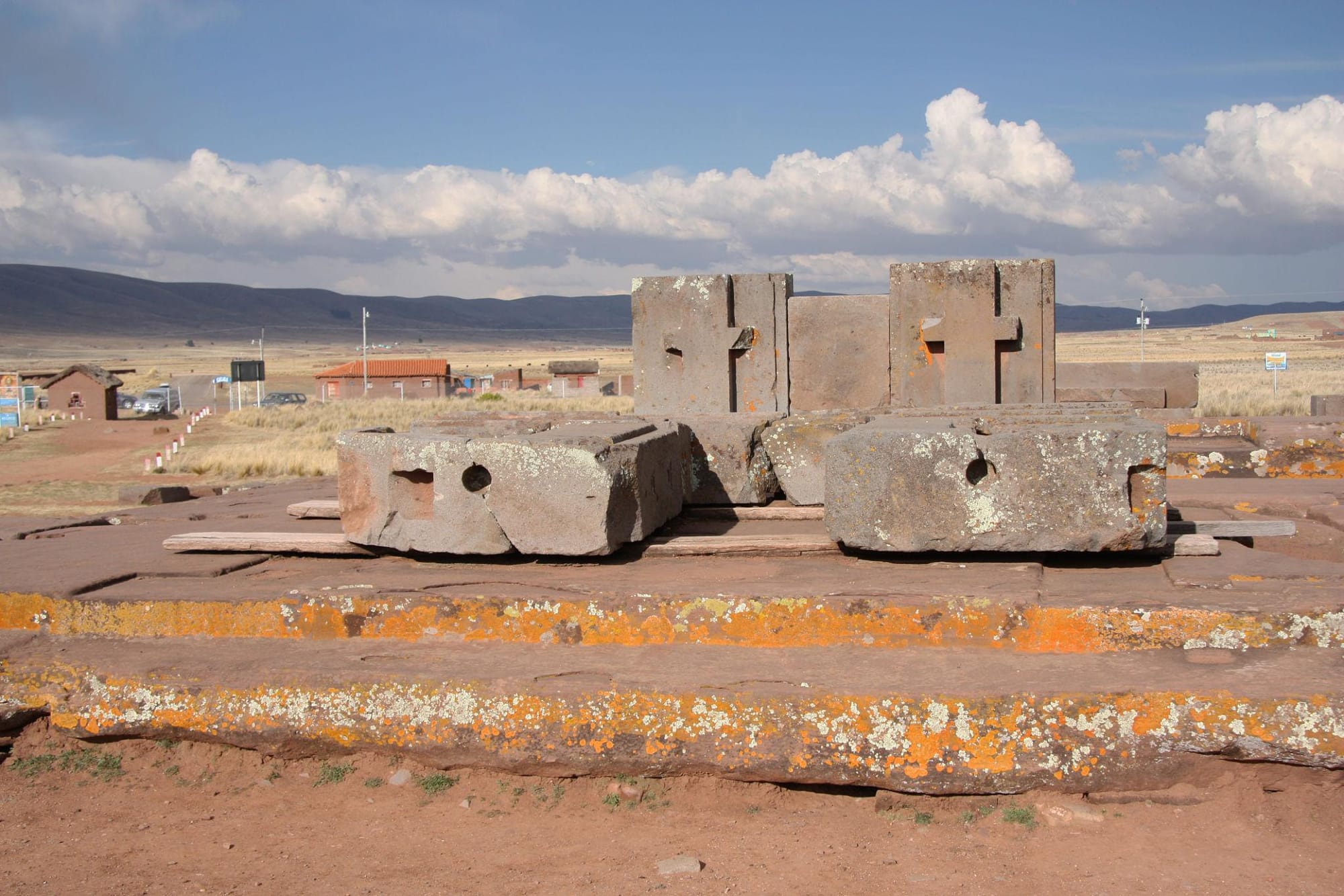
Puma Punku is a monumental platform complex within Tiwanaku, the political and spiritual center of a major pre-Inca civilization near Lake Titicaca in western Bolivia.
Located at approximately 3,850 meters above sea level, the complex formed part of a larger ceremonial landscape containing temples, courts, monoliths, gateways, drainage systems, and carefully planned public architecture.
Puma Punku is especially known for two categories of stonework:
- enormous red sandstone platform elements
- smaller but more intricately shaped andesite architectural blocks
- recessed panels and straight channels
- T-shaped and other clamp sockets
- repeated geometric components
- fragments associated with gateways and façade systems
- the iconic forms commonly described as H-blocks
The word precision requires care. It does not mean that every surface conforms to modern machining tolerances, nor does it establish the use of power tools. It describes deliberate geometric workmanship that can be measured, compared, and reconstructed.
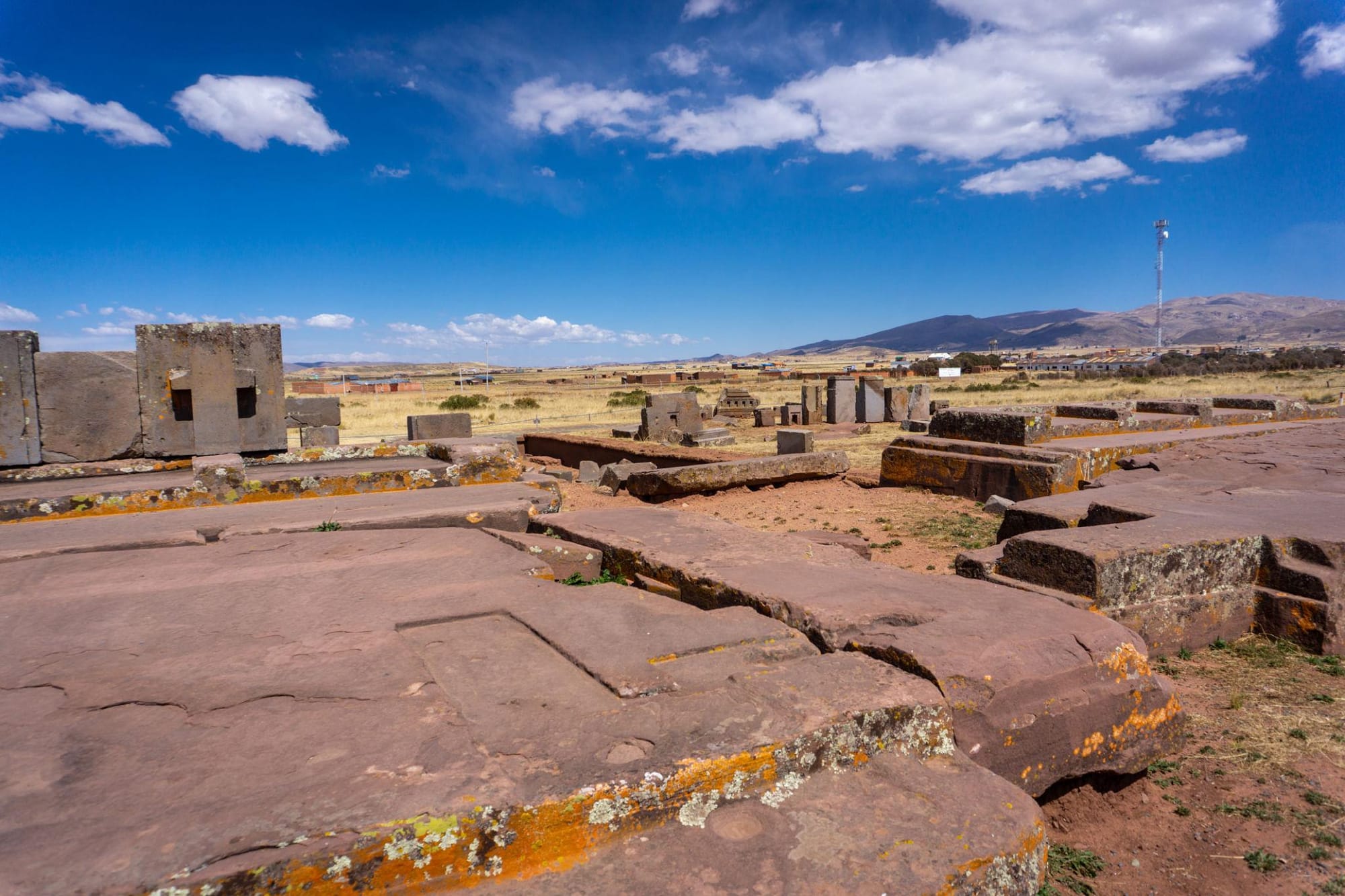
The popular image of Puma Punku is also incomplete. The blocks visible today do not remain in their original arrangement. The monument endured collapse, weathering, excavation, looting, stone reuse, and centuries of disturbance. Archaeologists are therefore not studying an intact building. They are attempting to reconstruct a damaged architectural system from surviving components.
That distinction changes the mystery.
Puma Punku is not an unexplained object isolated from history. It is a damaged part of the Tiwanaku world.
What remains uncertain is how that world organized the knowledge required to quarry, transport, shape, standardize, and assemble its stone architecture—and what the completed complex originally communicated to the people who moved through it.
Origins and Background
Puma Punku belongs to the Tiwanaku cultural world.
Tiwanaku developed near the southern shores of Lake Titicaca, becoming one of the great pre-Inca centers of the Andes. It flourished roughly between AD 500 and 900, though its development began earlier and its influence extended across regions that now include parts of Bolivia, Peru, Chile, and Argentina.
UNESCO recognizes Tiwanaku as a World Heritage Site and describes it as the spiritual and political center of a powerful pre-Hispanic culture.
That alone should shift the conversation.
Puma Punku was not built by anonymous “lost builders” floating outside history.
It was part of a civilization.
A civilization with religion.
Politics.
Engineering.
Iconography.
Agriculture.
Regional influence.
Public architecture.
Stonecraft.
Drainage systems.
Ritual spaces.
And a worldview organized around sacred geometry, water, mountains, ancestors, celestial order, and power.
The Tiwanaku world was not primitive.
It was high-altitude, complex, ritualized, and technically capable.
This is where modern readers often go wrong.
They look at the stones and ask:
How could “they” do this?
But that question usually hides an assumption.
That ancient Andean societies were too simple to create advanced stone architecture.
Puma Punku challenges that assumption.
Not by proving aliens.
By proving that the ancient Andes had forms of knowledge that modern people still struggle to reconstruct.
The damaged archive
One of the most important facts about Puma Punku is that the visible ruin is not the intact monument.
When Spanish chroniclers and early travelers described Tiwanaku, some architecture still stood in better condition than it does now.
Over the centuries, the site suffered from spoliation, treasure hunting, stone reuse, collapse, and disruption.
This matters because the “mystery” is partly archaeological.
The original arrangement is no longer fully visible.
Researchers have to work from:
- surviving fragments
- historic measurements
- field notes
- excavation data
- architectural comparisons
- 3D modeling
- stone profiles
- matching fragments
- repeated forms
- construction logic
The ruin is not silent because ancient people could not explain it.
It is silent because time broke the sentence apart.
What It’s Known For
Puma Punku is famous for the way its stones look.
Not just large.
Precise.
Geometric.
Intentional.
Almost modular.
That visual impression has made the site one of the most shared ancient mystery locations online.
But to understand it properly, we need to separate the real features from the exaggerated claims.
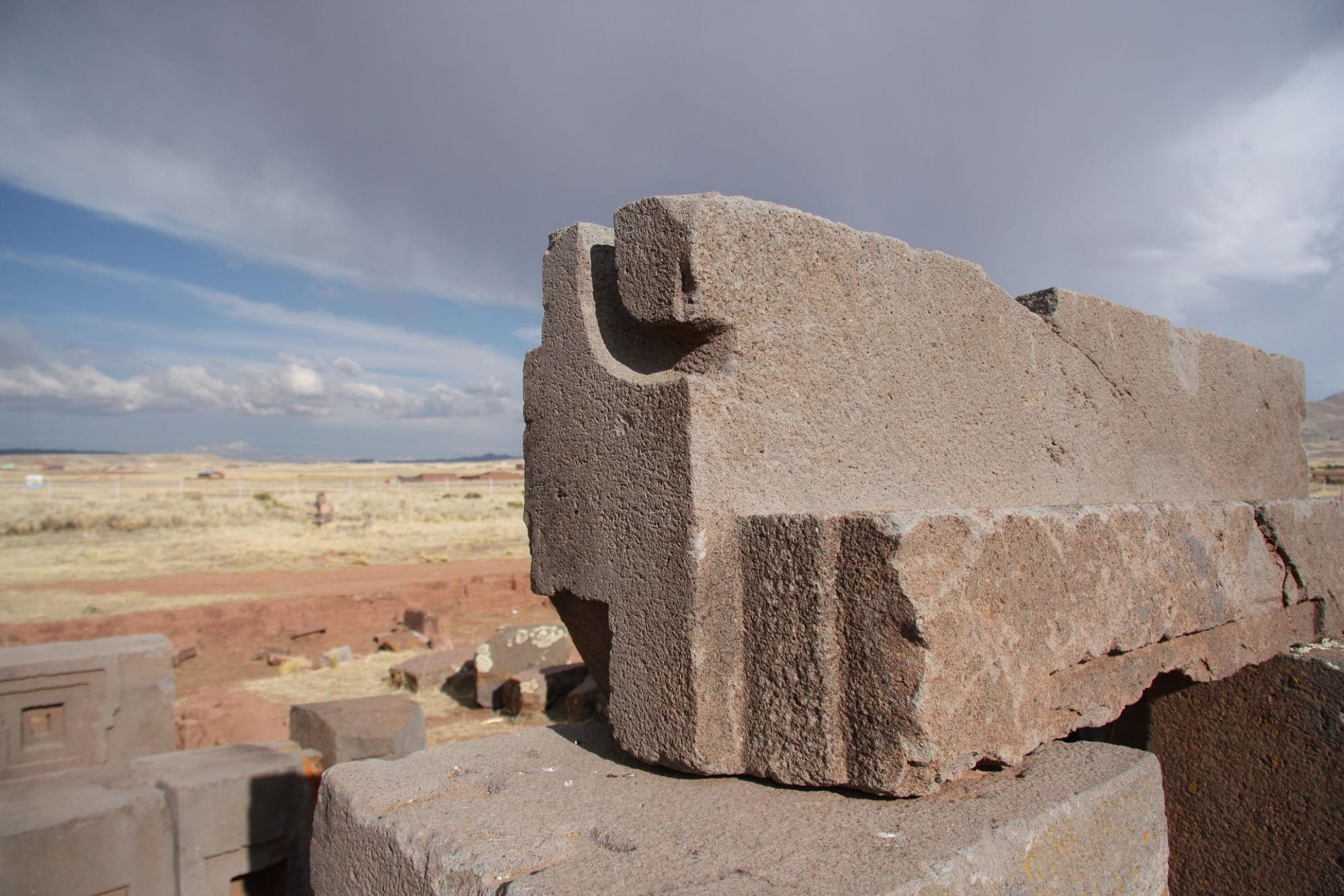
Precision-cut andesite
The most iconic Puma Punku stones are made from andesite, a hard volcanic rock.
Some blocks have crisp edges, sharp interior angles, recessed panels, grooves, and forms that appear standardized. The famous H-blocks are especially striking because they look like repeated architectural units.
This is where the “machine” language usually enters.
People say the stones look laser-cut.
That phrase is understandable visually, but misleading archaeologically.
There is no evidence for lasers.
There is no evidence for modern machinery.
There is no evidence for non-human tools.
What exists is a real stoneworking problem:
How did Tiwanaku artisans produce such clean geometry with the tools available in their world?
That question remains serious.
Researchers have proposed and tested techniques involving stone tools, abrasion, pounding, polishing, templates, straightedges, planning systems, and toolkits that may not have survived or been clearly identified archaeologically.
The cleanest answer is not “impossible.”
The cleanest answer is:
We know the results better than we know every step of the process.
Large sandstone slabs
Puma Punku also contains massive red sandstone blocks and platform elements.
The largest blocks are often discussed because of their weight and transport challenge. Some estimates place major sandstone slabs in the tens of tons, with the largest commonly discussed in the rough range of 80 to 130 tons.
These stones were not sitting conveniently at the site.
Stone sources had to be selected, quarried, shaped, transported, and placed.
That requires planning.
Labor.
Knowledge of terrain.
Staging.
Ropes.
Ramps.
Leverage.
Possibly rollers or sledges.
Coordination.
And social authority strong enough to mobilize the work.
Again, the mystery is not whether humans can move large stones.
Humans have done that in many places.
The mystery is how the Tiwanaku did it here, under these conditions, with these materials, at this altitude, inside this architectural system.
Modular architecture
One of Puma Punku’s most important features is its sense of repetition.
Some stones appear to be reduced versions of larger forms. Some blocks suggest replicated architectural units. Some fragments seem to belong to gateways, panels, walls, miniature models, or carefully designed modules.
This has led researchers to explore whether Tiwanaku builders used a kind of architectural grammar.
A system of forms.
A pattern language.
A way of designing buildings through repeatable stone components.
That is more interesting than the usual online claim.
Not “they had advanced machines.”
But perhaps:
They had advanced design logic.
The stones may show planning, proportional systems, templates, and a conceptual architecture that could scale forms up and down.
The broken gateways
Puma Punku likely included impressive gateway architecture.
Fragments suggest the presence of large monolithic portals or portal-like constructions. These connect Puma Punku to the broader Tiwanaku tradition, including famous monuments such as the Gate of the Sun.
Gateways matter in sacred architecture.
A gate is not only a doorway.
It is a threshold.
A place of transition.
A controlled passage between ordinary and sacred space.
At Puma Punku, the architecture may have guided movement, ritual procession, political theater, and cosmological meaning.
This is critical.
The stones were not just technical objects.
They were parts of a ceremonial machine.
Not a machine of gears.
A machine of meaning.
Reconstruction efforts
Modern researchers have used 3D modeling, historic measurements, and even 3D-printed fragments to test possible reconstructions of Puma Punku’s architecture.
This work is important because it treats the stones as parts of a broken system.
Instead of staring at one block and calling it impossible, reconstruction asks:
What did this block connect to?
What pattern does it repeat?
What fragments match?
What does the building become if the pieces are reassembled?
This is the grounded frontier of Puma Punku research.
The mystery is not only in the stones.
It is in the missing architecture.
The Core Idea or Signal
The core signal of Puma Punku is this:
Ancient precision does not automatically mean modern technology, but it does demand a better imagination of ancient capability.
That is the balance.
Puma Punku is often trapped between two lazy readings.
The first says:
Ancient people could not have done this, so it must be aliens, machines, lost lasers, or a vanished super-civilization.
The second says:
Ancient people did it, so there is nothing to see here.
Both fail.
The first underestimates the Tiwanaku.
The second underestimates the stones.
A better reading holds the tension.
Puma Punku was created within a real Andean civilization.
The site belongs to known cultural history.
But the precision stonework remains extraordinary.
Not supernatural.
Extraordinary.
It shows that ancient societies could develop specialized technical systems without leaving behind the kinds of tool evidence modern people expect.
It also shows that architecture can be both engineering and cosmology.
At Puma Punku, stone was not only cut.
It was organized.
Repeated.
Aligned.
Polished.
Joined.
Symbolized.
Scaled.
And placed into a ritual landscape that likely mattered as much as the construction method.
That is the signal.
Puma Punku is not a machine-age ruin.
It is an ancient design system whose full operating logic has not been completely recovered.
Perspectives and Interpretations
Puma Punku attracts very different interpretations because it sits at the intersection of evidence and imagination.
The archaeological view
The archaeological view places Puma Punku firmly inside Tiwanaku civilization.
This view sees the site as a monumental ceremonial platform, possibly connected to ritual movement, political authority, sacred geography, water systems, and gateway architecture.
It does not require non-human builders.
It does not require modern machines.
It does not require a lost global civilization.
It does, however, recognize that Puma Punku represents an exceptional expression of Andean stone technology.
The builders were not primitive experimenters.
They were specialists.
They worked with difficult materials, complex forms, large stones, and architectural design at a high level.
The engineering view
The engineering view focuses on the difficult questions:
How were the stones shaped?
How were the internal angles produced?
How were flat surfaces generated?
How were repeating forms measured?
How were massive blocks moved?
How were they aligned and assembled?
How much of the system used templates, geometry, and repeated modules?
How much was done with abrasion, pounding, polishing, stone tools, or tools that have not survived?
This is where Puma Punku remains important.
The site does not defeat engineering.
It invites engineering.
It asks modern researchers to reconstruct not only the final stones, but the process behind them.
The lost-technology view
The lost-technology view argues that Puma Punku reflects techniques no longer understood.
This view is not always the same as ancient astronaut theory.
Some versions are modest:
The Tiwanaku may have used specialized tools, methods, templates, abrasives, or construction sequences that archaeology has not fully identified.
That possibility is reasonable.
Ancient toolkits do not always preserve well. Tools can be reused, melted, taken away, misidentified, or made from materials that leave little trace.
Other versions are much stronger:
The stones prove power tools.
The stones prove advanced machining.
The stones prove non-human intervention.
The stones prove a civilization far older than Tiwanaku.
Those claims go beyond the evidence.
The site supports technical sophistication.
It does not establish modern machines.
The ancient astronaut view
Puma Punku is one of the favorite sites of ancient astronaut culture because the stones look so visually unfamiliar.
The blocks feel engineered.
Some cuts look almost industrial.
The ruin is broken enough to invite speculation.
This makes it easy to detach Puma Punku from Tiwanaku and present it as an impossible artifact.
That is the problem.
When the site is removed from its cultural context, it becomes a screen for projection.
The ancient astronaut interpretation often begins with a real observation:
The stonework is astonishing.
Then it jumps to an unsupported conclusion:
Therefore, humans could not have made it.
Wonder is valid.
Erasure is not.
The Tiwanaku deserve to remain in their own story.
Strengths and Limitations
Puma Punku has strong evidence behind it.
The site exists.
The stones exist.
The precision is visible.
The Tiwanaku context is real.
The UNESCO-recognized archaeological landscape is documented.
Modern reconstruction work is ongoing.
The stonework has been studied by serious researchers.
The site’s damaged condition is also documented, which explains why reconstruction remains difficult.
That gives Puma Punku a strong foundation.
But the limitations are just as important.
The original architecture is fragmented.
Many blocks are displaced.
The full construction sequence is not perfectly known.
The complete toolkit has not been recovered.
Some online claims exaggerate the precision, age, scale, and impossibility of the stones.
Some presentations imply that every block was machined to modern tolerances, which is not supported.
Some say the site is 12,000 or 15,000 years old, but mainstream dating places Puma Punku within the Tiwanaku cultural horizon, not deep prehistory.
Some claim the stones are proof of extraterrestrial construction, but no physical evidence supports that conclusion.
A careful Dossier separates the layers.
What is documented:
Puma Punku is part of the Tiwanaku archaeological complex in Bolivia, a major pre-Inca ceremonial and political center with accurately carved stone architecture.
What is claimed:
The site reflects unusually sophisticated ancient stoneworking, transport, design, and modular architectural planning.
What is interpreted:
The complex may have served as a ceremonial platform, threshold architecture, ritual entry zone, or sacred-political space connected to Tiwanaku cosmology.
What remains unresolved:
The exact tools, techniques, transport logistics, construction sequencing, and original architectural arrangement are still debated and reconstructed.
What is speculative:
Claims involving lasers, extraterrestrials, modern machining, vanished global super-civilizations, or extreme prehistoric dates.
That is the honest ledger.
Broader Implications
Puma Punku matters because it forces a more mature conversation about ancient technology.
Technology does not always mean electricity.
It does not always mean engines.
It does not always mean metal machines.
Technology can be social.
Ritual.
Architectural.
Geometric.
Agricultural.
Hydraulic.
Labor-organizing.
Memory-based.
Stonecraft can be a technology.
Measurement can be a technology.
Templates can be a technology.
Procession can be a technology of belief.
A city plan can be a technology of power.
Puma Punku reveals a civilization capable of working with precision, scale, and symbolism in a difficult environment. The altitude alone matters. This was not an easy place to build a major ceremonial center.
The Tiwanaku did not merely survive there.
They organized a world there.
They built public spaces, ceremonial architecture, agricultural systems, drainage systems, and iconographic traditions that influenced later Andean civilizations.
That is what the fringe versions often miss.
They chase the impossible tool and ignore the civilizational system.
But Puma Punku’s true power may be system-level.
It shows that ancient societies could embed knowledge into architecture without leaving written manuals.
They could build with repeatable forms without industrial factories.
They could use stone to create sacred thresholds without needing steel cranes.
They could create a ruin so precise that, centuries later, modern people would mistake the sophistication of the design for evidence that humans were not involved.
That is not a weakness of the ancient world.
It is a weakness of modern imagination.
The Reality Signal
What this subject represents
Puma Punku represents the tension between ancient achievement and modern disbelief.
It is the kind of site that exposes our assumptions quickly.
If we assume ancient people were simple, Puma Punku becomes impossible.
If we assume ancient people were capable of specialized knowledge, Puma Punku becomes difficult but meaningful.
The site represents a lost architectural grammar.
A system of stone forms whose fragments still imply a larger order.
It also represents the damage caused when ruins lose their context.
When a sacred structure becomes a scatter of broken blocks, imagination rushes in to rebuild what archaeology has not yet fully restored.
What reality frame it challenges
Puma Punku challenges the modern frame that precision belongs only to industrial civilization.
It challenges the idea that complexity requires modern machines.
It challenges the belief that ancient architecture was mostly rough, symbolic, or approximate.
But it also challenges fringe certainty.
Because a site can be mysterious without being alien.
A stone can be precise without being laser-cut.
A technique can be lost without being impossible.
A civilization can be advanced without resembling us.
That is the deeper reality frame.
Progress is not a straight line from primitive to modern.
Sometimes knowledge is local.
Specialized.
Embodied.
Inherited.
Lost.
Misread.
Reconstructed centuries later by people who assume their own tools are the only possible tools.
Why it matters now
Puma Punku matters now because ancient technology has become a major cultural battleground.
People are revisiting old timelines, megalithic sites, submerged landscapes, pyramids, geoglyphs, and pre-Inca architecture with renewed curiosity.
That curiosity is healthy.
But it needs discipline.
Puma Punku is a perfect test case.
It deserves wonder.
It also deserves context.
It should not be reduced to “aliens did it.”
It should not be dismissed as “just stones.”
It should be studied as a high-altitude expression of Tiwanaku design intelligence, where stonecraft, sacred space, and social organization met at a level still difficult to reconstruct.
Modern technologies like 3D modeling and 3D printing are now helping researchers reassemble the broken architecture in new ways.
That creates a powerful reversal.
The ancient builders used stone to encode form.
Modern researchers use digital tools to recover the form.
Between them sits the mystery:
How much knowledge can survive after the system that made it disappears?
What remains unresolved
The unresolved ledger is what keeps Puma Punku alive.
What is established:
Puma Punku is part of the Tiwanaku archaeological complex, a major pre-Inca center in Bolivia recognized for ceremonial and public architecture, accurately carved stonework, and cultural influence across the southern Andes.
What is claimed:
The site reflects advanced stoneworking, modular design, transport capability, and ritual architecture.
What remains unresolved:
The exact tools, techniques, original layout, construction sequence, transport logistics, and full symbolic function of the complex.
What remains speculative:
Claims of lost machining, extraterrestrial builders, laser cutting, extreme prehistoric dating, or a vanished non-Andean civilization.
Why it still matters:
Because Puma Punku reminds us that ancient people could create precision without becoming modern, and that lost knowledge does not always announce itself as myth. Sometimes it survives as a broken stone with a right angle no one can easily explain.
The Galactic Mind Perspective
Puma Punku tests something deeper than our theories about ancient tools.
It tests what modern civilization is capable of recognizing as intelligence.
We readily identify technology when it resembles our own: machines, engines, written calculations, factories, and standardized metal components. But an ancient technical system may have been distributed across trained hands, inherited procedures, physical templates, quarry knowledge, social organization, ritual authority, and forms of measurement that were never written down.
When that system disappears, the achievement remains while the operating instructions do not.
That imbalance creates the illusion of impossibility.
The surviving stones tell us that the Tiwanaku possessed the knowledge required to produce them. What they do not preserve is every experiment, failed block, workshop practice, transport method, measurement convention, or apprenticeship through which that knowledge was transmitted.
This does not make the strongest alternative claims true. Puma Punku has produced no verified evidence of extraterrestrial builders, laser cutting, or an industrial civilization erased from the archaeological record.
But rejecting those claims should not collapse the site into something ordinary.
The more consequential possibility is already visible: human civilizations can develop highly specialized systems of knowledge, encode those systems into architecture, and then lose enough of the process that later cultures struggle to reconstruct how the work was accomplished.
Puma Punku therefore represents a problem of civilizational memory.
Its mystery is not necessarily that someone other than the Tiwanaku built it. The mystery is how completely a real human capability can disappear while its results remain in plain sight.
That shifts the question away from Who else must have done this?
The better question is:
What else have human civilizations known, embodied, and lost because the system carrying that knowledge did not survive?
Open Thread
Puma Punku does not force a choice between ancient aliens and archaeological dismissal.
The evidence places the monument inside the Tiwanaku world. Its sandstone platforms, andesite components, architectural fragments, and ceremonial setting belong to a real Andean civilization—not an anonymous culture detached from history.
Yet cultural attribution is not the same as technical reconstruction.
Questions remain about the precise sequence of quarrying, transport, measurement, shaping, finishing, and assembly. The original arrangement is still being reconstructed, and the monument’s full ceremonial and symbolic purpose cannot be recovered from displaced blocks alone.
Perhaps that is why Puma Punku remains so compelling.
It does not break the timeline.
It reveals how incomplete the timeline can become when knowledge survives only through its products.
If we remove both the unsupported machinery claims and the impulse to dismiss the stonework as fully explained, what does Puma Punku actually show us about the sophistication and fragility of human knowledge?
What do you think? Drop your thoughts in the comments ...
More in Dossiers
Puma Punku and the Precision Problem of Ancient Stone
The foundational Dossier separating Puma Punku’s documented archaeology from claims involving lost machinery, extreme antiquity, and non-human construction.
The Nazca Lines and the Desert Geometry of the Ancient Mind
An examination of immense geoglyphs, ritual landscapes, astronomical interpretations, and the modern stories projected onto the Peruvian desert.
Great Zimbabwe: Stone, Trade, and the Fight Over Meaning
How an African stone city became evidence of a sophisticated civilization—and of what happens when ideology refuses to recognize ancient human achievement.
Sources / Receipts
- UNESCO World Heritage Centre — Tiwanaku: Spiritual and Political Centre of the Tiwanaku Culture
Official historical and archaeological context for Tiwanaku and its World Heritage designation. - Alexei Vranich — “Reconstructing Ancient Architecture at Tiwanaku, Bolivia: The Potential and Promise of 3D Printing”
Open-access research using digital models and 3D-printed fragments to test possible reconstructions of Puma Punku. - Alexei Vranich — “The Construction and Reconstruction of Ritual Space at Tiwanaku, Bolivia”
Archaeological analysis of Tiwanaku’s monumental spaces and the challenges involved in reconstructing their original forms. - Alexei Vranich — “A Radiocarbon Chronology of the Pumapunku Complex and a Reassessment of the Development of Tiwanaku, Bolivia”
Research examining the chronology of the Puma Punku complex within Tiwanaku’s broader development. - Jean-Pierre Protzen and Stella Nair — The Stones of Tiahuanaco: A Study of Architecture and Construction
Major architectural study of Tiwanaku stoneworking, construction methods, gateways, and monument design. - Jean-Pierre Protzen — “On Reconstructing Tiwanaku Architecture”
Examination of the evidence and methodological problems involved in reconstructing Tiwanaku’s damaged monuments. - Jean-Pierre Protzen and Stella Nair — “Who Taught the Inca Stonemasons Their Skills?”
Comparative study of Tiwanaku and Inca cut-stone masonry, including tools, techniques, and architectural traditions.


Discussion