
Before the computer became a device, it was an arrangement.
Memory.
Instruction.
Control.
Calculation.
Input.
Output.
A way of making thought executable.
John von Neumann stands near one of the strangest thresholds in modern history: the moment mathematics stopped being only a language for describing reality and became a machine for reorganizing it.
He was not simply a mathematician.
He was not simply a computing pioneer.
He was not simply a Cold War strategist.
Von Neumann was one of the rare figures whose ideas moved across nearly every major reality-system of the twentieth century: mathematics, physics, economics, war, computation, weather, artificial life, and the brain.
The Institute for Advanced Study describes him as a figure who helped pioneer the modern computer, game theory, nuclear deterrence, and more, with influence across pure and applied mathematics, computer science, physics, and economics.
That range is difficult to absorb.
It almost sounds exaggerated.
But with von Neumann, the exaggeration often fails in the opposite direction.
The deeper question is not only what he contributed.
The deeper question is what his life reveals about the twentieth century itself.
A world where logic became hardware.
Where strategy became mathematics.
Where war became simulation.
Where the brain became comparable to a machine.
Where civilization began to treat reality as something that could be modeled, computed, optimized, and predicted.
Von Neumann did not create that world alone.
But he helped give it architecture.
Overview
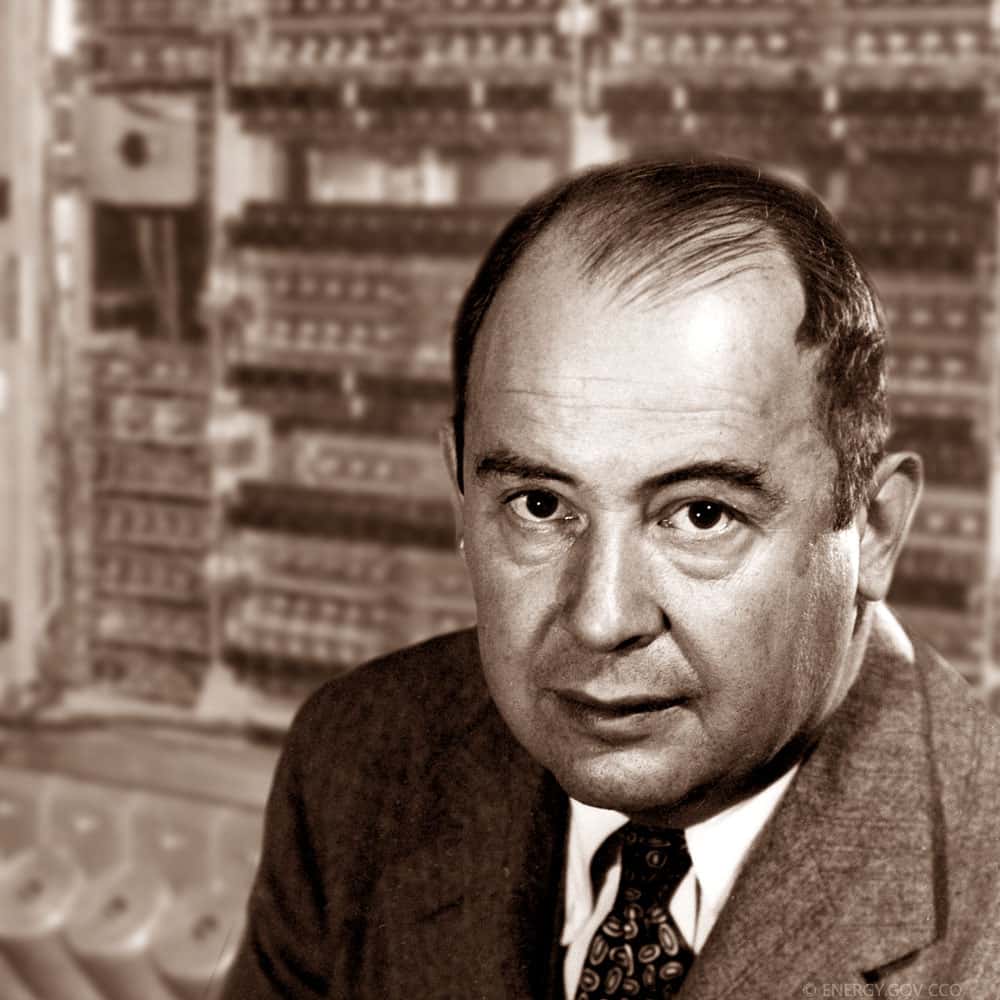
John von Neumann was a Hungarian-American mathematician, physicist, computer pioneer, and strategic thinker born in Budapest in 1903 and later associated with Princeton University and the Institute for Advanced Study. The IAS notes that he arrived in the United States in 1930 and, at age 30, became the youngest professor at the Institute for Advanced Study’s School of Mathematics.
His work touched an almost impossible spread of fields.
Set theory.
Quantum mechanics.
Operator algebras.
Game theory.
Computing.
Numerical simulation.
Ballistics.
Hydrodynamics.
Meteorology.
Nuclear strategy.
Artificial life.
The relationship between computers and the brain.
Most figures become known for one doorway into the future.
Von Neumann left several doors open at once.
He helped formalize game theory with economist Oskar Morgenstern.
He played a central role in the development and dissemination of the stored-program computer model commonly associated with “von Neumann architecture.”
He worked as a consultant during World War II and the early Cold War.
He later explored the analogy between computing machines and the living brain in The Computer and the Brain, published after his death by Yale University Press. Yale describes the book as a work exploring analogies between computers and the human brain, including von Neumann’s view that the brain operates both digitally and analogically, with its own statistical language.
For The Galactic Mind, von Neumann belongs in the archive because he represents something larger than intellectual brilliance.
He represents the rise of the calculable world.
The belief that reality, strategy, society, intelligence, and even life itself could be described in formal terms.
That belief built the modern age.
It also left behind questions we are still living inside.
Origins and Background
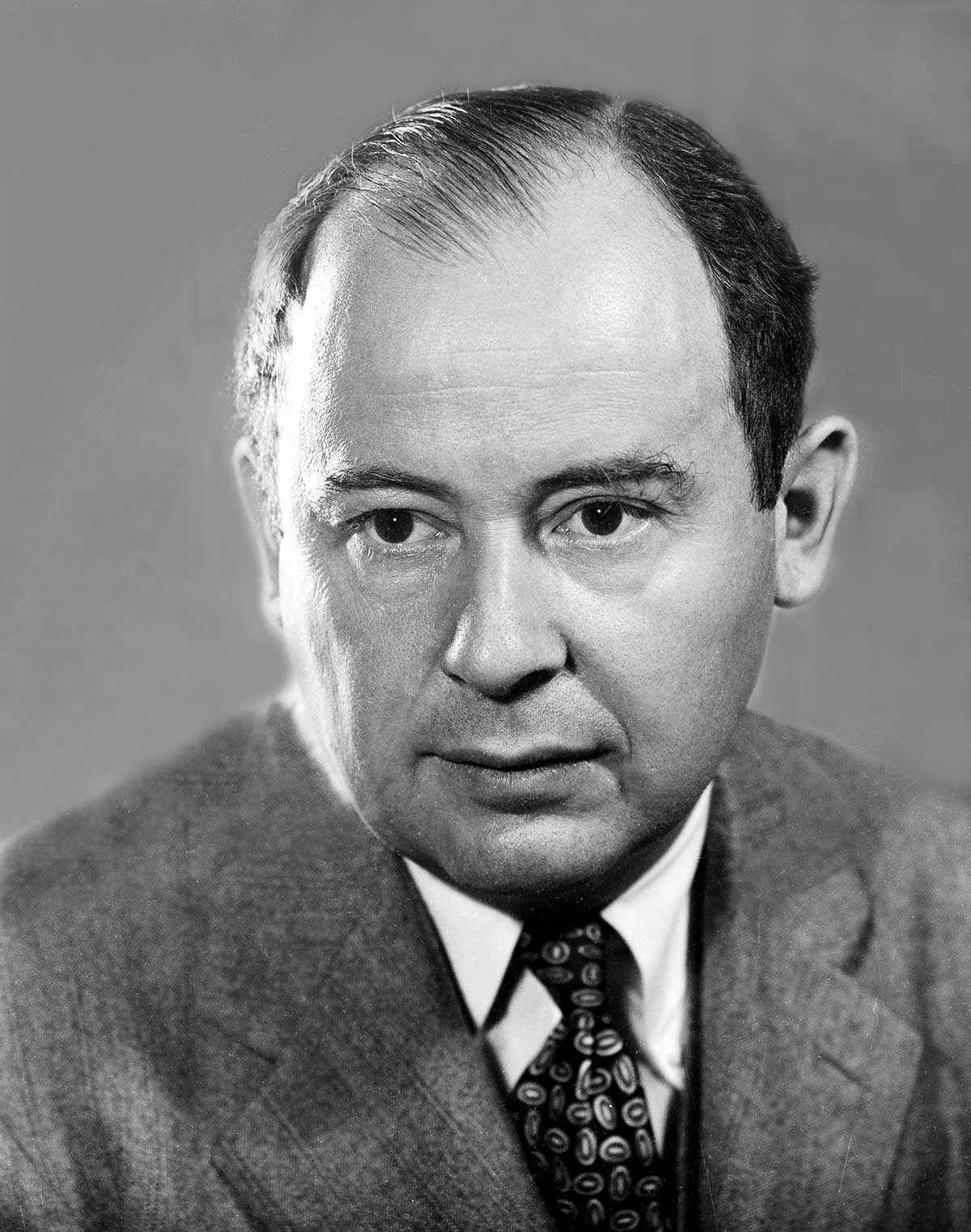
John von Neumann was born János von Neumann in Budapest on December 28, 1903. The IAS describes him as a classic child prodigy with extraordinary mental arithmetic ability and notes that he studied mathematics while also pursuing chemical engineering, eventually receiving a doctorate in mathematics from the University of Budapest in 1926.
His early intellectual environment was Europe between wars.
Mathematics was being transformed.
Physics was being transformed.
Logic was being transformed.
The old certainties of classical science were being pushed by quantum mechanics, relativity, formal logic, and the question of whether mathematics itself could be placed on secure foundations.
Von Neumann emerged inside that pressure field.
He studied in Göttingen, held positions in Berlin and Hamburg, and entered the Princeton orbit at a time when European intellectual life was being shattered by political catastrophe. The IAS notes that he was among the Hungarian and Jewish intellectuals who escaped Europe’s turmoil and came to the United States.
That migration mattered.
It helped relocate part of Europe’s mathematical and scientific brain trust into American institutions.
The result was not only academic.
It was civilizational.
The same minds that had been shaped by abstract mathematics, quantum theory, and formal logic would soon be drawn into war, computation, and state power.
Von Neumann became one of the clearest examples of this shift.
During World War II, he worked on hydrodynamics, ballistics, meteorology, game theory, and statistics, and he worked on the Manhattan Project.
After the war, his attention moved even more deeply into computing.
The Institute for Advanced Study’s Electronic Computer Project began in late 1945, with von Neumann as a persuasive advocate for building a general-purpose electronic computing machine at an institution originally built for theoretical work.
That transition is important.
The abstract mathematician became an architect of machines.
The theorist of logic became a builder of infrastructure.
The man who understood formal systems helped bring one into the physical world.
What It’s Known For
John von Neumann is known for several major contributions, but his influence is best understood as a pattern.
He repeatedly found ways to turn complex reality into formal structure.
Game theory
Von Neumann’s early work on games led toward one of the most important intellectual frameworks of the twentieth century.
The IAS notes that by 1928 he had written “The Theory of Parlor Games,” which contained a proof of the minimax theorem and concerned two-person zero-sum games.
In 1944, von Neumann and economist Oskar Morgenstern published Theory of Games and Economic Behavior. The Stanford Encyclopedia of Philosophy describes von Neumann and Morgenstern’s 1944 work as the great historical breakthrough that officially launched game theory.
Game theory changed how people thought about conflict, cooperation, markets, negotiation, war, and rational behavior.
It suggested that human action could be modeled as strategic interaction.
Not just choice.
Choice under conditions where other minds are choosing too.
That shift matters.
It turned society into a board of moves and counter-moves.
Poker.
Markets.
Diplomacy.
Nuclear deterrence.
Corporate competition.
Evolutionary behavior.
AI alignment.
Game theory became one of the languages of modern strategy.
Von Neumann helped formalize that language.
The stored-program computer
Von Neumann is closely associated with the architecture of the modern digital computer.
The Computer History Museum notes that the IAS computer and its “von Neumann architecture,” first described in the First Draft of a Report on the EDVAC, became a model for computers built at governmental and scientific institutions, standardizing the storage of programs and data in a computer’s common memory.
That idea is difficult to overstate.
A machine could store not only data, but instructions.
A program could become something held inside memory.
The machine could be general-purpose.
Not hardwired for one task.
Reprogrammable.
Symbolic.
Flexible.
This is one of the deep roots of the modern computer.
But the history must be handled carefully.
The “von Neumann architecture” label can make it sound as if von Neumann alone invented the modern computer. That is too simple. The Computer History Museum notes that the term fell out of favor among some historians because it masked the contributions of J. Presper Eckert and John Mauchly, and because the concepts around “stored program” computing were more historically complex than a single-person origin story.
The better reading is this:
Von Neumann did not single-handedly invent modern computing.
But his report, his institutional power, his mathematical clarity, and the IAS project helped crystallize and disseminate a model that became foundational.

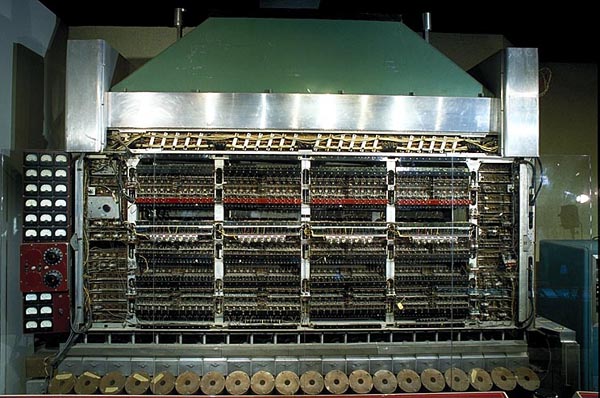
The IAS computer
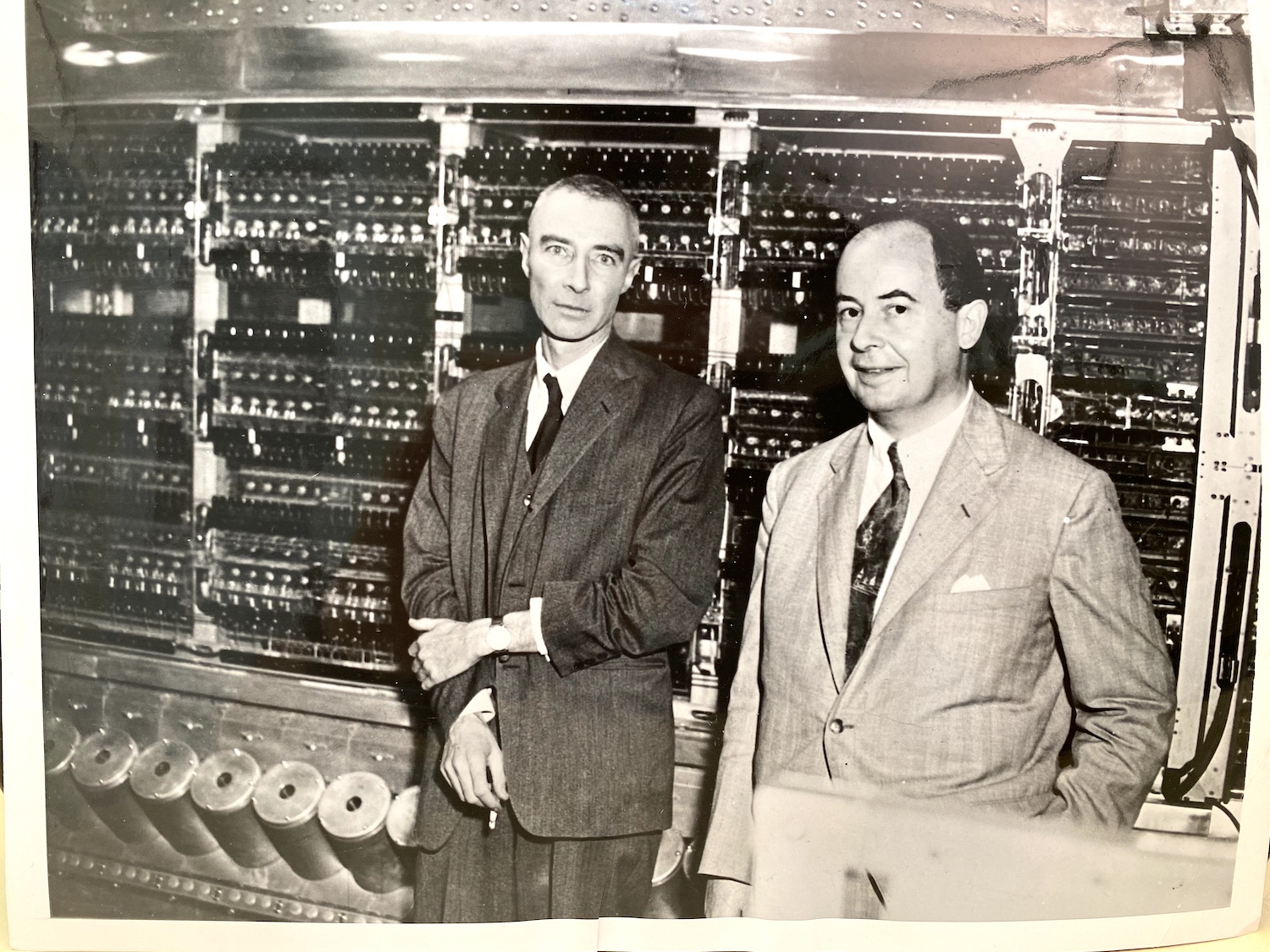
The IAS Electronic Computer Project turned the architecture into a physical machine.
The IAS describes the project as an effort to build a general-purpose postwar tool for scientific research, born from the demands of war but directed toward broader scientific use.
The Smithsonian notes that the IAS Computer was built from 1946 to 1951 at the Institute under von Neumann’s direction, with support from the Institute, the U.S. Atomic Energy Commission, and military agencies.
The Computer History Museum says the IAS machine became operational in 1952 and served as a prototype for the first generation of digital computers; seventeen similar vacuum-tube machines were built by governments and scientific institutions around the world.
That is the signal.
Von Neumann’s computer was not only a machine.
It was a pattern.
A template.
An architecture that could replicate through institutions.
The modern world was not only computed.
It was copied.
War, simulation, and deterrence
Von Neumann’s work cannot be separated from war.
The IAS describes his wartime work across hydrodynamics, ballistics, meteorology, game theory, statistics, the Manhattan Project, and government consulting. It also notes that in 1954 he was asked to become one of five atomic energy commissioners.
This is where the Dossier becomes morally complex.
Von Neumann helped bring mathematics into the machinery of war.
He worked in a period when states were using science to calculate destruction, optimize weapon systems, model blast effects, and think strategically about existential risk.
That does not make him a simple villain.
It does not make him a neutral hero either.
It makes him a figure of the twentieth century.
The same intellectual tools that could simulate weather could also simulate weapons.
The same mathematics that could model rational choice could inform nuclear deterrence.
The same computing machines that could help science could help war.
Von Neumann’s life does not allow a clean separation between intelligence and consequence.
The computer and the brain
Near the end of his life, von Neumann turned toward one of the deepest questions in computing:
What is the relationship between the computer and the brain?
His posthumous book The Computer and the Brain explored the analogy between computing machines and the living human brain. Yale University Press describes the work as comparing computers and brains and notes von Neumann’s conclusion that the brain operates both digitally and analogically, with a peculiar statistical language of its own.
This matters for The Galactic Mind because it sits near the origin of one of the most powerful metaphors of modern consciousness studies.
The brain as computer.
The mind as information processing.
Thought as computation.
That metaphor shaped cognitive science, AI, neuroscience, and the public imagination.
But von Neumann’s own comparison was not as crude as the slogan became.
He was interested in both similarities and differences.
The machine and the brain were not identical.
The analogy was a doorway, not a verdict.

Self-reproducing automata
Von Neumann also worked on self-reproducing automata, a field that later became important to artificial life, cellular automata, robotics, and speculative ideas about self-replicating machines.
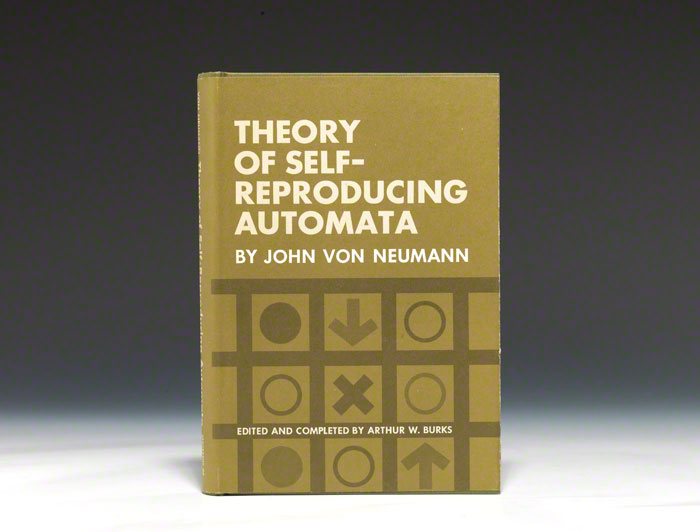
The IAS notes that his Theory of Self-Reproducing Automata was published in 1966, reconstructed from his manuscripts and notes by Arthur Burks.
This piece of the story feels especially modern.
A machine that can reproduce itself.
A formal system that can generate another version of its own structure.
A bridge between life and mechanism.
Long before contemporary AI, synthetic biology, nanotechnology, or von Neumann probes became part of futurist vocabulary, von Neumann was already thinking about how formal systems could imitate one of life’s deepest properties:
Replication.
The Core Idea or Signal
The core signal of John von Neumann is this:
Reality can be formalized.
That was his genius.
And the danger.
He saw patterns that could be turned into mathematics.
He saw games behind conflict.
Architecture behind computation.
Logic behind machines.
Models behind weather.
Strategy behind war.
Information behind biology.
Analogy between computers and brains.
The world, through von Neumann’s lens, became something that could be structured.
Not completely.
Not perfectly.
But enough to act upon.
That is the crucial shift.
When reality becomes formal, it becomes computable.
When reality becomes computable, it becomes programmable.
When reality becomes programmable, it becomes governable, scalable, weaponizable, automated, and simulated.
Von Neumann’s influence sits at that threshold.
He helped build the age where the map became powerful enough to alter the territory.
That is why he matters now.
Not only because we still use computing architectures descended from his world.
But because we now live inside the worldview he helped accelerate.
A world of models.
Systems.
Predictions.
Simulations.
Optimization.
Game-theoretic strategy.
Machine intelligence.
And the unresolved question of whether mind itself can be understood as computation.
Perspectives and Interpretations
Von Neumann can be interpreted through several lenses.
The mathematical view
From the mathematical view, von Neumann represents extraordinary range.
His work touched set theory, functional analysis, quantum mechanics, operator algebras, statistics, game theory, and more. The IAS describes his lectures on Hilbert space, measure theory, rings of operators, and continuous geometry as attracting wide attention among mathematicians and physicists.
In this view, his importance comes from the breadth and speed of his mind.
He was not simply solving isolated problems.
He moved between domains as if the borders were less real than everyone assumed.
That is part of his mystique.
The computer-history view
From the computer-history view, von Neumann is a foundational but complicated figure.
He helped articulate and spread the stored-program model that became central to modern computing. The Smithsonian holds the First Draft of a Report on the EDVAC, created by von Neumann and published by the Moore School of Electrical Engineering in 1945, as a public-domain historical document.
But historians also caution against treating him as the sole origin point.
The EDVAC and ENIAC histories included many contributors, including engineers and programmers whose names were often overshadowed. The Computer History Museum specifically notes that “von Neumann architecture” can mask the contributions of Eckert and Mauchly.
A grounded Dossier has to hold both truths.
Von Neumann was central.
He was not alone.
The strategic view
From the strategic view, von Neumann is one of the figures who helped mathematize conflict.
Game theory changed how people understood rational decision-making under competition. The Stanford Encyclopedia of Philosophy notes that von Neumann and Morgenstern’s 1944 introduction of game theory analyzed strategic situations such as zero-sum games and helped launch the field.
This influence became especially charged in the Cold War.
The world of nuclear deterrence was not just about weapons.
It was about signals.
Commitments.
Threats.
Credibility.
Expected responses.
Moves and counter-moves.
A planet thinking in game-theoretic terms.
That is one of von Neumann’s more unsettling legacies.
He helped create tools for understanding strategy.
Those tools became part of a world capable of destroying itself.
The AI and cognitive science view
From the AI and cognitive science view, von Neumann helped deepen the comparison between minds and machines.
His work on computing architecture and his later reflections in The Computer and the Brain made him part of the early conversation about whether cognition could be understood computationally. Yale describes that book as one of the classic works exploring analogies between computing machines and the human brain.
This matters now because artificial intelligence has made the analogy unavoidable again.
If a computer can process symbols, learn patterns, generate language, and simulate reasoning, what exactly separates the machine from the mind?
Von Neumann did not answer that question for us.
But he helped build the world in which we are forced to ask it.
The critic’s view
Critics can reasonably read von Neumann as a warning.
He represents the brilliance of abstraction without the guarantee of wisdom.
Mathematics can clarify.
It can also distance.
A model of war is still connected to war.
A theory of deterrence is still connected to existential danger.
A machine for calculation can become a machine for weapons design.
A framework for rational choice can flatten the moral complexity of human life into payoff structures.
That critique should not be dismissed.
Von Neumann’s life shows how quickly pure intelligence can become institutional power.
And institutional power does not always ask the deepest ethical questions before acting.
Strengths and Limitations
Von Neumann’s greatest strength was his ability to move across fields without losing precision.
He did not merely borrow metaphors.
He built formal systems.
He converted messy domains into mathematical structure.
That gave his work enormous force.
Game theory gave strategy a formal language.
Computer architecture gave calculation a general-purpose machine.
Numerical simulation gave science a new instrument.
The computer-brain analogy gave cognition a new frame.
But the limitations are equally important.
First, the “von Neumann architecture” label can distort history.
The stored-program computer emerged through a network of people, institutions, wartime needs, and engineering work. Von Neumann’s role was central, but not solitary. The Computer History Museum notes that the name can obscure the contributions of other figures in the EDVAC and ENIAC story.
Second, mathematical clarity is not the same as moral clarity.
A model can be elegant and still be used for destructive purposes.
Third, formal systems can tempt civilization into believing that anything not easily modeled is secondary.
Meaning.
Embodiment.
Ethics.
Consciousness.
Culture.
The irrational.
The sacred.
The unmeasurable.
Von Neumann’s world gives us power over reality by abstracting it.
But abstraction always leaves something behind.
A grounded ledger helps.
What is documented:
John von Neumann was a major figure in mathematics, game theory, computing, wartime science, the IAS Electronic Computer Project, and the early comparison between computers and brains.
What is claimed:
His work helped define major frameworks of the twentieth century: strategic rationality, stored-program computing, numerical simulation, and the computational analogy of mind.
What is interpreted:
Supporters see him as one of the most brilliant and consequential intellects of modern history. Critics see him as a symbol of how formal intelligence can become entangled with military power, technological acceleration, and moral abstraction.
What remains unresolved:
Whether the machine architecture he helped formalize is still the right metaphor for mind.
Whether computation can fully explain intelligence.
Whether formal models can safely guide civilization through existential risk.
Whether the calculable worldview can contain everything human beings value.
What is speculative:
Any claim that von Neumann “created the modern world” alone.
He did not.
But he helped shape several of its operating systems.
Broader Implications
Von Neumann matters because we are now living inside a von Neumann-shaped reality.
Not literally in every technical detail.
Modern computing has moved far beyond the vacuum-tube machines of the 1940s and 1950s.
But the deeper pattern remains.
Reality is modeled.
Systems are simulated.
Strategies are optimized.
Machines process instructions.
Data becomes memory.
Programs act on programs.
Artificial intelligence emerges from computation at scale.
The economy behaves like a game.
War behaves like a game.
Politics behaves like a game.
Social media behaves like a game.
Markets behave like systems of prediction, incentive, and response.
This is the world von Neumann helped make thinkable.
His legacy also matters because of AI.
The AI age is not only about faster computers.
It is about the fusion of several von Neumann threads:
Computation.
Strategy.
Simulation.
Self-replication.
Machine cognition.
Human-machine analogy.
Optimization under uncertainty.
The world is becoming more formal, more automated, and more recursive.
Software now writes software.
Models train other models.
Agents may eventually plan, act, cooperate, deceive, replicate, and optimize inside digital environments.
That sounds futuristic.
But the roots are old.
Von Neumann’s work on self-reproducing automata and his interest in the computer-brain relationship show how early the question appeared: can life, mind, and intelligence be understood as formal processes?
This also connects to existential risk.
Von Neumann asked, in a 1955 Fortune article, “Can We Survive Technology?” The IAS notes that he saw technology and science as neutral forces that could be used for good or ill, and that the future would require patience, flexibility, and intelligence rather than a single prescription.
That question has not aged out.
It has become more urgent.
Nuclear weapons.
Climate modeling.
AI.
Biotechnology.
Cybernetics.
Autonomous systems.
Synthetic life.
Planet-scale surveillance.
The same pattern keeps returning:
Humanity gains a new formal power over reality before it fully understands the consequences of using it.
Von Neumann’s story is not only about genius.
It is about acceleration.
The moment human intelligence began building tools powerful enough to reshape the conditions of human survival.
The Reality Signal
What this subject represents
John von Neumann represents the architecture of the formal world.
He represents the moment mathematics became infrastructure.
Not just symbols on a board.
Machines.
Strategies.
Weapons.
Simulations.
Economic models.
Computational minds.
Self-replicating systems.
He represents the belief that reality can be translated into structure.
That belief is one of the foundations of the modern age.
It gave humanity extraordinary power.
It also gave humanity new ways to distance itself from consequence.
What reality frame it challenges
Von Neumann challenges the older frame that reality is too messy, human, organic, spiritual, or unpredictable to be formalized.
His life says:
Conflict can be modeled.
Markets can be modeled.
Machines can store instructions.
Weather can be simulated.
The brain can be compared to a computer.
Life can be studied as self-reproduction.
Reality can be abstracted.
But he also challenges the opposite frame:
That formalization is enough.
His life reveals the tension between calculation and wisdom.
Between intelligence and judgment.
Between model and meaning.
Between the world as system and the world as lived reality.
Why it matters now
Von Neumann matters now because the twenty-first century is entering a new computational threshold.
AI systems are becoming more powerful.
Digital infrastructure is becoming more central.
Strategic behavior is being automated.
Prediction systems shape markets, politics, warfare, and personal life.
Self-improving and self-replicating technologies are no longer only theoretical concerns.
The world is becoming more machine-readable.
More modeled.
More optimized.
More strategic.
That is a von Neumann reality.
The question is whether humanity can develop wisdom at the same speed it develops computation.
What remains unresolved
The unresolved ledger is where von Neumann’s signal remains alive.
What is established:
He was one of the most consequential mathematicians and computing figures of the twentieth century, with major influence across game theory, computing, wartime science, and the early computer-brain conversation.
What is claimed:
His work helped define the operating logic of modern technological civilization.
What remains unresolved:
Whether formal systems can ever fully contain consciousness, ethics, meaning, or human life.
Why it still matters:
Because the future is being built by models.
And models do not merely describe reality anymore.
They increasingly govern it.
The Galactic Mind Perspective
John von Neumann belongs in The Galactic Mind archive because he reveals one of the most important transformations in modern history:
The conversion of reality into computation.
He did not just help invent machines.
He helped build the logic that made machines central.
He did not just study games.
He helped formalize strategic behavior.
He did not just work on scientific problems.
He helped create tools for simulating worlds.
He did not just compare computers and brains.
He helped make that comparison part of the modern imagination.
That is why his influence feels almost invisible now.
It has become part of the operating background.
The world already thinks in his patterns.
Programs and data.
Players and strategies.
Systems and simulations.
Optimization and deterrence.
Machine and mind.
But the deeper question is not whether von Neumann was brilliant.
That is settled.
The deeper question is whether brilliance is enough.
A civilization can calculate faster than it can reflect.
It can model before it understands.
It can optimize before it asks what should be optimized.
It can build machines before it understands the mind.
It can create systems before it knows whether those systems serve life.
That is the warning inside the genius.
Von Neumann’s legacy is not a simple monument.
It is a map of power.
It shows what happens when thought becomes architecture.
And it leaves us with the question that now sits beneath AI, nuclear technology, synthetic life, and planetary systems:
Can humanity survive the tools created by its most brilliant abstractions?
Open Thread
John von Neumann leaves us with a question that grows sharper with every generation of technology.
What happens when reality becomes computable?
When conflict becomes a game.
When weather becomes a model.
When life becomes an automaton.
When the brain becomes a machine.
When strategy becomes mathematics.
When the future becomes simulation.
Maybe von Neumann’s deepest legacy is not the computer architecture that bears his name.
Maybe it is the worldview beneath it:
The idea that reality can be translated into formal systems powerful enough to act back upon reality.
That idea built the modern world.
But it may not be enough to guide it.
If the twentieth century taught us how to compute reality, the twenty-first may ask whether computation can understand what reality is for.
What do you think? Drop your thoughts in the comments ...
Sources / Receipts
- Institute for Advanced Study, “John von Neumann: Life, Work, and Legacy” — biography, Princeton / IAS context, wartime work, awards, game theory, computer-brain work, self-reproducing automata, and “Can We Survive Technology?”
- Institute for Advanced Study, Electronic Computer Project — origins of the IAS computer, von Neumann’s role, stored-program architecture, influence of the IAS machine, and its replication across institutions.
- Computer History Museum, “John von Neumann Born” — EDVAC, IAS computer, and the standardization of programs and data in common memory.
- Computer History Museum, “The Neverending Quest for Firsts” — historical caution around “von Neumann architecture” and the masking of Eckert and Mauchly’s contributions.
- Computer History Museum, “Establishing a Pattern: Von Neumann at the IAS” — IAS machine as prototype and its influence on early digital computers.
- Smithsonian Libraries and Archives, First Draft of a Report on the EDVAC — public-domain archival record of the 1945 report.
- Smithsonian National Museum of American History, IAS Computer — object record, build dates, von Neumann direction, funding, and usage details.
- Stanford Encyclopedia of Philosophy, Game Theory — von Neumann and Morgenstern’s 1944 work as the historical breakthrough launching game theory.
- Yale University Press, The Computer and the Brain — description of von Neumann’s computer-brain analogy and later relevance.


Discussion