
Overview
Beneath Teotihuacan’s Temple of the Feathered Serpent, archaeologists uncovered one of the most compelling subterranean ritual spaces in Mesoamerica: a long, deliberately sealed tunnel ending in chambers loaded with offerings, reflective minerals, and traces of liquid mercury. The site was discovered after a sinkhole opened in 2003 near the temple, and the tunnel was later mapped and excavated by a team led by Sergio Gómez of Mexico’s National Institute of Anthropology and History. The larger city of Teotihuacan, now a UNESCO World Heritage site, was built between the 1st and 7th centuries A.D. and was one of the most powerful urban and cultural centers in Mesoamerica.
What makes this tunnel matter is not simply that it contained strange things. It matters because the finds appear to have been arranged as part of a cosmological environment: shining mineralized walls, symbolic depressions in the floor, offerings placed in sequence, and mercury likely intended to evoke sacred water in the underworld. The result is a space that feels less like a storage chamber and more like a staged descent into sacred reality. That interpretation is strongest in the archaeological literature itself, not just in mystery media.
Origins and Background
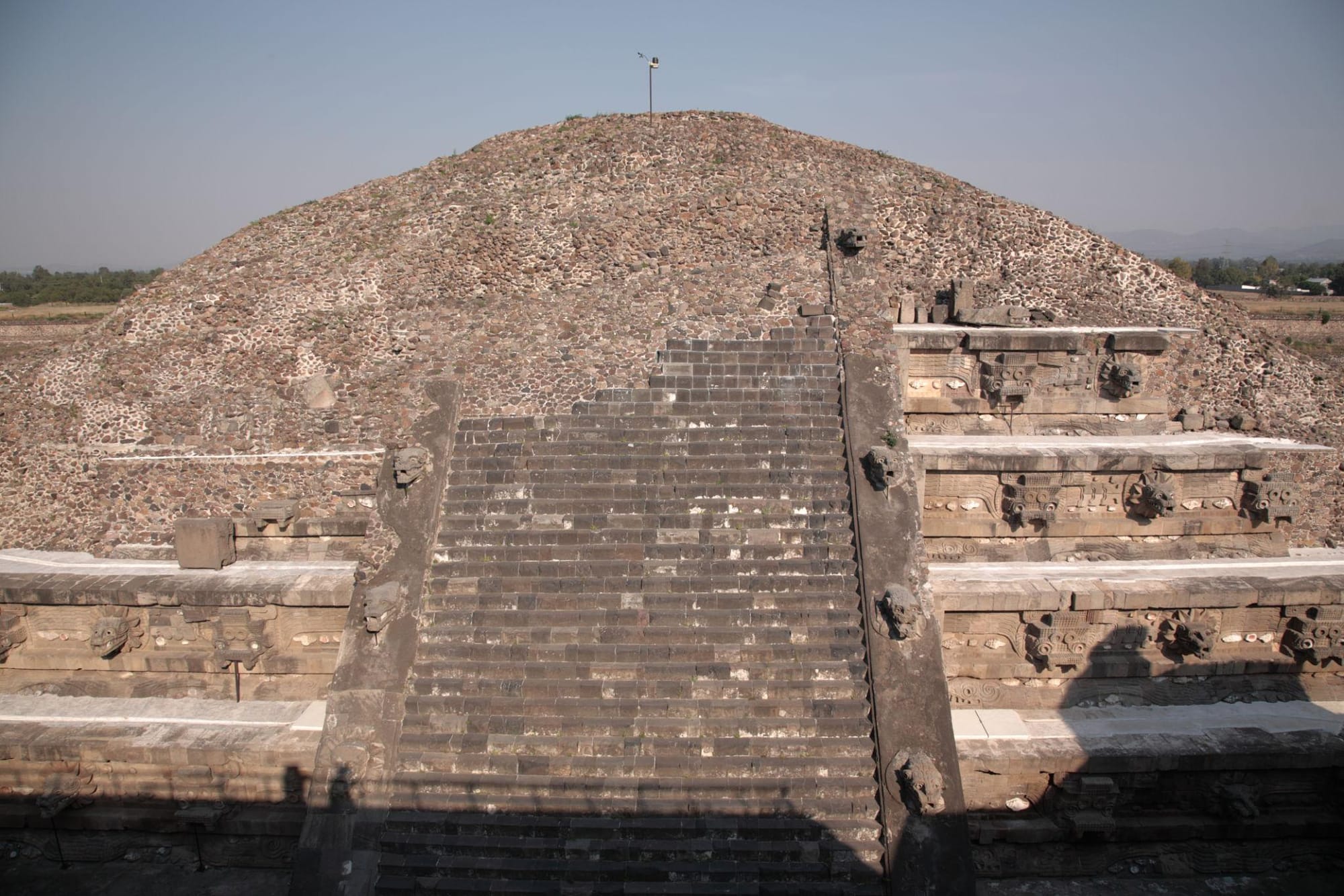
The tunnel sits beneath the Temple of the Feathered Serpent, also known as the Temple of Quetzalcoatl or the Temple of the Plumed Serpent, inside the Ciudadela complex at Teotihuacan, roughly 50 kilometers northeast of Mexico City. UNESCO describes Teotihuacan as a holy city laid out on geometric and symbolic principles, with the Temple of Quetzalcoatl standing beside the Pyramids of the Sun and Moon as one of its defining monuments.
The tunnel itself came to light in 2003 after heavy rains opened a sinkhole near the temple. Smithsonian’s reconstruction of the discovery describes Gómez descending into the opening and realizing he was standing inside a man-made passage blocked with immense stones. Ground-penetrating radar work followed, and by 2005 the team had mapped a tunnel running roughly 330 feet beneath the Ciudadela toward the center of the temple.
Later study established the tunnel as a substantial engineered feature. Julie Gazzola’s 2022 study reports that it is nearly 103 meters long, lies about 13 to 17 meters below the surface, includes two intermediate side chambers and three larger terminal chambers, and appears to have been constructed near the start of the Common Era. Based on radiocarbon dating, it remained in use for at least 250 years before being sealed by the Teotihuacanos themselves.
That background matters because it changes how the tunnel should be read. This was not a random cavity later reused for offerings. It was planned, built, used, and then intentionally closed. Even before the mercury entered the story, the architecture itself already suggested ritual design and restricted access.
What It’s Known For
The tunnel is known for several linked discoveries:
- its accidental rediscovery in 2003 and methodical excavation beginning in 2009
- its long sealed corridor leading to three terminal chambers
- tens of thousands of deposited objects, including shells, jaguar remains, pyrite mirrors, greenstone figures, rubber balls, seeds, and other ritual materials
- traces of liquid mercury recovered in the terminal area
- reflective minerals applied to the walls and vault to create a star-like effect underground.
The “mercury and pyrite” part of the story is what made the tunnel widely famous, but those materials were not isolated curiosities. Archaeology Magazine reported that large quantities of liquid mercury were found in a chamber at the end of the tunnel, alongside jade statues, jaguar remains, metallic spheres, and pyrite mirrors. Gazzola’s study adds that cinnabar and metallic mineral powders were also used throughout the tunnel complex in ways that appear symbolic and highly controlled.
What makes the site distinct is that its strangeness is archaeological before it is speculative. The mystery does not rest on one sensational object. It rests on the total composition of the space: tunnel, chambers, deposits, reflectivity, darkness, sacred geometry, and a setting under one of the city’s most ideologically charged temples.
The Core Idea
The deeper signal behind this tunnel is that Teotihuacan did not merely build monuments above ground. It appears to have built cosmology below ground too.
That is the real fascination here. The tunnel seems to have functioned as a ritual environment representing more than one layer of the world at once. Gazzola explicitly describes the space in symbolic terms: the tunnel as a metaphorical underworld, the crossing of the terminal chambers as an axis mundi, the darkened walls and bright metallic particles as a starry underworld sky, and the mercury as sacred water occupying the floor’s depressions like rivers or lakes.
Seen that way, the mercury is not just “weird metal under a pyramid.” It is part of a larger immersive system. The space seems designed to make underground ritual feel cosmological, to turn descent into experience. Smithsonian’s reporting echoes this by describing Gómez’s interpretation of the tunnel as a world outside ordinary time, beneath the daylit order of the city above.

Perspectives and Interpretations
The strongest archaeological interpretation treats the tunnel as a sacred underworld space tied to power, cosmology, and possibly rulership. Gazzola’s paper argues that the tunnel and its materials formed a symbolic complex, while Smithsonian presents Gómez’s view that the site may have represented a world before or beneath the world of the living. In this reading, the tunnel was a controlled place of ritual passage, possibly connected to investiture, founding myth, or elite funerary symbolism.
A narrower but still important interpretation centers on rulership. Gazzola notes Gómez’s hypothesis that the tunnel may have served as a funerary deposit for a powerful early ruler and as a place where investiture rites for later rulers may have been performed. Archaeology Magazine likewise framed the mercury discovery as potentially indicating the team was nearing the first royal tomb found at Teotihuacan, though that remained a possibility, not a confirmed conclusion.
More speculative interpretations often push the site toward “lost technology,” “Atlantean knowledge,” or unexplained energy use because mercury and reflective minerals sound exotic to modern ears. But the best-supported readings do not require that leap. The strongest evidence points toward ritual symbolism, cosmography, and sacred staging, not forgotten machinery. That is an inference from the balance of the archaeological sources reviewed here.
Strengths and Limitations
The biggest strength of this case is that it rests on a real, excavated, high-context ritual space rather than on a loose legend. The tunnel was physically discovered, mapped, excavated, and studied over years. Its architecture, depth, deposits, and symbolic layout are documented in museum journalism, archaeological reporting, and formal scholarship.
Another strength is coherence. The mercury, pyrite, cinnabar, offerings, and chamber arrangement do not appear randomly scattered. They fit a ritual logic. Gazzola’s study is especially important here because it situates the mercury within a broader system of symbolic materials, including blackened surfaces, metallic mineral powders, sacred depressions in the floor, and associations with underworld water and stars.
The limitations are real too. The most dramatic public claim, that the tunnel would reveal a royal tomb and finally settle who ruled Teotihuacan, remains unresolved in the sources reviewed here. Archaeology Magazine presented the mercury as a sign archaeologists might be closing in on such a tomb, but not as proof that one had been found. Gazzola’s paper keeps the funerary-rulership hypothesis alive without presenting it as concluded fact.
There is also an interpretive limit built into symbolic archaeology. A cosmogram, an underworld river, and an axis mundi are all strong readings, but they are still readings. The material evidence is real; the meanings attached to it are historically informed reconstructions. That does not weaken the tunnel’s significance, but it does mean we should separate what was found from what scholars think the finds were doing.
Broader Implications
This tunnel matters because it changes how Teotihuacan is imagined. Above ground, the city already reads as monumental, geometric, and cosmological. Below ground, the tunnel suggests that Teotihuacan’s builders extended that logic into hidden ritual space. The city was not only arranged for public spectacle. It may also have been structured for secret descent.
It also matters because it shows how ancient power may have relied on sensory environments, not just architecture. Darkness, glittering walls, sacred water imagery, valuable offerings, subterranean chambers, and carefully staged access would have made the tunnel a powerful religious theater. Inference is involved here, but it is strongly supported by the way the archaeological team and later scholarship describe the symbolic design of the space.
For The Galactic Mind, this is the larger resonance: some civilizations did not just encode belief into texts or surface monuments. They encoded it into movement, descent, atmosphere, and controlled vision. The Feathered Serpent tunnel feels important because it suggests that reality itself was something ancient priests or rulers tried to stage underground.

The Galactic Mind Perspective
This story is strongest when it stays grounded.
The tunnel does not need to be a lost machine, an Atlantean battery, or proof of supernatural technology to be astonishing. Its real power comes from the opposite: it is a materially grounded example of how an ancient civilization may have built a hidden symbolic world beneath one of its most important temples. That is more disciplined than fantasy, and in some ways more interesting.
The careful read is not “they hid advanced tech underground.” It is that they may have engineered an underworld in ritual form, using minerals, spatial symbolism, and restricted access to make cosmology physically felt. The evidence supports awe. It just asks us to keep that awe tethered to archaeology.
Open Thread
If Teotihuacan’s tunnel was designed to stage the stars, the waters of the underworld, and the axis of the cosmos beneath a state temple, then what was its deepest purpose: burial, investiture, initiation, or the manufacturing of sacred reality itself?
Sources / Receipts
- UNESCO, Pre-Hispanic City of Teotihuacan.
- Smithsonian Magazine, A Secret Tunnel Found in Mexico May Finally Solve the Mysteries of Teotihuacán.
- Archaeology Magazine, Liquid Mercury Discovered Beneath Teotihuacan Pyramid.
- Julie Gazzola, Cinnabar and mercury in Teotihuacan and, in particular, in the tunnel under the Feathered Snake temple, Mexico.
- The Guardian, Lakes of mercury and human sacrifices – after 1,800 years, Teotihuacan reveals its treasures.
What do you think? Drop your thoughts in the comments


Discussion