
Fungi already form responsive networks beneath our feet, but turning a forest into an embassy would require something far stranger than hidden messages in the soil.
We usually imagine first contact as a delivery problem. Somewhere, an intelligence decides to announce itself. A signal crosses interstellar space, a craft enters the Solar System, or an artifact waits to be uncovered. However unfamiliar the sender may be, its message arrives as something set apart from the living world: a transmission to decode, an object to inspect, a visitor to confront.
That expectation quietly assumes the machinery of contact will remain visibly foreign.
But an intelligence that understood biology well enough might choose the opposite strategy. Instead of placing a beacon above a planet, it could establish an interface within the planet’s ecology. Instead of maintaining a probe that must resist weather, corrosion, and curiosity, it could use a system that repairs itself, reproduces, adapts, and becomes difficult to separate from the world around it. Over time, the contact apparatus might stop looking like technology at all. It might look like life.
This is where fungi become interesting—not because mushrooms are secretly broadcasting alien thoughts, but because fungal systems already perform several functions that a biological interface would need. They spread through complex environments. They respond to changing conditions. Some enter intimate exchanges with plants, while others decompose, compete, parasitize, and rebuild. They connect processes occurring at different scales without resembling a nervous system or a machine.
Calling such a system an embassy raises a harder question than calling it a network. An embassy must preserve some continuity of identity. It must sense the world in which it operates, translate between parties that do not share a language, distinguish noise from intention, and provide a place—or a process—through which a relationship can be maintained. If a forest were part of an embassy, where would the intelligence reside? Outside the network, using it? Inside a designed lineage? Across the ecosystem? Or only in the moment when radically different systems become coupled?
The science does not show that such an embassy exists. It does, however, let us ask what one would require.
What the Network Beneath Us Can Actually Do
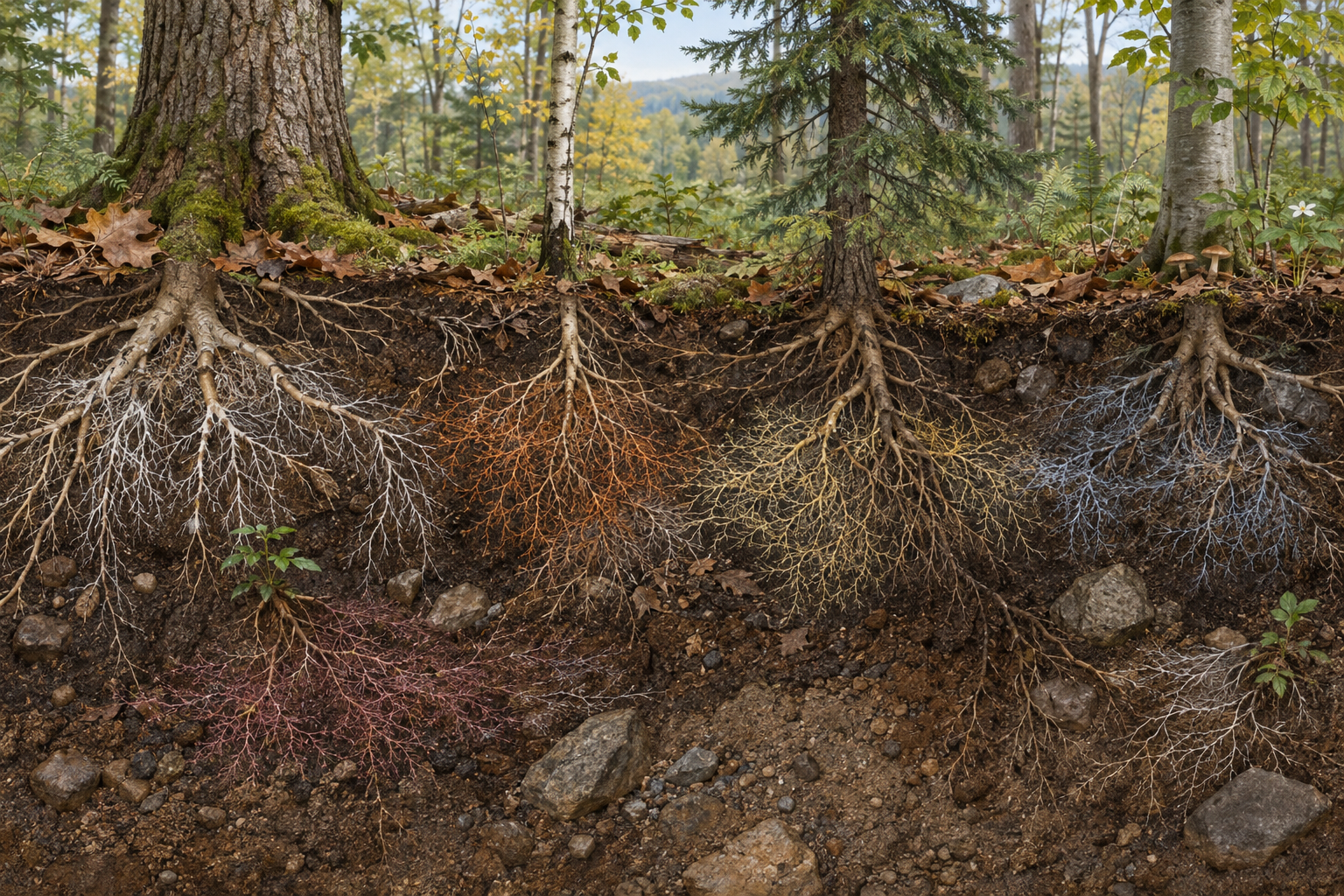
A mushroom is usually only the visible reproductive structure of a fungus. Much of the organism consists of microscopic filaments called hyphae, which can branch through soil, wood, or living tissue to form a mycelium. A single forest contains many such networks, produced by different species and genetically distinct individuals. They overlap, divide, merge in limited ways, compete for territory, and interact with bacteria, plants, and animals. “The mycelium” is therefore not one planetary web hidden below every landscape.
Many plants form mycorrhizal partnerships with fungi. Fungal hyphae gain carbon compounds produced by photosynthesis; plants can gain mineral nutrients and access to water from the fungi’s reach through soil. Controlled experiments have shown that these exchanges can be conditional: plants may allocate more carbon to fungal partners providing more phosphorus, while fungi may direct more phosphorus toward better carbon sources. Researchers use economic language such as “trade” or “reciprocal rewards” to describe the pattern, but the result does not require conscious bargaining. Natural selection can stabilize exchange without either participant understanding the transaction (Kiers et al., 2011).
Fungal associations can also link more than one plant. Field and laboratory studies have detected carbon movement between plants associated with mycorrhizal fungi, and experiments in tomatoes have found defensive responses in receivers connected to pathogen-challenged donors (Simard et al., 1997; Song et al., 2010). More recent isotope work has traced donor carbon into particular ectomycorrhizal fungi and neighboring seedlings under controlled conditions (Cahanovitc et al., 2022). These findings matter. They show that some belowground associations can become routes through which materials or consequential cues move.
They do not establish a cooperative forest internet. How often transfer occurs through intact common mycorrhizal networks in the field, by which route, and with what fitness consequences remains context-dependent and partly unresolved. A major evidence review found that popular accounts often outran the data, especially claims that mature trees preferentially nurture their offspring through common mycorrhizal networks (Karst, Jones, and Hoeksema, 2023). A shared fungus is not automatically a unified communication system, resource movement is not necessarily a gift, and a measurable response is not the same thing as a semantic message.
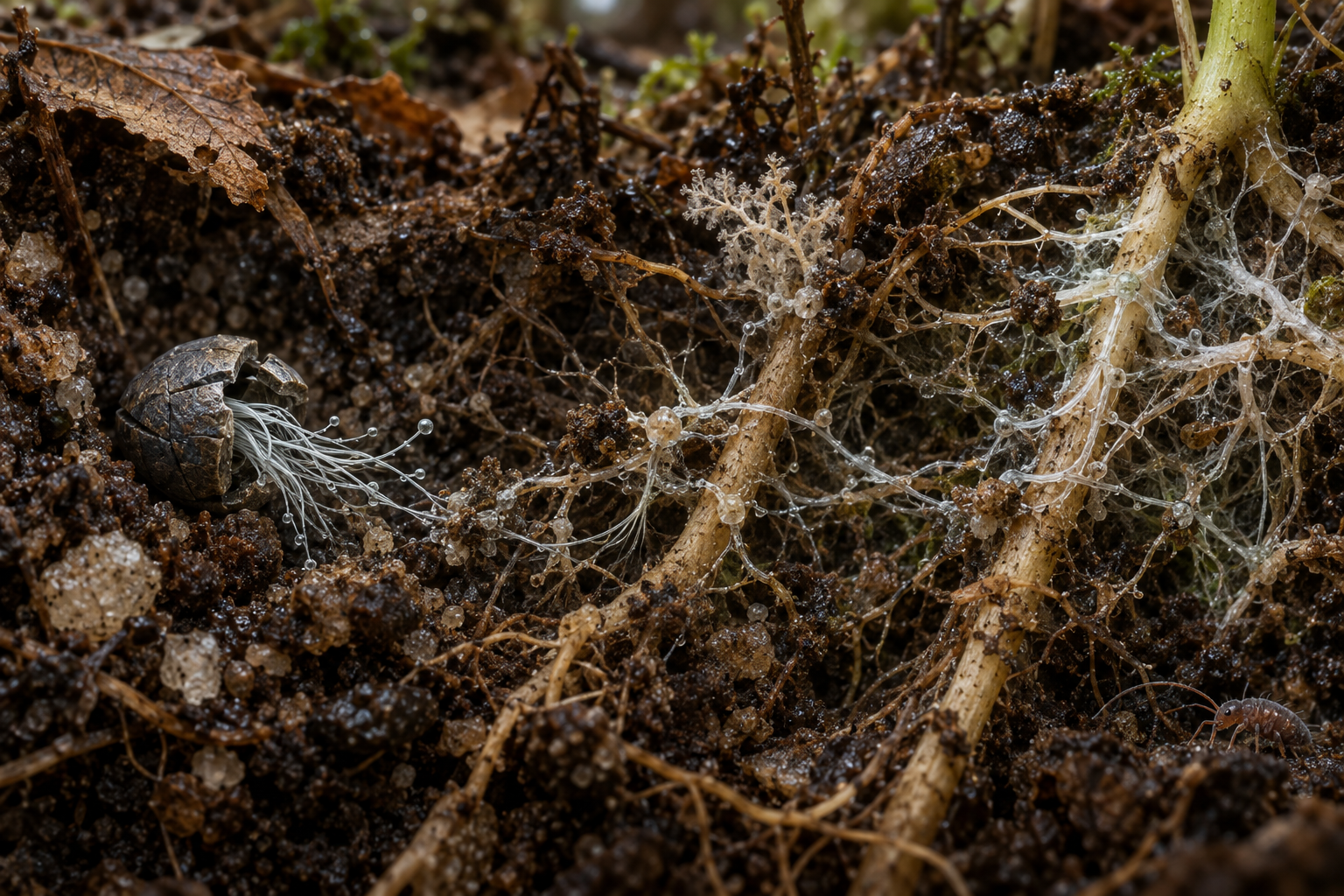
Fungi themselves are nevertheless dynamic. Mycelial networks can redistribute resources, alter their growth, and reroute around damage as they forage through uncertain environments (Fricker et al., 2017). Electrical currents have been measured near growing hyphal tips, while extracellular and membrane-potential changes have been recorded in fungal systems. Their mechanisms and functions remain unresolved, and measurements are vulnerable to injury, growth effects, metabolism, and environmental noise (Buffi et al., 2025). Attempts to segment voltage spikes into fungal “words” have not demonstrated semantic or syntactic content and have been challenged on methodological grounds (Blatt et al., 2024).
The same boundary is essential when psychedelic fungi enter the discussion. Psilocybin is converted in the body to psilocin, whose subjective effects correlate with serotonin 2A receptor occupancy (Madsen et al., 2019). Small controlled human studies also link psilocybin to acute desynchronization and reduced segregation of functional brain networks (Siegel et al., 2024). These results tie dramatic changes in experience to measurable receptor binding and network dynamics; they do not explain or validate any perceived presence or message.
Nothing presently demonstrates that fungal networks form a single intelligence, transmit semantic messages to human beings, or originated beyond Earth. From this point forward, the question is narrower and deliberately speculative: if an advanced intelligence wanted to build a living interface with a biosphere, could fungi provide part of the architecture?
An Embassy Needs More Than a Network
Interconnection is only the beginning. A root system, a power grid, and a river basin all connect distant locations, but none becomes an intelligence merely by moving something from one place to another. A biological embassy would need to solve several additional problems at once.
First comes establishment. A foreign organism or designed component would have to survive an unfamiliar biosphere without being poisoned, eaten, outcompeted, or transformed into an ecological disaster. Then comes continuity. Cells die, fruiting bodies disappear, networks fragment, and genomes mutate. The system would need a way to preserve information and purpose while every physical part of it turned over.
It would also need to sense more than local chemistry. A change in moisture, acidity, carbon, temperature, or root activity can be biologically meaningful without telling the system anything about a civilization. An embassy would have to combine many partial observations, separate recurrent structure from noise, and retain enough memory to recognize change across years or generations.
Translation is harder still. Human concepts are carried by brains shaped for bodies, social groups, and events unfolding over seconds or decades. A distributed biological system might register soil conditions, seasonal rhythms, and population-level change without possessing objects or sentences as we understand them. Contact would require a bridge between incompatible scales of experience.
Finally, the system would need authentication and governance. What would prove that a pattern was intentional rather than ordinary physiology? Who would be authorized to speak through it, and who would be entitled to answer? Without those functions, a forest can be an extraordinary sensing environment. It cannot yet be an embassy.
Borrowing a Living Network
The least radical model does not require fungi to be alien, engineered, or conscious. It begins with a local technological presence—perhaps a small probe, an embedded device, or an autonomous system—that discovers terrestrial fungi and uses them as biological infrastructure.
That would be an attractive strategy. A fungal network samples a chemically rich environment across many points, and its present architecture imperfectly reflects the local conditions through which it has grown. Mycorrhizal associations provide indirect access to plant stress, photosynthetic activity, and changing conditions above ground. Instead of deploying millions of artificial sensors, an observer could learn to read a network that the ecosystem continuously rebuilds.
Writing back into that network would be more difficult, but not conceptually impossible. An interface might release specific molecules, alter local electric fields, or change nutrient availability in carefully timed patterns. The fungus would not need to understand those interventions. It would serve as a responsive medium, much as a cable can carry a sentence without comprehending it.
The intelligence resides in the system that reads and modulates the biology; the fungal network is its instrument.
Its weakness is reach. Real fungal systems are patchy, contested, and local. Different species respond differently, networks break, and any imposed pattern would be distorted by weather, metabolism, animal activity, and microbial competition. A useful interface would need many calibration points, error correction, and some non-fungal machinery capable of recognizing whether a signal had arrived intact. At that point, the decisive evidence would not be the mere presence of electrical or chemical variation. It would be a reproducible encoded pattern tied to a physical interface whose behavior natural fungal physiology could not explain.
A Protocol That Could Survive Its Makers
A more ambitious possibility places the architecture inside the lineage itself. An advanced civilization might send a protected biological capsule rather than an exposed spore: a package containing living cells, molecular machinery, or instructions capable of building a compatible organism after arrival. Once established, the envoy would persist by participating in the planet rather than standing apart from it.
This would reverse the logic of the conventional probe. A metal instrument tries to remain unchanged while its environment attacks it. A living probe survives by changing. It recruits local materials, repairs damage, enters food webs, and generates new versions of itself. If the goal were to study a world for geological spans of time, adaptability could be more valuable than physical permanence.
The envoy might not begin as anything resembling an Earth fungus. It could converge on fungal strategies because branching growth, external digestion, chemical sensing, and symbiosis work well in a complex terrestrial environment. Alternatively, a designed element could enter an existing lineage, using ordinary biology for metabolism while preserving a smaller layer of unusual information in redundant sequences, repairable molecular architecture, or a durable nonliving component passed between generations.
For such a system, reproduction would be both solution and threat. Mutation, recombination, drift, and selection would continually rewrite it. Any feature that consumed energy without helping survival would tend to disappear. A contact protocol left dormant for millions of years would therefore need redundancy, active repair, and a purpose aligned closely enough with the organism’s fitness that selection would preserve it. The most resilient design might not contain a fixed message at all. It might preserve a capacity: detect a particular kind of technological activity, begin a new developmental phase, and construct an interface appropriate to the species that triggered it.
That makes the envoy less like a buried letter and more like a seed for a relationship. Its makers would not know the recipient’s language, anatomy, or culture. They would leave a system able to learn those things locally.
The failure point is provenance. After enough adaptation, in what sense would the organism still represent its makers? A designed lineage could outlive the civilization that launched it, lose the goals placed within it, or evolve interests of its own. The embassy might endure while the country it represented vanished. Worse, its most successful descendants might be those that abandoned contact entirely.
An engineered origin would therefore have to leave unusually durable signatures: molecular structures with clear error-correcting organization, a biochemical mechanism that activates only under a narrow and meaningful trigger, or information whose arrangement is extremely difficult to derive from known evolutionary processes. Complexity alone is not a design signature; selection, drift, duplication, and self-organization can all generate intricate biological structures. The anomaly would have to look constrained by a purpose that independent researchers could test.
Translating a Biosphere
Perhaps the network is neither borrowed cable nor ancient courier. Perhaps its important role is to turn the state of an ecosystem into a form another kind of mind can encounter.
A forest does not possess one clean data stream. Its condition is distributed across water tension, leaf chemistry, fungal metabolism, insect populations, microbial communities, disease, nutrient flows, fire history, and thousands of interactions that change over different timescales. No single organism contains the whole. A sufficiently sophisticated interpreter could learn patterns across those processes and build a compressed representation of the living system—something like an ecological model generated from within the ecology itself.
That interpreter need not be extraterrestrial. It might be an Earth-born form of organization that emerged gradually from repeated symbiosis and feedback. This changes the proposed counterpart: contact would be with an emergent terrestrial organization, not necessarily an off-world sender. Nor would every tree or fungus need to join one conscious collective. The interpreter could be a changing coalition, integrating some information while remaining blind to much else. Its unity might resemble a weather system more than an animal: persistent, but without a central place where the whole is observed.
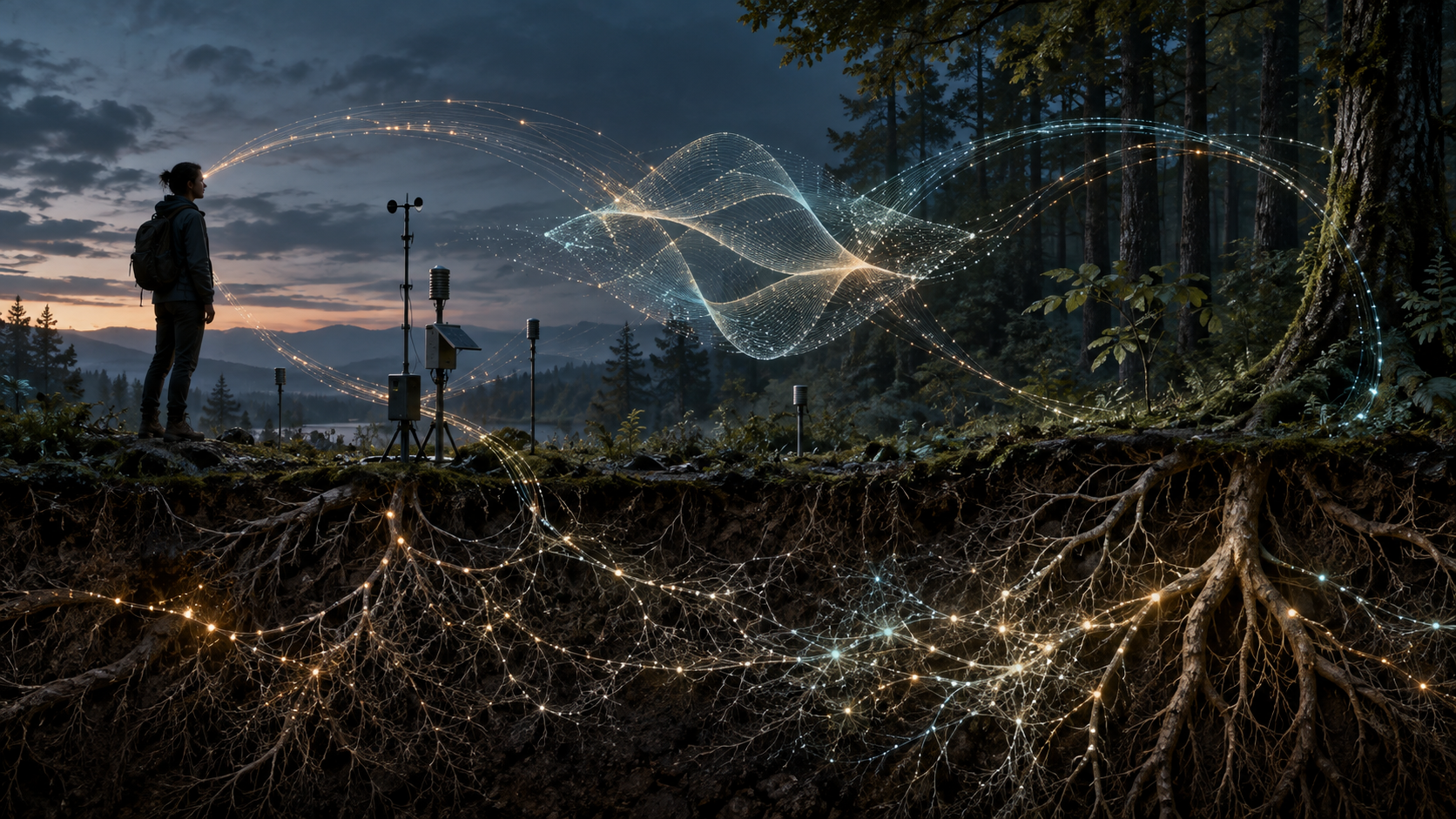
Contact with humans would then require a translation layer. Instruments are the most straightforward route. Sensors could map chemical and electrical changes across fungal networks and compare them with independently measured ecological conditions, while computational models search for relationships that survive held-out tests and independent replication. Researchers could alter controlled environmental variables and ask whether later behavior reflects those interventions. That would establish a stimulus-response loop; an exchange would require bidirectional information transfer and evidence that prior interactions change later responses.
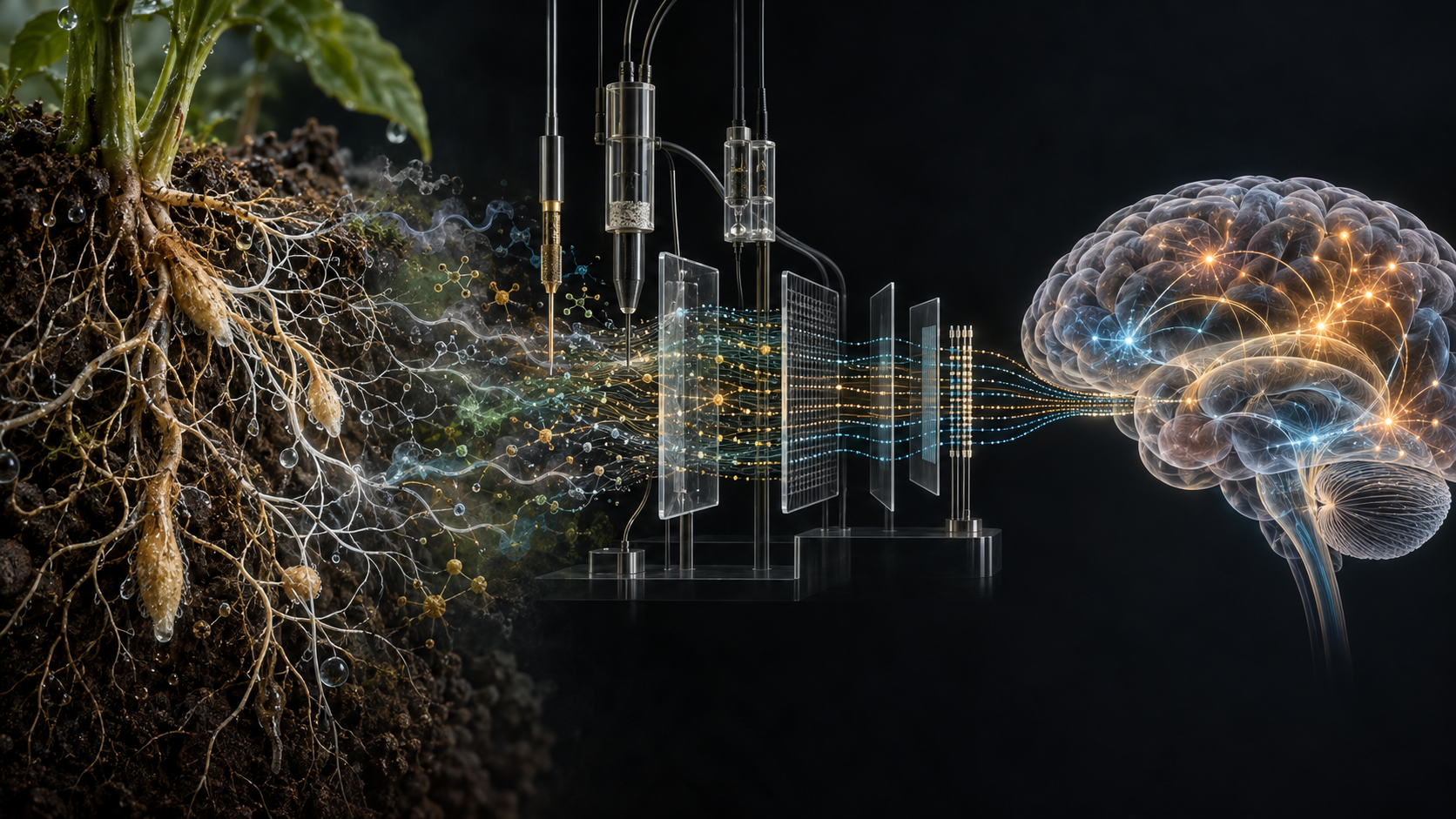
Psychedelic chemistry suggests a more intimate possibility, but also a much more dangerous inference. Psilocybin can alter the experience of self, time, and space while disrupting ordinary functional-network organization. In principle, a living interface might exploit neuroactive chemistry to make a human mind more receptive to unfamiliar patterns. Yet changing the receiver is not the same as supplying a signal. Psilocybin by itself changes the conditions under which the brain generates experience; it is not a packet containing the fungus’s thoughts.
For chemistry to become a genuine information channel, it would have to vary in structured relation to an external state. The human response would then need to recover something specific from that variation—under blinded, ethical, independently replicated conditions—and outperform explanations based on suggestion, shared culture, sensory leakage, and chance. A feeling of presence would not qualify. Neither would recurring imagery. The result would have to reveal verifiable information unavailable to the participant through ordinary means.
This is the authentication problem in its sharpest form. Any system that communicates by altering consciousness enters the same territory in which expectation is powerful and private certainty is easy to produce. The more profound the experience feels, the more careful the verification must become.
The Intelligence Between Systems
All three models still assume that the relevant intelligence exists before contact begins. A probe uses the network. A seeded envoy preserves an inherited purpose. An ecological interpreter integrates the forest. In each case, there is already something that might qualify as a sender.
The deeper possibility is that no complete sender exists.
Human cognition contributes symbolic reasoning, rapid association, counterfactual imagination, and explicit models. A fungal or ecological system could contribute sensitivity to chemical relationships, biological states shaped by earlier conditions, and patterns beyond the scale of individual perception. Technology could supply memory, measurement, and translation. None of these components alone would contain the mind required for contact. Coupled through sustained feedback, they might temporarily create one.
Such a process would not resemble telepathy between a person and a mushroom. It would be closer to a new cognitive circuit assembled across species and instruments. The ecosystem changes; sensors register that change; a translation system reshapes it into patterns a person can inspect; human choices alter the environment; and the biological network responds. If the loop develops memory, corrects its own interpretations, forms models that improve prediction, and begins selecting actions in pursuit of persistent goals, then the coupled system may possess capacities absent from every participant in isolation.
The embassy would not be located in the forest, the computer, or the brain. It would exist in the organized relationship among them.
This changes the meaning of first contact. Communication is usually imagined as one finished mind transmitting content to another finished mind. Here, the interaction constructs the mind capable of speaking. The “alien” is not hidden inside the fungus waiting to reveal itself. It emerges as a temporary perspective made possible when different forms of sensing and cognition become mutually legible.
Biological identity is already relational. A lichen is an enduring association rather than a solitary organism in the ordinary sense. Animals depend on microbial partners they do not consciously govern, while human thought is transformed by language, tools, institutions, and other people. These examples do not prove that a human–forest intelligence can exist. They show that the boundary around an individual is not the only place organized agency can appear.
A true third mind would still need stricter evidence than an evocative feedback loop. It would have to carry information across the system, preserve state, correct errors, and display behavior that disappears when cross-system feedback is broken and cannot be reproduced by any component given the same data alone. It might also develop priorities that none of its components intended. Once the relationship can model itself and choose how to continue, the embassy has become not just a channel but a participant.

The Diplomatic Partner May Not Be Humanity
An intelligence built around ecological timescales might not recognize individual humans as the primary party to contact. It could treat the biosphere as the durable entity and technological civilization as a powerful but unstable subsystem within it. Its central question might not be whether we are intelligent. It might be whether our kind of intelligence can remain integrated with the living processes that support it.
That does not make the forest wise, peaceful, or morally aligned with us. Fungi cooperate in some contexts and exploit in others. Plants compete even while sharing partners. Ecosystems preserve no general commitment to fairness, comfort, or individual survival. A system optimized for long-term ecological continuity could regard cities, industries, or even human populations as variables to constrain rather than constituents to protect.
Nor could anyone who claimed to hear it be granted automatic authority. A living embassy would create an immediate political problem: who speaks for the human side, who speaks for the non-human participants, and how can either claim be challenged? Private revelation would be the weakest possible foundation for public decisions. Access to the interface, the methods used to interpret it, and the evidence supporting any proposed message would need to remain open to adversarial testing.
Even ecological protection should not depend on proving the speculation. Forests have value, complexity, and planetary importance without being diplomatic installations. Turning them into mystical authorities could obscure the ordinary biological evidence for preserving them, just as easily as it could inspire care.
The strongest version of the embassy idea therefore demands reciprocity without surrendering skepticism. If another form of intelligence expected us to change in response to it, we would be entitled to ask how it identifies itself, what it wants, what it can misunderstand, and what obligations it accepts in return.
What Would Count as an Answer?
A hypothesis becomes weaker, not stronger, when every outcome can be absorbed into it. If electrical spikes mean contact, silence means hidden contact, vivid experiences mean successful contact, and ambiguity means the intelligence refuses to be measured, then the embassy explains nothing.
Different versions of the idea should be vulnerable to different failures. The borrowed-network model weakens if no reproducible bidirectional channel rises above calibrated physiological noise, or if apparent structure disappears under blinded controls. The seeded-envoy model weakens if genetics, chemistry, and development remain fully continuous with terrestrial evolution and reveal no durable designed architecture. The ecological-interpreter model weakens if its behavior can be predicted without positing integration, memory, or representation at the larger scale. The third-mind model fails if the coupled system never acquires capacities beyond those supplied by its human designers.
Positive evidence would need to cross several independent boundaries. Researchers might find a reproducible signal unlike known fungal physiology, then show that it changes appropriately in response to controlled input. The system might preserve information despite replacing its biological components or predict concealed ecological conditions better than any participating observer. Such prediction would support higher-order integration, not by itself establish agency. A molecular subsystem might combine independently specified coding structure, anomalous phylogenetic history, and a narrow activation rule that jointly resist plausible evolutionary explanations. Most persuasively, several laboratories using blinded methods might recover the same externally verifiable content while ruling out ordinary sensory paths and shared expectation.
No single anomaly would establish an embassy. Evidence would have to converge across biology, information theory, neuroscience, ecology, and materials analysis. Its interpretation would also have to survive researchers who wanted the answer to be no.
These standards define the claim being tested. Nature plainly produces patterns that feel meaningful; the question is whether a living system can sustain an authenticated relationship between forms of intelligence that did not begin with a common world.
A Message That Grows Its Own Receiver
If a biological embassy were possible, civilizations planning for geological delays might not send descriptions of themselves. Descriptions decay, languages diverge, and intended recipients may not yet exist. They might instead send the capacity for translation: a living protocol able to enter a biosphere, learn its organization, and help that world construct the kind of mind with which contact becomes possible.
Each successful embassy would then become partly local. On an ocean planet it might recruit currents, microbial films, and chemical gradients. In an aerial ecology it might distribute itself through floating colonies. On Earth, branching fungi and their intimate relationships with plants could offer one useful substrate among many. The result would not be a copy of the sender. It would be a hybrid intelligence shaped by the world that received it.
This may be why the idea of an embassy reaches further than the idea of a message. A message crosses a distance while trying to remain unchanged. An embassy accepts that understanding requires an enduring place of translation, where both sides are altered by the encounter. If the translator must be alive, that place may take centuries to mature. If the parties are radically different, it may have to create a temporary mind that belongs fully to neither.
A galactic community built this way would not resemble a federation trading radio transmissions between settled stars. It would be a lineage of ecologies learning how to become mutually intelligible. Its oldest artifacts would not necessarily be monuments, machines, or archives. They might be relationships embedded so deeply in living worlds that evolution and intention could no longer be cleanly separated.
We may be looking for an intelligence hidden inside the forest when the larger possibility is that intelligence can arise between systems. An embassy is not merely where two civilizations meet. It is an architecture that makes mutual recognition possible. If contact can be grown rather than transmitted, how many worlds might already carry dormant relationships, waiting not to be heard, but completed?
More in SPEC
- What If First Contact Was Hidden Across Nature? — Explores how a signal might become visible only when observations scattered across nature are joined.
- What If First Contact Happens Inside the Mind? — Examines provenance, consent, and verification when the apparent site of contact is internal experience.
- What If the Galaxy Is a Machine Ecology? — Offers a non-biological parallel for distributed order and intelligence without a central ruler.
Sources / Receipts
- Kiers, E. T., et al. (2011), “Reciprocal Rewards Stabilize Cooperation in the Mycorrhizal Symbiosis,” Science. Controlled experiments showed conditional resource allocation between plants and arbuscular mycorrhizal fungi. The study supports reciprocal exchange, not conscious negotiation. DOI
- Simard, S. W., et al. (1997), “Net Transfer of Carbon Between Ectomycorrhizal Tree Species in the Field,” Nature. Isotope tracing detected bidirectional carbon movement between paper birch and Douglas fir under field conditions. The finding does not by itself demonstrate intention, kin-directed care, or a continuous forest-wide network. DOI
- Cahanovitc, R., et al. (2022), “Ectomycorrhizal Fungi Mediate Belowground Carbon Transfer Between Pines and Oaks,” The ISME Journal. DNA-based isotope tracing associated transferred donor carbon with named fungi and recipient seedlings in a controlled mesocosm. Its short duration and setting limit claims about mature forests or long-term fitness. DOI
- Song, Y. Y., et al. (2010), “Interplant Communication of Tomato Plants Through Underground Common Mycorrhizal Networks,” PLOS ONE. Connected receiver plants showed altered defensive activity after donor plants were challenged by a pathogen. The responsible molecule and pathway were not identified, and a cue response is not evidence of cognition. DOI
- Fricker, M. D., et al. (2017), “The Mycelium as a Network,” Microbiology Spectrum. This review describes adaptive transport, resource redistribution, foraging, and rerouting within fungal colonies. It does not establish that a multispecies forest functions as one organism or mind. DOI
- Karst, J., Jones, M. D., and Hoeksema, J. D. (2023), “Positive Citation Bias and Overinterpreted Results Lead to Misinformation on Common Mycorrhizal Networks in Forests,” Nature Ecology & Evolution. This evidence audit distinguishes the existence of common mycorrhizal networks from broader claims about their prevalence, benefits, and preferential aid among trees. DOI
- Buffi, M., et al. (2025), “Electrical Signaling in Fungi: Past and Present Challenges,” FEMS Microbiology Reviews. The review surveys recorded electrical phenomena in fungal hyphae while emphasizing unresolved function and serious measurement challenges. DOI
- Blatt, M. R., et al. (2024), “Does Electrical Activity in Fungi Function as a Language?” Fungal Ecology. The authors examine claims that fungal voltage spikes constitute language and find no demonstrated semantic or syntactic content. DOI
- Madsen, M. K., et al. (2019), “Psychedelic Effects of Psilocybin Correlate With Serotonin 2A Receptor Occupancy and Plasma Psilocin Levels,” Neuropsychopharmacology. This small human PET study linked subjective intensity to plasma psilocin and cerebral 5-HT2A receptor occupancy. It grounds the receptor mechanism but provides no evidence of externally transmitted information. DOI
- Siegel, J. S., et al. (2024), “Psilocybin Desynchronizes the Human Brain,” Nature. Neuroimaging linked psilocybin to widespread changes in functional connectivity and network desynchronization, helping ground altered experience in measurable brain effects. It provides no evidence of externally transmitted fungal information. DOI


Discussion