
Overview
Newgrange is a vast Neolithic passage tomb in the Brú na Bóinne landscape of County Meath, Ireland, built around 3200 BC and aligned so that the rising sun at midwinter sends light through a roof-box above the entrance and into the inner chamber. Heritage Ireland describes Brú na Bóinne as home to the great passage tombs of Newgrange, Knowth, and Dowth, while UNESCO identifies the larger complex as one of Europe’s most important concentrations of prehistoric megalithic art and ritual architecture.
What makes Newgrange matter is not only that it is old, or even that it is beautiful. It matters because it seems to have been built as an experience of precision. Stone, darkness, season, sunrise, and enclosed movement all converge in one place. The monument does not simply contain a burial space. It appears to stage time itself. That larger reading is supported by the site’s documented solstice alignment and by the wider ceremonial significance archaeologists attribute to Brú na Bóinne.
Origins and Background
Newgrange stands within the bend of the River Boyne, inside the Brú na Bóinne World Heritage property. Heritage Ireland calls this landscape Ireland’s richest archaeological area, and UNESCO notes that the complex’s major monuments had social, economic, religious, and funerary functions. In other words, Newgrange was never just an isolated mound. It belonged to a larger sacred and political landscape.
The monument itself dates to roughly 3200 BC, placing it deep in the Irish Neolithic. Heritage Ireland describes monuments such as Newgrange as among the oldest standing structures in Europe and emphasizes that they were central to Neolithic people’s worldview. That matters because it shifts Newgrange out of the category of quaint prehistoric curiosity and into the category of serious civilizational architecture.
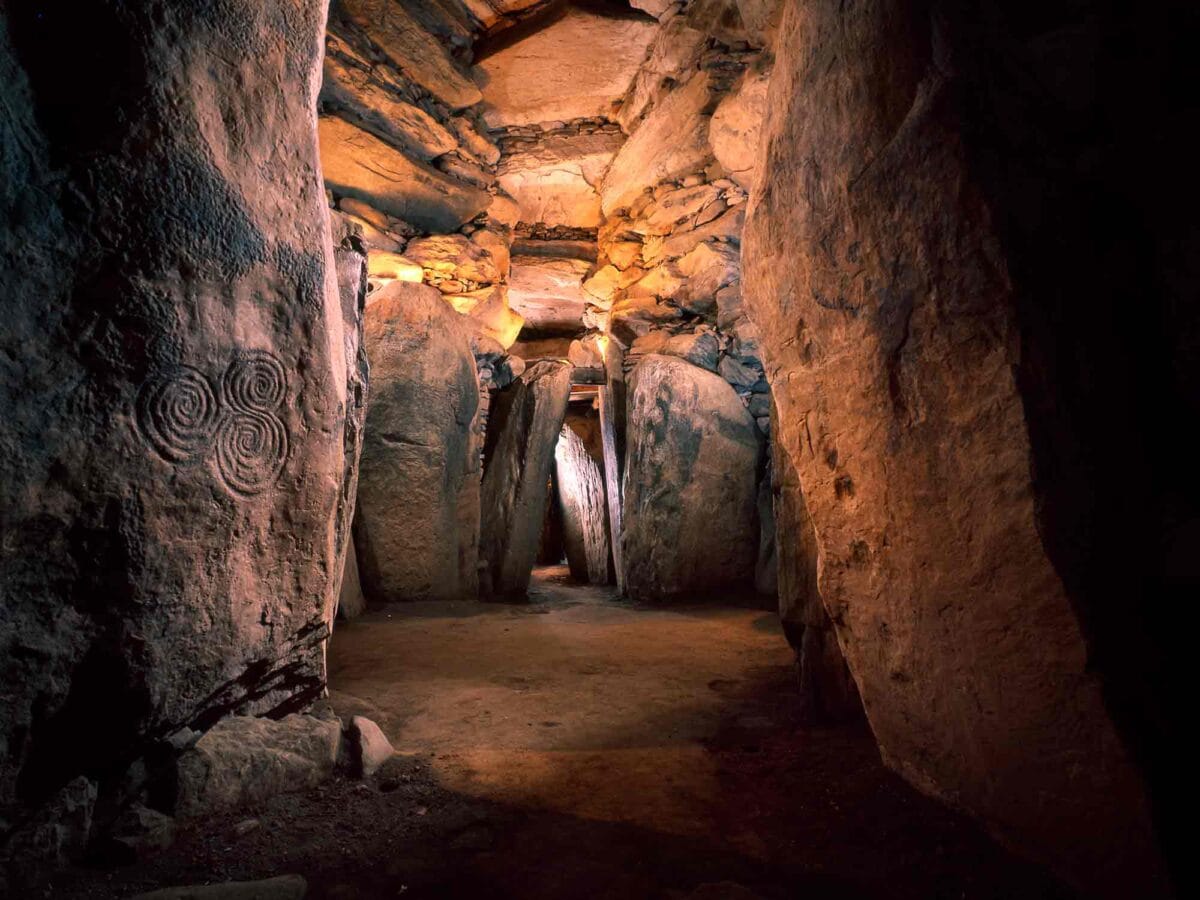
Modern attention to Newgrange often begins with the solstice, but the site is bigger than that single event. The mound, kerbstones, long passage, corbelled chamber, and carved megalithic art all belong to the same system. Heritage Ireland and UNESCO both frame the Brú na Bóinne monuments as ceremonial and symbolic structures, not just tombs in the narrow modern sense.
What It’s Known For
Newgrange is best known for a few defining features:
- its great circular mound and stone-built passage tomb form within Brú na Bóinne.
- the winter-solstice sunrise alignment, where light enters through the roof-box above the doorway and reaches the chamber for several mornings around December 21.
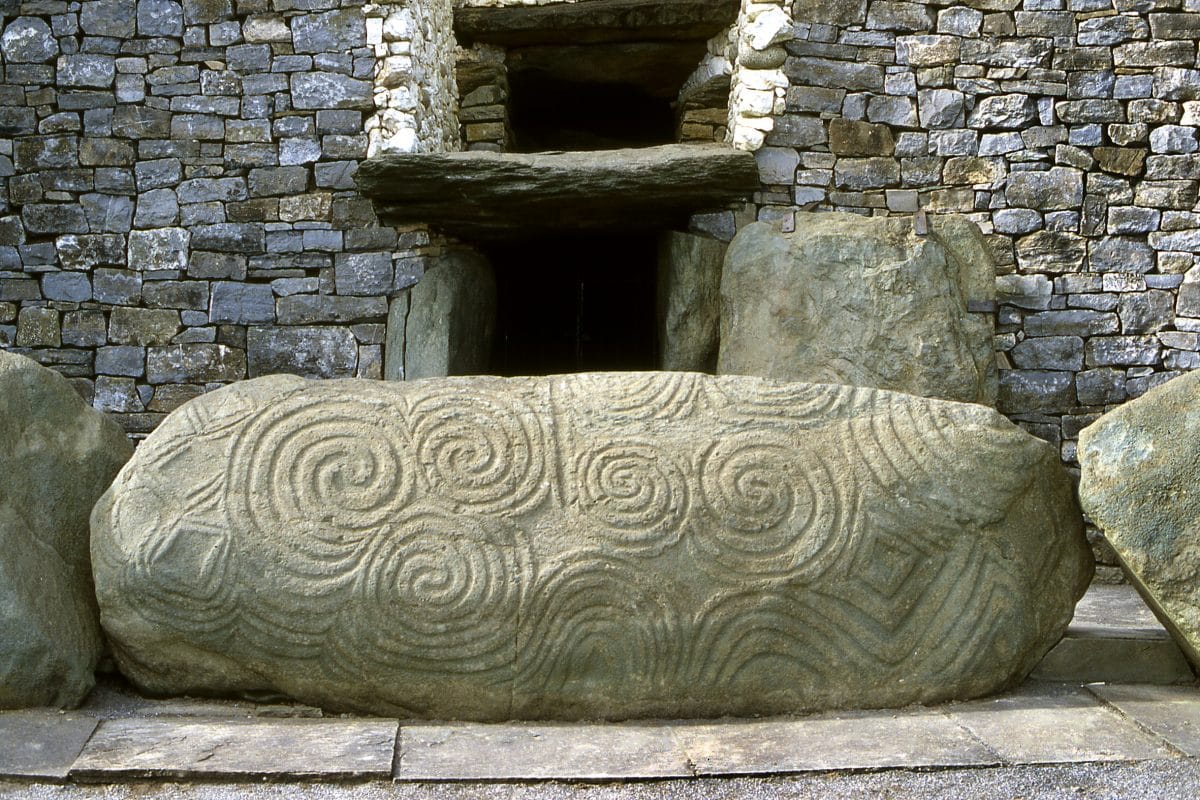
- the rich megalithic art, especially spirals and curvilinear carvings on stones at and within the monument. UNESCO identifies Brú na Bóinne as Europe’s largest and most important concentration of prehistoric megalithic art.
- its status as one of Ireland’s most important prehistoric sites and one of the most publicly recognizable monuments in the country today.
What makes Newgrange distinct is that its most famous feature is not just visual or structural. It is performative. The monument changes with the year. For a few days at midwinter, architecture and sunlight interact in a way that turns the site from stone container into timekeeping event. That inference is directly supported by Heritage Ireland’s description of the roof-box alignment and the annual solstice access process.
The Core Idea
The deeper signal behind Newgrange is that ancient architecture could be built to do more than stand. It could be built to activate.
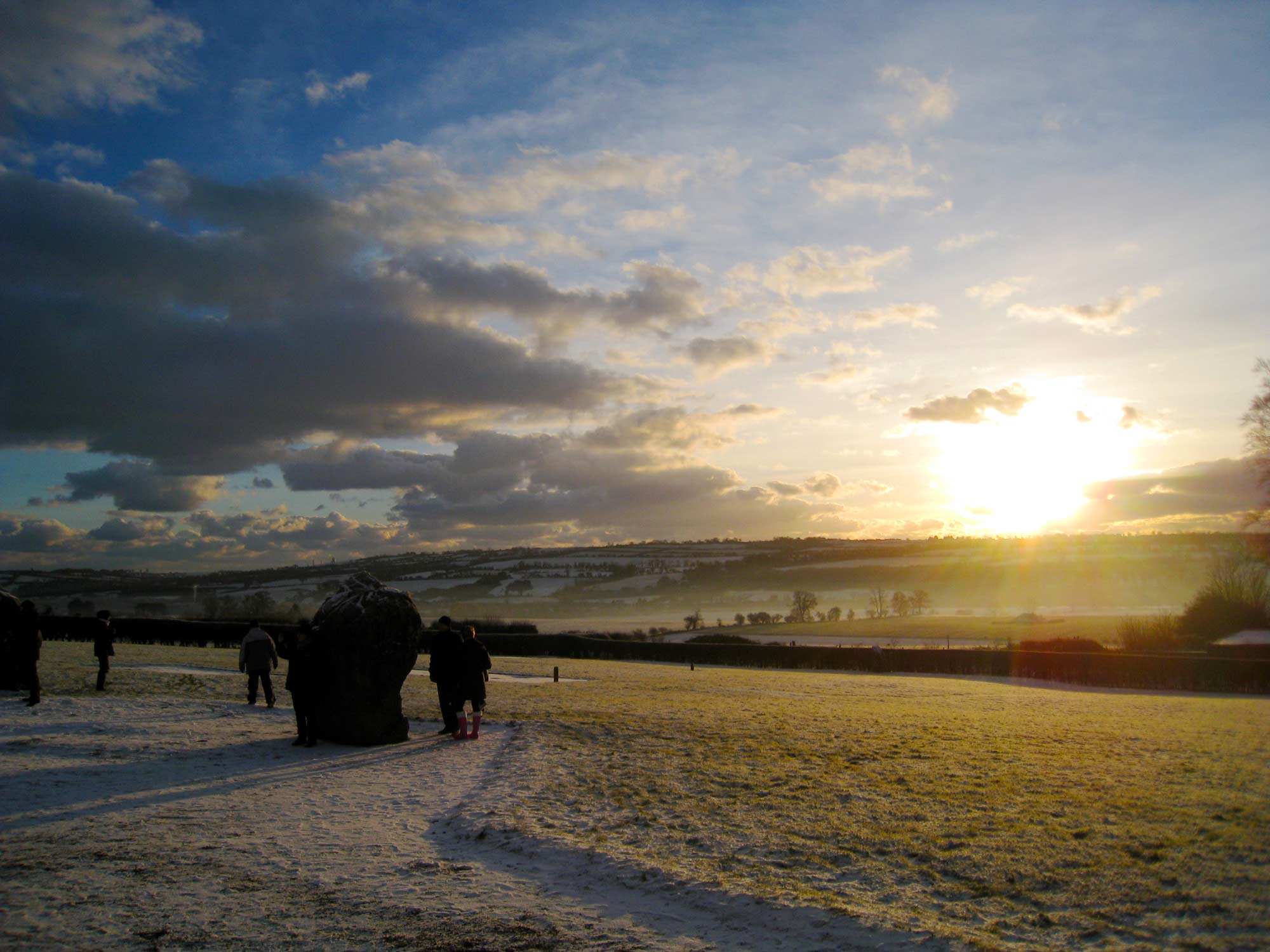
That is the real force of the monument. The passage remains dark most of the year. Then, at the winter solstice, dawn light enters through the roof-box and travels inward, illuminating the chamber for up to about 17 minutes. Heritage Ireland describes this as one of the monument’s defining features. The structure is not merely aligned to the sun in an abstract sense. It is designed to transform light into event.
This is why “solstice engine” is a useful phrase. Not because Newgrange was a machine in the modern technological sense, but because it appears to convert celestial timing into ritual experience. It takes the shortest days of the year and turns them into something legible, embodied, and communal. That is an inference, but it is grounded in the monument’s known alignment and ceremonial setting.
Perspectives and Interpretations
The strongest archaeological and heritage interpretation sees Newgrange as part of a ceremonial, funerary, and cosmological landscape. UNESCO explicitly says the monuments of Brú na Bóinne had social, economic, religious, and funerary functions. This matters because it keeps the site from being reduced to either “just a tomb” or “just an observatory.” The evidence points to something more integrated.
A more focused interpretation emphasizes the solar alignment itself. Heritage Ireland states that the passage and chamber are aligned toward the rising sun at the winter solstice and that the roof-box allows the sun’s light to penetrate and illuminate the chamber. In this reading, the monument embodies a ritual relationship with cyclical time, darkness, and renewal.
Some popular interpretations go further and treat Newgrange as proof of lost advanced science, hidden energy knowledge, or a forgotten civilization far beyond what archaeology can support. The site’s precision certainly invites awe, but the strongest official and scholarly framing does not require those leaps. Newgrange is already extraordinary as a Neolithic monument built by people with deep observational skill, symbolic intelligence, and organizational capacity.
The balanced reading is therefore the strongest one. Newgrange is not mysterious because it needs aliens, Atlantis, or secret technology. It is mysterious because a very ancient society built a monument that still works, still stages time, and still exceeds the casual assumptions modern people bring to prehistory. That is an inference from the official heritage record and the documented solstice event.
Strengths and Limitations
The greatest strength of Newgrange as a subject is that the core case is rock solid. The monument is real, accessible, protected, and extensively documented through Irish heritage institutions and UNESCO. The solstice alignment is not rumor. It is a repeatedly observed feature built into the structure itself.
A second strength is contextual richness. Newgrange is not floating alone in the landscape. It belongs to Brú na Bóinne, a wider prehistoric ensemble that includes Knowth, Dowth, associated ritual sites, and the Boyne floodplain. Heritage Ireland’s description of the area as Ireland’s richest archaeological landscape helps show that Newgrange’s meaning expands when seen in relation to the broader sacred terrain around it.
The limitations are interpretive. We can document the structure, the light event, the art, and the monumental setting. We cannot recover the full interior worldview of the people who built it with absolute certainty. Any account of what the solstice alignment “meant” beyond the material fact of the alignment remains a historically informed reconstruction, not a direct transcript of Neolithic belief.
There is also a modern framing problem. Because Newgrange is so visually and symbolically powerful, it attracts projection. It can be romanticized as Celtic, though it predates the Celtic period by millennia, or folded into vague “ancient wisdom” language that blurs archaeological specificity. The strongest dossier version resists that drift and keeps the site anchored in the Neolithic and in the evidence actually available.
Broader Implications
Newgrange matters because it demonstrates that very early monument builders were not only moving stone. They were organizing experience.
The monument suggests a society capable of integrating astronomy, architecture, symbolic carving, spatial restriction, and seasonal timing into one coherent structure. That does not just imply skill. It implies worldview. The builders were not simply marking the year. They were shaping how the year would be felt. That inference is supported by the monument’s known alignment and ceremonial context.
It also matters because Newgrange disrupts a lazy story about prehistory. Too often, the ancient past is imagined as technically primitive and spiritually vague. But Newgrange suggests planning, symbolic density, and observational exactness on a scale that still impresses modern visitors and heritage professionals. Heritage Ireland’s own language about worldview and alignment points in that direction.
For The Galactic Mind, the deeper resonance is clear: some of humanity’s oldest surviving monuments were not only shelters for the dead or displays of power. They were reality-framing devices. Newgrange feels so alive today because it still does what it was built to do.
The Galactic Mind Perspective
Newgrange is important not because it proves some hidden lost science, but because it reveals how much ancient people could already do with observation, timing, and symbolic architecture.
That is the disciplined wonder of the site. The roof-box, the passage, the chamber, the carved stones, and the winter sun together create a monument that still feels active. It narrows the distance between archaeology and lived experience. You do not just study Newgrange. You wait for it to happen.
The strongest way to read Newgrange is as a place where the built environment was used to make cosmic order visible. In that sense, it is not just a tomb. It is a threshold structure, one that turns the shortest days of the year into proof that darkness has a measure and a return. That final line is an inference, but it is rooted in the monument’s actual alignment and annual use.
Open Thread
If Newgrange was designed so that the year’s thinnest light would enter the deepest dark at exactly the right moment, then what was its deepest purpose: burial, renewal, initiation, or the deliberate making of cosmic reassurance in stone?
Sources / Receipts
- Heritage Ireland, Brú na Bóinne Visitor Centre: Newgrange, Knowth and Dowth.
- UNESCO, Brú na Bóinne - Archaeological Ensemble of the Bend of the Boyne.
- Heritage Ireland, Relive the Winter Solstice 2025 at Newgrange.
- Heritage Ireland, Mesolithic - Iron Age (8000BC - 400AD).
- Heritage Ireland, A Neolithic ritual landscape revealed.
- Brú na Bóinne Management Plan.
What do you think? Drop your thoughts in the comments


Discussion