
Overview: Who This Is
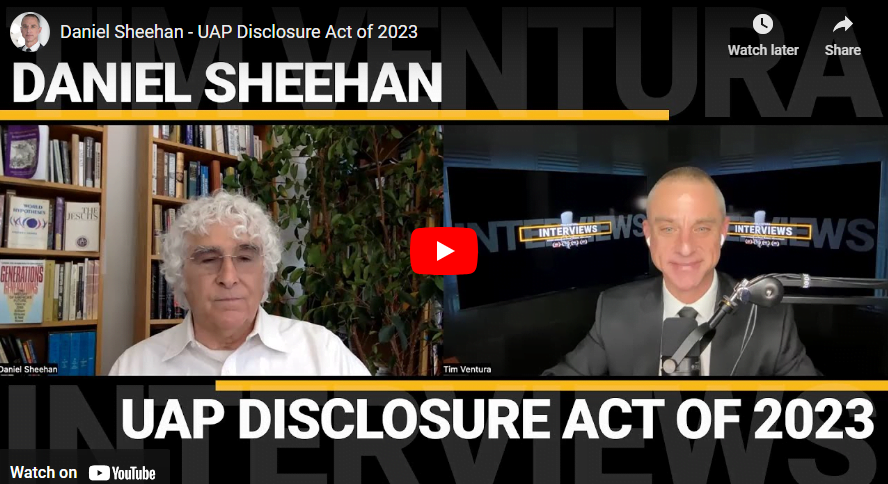
Daniel P. “Danny” Sheehan is an American public-interest lawyer, political activist, educator, author, and founder of the New Paradigm Institute, a UAP-disclosure initiative operating through the Romero Institute.
He is not primarily a UAP scientist, aerospace engineer, or government investigator. His relevance to the subject comes from law: records preservation, congressional oversight, whistleblower protection, classification authority, litigation, and the institutional mechanisms through which hidden information might be compelled into public view.
That distinction is essential.
Sheehan’s documented public work includes decades of legal advocacy and involvement with organizations pursuing civil rights, environmental, Indigenous, and government-accountability causes. His own biographies also attribute significant roles to him in several landmark cases. Because the scope of those roles varies and because many descriptions originate with Sheehan or organizations he leads—they should not all be treated as independently verified accomplishments of equal weight.
His UAP work contains the same evidentiary division.
What is documented is that Sheehan founded the New Paradigm Institute, advocates for disclosure legislation, publicly challenges official UAP conclusions, and mobilizes citizens around government transparency.
What remains unverified are his strongest claims: that parts of the United States government or private industry possess recovered non-human craft, biological material, or technologies of unknown origin.
This Dossier therefore examines four separate questions:
What has Sheehan demonstrably done?
What does he claim to know?
What has the government officially concluded?
And what legal processes could allow the evidence, not institutional authority or personal confidence, to decide between them?
Origins and Background
Daniel Peter Sheehan was born in Glens Falls, New York, in 1945. He graduated from Harvard College in 1967 and Harvard Law School in 1970. His official biography describes subsequent training in comparative social ethics at Harvard Divinity School; it is more precise to describe him as Harvard Divinity School–trained rather than imply an additional completed degree.
Sheehan began his legal career at Cahill, Gordon, Sonnett, Reindel & Ohl, the firm representing The New York Times during the Pentagon Papers litigation. His own accounts describe him as contributing to the legal team that defended the newspaper’s right to publish the classified history of the Vietnam War.
Later institutional biographies associate him with legal work involving Watergate defendant James McCord, the Wounded Knee occupation, Karen Silkwood, Three Mile Island, the American Sanctuary Movement, Indigenous rights, and other public-interest causes.
Those descriptions require proportion.
Sheehan’s involvement was not identical in every matter. Depending on the case, he served in roles that included counsel, associate counsel, investigator, advocate, organizational leader, or member of a larger legal team. Listing the cases without explaining those distinctions can create the impression that he personally argued or won each one.
The consistent thread is more defensible: Sheehan built his career around conflicts involving institutional secrecy, alleged government misconduct, corporate power, civil liberties, and public accountability.
That history explains both his attraction to the UAP question and the lens through which he interprets it.
To supporters, decades spent challenging powerful institutions give him experience recognizing how secrecy operates.
To critics, the same history may encourage him to interpret incomplete evidence through a preexisting expectation of concealed networks.
Both possibilities belong in the record.

What It’s Known For
Sheehan is known for several overlapping roles.
Public-interest law
His core identity is legal.
Sheehan’s official biographies describe him as a constitutional litigation and appellate attorney who has worked for decades on civil rights, public-interest litigation, and social movements.
That matters because his credibility in the UAP conversation is tied less to scientific research and more to legal strategy.
He is not primarily presenting himself as a physicist, astronomer, or aerospace engineer.
He is presenting himself as an attorney asking who controls the evidence, who has standing to demand it, and what legal mechanisms could force disclosure.
The Christic Institute, Avirgan v. Hull, and the Credibility Question
Sheehan helped establish the Christic Institute, a public-interest law organization that combined investigation, litigation, public education, and political organizing. The Romero Institute later continued parts of that mission.
Any balanced account of this period must include the outcome of Avirgan v. Hull.
The Christic Institute represented journalists Tony Avirgan and Martha Honey in a civil racketeering lawsuit alleging that a covert network connected to Contra operations and other clandestine activities was responsible for the 1984 La Penca bombing in Nicaragua.
The case did not succeed.
The federal district court granted summary judgment to the defendants and imposed substantial attorney-fee and cost sanctions. In 1991, the United States Court of Appeals for the Eleventh Circuit affirmed the judgment.
The appellate opinion found that the plaintiffs failed to produce competent evidence connecting the defendants to the bombing. It also sharply criticized the factual foundation of a key affidavit submitted by Sheehan and concluded that he and the Christic Institute had unreasonably prolonged the litigation.
Sheehan and his supporters have framed the case’s defeat and its financial consequences as part of a politically motivated effort to disable the Institute. That is their interpretation. It was not the court’s finding.
This history does not erase Sheehan’s other legal work, nor does it determine whether any of his UAP claims are true. It does establish a relevant credibility warning: allegations involving hidden networks must ultimately survive evidentiary testing, source verification, and adversarial review.
That lesson follows Sheehan into the disclosure debate.
His willingness to pursue claims that institutions reject can be a strength when genuine misconduct is being concealed. It becomes a liability when the supporting evidence cannot withstand independent examination.

UAP Disclosure Act Advocacy
Sheehan and the New Paradigm Institute have strongly advocated for legislation compelling the preservation, review, and release of government UAP records.
In July 2023, Senators Chuck Schumer and Mike Rounds introduced a proposed UAP Disclosure Act modeled on the JFK Assassination Records Collection Act.
The original proposal included several unusually strong mechanisms:
- A presumption favoring disclosure
- An independent presidentially appointed review board
- Subpoena and review authority
- A controlled-disclosure process
- Federal eminent-domain authority over alleged technologies of unknown origin or biological evidence of non-human intelligence
The final legislation did not preserve that complete structure.
Public Law 118-31, enacted in December 2023, established a centralized UAP Records Collection at the National Archives and required federal agencies to identify, preserve, review, and transfer relevant records. It also created standards governing postponed disclosure.
The final law did not establish the independent review board or eminent-domain mechanism contained in the broader Senate proposal.
That difference matters. The proposed legislation described an external disclosure authority capable of challenging agency decisions. The enacted law left much of the initial review with the agencies that possess the records.
The process nevertheless produced a tangible result. The National Archives established Record Group 615, began receiving agency transfers, and released an initial group of records in April 2025, with additional material being added on a rolling basis.
Sheehan’s advocacy therefore exists within a real policy transformation. The government now has a legally mandated UAP records-collection process that did not previously exist in this form.
That achievement demonstrates institutional movement. It does not, by itself, verify recovered craft, biological remains, or a hidden non-human presence.

Non-Human Intelligence Claims
Sheehan does not limit himself to arguing that the government should release more records. He has made direct claims about what he believes those records and hidden programs contain.
In a March 2024 open letter, Sheehan stated that, while participating in a research project in 1977, he was shown government photographs depicting an alleged UFO-retrieval operation. He described seeing a metallic, saucer-shaped object bearing unfamiliar symbols.
In an August 2025 interview with FOX 32 Chicago, he continued to allege that the Department of Defense was withholding evidence concerning UFOs and non-human intelligence.
These are direct claims made by Sheehan. They are not inventions attributed to him by critics.
But they remain claims.
No authenticated public copy of the photographs he describes has been produced through him. No publicly testable material, verified chain of custody, or independently accessible program record has yet established the recovered non-human technology he says exists.
The official government position is substantially different. In its 2024 historical review, AARO stated that it found no verifiable evidence that the United States government or private industry possessed or reverse-engineered extraterrestrial technology. It attributed many legacy-program allegations to misidentified national-security activities, unsupported reporting, or claims circulating among overlapping groups.
Sheehan and the New Paradigm Institute reject AARO’s conclusions and accuse the office of continuing the concealment it was created to investigate.
Neither institutional authority nor accusation can settle the dispute alone.
AARO’s finding is not proof that every hidden program or allegation is impossible. Sheehan’s confidence is not proof that the programs exist.
The dispute becomes adjudicable only through evidence such as authenticated records, traceable appropriations, named programs, firsthand testimony subject to examination, physical material with documented custody, or technical data available to independent investigators.
Until then, the accurate classification is unresolved—not confirmed and not disproven.

The Core Idea or Signal
Daniel Sheehan’s most defensible signal is procedural:
The UAP question cannot be resolved through belief, denial, or institutional reassurance. It requires a process capable of testing claims against records and evidence.
Sheehan often describes disclosure in constitutional terms. That language is powerful, but it requires precision.
American law does not recognize an unlimited constitutional right for every citizen to access all classified government information. Public access usually depends on specific mechanisms: congressional oversight, statutory disclosure requirements, the Freedom of Information Act, records-preservation law, whistleblower channels, declassification review, litigation, and executive authority.
The constitutional dimension appears most clearly in the separation of powers.
Can Congress obtain the information necessary to oversee programs funded in its name?
Can executive agencies or private contractors prevent meaningful review?
Can classification protect legitimate national-security interests without becoming a permanent barrier against accountability?
Can records be preserved before institutions decide whether they should be disclosed?
And can individuals report alleged misconduct without exposing themselves to unlawful retaliation?
These questions matter whether the strongest UAP claims are true, false, or somewhere between.
There are ultimately two different propositions inside Sheehan’s work:
The first is that classified UAP programs and records require stronger oversight. That proposition can be evaluated through law and policy.
The second is that hidden systems possess evidence of non-human intelligence. That proposition requires evidence beyond the need for oversight itself.
The legal frame does not prove that extraordinary material exists.
It determines whether institutions capable of withholding it can be checked.
Perspectives and Interpretations
Daniel Sheehan is interpreted very differently depending on where someone stands in the UAP debate.
The supporter view
To supporters, Sheehan is one of the few people with enough legal experience and institutional memory to confront the disclosure issue seriously.
They see him as a bridge between whistleblowers, lawmakers, advocacy groups, and the public.
In this view, his long career in public-interest law makes him unusually capable of understanding how powerful institutions hide information, manage narratives, and resist accountability.
Supporters also see him as someone willing to say what others only imply.
That is part of his appeal.
He does not speak in soft hints.
He speaks in structural accusations.
For an audience frustrated by decades of denial, ridicule, and secrecy, that directness feels necessary.
The skeptical view
To skeptics, Sheehan’s public claims often run far ahead of the publicly available evidence.
They may respect his legal background while questioning his conclusions about UAP.
The strongest skeptical argument is not that all UAP claims are false.
The stronger argument is that extraordinary claims require publicly testable evidence, not only advocacy, testimony, insider accounts, or confidence.
A legal theory can expose a path toward disclosure.
But it cannot substitute for verified materials.
A whistleblower claim can be important.
But it is not the same as a recovered object, authenticated document, clear chain of custody, or independently confirmed technical evidence.
This is the pressure point.
Sheehan’s work raises serious questions.
But some of his strongest claims still require stronger public proof.
The institutional view
To government institutions, Sheehan represents a familiar but difficult kind of figure:
the public-interest attorney who treats secrecy as a constitutional problem.
Institutions may see UAP disclosure demands as too broad, too speculative, or potentially harmful to national security.
They may argue that classified programs, sensor systems, military platforms, intelligence methods, and defense technologies cannot simply be opened because the public wants answers.
That concern is real.
Not every secret is illegitimate.
But Sheehan’s counterargument is also real:
National security cannot become an unlimited shield against oversight.
This is where the debate becomes sharper.
The question is not whether secrecy can exist.
The question is whether secrecy can become self-governing.

Strengths and Limitations
Sheehan’s greatest contribution to UAP disclosure is procedural imagination.
He recognizes that meaningful disclosure would require more than a press conference or presidential announcement. Records would need to be preserved. Agencies would need deadlines. Congress would need access. Witnesses would need lawful reporting channels. Classification decisions would require review. Contractors might need to be brought inside the disclosure framework.
That approach gives the movement an actionable structure.
It also helps shift the public conversation away from endless cycles of anonymous sources, hints, and anticipated revelations. A legal process can force claims toward outcomes: corroboration, contradiction, disclosure, dismissal, or continued justified restriction.
The limitations begin where Sheehan moves from advocating a process to asserting its conclusion.
His strongest claims depend on information the public cannot independently examine. Some are based on experiences he says occurred decades ago. Others appear connected to whistleblowers, private sources, classified allegations, or overlapping disclosure networks.
His record in Avirgan v. Hull adds a relevant caution. There, allegations about a covert network failed under judicial examination, and the courts criticized the evidentiary foundation used to advance them. That outcome does not prove his present claims are false, but it makes rigorous source verification especially important.
A second limitation is rhetorical.
Demanding transparency does not require assuming that every withheld record confirms non-human intelligence. When advocacy begins with the conclusion it seeks to establish, the distinction between investigation and confirmation can collapse.
Sheehan is strongest when he asks:
What records exist?
Who controls them?
What authority reviews them?
What standards govern withholding?
He is weakest when personal certainty is presented as a substitute for publicly available evidence.
The case for accountable oversight can stand on its own. It does not need recovered spacecraft to be valid.
Broader Implications
Daniel Sheehan’s UAP work matters because it touches a central problem of the modern era:
Reality is increasingly mediated by institutions the public does not fully understand.
Military agencies.
Intelligence offices.
Private contractors.
Classified programs.
Advanced aerospace systems.
Surveillance networks.
Special access compartments.
Scientific advisory bodies.
Legal exemptions.
This is not limited to UAP.
It applies to AI.
Biotechnology.
Surveillance.
Space systems.
Energy technology.
National-security research.
The deeper question is whether democratic societies can remain democratic when the most consequential knowledge is locked inside restricted systems.
Sheehan’s UAP advocacy brings that question into symbolic focus.
If UAP are only misidentified objects, classified aircraft, sensor errors, drones, balloons, and atmospheric events, then public trust still requires better reporting and clearer explanations.
If UAP include unknown technologies, then the oversight problem becomes more serious.
If UAP involve non-human intelligence, then secrecy becomes civilizational.
The range of possibility is enormous.
That is why the issue attracts such intense emotion.
People are not only asking about objects.
They are asking whether reality itself has been curated.
Sheehan speaks directly to that suspicion.
That makes him powerful.
It also makes disciplined evaluation necessary.
Because once a subject becomes a container for institutional distrust, every absence of evidence can start to feel like evidence of suppression.
That is dangerous.
But so is the opposite error.
A society that dismisses every demand for transparency as conspiracy thinking may allow secrecy to become unaccountable.
The Galactic Mind posture sits between those failures.
Do not accept every claim.
Do not dismiss every concern.
Follow the evidence.
Demand the records.
Protect the witnesses.
Separate what is known from what is alleged.
And never confuse official silence with final truth.
The Reality Signal
What this subject represents
Daniel Sheehan represents the legal and political layer of UAP disclosure.
He shows what happens when an anomalous subject moves beyond sightings and enters systems of legislation, classification, records management, congressional authority, litigation, and public advocacy.
His importance does not depend entirely on whether his strongest claims are eventually confirmed. He represents the attempt to create a process through which those claims could be tested.
What reality frame it challenges
Sheehan challenges the assumption that official secrecy and democratic accountability naturally remain in balance.
He also challenges a simpler disclosure narrative: that the only choices are complete government honesty or a total extraterrestrial cover-up.
Institutions can possess classified UAP records without possessing alien technology. They can withhold information for legitimate security reasons, institutional self-protection, bureaucratic inertia, or some combination of all three.
The existence of secrecy does not reveal what the secrecy contains.
Why it matters now
The legal environment has already changed.
Congress created reporting requirements. AARO established channels for current and former government personnel. The National Archives created a dedicated UAP records collection. Agencies were ordered to identify and transfer responsive material. Historical records continue to reappear through official archives.
These developments validate Sheehan’s argument that the subject has become a governance issue.
They have not validated his conclusion that recovered non-human craft or biological material lies behind the process.
That distinction is where serious inquiry begins.
What remains unresolved
It remains unknown whether relevant records have been completely identified, whether all responsive agencies and contractors have complied, and whether congressional oversight reaches every program that should fall within its authority.
It also remains unknown whether Sheehan’s alleged photographs, sources, and program claims can be independently located and authenticated.
The final question is therefore not simply whether Sheehan is right.
It is whether the emerging disclosure system is capable of proving him right—or demonstrating where his claims fail.

The Galactic Mind Perspective
Daniel Sheehan’s story contains three propositions that are often compressed into one.
First: UAP reports and government records exist. This is documented.
Second: some UAP information is classified, restricted, or embedded within national-security systems. This is also documented.
Third: those systems conceal recovered non-human craft, biological material, or transformative technology. This remains unverified.
The evidentiary strength changes as we move from one proposition to the next.
Sheehan’s greatest contribution is insisting that the transition cannot remain permanently hidden behind authority. If the third proposition is true, lawful oversight may be one of the only mechanisms capable of establishing it. If it is false, the same process can expose how rumor, secrecy, misidentified programs, and institutional distrust produced a mythology that appeared increasingly concrete.
That makes archives more than storage.
They are where claims either acquire a traceable history or begin to dissolve.
The deepest danger is not only government secrecy. It is allowing the existence of secrecy to become automatic proof of whatever we already suspect lies behind it.
The opposite danger is equally real: allowing official denial to end inquiry before the underlying records, reasoning, and limitations are visible.
The Galactic Mind position is neither reflexive belief nor institutional deference.
Preserve the record.
Protect legitimate witnesses.
Test the allegation.
State what the evidence can support.
And leave the remainder unresolved until something stronger arrives.
Open Thread
Daniel Sheehan leaves the disclosure movement with a test larger than any single UFO claim.
Can a democratic system investigate allegations against its own classified institutions without assuming the allegations are either true or absurd?
If Sheehan is wrong about recovered non-human technology but right about the weakness of oversight, his legal frame still matters.
If he is right about both, then the institutions responsible for resolving the question may also be implicated in keeping it closed.
And if the truth lies somewhere between—inside genuine anomalies, protected technologies, institutional failures, sincere witnesses, and claims that grew stronger as they circulated—then only a transparent evidentiary process can separate them.
What would convince you that the disclosure system is working: more testimony, stronger legislation, authenticated documents, physical evidence, or something else entirely?
What do you think? Drop your thoughts in the comments ...
More in Dossiers
Project Blue Book and the Official Management of the Unknown
How the Air Force investigated thousands of UFO reports, explained most of them, and created a model for administratively closing an unresolved question.
David Grusch: The Defining UAP Whistleblower
The intelligence officer whose sworn allegations placed crash-retrieval programs and non-human intelligence directly before Congress.
Karl Nell and the Controlled Disclosure Problem
A decorated military officer expresses certainty about non-human intelligence—but the public evidence remains separated from the confidence of the claim.
Sources / Receipts
Sources connected to Sheehan and the New Paradigm Institute document their own biographies, claims, and advocacy. They are primary sources for what Sheehan says—not independent verification that every biographical or UAP claim is accurate.
- New Paradigm Institute — Daniel Sheehan Biography
The Institute’s account of Sheehan’s education, legal career, advocacy, and creation of the New Paradigm Institute. - Daniel P. Sheehan — Extended Official Biography
Sheehan’s own description of his legal roles, education, institutional work, and UAP involvement. - Avirgan v. Hull — Eleventh Circuit Court of Appeals Opinion
The appellate decision affirming summary judgment and sanctions arising from the Christic Institute’s La Penca litigation. - Senators Schumer and Rounds — Proposed UAP Disclosure Act of 2023
Official description of the original proposal, including its records collection, independent review board, disclosure presumption, and eminent-domain provisions. - Public Law 118-31 — Fiscal Year 2024 National Defense Authorization Act
The enacted legislation containing the final UAP records-preservation, review, transfer, and disclosure provisions. - National Archives — UAP Records Collection
The official home of Record Group 615 and other government UFO and UAP records. - National Archives — Initial 2025 UAP Records Release
Confirmation that NARA began releasing transferred records from federal agencies under the 2024 NDAA. - Department of Defense — AARO Historical Record Report Summary
The government’s official position that AARO found no verifiable evidence of extraterrestrial technology or hidden reverse-engineering programs. - AARO — Congressional and Historical Products
Official UAP reports, hearing materials, annual reports, and the Historical Record Report. - Daniel Sheehan — Open Letter Challenging AARO
Sheehan’s account of the photographs he says he viewed in 1977 and his reasons for rejecting AARO’s conclusions. - FOX 32 Chicago — Sheehan on UAP Secrecy and Alleged Alien Evidence
The August 2025 interview around which the original version of this Dossier was partially framed. - NASA — UAP Independent Study and Final Report
NASA’s scientific assessment of the UAP data problem and recommendations for improved collection and analysis.


Discussion