
What if the “craft” is not the visitor?
What if the craft is the translation?
That is the uncomfortable idea sitting underneath Paul Hynek’s recent comments on interdimensional beings and UAP.
At first glance, the claim sounds like pure speculation. Interdimensional beings do not need crafts. Some UFOs may not be vehicles at all. Some may be entities, life forms, or intelligence events that our senses interpret as objects because our minds and instruments need something physical to hold onto.
That is not a small shift.
It changes the question.
For most of the modern UFO era, people have imagined the phenomenon through a machine-based frame. Objects in the sky. Metallic discs. Advanced aerospace vehicles. Nuts-and-bolts technology. Beings crossing space inside engineered craft.
That model still dominates the public imagination.
But there has always been another line of thought running beside it.
A stranger one.
J. Allen Hynek saw it.
Jacques Vallée expanded it.
John Keel pushed it into uncomfortable territory.
And now Paul Hynek, the son of J. Allen Hynek, is helping carry that older question into the current UAP conversation.
The question is simple, but destabilizing:
What if some encounters are not machines arriving from elsewhere, but intelligence appearing through a reality layer we do not yet understand?
This Dossier is not a claim that the interdimensional hypothesis is true.
It is not evidence of non-human beings.
It is not proof that UFOs are alive.
It is a map of a signal.
And the signal is this:
The UFO question may be deeper than aerospace.
Overview: What This Is
Paul Hynek is a technologist, entrepreneur, finance executive, professor, entertainment industry consultant, and son of Dr. J. Allen Hynek, the astronomer who served as a scientific consultant to the U.S. Air Force’s UFO investigations and later helped define modern ufology.
Paul is not just “the son of J. Allen Hynek,” though that relationship is central to why he is listened to in the UFO world.
He has his own background in finance, technology, entertainment, virtual production, startups, and media. He has worked around advanced visualization, entertainment technology, and future-facing systems. He is also listed as Chief Financial Officer of the Hollywood Disclosure Alliance, an organization built around the intersection of UAP, entertainment, and public culture.
That combination matters.
Paul Hynek sits at an unusual crossroads:
- the Hynek family legacy
- the post-Project Blue Book UFO tradition
- Hollywood’s role in shaping public imagination
- modern UAP disclosure culture
- technology and virtual-world thinking
- speculative models involving interdimensional intelligence
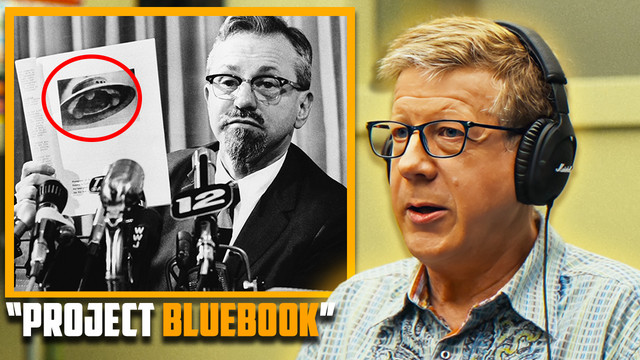
Referencing the clip attached: Paul Hynek discussing the possibility that interdimensional beings would not need craft in the way humans imagine craft.
This Dossier expands the frame.
Because the importance of the comment is not simply whether Paul Hynek is right.
The importance is what the comment reveals about the changing UAP conversation.
The old question was:
Are UFOs advanced vehicles?
The deeper question may be:
Are we even interpreting the phenomenon in the right category?
Origins and Background
To understand Paul Hynek’s signal, you have to begin with his father.
Dr. J. Allen Hynek was not a fringe figure at the start of his UFO career. He was an astronomer, professor, and scientific consultant brought into the U.S. Air Force’s UFO investigations to help identify ordinary explanations for strange reports.
He worked with Project Sign, Project Grudge, and Project Blue Book.
For years, his job was to filter sightings through known categories:
Venus.
Meteors.
Weather balloons.
Aircraft.
Atmospheric effects.
Misidentification.
Hoaxes.
Most cases could be explained this way.
But not all.
That residue changed Hynek.
He became dissatisfied with the way stronger cases were handled. He did not become a careless believer. He became a critic of careless dismissal.
His later work helped create the “Close Encounter” classification system and pushed UFO study toward a more disciplined framework. He argued that unexplained cases should not be waved away simply because the subject was embarrassing.
That is the inheritance Paul Hynek carries.
Not a simple belief system.
A tension.
The Hynek legacy has always lived between skepticism and openness, between science and stigma, between official explanation and unresolved anomaly.
Paul Hynek’s own background adds another layer.
He is not a field investigator in the old mold. He is closer to a technology and media figure. His biography includes finance, software, entertainment, startups, virtual production, augmented reality, board work, and consulting. He has also been associated with the History Channel’s Project Blue Book series, which dramatized his father’s work for a modern audience.
This matters because Paul’s public position is not only inherited from his father.
It is shaped by the era he lives in.
His father studied witnesses and case files.
Paul lives in a world of simulation, virtual production, artificial intelligence, media systems, crypto, augmented reality, and cinematic world-building.
That does not prove his claims.
But it helps explain his lens.
When someone with a Hynek family background and a technology-media background says the phenomenon may not require “craft,” the comment lands differently.
It connects the old UFO archive to a new reality question:
What if our categories are too human?
What It’s Known For
Paul Hynek is known in the UAP world for several overlapping reasons.
The Hynek legacy
The most obvious association is his father.
J. Allen Hynek became one of the central scientific figures in the modern UFO conversation. His work with Project Blue Book, his later criticism of institutional dismissal, and his “Close Encounter” classification system shaped the language still used around UFO encounters today.
Paul Hynek is often invited into UAP conversations because he carries personal proximity to that legacy.
He grew up near a household where UFOs were not abstract entertainment. They were part of serious conversation, public controversy, and scientific tension.
That gives his perspective a different kind of weight.
Not proof.
Proximity.
Technology, finance, and entertainment
Paul Hynek’s public bios describe him as a Wharton MBA with decades of experience in finance, technology, cryptocurrency, entertainment, startups, and high-tech advisory work.
This makes him unusual inside the UAP space.
He is not simply repeating old UFO lore. He is someone whose professional life has moved through worlds that already blur the boundary between physical reality, virtual reality, simulation, media, and future technology.
That background makes the “craftless” idea feel less like a mystical leap and more like a category challenge.
If humans can build simulated environments, augmented overlays, virtual beings, AI agents, and perception-shaping media systems, then it becomes easier to imagine that a more advanced intelligence might not interact with reality in the way we expect.
Again, this does not prove anything.
But it changes what kinds of questions feel possible.

The Hollywood Disclosure Alliance
Paul Hynek is listed as Chief Financial Officer of the Hollywood Disclosure Alliance.
That connection is important because UAP culture is no longer shaped only by government documents and eyewitness reports.
It is shaped by media.
Movies.
Podcasts.
Streaming series.
Documentaries.
Clips.
Narrative architecture.
The Hollywood Disclosure Alliance is part of a broader trend: UAP is becoming an entertainment, cultural, political, and disclosure issue at the same time.
Paul Hynek sits inside that convergence.
His father helped shape one of the most important UFO films ever made through the “Close Encounters” language.
Paul now works in an era where disclosure itself is being mediated through Hollywood, podcasting, streaming platforms, and online clips.
The interdimensional hypothesis
The recent clip that triggered the original Signal Check centers on the idea that some UAP may not be craft in the ordinary sense.
They may be:
- entities
- life forms
- manifestations
- intelligence events
- interdimensional intrusions
- perception translations
- something that appears as a craft only because that is how we process it
This is not a new idea.
The interdimensional hypothesis has a long history in UFO thought. It is associated with figures such as Jacques Vallée, John Keel, and parts of the Hynek tradition.
The key move is this:
Instead of assuming the phenomenon is extraterrestrial technology crossing physical distance, the interdimensional frame asks whether some reports involve a reality structure adjacent to ours, overlapping ours, or accessed through altered perception, liminal states, or unknown physics.
That hypothesis remains speculative.
But it has survived because some high-strangeness cases do not behave like simple aerospace events.
They include bizarre entities, telepathic communication, dreamlike sequencing, time distortion, symbolic messages, poltergeist-like effects, and encounters that feel more like controlled perception than mechanical arrival.
This is the terrain Paul Hynek is stepping into.

The Core Idea or Signal
The core signal of Paul Hynek’s “craftless” framing is this:
The phenomenon may not be misidentified because we see it badly. It may be misidentified because we categorize it too narrowly.
That is the deeper issue.
A craft is a human category.
We understand movement through vehicles.
Cars.
Planes.
Rockets.
Ships.
Satellites.
Drones.
If something appears in the sky, moves intelligently, and seems controlled, we instinctively imagine hardware.
But what if that assumption is too primitive?
What if a sufficiently advanced intelligence does not travel through space the way we travel through space?
What if it translates across states?
What if the “object” is only the interface?
What if the craft is not a vehicle, but a render?
What if our instruments convert an event into something object-like because that is the only measurable form available?
This is where the idea becomes interesting.
Not because it is proven.
Because it challenges the default frame.
The nuts-and-bolts hypothesis asks:
Where did the craft come from?
The interdimensional hypothesis asks:
What kind of reality would make the craft unnecessary?
That is the shift.
Perspectives and Interpretations
Paul Hynek’s framing can be read in several different ways.
The believer view
To believers, the “craftless” idea feels like an overdue expansion.
Many people who study high-strangeness cases already suspect that the phenomenon is not simply a fleet of metal objects from another star system.
They point to cases where witnesses report impossible movement, sudden disappearance, mind-to-mind communication, altered states, symbolic behavior, or beings that do not behave like biological astronauts.
From this view, the interdimensional hypothesis helps explain why the phenomenon often feels dreamlike, absurd, elusive, personal, and difficult to pin down.
It also helps explain why the phenomenon seems to interact with consciousness.
If the event is partly perceptual, then witness experience is not just noise.
It may be part of the interface.
The skeptic view
To skeptics, the interdimensional hypothesis creates a serious problem.
It can become unfalsifiable.
If no craft is recovered, the theory can say there was never a craft.
If the evidence is ambiguous, the theory can say the phenomenon does not behave like physical evidence.
If the witness experience is dreamlike, the theory can say that is exactly how interdimensional contact would appear.
That is dangerous.
A hypothesis that explains everything can end up testing nothing.
The skeptical critique is important:
What would count as evidence?
What would count against the theory?
What predictions does it make?
How could it be separated from hallucination, misperception, mythology, sleep paralysis, altered states, cultural expectation, or ordinary aerospace phenomena?
Without those boundaries, “interdimensional” can become a fog machine.
It sounds profound, but avoids discipline.
The scientific view
Science can entertain strange possibilities, but it needs operational definitions.
“Interdimensional beings” is not currently a mature scientific category.
It is not enough to say something may come from another dimension.
What does dimension mean?
A mathematical dimension?
A parallel universe?
A brane cosmology scenario?
A hidden physical layer?
A consciousness-accessible reality?
A symbolic term for nonlocal intelligence?
These are not interchangeable.
This is where the term needs caution.
The word “interdimensional” often functions as a container for many different ideas, some physical, some metaphysical, some psychological, some spiritual.
That does not make the idea worthless.
It means the idea has to be clarified before it can be tested.
The Hynek-Vallée view
The most serious version of the interdimensional discussion does not begin with fantasy.
It begins with pattern tension.
Hynek and Vallée recognized that some UFO reports did not behave like straightforward spacecraft reports. Some seemed to cross categories: physical, psychic, folkloric, symbolic, technological, and absurd.
Vallée especially argued that the phenomenon might operate as a control system, interacting with culture and perception rather than simply arriving as visitors from another planet.
In that tradition, Paul Hynek’s comment is not random.
It belongs to a lineage.
A strange lineage, but a real one.
The point is not “aliens are demons” or “UFOs are hallucinations” or “craft do not exist.”
The point is more careful:
Some cases may not fit the machine model.
And if they do not fit the machine model, we may need a larger map.
Strengths and Limitations
The strength of Paul Hynek’s framing is that it resists a common trap.
It does not assume that non-human intelligence, if real, would behave like us.
That is important.
Humans are vehicle-builders because we are embodied organisms moving through space with limited biology.
We need ships because we are separate from the sea.
We need aircraft because we cannot fly.
We need rockets because we cannot live in space.
But an intelligence operating through different physics, different embodiment, different consciousness, or different dimensional access might not need vehicles at all.
That is a valid thought experiment.
It opens the frame.
It asks whether “craft” may be a projection of human technological imagination.
But the limitation is just as important.
The more abstract the hypothesis becomes, the easier it is to detach from evidence.
An interdimensional explanation can become too flexible.
It can absorb every contradiction.
It can explain missing hardware, strange behavior, symbolic content, witness alteration, and lack of repeatable evidence.
That flexibility is useful philosophically.
It is dangerous evidentially.
A grounded version of the idea must separate layers.
What is documented:
Paul Hynek has publicly discussed the possibility that some UAP may not be craft in the conventional sense.
He is the son of J. Allen Hynek and is publicly connected to UFO media, the Hollywood Disclosure Alliance, and the legacy of Project Blue Book.
The interdimensional hypothesis has a long history in UFO thought and is associated with figures such as Jacques Vallée, John Keel, and J. Allen Hynek circles.
What is claimed:
Some UAP may be entities, life forms, intelligence events, or interdimensional manifestations rather than machines.
What is speculative:
That these events represent beings from another dimension, parallel reality, consciousness layer, or adjacent state of existence.
What remains unresolved:
How to test such a hypothesis, what predictions it makes, and how to separate it from altered perception, misidentification, folklore, psychology, classified aerospace technology, or unknown natural phenomena.
Why it still matters:
Because if UAP are studied only as objects, any case that behaves like an event, intelligence, or perceptual interaction may be misunderstood from the beginning.
That is the honest line.
Open the frame.
Do not claim the answer.
Broader Implications
The “craftless” hypothesis matters because it pushes the UAP conversation into a larger reality question.
Are we dealing with technology?
Biology?
Consciousness?
Unknown physics?
A misread intelligence?
A natural phenomenon that mimics agency?
A cultural feedback loop?
A classified system?
A spiritual encounter reinterpreted through modern language?
Or several categories at once?
This is where the UFO subject becomes difficult.
It may not be one thing.
Hynek himself warned against reducing all UFO cases to a single explanation. Weather phenomena do not all come from one source. Lights in the sky, radar returns, close encounters, entity reports, physical traces, and psychic aftermaths may not belong to one bucket.
The modern UAP era often tries to make the subject cleaner by narrowing it to sensor data and military encounters.
That is understandable.
It makes the issue more respectable.
But the high-strangeness layer has never disappeared.
It keeps returning.
Paul Hynek’s framing matters because it brings that layer back into the conversation.
If the phenomenon includes consciousness effects, perception shifts, symbolic encounters, or non-ordinary states, then studying only hardware may miss the deeper structure.
But there is a risk.
Once UAP becomes too broad, it can lose contact with evidence.
Everything becomes connected.
Dreams, DMT, angels, cryptids, spirits, UFOs, simulation theory, ultraterrestrials, portals, synchronicities.
That can be fascinating.
It can also become unmanageable.
The Galactic Mind position should stay disciplined:
The craftless hypothesis is worth examining as a model.
It is not proof.
It is a pressure test against our assumptions.
The most important thing it does is remind us that advanced intelligence may not appear in the form our century expects.
In the 1950s, we imagined saucers.
In the 1970s, we imagined star travelers.
In the 1990s, we imagined abductions and black projects.
Today, in the age of simulation, AI, quantum speculation, psychedelics, and virtual worlds, we are beginning to imagine interface.
That shift says something about the phenomenon.
It also says something about us.

The Reality Signal
What this subject represents
Paul Hynek represents the inheritance and mutation of the Hynek legacy.
His father helped move UFOs from ridicule toward inquiry.
Paul’s “craftless” framing pushes the question one layer deeper:
What if inquiry itself has been trapped inside the wrong metaphor?
He represents a new phase of the UFO conversation, where the subject is no longer only about sightings or official documents, but about perception, media, consciousness, technology, simulation, and reality architecture.
That is why this matters.
Paul Hynek is not simply repeating his father’s work.
He is carrying the Hynek question into a different century.
What reality frame it challenges
The craftless hypothesis challenges the machine-based model of contact.
It challenges the assumption that advanced intelligence must arrive inside objects.
It challenges the idea that reality is only physical matter moving through physical space.
It also challenges believers and skeptics at the same time.
Believers are challenged because the hypothesis may not deliver the clean hardware proof they want.
Skeptics are challenged because the absence of hardware may not be enough to dismiss every case.
The frame it disturbs is simple:
If something is real, it should behave like an object.
But what if some realities behave more like interfaces?
That is the deeper challenge.
Why it matters now
This idea matters now because humanity is entering an interface age.
AI can speak like a person.
Virtual worlds can simulate environments.
Augmented reality can overlay meaning onto perception.
Neuroscience is studying altered states.
Psychedelic research has re-entered mainstream conversation.
UAP has moved into government language.
The old boundary between mind, machine, and reality is becoming less stable.
In that context, the idea of craftless intelligence feels culturally timed.
It does not mean it is true.
But it explains why the idea is returning.
Modern people are beginning to understand that intelligence does not always need a body in the way we assumed.
Agents can appear through screens.
Avatars can act without flesh.
Simulations can create environments.
Signals can look like presences.
If human technology is already teaching us that presence can be mediated, then a truly advanced intelligence may not need to arrive as a spaceship.
It may arrive as an experience.
What remains unresolved
Everything important remains unresolved.
There is no public proof that interdimensional beings are behind UAP.
There is no confirmed evidence that non-human intelligence is entering our world through adjacent dimensions.
There is no accepted scientific model that explains how such contact would occur.
Official U.S. reviews have not verified extraterrestrial technology or non-human craft in government possession.
NASA has emphasized the need for better data and scientific methods.
AARO has stated that it has found no evidence of extraterrestrial technology.
But none of that fully answers the interdimensional question.
Because the interdimensional hypothesis is not just a hardware claim.
It is a category claim.
That makes it harder to test.
And harder to dismiss cleanly.
The unresolved ledger is this:
What is established:
Paul Hynek has publicly discussed a craftless or interdimensional reading of some UAP.
What is claimed:
Some UAP may be entities, life forms, or intelligence events rather than vehicles.
What remains unresolved:
Whether this idea can be translated into testable predictions, repeatable observations, or scientific categories.
Why it still matters:
Because the way we frame the phenomenon determines what evidence we look for.
If we assume craft, we search for vehicles.
If we assume intelligence events, we search for interaction patterns.
If we assume perception, we study witnesses differently.
If we assume interface, we may need an entirely new method.

The Galactic Mind Perspective
Paul Hynek belongs in The Galactic Mind archive because his comment opens a deeper layer of the UAP question.
Not the simple layer.
Not “Are aliens real?”
Not “Are UFOs craft?”
The deeper layer:
What kind of reality would make our categories fail?
That is where this becomes interesting.
The craftless hypothesis should not be treated as established fact.
It should be treated as a reality stress test.
If we force every unknown into the machine model, we may miss cases that behave more like perception, intelligence, or symbolic contact.
But if we abandon evidence entirely, we lose the very discipline that makes inquiry meaningful.
That is the balance.
The unknown deserves more than ridicule.
It also deserves more than vague mysticism.
Paul Hynek’s value is not that he proves interdimensional beings exist.
His value is that he reminds the UAP conversation of something his father understood:
The most puzzling cases may require the most careful categories.
A Dossier is not a monument.
It is a map of influence.
And this influence is clear:
The UFO question is no longer only about where something came from.
It is about what kind of thing we think we are seeing.
Maybe some UAP are craft.
Maybe some are errors.
Maybe some are classified systems.
Maybe some are rare natural events.
Maybe some are something stranger.
But if even a small percentage of cases involve a form of intelligence that does not travel as we travel, then the most important question is not “Where is the ship?”
It is:
What if there was never a ship?
Open Thread
Paul Hynek’s “craftless” framing leaves behind a question that does not resolve easily.
If an intelligence does not need a craft, how would we recognize it?
Would it appear as a light?
A being?
A symbol?
A dream?
A voice?
A pattern in the sky?
A glitch in instruments?
A presence in altered states?
A physical object only long enough for our minds to stabilize the encounter?
This is where the UFO question starts to blur into consciousness, mythology, technology, and the limits of perception.
Maybe the phenomenon is not asking us to identify the vehicle.
Maybe it is asking us to reconsider the interface.
And maybe the real mystery is not only what appears.
It is why reality translates it the way it does.
What do you think? Drop your thoughts in the comments ...
Sources / Receipts
- Area52 Clips: “Interdimensional Beings Don’t Need Crafts”
- Area52 / DEBRIEFED: “What My Father Knew About UFOs” with Paul Hynek
- Hollywood Disclosure Alliance board biography for Paul Hynek
- WorkingNation biography for Paul Hynek
- Northwestern University Archives: J. Allen Hynek background and Project Blue Book context
- U.S. Air Force / OSI Project Blue Book materials
- NASA UAP Independent Study Team Final Report
- AARO Historical Record Report, Volume 1
- Jacques Vallée, Passport to Magonia
- J. Allen Hynek and Jacques Vallée, The Edge of Reality


Discussion