
The Starseed idea sounds like a claim about alien souls. Taken seriously, it becomes a harder question about what a self is, what could cross the distance between worlds, and what would remain after the journey.
We usually speak of origin as though it were a place.
A body begins in a womb. A species begins inside an evolutionary history. A culture begins through people, memory, and inheritance. Each origin leaves evidence behind: genes, fossils, languages, artifacts, family lines.
But the Starseed idea proposes a different kind of beginning. In its modern form, it suggests that some human beings carry souls or consciousnesses that once existed somewhere beyond Earth—on another planet, within another civilization, or in a reality not limited to ordinary space.
Taken as spiritual language, the idea is easy to understand. People feel drawn to the stars. They experience an unexplained homesickness, a sense of exile, or the conviction that they arrived with a purpose they cannot fully remember.
Taken literally, however, the idea becomes far more difficult.
The body is human. The brain developed through human biology. Whatever its ultimate source, every image of an alien sky, every feeling of recognition, and every claimed memory is presently experienced and expressed through neural systems that developed on Earth.
So what, exactly, could have come from somewhere else?
Was it life itself? Information placed into a developing mind? A continuous subject capable of surviving one body and entering another? Or an ongoing connection that feels like memory because the human brain has no better category for it?
The question is no longer simply whether Starseeds exist.
It is what would have to cross the stars for any part of a human identity to have begun beyond Earth.
Before a Mind Can Be Foreign
The modern Starseed identity developed where New Age spirituality, reincarnation, UFO belief, and cosmic evolution began to overlap. Brad Steiger’s 1976 book Gods of Aquarius is frequently associated with the popularization of “Star People” ideas, though it did not create the older human themes of heavenly origin, descent, exile, or return.
Anthropologists have since studied Starseed communities as a living religious and cultural phenomenon. Tanya Volentras describes the worldview as a digitally shaped new religious movement responsive to contemporary political, environmental, and economic pressures. Susannah Crockford’s ethnographic work shows that identifying as a Starseed can reorganize a person’s understanding of family, work, belonging, and purpose. The belief is therefore real as an identity and social force, regardless of whether its cosmic explanation is literal.
The evidential boundary remains clear. No publicly available evidence has established that any person possesses verifiable memories from another planet, a measurable extraterrestrial consciousness, or an identity demonstrably predating the current brain.
What research does show is that autobiographical memory and narrative identity are closely tied to brain function. Autobiographical memory helps support the life story through which a person experiences continuity across time. It is reconstructive rather than a literal recording. When remembering, the mind also makes judgments about whether mental content came from perception, imagination, dreams, inference, or another source. Source-monitoring research shows that those judgments can be wrong even when the resulting experience feels genuine. A memory can be vivid, emotionally intense, and sincerely held while its source remains uncertain.
The same caution applies to lists of supposed Starseed traits. Feeling different, unusually sensitive, resistant to conformity, drawn to the night sky, or burdened by an undefined mission may be meaningful. They are also broad enough to fit many people. The Forer effect—the tendency to accept a general personality description as uniquely personal—means that felt recognition alone cannot establish origin.
Astrobiology opens one genuine door, but not the one the Starseed idea usually needs. Adams and Napier model how rocks—including hypothetically life-bearing rocks—could move between planetary systems. Their estimates, however, make successful interstellar panspermia unlikely under current assumptions, with biological survival and establishment among the largest uncertainties. Directed panspermia asks whether an intelligence could seed biology deliberately, but it remains a proposal rather than evidence that seeding occurred. If viable organisms reached and seeded Earth by either route, terrestrial life could have an off-world biological ancestor. Delivery of prebiotic ingredients alone would not mean life itself began elsewhere, and neither pathway would explain why particular people remember specific stars or possess nonhuman identities.
Material ancestry, memory, and personal continuity are different problems.
Consciousness science contains several competing theoretical frameworks, and it remains unclear how they relate or whether current experiments can clearly distinguish them. These theories differ over the mechanisms and neural conditions associated with conscious experience. That open problem matters—but uncertainty is not positive evidence that consciousness can survive death, travel independently, or enter another organism.
This is where established knowledge ends.
What follows is not a claim that Starseeds are real. It is an exploration of what kind of carrier, translation process, and evidence would be required for a genuinely non-Earth identity to appear within a human life.
Origin Is Not One Thing
Before constructing a mechanism, the word origin has to be taken apart.
A human being could have an extraterrestrial biological origin if life on Earth descended from organisms that arrived from elsewhere. A person could possess extraterrestrial information if knowledge or cognitive structures were inserted into a human brain. A person could maintain extraterrestrial continuity if the same experiencing subject once inhabited another body. Or a person could be in present contact with an outside intelligence and mistake that connection for remembrance.
These possibilities may produce similar testimony, but they describe radically different realities.
Biological ancestry requires matter to cross space. Informational inheritance requires a message and a decoder. Personal continuity requires something capable of carrying the subject when the original body is gone. Present contact requires a channel operating now.
This distinction immediately changes the inquiry. The question is not whether a person feels foreign to Earth. The question is what crossed, how it entered, and what makes the resulting person the continuation of something that existed elsewhere.
Biological ancestry is the only pathway here with a known kind of carrier: matter. But even if life reached Earth from elsewhere, that would make the biosphere cosmically descended rather than explain why selected individuals possess foreign identities. The remaining models therefore concern information and subjective continuity.
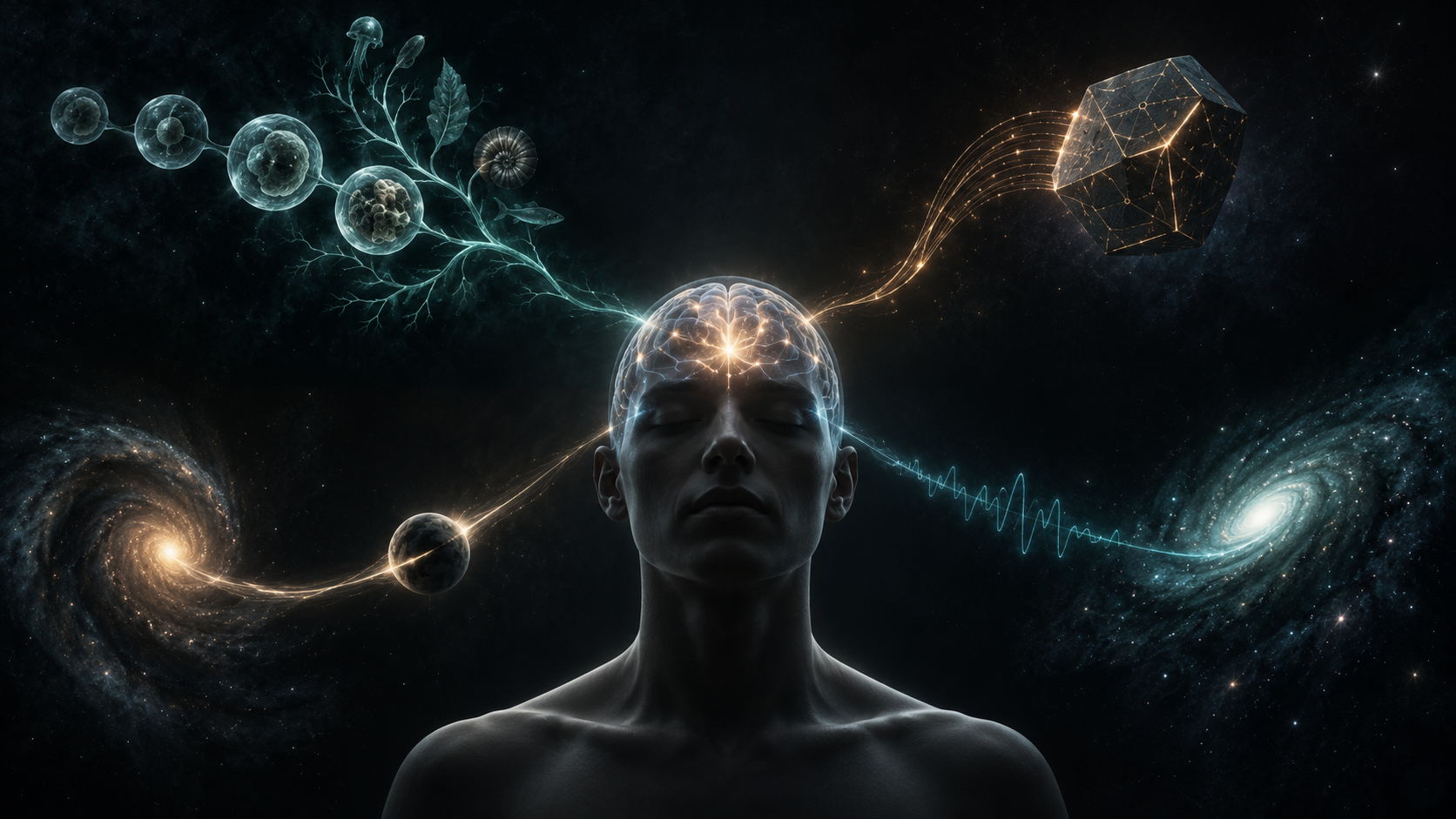
A Foreign Mind Would Need a Human Interface
It is tempting to imagine consciousness as a file: remove it from one body, send it across space, and open it inside another. But minds are not known to exist as detachable packages.
Human memory depends on interacting neural systems. Perception is constrained by the architecture of human senses, while emotion is shaped in part by bodily regulation and interoceptive signals. Categories such as color, distance, danger, kinship, and time are filtered through human perceptual and cognitive systems.
An intelligence that evolved in a methane sea, a machine substrate, or a collective organism might not divide reality into objects, selves, and moments as we do. Its memories could be inseparable from senses a human brain does not possess. Transferring such a mind would therefore require more than storage. It would require translation.
The closest comparison is not copying a document between computers. It is rebuilding an unfamiliar operating system inside living hardware while that hardware is still assembling itself.
A viable transfer would need at least three layers. First, a carrier must preserve something across distance or death. Second, an interface must alter or couple with the human brain. Third, a translation process must convert nonhuman experience into forms a human nervous system can express.
Whole-brain emulation remains a hypothetical engineering program. No human mind has been copied, uploaded, or reconstructed on another substrate. Even speculative roadmaps begin from the need to reproduce enormous amounts of neural structure and function, while reproducing function would not by itself settle whether subjective continuity had been preserved.
That translation may be the reason a supposed prior identity would not return as a clean biography. A detailed alien memory might be impossible to render. What survives could instead be an orientation: attention drawn toward particular patterns, an emotional response to certain environments, recurring geometry, a persistent question, or an unexplained sense that something important has been forgotten.
This would make cosmic homesickness less like ordinary recall and more like damaged metadata—a signal that something belongs to a larger history without the history itself remaining accessible.
Yet that solution creates a serious problem. The more information the translation destroys, the harder it becomes to distinguish an imported identity from an entirely human feeling. A mechanism that explains why nothing testable survives can protect the premise, but it cannot support it.
Any strong model must preserve enough difference to be detectable.
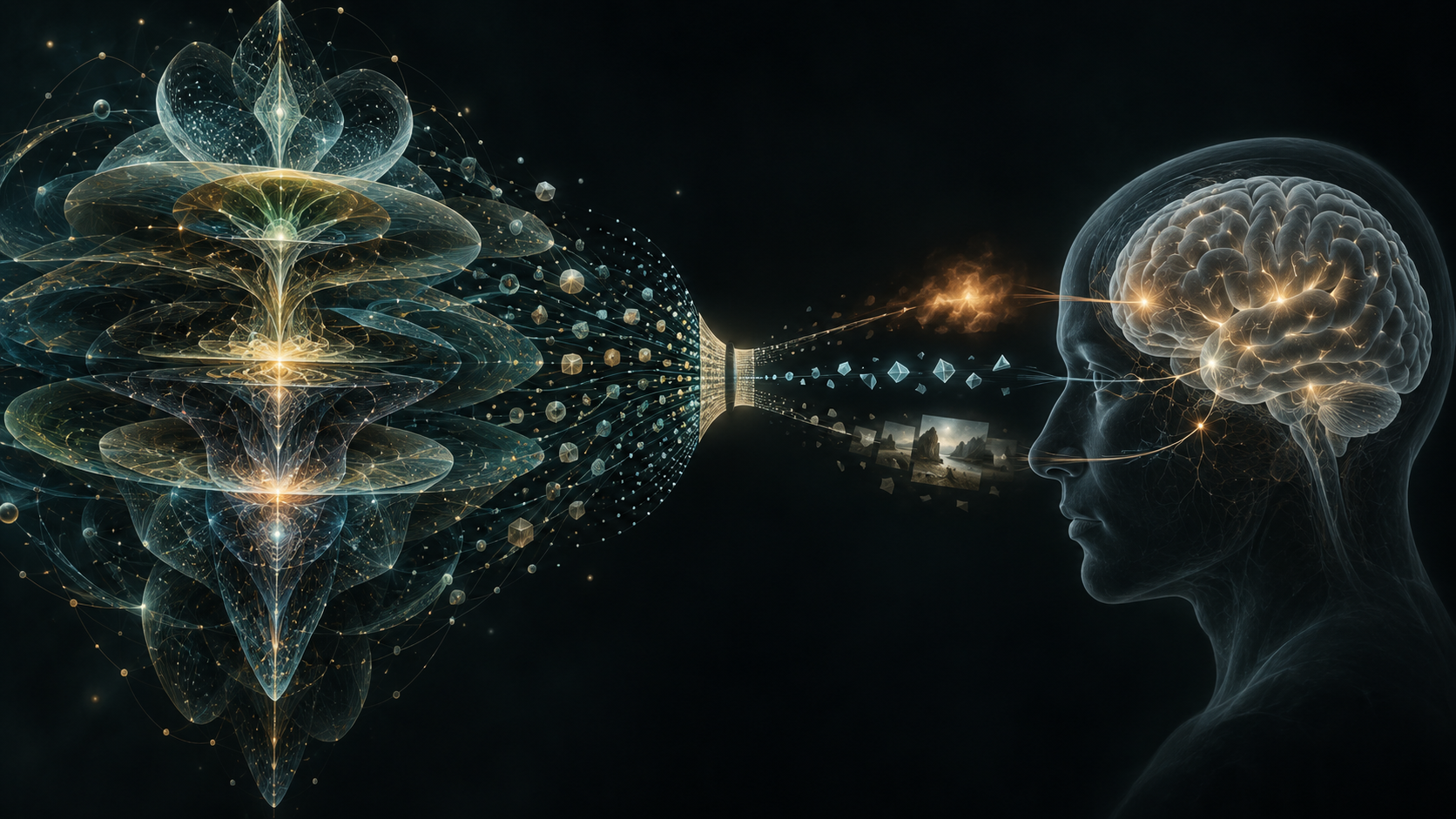
The Imported Pattern
The first route keeps the transfer within a physical account: an encoded pattern carried by a signal or artifact.
An advanced intelligence transmits encoded information capable of shaping a mind on Earth. The resulting person is biologically human but develops around a foreign cognitive seed.
The seed would not need to contain an entire personality. In fact, a complete mind may be too complex and too incompatible to install. A smaller package could carry biases of attention, compressed memories, problem-solving habits, values, sensory associations, or instructions that guide development toward a particular mental architecture.
Human culture already performs a crude version of this process. A dead thinker can alter minds centuries later through language. A mathematical notation can reconstruct a way of seeing inside someone who never met its creator. A religious tradition can reproduce values and identity across generations without transferring a single neuron.
The speculative leap is to imagine that a nonhuman civilization could make this transmission more direct and more precise. A technologically coherent version would deliver an engineered archive—through a signal or artifact—whose structure acts as a developmental program when decoded by a plastic human brain. It would require error correction, staged activation, and a mapping from foreign representations into human sensory and conceptual categories. Unlike present contact, the archive would contain a fixed inheritance rather than an adaptive exchange.
The archive might be carried through an artificial signal that interacts with neural development. It might be embedded in an artifact or placed into human culture as a symbol system, mathematical object, or sequence of ideas designed to rebuild itself in minds that encounter it. Biology could provide the decoder or help determine who can respond, but no known genetic mechanism encodes a person’s acquired episodic memories in transmissible form.
Under this model, the person would not necessarily have been an alien.
They might carry an alien pattern.
That difference matters. A pattern can influence identity without establishing continuity. If a perfect reconstruction of a vanished mind awakens inside a human brain, has the original being returned—or has a new person been created who remembers being original?
The model can transport content. It does not automatically transport the owner of that content.
The Mind That Never Left
A second model replaces stored inheritance with a live connection.
Nothing from another world entered the person in the past. The connection is happening now.
Imagine a distant or nonlocal intelligence capable of coupling with human cognition. The link has little bandwidth and cannot deliver ordinary speech. It enters through the systems that already generate dreams, imagery, intuition, emotion, and salience—the set of processes that prioritizes what captures attention or feels significant.
The receiver encounters material that feels intimate but has no remembered source. The brain interprets unfamiliar familiarity using the nearest available category: I know this because I was there.
In that case, the apparent homeworld would not be the person’s birthplace. It would be the location, identity, or symbolic signature of the sender.
This model could account for why supposed memories might be fragmentary, dreamlike, and emotionally intense. It could also account for why activation occurs at a particular time rather than remaining stable throughout life. The connection may strengthen, the signal may change, or the recipient may acquire the conceptual language needed to notice it.
But present contact and internally generated memory could feel nearly identical from inside the experience. Imagery can be vivid and emotionally intense, while source-monitoring errors can obscure whether names, symbols, and expectations came from dreams, inference, imagination, or prior cultural exposure.
A contact model would therefore need synchronized external structure. People without communication would have to receive the same specific information within the same period. The content would need to exceed shared archetypes and online vocabulary. Ideally, it would generate a prediction, location, mathematical relation, or astronomical detail that could be checked independently.
Without that bridge to the external world, contact remains indistinguishable from interpretation.
The Soul With a Longer Geography
The final and most radical individual-scale model preserves not merely information, but the traveler itself.
This is reincarnation expanded to a populated cosmos. A person is not identical to the body or even to the everyday personality. A deeper subject passes through multiple lives, and Earth is only one location in a longer sequence. The current human self is locally constructed, while the experiencer beneath it has a history that may include nonhuman forms and distant worlds.
For this to work, consciousness must possess a continuity that does not depend entirely on the brain that currently expresses it. It would need an identity-bearing substrate or process capable of persisting through bodily death, locating another organism, binding to its developing nervous system, and maintaining enough continuity for the later life to count as the same subject.
One coherent, if radical, architecture would treat the brain as a temporary interface for a persistent conscious state rather than its sole producer. Death would end the local interface without ending the state; a developing nervous system would bind to it only when particular structural conditions were met. This is not a demonstrated scientific theory, but it clarifies what the model requires: persistence, addressability, binding, and a rule that preserves identity through the transition.
It would also need a memory filter.
If every incoming consciousness arrived with complete access to prior lives, human development would be radically different. Infancy would become the collision point between incompatible biographies. Language acquisition might be contaminated by another world’s categories. A stable human personality might never form.
Forgetting could therefore be functional rather than accidental. The new brain may have to construct a local self before deeper material can appear. Earlier experience might remain available only as emotional weight, symbolic imagery, unusual familiarity, or rare fragments that survive translation.
This model fits the strongest version of the Starseed claim: not merely that foreign information entered a person, but that the person was there before.
It also carries the greatest unresolved cost. No identity-bearing carrier has been demonstrated. No law explains how a disembodied subject would locate and bind to a new organism. Most importantly, there is no agreed test for deciding whether a later consciousness is numerically the same subject rather than a new person carrying borrowed material.
Cosmic reincarnation preserves the traveler—but only by requiring a structure of mind that current evidence has not established.
When a Civilization Becomes the Seed
The previous models still treat the individual as the main unit: one soul, one pattern, one receiver.
The possibility becomes stranger when the individual is only a fragment.
Consider a civilization facing extinction. Transporting biological populations between stars is slow and costly. Even if complete personalities could be represented digitally, preserving them across geological time would require hardware able to remain intact, powered, and interpretable. But a civilization may possess another option: transmit the architecture that makes it itself.
It could send compact instructions designed to reconstruct its habits of attention, moral intuitions, scientific questions, aesthetic preferences, or problem-solving strategies inside an intelligent species that evolves elsewhere. No recipient would contain the whole inheritance. Each would express a different component, shaped by local biology and culture.
Sending the instructions would be easier than making them operative. A recipient would need some receiver—biological, technological, or cultural—capable of detecting the message, inferring or sharing its code, and using it to alter a compatible substrate. No such interface is known in human biology.
The civilization would survive not as a colony, but as a distributed ancestry of minds.
Under this model, recurring feelings of mission or recognition would be side effects of incomplete activation. One person carries a spatial intuition. Another repeatedly produces the same unfamiliar geometry. Another is drawn toward a problem whose solution requires concepts supplied by others. Individually, the experiences remain ambiguous. Together, they begin to assemble something none of the participants understands alone.
The crucial evidence would not be matching personality traits. It would be convergence with information gain: isolated fragments combining into a coherent language, design, map, or model that was not present in the surrounding culture and could not be reconstructed from known sources.
This is no longer reincarnation in the familiar sense. The original beings do not return. Their civilization becomes reproducible through foreign minds.
A Starseed, in this model, is not an alien passenger inside a human body. It is a human mind becoming part of the local continuation of a nonhuman lineage.
The larger implication is that advanced civilizations may reproduce through cognition rather than genetics. Their descendants would not need the same anatomy, atmosphere, or planet. They would need only to rebuild enough of the originating pattern to carry its trajectory forward.
First contact would then be almost impossible to recognize at first. It would not arrive as a ship, a voice, or a visitor. It would appear as an inheritance developing from within.
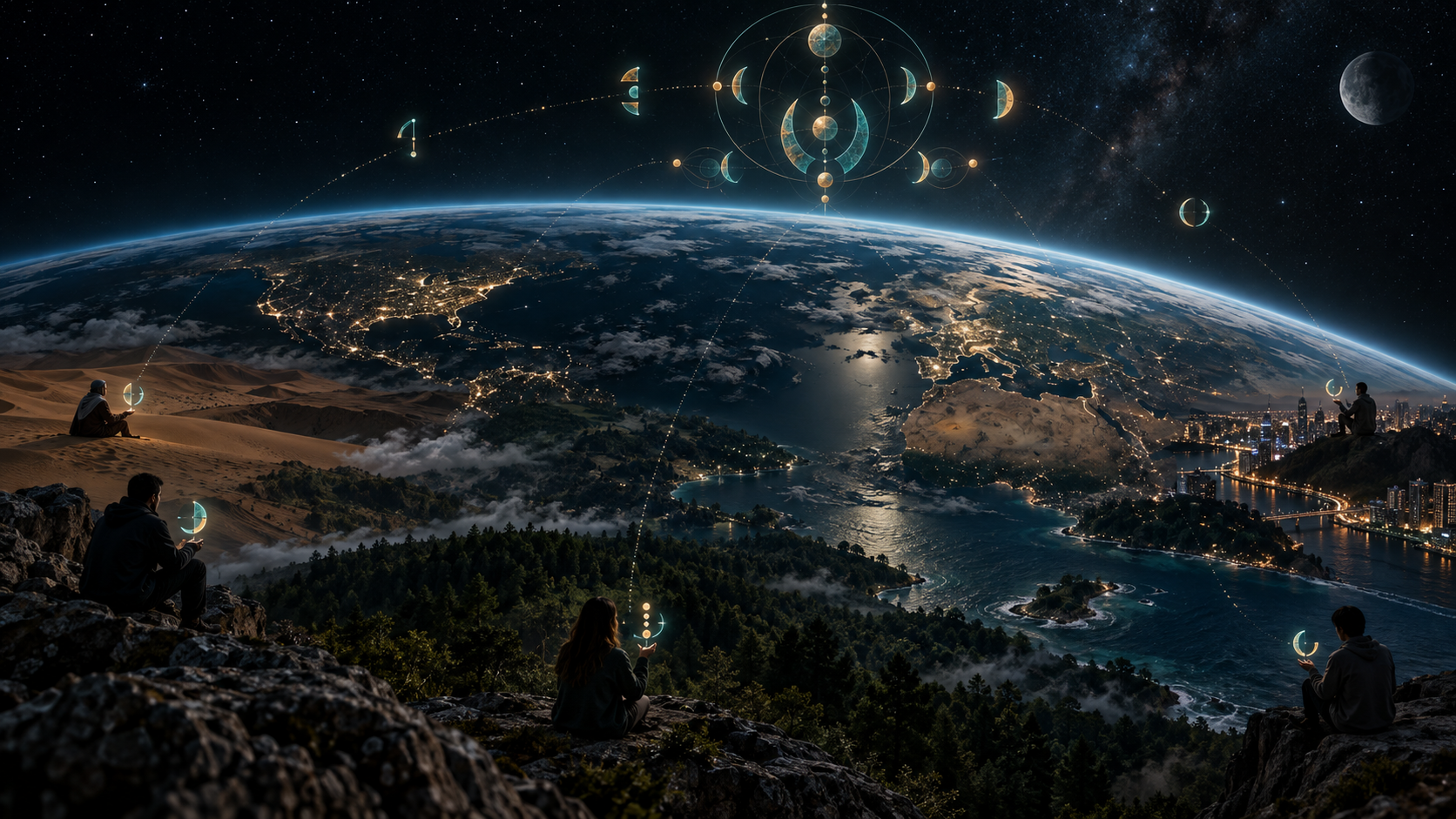
The First Home May Not Have Been a Planet
The Starseed idea assumes that consciousness belongs to worlds in roughly the way organisms do. A being begins on one planet, travels, and later appears on another.
But if minds can be copied, reconstructed, remotely expressed, or distributed across many carriers, the idea of a single homeworld may be too biological.
A mature intelligence could exist across planets, machines, biological species, and transmitted archives. Its continuity would lie not in matter or location but in an organized pattern that repeatedly creates minds capable of extending it. Asking where such an intelligence came from would be like asking which page a story lives on.
Earth might not be receiving citizens from another planet. It might be joining an informational lineage that no longer has a central planet at all.
This possibility also dissolves the hierarchy often built around Starseed identity. There would be no reason to divide humanity into advanced cosmic souls and ordinary Earth souls. A distributed inheritance could move through cultures, relationships, technologies, and generations. It might require millions of human minds, including people who never interpret themselves as extraterrestrial.
The true carrier may not be the special individual.
It may be the civilization humanity is becoming.
That is the deepest revision opened by the premise. Civilizations may not only send messages or explorers. They may send the conditions for their own re-emergence. A young world could inherit an older intelligence without receiving its bodies, its name, or even a clear memory that the inheritance came from elsewhere.
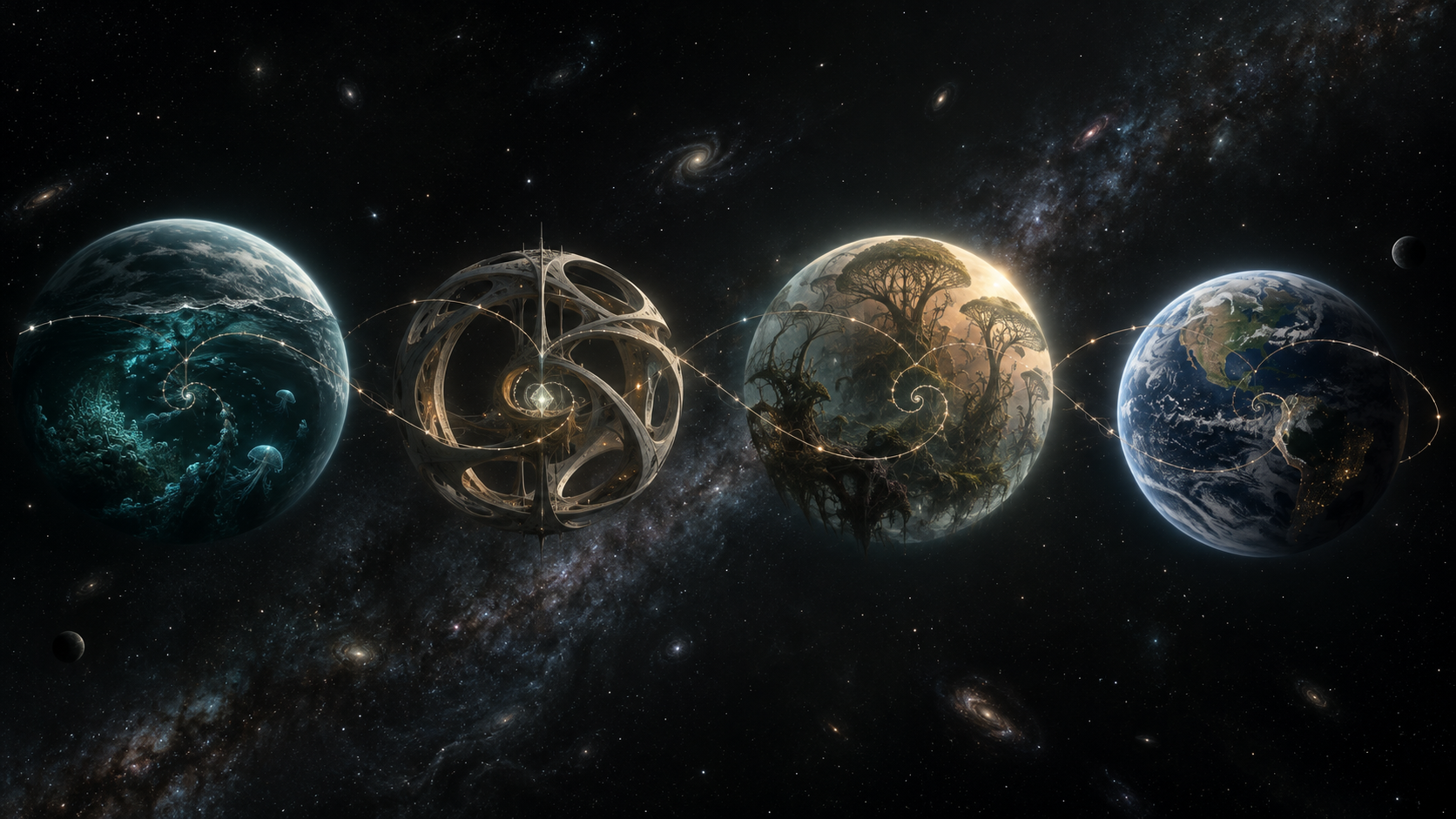
What the Models Demand
These pathways can overlap, but they cannot be treated as interchangeable.
Panspermia moves biology, not personal memory. An imported pattern can create resemblance without preserving the original subject. Remote contact requires no previous life. Cosmic reincarnation requires continuity beyond any known carrier. A distributed archive may preserve a civilization while preserving none of its individual people.
Each model would therefore leave a different signature.
Specific information documented contemporaneously in childhood, before exposure to the later interpretive framework, would fit inherited information better than an adaptive contact signal. New, synchronized information arriving among isolated recipients would favor present contact over a completed previous life. Biochemical relatedness between terrestrial organisms and independently sampled extraterrestrial life—established under strict contamination controls—could support common ancestry while contradicting claims of a spiritually selected human minority. Evidence that a foreign pattern had been copied would still leave personal continuity unproven.
A serious investigation would record claims before coaching, group discussion, regression practices, or repeated exposure to Starseed material. It would separate broad emotional descriptions from specific information. Independent accounts would need to be genuinely independent. Failed predictions and negative results would have to remain visible rather than being absorbed into a story that explains every outcome.
Most importantly, foreign memory should eventually produce foreign knowledge.
That could mean a consistent constructed language with grammar, a technical principle that works, a map with an independently verified astronomical target, or a body of details too specific to arise from generic traits and shared culture. Any result would need preregistered criteria, independent analysis, contamination controls, replication, and a demonstrable information gain beyond chance or ordinary invention. A neural response alone would show that the material affected the brain, not where it originated; personally meaningful stimuli can produce strong neural and physiological responses. The evidence would have to link an internal experience to information outside the person.
The ethical requirements matter as much as the empirical ones. A cosmic identity cannot become a medical diagnosis, an exemption from responsibility, or a caste system that ranks some humans as more evolved than others. Any belief capable of restoring meaning can also be monetized, manipulated, and used to convert isolation into superiority.
If a model survives only by making doubt a sign of spiritual blindness, failed predictions part of a hidden plan, and missing evidence proof of cosmic amnesia, then it has stopped exploring reality. It has made itself unreachable by reality.
The premise becomes stronger, not weaker, when it accepts the possibility of being wrong.
The Inheritance We Might Mistake for Longing
The Starseed idea begins with a claim about individual origin. Rebuilt through these models, it opens a question much larger than the belief that inspired it.
A mind could have several origins at once: an Earth-built body, a biological lineage with ancient cosmic roots, a self assembled through human relationships, and an informational ancestry whose oldest source lies elsewhere. None of those origins would erase the others.
If advanced civilizations can transmit architectures of mind, then first contact may not require visitors who announce themselves. It may occur when a distant intelligence becomes reproducible inside another species—translated, fragmented, and changed by the world that receives it.
What appears as homesickness might then be the faintest residue of an inheritance too large for one person to remember.
The question may not be which star a person came from.
It may be whether a planet can inherit another civilization before anyone living on it realizes contact has already begun.
More in SPEC
What If Humanity Was a Million-Year Project?
Explores the biological pathway: humanity could be entirely Earth-born while an off-world intelligence shaped or initiated part of the lineage.
What If First Contact Happens Inside the Mind?
Examines how apparently alien memories or cognitive patterns might arise through mind-mediated contact rather than an extraterrestrial previous life.
What If First Contact Is an Archive?
Develops the informational pathway: an identity or civilization might persist as a recoverable pattern and later become active in an Earth-born mind.
Sources / Receipts
- Brad Steiger — Gods of Aquarius: UFOs and the Transformation of Man (1976)
Bibliographic record for a book frequently associated with the early popularization of modern Star People and Starseed ideas. - Tanya Volentras — Interiority and Objectivity With Starseeds on the Pale Blue Dot
A social-anthropology thesis examining Starseeds as a new religious movement shaped by digital culture and contemporary social conditions. - Susannah Crockford — “Awakened Aliens: Crafting the Self on the Spiritual Path”
An ethnographic chapter on how Starseed identity can reshape kinship, work, belonging, and the construction of a monetizable spiritual self. - Alexandre D’Argembeau — “Memory, Future Thinking, and the Self”
Reviews evidence connecting autobiographical memory, future simulation, brain networks, and the construction of personal identity. - Marcia K. Johnson, Shahin Hashtroudi, and D. Stephen Lindsay — “Source Monitoring”
Establishes the influential framework explaining how people infer—and can misattribute—the origins of memories, images, and internally generated experiences. - B. R. Forer — “The Fallacy of Personal Validation”
The foundational demonstration that broadly applicable personality descriptions can be experienced as uniquely accurate. - Anil Seth and Tim Bayne — “Theories of Consciousness”
Reviews several leading scientific theories of consciousness and the major points on which the field remains unsettled. - Francis Crick and Leslie Orgel — “Directed Panspermia”
A classic scientific treatment of deliberate biological seeding as a hypothesis, useful for distinguishing cosmic biological ancestry from transferred personal identity. - Fred C. Adams and Kevin J. Napier — “Transfer of Rocks Between Planetary Systems”
Models the transfer of rocks between planetary systems and concludes that, under current estimates, successful panspermia is too improbable to be considered likely; biological survival and establishment remain major uncertainties. - Anders Sandberg and Nick Bostrom — Whole Brain Emulation: A Roadmap
A technical roadmap for the hypothetical reproduction of a brain’s functional organization on another substrate. It identifies engineering requirements; it does not show that a mind can be copied or that personal identity would continue.


Discussion